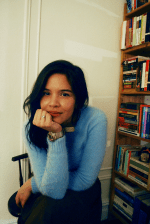
Book Birthday: What the Wind Can Tell You


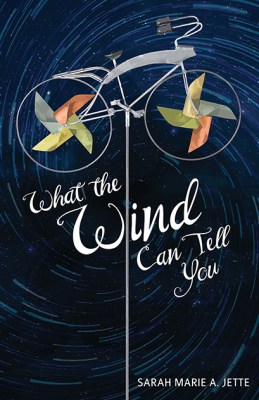
Happy book birthday to What the Wind Can Tell You

(May 15, Islandport Press)

About the book:

In this new middle grade novel by Sarah Marie Aliberti Jette, seventh-grader Isabelle Perez is fascinated by wind. And this year, she’s determined to win the middle school science fair with her wind machine. She’s just as determined to have her brother, Julian, who has a severe form of epilepsy and uses a wheelchair, serve as her assistant. But after Julian has a grand seizure, everything changes.

Isabelle is suddenly granted entry into Las Brisas, a magical world where Julian’s physical limitations disappear, and one, she discovers, that he visits every night. The more Isabelle explores Las Brisas, the more possibilities she sees––for Julian, and for herself––and the more she finds herself at odds with her parents. Debut author Sara Marie A. Jette has told, with remarkable insight, humor, and a touch of magical realism, a powerful story of a family struggling to love without fear.

About the author:

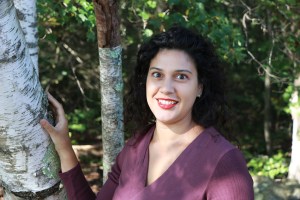
Sarah Marie Jette grew up in Lewiston, Maine, and now lives in Belmont, Massachusetts, but her route from Maine to Massachusetts was anything but a straight line. She got her degree in English and Women’s Studies at Mount Holyoke College, then went halfway around the world to serve in the Peace Corps in Mongolia. She then studied rehabilitation counseling at Boston University’s Sargent College of Rehabilitation before turning to teaching. She now teaches fourth grade at Thompson Elementary School in Arlington, Mass. Somehow, between her students and her own three young children, she finds time to write. “Finding time to write is hard, but necessary,” she says.

  1. How does your heritage affect your writing? Why did you choose to make Isabelle and her family Mexican-American? 

A: When I wrote What the Wind Can Tell You, I made Isabelle Mexican-American because I wanted to write the character I searched for as a child. I spent my childhood searching for characters who looked like me in books. Fairy tale princesses were always ‘fair.’ The books I read described characters with blue eyes and freckles. Whenever I found a character with dark hair or brown eyes, I told myself that they were like me, though, deep inside, I knew that they weren’t. Representation matters—not token characters in the background, but complex and interesting characters from diverse backgrounds that you can fall in love with. I make an effort to fill my classroom library with diverse books. There are more than there used to be, but still not enough.

Q: What was the inspiration for What the Wind Can Tell You?

A: The inspiration for What the Wind Can Tell You was a single lightning bolt. It hit me as I drove home after visiting with friends. I had just held their newborn baby and spent time with the baby’s big brother. On my drive, I imagined the relationship these boys were going to have. I thought about the love between siblings and how special it is. I pulled my car over and wrote my idea down on a paper napkin.

The baby’s big brother has epilepsy, much like my character, Julian. He was diagnosed when he was a few months old. On Sunday mornings, for about two years, I babysat him. I held him, fed him, changed his diapers, soothed him through seizures, and read to him. Sometimes, therapists visited and I learned ways to help him strengthen his muscles or track objects with his eyes. His music therapists were my favorite.

I had been writing for years, but this was the first time I found a story that felt so right. I wrote furiously and completed the first draft in three months. It would be many more years of revising before my story was ready to submit to editors, but my inspiration carried me through.

Q: Do you have any writers or books you most admire and turn to for inspiration? 

A: I admire the writing of Michelle Cuevas. The language in her books is rich and beautiful. She deals with big issues—growing up, identity, and loss—but she is also very playful in her writing. I love reading her books out loud so I can see how my students react to her words. I am also a big fan of Jonathan Auxier. I read his book Peter Nimble and his Fantastic Eyes to my students every year. His stories are unusual, engaging, and a lot of fun.

Best of luck to the brand-new What the Wind Can Tell You

Book Review: Ugly Cat and Pablo by Isabel Quintero


Review by Cecilia Cackley

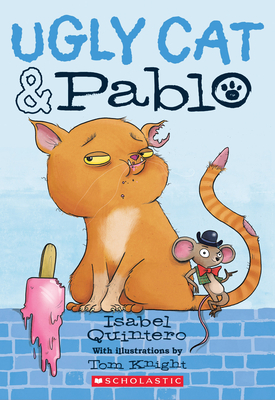
DESCRIPTION OF THE BOOK: Ugly Cat is dying for a paleta, or ice pop, and his friend Pablo is determined to help him get one by scaring a little girl who is enjoying a coconut paleta in the park. Things go horribly wrong when, instead of being scared, the little girl picks Pablo up and declares that he would make a great snack for her pet snake. Oh and there’s also the small problem that Ugly Cat may have inadvertently swallowed Pablo in all of the commotion!

Ugly Cat and his impeccably dressed mouse friend, Pablo, are an unlikely and dynamic duo who will win young readers over with their ridiculously silly antics and their search for tasty treats.

MY TWO CENTS:  As Pablo likes to say “Oh my galleta!” What a charming, silly, delightful book! I was captivated by Ugly Cat and Pablo from the very first page. They are a fantastic odd couple, one pre-occupied with food and the other with adventure. Quintero’s dialogue is snappy and if some of the vocabulary is a little above the average elementary reader, it makes it a great read-aloud and vehicle for introducing new words in both English and Spanish. I appreciate that the Spanish isn’t italicized and all the characters go back and forth between both languages, so no one is singled out as the ‘Other’.

Quintero slips in some good lessons about being kind to friends, listening, and using your words when there’s a misunderstanding. This book falls squarely in the genre of buddy animal comedy, with tons of kid appeal. The setting of an urban park is well chosen and readers will be almost as hungry as Ugly Cat by the time they finish reading the descriptions of all the great street food. Best of all, this is a series, so students who fall in love with Ugly Cat and Pablo will soon have more adventures to giggle over.

Extra points to Scholastic for great book design and back matter! Ugly Cat and Pablo each have their own font for their dialogue, giving a comic book sensibility to the pages that don’t have any word bubbles as part of the illustrations. There are pictures on almost every page to lend support to visual learners, a glossary at the back that translates the Spanish, and even a recipe for Ugly Cat’s favorite treat, paletas.

TEACHING TIPS: The strong characters and specific setting make this a great choice for elementary school book groups. Students can discuss the motivations each character, their misunderstandings and predictions for what will happen at all the cliff-hanger chapter endings. Students could also write their own endings for some of the book’s incidents and make different choices for the characters.

Another great project would be to compare the friends in this book to other animal books with friends, such as classics Frog and Toad or George and Martha, or more contemporary stories such as The Story of Diva and Flea by Mo Willems. Students could also compare the parks and streets of Paris in Diva and Flea to the parks and streets in Ugly Cat and Pablo.

ABOUT THE AUTHOR: Isabel Quintero is a writer and the daughter of Mexican immigrants. She was born, raised, and resides in the Inland Empire of Southern California. She earned her BA in English and her MA in English Composition at California State University, San Bernardino. Gabi, A Girl in Pieces from Cinco Puntos Press, her first novel, is the recipient of several awards including the 2015 William C. Morris Award for Debut YA Novel and the California Book Award Gold Medal for Young Adult. In addition, the book was included on School Library Journal’s Best Books of 2014, and one of Kirkus’ Best Teen Books of 2014, among other lists. The first in her series of chapter books for Scholastic, Inc. Ugly Cat and Pablo, was released in Spring 2017. Her first graphic novel, a biography about photographer Graciela Iturbide, released by Getty Publications in March 2018. In addition to writing fiction, she also writes poetry and her work can be found in The Great American Literary Magazine, Huizache, As/Us Journal, The Acentos Review, The Pacific Review, and others. You can follow her on Twitter @isabelinpieces or visit her website laisabelquintero.com.


ABOUT THE REVIEWER: Cecilia Cackley is a performing artist and children’s bookseller based in Washington DC where she creates puppet theater for adults and teaches playwriting and creative drama to children. Her bilingual children’s plays have been produced by GALA Hispanic Theatre and her interests in bilingual education, literacy, and immigrant advocacy all tend to find their way into her theatrical work. You can find more of her work at www.witsendpuppets.com.

Doodling as Activism: How I Produced My Diary of a Reluctant Dreamer

Earlier this week, we published a review of Diary of a Reluctant Dreamer: Undocumented Vignettes from a Pre-American Life. Today we are pleased to present a guest post by the author-illustrator.

By Alberto Ledesma

From 1989 to 1996 I attended graduate school at UC Berkeley. During my last four years in the Ethnic Studies doctoral program, I spent almost every day studying the ways that undocumented immigrants had been represented in Mexican American novels and short stories. I read hundreds of pieces, dozens of novels and many, many short stories—the works themselves and the literary criticism that had been written about them—all in an effort to understand what role undocumented immigrant characters and stories played in the larger world imagined by Mexican American authors. I had pursued this project because of my own experience as a previously undocumented student. It’s funny how our own biographies sometimes compel us to seek answers to questions about ourselves, right?

Being undocumented had had such a profound impact on the shaping of my and my family’s cultural identities that I was eager to understand the many ways that that experience had also been represented in the collection of books and stories contained by Chicano literature. But, in the late 1980s and early 1990s, when I was in graduate school, there seemed to be few works that placed undocumented characters as the protagonists of their stories. This confused me, because I knew that there were millions of undocumented people living in the same neighborhoods like the one where I grew up. And I knew that several million undocumented immigrants had just gone through the federal amnesty process that my family and I had just gone through. Surely, I thought, some Mexican American authors must have written stories that focused on experiences like mine.

For the most part, my interest in exploring undocumented stories remained undaunted during the mid 1990s. And though the days that I spent working on my dissertation were long, often starting at the crack of dawn and ending only once the library at UC Berkeley closed, I was driven by a strong desire to show that undocumentedness was another kind of Mexican “American” experience and that it deserved to be told within the corpus of books we now called Chicano literature. In the end, however, after I finished my dissertation and published a number of articles connected to it, that scholarly dialogue that I was hoping to initiate about the role of undocumented immigrant experience within Chicano literature did not seem to want to take off. Still, I taught classes focusing on immigrant subjects, attended many literary conferences where I made impassioned presentations about the importance of incorporating undocumentedness as an important interpretive lens within the field of Chicano letters, and while I was heartened by the emergence of Gloria Anzaldúa’s Borderlands theory and analytical focus, it seemed that undocumented ways of knowing would remain largely absent from Chicano literary studies. So it was that after attending a major conference in Zacatecas, Mexico, in the late 1990s, and after noticing that once again I seemed to be the lonely voice in the wilderness, that I decided to take a break from my research while I raised my infant daughter.

That break ended up lasting eighteen years as I moved from teaching and research to doing college administrative work. As the years passed I thought that I had left my project behind; however, in 2012, while I was teaching a Summer Bridge class as part of my responsibility of being an administrator at Berkeley’s Student Learning Center, something magical happened—the Undocumented Student Movement emerged and it placed the concern over undocumented immigrants at the heart of Latinx studies. Throughout the country, undocumented students were participating in marches and protests, all in an effort to get the US Congress to pass the Dream Act. Some students had gone to protest President Barack Obama during the Democratic National Convention. Some initiated sit-ins at senator offices. And eventually, as a result of all their efforts, the Obama Administration created the Deferred Action for Childhood Arrivals policy (DACA), a policy that permitted undocumented immigrants who had been brought to the US as children to attend college and work.

The creation of the DACA policy inspired me to return to the questions I had about what being undocumented meant in the United States. But, instead of writing more essays about this issue, I decided to draw cartoons instead. It all happened because of that Summer Bridge class I was teaching when the undocumented student movement exploded across the United States. Though I was excited about doing a lecture about the undocumented student movement, my students had expressed a frustration with the amount of work that I had already assigned them. So, in order to pique their interest, I tapped into and old and neglected talent and drew a quick sketch of “A Day in the Life of an Undocumented Student.” Though my students had complained about all the work that they had had to do, I noticed that many of them began doing research on the movement on their own. So, I sketched other cartoons and shared them via Facebook. All of the sudden, I began getting hundreds of friend requests and they began asking me to draw more cartoons, to share my experience though art. After several years of doing so, of drawing vignettes based on my undocumented life, I had the makings of a book.

You might wonder why I, as a trained literary scholar in this field, decided to do something for which I had no training at all? Interestingly, it was only after I started doing cartoon sketches about my undocumented heritage that that the conversation that I wanted to get started actually occurred. What changed? Why did it my cartoons elicit a reaction that my scholarship did not? I think that the main reason my cartoons hit the nerve that my essays and stories could not do had everything to do with the form. As the saying goes, “a picture is worth a thousand words.” Here, I was creating visual essays, communicating the same ideas I had been researching, with the cartoons I was crafting. I realized that the young people who responded to my cartoons were also more accustomed to consuming visual text. Snapchat, Facebook, emojis, all of these had developed in them literacy skills for quickly digesting ideas in images.

It did not take me long to understand that my cartoon memoir was also effective because of its flexible narrative form. I did not have to assume a stuffy authorial voice to maintain my credibility. In my cartoons the fourth narrative wall was pliable; I could as easily be an overeducated omniscient narrator as I could be a vulnerable first-person witness to the same story without jarring the viewer. And yet, because my assumption was so strong that the only way my undocumented story could be accepted was if it came from an overly academic point of view, I had not even considered cartoons as a serious tool for inquiry. All those years of academic training that I had received in graduate school had led me to believe that the only option I had for sharing my undocumented experience was through dense textual analysis.

Today, when I attend important lectures and I am really into what the speaker is saying, I don’t take traditional notes. Rather, I take out my sketchbook, my favorite fountain pen, and I start doodling. I judge the quality of a talk by the complexity of the sketches I produce. Indeed, now that I have done a bit more research on it, I have learned that cartooning is an effective form of communication: it allows for better mental digestion of complex ideas; engages multiple intelligences; and, it allows viewers of an image to understand a story from multiple lenses. It is because of this that cartooning has allowed me to communicate the fears I felt when I was undocumented much more effectively than my writing ever could. This is the reason why I created my illustrated memoir, Diary of a Reluctant Dreamer.

And yet, there is only so much my little book can do. The xenophobic program that is now aiming to persecute undocumented immigrants is all too real. This program, however, is not just aimed at undocumented immigrants. The attack on undocumented immigrants is just but the most obvious aspect of what seems to be a larger policy that has taken aim at the heart of what used to be an American progressive democracy—the social infrastructure that, as a result of the labor organizing and social activism of the ‘30s to ‘60s, increased access to education, health care, and legal protections for all working class and poor people. My belief is that working class and poor people of all ethnic backgrounds now need each other more than ever and that we cannot let false debates based on false moralisms distract us from our common humanity. To view undocumented immigrant experience in the US as a totally unredeemable experience that needs to be excised without mercy is to buy into a false equivalency that has already stopped us from discerning what is lawful versus what is just.

This is the reason why I have chosen to confront my fears about what it meant for me to be undocumented, because I cannot ask that people show empathy for the undocumented community, unless I first show empathy for the totality my own undocumented experience. And that is why, in spite of my fears, I will continue to illustrate my undocumented American life.

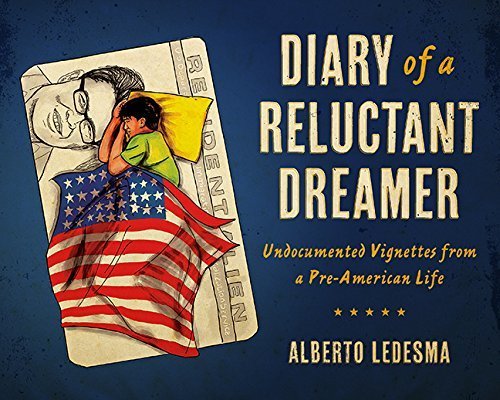
Book Review: Diary of a Reluctant Dreamer: Undocumented Vignettes from a Pre-American Life, Written & Illustrated by Alberto Ledesma

Reviewed by Lila Quintero Weaver

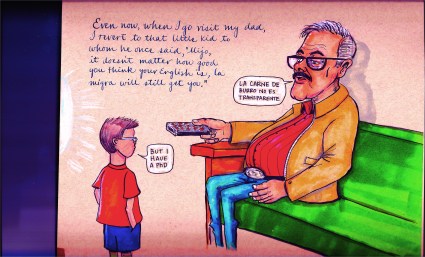
DESCRIPTION OF THE BOOK: In this hybrid memoir, Alberto Ledesma wonders, At what point does a long-time undocumented immigrant become an American in the making? From undocumented little boy to “hyper documented” university professor, Ledesma recounts how even now, he sometimes finds himself reverting to the child he was, recalling his father’s words: “Mijo, it doesn’t matter how good you think your English is, la migra will still get you.”

Exploring Ledesma’s experiences from immigrant to student to academic, Diary of a Reluctant Dreamer presents a humorous, gritty, and multilayered portrait of undocumented immigrant life in urban America. Ledesma’s vignettes about life in the midst of ongoing social trauma give voice to a generation that has long been silent about its struggles. Delving into the key moments of cultural transition throughout his childhood and adulthood—police at the back door waiting to deport his family, the ex-girlfriend who threatens to call INS and report him, and the interactions with law enforcement even after he is no longer undocumented—Ledesma, through his art and his words, provides a glimpse into the psychological and philosophical concerns of undocumented immigrant youth who struggle to pinpoint their identity and community.

MY TWO CENTS: Powerful and timely, Diary of a Reluctant Dreamer: Undocumented Vignettes from a Pre-American Life is the stunning, hand-illustrated chronicle of Alberto Ledesma’s twelve years in undocumented limbo and the psychological toll those years exacted. Drawing—or doodling, as he often calls it— became of one Ledesma’s most reliable coping mechanisms for the stresses of living in the U.S. without documentation. He began the doodling practice as a quiet act of defiance, since even privately acknowledging one‘s lack of papers broke a cultural taboo held by many insiders in Ledesma’s undocumented community. This taboo reached inside the very walls of his family home, where the fear of detection and deportation hung like a black cloud over their daily existence.

In this work, Alberto Ledesma offers a perspective of the American experience that few have written about, plumbing its layers of complexity through richly observed episodes, supplemented by striking text-and-image panels. His personal stories reveal troubling family dynamics, from the pain of feeling misunderstood to his father’s emotional unavailability and bouts of drinking. They also explore Alberto’s adolescent years, when the ache to free himself from the constant secrecy demanded by the family’s status was at its height. Stories of close calls render the fear palpable. In one vivid example, Alberto, his siblings, and their mother sit in a parked car next to a field while their father wanders into the undergrowth to pick wild cactus leaves. As cars occupied by white people pass by, some drivers cast suspicious glances at the Mexican family. When one of the sisters spots a no-trespassing sign, tension turns to panic and eventually to anger at their father for placing them in such a vulnerable position.

In 1986, the Ledesma family achieved legal status through provisions outlined in the Immigration Reform and Control Act, a law passed during the Reagan administration. But as Alberto explains, “though we were now ‘legal,’ those twelve years of conditioning did not disappear.” Long after his status is resolved, the fear of being hunted persists. He demonstrates the extent of that struggle through contemporary exchanges with his young daughter, Sofia, who peppers him with such questions as, “What does it mean that you were once illegal?”

Ledesma ultimately transitioned into academic life, earning a Ph.D. and landing a teaching and administrative position at the University of California at Berkley. He connects his academic drive to the phenomena of “hyper-documentation.” Originated by Dr. Aurora Chang, this term “describes the effort by Dreamers to accrue awards, accolades, and eventually academic degrees to compensate for having been undocumented.” The burdensome effect of this impulse comes through in one of Ledesma’s most potent drawings, which shows a brown-skinned person dressed in cap and gown, pulling a file cabinet tethered by rope and bursting with award certificates.

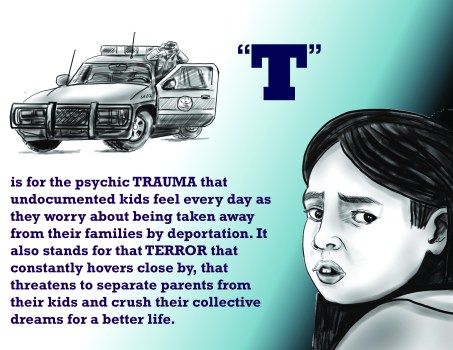
In addition to its memoir sections, Diary of a Reluctant Dreamer includes dozens of serial and stand-alone text-and-image panels, which reflect on multiple aspects of undocumented life. An entire chapter, “The Undocumented Alphabet,” illuminates twenty-six poignant realities experienced by the community. They include:

        “A” is for the ABUELITOS left back in Mexico and the knowledge that until you fix your status you can’t go visit them no matter how much you miss them.

        “E” is for the EDUCATION your mother asked you to get so that you wouldn’t end up working at the same garment factory she did.

Crossing the southern border without papers is an act fraught with peril, but as Diary of a Reluctant Dreamer makes clear, it’s only the start of a long, precarious journey that plays out in the daily existence of millions of undocumented Americans. At this writing, the future of many DACA recipients and other undocumented youth remains in limbo. Their fate is in the hands of elected officials all too willing to play political football with human lives. Alberto Ledesma’s account offers a strong and essential counterpoint to the xenophobia infecting public discourse about U.S. immigration. It brings penetrating light into the liminal spaces occupied not only by Dreamers, but all undocumented immigrants, and makes a convincing case that their stories deserve a chapter in our national narrative.


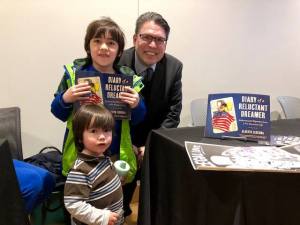
Last month, while Alberto Ledesma was at The Ohio State University for a panel on comics and immigration, he stopped for this photo opportunity with Liam Miguel and Ethan Andrés Pérez, sons of our fellow Latinxs in Kid Lit blogger, Ashley Hope Pérez.

Liam Miguel read Diary of a Reluctant Dreamer from cover to cover (even the parts in cursive, which were tricky for him at first), and he was thrilled to get his copy signed. For him, hearing Alberto’s stories was a way to better understand his father’s path to legal status as well as the realities for many young people who were not so fortunate to come at a time when that path was opened.

ABOUT THE AUTHOR-ILLUSTRATOR: Alberto Ledesma, a Mexican-American scholar of literature, holds a doctorate from the University of California, Berkeley. His publications include poetry, academic articles, and short stories, which have appeared in Con/Safos: A Chicana/o Literary Magazine, and in Gary Soto’s Chicano Chapbook Series (#17). He has also published essays  in ColorLines and New America Media. Ledesma, who participated in Sandra Cisneros’s Macondo Workshop and in the VONA Writers Workshopserves as Graduate Diversity Director for the Outreach and Diversity Office of the Arts & Humanities Division in the College of Letters & Science at the University of California, Berkeley.

Book Review: Telegrams to Heaven / Telegramas al Cielo by René Colato Laínez, illus. by Pixote Hunt

Review by Jessica Agudelo

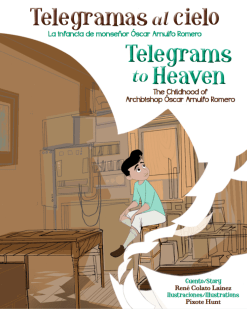
DESCRIPTION OF THE BOOK: Telegrams to Heaven / Telegramas al Cielo recounts the moving childhood of Archbishop Óscar Arnulfo Romero y Galdámez, who from an early age discovers the candor, light and power of the word, which he uses to pray and to write poetry, sending telegrams to heaven from his heart. René Colato Laínez, the renowned Salvadoran writer, has written a touching story about the great Salvadoran prophet who dreamed from his childhood of being a priest, and became not only a priest, but also a bishop, an archbishop, and the great orator of his country. His word remains, for the Salvadoran people and the world—a prayer, a poem, a sweet telegram that Archbishop Romero continues to send in the name of his people to the heart of heaven. The colorful, modern illustrations of Pixote Hunt make us reflect with deep tenderness, showing us the innocence of the great Archbishop Romero as a young child.

MY TWO CENTS: René Colato Laínez offers a bilingual picture book tribute to the Archbishop Oscar Arnulfo Romero, chronicling the icon’s early spiritual development. The Archbishop, then simply known as Oscar, grew up in Ciudad Barrios, in the San Miguel department of El Salvador. Laínez introduces us to Oscar as he works in his family’s home post office and telegram business. Oscar marvels at the telegraph, which can, “like magic” send messages across long distances. He then begins to wonder if he can also use this technology to communicate with heaven. His father clarifies that messages can be sent to God through prayer, prompting Oscar’s dedication to praying “when he woke up, when he milked the cow, after he finished his homework and to give thanks before every meal.” Oscar’s devotion permeates all aspects of his life. Even his artistic talents, like playing the flute and writing poetry and music, serve as expressions of his spirituality and commitment to God.

The story’s sole source of tension arises when Oscar expresses his desire to become a priest. His father is chagrined, and instead sends his son to work at a carpentry shop as a distraction. The text, however, does not specify why Oscar’s parents were not supportive of his wish to become a priest. His father’s admonition, “there are so many things that you can be in this life,” coupled with details in the text about businesses owned by the Romeros and their ability to hire a private teacher for Oscar, hint at a socioeconomic reason. Laínez may have highlighted the moment to demonstrate Oscar’s staunch and early commitment to the Church, but I wanted more clarity.

Indeed, Oscar is not dissuaded from entering the priesthood. When Bishop Dueñas visits Ciudad Barrios, Oscar uses his carpentry shop earnings to buy a crisp white suit to meet the prelate. This encounter is a watershed moment in Oscar’s life, and thus ends the narrative chronicling his childhood. On the following page, we see Oscar as an adolescent, headed to youth seminary in San Miguel and, as the text indicates, later on to Rome, at the behest of Bishop Dueñas, to complete his studies. The final spread is of Oscar, now ordained as Father Arnulfo Romero, palms facing up in front of the church altar, ready to celebrate mass in front of the Ciudad Barrios community, where his journey began.

The accompanying illustrations by Pixote Hunt mainly mirror the information conveyed in the text, but the images lack the warmth of Laínez’s tone. The digital, abstract style leaves characters appearing flat and expressionless, and fail to depict settings distinctly. Many of the spreads are set against surreal or monochromatic backgrounds, such as the telegram and carpentry shops, which appear almost indistinguishable because of the identical color choices. In the few scenes in which a setting is clear, such as the central plaza or the town’s church, details are limited to straight lines, and the people of the community appear as outlined shapes in a solid color with indistinguishable facial features.  Although the story is about The Archbishop, who came to be loved and respected across the world, he will be forever identified with El Salvador. The abstract visual elements used in the illustrations instead create a distance between the subject and his surroundings, an overall disappointing effect.

Laínez’s admiration and respect for the Archbishop is evident and deeply personal, as he relates in the Author’s Note. No doubt Salvadorans and other Latinxs familiar with the Archbishop will be touched and pleased to see his story in print, particularly for young audiences. This title also serves as a reminder of the hope that lives within the Salvadoran community despite many current and past hardships. However, for audiences completely unfamiliar with the Archbishop, or those looking for a comprehensive biography, the story’s narrow focus and static illustrations will fall short. I was left with many additional questions about Oscar’s childhood, his hometown, and his family. Perhaps other readers will, like me, be encouraged to seek more information elsewhere. I do, however, reserve the hope that this will be the first of many titles for young readers that will chronicle that Archbishop’s life and legacy.

Image result for rene colato lainezABOUT THE AUTHOR: Known as “the teacher full of stories,” René Colato Laínez is the Salvadoran author of several bilingual picture books including I Am René, the Boy/Soy René, el niño (Piñata Books), Waiting for Papá/Esperando a papá (Piñata Books), Playing Lotería/ El juego de la lotería (Luna Rising). I Am René, the Boy received the Latino Book Award for “Best Bilingual Children’s Book.” Playing Lotería was named a “Best Children’s Book” by Críticas magazine and the New Mexico Book Award “Best Children’s Book.” Playing Lotería and I Am René have both been nominated for the Tejas Star Book Award—the K-6 bilingual counterpart to the Texas Bluebonnet Award.

Image result for pixote huntABOUT THE ILLUSTRATOR (From his website): As a director, art director and designer in the film industry I bring more than 10 years experience in animation to every project. Highly skilled in drawing, painting and musical composition, my creative goal is to bring an innovative insight to every project. Always on the cutting edge, my experience in combining animation with live action began in 1994 when I directed and art directed THE PAGEMASTER, and continued as I designed the 3D opening and interstitials for FANTASIA 2000 that seamlessly weaved the animated sequences together. I feel my unique achievements in film and music have garnered me the honors of being a voting member of both the Academy of Motion Picture Arts and Sciences and the GRAMMYs/Recording Academy.

J_AgudeloABOUT THE REVIEWER: Jessica Agudelo is a Children’s Librarian at the New York Public Library. She has served on NYPL’s selection committee for its annual Best Books for Kids list, and is currently a co-chair for the 2018 list. She contributes reviews of English and Spanish language books for School Library Journal and is a proud member of the Association of Library Services to Children and REFORMA (the National Association to Promote Library and Information Services to Latinos and Spanish Speakers). Jessica is Colombian-American and was born and raised in Queens, NY.

Book Review: Us, In Progress: Short Stories About Young Latinos


Review by Jessica Walsh
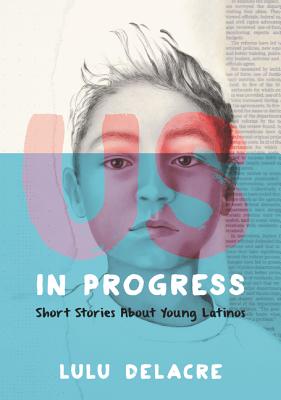
DESCRIPTION OF THE BOOK: Acclaimed author and Pura Belpré Award honoree Lulu Delacre’s beautifully illustrated collection of twelve short stories is a groundbreaking look at the diverse Latinxs who live in the United States.

In this book, you will meet many young Latinxs living in the United States, from a young girl whose day at her father’s burrito truck surprises her to two sisters working together to change the older sister’s immigration status, and more.

Turn the pages to experience life through the eyes of these boys and girls whose families originally hail from many different countries; see their hardships, celebrate their victories, and come away with a better understanding of what it means to be Latino in the U.S. today.

MY TWO CENTS: There are twelve stories in this collection, each a beautiful snapshot of life, family, tragedy, and transformation. Each story is inspired by real events and people, some the author knew personally. Included at the end of the book are links to the original articles that inspired each story. The stories begin with a refrán, a familiar Spanish saying that connects with the paired story. A mixed-media portrait also accompanies each story, further personalizing the characters for the reader. Each portrait is intentionally left unfinished to illustrate the idea that each person is a work in progress.

Here is just a peek at a few of the twelve vibrant stories in the collection.

Emilio and José begin this collection in “The Attack.” Twin brothers, whose emotions are closely tied together, watch as their mother works tirelessly to support their older brother’s epilepsy needs. As the story opens, we find out that the twins’ brother, Tony, has been experiencing more and more frequent seizures, and this becomes the source of the main conflict in “The Attack.” During one violent seizure, Tony — holding a knife for cutting fruit — unintentionally harms himself. Frightened, the twins call 911, and soon, officers arrive on the scene to find a bleeding Tony, knife in hand. Then, through a series of miscommunications, an officer is injured, and Tony is charged with assault on an officer. The family is then faced with the uncertainty of what a lawsuit will mean for their family and their lives in the United States. In this short opener, I was brought into the fabric of this family’s heartaches and struggles and I found myself heartbroken fabout they choices they face.

In “Selfie,” 13-year-old Marla is desperate to avoid the same fate as her mother, dependent on insulin shots to treat her diabetes. Showing signs of pre-diabetes, Marla is self-conscious about the dark patches that develop on her skin. She is particularly sensitive to the dark patches showing up when she and her friends take photos and selfies. She knows that a healthy diet and exercise are key, but healthy food is expensive and can’t often be found at the Food 4 Less, the discount market where Marla’s Mamá shops the sales once a month. So, when an opportunity to work her way toward a bike of her own comes up at the local bike club, Marla tries to convince her mother to let her make the 40-minute bus ride by herself. With the help of a supportive teacher and the hope that her Mamá will give her blessing, Marla begins to see how much strength she has.

If you haven’t fallen in love with the collection yet, you will in “Burrito Man,” the fourth story in the collection. On Take Our Daughters to Work Day, Alex wishes she could be anywhere but with her father, “just a food-cart vendor.” Up at 4 a.m., Alex thinks about her friends enjoying air-conditioned offices instead of melting in the heat and being bombarded by the sounds of traffic all day. But Alex’s disappointment doesn’t get her Papi down; he tells her it is going to be a great day because of her. As the day goes on, and the temperatures rise, Alex is floored as one customer after another not only greets her Papi like family, but seems honored to meet “the famous Alex!” Alex is impressed by the way her father treats his customers, remembering minute details about their lives. She is equally embarrassed to find out that her father gushes about her regularly to these strangers. However, teenage humiliation is transformed into pride by the end of the story for what her father has built on his corner.

In “Band-Aid,” we find Elena, whose world is turned upside down when her Papi is picked up by la migra and deported to Honduras. She not only has to face the devastating loss of her father, but also her home, school, and best friend when her mother is forced to move her family and work long hours to make ends meet. Soon, hope arrives in the form of la gran madre, Doña Sánchez. Elena’s mother knows that her children, US citizens, would be safe under the care of la gran madre if she were to be deported. But safety comes in the form of signing over legal guardianship to Doña Sánchez. Elena agonizes at the thought of her family being further torn apart, but she knows the decision lies with her mother. This important story shines in this collection as a beautiful and tragic reminder of what politics is doing to families living here.

“Pickup Soccer,” written in verse, at first, seems to be just a fun ode to fútbol. The narrator, Hugo, wants to be a famous commentator, and we see his neighborhood through his eyes as he and his cousin Hector make their way to the “old neighborhood field.” But, look closer, and you will see that in Hugo’s fast-paced descriptions are signs of of gentrification in the Mission neighborhood. Soon, the neighborhood kids are faced with being kicked off the field by techie start-up guys, including Hugo’s cousin Hector, brandishing a reservation permit through the new City of San Francisco app. Insults start flying, and Hugo knows he must think on his feet, like a true sports commentator, to help both sides coexist on and off the field.

The collection closes with “90,000 Children,” a transformative story about a young boy, Frank, dreaming of the day when he can follow in his father’s footsteps as a border patrol agent. The story’s title references the statistic shared by Frank’s father, that 90,000 unaccompanied minors would be entering the United States by the end of the year. One day, while out with his father, Frank encounters a young girl by herself outside of a saloon. He is drawn to her and further intrigued by an illustration she shows him of a beautiful landscape, an illustration she gives him to keep. After that day, Frank can’t stop thinking about the girl, and what became of her. He struggles with his complex feelings of prejudice toward immigrants and awe at his impression of the young girl after spending only a few moments with her. Woven throughout this story are the complexities of discrimination not only between Frank and the people his father encounters every day, but the discrimination at play in Frank’s own family, between verdadero Francisco Spanish blood and Mayan “indiecitos,” as Frank’s grandfather says. Frank’s transformation is not only evident in his changing actions and words, but in his perception of the work his father does at the border.

This book in the hands of kids is an exciting prospect. Individually, you could delve into each character’s story, reveling in the rich development of character, place, and voice. As a whole, imagine the conversations around Lulu Delacre’s robust writing. Further, readers will be captivated with the true elements of these works, all found in the “Notes on the Individual Stories” section at the back of the book. But let’s end with the front of the book. The beautiful cover artwork, in combination with the title, sends a message to all of our kids that this book is for all of us.
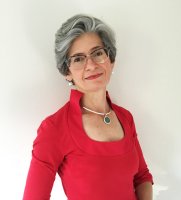
 Lulu Delacre Media Photo 1 ABOUT THE AUTHOR: Three-time Pura Belpré Award honoree Lulu Delacre has been writing and illustrating children’s books since 1980. Born and raised in Puerto Rico to Argentinean parents, Delacre says her Latino heritage and her life experiences inform her work. Her 37 titles include Arroz con Leche: Popular Songs and Rhymes from Latin America, a Horn Book Fanfare Book in print for over 25 years; and Salsa Stories, an IRA Outstanding International Book. Her bilingual picture book ¡Olinguito, de la A a la Z! Descubriendo el bosque nublado; Olinguito, from A to Z! Unveiling the Cloud Forest has received 20 awards and honors including an NCTE Orbis Pictus Honor and an ALA Notable for All Ages. Her most recent title, is Us, in Progress: Short Stories About Young Latinos. Delacre has lectured internationally and served as a juror for the National Book Awards. She has exhibited at The Eric Carle Museum of Picture Book Art; The Original Art Show at the Society of Illustrators in New York; the Museum of Art of Puerto Rico and the Museum of Ponce in Puerto Rico among other venues.

Us, In Progress: Short Stories About Young Latinos has been recognized as a Kirkus Best Book of 2017, a New York Public Libraries Best Book of 2017 and a Los Angeles Public Libraries Best book of 2017. It has also been awarded a Malka Penn Honor for Human Rights in Children’s Literature.