Generational Trauma and Learning to Love in Anna-Marie McLemore’s Wild Beauty


“Every woman in this house had inherited it, the same way they had inherited the loss and the broken hearts written into their blood” —Anna-Marie McLemore, Wild Beauty

By Dr. Sonia Alejandra Rodriguez

Estrella Nomeolvides refers to her and/or her family as being poison ten times throughout the novel. The Nomeolvides women grow flowers by digging their hands into the earth and allowing the magic inside them to pour out making gardens of the land around them. Generations of Nomeolvides women live in La Pradera, a land that, although owned by the white and affluent Briar family, has its own powers and resentments. The Nomeolvides women ended up at La Pradera after being chased out of other places having been accused of witchcraft and of making men disappear. Now, they can die if they refuse to grow flowers in the land because then the flowers will just grow inside them and they can die if they try to leave La Pradera.

Estrella and her cousins are heirs to the generational trauma born out of a history of displacement and dispossession. For most of the novel, the trauma is associated with the men the land has literally taken from them. They understand this trauma, they might challenge it and refuse it, but, for the most part, they accept it as their burden to bear. The Nomeolvides women are convinced that La Pradera will take whomever they romantically love thus they fear loving someone too hard.

The story is propelled by the cousins’ desire to protect their shared love, Bay Briar. Once they all find out that each one of them is in love with Bay they fear what their collective love might do to her. The cousins bury something special to each of them in the earth in exchange for Bay’s life. It seems to work, but the mysterious appearance of a young man they name Fel forces them to unearth their past and the secrets buried in the land.
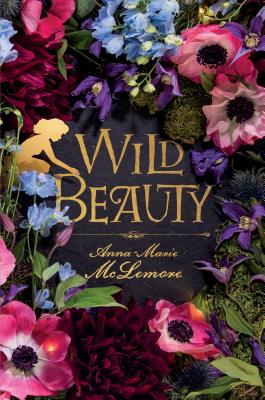
Wild Beauty is a novel about the stories, lessons, and warnings that are passed on from one generation of women to the next. The older Nomeolvides women share stories of the other women in their family who have left and have died, who have tried to deny their gifts only to find themselves surrounded by unruly flowers, and of women who have learned not to love as deeply. The sharing of these stories, lessons, and warnings, both in the novel and in real life, is a political act. When women exchange knowledge in this way, it is, among other reasons, for survival’s sake because it is likely that there are larger systemic oppressions that threaten their daily lives—as is the case for the Nomeolvides women. As a result, trauma can also be passed down from one generation of women to the next.

Estrella calls this trauma a poison that runs in the blood of the women in her family. However, when she speaks of the poison as it impacts all of the women, she talks about it in a very transactional way. She says, “Sorrow was a family heirloom, written into their blood like ink on a will” (262). In this quote, and in the epigraph opening this essay, sorrow, loss, and broken hearts connote significant value and exchange. Heirlooms are special and are worth enough to be passed down. Heirlooms are taken care of and cherished so that they may be passed down. Inheriting an heirloom suggests that one has taken over the responsibility of taking care of said heirloom. Wills are a very typical way to exchange the ownership of an heirloom from one party to another. This reading suggests that, at least at some level, Estrella understands that this poison was inflicted on her family and that it wasn’t necessarily a choice.

The idea of the writing in the blood like ink on a will continues to develop in the novel as the cousins fight to take La Pradera from the Briar family and as it’s revealed that the Briar family built an estate over a collapsed quarry where many men died: “They were the immigrants, the underaged, the ones left off the role sheets. And they had been caught [in the quarry], in the ages they had been when they died, freed neither by being found and given burials, nor by their families hearing what had become of them, nor by the truth ever being told” (288). Estrella sees that the contracts, the wills, and the legalese that protected the Briars are fraught. Therefore, if the ink on a will can be challenged, then so can the poison written in the blood. In other words, Estrella realizes that La Pradera took their men not because they are cursed but because their gardens helped to further hide the truth of what had happened on that land. So, at the end, the women are not poison.

This truth, however, does not free Estrella because while she might have settled her family’s inheritance of sorrow, loss, and broken hearts, she is still convinced that she is poison. The narrator says of Estrella: “Her heart was poison. It was a close tangle of thorns. Even when it held love, that love came sharp, and she didn’t know how to offer it to anyone except with the edges out” (285). This particular moment in the novel is as important as it is beautiful because it touches on the realities of what it means to unearth our traumas. In other words, giving names to the trauma, pinpointing their origin, revealing truths about the traumas does not equal closure, peace, or complete healing. Instead, it is often the case that learning truths about our trauma means there’s a lot more self, familial, and community healing left to do. The description of Estrella’s love brought these questions to mind: What do we do when our identity has intertwined with the trauma? What do we do when the truths about the trauma are too much? How do we learn to love when the trauma is ongoing?

Wild Beauty offers two answers to these questions. First, the narrator says of Estrella, “If she apologized for her own heart then she would make it tame, and small. But like this, it was wild, and limitless” (282). At this moment in the novel, the description of Estrella’s heart is about her love for her family, her desire to follow her heart, her heart’s inclination to love men and women, and of her fear of loving too deeply. She won’t apologize for who she is, trauma and all, and she can see that her heart isn’t poison but is instead “wild and limitless.” Her heart is capable of simultaneously holding love and hurt. It doesn’t have to be one or the other. Feeling that our heart is full of hurt doesn’t mean that there isn’t any room for love. And, feeling all the love imaginable doesn’t mean we are immune to getting hurt again. The second answer Wild Beauty provides comes toward the end of the novel when the narrator says, “They had to rip out their fate by the roots” (311). Generational trauma doesn’t need to define us or determine our future. It is something that needs to be acknowledged so that we may rip it out and create more possibilities for ourselves.

McLemore creates a wonderful and beautiful world in Wild Beauty. The Nomeolvides women are sincere, and flawed, and complicated. Their desire to love wholeheartedly but being unable to, for whatever reason, will resonate with many readers. The villains are too familiar. The underlying story of exploiting the land for profit, often times at the sake of disenfranchised bodies, is extremely important. The connection that McLemore makes between generational trauma and the land is also significant. At the end, Wild Beauty encourages us to not be afraid to love.

CLICK HERE for an interview with author Anna-Marie McLemore about Wild Beauty.
 

FullSizeRender (1)

Dr. Sonia Alejandra Rodriguez teaches composition, literature, and creative writing as an Assistant Professor at LaGuardia Community College in NYC. Her research focuses on Latinx children’s and young adult literature. Follow her on twitter @mariposachula8


Q&A and Cover Reveal with Author-Illustrator Tony Piedra


By Cecilia Cackley

Today, we’re thrilled to introduce you to Tony Piedra, a former film animator who worked on several awesome Pixar movies, including the Oscar-winning Coco! Tony will have his debut picture book released by Arthur A. Levine Books later this year. Before we get to the Q&A, here’s some background information on the author-illustrator:

tony piedraFrom his website: In a previous chapter of my life, I was a Sets Technical Director at Pixar Animation Studios. For nine years, I collaborated with some of the most talented artists and storytellers in the world to help realize the environments in films, such as, UpCars 2The Good DinosaurInside Out, and Coco, as well as several of Pixar’s short films, including The Blue Umbrella. Now, I am taking the skills and experiences from my time working in the film industry and putting them to use as an author and illustrator of children’s books. My debut picture book, The Greatest Adventure, will be released Fall 2018 through Arthur A. Levine Books an Imprint of Scholastic Inc.

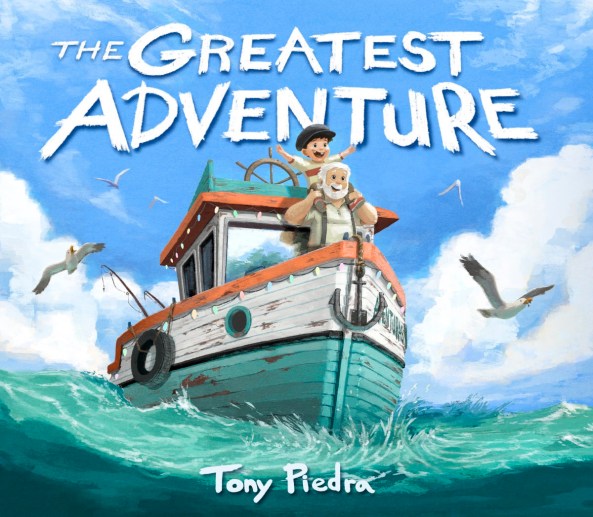
Now, here’s a brief description of The Greatest Adventure:  Eliot imagines sailing wild rivers and discovering giant beasts, right there on his block. But he wishes his adventures were real. Eliot’s grandpa, El Capitán, once steered his own ship through dangerous seas, to far-off lands. But he can’t do that anymore. Can Eliot and El Capitán discover a real adventure… together? Come find out All aboard The Greatest Adventure.

Now….here is the beautiful cover of the book, which releases September 11, 2018.


GREATEST ADVENTURE Cover

ALSO, CLICK ON THE LINK TO GET A GLIMPSE OF THE INSIDE ART: Greatest Adventure


Q. What picture books do you remember from when you were growing up? Are there any stories or artists that were especially meaningful or inspirational for you?

A. In a bright red building I affectionately remember as the “Red Library,” I discovered a book called Album of Sharks, illustrated by Rod Ruth and written by Tom McGowen. This book left such a vivid impression on my mind due to Ruth’s striking full page illustrations, that over 20 years later, when I tried to locate a copy of the book with absolutely no information other than my childhood memories, I was able to do so because I remembered each and every one of Ruth’s illustrations so clearly. I find it funny how at such young age we are intrinsically drawn to certain subjects, and for whatever reason I was then, and still am, drawn to sharks. I love the danger, mystery, and wonder they conjure in my mind, and Ruth’s illustrations captured this in a way that no photo has ever been able to do.  Later I learned that Rod Ruth and Tom McGowen paired up on over a half dozen “Album of” books, each beautifully illustrated, and I imagine, entertainingly written—I wasn’t such a good reader back in those early days.  As an homage to Album of Sharks and more specifically as a small, but deeply felt thank you to Rod Ruth, I inserted a token of admiration for one of Ruth’s most memorable paintings in my debut picture book, The Greatest Adventure.


Q. What are your favorite art materials to work with? How much (if any) of your process is digital?

A. Just give me a pencil and some white computer paper, and I will be distracted working for hours. These have been my default materials since the beginning. I dabble with gouache, acrylics, and oils, but they are not my natural mediums. If I need to do some thinking or planning there’s nothing better than pencil and paper. I followed that same practice on The Greatest Adventure. Throughout the planning and dummy stage of this book I solved compositions and decided on scene staging with these simple materials and time. All the heavy lifting happens at this humble stage. When I’m finally satisfied with a composition and ready to do a final illustration, I scan in the sketches and begin the meticulous process of painting them digitally in Photoshop.  My final paintings are 95% digital with subtle touches of texture scanned in from traditional media.

Q. You’ve come to picture books from animation (congratulations on Coco’s many wins!). How is the artistic process for the two kinds of storytelling similar or different? Are there any secrets about Coco (or Pixar in general) you can share with us?

A. Thank you for the congratulations. Coco represents the final year and a half of my career at Pixar, and I’m very proud of the film, and the work I helped bring to the screen, namely the cemetery in Miguel’s hometown of Santa Cecilia.

Fundamentally, the process of creating a picture book and an animated film are very similar in that both mediums require a team of individuals to bring to life a story and world that had never existed before. Where they differ most strikingly is in the number of individuals per team and their level of specialization. Picture book-making, though clearly a team effort, does not require an army of individuals at the creative stage. Much of the work is realized by the author and illustrator in collaboration with the editor, designer and production team. And so, in general terms, the publishing team is smaller and the skillset of each individual on that team fairly broad when compared to the specialization required in producing a computer-generated film. A typical Pixar film employs 250-300 highly-specialized people to collaborate on a singular vision. Just to give you an idea of how specialized the work on these films is, there are specialists known as “groomers,” whose sole responsibility is to create hair, and trust me this is a full-time job, especially, when you’re trying something as innovative as the wild, red locks of Merida in Pixar’s Brave, or you’re styling the hair for an entire town as was required in Coco. Imagine the equivalent in the picture book world, an illustrator who only draws hair!

My area of expertise is called Set Dressing. It is not too different from interior decoration. Think of how interior decorators bring rooms and homes to life with their choices of color and arrangement of decor. There is, however, one key difference: the set dresser’s goal in arranging objects on a film is to reveal aspects of the characters through their environment, which requires a great deal of story specificity. Think of a college dorm room versus the bedroom of someone who is obsessively organized. How would these rooms be arranged differently? What would each room say about its owner’s character? The answers to these questions are provided by set dressing. My work on Coco required the careful arrangement of flowers, candles, and foods on the graves which made up the cemetery in the film. These ofrendas were arranged to show the love and respect family members paid to their deceased relatives on Día de los Muertos. It took me nearly a year and a half to set dress the entire cemetery, and this is but one part of the process required to bring to screen one scene in the film.

Q. What are some books you’re looking forward to from Latinx creators? These can be picture books or chapter books.

I have admired the work of Julia Sardá for many years. Her work is primarily known in Europe, but I think that she is one of the most talented children’s book illustrators out there today. Somebody please bring her to the American children’s book market! I’m also excited to see what comes next from Lorena Alvarez, a Colombian children’s book author and illustrator, whose exciting work I came across last year with the release of Night Lights published by Flying Eye Books.  I also just discovered JOAN PROCTOR, DRAGON DOCTOR: The Woman Who Loved Reptiles written by Patricia Valdez and illustrated by Felicita Sala. The book was recently released and it speaks to me both through Felicita’s beautiful illustrations and the subject’s love of lizards, which I can completely relate to. I can’t wait to get my hands on it!

Q. What do you want your next great adventure to be? Is there anywhere you want to travel to or wonders you’d like to see?

At the beginning of last year, I wondered the same thing: what would be my next adventure? I had just left Pixar to pursue a full-time career in children’s books, and one of my goals outside of finishing up my first book was to find ways to travel the world as an independent artist. For the longest time, I had admired how my best friend’s sister had managed to see so much of Europe and South America with the help of playwright grants. So naturally, I figured somebody for some reason must need an author/illustrator to go to the rainforest! I then stumbled upon an artist-in-residence program called Voices of the Wilderness.  This residency sponsored by the U.S. Forest Service brings artists of all sorts to remote areas of Alaskan wilderness to witness their beauty and share the importance of conserving these wild corners with the American public. I applied for the residency and a few months later found myself standing in the rain on Admiralty Island, a 1,500 square mile rock covered in a swath of temperate rainforest and home to the greatest concentration of coastal brown bears in the world. This was not the adventure I had envisioned; it was grander. And this island and one bear in particular on it have become the centerpiece of my next story for children. Where next?  Who knows!


Cecilia Cackley is a performing artist and children’s bookseller based in Washington, DC, where she creates puppet theater for adults and teaches playwriting and creative drama to children. Her bilingual children’s plays have been produced by GALA Hispanic Theatre and her interests in bilingual education, literacy, and immigrant advocacy all tend to find their way into her theatrical work. You can find more of her work at www.witsendpuppets.com.
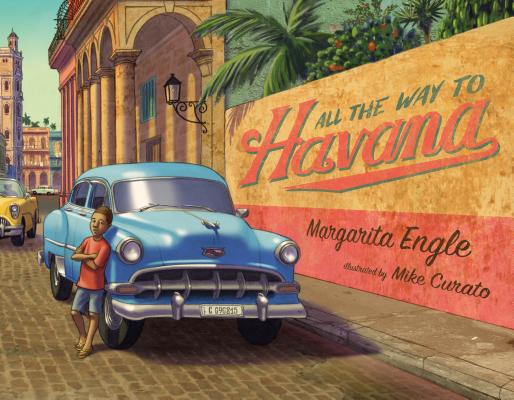
Book Review: All the Way to Havana written by Margarita Engle, illus. by Mike Curato


Reviewed by Cecilia Cackley

DESCRIPTION OF THE BOOK: Together, a boy and his parents drive to the city of Havana, Cuba, in their old family car. Along the way, they experience the sights and sounds of the streets–neighbors talking, musicians performing, and beautiful, colorful cars putt-putting and bumpety-bumping along. In the end, though, it’s their old car, Cara Cara, that the boy loves best.

MY TWO CENTS: I really enjoyed the trip this picture book takes through the Cuban countryside and into the city of Havana. It is easy to identify with the narrator, as he gets squashed in the backseat by all the passengers! Engle makes the question of whether or not the narrator and his father can get the car to work a suspenseful one, but as the journey gets underway, we don’t feel pity for the family for having an old car, but rather excitement for everything they see along the road to Havana. The bright colors of the cars alongside the blue of the sky and ocean make the pictures very attractive and illustrator Mike Curato adds plenty of detail to the vehicles and the scenery in Havana. The figures in the pictures can sometimes look a little flat, but it was nice to see an Afro-Latinx family featured—an unfortunate rarity in a lot of picture books. Both the author and illustrator include notes at the end talking a little about the background of the story and the process of researching the illustrations.

TEACHING TIPS: As might be expected, this is a perfect story time book, especially for kids around ages 2-4 who are usually VERY into cars, trucks, and trains (so much that many bookstores have a separate section just for those books). The sounds the car makes invite call and response with story time or classroom listeners. The way the narrator talks about how Cara-Cara looks compared to all of the other cars might be a good lead in to having students draw their own imaginary car, including what it would look like and what sounds it would make. The context of traveling to a family celebration is also a good discussion point, where children can talk about their own trips to visit relatives and various family celebrations.

WHERE TO GET IT: To find All the Way to Havana, check your local public library, your local bookstore, or IndieBound. Also, check out GoodreadsAmazon, and Barnes & Noble.


Margarita Headshot

ABOUT THE AUTHORMargarita Engle is the national Young People’s Poet Laureate, and the first Latino to receive that honor. She is the Cuban-American author of many verse novels, including The Surrender Tree, a Newbery Honor winner, and The Lightning Dreamer, a PEN USA Award winner. Her verse memoir, Enchanted Air, received the Pura Belpré Award, Golden Kite Award, Walter Dean Myers Honor, and Lee Bennett Hopkins Poetry Award, among others. Drum Dream Girl received the Charlotte Zolotow Award for best picture book text. Her newest verse novel about the island is Forest World, and her newest picture books are All the Way to Havana, and Miguel’s Brave Knight, Young Cervantes and His Dream of Don Quixote.

Books forthcoming in 2018 include The Flying Girl, How Aída de Acosta learned to Soar, and Jazz Owls, a Novel of the Zoot Suit Riots. Margarita was born in Los Angeles, but developed a deep attachment to her mother’s homeland during childhood summers with relatives. She was trained as an agronomist and botanist as well as a poet and novelist. She lives in central California with her husband.


ABOUT THE ILLUSTRATOR: Mike Curato loves drawing and writing almost as much as he loves cupcakes and ice cream (and that’s a LOT!). He is the author and illustrator of everyone’s favorite polka-dotted elephant, Little Elliot. His debut title, Little Elliot, Big City (Henry Holt Books for Young Readers, Macmillan), released in 2014 to critical acclaim, has won several awards, and is being translated into over ten languages. There are now four books in the Little Elliot series: Little Elliot, Big City; Little Elliot, Big FamilyLittle Elliot, Big Fun; and the latest addition, Little Elliot, Fall Friends. Meanwhile, Mike had the pleasure of illustrating Worm Loves Worm by J.J. Austrian, All the Way to Havana by Margarita Engle, and contributed to What’s Your Favorite Color? by Eric Carle and Friends. He is working on several other projects, including What If… by Samantha Berger and his first graphic novel. Publishers Weekly named Mike a “Fall 2014 Flying Start.” In the same year he won the Society of Illustrators Original Art Show Founder’s Award.


ABOUT THE REVIEWER: Cecilia Cackley is a performing artist and children’s bookseller based in Washington, DC, where she creates puppet theater for adults and teaches playwriting and creative drama to children. Her bilingual children’s plays have been produced by GALA Hispanic Theatre and her interests in bilingual education, literacy, and immigrant advocacy all tend to find their way into her theatrical work. You can find more of her work at www.witsendpuppets.com.

Book Review: Alma and How She Got Her Name/ Alma y come obtuvo su nombre, by Juana Martinez Neal


Coming to a shelf near you on April 10, 2018!

Reviewed by Dora M. Guzmán

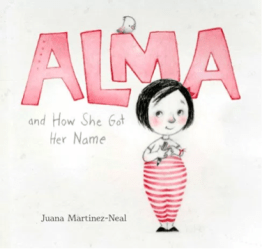
PUBLISHER’S DESCRIPTION: If you ask her, Alma Sofia Esperanza José Pura Candela has way too many names: six! How did such a small person wind up with such a large name? Alma turns to Daddy for an answer and learns of Sofia, the grandmother who loved books and flowers; Esperanza, the great-grandmother who longed to travel; José, the grandfather who was an artist; and other namesakes, too. As she hears the story of her name, Alma starts to think it might be a perfect fit after all — and realizes that she will one day have her own story to tell. In her author-illustrator debut, Juana Martinez-Neal opens a treasure box of discovery for children who may be curious about their own origin stories or names.

MY TWO CENTS: What is in a name? A name is a gift given to you at birth and you carry it through all your stages of life. Parents and guardians spend months deciding on their baby’s name, sometimes even long before a baby is in the picture. But what if your name doesn’t fit on your paper because of its length?

In a world where we tend to question our differences, this story does quite the opposite. Growing up in the United States, one tends to have a single first name, maybe a middle name, and just one last name. However, this differs in certain other countries, including in Latin American, where it is not out of the ordinary to have more than one name.

Meet Alma Sofia Esperanza José Pura Candela, the main character of this story. Yes, her name is long. However, wondering about the length is what leads Alma on the journey to discover the story behind her name. Throughout the book, we learn the rich history and origins of each of Alma’s names. Many of her names were inspired by her ancestors and their humble traits and contributions to the world. The people behind her names influence Alma’s passions and character, even as she embraces each person and the love they gave her as a baby. She quickly learns that those same traits are present in her everyday life, and she rightfully claims that name through her affirmation of “I am____”. Alma soon learns that with claiming her name comes a lot of love and culture. She will now be able to contribute those gifts to the world. As Alma declares, “I am Alma, and I have a story to tell.”

This story wonderfully illustrates how to embrace YOU and the name you carry throughout life. In this story, Juana demonstrates that our name is a spotlight on not only our ancestors and the imprints they left on our lives, but also a forever part of us and what we can give to this world.

This picture book illuminates an essential connection to ancestors. Inspired by her own name, Juana reminds readers that our names are not just our own, but a reflection of our culture as well.

I am always amazed at Juana’s illustrations, especially in this picture book. The beauty of the main character connecting to her past is captured in colors and soft shades that will delight the reader’s eye. Juana also brings attention to each name through the addition of colorful accents and font styles. In page after page, the illustrations offer a collective reflection of everything that Alma’s ancestors represent, forming a visual reminder that who we are is a collection of everyone who came before us.

TEACHING TIPS: Teachers of all grade levels can use this picture book to illustrate our Latinx identity. This book is a perfect addition to an identity unit, where readers can delve into their own names and family trees. Teachers can also use this book as a reading mentor text around the main character’s learning process, as well as understanding the author’s message. The Spanish version is authentic to the Spanish language and perfect for bilingual/dual language classroom settings. Alma and How She Got Her Name/Alma y como obtuvo su nombre is a definite must add to all libraries in classrooms and homes!


ABOUT THE AUTHOR-ILLUSTRATOR: Juana Martinez Neal is an award-winning illustrator and artist. Her passion for art started as a child and led her to study at one of the best schools in fine arts in Peru. Her journey as an illustrator led her to the United States, where she continues to illustrate a variety of children’s books. For updates on her art, follow her on Instagram @juanamartinezn. Juana’s official website can be found at http://juanamartinezneal.com/


ABOUT THE REVIEWER: Dora M. Guzmán is a bilingual reading specialist for grades K-5 and also teaches college courses in Children’s Literature and Teaching Beginning Literacy. She is currently a doctoral student with a major in Reading and Language. When she is not sharing her love of reading with her students, you can find her in the nearest library, bookstore, or online, finding more great reads to add to her never ending “to read” pile!

Artist Jose Pimienta Gives Advice and Talks About Tools & Techniques


By Cecilia Cackley

Joe Pi’s almost full name is Jose Pimienta. He was born in the Imperial Valley and raised as a Cachanilla in Mexicali, BC. During his upbringing, he was heavily influenced by animation, music and short stories. He’s been drawing as long as he can remember and loved analyzing everything on the TV screen.

After high school, he left his garage band and ventured toward Savannah, Georgia, where he studied Sequential Art and discovered the wonders of Storyboarding. He also discovered a wider variety of music, traveled more and made friends. By the age of 24, he ran into a good suggestion, which was to move to SoCal and pursue a career in storyboarding. In 2009, he packed his belonging and drove to Los Angeles, with a friend. Nowadays, he resides in Tujunga where he takes walks every morning along with a big cup of coffee. He draws comics, storyboards, and sketches for visual development.

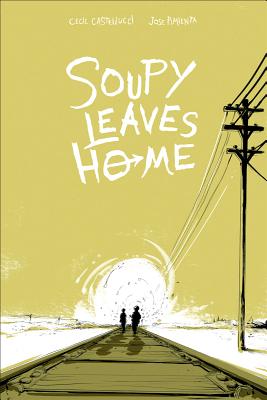
Joe’s latest book is the YA graphic novel Soupy Leaves Home, a historical fiction story by Cecil Castellucci set during the Great Depression. He was kind enough to talk to us about his background and work as an artist.

Did you read comics as a kid? What were your inspirations for becoming an artist? 

Unfortunately, I didn’t read many comics as a kid. I tried getting into superheroes several times, but they never really hit a chord with me. It wasn’t until my teens that I discovered other graphic novels, manga, and slice-of-life stories in comics that rocked my world. I did, however, read a lot of newspaper strips, but I also felt that wasn’t my fit for the type of stories I wanted to tell.

As a kid, my inspirations tended to come from animated movies, books with illustrations and music videos. As long as I can remember, I’ve always liked all those “making of-” featurettes and interviews with film makers and artists. They tended to reveal parts of the process and how a piece of art (whether it was a cartoon, a movie, or a song) was made. So, I guess I was inspired to be an artist by learning more about the arts I liked. The thought seemed logical: I like this Art and this is how they’ve done it and I want to do that because when I try it, I love it. Conclusion: learn more how to do it and keep going.

Please tell us a little bit about the tools you used to draw Soupy Leaves Home.

For Soupy Leaves Home, I drew it the way I prefer to draw comics, which is:

On regular type paper, 8.5 by 11 and a mechanical pencil (0.5, to be precise). I draw 1″ by 1.5″ rectangles and that is the thumbnail for a comic page. I draw my thumbnails small while reading the script, so it helps me to plan out the pace and what the beats of the story are. That way I know if I want to build up to a big scene or if I want to keep a steady pace for a few pages.

After that, I draw on 9×12 2-ply bristol board. Personally, I like the Smooth surface better than the Vellum, but sometimes, Vellum is all the store has, so… ANYWAYS, I draw the page with a blue-lead 0.5 mechanical pencil. I keep my pencils a bit loose, but knowing that I can tighten up later with the inks.

Once the pages are approved, I ink on top of the original pencils with micron pit pens, brush pens, India ink and brush, liquid paper white-out, and sometimes a few fountain pens. After that, I scan the pages and color them digitally with Photoshop. In this stage, I also do some more specific edits, such as deleting certain pencil marks that I couldn’t erase, or making sure the white out looks cohesive on the page. If the blacks look a bit too strokey, or if I just want a solid black instead of having visible brush marks, this is the stage to fix that. After that, my editor takes my files and has a letterer do that which I cannot: letter the book. Those are all my tools: papers, 0.5 mechanical pencils, brush pens, India ink and brush pens, AND Photoshop.

Soupy Leaves Home joins a growing field of comics of all genres, aimed at a teen audience. Are there other titles you recommend to people looking to read more YA comics?

Oh, absolutely:

Boxers and Saints by Gene Luen Yang

This One Summer by Mariko Tamaki and Jillian Tamaki

Surfside Girls by Kim Dwinell

Chiggers by Hope Larson

Nameless City by Faith Erin Hicks

Year of the Beasts by Cecil Castelucci

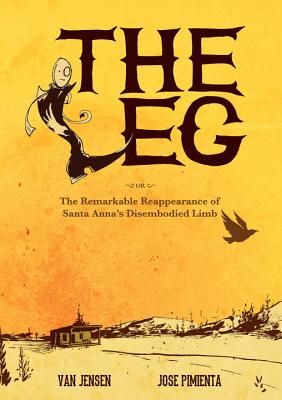
The Leg by Van Jensen and… me, hehe.

.                                                  

While comics for kids and young adults has been exploding as a publishing field, there have been comparatively few Latinx authors and artists getting attention, with the exception of the Giants Beware and Lowriders series. What advice do you have for young Latinx artists looking to break into comics? 

Dear Latinx who want to break into comics: Be bold, fearless, humble, and optimistic. Bold, because it reflects confidence and strength. Fearless, not just because of the current atmosphere, but also because that’s how we fight fear mongering, which is used to keep us quiet and divided. Humble, because, it reminds us that there is a bigger picture in our society, and that which benefits our community, automatically helps us grow to be better individuals living together. And optimistic, because as artists, our spirit is essential, so it’s important to keep it bright.

About breaking into comics? We can post and share. Ask everyone for support, launch Kickstarters, look at companies that you’re interested in, and see their submission guidelines and follow directions, while showing why your stories matter and why they’d be a great fit for their company. Go to conventions near you, small or big (of course they can be expensive, but plan for that. See how many you can make it to), make minis to hand out to show what you’re interested in doing. Go to conventions of what you like (for example, if you like baking, wrestling, cars or music; go to those conventions) get a small vendor table and sell your comic (about baking, wrestling, cars or music.) Starting a Patreon account, I hear, is a popular avenue these days. Most importantly: KEEP GOING. Do not stop making art and telling others about it. I’ve heard several quotes, and the one that still fits best is: It’s a marathon, not a sprint. Do not give up sharing your stories.

On a last note, see if I can end well here: When I first became interested in comics, I wished I had known more Latinx cartoonists (which there were, but I didn’t know about that many). To those who see my work, I hope I can make a positive impression, but furthermore, I hope that they go on to make art that inspires even more people.


Cecilia Cackley is a performing artist and children’s bookseller based in Washington, DC, where she creates puppet theater for adults and teaches playwriting and creative drama to children. Her bilingual children’s plays have been produced by GALA Hispanic Theatre and her interests in bilingual education, literacy, and immigrant advocacy all tend to find their way into her theatrical work. You can find more of her work at www.witsendpuppets.com.

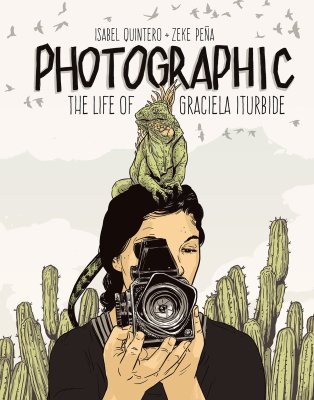
Book Review: Photographic: The Life of Graciela Iturbide

Reviewed by Lila Quintero Weaver

DESCRIPTION OF THE BOOK: “I see reality in another way with a camera. Looking through the lens, I peer into another world…”

Born in Mexico City in 1942, Graciela Iturbide wants to be a writer, but her conservative family has a different idea. Although she initially follows their wishes, she soon grows restless. After tragedy strikes, she turns to photography to better understand the world. The photographic journey she embarks on takes her throughout Mexico and around the globe, introducing her to fascinating people and cultures, and eventually bringing her success and fame. With more than two dozen photographs by Iturbide herself, Photographic explores the question of what it means to become an artist.

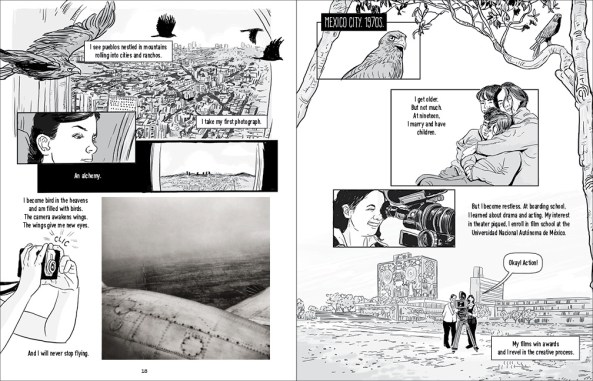
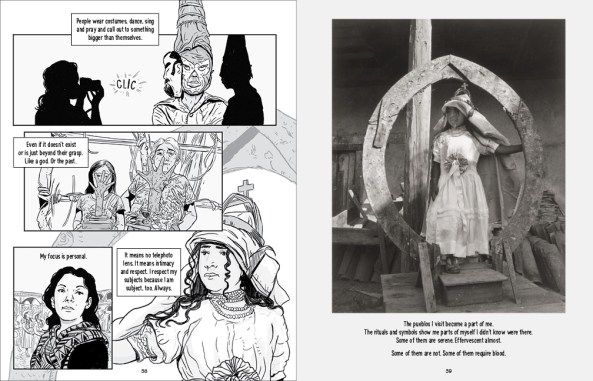
MY TWO CENTS: Photographic is a lively and compelling celebration of the life and work of critically acclaimed Mexican photographer Graciela Iturbide. Young readers and fans of nonfiction graphic novels will devour it. I certainly did. Written by poet-novelist Isabel Quintero and illustrated by Zeke Peña, this slender graphic novel from Getty Publications tells its stories through an arresting blend of text and photocomics. Not many graphic novels attempt Photographic‘s approach—that is, placing reproductions of Iturbide’s camerawork alongside Peña’s pen-and-ink drawings. Then again, Photographic is no routine examination of an artist’s life. Guided by Quintero’s lyrical narrative, it also offers a powerful and disarming time capsule of Mexico’s cultural and social glories, as encountered by Iturbide during her photographic journey.

Photographic‘s pictorial narrative crisscrosses decades, allowing readers to peer through Iturbide’s lens as she traverses the geographic spine of Mexico, ventures across the border into Latinx communities in the United States, and on to international settings. The story flows from present-day views of Iturbide to flashes of her youth, when her father buys her a Brownie camera. It resumes in young womanhood, as she studies under photography master Manuel Álvarez Bravo. From there, we witness the continuing evolution of the artist as she undertakes a series of photographic projects.

Courtesy of Getty Publications


Iturbide possesses a selective eye, one that ennobles the disregarded and humble. This is most evident in her deeply humanizing portraits of people found along the margins of society. Such subjects include young men in Tijuana whose tattooed bodies read like a codex, as well as Juchitán’s “muxes, who are both men and women at the same time,” as Quintero explains in the text.

Iturbide’s range of subjects is wide. She occasionally photographs mammals and reptiles, but birds dominate this area of interest. In her photos, they appear singly and in flocks, on perches and in flight, as living creatures and as dusty, feathered bodies. Echoing this passion, Quintero skillfully adopts avian motifs to express some of the most elusive aspects of Iturbide’s photographic instinct.

Each time I look through the viewfinder I see myself…

I use my bird sight to see the fragments. The camera as mirror as bird eye.

And I with eyes to fly.  

Always midflight.

I look to the skies.

Birds like shifting stars and all of them speaking to one another—telling different stories. Wings spread and reverberate until silence.

Courtesy of Getty Publications


Although Iturbide resists being labeled magical or surrealist, her art unquestionably plays along the edges of reality. Even when photographing everyday objects, the images she captures teem with mystery and questions. A notable example is her work at Casa Azul, the house of Frida Kahlo and Diego Rivera. There, in the bathroom, which was sealed after Kahlo’s death for fifty years, Iturbide’s camera brings our attention to porcelain fixtures, detached leg braces and corsets. Although composed of ordinary objects, these tableaus wordlessly communicate Kahlo’s physical suffering and bring into sharper relief the triumph of her immense contributions.

Iturbide’s portraits of uncelebrated women are among her greatest achievements. In one striking photograph, four young women from East Los Angeles pose in front of a mural devoted to Mexican revolutionary and political figures Zapata, Juárez, and Pancho Villa. In their defiant expressions and unapologetic stances, these women testify to the subversive spirit that lives on in their community. Even more startling is Iturbide’s documentation of Juchitán, a city in Oaxaca whose inhabitants are chiefly Zapotec, and where for generations, women have called the shots. “In Juchitán, women drive commerce, and men ask for an allowance.” Out of this matriarchal setting comes one of Iturbide’s most unforgettable photographs, a portrait of a market vendor wearing a crown of live iguanas. Zobeida, as she is identified, is rendered mythical, regal, an image for the ages, La Medusa Juchiteca. Yet Zobeida is a flesh-and-blood woman, making a living selling her wares and not anyone seeking immortality as a goddess. Iturbide’s camera lens frames these dual realities. She has learned how to see what many others miss— a reflex she cannot help but exercise in one after another iconic photograph.

And now, Photographic has brought Iturbide’s empathetic, ennobling, and powerful art to young readers and fans of the graphic novel. It’s no small order to synthesize a lifetime of artistic growth and achievement, but this book delivers, thanks to the wonderful collaborative work of Isabel Quintero and Zeke Peña, who are impressive artists in their own right, with rich futures in their respective fields.

TEACHING TIPS: For middle school or high school, Photographic could be used as a supplementary text for the study of Latinx/Mexican culture and sociology, as well as in biographical examinations of artists and their working methods.

In addition to its broader classroom potential, Photographic suggests fresh approaches to the teaching of photography. Borrowing from themes found in its pages, here are some shooting assignments to consider: 1. Go on the hunt for a naturally occurring still life (not staged). 2. Locate a striking landscape or urban-scape that most people would pass by without noticing. 3. Scour your world for intriguing human faces—not necessarily pretty ones—and take care to photograph them with respect and dignity. 4. Include a self-portrait. For inspiration, examine Iturbide’s revelatory photos of herself, which offer strong and original counterpoints to the superficial selfie.

In addition, every frame of Iturbide’s work demonstrates principles of design and composition. Ask students to study her photos for their use of negative space, symmetry, asymmetry, minimalism, close ups, and judicious cropping—then have them pull out their cameras and emulate.

Finally, the wonderful teaching blog Vamos a Leer has published a preview of Photographic, which includes links to many resources, including interviews with Isabel Quintero and Zeke Peña. Don’t miss it!

ABOUT THE SUBJECT: Graciela Iturbide lives and works in Mexico City, where she was born. Her photography enjoys worldwide acclaim and has received major international prizes. It is often the subject of solo exhibitions at heralded art centers, such as the Philadelphia Museum of Art, the Paul Getty Museum, and the Centre Pompidou. Learn more about Iturbide’s life and view galleries of her work by visiting her official website.  Photo by Christopher Sprinkle


ABOUT THE AUTHOR: Isabel Quintero is a poet and novelist of Mexican heritage, born in California. She is best known for her trailblazing Gabi, a Girl in Pieces (Cinco Punto Press, 2014), winner of the 2015 William C. Morris Award for YA Debut Novel and many other distinctions. It was reviewed on Latinx in Kid Lit by Sonia Alejandra Rodriguez. Follow Isabel’s writing journey on her blog.


ABOUT THE ILLUSTRATOR: Zeke Peña is a comics artist and illustrator from El Paso, Texas. Among his many book covers, Zeke is the artist behind the powerful cover of Gabi, a Girl in Pieces. Explore his illustration and painting galleries at his website.


ABOUT THE REVIEWER: Lila Quintero Weaver (no relation to Isabel Quintero) is one of the founding bloggers of Latinxs in Kid Lit. She wrote and illustrated a graphic memoir, Darkroom: A Memoir in Black & White, and will release My Year in the Middle, her first children’s book, on July 10, 2018. Learn more about her work here.