
Reviews by Ruby Jones
MARTA! BIG & SMALL
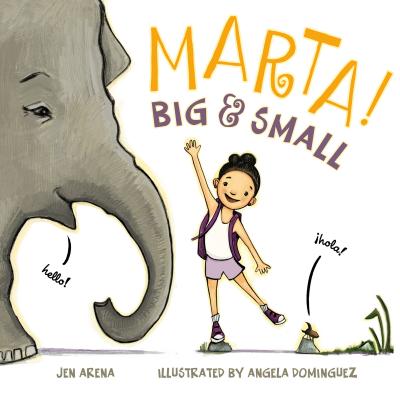 DESCRIPTION OF THE BOOK: Marta is una niña, an ordinary girl . . . with some extraordinary animal friends! As Marta explores the jungle, she knows she’s bigger than a bug, smaller than an elephant, and faster than a turtle. But then she meets the snake, who thinks Marta is sabrosa—tasty, very tasty! But Marta is ingeniosa, a very clever girl, and she outsmarts the snake with hilarious results.
With simple Spanish and a glossary at the end, this fun read-aloud picture book teaches little ones to identify opposites and animals and learn new words.
MY TWO CENTS: Marta is a little girl who is exploring the animals around her. Compared to a horse, Marta is lenta. Compared to a turtle, Marta is rapida. All of this fun catches the eye of an animal that finds Marta sabrosa. Using her cleverness, Marta is able to escape.
Judging by only the title and the beginning of the book, you might be tricked into thinking that Marta! Big & Small is about opposites but you would be wrong! This picture book has an ingenious ending that is actually empowering to little girls….girls can be clever! What I really appreciated was that at the end of the book, there are Spanish to English translations of both Marta’s attributes and also the animals she encounters. Not only that, but the illustrations are very clean but bold and vibrant. It’s a great book for any young reader.
TEACHING TIPS: This book is a great opportunity to learn about opposites and comparing our attributes to the world around us. A good lesson would be comparing our size to various objects like a pencil or a house. Teachers could also review a variety of animals in English and Spanish.
WHERE TO GET IT: To find Marta! Big & Small, check your local public library, your local bookstore, or IndieBound. Also, check out Goodreads, Amazon, and Barnes & Noble.
 ABOUT THE AUTHOR: Jen Arena is a former editorial director at Random House Books for Young Readers. She now writes books for children full time, including 100 Snowmen, a wintry counting story, and Besos for Baby, a bilingual board book of kisses. Her books have been translated into French, Korean, Arabic, and of course, Spanish.
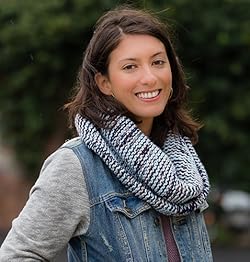 ABOUT THE ILLUSTRATOR: Angela Dominguez was born in Mexico City, grew up in the great state of Texas, and lived in San Francisco. She’s the author and illustrator of picture books such as Let’s Go, Hugo!;Santiago Stays; Knit Together, and Maria Had a Little Llama, which was an American Library Association Pura Pelpré Honor Book for Illustration. She now writes and creates in her studio in Brooklyn, New York.
THE CHUPACABRA ATE THE CANDELABRA
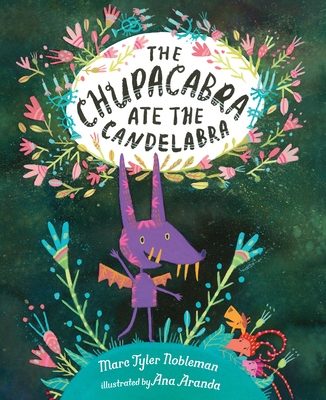 DESCRIPTION OF THE BOOK: Like most goats, Jayna, Bumsie, and Pep’s greatest fear is being eaten for dinner by the legendary chupacabra. (It’s common knowledge that goats are a chupacabra’s favorite food!) One night, tired of living in fear, the impetuous goats whip out their trusty candelabra and head off to find the beast and scare it away before it can find them. Little do they know that candelabras are the chupacabra’s third-favorite food . . . and he isn’t about to stop there. This chupacabra has quite the appetite, and the goats are in for a big surprise!
MY TWO CENTS: The chupacabra loves to eat many, many things. Three little goats hope that it definitely isn’t them! To make make sure they don’t become dinner, goats Jayna, Bumsie and Pep set off to scare the chupacabra before he scares them. When they encounter the continually hungry chupacabra, he devours their candelabra in an instant and demands more. When they are unable to produce more candelabras, the chupacabra eats his second-favorite meal. Finally, when they are unable to satisfy his desires using his third- and second-favorite foods, the chupacabra reveals what his favorite thing to eat is: Goat cheese! The relieved goats merrily proclaim that they have so much goat cheese, he’ll never be hungry again.
The first thing that you notice is this book’s winning feature: it’s beautiful and vibrant illustrations. It is obvious the illustrator was inspired by the colors and history of Mexico. She does a wonderful job of depicting the story line while still interjecting humor and whimsy.
The story line itself, however, has some issues. Mainly, the writing reads rather choppy and forced. I would have much preferred if the chupacabra were more similar to the little old lady who swallowed a fly, where the chupacabra would devour any ridiculous thing including a candelabra. Also, reading this book aloud was very difficult for me as some of the wording didn’t really seem to flow right. Finally, there were some phrases that most kids will fail to get like “the whole enchilada” or words like “cucaracha”.
In the end, the book is a whimsical and funny read, but I was left wishing for more finesse with the storytelling.
TEACHING TIPS: Teachers could definitely use this book to teach the culture and history about the chupacabra, highlighting the place it holds in, not just Latino culture, but throughout the Americas. There could also be a unit on Mexican art, using this book’s illustrations for inspiration. Children could also perform their own little “Three Billy Goats Gruff” version of goats and the chupacabra as a play!
WHERE TO GET IT: To find The Chupacabra Ate the Candelabra, check your local public library, your local bookstore, or IndieBound. Also, check out Goodreads, Amazon, and Barnes & Noble.
 ABOUT THE AUTHOR: Marc Tyler Nobleman is the author of Boys of Steel: The Creators of Superman and Bill the Boy Wonder: The Secret Co-Creator of Batman, which helped correct the credit line of one of the world’s most beloved characters. Formerly a writer for Nickelodeon Magazine and a cartoonist whose work has appeared in over a hundred publication, Marc lives in Maryland. His third-favorite thing to eat is anything banana flavored.

Photo by Feather Weight
ABOUT THE ILLUSTRATOR: Ana Aranda was born and raised in Mexico City, where she first befriended a chupacabra, and she completed her undergraduate studies in illustration in France. She now lives in San Francisco, California, where she has painted murals in the Mission District, for the consulate general of Mexico, and for the prestigious de Young Museum. Her biggest inspirations are her childhood memories, the vibrant colors of Mexico, and music. Her first, second, and their-favorite things to eat are tacos.
 ABOUT THE REVIEWER: Ruby Jones has been working in public libraries since 2007 in various capacities, including Adult & Teen Services technician and webmaster at her current library. She currently lives in Maine with her husband and precocious 2 year old. She continually strives to impart a passion and a sense of fearlessness toward technology, reading and learning for all ages.
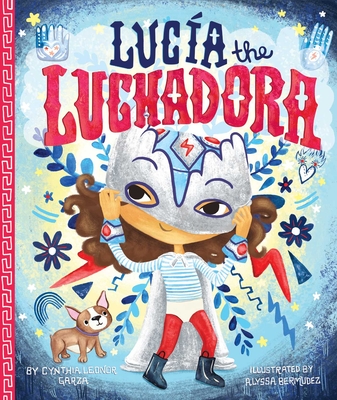 DESCRIPTION OF THE BOOK: Lucía zips through the playground in her cape just like the boys, but when they tell her “girls can’t be superheroes,” suddenly she doesn’t feel so mighty. That’s when her beloved abuela reveals a dazzling secret: Lucía comes from a family of luchadoras, the bold and valiant women of the Mexican lucha libre tradition. Cloaked in a flashy new disguise, Lucía returns as a recess sensation! But when she’s confronted with a case of injustice, Lucía must decide if she can stay true to the ways of the luchadora and fight for what is right, even if it means breaking the sacred rule of never revealing the identity behind her mask. A story about courage and cultural legacy, Lucía the Luchadora is full of pluck, daring, and heart.
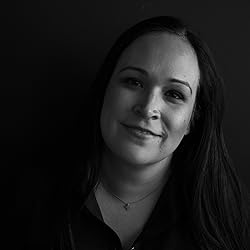 ABOUT THE AUTHOR (from her website): I’m a writer and write all sorts of things. My debut picture book
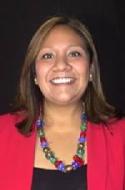 ABOUT THE REVIEWER: Sanjuana C. Rodriguez is an Assistant Professor of Literacy and Reading Education in the Elementary and Early Childhood Department at Kennesaw State University. Her research interests include the early literacy development of culturally and linguistically diverse students, early writing development, literacy development of students who are emergent bilinguals, and Latinx children’s literature. She has published in journals such as Journal of Language and Literacy Education, Language Arts, and Language Arts Journal of Michigan.
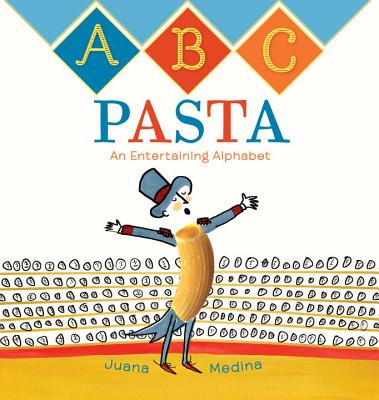 DESCRIPTION OF THE BOOK:
 ABOUT THE AUTHOR:
  ABOUT THE REVIEWER: Cecilia Cackley is a performing artist and children’s bookseller based in Washington DC where she creates puppet theater for adults and teaches playwriting and creative drama to children. Her bilingual children’s plays have been produced by GALA Hispanic Theatre and her interests in bilingual education, literacy, and immigrant advocacy all tend to find their way into her theatrical work. You can find more of her work at
  Cecilia Cackley is a performing artist and children’s bookseller based in Washington, DC, where she creates puppet theater for adults and teaches playwriting and creative drama to children. Her bilingual children’s plays have been produced by GALA Hispanic Theatre and her interests in bilingual education, literacy, and immigrant advocacy all tend to find their way into her theatrical work. You can find more of her work at
 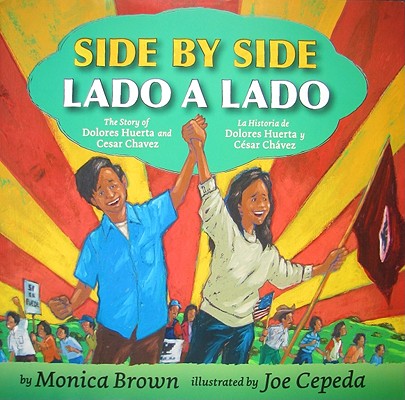 DESCRIPTION FROM THE PUBLISHER: Every day, thousands of farmworkers harvested the food that ended up on kitchen tables all over the country. But at the end of the day, when the workers sat down to eat, there were only beans on their own tables. Then Dolores Huerta and Cesar Chavez teamed up. Together they motivated the workers to fight for their rights and, in the process, changed history.
 ABOUT THE AUTHOR: Monica Brown, Ph.D. is the author of many award-winning books for children, including
 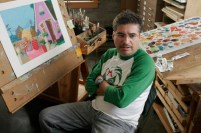 ABOUT THE ILLUSTRATOR: Joe Cepeda is an award-winning illustrator of children’s books who also works in magazine illustration. He lives in California and serves as president of the Society of Illustrators of Los Angeles. For more information, visit his
  ABOUT THE REVIEWER: Maria is a writer, workshop leader and coach who facilitates The Butterfly Series, a writing and creative arts workshop for women who want to explore what’s next in their life journey. In December 2016, she won 1st place in the 2016 Intergenerational Story Contest for her piece, Family Recipes Should Never be Lost. Her work has appeared in the Apogee Journal, Entropy Magazine, and A Quiet Courage. Her piece Meet me by the River will be published in Deborah Santana’s forthcoming anthology All the Women in my Family Sing (Jan 2018)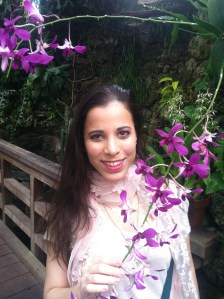
 Q: I know you’ve talked about how you love to visit botanical gardens, which inspired La Pradera. Which gardens would you recommend people try and visit?
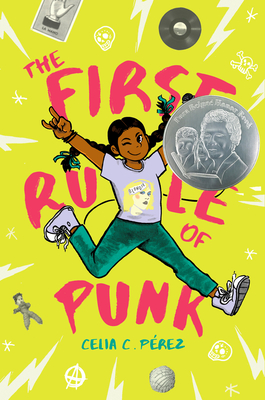 There is a scene half-way through Celia C. Pérez’s brilliant middle-grade novel
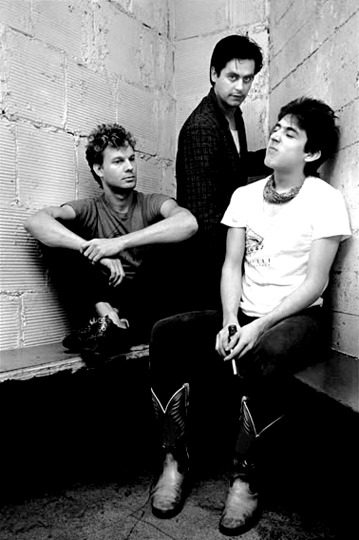
 :format(jpeg):mode_rgb():quality(40)/discogs-images/R-2797380-1301471350.jpeg.jpg) record, Malú listens to the first bars of “Swift Moves” the EP’s opening song and asks in wonder, “Who is she?” To which Mrs. Hidalgo replies, “That’s Teresa Covarrubias.” And, so begins a history lesson for the ages. By introducing Malú to Teresa Covarrubias, the legendary singer of The Brat—the best punk band ever to harken from East L.A. —Mrs. Hidaldo, in a true punk rock move, being that she’s one herself, reclaims the cultural lineages that are so often erased and suppressed by dominant narratives, by affirming to Malú: “And they’re Chicanos, Mexican Americans … Like us.” (Pérez 162). Mrs. Hidalgo opens a door and illuminates for Malú something so beautiful and lucent about our culture. She designates this beauty as being uniquely part of a Chicanx experience and sensibility. So that in this moment, Malú’s prior knowledge and understanding of the punk narrative expands to include her in it as a Mexican American girl. She too belongs to this lineage of Mexicanas and Chicanas that made their own rules, which as Malú will go on to learn, indeed is the first rule of punk (Pérez 310).
record, Malú listens to the first bars of “Swift Moves” the EP’s opening song and asks in wonder, “Who is she?” To which Mrs. Hidalgo replies, “That’s Teresa Covarrubias.” And, so begins a history lesson for the ages. By introducing Malú to Teresa Covarrubias, the legendary singer of The Brat—the best punk band ever to harken from East L.A. —Mrs. Hidaldo, in a true punk rock move, being that she’s one herself, reclaims the cultural lineages that are so often erased and suppressed by dominant narratives, by affirming to Malú: “And they’re Chicanos, Mexican Americans … Like us.” (Pérez 162). Mrs. Hidalgo opens a door and illuminates for Malú something so beautiful and lucent about our culture. She designates this beauty as being uniquely part of a Chicanx experience and sensibility. So that in this moment, Malú’s prior knowledge and understanding of the punk narrative expands to include her in it as a Mexican American girl. She too belongs to this lineage of Mexicanas and Chicanas that made their own rules, which as Malú will go on to learn, indeed is the first rule of punk (Pérez 310).

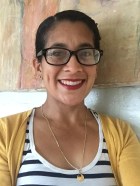 ABOUT THE AUTHOR: (from her
  ABOUT THE REVIEWER: Lettycia Terrones is a doctoral student in the Department of Information Sciences at University of Illinois at Urbana-Champaign, where she researches Chicanx picturebooks as sites of love and resilient resistance. She’s from East L.A. Boyle Heights.
 Latinxs in Kid Lit