Book Review: I Lived on Butterfly Hill by Marjorie Agosin

By Sarah Hannah Gómez

18048909DESCRIPTION FROM THE BOOK JACKET: Celeste Marconi is a dreamer. She lives peacefully among friends and neighbors and family in the idyllic town of Valparaiso, Chile–until the time comes when even Celeste, with her head in the clouds, can’t deny the political unrest that is sweeping through the country. Warships are spotted in the harbor and schoolmates disappear from class without a word. Celeste doesn’t quite know what is happening, but one thing is clear: no one is safe, not anymore.

The country has been taken over by a government that declares artists, protestors, and anyone who helps the needy to be considered “subversive” and dangerous to Chile’s future. So Celeste’s parents–her educated, generous, kind parents–must go into hiding before they, too, “disappear.” To protect their daughter, they send her to America.

As Celeste adapts to her new life in Maine, she never stops dreaming of Chile. But even after democracy is restored to her home country, questions remain: Will her parents reemerge from hiding? Will she ever be truly safe again?

Accented with interior artwork, steeped in the history of Pinochet’s catastrophic takeover of Chile, and based on many true events, this multicultural ode to the power of revolution, words, and love is both indelibly brave and heartwrenchingly graceful.

MY TWO CENTS: This reads like a pretty classic middle grade novel in the tradition of Sharon Creech or Patricia Reilly Giff. Celeste has a very sweet and thoughtful way about her, and she narrates the day-to-day of her life with the eye of a girl who is young but observant. There is some beautiful scene setting in her house, where her grandmother, nanny, mother, and father dote on her; and at school, where she has a great teacher and the usual smattering of fun, doofy, and snobbish classmates. She has an idyllic life and loves it—until the president is assassinated and the dictator takes over.

Agosín does a good job of showing how this type of takeover happens gradually and all at once, and Celeste observes different things happening – like some classmates not showing up for school or the adults in her life all of a sudden being worried about her safety – and only slowly begins to put them together as being related to the same thing. When she moves to Maine, Celeste remains very observant and thoughtful about everything. Her descriptions are just beautiful.

But that’s also a weakness in the book – Celeste is so thoughtful that it doesn’t always feel like she has any emotion. Her parents have to go into hiding and she says she’s sad, but you don’t necessarily see it – the quality and style of her narration and her observations don’t change much depending on her mood. And it doesn’t help that the last quarter of the book goes from lyrical and fairly realistic to a totally Disney TV movie ending.

That said, there is plenty of good in this book. Latin@s? Check. And, unlike any books I remember reading from my childhood or much during my adulthood, Celeste’s family is also Jewish – her grandmother speaks to her in German and reminisces about escaping the Holocaust by coming to Chile. That parallel is what really gives the book its emotional impact. Celeste is very attached to her grandmother, and knowing that the grandmother is watching a country unravel for the second time is poignant. Acknowledging that part of Latin American history and giving Jewish-Latinas a heroine to root for is a great strength of this book, especially since it manages to use Spanish, Chilean cultural traditions, and Jewish traditions in a way that neither over explains to those of us who know it already nor under explains to those who are unfamiliar.

I would hand this book to any little girl who is already a fan of classic middle grade characters who love to write, like Betsy Ray or Harriet M. Welsch, or to fans of books by Julia Alvarez or Jeanne Birdsall.

AUTHOR: Marjorie Agosín was born in Maryland and raised in Chile. She and her parents, Moises and Frida Agosín, moved to the United States due to the overthrow of the Chilean government by General Pinochet’s military coup. Coming from a South American country and being Jewish, Agosín’s writings demonstrate a unique blending of these cultures. Agosín is well known as a poet, critic, and human activist. She is also a well-known spokesperson for the plight and priorities of women in Third World countries. Her deep social concerns and accomplishments have earned her many awards and recognitions, and she has gained an international reputation among contemporary women of color.

FOR MORE INFORMATION ABOUT I Lived on Butterfly Hill, visit your local library or bookstore. Also check out worldcat.org, indiebound.org, goodreads.com, amazon.com, and barnesandnoble.com.


HannahSarah Hannah Gómez is a school librarian in Northern California with a passion for promoting diverse literature to tweens and teens of all colors. She has an MA from the Center for the Study of Children’s Literature and an MS in library and information science from Simmons College. She blogs at her own website and at YALSA’s The Hub. She is working on a novel and a screenplay.
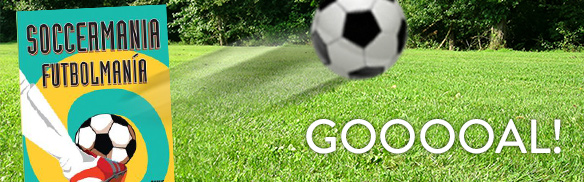
Soccer Mania Sweeps Scholastic as World Cup Plays Out in Brazil

By Concetta Gleason
Editorial & Creative Coordinator for Scholastic’s Club Leo

The original post can be found here on Scholastic’s site.

The World Cup kicked off Thursday, June 12, and Club Leo en Español has been cheering on our favorite teams ever since. Safe to say, soccer mania has swept Scholastic! The World Cup is the largest fútbol (aka soccer, in North America) competition in the world. Every four years a different country has the honor of hosting the games. This year, the World Cup is being hosted by Brazil. It’s the first time in almost 30 years that the games will be played in Latin America. Brazil is a soccer haven, having won the Cup a total of four times thus far. In fact, Pelé— arguably fútbol’s greatest star—hails from Brazil. Pelé is the only player to have been a world champion three times. He won in 1958, 1962, and 1970.

The World Cup is a global phenomenon and Club Leo en Español is showcasing the bilingual book Soccermania/Futbolmanía to celebrate the games. Soccermania/Futbolmanía is a great resource for learning about wild antics and fun back stories from the history of the World Cup and the game of fútbol. Some of these facts need to be read to believed! Let’s take a sneak peek at some info from the book.

Fun and Wacky Facts About Fútbol:

1. The first World Cup was played in Uruguay in 1930. At the time, different countries had different rules for the game and some of FIFA’s universal rules were still in flux. The finalists, Uruguay and Argentina, couldn’t agree on what type of ball to use. As a compromise the first half was played with an Argentinean ball and the second half with a Uruguayan ball. (Uruguay won!)

2. How many soccer balls are made every year around the world? A hundred million!

3. While fútbol may have officially started in the United Kingdom in the mid-1800s,  many ancient cultures played sports that resemble the game:

  • China played a game called cuju during the Han Dynasty.
  • Greece played a game called episkyros more than 2,000 years ago.
  • The Roman Empire played a game called harpastum more than 1,500 years ago.
  • Japan played a game called kemari 1,400 years ago.

4. The Nike Corporation makes fútbol attire and memorabilia out of plastic bottles. It takes eight bottles to make a shirt and five bottles to make a pair of shorts.

Check out Soccermania/Futbolmanía to learn more interesting and surprising facts! Below are some more exciting resources for fútbol fans, old and new:

La historia de los Mundiales (History of the World Cup)

Pelé, King of Soccer/Pelé, el rey del fútbol

Enjoy the World Cup, and let’s honor the sport’s ability to unify people around the world by living up to the 2014 slogan: “All in one rhythm.”

Author’s Note: Club Leo en Español supports your classroom with fun and affordable books that connect children’s home language and learning. Our books include amazing series, original titles, and winners of the Pura Belpré Award, which celebrates the remarkable contributions of artists who give voice to the Latino community through children’s literature.

Club Leo en Español apoya tu salón de clases con libros divertidos y asequibles que conectan la lengua materna y el aprendizaje de los niños. Nuestra colección incluye increíbles series, títulos originales y ganadores del Premio Pura Belpré, que celebra los extraordinarios aportes de artistas que dan voz a la comunidad latina a través de la literatura infantil.

Illustrator Joe Cepeda Talks to Latin@s in Kid Lit, Part 2

By Lila Quintero Weaver

We’re continuing a fascinating conversation with acclaimed illustrator Joe Cepeda. His work graces many Latin@-themed children’s books. Did you miss the first installment? Go here.

Lila: When did your interest in art begin? How did you train for a career in illustration?

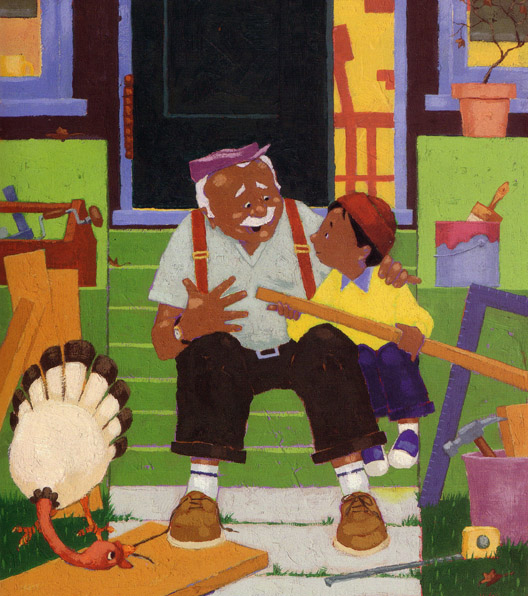
Joe: When I was young, I enjoyed drawing enough that my mom enrolled me at the Los Angeles Music and Art School in East Los Angeles, a small jewel of a place where I first tried painting. By my teens, though, I stopped going and after graduating high school found myself headed to college to study engineering. It took me awhile before I changed all of that. Initially, I thought I’d be an editorial cartoonist, but as soon as I got a brush back in my hand, I realized I wanted to do something that had an artfulness to it as well. Illustration afforded the perfect combination of content and creative articulation for me.

swing_leopoldo1

To be honest, my training was largely guided toward editorial work. I sort of fell into children’s books. Creating a piece for a magazine article is much like doing work for a cover. There is a certain amount of seduction employed in influencing a magazine reader to stop and read an article, much the way you’d want someone to pick up a book off a shelf. A combination of abstraction, mystery, emotion, and information might play a role in creating that single image that will lure the audience in.

From the books I’ve illustrated, I pretty much taught myself sequential image-making and continue to do that. With a portfolio largely lacking any real samples that reflected page-turning sensibilities, it was very fortunate that I was signed up to illustrate those first books. I believe that it was an inclination to write a picture as much as illustrate one that may have been evident to my first editors and art directors. They seem to have responded to that and took a risk. I’m grateful to them for doing so.

GraciasGrandfather_72cropped

Lila: Most of us have no idea how an illustrator goes about his work. Can you give us a tour of the process?

Joe: In many ways, the real work is done throughout the sketch phase. For editorial work, I usually create a few alternate ideas for a director to choose from. The sketches need to be tight enough for the director to envision the finished art.

For books, the sketch process is more comprehensive. The first sketches are thumbnails in which I mostly brainstorm, trying to find the basic rhythm, character introduction, action, choreography of the story, etc. The second phase of sketches, laid out as a dummy (a design/template that allows you to see the whole book planned out) focuses on the essential content of the story, as well as soundly composing the images. This is the working plan to be shared with editors and art directors. It’s important to understand that this design is as much for others as it is for oneself. This is where mistakes are caught.

Finally, in the last draft of sketches, details are included to a more specific degree. The emotions of your images many times are expressed in the details of your illustrations. It’s where things become funny, scary, thrilling, suspenseful, etc. This shouldn’t be confused with complexity—a simple picture has as much power as an ornate one. Once the dummy is okayed, it’s on to the finished work. Almost all of my books have been executed as oil paintings over acrylic under-paintings on illustration board. A recent book I illustrated was delivered as digitally rendered finishes. Whatever your medium of choice, the more confident you are of your plan, the more enjoyable the last part of the process will be. I leave color out of the initial plans because I prefer to be responsive when it comes to that, leaving a level of spontaneity for the end.

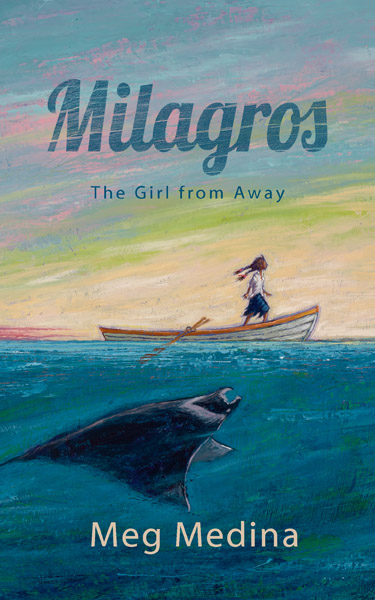
Milagros_jacket_finish72Lila: Let’s close out this conversation by returning to a book cover, the one you recently did for the e-book version of Meg Medina’s Milagros: A Girl from Away. It’s breathtaking, truly exceptional. I know Meg was thrilled with it!

Joe: Thanks for the kind words. Milagros is a great story and it was a wonderful opportunity to illustrate the cover of the e-book. After reading the manuscript, I couldn’t help responding to Milagros as a girl between two worlds. It’s the “between” part that intrigued me as a source for creating a provocative image. Milagros is not only traveling from one place to another, as she does in the story, she’s also between the clarity of a wide-open sky and the deep mystery and profundity of the ocean. The magical realism of the story, in my mind, calls for a more symbolic and open-ended image. Alternative ideas depicted Milagros closer to the viewer, larger in the design. This would emphasize Milagros more. A reader might respond to that kind of image, “That girl looks like me, i want to read about her.” It’s certainly popular to create covers that are more character-based, but, I’m glad that we decided to go the other way, that is, emphasizing the mystery, the peril of the journey, and the hopefulness and optimism of Milagros’ spirit. A reader here might ask, “Where is that girl going? What is she facing? Is she lost? Is she on her way somewhere? Is she safe? Will she get there? What will she find? Keeping her small in the design also helps the reader ask, “Who is she?” My first sketches didn’t include the manta ray, inclined to depict Milagros navigating her way alone, but, as we discussed, it’s a central part of the story. I’m glad mantas are such mysterious and, perhaps, very poetic creatures. I wanted it to have an ambiguous posture… is it a threat to her, or is it a witness, or, even something more? For me, the more questions you ask when looking at a cover, the better a cover does its job.

“““““““`

To learn more about Joe’s craftsmanship and illustration technique, see this extensive interview by Kathleen Temean.

Want to see Joe in his studio and hear more of his story? Here’s a video interview, worth the double click-through!


Illustrator Joe Cepeda Talks to Latin@s in Kid Lit, Part 1

By Lila Quintero Weaver

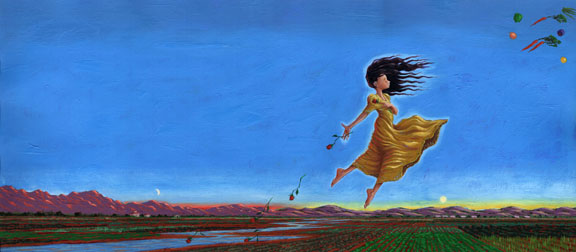
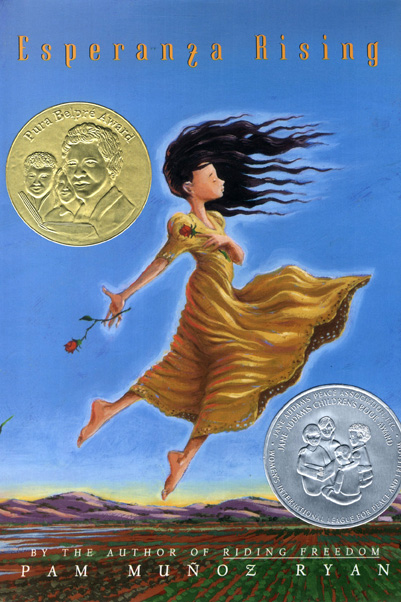
Long before I met Joe Cepeda at the National Latino Children’s Literature Conference in 2012, a post card of the cover illustration of Pam Muñoz Ryan’s Esperanza Rising was tacked to my then-11-year-old daughter’s bedroom wall. Every time I glanced at that soaring figure, my spirits lifted. Surely part of the book’s enormous success can be traced back to Joe’s luminous cover painting of Esperanza floating above the California earth, but that’s hardly the end of his contribution to children’s literature.

Lila: Welcome to Latin@s in Kid Lit, Joe! Thank you for taking time out of your busy schedule to talk art and books. Let’s start our conversation with Esperanza Rising. How did you come up with the concept?

Joe: After seeing the title, it wasn’t too difficult to imagine young Esperanza in the air. My first sketch depicted Esperanza with her hair and dress floating behind her as if she were flying. Almost immediately, however, I changed it and flipped her dress and pretty dark tresses to sweep in front of her. What I realized is that I didn’t want to show Esperanza as if she were navigating in the air on her own. I wanted her to be swept away by the wind. Everyone who has read the book knows that Esperanza’s life changes from one day to the next and I wanted the image to reflect that life-altering event, as well as the hopefulness her story and name literally implies.

EsperanzaJacket72 copy 2Lila: What does it mean to you to have your work as the cover of such a powerful story?

Joe: A great deal. It’s never a bad thing to have your work associated with a story that has such resonance. In contrast to doing an illustration for a magazine, which has a very short life, a book hangs around longer. A book that continues to reach so many readers, year after year, is wonderful for the life of the image as well. Beyond that, one is always striving to create work that might emotively uplift the reader. It’s a beautiful story and if the cover helps to do just that, it’s very gratifying.

Lila: Your list of children’s books includes quite a few with Latino or African American characters. Does being Latino influence your development of minority characters and the worlds they inhabit? SideBySide_04_72

Joe: This is always a bit of a difficult question to answer, perhaps because I think very little about it when I’m illustrating books about people of color. I’d say the books that I see that seem to miss the mark ethnically/culturally seem to overthink it. There are a lot of things I may consider in developing a character before I get to their ethnic depiction. Does she wear glasses? Is she thin? Short? Should he be neat or a bit of a slob? Is he forgetful? Would he wear a hat? Many of the of the character’s inclinations and look are not included in the manuscript. By the time I get to the character’s cultural look, it kind of takes care of itself.

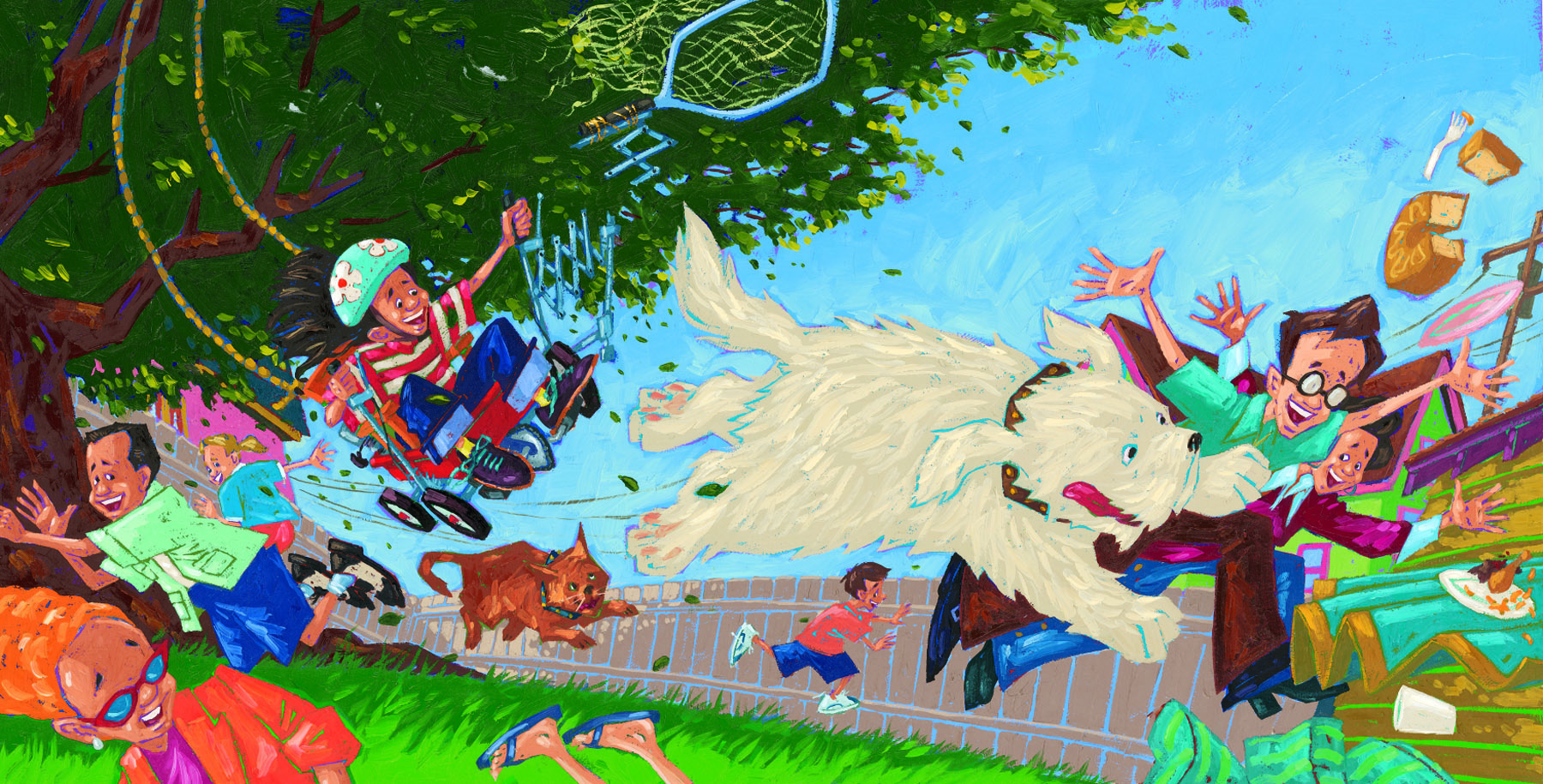
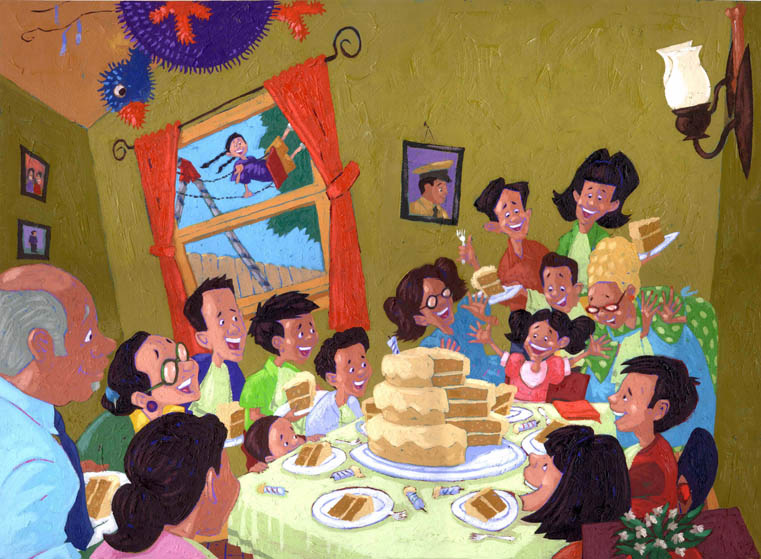
I wrote a story, The Swing, that took place in a neighborhood just like the street I grew up on. I’m Chicano, and I could write and illustrate that story about Chicano neighbors from a very immediate and intimate place. East Los Angeles isn’t Spanish Harlem, though, nor is it Little Havana. It seems to me illustrating stories about those Latino communities wouldn’t be all that different than illustrating a story about Inuits in the Arctic, Mongolians living in Yurts, or a story set in the Deep South. I’m respectful of the content and information that presents itself in illustrating stories of people of color, but I don’t live there that long. My preference is not to develop minority characters as much as illuminate the story that’s being told. For me, every step toward “development” is one toward information, accuracy and specificity, which is all fine and good, but it might also be one more step away from grandness and magic… and the informal joy of uncertainty and open-endedness.

MiceAndBeans4_75 copy

Lila: What’s on your drawing board right now?

Joe: Starting a new bilingual book based on a kid’s song. Writing a story for a picture book. Lunch.

 ——————-

And that’s not the end of Joe’s fascinating interview. Please stay tuned for tomorrow’s  follow-up post!

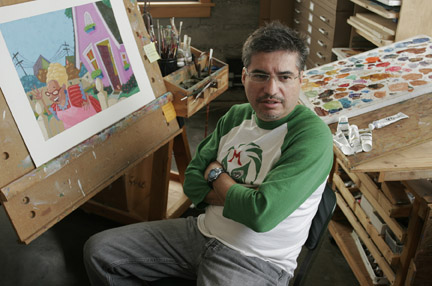
 second_pic_4x6_72Joe Cepeda is an award-winning illustrator of children’s books who also works in magazine illustration. He lives in California and serves as president of the Society of Illustrators of Los Angeles. For more information, visit his website.

Guest Post: Self-Publishing Often the Only Recourse for Writers of Color

By Zetta Elliott 

“I am an immigrant.” When I visit schools, I always start my presentation with these words. Next, I ask the students to guess my country of origin. Their answers are often predictable and sometimes surprising: the Dominican Republic, Puerto Rico, Mexico—Italy! When I tell them that I don’t speak Spanish but I do speak a little French, they call out a different list of countries until someone gets it right: Canada.

I open with my immigrant status in part because I once had a Latina approach me at the end of a presentation in Brooklyn and say, “I hate that word.” I didn’t ask about her status, but it was clear that she felt there was something shameful about being an immigrant. So I announce my own status with pride and use my presentation to demonstrate how my early years in Canada helped to shape the writer I became after I migrated to the US twenty years ago.

Immigration is a charged issue here, and though Canadians aren’t generally mentioned in the national debate, there’s still a pretty good chance I could run into trouble in Arizona. As a mixed-race woman of African descent, I often get read as Latina. Here, in New York City, I walk with my driver’s license, my passport, and my green card at all times because my Afro-Caribbean father taught me that some protections are reserved for citizens only (and only those citizens who aren’t brown like me). My father also urged me not to get involved in social justice movements, but I chose to disregard that advice.

I’m a black feminist—or what my father would call “a troublemaker.” I began to write for children over a decade ago because I couldn’t find culturally relevant material to use with my black students. I came to the US to attend graduate school, and there I developed a deeper understanding of intersectionality and invisibility. The title of one black feminist anthology encapsulates this perfectly: All the Women are White, All the Blacks are Men, But Some of Us Are Brave. Black women too often find themselves erased from discussions of racism and sexism, and when it comes to children’s literature, it can be just as easy for Afro-Latin@ kids to fall through the cracks.

Published by Skyscape, 2010

In 2000, I started a book club for the girls in my building. They were all black and we had been meeting for weeks before I realized that half the girls in the group were Panamanian. When they were with me, they spoke the black vernacular of their African American peers, but at home they spoke Spanish. When I wrote my YA time-travel novel A Wish After Midnight, I decided to give my protagonist a hybrid identity—Genna Colon’s mother is African American but her father is an Afro-Panamanian immigrant. When her father leaves the family to return to Panama, Genna yearns for a connection to her Latino heritage, but her jaded mother insists that race trumps ethnicity: “in America, it doesn’t matter where you’re from or what language you speak. Black is black and you might as well get used to it.”

Such a simplistic understanding of race is not uncommon, but many scholars, activists, and artists advocate for an appreciation of multiplicity—recognizing and respecting the specificity of blackness instead of reducing it to a single generic identity. As a black feminist writer, one of my goals is to counter the marginalization of black children in literature by writing stories about kids who are silenced and/or rendered invisible. I try to avoid the all too familiar “types” that seem to show up over and over again. Hakeem Diallo is a gifted basketball player but he’s also Muslim, biracial (black and South Asian), and he dreams of becoming a chef one day. Dmitri is a bird-watching math whiz who loses his mother to cancer and so lives with his elderly white foster mother. Judah is a Rastafarian teen from Jamaica who dreams of moving to Africa.

munecas_front_covercorrected

Self-published through CreateSpace under Rosetta Press

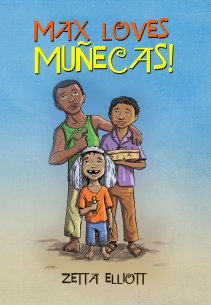
In 2009, I went to see the film adaptation of Neil Gaiman’s novella Coraline. I had some issues with the representation of women in the film, and went home thinking of a way to write a story about black boys and dolls. The end result was Max Loves Muñecas!—one of four chapter books that I self-published in May. The story follows three homeless boys in 1950s Honduras who are taken in by a kind woman who makes dolls. I was inspired by my father’s childhood in the Caribbean. He was raised by his grandmother on the island of Nevis, and with no money to spare, my father learned to make his own toys out of recycled materials. They were poor but my great-grandmother made sure my father was always presentable and well behaved. Respectability meant a lot since the family had so little.

I knew I wanted my story to take place within the Caribbean basin, but I had limited knowledge of Latin America. I chose Honduras for the setting of Max Loves Muñecas! because the best doll maker I know is Afro-Honduran designer Cozbi Cabrera. Also my community college student Saira, a Garífuna woman, gave a presentation in class about the murder rate in Honduras—the highest in the world. This is due, in part, to street violence fueled by gang members who have been deported from the US. My story isn’t set in contemporary Honduras, but the book does challenge gender norms and exposes the tender, creative side so many boys are forced to conceal.

I often write about boys because I have seen firsthand how expressive, sensitive boys shut down as they mature and assume the hard, unfeeling posture of a young “thug.” Boys around the world are socialized in a way that leaves them unable to reveal their authentic selves and the consequences can be devastating—especially for girls, but for boys and men as well. As a feminist I realize that if I want to end violence against women and girls, I have to start paying more attention to boys.

These issues mean a lot to me, but social justice is not generally a priority for the children’s publishing industry. For the past five years I have written essays and given talks about the glaring inequality within publishing, and the issue has garnered more attention recently thanks to the social media campaign #WeNeedDiverseBooks. Several editors rejected Max Loves Muñecas! (the last one wrote, “Zetta is such a lovely writer and I did enjoy this story – but I just don’t think we can find a big enough market for it”) and so the story sat on my hard drive for five years until I finally decided to self-publish it. I found a Honduran illustrator, Mauricio J. Flores, on Elance; he completed ten black and white illustrations and I used the print-on-demand site CreateSpace to publish the book.

The biggest challenge with self-publishing is finding a way to connect your books with readers. The Brown Bookshelf recently ran a series called “Making Our Own Market,” and I contributed a guest post in which I shared my core objectives:

  1. To generate culturally relevant stories that center children who have been marginalized, misrepresented, and/or rendered invisible in children’s literature.
  2. To produce affordable, high-quality books so that families—regardless of income—can build home libraries that will enhance their children’s academic success.
  3. To produce a steady supply of compelling, diverse stories that will nourish the imagination and excite even reluctant readers.

If these objectives resonate with you, I hope you’ll give my books a chance. The bias against self-published books is hard to overcome; major outlets refuse to review them, and only a few book bloggers are willing to give self-published books a chance (thank you, Latin@s in Kid Lit). Many are poorly written and shoddily produced, but when publishing gatekeepers exclude so many talented writers of color, self-publishing is often our only recourse. If we wait for the industry to change, another generation of children will grow up as I did—without the “books-as-mirrors” they need and deserve.


IMG_1198Born in Canada, Zetta Elliott earned her PhD in American Studies at NYU. Her poetry has been published in several anthologies, and her plays have been staged in New York and Chicago. Her essays have appeared in Horn Book MagazineSchool Library Journal, and The Huffington Post. Her picture book, Bird, won the Honor Award in Lee & Low Books’ New Voices Contest and the Paterson Prize for Books for Young Readers. Elliott’s young adult novel, A Wish After Midnight, has been called “a revelation…vivid, violent and impressive history.” Ship of Souls, published in February 2012, was included in Booklist’s Top Ten Sci-fi/Fantasy Titles for Youth and was a finalist for the Phillis Wheatley Book Award. Her third novel, The Deep, was published in November 2013. She currently lives in Brooklyn.

Other books by Zetta Elliot. For a full list, visit her blog.

Published by Lee and Low, 2008

Published by Skyscape, 2012

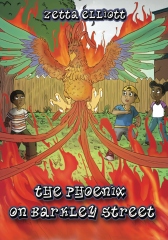
The Phoenix on Barkley Street

One of four kids books self-published, 2014


Writers and Cantantes: How Music Inspires While Writing

By Zoraida Córdova

My least favorite feeling is the moment I dig in my purse and realize I left my headphones at home. ARGH! Not only is it a terrible thing because I hate the sound of the busker butchering Wonderwall on acoustic, but it’s because I love music. No Bella Swans up in here.

This is not to say that my taste in music is great. I will never understand Lana Del Rey and sometimes I like country songs (I hope you can still accept me as a friend.) But music, like all things we invest our love into, is a matter of personal taste.

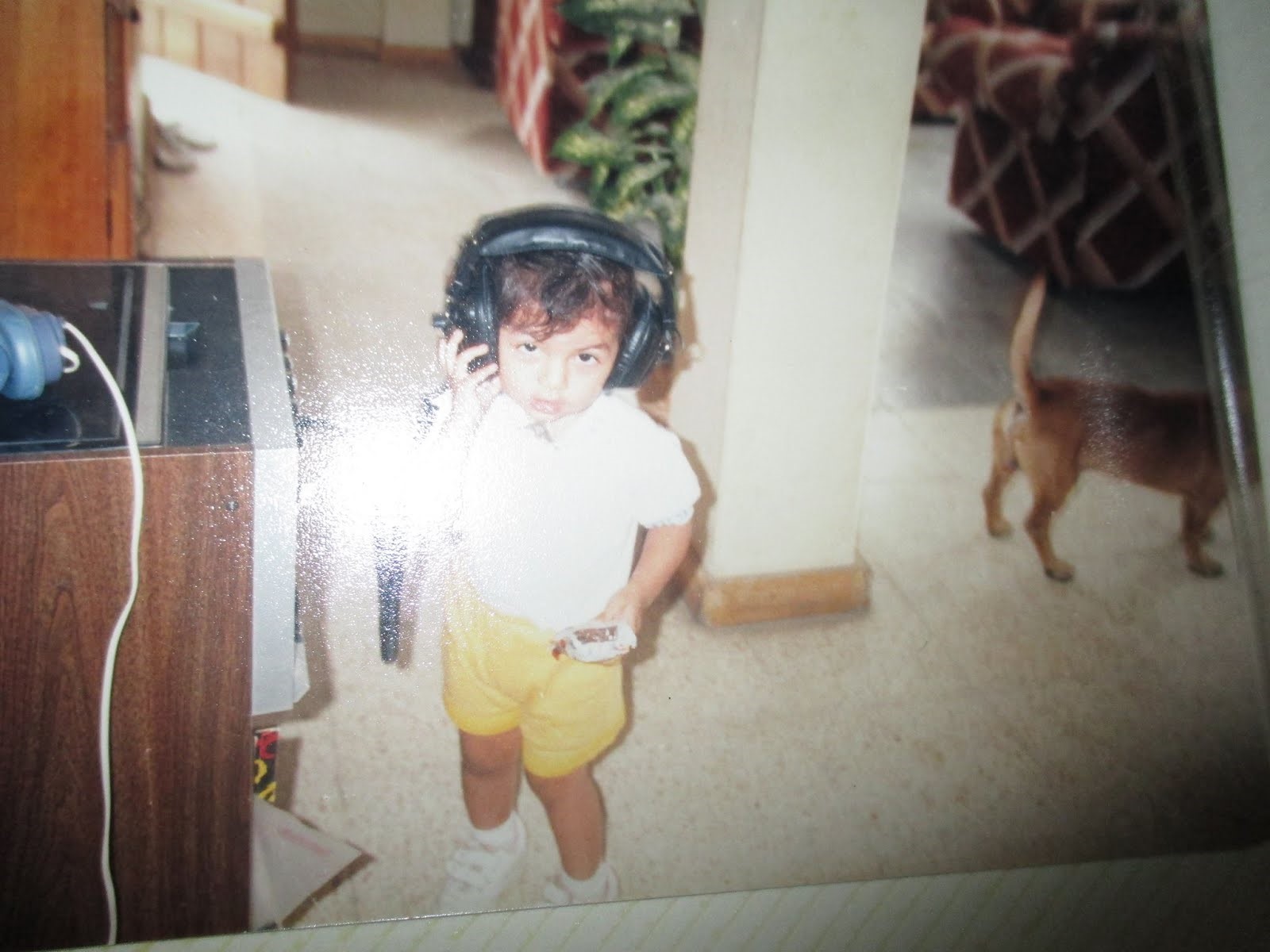
One of my favorite stories my grandmother tells me about my childhood is that when I was a baby, the only way to get me to shut up was to put a radio beside my hammock (crib? What you think I am, a Queen?). So for as long as I can remember, I’ve been listening to the smooth stylings of Lisandro Mesa, Oscar D’Leon, Ruben Blades, and because I’m Ecuadorian, Julio Jaramillo.

Zoraida pic1How many of you need playlists when you’re writing? I certainly do. Music has always gotten my creativity flowing, and I especially love Latin music because it always tells a STORY. (Sometimes it makes me sad that younger generations don’t get the Salsa greats and instead get “I LUH YA PAPI” by JLo, but that’s a different story.)

When I was 5 , I didn’t understand that “No Le Pegue La Negra” by Joe Arroyo told the story of how African slaves were brought to Colombia in the 1600s and started intermarrying with the Natives. The Spaniards would beat the African women and then people would rebel. While that’s kind of a morbid thing to be listening to when you’re little, these were the songs I grew up with.

Most Latin pop ballads by Christian Castro and Chayanne are about how they can’t be with the girl, but they’re in so much love, oh my god. Shakira’s original Rock Latino songs were a mix of Colombian vallenato instruments and electric guitars and all of her words used to be pure poetry. The other day I felt really moody on my train ride to work, so I put on Selena’s greatest hits and a bidi bidi bom bom later, I was in a perfectly good mood. See, my grandmother had a good idea all those years ago.

These are the sounds, I realize, I have had in all my writing playlists. My Maná is mixed in with my Red Hot Chili Peppers and my Celia Cruz is mixed in with my Goo Goo Dolls. Whether I’m writing about mermaids in Coney Island or I’m working on a contemporary romance set in Boston.

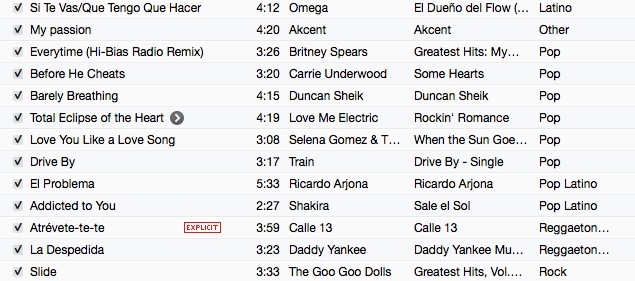
I leave you with a random sampling of the last songs I listened to on iTunes.

Zoraida Pic2

What do you listen to when you write? What was your favorite song growing up? Share with us in the comments!