Dear Hollywood: Please Consider Latinas for the “Matched” Movie

By Cindy L. Rodriguez

One of my seventh-grade Latina students, who never reads, had her nose buried in Ally Condie’s Matched the other day. She’s reading both The Giver by Lois Lowry and Matched as a companion novel for her Language Arts class. She stopped reading and looked at me as if something just occurred to her.

Student: Is Cassia Latina? Her name is Cassia Maria Reyes.

Me: I don’t know, but I’ll try to find out.

I searched online and thoughts ranged from definitely to definitely not. Some people seemed to think she had a Latin last name but was “probably white.” Hmmm. A person can be white and Latina, just as a person can be black and Latina. So, my search didn’t really answer my question.

I asked on Twitter and someone forwarded the question to Ally Condie (!) And she responded (!) She wrote: “She’s whatever you want/need her to be. But yes, I deliberately left that door open with middle/last names.”

Hmmm. Intriguing.

Condie did what I often do with my students when they ask me a question about what we’re reading, and they expect me to give them “the right answer.” Instead, I pull the ole switcheroo, as many teachers and therapists do, and ask them, “What do you think?” And then we discuss their thoughts and whether the text supports their ideas. Readers will never know an author’s every intention; the work is “out there,” open to interpretation. Well played, Ally Condie (a former teacher).

Since I couldn’t provide my student with a definite answer, here’s what I said:

Me: I don’t know. What do you think?

Student: I think she’s Latina.

Me: Okay, then. Keep reading and see if it comes up. Sometimes race and culture are important in a book, but sometimes those issues aren’t mentioned much.

I wish I could say more, but I am not an expert on minority representations in sci-fi and fantasy. I know from reading other blogs that this is a big issue, but I cannot speak to it with authority. Contact us if you can and would like to write a guest post. (Seriously!)

Then she asked:

Student: Is there a movie for this?

Me: There will be! And there’s going to be a movie for The Giver, too. How cool, you’ll have read both books before seeing the films!

She didn’t really share my enthusiasm about books before movies, but anywho….It got me thinking about the Matched movie, which is in development at Disney.

I’m all for fierce, smart, butt-kicking girls, but in the four most recent major movies based on young adult novels, the protagonists all look the same: long, brownish red hair and light skin. Here they are:


I know this has been discussed before, but my student made me wonder who Hollywood might cast as Cassia Maria Reyes. Online, the fan favorite is Nina Dobrev from the Vampire Diaries. Here she is:

Hmmm. I can see that, considering the cover of Matched looks like this:

But…since the author “left the door open” to the possibility that Cassia Maria Reyes is Latina, then I think it’s the perfect opportunity for Disney to do something different and make the Matched protagonist stand out from the others. I’m not saying they should hire a Latina “just because.” Choose the best actress to play the role, of course. What I am saying is the door is open; walk through it, Disney. At the very least, consider hiring a young, talented Latina actress who could totally pull off portraying a rebellious heroine on the big screen. Please take advantage of this opportunity. Do not limit your casting call to young women who “should be Caucasian,” which happened with The Hunger Games movie. Do not cause the internet to explode–yet again–as it did this week over the casting of Mara Rooney as Tiger Lily in the upcoming movie Pan.

Broaden your scope, Disney. Seize the moment. Take a chance. Live a little. I’ll even offer some suggestions of Latina actresses who have proven their talent (see below). Your people should call their people. Have lunch. Talk. Why not? I know at least one seventh-grade girl who would look up at the big screen and say, “Cool.” And I have the hope that most other people would, too.


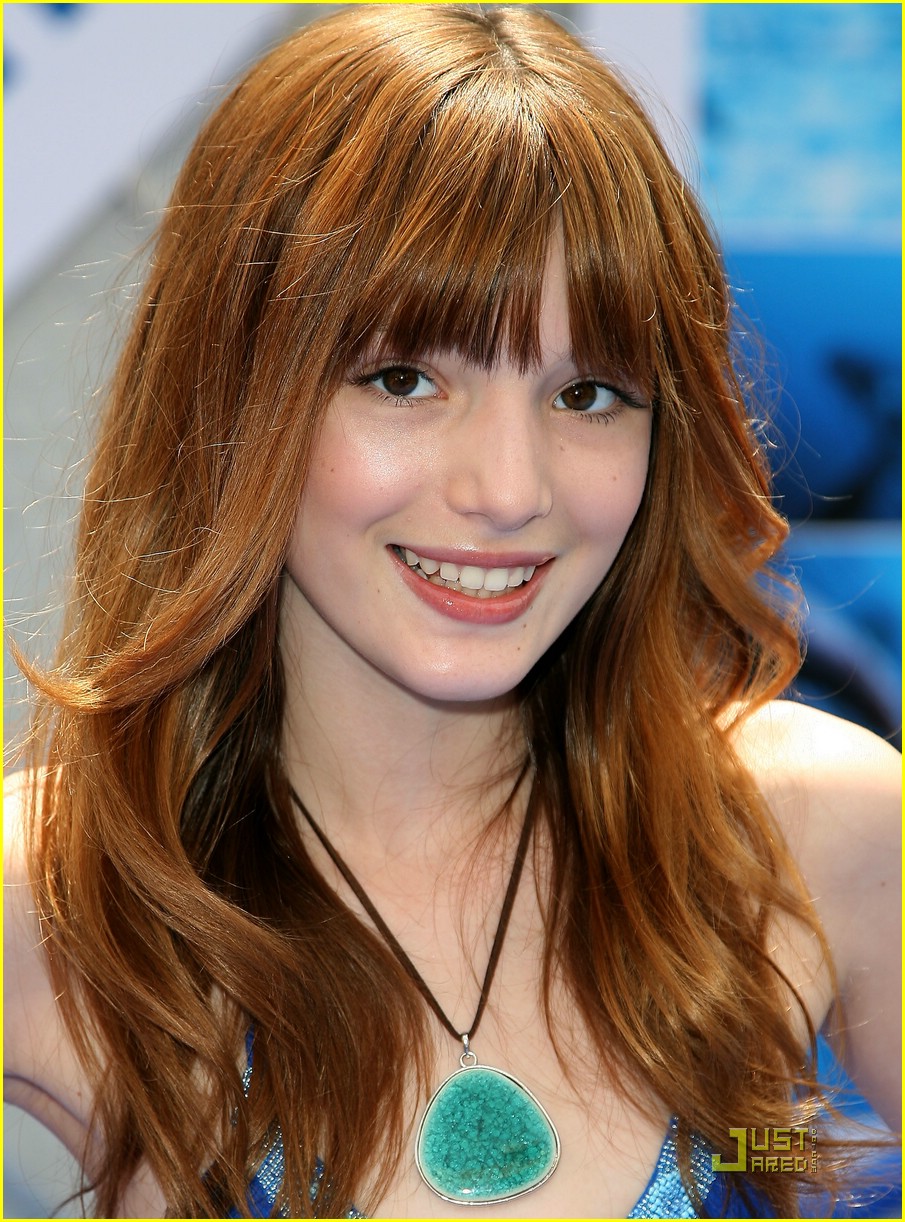
Naya Rivera     Seychelle Gabriel     Victoria Justice   Francia Rasia   Premiere Of Disneynature's "Oceans" - Arrivals

Left to Right: Naya Rivera, Seychelle Gabriel, Victoria Justice, Francia Raisa, Bella Thorne
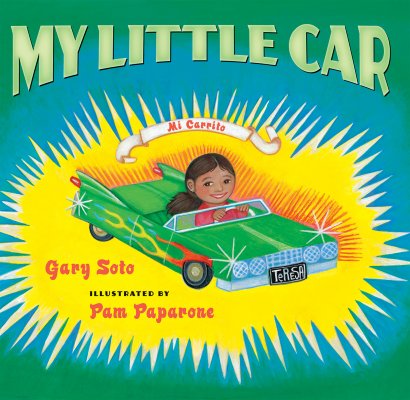
Book Review: My Little Car by Gary Soto

MyLittleCarCoverBy Sujei Lugo

DESCRIPTION FROM THE BOOK JACKET: Teresa’s grandfather—her abuelo—gives her a fantastic little car for her birthday and she can’t wait to show it off to everybody. The car is so cool that the other bikes on the sidewalk part for her and even grown-ups turn their heads as she goes by. Teresa promises she’ll always take care of her beautiful carrito, but some promises are hard to keep. When Teresa’s abuelo comes to visit, will he even recognize his beautiful present?

MY TWO CENTS: Through a shiny book cover of a girl riding a little car with a big smile, Gary Soto and Pam Paparone introduce us to a Chicana first-grader named Teresa. Her confidence and pride are enhanced when she receives a toy lowrider for her birthday, a customized car originated by Chicanos in California. Paparone’s bright acrylic illustrations strongly complement Soto’s words to project the subculture surrounding lowriders and other features distinctive of some Chicano and Latino neighborhoods and their communities.

When we first meet Teresa she is feeling embarrassed by her tricycle, thinking that it was a toy for “little kids.” For her birthday, she receives a beautiful lowrider with a personalized plate from her abuelito, giving her an immediate sense of independence and the confidence of being recognized as a big girl. Through this gift and Teresa’s relationship to it, Soto presents us with two important themes: the obvious one is the importance of taking responsibility and care of your belongings and the second one is presented in a more nuanced way, and perhaps silently aimed to parents: how easy it is to break the “gendering” of toys and roles.

Once Teresa receives her carrito, she pedals non-stop down the sidewalk, around her neighborhood, and she even takes it to the playground car show, where she wins first place. But as the days pass, she becomes careless with her carrito: she leaves it out in the rain, it gets pooped on by birds, it’s crushed by her dad’s truck, and it even gets sticky from spilled soda. Her mother and grandfather get preachy and stern while teaching Teresa the importance of taking responsibility of her belongings and the preaching works: in the end she learns her lesson.

Interestingly, the book never gets preachy when dealing with the gender stereotyping of toys. We live in a society where we are constantly presented with gender-stereotyped toys in books, movies, TV shows, commercials, and stores. In this book we have a Chicana girl who disrupts the gender norms around cars as toys solely for boys, and who challenges the machismo present in Latino communities. Gary Soto shows formidable restraint by not including a single line in the book that says that girls should or shouldn’t do certain things. He just provides us with a story that normalizes girls liking toy cars by showing Teresa being happy with her gift and using it without any limits. Surely this portrayal is one that car-loving kids from any gender will identify with.

TEACHING TIPS: This picture book works well as a read aloud for parents, guardians, and librarians. It can be used to teach about responsibility and ownership, while at the same time, children can learn some words in Spanish. The book includes a glossary of the few words in Spanish incorporated throughout the story.

Spanish and Language Arts teachers (Pre-K-2nd grade) can use the text to not only teach Spanish words, but also to develop classroom activities, such as sequence of events, vocabulary, and alternate endings to the story. It is also useful to incorporate Mexican-American Studies to elementary school classrooms.

LEXILE: N/A

AUTHOR: Gary Soto is a Mexican-American author, who has written picture books, chapter books, poetry collections, young adult books, plays and novels. Soto, raised in Fresno, California, has a B.A. in English from Cal State and a M.F.A. from the University of California, Irvine. He has received several awards, including the 1977 Bess Hokin Prize, the Levinson Award, the Literature Award from the Hispanic Heritage Foundation, the American Book Award from the Before Columbus Foundation, the Andrew Carnegie Medal from the American Library Association and the Beatty Award for his book, Baseball in April. He is also the recipient of fellowships from the California Arts Council, the Guggenheim Foundation and the National Endowment for the Arts. In addition to his work as a writer, Gary Soto has taught English to Spanish-speakers as a volunteer. He divides his time between Berkeley, California and his hometown of Fresno.

Some of his selected books are: The Skirt, Pacific Crossing, Chato and the Party Animals, Baseball in April and Other Stories, Neighborhood Odes, Too Many Tamales, Chato’s Kitchen, Taking Sides, Off and Running, Cat’s Meow and Chato Goes Cruisin’.

ILLUSTRATOR: Pam Paparone is an illustrator of many books for children, such as: Raindrop Plop by Wendy Cheyette Lewison, I Like Cats by Patricia Hubbell, Flip, Float, Fly: Seeds on the Move by JoAnn Early Macken, The Tattletale by Lynn Downey and Of Number and Stars: The Story of Hypatia by D. Anne Love. She is also the author and illustrator of Cinco Patitos/Five Little Ducks and Who Built the Ark?  Her paintings have appeared on the cover of The New Yorker. Pam Paparone lives in Philadelphia, Pennsylvania.

My Little Car was one of commended titles of the 2007 Américas Award for Children’s and Young Adult Literature. For more information about My Little Car visit your local library or bookstore. Also check out WorldCat.org, Indiebound.org, Goodreads, Amazon and Barnes and Noble.

Writing Tips and Diversity Points at the SCBWI Winter Conference

By Cindy L. Rodriguez

The Winter Conference of the Society of Children’s Book Writers and Illustrators in New York is kind of like a massive family reunion, with all 1,000+ people having a love of children’s literature in their blood. It’s very cool for me to break away from my full-time day job as a middle school teacher and attend this annual gathering of creative people who all want to be published or work in some capacity with kid lit. While this love of children’s literature is the common denominator at the conference, the attendants are diverse people with myriad interests. Because of this, my ears naturally perk up when speakers address diversity in publishing.

The SCBWI did not have a specific panel or break-out session dedicated to diversity in children’s publishing, but speakers included Raul Colón, Shadra Strickland, Jack Gantos, and Nikki Grimes. Also, the topic of diversity popped up throughout the conference as writers, illustrators, and editors offered great advice about craft.

During her Saturday session, Anica Rissi, an executive editor at Katherine Tegen Books, outlined seven essential things to remember about writing contemporary fiction.

  1. Just do it: write regularly. Make time for this in your life. Be fierce in protecting your writing time.
  2. Give the reader something to wonder about.
  3. Start with the story, not the back story. Throw us into the action.
  4. You need both external and internal tensions, a plot arc and an emotional arc. You need that emotional growth.
  5. Details should matter. Ask what is this book really about? Is every scene a part of that? When in doubt, take it out.
  6. You need to bring out relatable truths through your characters. Create timeless and timely essential relationships and show how the relationships change the character. During this part of her talk, she said, “Please don’t just write about white people and please don’t just write about straight people.” She added that diverse characters should not always be the “token best friend.” A writer should make every person in the novel “a real person,” she said.
  7. World building exists in contemporary fiction, too. Setting needs to be a character.

Later, Nancy Siscoe, a senior executive editor with Knopf Books for Young Readers, discussed seven essential things about writing the classic middle grade novel. They are:

  1. Audience: middle grade fiction is for readers 8-12 years old. It’s an age of independence, of becoming a person separate from your family. It’s an age of enthusiasm, optimism, and openness.
  2. Plot: Put your kid character in charge. Let them solve their own problems, keep them moving, keep the stakes high.
  3. Hope: You don’t need a happy ending, but you do have to have hope.
  4. Likeable characters: You want a main character your readers would want to be friends with, someone they will care about.
  5. Voice: Make it distinctive. It’s the quality that sets the tone and sets your book apart from others.
  6. Read it aloud: The writing should be smooth, clean, and clear. Middle grade books are often read aloud, so try it while writing.
  7. Heart: The quality that makes your own heart feel bigger and wiser and stronger for having taken the journey.
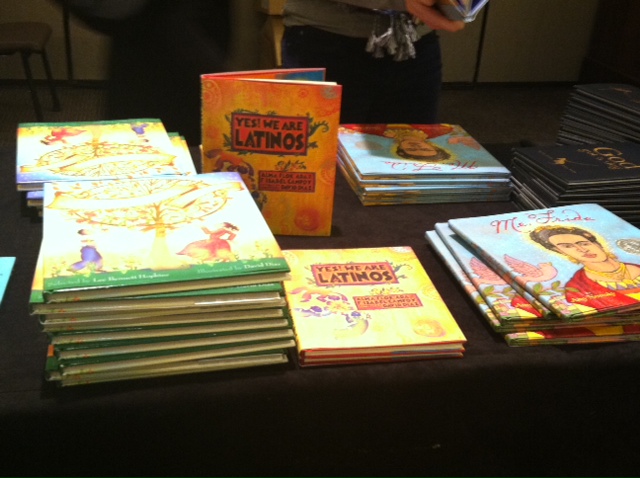
Some of the Latin@ titles at the book sale

Some of the Latin@ titles at the book sale

During her talk, Siscoe was asked about diversity. She responded by saying she is always on the lookout for diverse main characters. In fact, she said a “selling point” for the novel Unusual Chickens for the Exceptional Poultry Farmer, a middle grade debut by Kelly Jones set to release in 2015, was its Latina protagonist.

The final panel on Saturday was about book banning rather than craft. Susanna Reich, chair of the Children’s and Young Adult Book Committee for PEN American Center, floored me during this session. She said children’s and young adult books make up the vast majority of books on the ALA’s list of banned and challenged books. While I knew children’s books were often challenged, I didn’t realize that on the most recent list of the “Top 100 Banned/Challenged Books” from 2000-2009,” 72 of the top 100 are children’s and young adult books, with Harry Potter at the top of the list.

Reich also made the point that censorship isn’t only about removing books from shelves. Censorship also occurs when so few diverse titles make it onto the shelves. “It’s a form of censorship when the amount of multicultural kid lit published hasn’t increased in twenty years,” she said.

But what about those books that do make it onto the shelves? Well, it’s up to us to buy them. Reich quoted poet Alexis DeVeaux, who said, “Buying a book is a political act.” Reich challenged each of us to think about the books we choose to buy and read. Do we censor our book buying in any way? Do we make a conscious effort to read beyond our comfort zones? Do parents and teachers select books for their children and students that include diverse characters?

Multicultural books can speak to all kids, not only kids of color,” said Reich.

Hear, hear! More details from Reich’s talk can be found here on the SCBWI site.

At the end of an SCBWI conference, I am always exhausted in a good way, with a thousand things to consider as a reader, writer, parent, and teacher. This year, the speakers in the sessions I attended reinforced the idea that I can help to promote diversity in children’s literature in each of these roles. Not only can I broaden my own reading interests, but I can expand reading choices for my daughter and my students. By doing this, I will support diversity in kid lit and the members of my SCBWI familia who write, illustrate, edit, and publish books with diverse characters.

Book Review: Confetti Girl by Diana López

By Cindy L. Rodriguez

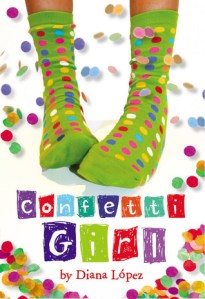
Confetti GirlDESCRIPTION FROM THE BOOK JACKET: Apolonia “Lina” Flores is a sock enthusiast, a volleyball player, a science lover, and a girl who is looking for answers. Even though her house is crammed full of her dad’s books, she’s having trouble figuring out some big questions, like why her father keeps retreating into his reading, why her best friend is changing their old rules, and, most of all, why her mother had to die last year. Like colors in cascarones, Lina’s life is a rainbow of people, interests, and unexpected changes.

MY TWO CENTS: In Confetti Girl, López masterfully blends serious middle school issues, like friendships and first kisses, with the even more serious issues middle schoolers face, such as the death of one parent and the paralyzing grief of the other. Apolonia “Lina” Flores is an easily lovable character with her crazy socks and desire to do well on the volleyball court and in the classroom. But everything starts to unravel as Lina’s dad gets lost in books and her best friend, Vanessa, gets lost in Carlos’s dreamy eyes. With her relationships already strained, Lina’s situation gets worse when she’s benched for failing grades.

What makes Confetti Girl not only an awesome middle grade read but also a great novel about Latin@s is how López seamlessly weaves in cultural details. She talks about how she decided to include certain details here. By using such things as cascarones and dichos throughout the novel, López introduces cultural specifics to readers without being preachy or teacher-like. In other words, I could see young readers responding with, “Cool, let’s make those,” or “Yup, my mom says things like that all the time,” instead of “Oh, that’s a Latin thing” (closes book). The Kirkus review of this novel put it this way: “An appealing coming-of-age novel set in a traditional Mexican-American town, in which Hispanic teachers, students and parents celebrate traditional American holidays such as Thanksgiving alongside such traditional Mexican observances as el Día de los Muertos and a Quinceañera.” Click here for the full review.

Confetti Girl, López’s first middle grade novel, was a winner of the William Allen White Award and named to New York Library’s “100 Titles for Reading and Sharing.” It was a commended title for the 2010 Américas Award for Children’s and Young Adult Literature, and Latinidad’s “Top Latino Book of the Year” for Middle Grade Category. It was also a Scholastic Book Club and Book Fair Selection.

TEACHING TIPS: Lots of great teaching tips, including discussion questions and activities, can be found on the author’s website. Click here for her “Teacher Resource” page and here for a PDF of a Teacher’s Guide for Confetti Girl.

Also, to align with the Common Core State Standards, teachers could easily mix this fictional novel with nonfiction articles that range from cascarones to the grieving process. Teachers could also bring in Watership Down by Richard Adams since it plays a significant role in Confetti Girl. Students could read Watership Down first and then read Confetti Girl to truly understand how the classic novel helps Lina to make sense of her own life.

LEXILE: 660

AUTHORDiana López is the author of the adult novella, Sofia’s Saints and the middle grade novels, Confetti Girl, Choke, and the recently released Ask My Mood Ring How I Feel. She is also featured in the anthologies Hecho en Tejas and You Don’t Have a Clue. She has been a guest on NPR’s Latino USA and is the winner of the 2004 Alfredo Cisneros del Moral Award. Diana teaches English and works with the organization, CentroVictoria, at the University of Houston Victoria.

For more information about Confetti Girl visit your local library or bookstore. Also check out GoodreadsIndieBound.orgWorldCat.orgLittle Brown Books for Young ReadersScholasticAmazon, and Barnes and Noble.

You can also click here for a book trailer of Confetti Girl featuring the author!

Diana can also be found on the site Read to Write Stories, where she blogs about how to create conflict with subtext.

Diana López on Migas, Confetti, and Martha Stewart

By Diana López

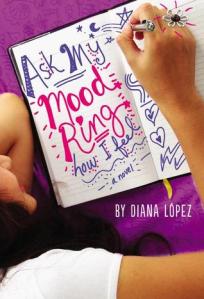
Ask My mood RingRecently, I was asked an excellent question. This came from a writing teacher who shared Ask My Mood Ring How I Feel with his class and wanted me to comment on the narrative techniques I used. His students noticed that I’d added a description of migas, a dish that Tejanos are very familiar with. So they were curious about how I handled cultural details in my fiction. In other words, when writing for readers who do not have the same cultural background as my characters, how do I decide what to explain and what to leave for the reader to figure out?

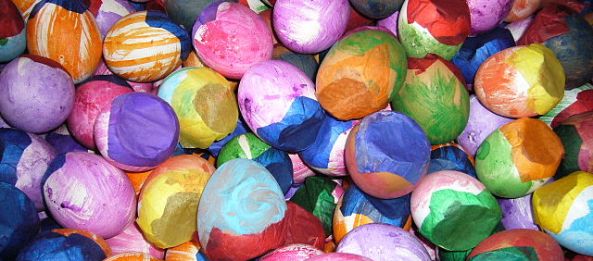
I love sharing the unique foods, words, and customs of my Tex-Mex world. That said, I don’t intentionally add cultural details. I don’t have to because they’re here, in my home and neighborhood. I don’t even recognize them as unique sometimes. For example, in the second chapter of Confetti Girl, we visit a home filled with cascarones and everything that is used to make them—eggshells, tissue paper, vinegar dyes, and confetti. I grew up with cascarones. Starting in January, my mother would save eggshells, and by the end of Lent, we’d have piles of egg cartons stacked on top of the fridge. She’d save old magazines and newspapers too, so we could make confetti with a hole-puncher. Then a few days before Easter, the family would gather around the table to dye the eggshells and fill them with confetti. This was my favorite part of cascarones—not cracking them on each other’s heads but making them.

Confetti GirlCascarones are an important tradition during San Antonio’s Fiesta, and people often sell them from empty parking lots or their front yards. After seeing so many confetti eggs around my neighborhood, I thought, what a great detail for my book. I had no idea they’d be so important in the final version.

When I first submitted the manuscript to New York publishers, they wrote back with questions about these mysterious cascarones. They wanted pictures and instructions. They were so fascinated by something I’d taken for granted. So now when you open a copy of Confetti Girl, you’ll see the confetti egg instructions on its opening pages. It’s wonderful to hear from readers who are making them for the first time. A young girl from Australia wrote to say that she and her mum made them, and when I visit schools, students often share some very creative cascarones, much too pretty to crack on anyone’s head.

Something similar happened with a cultural detail in my mood ring book. Making a promesa when someone gets ill is a common practice in South Texas, so naturally, when my character Erica learns her mother has breast cancer, she makes a promise to get five hundred people to sponsor her for a fundraiser. Like the cascarones, the promesa gained importance as I worked through the novel. Not only did it provide a goal for Erica, but it also worked thematically by giving her a chance to ask a lot of questions about faith and hope. I love when details come to life this way.

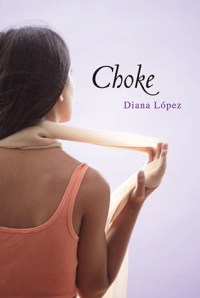
ChokeThere are smaller cultural details in my books, too. Erica sings “pio pio pio” to her mom. In Choke, my character eats barbacoa and drinks Big Red for breakfast. My books are full of “mijas” and “viejitos.” These details may not take on any symbolic significance, but they are just as important because they’re integral to the setting.

At a book festival last month, a participant asked me to name a pet peeve related to writing. I said, “I hate when people tell me I should add more cultural interest to my books.” In other words, I don’t like these details to be forced. They have to feel natural, and as long as I’m not consciously adding them, they will be. Sure, my characters eat migas, but they eat pizza, too.

So how do I decide which details to explain and which to leave alone? This is where a good editor comes in. We’ll get to this point in the revision process where she’ll highlight places with unfamiliar images and words. I remember the first time this happened. I wrote a book set in Corpus Christi, and I mentioned the T-heads, not realizing how unique that term was. The editor had no idea what I was talking about, so I added an appositive phrase for clarification. Ultimately, that’s what I have to determine. Are there enough context clues or should I be a little more explicit? The last thing I want is for a reader to stop because she’s confused. In that sense, I am very grateful to have an editor who is not from my world and who can point out these places—and the best editors are good about letting me decide what to do.

Now here’s something very interesting. Did you know that Martha Stewart featured cascarones on her show? Soon they’ll be as mainstream as piñatas and guacamole, so don’t be surprised when I take all the credit!

Photo credit: Todd Yates

Photo credit: Todd Yates

Diana López is the author of the middle grade novels Confetti Girl, Choke, and Ask My Mood Ring How I Feel. An adaptation of Choke will be featured on the Lifetime Movie Network this summer. Ms. Lopez teaches at the University of Houston-Victoria and works with CentroVictoria, an organization devoted to promoting Mexican American literature. She is also one of the editors of the literary magazine, Huizache.

The Kid Lit World Needs Gary Soto and Others Like Him

By Cindy L. Rodriguez

When Gary Soto’s book, the one attached to the Marisol Luna American Girl doll, was released in 2005, I was in my fourth year of teaching middle school and attending graduate courses. In other words, I was buried in essays–correcting them and writing them–and was clueless that Soto’s book about a 10-year-old Chicago girl had sparked negative national media attention, protests, and harassing phone calls to the author’s home. For more information on the original story, click here.

The 2005 book-and-doll release is old news, but only a few months ago, eight years later, Soto wrote this piece in the Huffington Post, explaining why he has has stopped writing children’s literature.

I’m not going to rehash the Pilsen vs. Des Plaines debate, and I’m not going to say it was right or wrong for Soto’s fictional family to decide they wanted to move because the neighborhood was too dangerous. Those debates were had in 2005.

This post is about Gary Soto, an award-winning, prolific Mexican-American writer, leaving a business that needs him and many others like him. Gary Soto has written picture books, chapter books, poetry, and novels for middle school, high school, and adults. In the often-referenced New York Times article about the lack of Latin@ books in classrooms, Gary Soto is listed as one of the exceptions.

“While there are exceptions, including books by Julia Alvarez, Pam Muñoz Ryan, Alma Flor Ada and Gary Soto, what is available is ‘not finding its way into classrooms,’” said Patricia Enciso, an associate professor at Ohio State University.

Do we need more Latin@ books, written by a variety of authors, in classrooms? Yes. But, Soto and the others are already there, on the shelves, in students’ hands. I’ve read his short stories with my students, and a colleague recently read Buried Onions with her eighth graders based on my recommendation. He is in anthologies and on school book lists. Soto, along with a handful of other Latin@ authors have paved the way, and now he has vowed not to write any more children’s literature.

This comes at a time when 53 million Hispanics live in the U.S., according to the 2012 census. Hispanics are the second largest race or ethnic group (behind non-Hispanic whites), representing about 17 percent of the total population. Meanwhile, a study by the Cooperative Children’s Book Center reported the number of children’s books with multicultural content has not increased in 18 years.

Soto’s retirement from the kid lit world saddens me, as a reader, writer, and supporter of Latin@s in kid lit. We have lost a giant in the business, and I worry that what happened to Soto could discourage writers from including Latin@ characters in their manuscripts. Writers have legitimate fears about “getting it right” and not offending readers, especially if they are crossing into territory–gender, race, religion, ethnicity, culture, sexuality–that they do not understand first-hand. Think about it, Soto, a member of the Latin@ community, was at odds with members of the Latin@ community, over a Latina doll and her story. What does this mean for other writers, especially non-Latin@s who want to write Latin@ characters? Should they not bother? Should they use made-up locations to avoid referencing a specific community? Are the subjects of poverty and crime off limits?

I hope writers aren’t scared away from including Latin@ characters, and I hope Gary Soto reconsiders his retirement from kid lit. Also, wherever we each stand on the Pilsen-Mattel issue, I hope we all can at least tip our hat to Soto for his contribution to Latin@ literature.

Too Many Tamales   Chato Goes Cruisin'   Baseball in April and Other Stories   Buried Onions   The Afterlife