From the Margins of Disaster

By Ashley Pérez

newlondonexplosionNIGHT

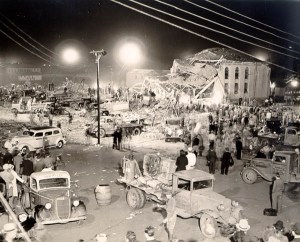
My third novel is about disasters. The disaster that catalyzes many of the events—a 1937 school explosion in New London, Texas—captured international media attention at the time. A more pervasive disaster—systemic racial inequality and unequal access to opportunity—didn’t raise an eyebrow.

Before the explosion, New London was seen as one of the luckiest towns in the country. A small farming village made suddenly prosperous by the discovery of oil, New London was spared the worst effects of the Great Depression. In fact, tax revenues from oil production were what made the building of the New London school possible. It was described in newspapers as “the richest rural school in the world.” At a time when schools in other communities could barely pay their teachers half wages, the New London school had chemistry laboratories, a home economics cottage with a suite of electric sewing machines, musical instruments and band uniforms for all the children, sports, foreign languages and fine arts, even college-credit courses. These opportunities were remarkable for the time and in that they were made available to the many children of the oilfield workers who flooded the area in search of work.

In the end, more than 200 of these children were killed. The estimate is 217, although it’s impossible to know for sure. Many of the bodies were not identifiable or intact after the explosion, meaning that identifications depended on the recovery of personal objects or body parts that had unique characteristics (scars, birthmarks, and the like). In addition, the oilfield workers in New London came and went at all times of the year, meaning that it was hard to know who was enrolled at the time of the explosion. Some families that lost children simply collected the bodies of their kids, packed up, and drove out of town, heading back toward West Texas or Oklahoma or wherever they called home. A systematic record of recovered bodies was not established until hours after the explosion, meaning that some dead children may not have been included in the final count.

As I learned more about the disaster, I found myself returning to a question: what might the New London explosion have meant for black Americans whose children were spared precisely because of their exclusion from the state-of-the-art white school? The oral histories and documentary materials on the explosion make no reference to African American experiences. This kind of exclusion was typical of the time; news in the black community—whether good or bad—rarely received coverage. In many ways, then, the novel narrates from a gap or a silence in the historical record, imagining possibilities based on other histories and on the dynamics between the characters I invent. (I talk about gaps in the historical record a bit more here.)

My research also led to the discovery that at least one Hispanic child was killed in the explosion, and I began to imagine the unique confluence of circumstances that could make it possible for a Mexican-American child to attend a white school in 1930s Texas. At that time, and for decades to follow, any place in Texas with a significant Hispanic population employed a tripartite segregation system: white schools, black schools, and even more inferior “Mexican” schools that systematically marginalized students and worked to force them out of the public school system altogether. (More on that process here.) Unlike cities like San Antonio or the rural towns of South Texas, New London did not have an established Mexican-American community. The oil boom—and the prospect of work—attracted people from all over the state and country. In Gather, the opportunity to attend the New London School is what brings the Mexican-American protagonist and her twin siblings to East Texas in the first place.

A shared history of school segregation is something that unites the protagonist and her eventual love interest, the handsome son of the principal of the London Colored School. But there are important differences to note, too, about their experiences in school. While African-Americans in 1930s faced gross inequalities when it came to educational resources, the pioneering efforts of many individuals to use education as a tool for advancement meant that finishing high school and possibly even attending an all-black college were at least possible. Not so for most Mexican-American students in Texas, where most kids were essentially forced out of public school by sixth grade.
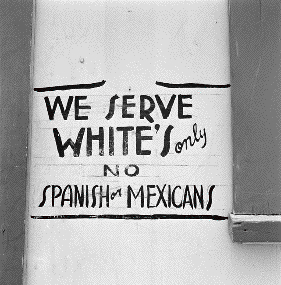
WHITESonly

Enormously overcrowded classrooms in the “Mexican” schools made learning difficult, putting the students further behind their white peers with each year. On top of that, the school districts in Texas often divided each elementary grade into two years (for example, “lower first,” “upper first”) in “Mexican” schools. The result was that–by middle school—these students were often told they were “too old” for the grade they should have been able to join in the (white) middle school. Access to high school was extremely limited; in Houston in the 30s, for example, only a handful of Mexican-Americans (usually lighter skinned) graduated from high school at all despite a significant Hispanic population in the area. These students faced discrimination in white schools, and there was no “Mexican” public high school. Access to university-level study would have been limited to those students who could pass for white.

In addition, unlike African-Americans, whose teachers–also African-American–were usually committed to helping students use education to combat their circumstances, Mexican-American children were almost invariably taught by white teachers who often considered this an “undesirable” placement and were quick to underestimate the abilities of their students.

While these experiences of inequality wouldn’t seem to be central to the novel, in many ways they condition both the possibility of the story and the particulars of its unfolding. And they are the dark current that runs beneath and through the events of the school explosion and its aftermath in the story. For a taste of this novel, which is forthcoming in 2015 from Carolrhoda Lab, check out the excerpt recently published by The Texas Observer.


Images and credits:

The New London School during the all-night recovery effort, March 19, 1937 (Photo credit: Prints and Photographs Collection, Archives and Information Services Division, Texas State Library and Archives Commission. 1976/11-7.)

“No Spanish or Mexicans” sign (Photo by Russell Lee. 1949, Dimmitt, Texas. Archived at the Center for American History, University of Texas.)
Book Review: Niño Wrestles the World by Yuyi Morales

By Sujei Lugo

DESCRIPTION FROM THE BOOK JACKET: Señoras y señores, put your hands together for the fantastic, spectacular, one of a kind…Niño! In a single move, he takes down his  competition! No opponent is a challenge for the cunning skills of Niño, world champion lucha libre competitor!

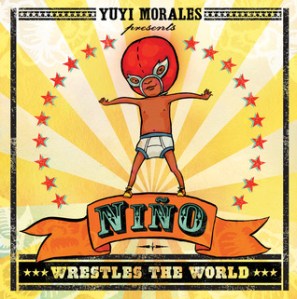
MY TWO CENTS: As soon as you take a glimpse of the book cover, you know that Yuyi Morales is presenting you with a treat of pint-sized lucha. The colorful and mixed-media artwork and its wrestling match layout, capture the energy and enthusiasm of the characters and lucha libre itself. Written in English with a dash of Spanish words and onomatopoeias, readers are exposed to an action-packed picture book filled with elements of Mexican and other Spanish-speaking cultures.

NiñoWrestlestheWorldCover“¡Niño! ¡Niño! ¡Niño!” It is through this chant that we are introduced to Niño, a paleta eater, toy-loving, and acrobatic boy. Once Niño puts on his luchador mask, contenders such as La Momia de Guanajuato, La Llorona and Cabeza Olmeca, line up to challenge him. With his playful lucha style, Niño challenges his opponents with puzzles, dolls, marbles, popsicles and tickles, showing how Morales playfully incorporates childhood glee into this wonderful homage to lucha libre. At the end of the story we also meet Niño’s toddler sisters, who are mischievous and loud and drive Niño crazy! This is where Yuyi Morales uses the opportunity to capture and address siblings’ relationships, while showcasing the “best move” to defeat sibling rivalry.

I could not deny that it crossed my mind that Niño Wrestles the World, plays as a homage and retelling of the legacy of Mexican lucha icon, El Santo. Like El Santo, once Niño puts on his luchador mask, he never takes it off. Like El Santo, in his movies, Niño challenges the mummy of Guanajuato, the llorona, and aliens. And you could say that when later in the book Niño joins his sisters and challenges new opponents, we are seeing a retelling of adventures where El Santo joins fellow luchadores Blue Demon and Mil Máscaras. Setting the wonderful El Santo references aside, in this picture book we have a fun and energetic story and lovable characters that will release the inner luchador or luchadora in kids and adults of all ages.

Niño Wrestles the World is the 2014 Pura Belpré Illustrator Winner and was named a highly commended title by the 2014 Charlotte Zolotow Award. It was also included in a series of list such as A Fuse #8 Production 100 Magnificent Children’s Books 2013, School Library Journal Top 10 Latino-themed Books of 2013, Fanfare (Horn Book’s list of the best books for young people published in 2013), Center for the Study Multicultural Children’s Literature Best Multicultural Books of 2013 and Latinas for Latino Lit Remarkable Latino Children’s Literature of 2013.

TEACHING TIPS: While early readers and kids between the ages of 4-8 might enjoy reading this picture book, it is through the activity of reading aloud that its energy and humor really stands out. Adults and childrens’ librarians can read the book, while teaching new vocabulary and words in Spanish to kids.

Language Arts, Visual Arts, and Social Studies teachers (pre-school- 2nd grade) could also use Niño Wrestles the World with their students. The book is filled with fun onomatopoeias, adjectives and words in Spanish, which will attract students to the language learning process. Art teachers can collaborate with Language Arts teachers with the masks of the different characters of the story. Templates of different lucha masks are available on Yuyi Morales’ website, or you can be creative with your own mask!

The elements of Mexican culture exposed through Niño’s opponents, the trading-card-style information of each opponent (includes pronunciation), and Yuyi Morales’ illustrations provide the opportunity to incorporate them into Social Studies curricula. Educators should be provided with resources and materials that will serve as tools to bring multiethnic/multicultural exposure and discussion into the classroom. This is especially relevant now since Mexican American and Latin@ Studies curricula and books are constantly challenged in the U.S. public education system.

LEXILE: N/A

AUTHOR: Yuyi Morales is a Mexican author, illustrator, artist, and puppet maker. She has a bachelor’s degree in Psychology and Physical Education from the University of Xalapa, México and used to host her own Spanish-language radio program for children in San Francisco, California.

She has won numerous awards for her children’s books such as the Tomás Rivera Mexican American Children’s Book Award for Just a Minute: A Trickster Tale and Counting Book (2004) and Los Gatos Black on Halloween (2008), the Pura Belpré Author Honor for Just in Case: A Trickster Tale and Spanish Alphabet Book (2009), the Pura Belpré Illustrator Award for Just a Minute: A Trickster Tale and Counting Book (2004), Just in Case: A Trickster Tale and Spanish Alphabet Book (2009) and Los Gatos Black on Halloween (2008), and Pura Belpré Illustrator Honor for My Abuelita (2010) and Harvesting Hope: The Story of Cesar Chavez (2004).

Morales divides her time between the San Francisco area and Veracruz, Mexico. Her lastest picture book Viva Frida! will be released in September 2014.

For more information about Niño Wrestles the World visit your local library or bookstore. Also check out Macmillan Publishers, Goodreads, Indiebound.org, WorldCat.org, Amazon, and Barnes and Noble.  

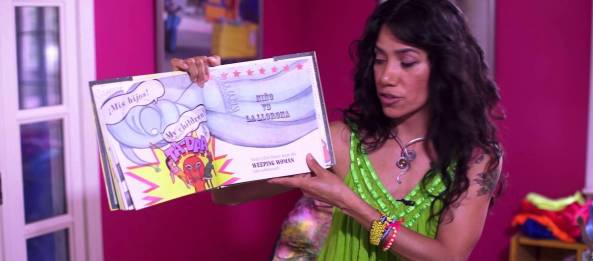
Enjoy this video of Yuyi Morales reading Niño Wrestles the World!

Congratulations to ALA Youth Media Award Winners and Honor Books

The annual award announcements from the American Library Association at its midwinter meeting is like the Golden Globes-Oscars-Grammys for the kid lit world. This year, we were especially thrilled to see the number of books by and/or for Latin@s on the lists.

Congratulations to all the winners! You can find the full list here. We’re sending out an extra abrazo to the following authors and illustrators:

Pura Belpré (Illustrator) Award honoring a Latino illustrator whose children’s books best portray, affirm and celebrate the Latino cultural experience: “Niño Wrestles the World,” written and illustrated by Yuyi Morales.

Three Belpré Illustrator Honor Books were selected: “Maria Had a Little Llama / María Tenía una Llamita,” illustrated and written by Angela Dominguez; “Pancho Rabbit and the Coyote: A Migrant’s Tale,” illustrated and written by Duncan Tonatiuh; and “Tito Puente: Mambo King / Rey del Mambo,” illustrated by Rafael López, written by Monica Brown.


Pura Belpré (Author) Award honoring a Latino writer whose children’s books best portray, affirm and celebrate the Latino cultural experience: “Yaqui Delgado Wants to Kick Your Ass,” written by Meg Medina.

Three Belpré Author Honor Books were named: “The Lightning Dreamer: Cuba’s Greatest Abolitionist,” written by Margarita Engle; “The Living,” written by Matt de la Peña; and “Pancho Rabbit and the Coyote: A Migrant’s Tale,” written and illustrated by Duncan Tonatiuh.


Robert F. Sibert Informational Book Award for most distinguished informational book for children: “Parrots over Puerto Rico,” written by Susan L. Roth and Cindy Trumbore, and illustrated by Susan L. Roth.

Stonewall Book Award – Mike Morgan & Larry Romans Children’s & Young Adult Literature Award given annually to English-language works of exceptional merit for children or teens relating to the gay, lesbian, bisexual and transgender experience: “Fat Angie,” written by e. E. Charlton-Trujillo.

William C. Morris Award for a debut book published by a first-time author writing for teens: “Charm & Strange,” written by Stephanie Kuehn.

Book Review: Death, Dickinson, and the Demented Life of Frenchie Garcia by Jenny Torres Sanchez

Death, Dickinson, and the Demented Life of Frenchie GarciaBy Cindy L. Rodriguez

DESCRIPTION FROM THE BOOK JACKET: How do you know someone after they’re gone? Frenchie Garcia didn’t know she would be the last person to see Andy Cooper alive. She barely knew him. So why did he choose to be with he before he committed suicide? Her imaginary pal Em (a.k.a Emily Dickinson), who Frenchie visits regularly at her favorite place–the cemetery–is the only one who knows about her last hours with Andy. With guilt and confusion mounting, can Frenchie pull off the one thing that could give her closure?

MY TWO CENTS: Frenchie goes on a road trip with a super-cute new “friend” Colin to make sense of what happened the one and only night she hung out with Andy Cooper, the boy she loved from afar through high school. Frenchie is haunted by the usual questions when grieving: Why? Why him? What could I have done to help him? Could I have stopped him? The last two questions are most painful because she was the last person to see Andy before he died, and, therefore, feels responsible. Sanchez easily blends heart-wrenching grief with regular teen angst, serious moments of conversation with quips like, “Get up, Loser!”from Robyn, Frenchie’s friend who knows something is wrong, but isn’t sure what. Also, Frenchie Garcia is a Latina protagonist in a book that isn’t about being Latina. Frenchie is an artist who likes punk rock and Emily Dickinson; she’s a young Latina who doesn’t speak a single word of Spanish in the novel. Some readers/writers/bloggers have asked for more books with diverse characters who are not dealing with issues of ethnicity, culture, race, etc. This is a good example.

TEACHING TIPS: What student wouldn’t fill an entire notebook about a day they’d like to do-over? This is a perfect before-reading activity that could be revisited and added to as the novel continues. As Frenchie leads Colin through her last night with Andy, students could write about their chosen “do-over” night, what they’d do differently, and what they’d discover. By the end, students have read a cool book and written a personal narrative!

Emily Dickinson’s poetry is made for close reading, which is all the rage with the new Common Core State Standards. Students could read and re-read any of Dickinson’s poems featured in the novel. Close, multiple readings allow students to analyze work down to the word level to gain deeper meaning. In this case, students would gain a deeper understanding of Dickinson and Sanchez’s novel, as they could discuss how the poems fit with the novel.

LEXILE: N/A

AUTHOR: Jenny Torres Sanchez lives in Orlando, Florida with her husband and children. Before writing her debut novel, The Downside of Being Charlie, she taught high school for several years. She credits her eclectic students for inspiring her to write young adult novels.

Her other YA novel is:

The Downside of Being Charlie

FOR MORE INFORMATION about Death, Dickinson, and the Demented Life of Frenchie Garcia, visit your local library or book store. Also, check out Running Press BooksIndieBound.org,  GoodreadsAmazon.com, and Barnes and Noble.com.

Author Jenny Torres Sanchez & Her Characters Are Inspired by the Arts

By Jenny Torres Sanchez

When I was in school and I’d read a story in my English textbook, many times there was a photo or an art piece that went along with it. And there’d always be a question at the end of the story that would ask how the art piece and story go together. Some people hated that question.

I loved it.

I’ve always loved the idea of art going together. It makes sense to me, the way they connect. The way one piece of art can inspire another piece of art, or how you can see a story in a painting, or how a story can paint images in your head. I LOVE that. I guess that’s why I find a lot of inspiration in other forms of art. Not only do I enjoy them for what they are (a striking painting, a haunting photo, a song that you can’t get out of your head), but I also enjoy them because of the stories I see in them.

CharlieMusic? Listen to the lyrics; there’s a story there. Paintings? Full of story, either of the subject or the artist. Photography? Setting. People. Captured moments. It’s kind of like an artist is setting me up for a story, igniting that spark that helps me write. For me, all art is striving to make a connection, with the reader, with the listener, with the viewer. It’s striving to ask you to look inside yourself, or outside yourself, and really wonder and think and feel. And I think you really need to feel to write, so for me the two go hand in hand.

But I also think art can be more than inspiration.

In my books, my characters often turn to art in some way while they’re going through a difficult time. In The Downside of Being Charlie, Charlie finds he can make better sense of the world through the lens of a camera. He is incredibly vulnerable and scared and unable to express himself or deal with his family issues. But in photography, he finds a way to do that. Actually, with Charlie, photography becomes this way of seeing things, exposing things no one else around him wants to see. So, photography also becomes this very powerful and empowering thing for him.

FrenchieIn Death, Dickinson, and the Demented Life of Frenchie Garcia, Frenchie is fascinated by Emily Dickinson’s poems, specifically those about death because she’s is in a dark place in her life. Her high school crush has just committed suicide after an amazing night of adventure with her. Dickinson’s poetry reflects Frenchie’s own feelings, and helps her to come to terms with something that just doesn’t make sense.

I don’t set out to make my characters artsy but they usually end up that way. I think it’s because I also see the arts as something that can save us (I hesitate to use the word save, I really do, because I think ultimately, we choose to save ourselves). But I truly believe music, art, writing, stories can offer us a safe haven and inspiration. A place to hang out for awhile, sometimes as an escape, sometimes as a place to make better sense of whatever it is we are going through. Sometimes it is conscious, and sometimes, not so much. Either way, the arts really can be a sort of salve for anyone who has gone through tough times. I like salve better than save. Add the L.

Overall though, art is pretty amazing in any medium. It asks us to feel. It offers us comfort and understanding. And that can’t be bad.

Jenny TorresFrom the Running Press site: Jenny Torres Sanchez lives in Florida with her husband and children where she currently writes full time. Before her debut novel The Downside of Being Charlie she taught high school for several years, where she credits her eclectic students for inspiring her to write young adult novels.

On Thursday, her second novel, Death, Dickinson, and the Demented Life of Frenchie Garcia will be featured on our Libros Latin@s post.

Book Review: Tito Puente: Mambo King / Rey del Mambo by Monica Brown

Tito Puente, Mambo King/Tito Puente, Rey del MamboBy Sujei Lugo

DESCRIPTION FROM THE BOOK JACKET: Meet Tito Puente, the King of Mambo. Tum Tica! From musical prodigy on the streets of Harlem to five-time Grammy Award winner, Tito’s life was full of rhythm. Drums and claves, saxophones and tambourines were all part of the fun. Tac Tic! Monica Brown and Rafael López, the award-winning creators of the Pura Belpré Honor Book My Name is Celia/Me Llamo Celia, team up once again for another spectacular collaboration in this upbeat tribute to a musical legend.

MY TWO CENTS: Brown was presented with the challenge of summarizing Tito Puente’s life and music career in a picture book, and with the collaboration of Rafael López and his lovely illustrations, she succeeded wonderfully. What makes this picture book stand out is how beautifully words (English and Spanish) and images resonate with Tito’s sounds. The illustrations here are so vivid that you can almost see movements and listen to the sounds that are evoked. Brown and López effectively capture the beat and feeling of Tito Puente’s music throughout every page.

The book starts with an image of a boy and girl peeking through a curtain, as if we are about to start a show. This is where we are welcomed to Tito’s story from his childhood in El Barrio to his Grammy award-winning years. López’s colorful and vibrant images, along with Brown’s words and onomatopoeia, show us how music was constantly present in Tito’s life. These same images and words also construct a fond view of Latino life and music in NYC during Tito’s life.

Brown and López give us a very entertaining book that also manages to educate us about Tito’s life and the importance of music education. It is important to remember that Tito Puente was a product of music education and a supporter of music programs in schools. He even successfully worked toward the creation of the Tito Puente Educational Foundation that offers scholarships to children interested in learning music. This is an issue that is relevant when arts and music programs are constantly facing budget cuts. Being in tune with Puente’s life (and other great musicians and singers) helps to inspire us to support arts and music education, thus this picture book also serves as a great tool to familiarize with the power of music and arts as an important aspect of the learning process.

Tito Puente: Mambo King/Rey del Mambo is the second collaboration between Monica Brown and Rafael López. Published in March 2013, the book was selected by various Best of 2013 lists such as: Latinas for Latino Lit’s Remarkable Latino Children’s Literature of 2013, School Library Journal’s Top 10 Latino-themed Books of 2013, and Center for the Study Multicultural Children’s Literature Best Multicultural Books of 2013. Here is the wonderful bilingual trailer for this picture book:

TEACHING TIPS: This is a bilingual picture book (ages 4-7) that works well for early readers, but is a perfect one to read aloud. Parents, grandparents, family members, friends, or guardians can read in English, Spanish, or both, while teaching words and sounds to their young ones. School and public librarians can also use this book during storytime, and they can incorporate Tito’s songs and beats as the closing songs.

Going along with Tito Puente’s sense of collaboration with music, teachers (pre-school-2 grade) can also collaborate in school with this book. Language Arts, English, and Spanish teachers can read this book to their students, while teaching new words (in English and Spanish), onomatopoeia, and Tito’s life (the book includes a short biography). Art teachers can encourage and help students to create different musical instruments that are mentioned in the book. Music teachers can use the basic musical notation of a rumba for timbales, bongo, and congas that is available at the end of the book to teach some beats to the students.

LEXILE: AD740L

AUTHOR & ILLUSTRATOR: (information comes from HarperCollins Publishers, Monica Brown’s website, Rafael López Books’ website, and Rafael López’ website.

Monica Brown is the author of many award-winning children’s books and an English Professor at Northern Arizona University, specializing in U.S. Latino Literature and Multicultural Literature. She has a BA in English from University of California, Santa Barbara, an MA in English from Boston College and a PhD in English from The Ohio State University. In addition to children’s books, Monica Brown also writes and publishes scholarly work with a Latin@ focus. She is a recipient of the prestigious Rockefeller Fellowship on Chicano Cultural Literacies from the Center for Chicano Studies at the University of California.

Brown has stated that her Peruvian-American heritage and her desire to share Latin@ stories are the inspiration for her books. Her first book of the Marisol McDonald series, Marisol McDonald Doesn’t Match/Marisol McDonald No Combina is the winner of the Tejas Star Book Award (2012-13), the International Latino Book Award (2012) and a Pura Belpré Honor for Illustration (2012). Other of her numerous awards are: the Américas Award for Children’s and Young Adult Literature (2005) for her picture book My Name is Celia: The Life of Celia Cruz/Me Llamo Celia: La Vida de Celia Cruz; the Pura Belpré Award (2008) for My Name is Gabito: The Life of Gabriel Garcia Márquez/Me Llamo Gabito: The Life of Gabriel Garcia Márquez; and the International Latino Book Award (2006) for My Name is Gabriela: The Life of Gabriel Mistral/Me Llamo Gabriela: La Vida de Gabriela Mistral

Rafael López is a Mexican award-winning illustrator and artist, whose work is influenced by his cultural heritage, colors of Mexican street life, and Mexican surrealism. In addition to children’s books, López has illustrated posters, United States Postal Service stamps such as the Latin Music Legends series, and he has launched street art projects to revitalize urban neighborhoods, such as the Urban Art Trail Project.

He is the recipient of various Pura Belpré Honor for Illustration awards for books such as: My Name is Celia: The Life of Celia Cruz/Me Llamo Celia: La Vida de Celia Cruz (2006), Book Fiesta!: Celebrate Children’s Day/Book Day/ Celebremos El Día de los Niños/El Día de Los Libros (2010) and The Cazuela That the Farm Maiden Stirred (2012). He also received two Américas Awards for Children’s and Young Adult Literature for My Name is Celia (2006) and ¡Yum! ¡Mmmm! ¡Qué Rico! Americas’ Sproutings (2007).

For More Information about Tito Puente: Mambo King / Rey del Mambo (2013), visit your local library or bookstore. Also, check out worldcat.org, indiebound.org , goodreads.com, amazon.com, barnesandnoble.com  & harpercollins.com