On Fearlessness, and Writing to Change the World: A Guest Post by Author Marie Marquardt


By Marie Marquardt

“I am fearless, except when I’m not.”

This is how I describe myself, each time that I gather in a classroom of ESOL students to run writing workshops. It’s part of an exercise developed by Alma Flor Ada and Isabel Campoy, in their fabulous resource Authors in the Classroom: A Transformative Education Process. Each person makes a statement about who they understand themselves to be, or maybe just about how they feel at that particular moment. The statements build together to create poetry – simple, beautiful, honest poetry.

This exercise was first introduced to me by Meg Medina, who has inspired me immensely with her practice of “literary citizenship.” One way that I strive to live into the identity of a literary citizen is by gathering with nascent speakers of English – teenagers full of ideas and energy, with incredible and often heart-wrenching stories to tell, yet struggling to put them into words that are not their first language – and, in some cases, not their second or third, either. I try to be fearless as I read to them from my own stories, but sometimes I’m not.

I worry about how they will evaluate me – the middle-aged white lady whose recent book features characters like many of them – kids who have run away from some of the most dangerous communities in the world, looking for a safe place to live and maybe – just maybe – to one day call “home”.
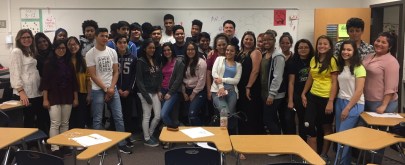
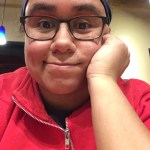
Group shots and selfies from a recent workshop with ESOL students in a Gwinnett County, Georgia High School.
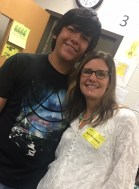
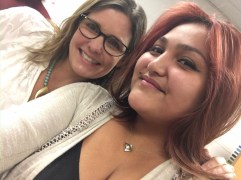
My very best days as an author are these days, when eager students come rushing up to me after our workshop, asking for selfies; when they tell me about their favorite character; when they marvel at how I learned to cuss like a Salvadoran, or how much I know about making pupusas. I want so much for my books to resonate with them — Their stories inspire me to write young adult novels in the first place.

Because of how profoundly these young adults’ experiences have shaped me, every one of my books has at least one point-of-view character who is an immigrant from Mexico or Central America. For twenty years, as an academic researcher, advocate, and service provider in Latinx immigrant communities in the South, I’ve listened to teen immigrants’ stories, and I’ve seen them unfold. I consider it an honor to create characters inspired by the teens I have had the great privilege to know. They have trusted me with their stories and I feel a great responsibility to convey their truth onto each page.

This is not a process that I take lightly, so I don’t do it alone. I rely on consultants who identify with the cultural traditions and national-origin groups I am representing. They teach me about the nuances of the culture and language, and they help me get a deeper understanding so I can build more robust and honest characters on the page (in other words, they teach me such important skills as cussing like a Salvadoran!).  I also rely on sensitivity readers, and I take their feedback very seriously.

Equally important, I consider it my responsibility to support the work of #ownvoices authors by  mentoring young authors from marginalized communities. I have worked for two years as a volunteer with We Need Diverse Books’ Walter Dean Myers Grant committee, and this year, I’ve pledged to work with ESOL students, facilitating workshops that help them build their own authorial voices and tell their own powerful stories.

I recently read a short interview with Jacqueline Woodson, when she was honored with the Lambda Literary Visionary Award. She said something that I think is damn near perfect: “Write specifically and furiously. Write to change the world.”

I aim to write specifically.
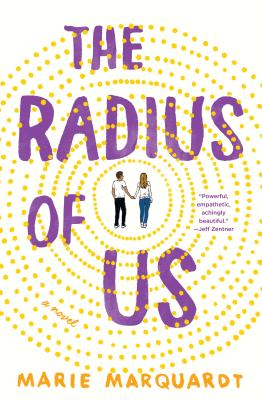
The Radius of Us CoverI can only tell the stories that I know. In the case of The Radius of Us, I felt compelled to write the story of a young asylum seeker from El Salvador because of the relationships I have built with real young adults in similar situations. It has been one of my greatest honors to help run a non-profit called El Refugio, which works with detained immigrants and their families. As part of that work, I have experienced the heartbreak of building friendships with dozens of young asylum seekers from the northern triangle of Central America. I have spent countless hours visiting with these young men in detention, sitting across the glass from them, telephones pressed to our ears. Unlike my story’s protagonist, most of these young men never have the chance to leave detention, until they are deported.

I aim to write furiously.

I am desperate for more people to know and understand the stories of these young men, and I also am, indeed, furious. I have followed some of them back to El Salvador, to see how they are faring after deportation. I have seen the dire circumstances into which our courts return them. I can’t wrap my head around the fact that, in the immigration court that determines the fate of these young men, only 5% are granted asylum. I can’t bear the thought that, like our friend Moises, some of these young people are being sent back to die.

I write to change the world.

On good days (fearless days), I remind myself that writing these stories is an act of compassion. When I allow myself to dive into the experience of Phoenix – an asylum-seeker from El Salvador, or Gretchen – a white suburban girl who was the victim of assault – I practice compassion. I hope that by telling these stories, I can model compassionate action, and I also fervently hope that, once they are out in the world, my stories will open safe, compassionate spaces. I hope that they create opportunities for teen readers to speak honestly with one another, to recognize those insidious systems (like racism and xenophobia) that aim to keep us apart, and also to affirm the beautiful, fragile humanity that we share in common.

I believe that, with more compassion, our world would be a radically different place. Compassion compels us to walk alongside people in crisis, and not to turn away. Compassion drives us to seek mutual understanding, to find those human qualities and dispositions that we share in common, while also not dismissing the profound differences that shape our experiences. Compassion changes the world.

This is what drives me to be fearless (except when I’m not).
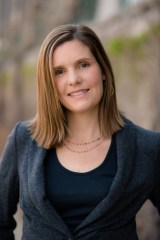
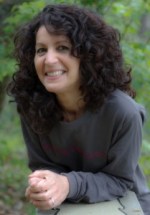
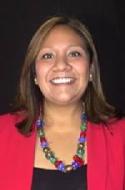
Marie Marquardt is a Scholar-in-Residence at Emory University’s Candler School of Theology and author of contemporary YA fiction. She has written several articles and co-authored two non-fiction books about Latin American immigration to the U.S. South. She also has written three novels for young adults, based in part on her experience working with immigrants in the South: DREAM THINGS TRUE (St. Martin’s Griffin/ September 2015), THE RADIUS OF US (St. Martin’s Griffin/ January 2017) and FLIGHT SEASON (St. Martin’s Griffin/ forthcoming February 2018). She lives in a very busy household in Decatur, Georgia, with her spouse, four children, a dog, and a bearded dragon. When not writing, teaching, or chauffeuring her children, she can be found working with El Refugio, a non-profit that serves detained immigrants and their families.
Spotlight on Latina Illustrators Part 5: Alyssa Bermudez, Elisa Chavarri and Zara González Hoang


By Cecilia Cackley

This is the fifth in a series of posts spotlighting Latina illustrators of picture books. Some of these artists have been creating children’s books for many years, while others will have their first book out soon. They come from many different cultural backgrounds, but all are passionate about connecting with readers through art and story. Please look for their books at bookstores and libraries!

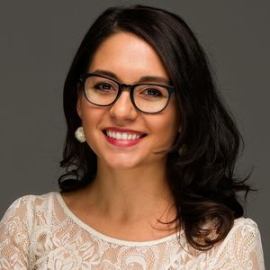
Alyssa Bermudez

Photo by Mark Cowles

Photo by Mark Cowles

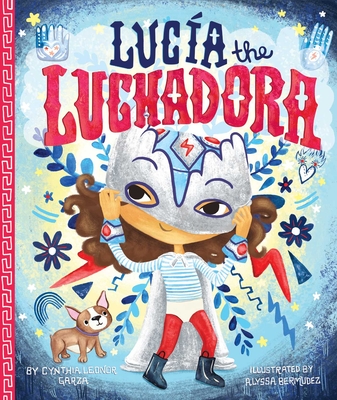
Alyssa Bermudez is a New Yorker who studied at the Fashion Institute of Technology and now lives and works in Tasmania. She illustrated Lucia the Luchadora by Cynthia Leonor Garza, which was published in 2017 by Pow! Kids Books.

Q: What or who inspired you to become an artist?

A:  I have always wanted to be someone who makes things. Whether it was designing shoes or learning to sew, I have always felt most like my true self when I’m making something. Growing up in New York, I had access to incredible artistic resources, and being exposed to that from a young age also made it feel totally natural. I don’t actually remember a time that I didn’t want to become an artist.

Q: Tell us something about your favorite artistic medium.

A:  Watercolor and Photoshop are my current absolute favorites. Watercolor has a mind of its own and sometimes that spontaneity shows up on the page. I love the confidence of its presence and combining it with digital techniques where I can control it afterwards.

Q: Please finish this sentence: “Picture books are important because…”

A: Picture books are important because it allows children to visualize and understand their own stories as they grow up. They can see their lives reflected in this way. The world is an exciting and colorful place full of adventure, and picture books highlight this to kids and adults.

Lucia the Luchadora Cover

Elisa Chavarri

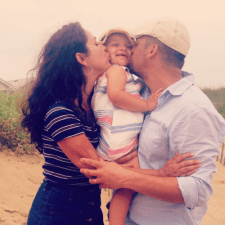
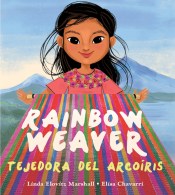
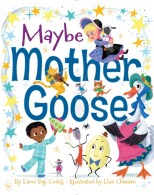
Elisa Chavarri is a freelance illustrator originally from Lima, Peru. She did much of her growing up in Northern Michigan where she now resides with her husband, baby girl, cat, and dog. Elisa graduated with honors from The Savannah College of Art and Design, where she majored in Classical Animation and minored in Comics.  Books she has illustrated include Rainbow Weaver/Tejadora del arco iris from Lee & Low Books, Maybe Mother Goose and Fairly Fairy Tales from Aladdin Books and various titles for American Girl.

Q: What or who inspired you to become an artist? 

A: For me, it was my love of the old classic Disney movies and cartoons, once I discovered that people actually created these characters and worlds by doing countless drawings and concept art, I was hooked. In addition I’ve liked drawing and coloring as long as I can remember.

Q: Tell us something about your favorite artistic medium.

A: This is a tough one for me because I like different mediums for different reasons. My top favorites are pencil/paper, acrylics, watercolors, and digital. The one I use the most is digital, and it’s the one I learned last, but for completing work on time and revisions, it is the most versatile and efficient medium. To play around with on my own time and for personal projects I really enjoy acrylics and watercolors for their ease of use. I’ve been using these and oil paints since I was a kid thanks to my mom encouraging my artistic leanings and putting me in various classes. Digital painting I began learning in college, but mostly am self-taught.

Q: Please finish this sentence: “Picture books are important because…”

A: They introduce children to stories/reading and the arts which are among the most life enriching things in the world!

RAINBOW_WEAVER_fnl_JKT.jpg  maybe-mother-goose-9781481440363_hr.jpg  5246204269_e722bedb32_b.jpg


Zara González Hoang

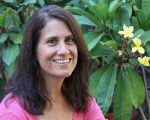
Zara Gonzalez HoangZara González Hoang is an illustrator originally from Minneapolis, now living near Washington, D.C. She studied art at the University of Wisconsin-Madison and will illustrate the upcoming picture book Thread of Love by Surishtha Sehgal and Kabir Sehgal for the Simon and Schuster imprint Beach Lane.

Q: What or who inspired you to become an artist?

A: I was lucky enough to be born into a family of teachers, so paper and art supplies were always around. I think at the heart of it all was the feeling of connection I got as a child drawing with my dad. I remember him lying on the floor with me, a sketchbook between us, drawing horses (my favorite) and boats (his favorite). My dad had a creative soul that wasn’t often expressed, so to be able to share a piece of it was always something special.

Q: Tell us something about your favorite artistic medium.

A: I work primarily digitally. I’ve always been drawn to computers (I was actually a computer science major in college for a little while), so I think the idea of merging art and technology appeals to me on different levels. I like working digitally because it’s so easy to change things if you’re not satisfied. I have a tendency to change my mind a lot so being able to change colors with ease or move elements around is really appealing. I draw so much digitally that when I’m drawing traditionally and make a mistake my mind tells me I need to hit the undo button (even though that is obviously not possible!)

Also, being a mom of young son, it’s a lot easier to turn on my tablet and get some “painting” done without having to worry about my paint drying on my brushes or making a giant mess that I don’t have time to clean up when my guy needs me. There are so many great brushes being created for Photoshop these days (Kyle’s Brushes are my favorite) that emulate different traditional media that it’s become a lot harder to tell the difference if you know what you are doing.

Q: Please finish this sentence: “Picture books are important because…”

A: They help children make sense of the world around them. There is a quote that I read recently that really resonates with me and gets to the heart of why I think picture books are important so I will just put that here because I don’t think I can say it any better than Dr. Rudine Sims Bishop:

“Books are sometimes windows, offering views of worlds that may be real or imagined, familiar or strange. These windows are also sliding glass doors, and readers have only to walk through in imagination to become part of whatever world has been created or recreated by the author. When lighting conditions are just right, however, a window can also be a mirror. Literature transforms human experience and reflects it back to us and in that reflection we can see our own lives and experiences as part of the larger human experience. Reading, then becomes a means of self-affirmation, and readers often seek their mirror in books.”

I got into picture books because as a mixed-race Latina Jew married to a Vietnamese refugee with a Vietnamese/Puerto Rican/Jewish Buddhist child I want to help create mirrors for children who don’t have them. There are so many stories that are not represented, I feel like part of my purpose is to help bring them to life.

Book Review: Who’s Ju? (Seventh Grade Sleuths #1) by Dania Ramos


Reviewed by Caissa Casarez

Image result for who's ju? book coverDESCRIPTION FROM THE BOOK’S BACK COVER: Justina ‘Ju’ Feliciano and her fellow seventh-grade sleuths are on the case! A sneaky vandal has damaged scenery from the middle school drama club production and the newbie detectives must catch the culprit before opening night.
But Ju faces a completely different kind of mystery when a genetics assignment forces her to investigate the cold hard fact that her frizzy blonde hair and amber eyes don’t match the shades of brown that run in her family. This is one case she wishes she didn’t have to solve. Only there’s no escaping the Blueprint of Life Project, so Ju searches the attic for family documents she needs to complete her schoolwork. Instead, she discovers strange clues that make her wonder if her parents are keeping a huge secret.

Ju’s amateur sleuthing and a confrontation with her parents finally lead to the cold hard facts about her past. And even though her life changes forever, she’s still the same mystery-loving girl she’s always been.

MY TWO CENTS: This book drew me in right away with the title of the first chapter (“DNA Malfunction”) and the first mini-paragraph – “It’s not hard evidence. Just a family photo stuck on our silver fridge with a teapot magnet. Case closed.” It may not be clear to some, but I knew I was in for a good read – and I was right.

As the book begins, Dania Ramos uses a great choice of words to describe the middle school setting and to profile the main character, Justina (pronounced Hoosteenah) Feliciano. She’s just a normal 7th grade girl who’s trying to survive the tumultuous times in middle school while trying to figure out why she doesn’t look like the rest of her Puerto Rican family. With her frizzy blond hair and light eyes, she stands out.

Justina – or Ju (pronounced Hu) for short – has her core group of friends, the Seventh-Grade Sleuths, and she’s not the most popular girl in school, so she’s surprised when former friend Sara asks her for help to solve a very important case. I loved how Ramos wrote the case of the vandalized scenery in a way similar to a decades-old cold case – because to Justina, Ig, and Gunther, it is that big of a deal.

The other conflict in the book involves a genetics assignment in Justina’s health class. Her mother is immediately against the assignment, and she wants to know why – so she finds out. Ramos’ writing compared Justina to Sherlock Holmes and other detectives, which I got a kick out of. I also loved how Justina was so determined to find answers, even when her parents weren’t okay with it.

Another aspect of the book that hit home for me was when Ju decided to change her identity – new clothes, new (blond) hairdo, and a new name. I tried a similar method in middle school myself, which I’m ashamed of now. But on the other hand, when you feel out of place in a way Justina does in the book, it’s an understandable move.

After a runaway scare (and reconciling with best friend Ig), Justina eventually finds out the truth – she doesn’t look like the rest of her family because she’s adopted. She’s heartbroken but is understanding, and even agrees to meet her birth father. Ramos wrote this part of the story in a way that was endearing and welcoming, which I enjoyed.

Overall, Who’s Ju? is a lovely read. I would say the question in the title is certainly answered, but I hope to see more from Ramos about Ju and her friends and family in the future.

TEACHING TIPS: This book would be a great way for middle-grade students, especially girls, to learn about something that isn’t taught in many classes before high school – social sciences. It’s important for kids to learn that you are not defined by your skin color and that, like Justina, you can identify a certain way no matter how you look. The book would also help kids learn about adoption and solving crimes.

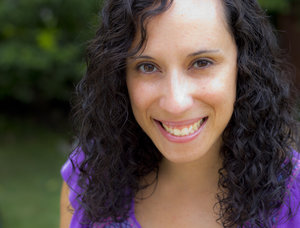
ABOUT THE AUTHOR (from her website): Dania is an author, playwright, and teaching artist. Her middle grade novel Who’s Ju? won the 2015 International Latino Book Award for Best YA eBook and was a finalist for the ILBA Mariposa Award for Best First Book.

Dania’s stage writing credits include Mi Casa Tu Casa (Luna Stage, Dreamcatcher Rep, New Jersey Theatre Alliance’s Stages Festival) and Hielo (developed through the Women Playwrights Project at Writers Theatre of New Jersey). Her plays have also been featured in the New Jersey Women Playwrights Series (co-presented by Writers Theatre of New Jersey and Speranza Theatre Company), Repertorio Español’s Nuestras Voces Reading Series, Writers Theatre of New Jersey’s FORUM and Soundings Reading Series, Luna Stage’s Short Play Festival, and the Maslow Salon Reading Series at Wilkes University. She’s been a finalist in the MetLife Nuestras Voces National Playwriting Competition and the recipient of a New Jersey State Council on the Arts Playwriting Fellowship.

Dania is a creative writing instructor and a theatre teaching artist. She has led arts residencies and workshops for organizations including New Jersey Performing Arts Center, Writers Theatre of New Jersey, Writopia Lab, and the New Jersey School of Dramatic Arts.

Dania is a member of the Dramatists Guild of America, the Society of Children Book Writers and Illustrators, and Actors Equity Association. She holds an MA in Creative Writing from Wilkes University and a BFA in Theatre Performance from Montclair State University. She lives in New Jersey with her husband.

BOOK LINKS: Amazon, Barnes & Noble, IndieBound, GoodReads


ABOUT THE REVIEWER: Caissa Casarez is a proud multiracial Latina and a self-proclaimed nerd. When she’s not working for public television, Caissa loves reading, tweeting, and drinking cold brew. She especially loves books and other stories by fellow marginalized voices. She wants to help reach out to kids once in her shoes through the love of books to let them know they’re not alone. Caissa lives in St. Paul, MN, with her partner and their rambunctious cat. Follow her on Twitter & Instagram at @cmcasarez.

Book Review: One of a Kind Like Me/Único como yo written by Laurin Mayeno, illustrated by Robert Liu-Trujillo


Reviewed by Maria Ramos-ChertokUnico_00-Rob Liu-Trujillo_72 dpi

DESCRIPTION OF THE BOOK: Tomorrow is the school parade, and Danny knows exactly what he will be: a princess. Mommy supports him 100%, and they race to the thrift store to find his costume. It’s almost closing time. Will Danny find the costume of his dreams in time? One of A Kind, Like Me / Unico como yo is a sweet story about unconditional love and the beauty of individuality. It’s a unique book that lifts up children who don’t fit gender stereotypes, and reflects the power of a loving and supportive community. The book is written by Laurin Mayeno, illustrated by Robert Liu-Trujillo, and translated by Teresa Mlawer.

MY TWO CENTS: One of a Kind Like Me/Único como yo is a book every elementary school should own. It takes the subject of gender identity out of the public discourse, where morality and religion weigh heavily in the debate, and puts it into the personal realm of a young boy named Danny/Danielito. Teaching readers about gender expression from a child’s point of view does exactly what children do best – cut right to the heart of the matter. Danny is clear about wanting to dress as a princess for the school parade. His determination and creativity were inspiring to me as an adult reader, yet the book offers a beautiful lesson about the importance of listening to yourself and following your dreams to young and old readers alike. Beyond the gift of the story itself, the book is written in both Spanish and English, providing entry to ideas about gender expression that I have not often encountered in traditional bilingual books. Finally, the ultimate confrontation that Danny/Danielito has with his friends offers a promising way for readers to consider how to react to someone who expresses them self in a way that challenges notions of binary gender roles. While the book is written for children, I’d recommend it as a gift to anyone who might expand their thinking on gender expression.

TEACHING TIPS: One of a Kind Like Me/Único como yo can be used in any elementary school class to begin a discussion on self-expression. A discussion question like: What are the different ways we express to the outside world who we are inside? might be an interesting entree. I’d also strongly recommend it to discuss bullying. For example, What did the kids at school do to make Danny/Danielito cross his arms? How did he deal with it? This could also be a way to get children to talk about experiences they’ve had with bullying, both as perpetrators and victims. That conversation can easily lead to having children brainstorm ideas of how to respond effectively to bullies. For older children in fourth and fifth grade, this book can be used to discuss gender identity and gender expression and how peer groups influence choices about what we share about ourselves and how we share it. It connects well with a talk about peer pressure and how to get in touch with our own sense of what is right for us and what isn’t. Finally, there is an excellent note at the back of the book to parents, caregivers and educators that provides an additional resource where one can access videos, books, guides, organizations, and other services that can be of assistance to anyone wanting to learn more about gender diversity.

photo credit: Scott Hoag of @rockwellcreative

ABOUT THE AUTHOR: For more than 17 years, Laurin Mayeno has provided consulting services to numerous organizations, resulting in greater diversity, more inclusive and equitable work environments, and improved effectiveness working with diverse populations. Laurin’s experiences as a mixed race woman growing up during the social movements of the 1960s, led her to work that fosters inclusion, equity and full appreciation for cultural diversity. Her experience as the mother of a gender-expansive, gay son, also gave her a deep appreciation for importance of responding to gender diversity, which is now a central focus of her work. Her Proud Mom videos and her bilingual children’s book One of a Kind, Like Me/Único como yo are among the resources she has developed to spark dialogue and understanding.

Robert Trujillo by Tiffany Eng

Photo by Tiffany Eng

ABOUT THE ILLUSTRATOR (From his website): My name is Robert Liu-Trujillo. I am the author and illustrator of Furqan’s First Flat Top. I was born in Oakland, California and raised all across the Bay Area. I’m a visual artist, father, and a husband who employs the use of illustration, public art, and storytelling to tell tales. These tales manifest in a variety of forms and they reflect my cultural background, dreams, and political / personal beliefs. My motivation to do what I do is to unearth beautiful and un-told stories, to be a positive and nurturing influence on my son, and to honor my ancestors and family who worked so hard for me to be here. I love music, nerdy things, and can get along well with most people. I seek fun, ice cream, and justice. I’m also a co-founder of The Trust Your Struggle Collective, a contributor to Rad Dad,  and the founder of Come Bien Books.


ABOUT THE REVIEWER: Maria Ramos-Chertok is a writer who lives in Mill Valley, CA. She is the founder and facilitator of The Butterfly Series, a writing and creative arts workshop for women who want to explore what’s next in their life journey. Her work, most recently, has appeared in San Francisco’s 2016 Listen to Your Mother show (www.listentoyourmothershow.com) and in the Apogee Journal of Colombia University. Her piece Meet me by the River will be published in Deborah Santana’s anthology All the Women in my Family Sing  (2017) and she will be reading in San Francisco’s LitCrawl in October 2016.  For more information please visit www.mariaramoschertok.com
April 2017 Latinx Book Deals


Compiled by Cecilia Cackley

This is a monthly series keeping track of the book deals announced by Latinx writers and illustrators. The purpose of this series is to celebrate book deals by authors and illustrators in our community and to advocate for more of them. If you are an agent and you have a Latinx client who just announced a deal, you can let me know on Twitter, @citymousedc. If you are a Latinx author or illustrator writing for children or young adults, and you just got a book deal, send me a message and we will celebrate with you! Here’s to many more wonderful books in the years to come.

April 27

Anne Hoppe at Clarion Books has bought world rights to The Sky’s the Limit, a middle grade memoir by rocket scientist and interim CEO of the Girl Scouts of the USA Sylvia Acevedo. The book is a personal account of how Acevedo overcame childhood poverty through her involvement with the Girl Scouts and Head Start, to become one of the first Hispanics to receive a post-graduate degree in engineering from Stanford University. The book will be simultaneously published in English and Spanish, in fall 2018.

Author agent:  Adriana Dominguez at Full Circle Literary.

Andrea Welch at S&S/Beach Lane has acquired world rights to mother-son team Surishtha Sehgal (l.) and Kabir Sehgal‘s Thread of Love, to be illustrated by Zara Gonzalez Hoang. The picture book is a sibling-love and Indian-holiday story told to the tune of the classic song “Frére Jacques.” Publication is scheduled for fall 2018.

Illustrator agent:  Andrea Morrison at Writers House.

Jenna Pocius at Little Bee has acquired world rights to Coyote Moon author Maria Gianferrari‘s (l.) Operation Rescue Dog, a story told from two points of view: that of a girl on her way to meet her new rescue puppy, and the puppy itself as she approaches their meeting place. Luisa Uribe will illustrate; publication is slated for summer 2018.

Illustrator agent: Alli Brydon at Bright USA.

April 25

The first three books from Disney-Hyperion’s new imprint Rick Riordan Presents were announced, and one is Storm Runner by Jennifer Cervantes, a book about a 13-year-old boy who must save the world by unraveling an ancient Mayan prophecy. It will publish in September 2018.

April 20

Carol Hinz at Lerner/Millbrook Press has acquired world rights to The Vast Wonder of the World, a picture book by Mélina Mangal (l.), illustrated by Luisa Uribe, about the life and accomplishments of Ernest Everett Just, an African-American research biologist. The book is slated for fall 2018.

Illustrator agent: Alli Brydon at Bright USA

April 18

Victoria Rock at Chronicle Books has bought world rights to Rosie’s Sword by Jacqueline Veissid (l.), to be illustrated by Paola Zakimi, in which a girl, always feeling left out of her older brothers’ play, uses a stick and a big imagination to transform the world around her. Publication is slated for spring 2019.

Illustrator agent: Emily van Beek at Folio Jr. / Folio Literary Management.

April 13

None.

April 11

None.

April 5

Kat Brzozowski at Feiwel and Friends has bought 2017 Stonewall Honor recipient Anna-Marie McLemore‘s Blanca & Roja, a magical realist Snow-White & Rose-Red meets Swan Lake, in which two sisters become rivals in a game that will turn the losing girl into a swan. Publication is scheduled for fall 2018.

Author agent: Taylor Martindale Kean at Full Circle Literary.

Book Review: Mamá The Alien/ Mamá La Extraterrestre Written by Rene Colato Laínez, Illustrated by Laura Lacámara


Reviewed by Sanjuana C. Rodriguez

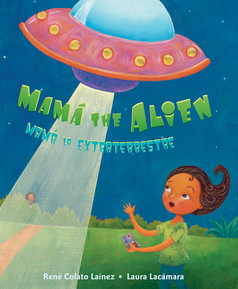
Main_mama_the_alien_fc_hi_res_finalDESCRIPTION FROM THE BOOK JACKET: Sofía has discovered a BIG secret. Mamá is an alien–una extraterrestre! At least, that’s what it says on the card that fell out of her purse. But Papá doesn’t have an alien card. Does that mean that Sofía is half alien?

Sofía heads to the library to do some research. She finds out that aliens can be small, or tall. Some have four fingers on each hand, and some have big round eyes. Their skin can be gray or blue or green. But she and Mamá look like human people. Could Mamá really be an alien from another planet?

Filled with imagination and humor, Mamá the Alien/ Mamá la extraterrestre is a sweet and timely immigration story, and a tender celebration of family, no matter which country (or planet) you are from.

MY TWO CENTS: In this bilingual book, Sofía is bouncing a ball when she knocks her mother’s purse to the floor. In the purse, Sofia discovers a card with the word “ALIEN” at the top. Sofía begins to think that her mother is, indeed, an alien. She even thinks she must be half alien, “I started to put the puzzle together. Mamá was an alien. Papá didn’t have a card, so he was not an alien. That mean I was half alien.”

Sofia researches aliens and wonders how her mother has hidden the fact that she is an alien from her. As Mamá gets ready for her citizenship ceremony, Sofía sees a shadow of her mom with rollers in her hair and tells her parents her suspicion about Mamá being an alien. Sofía learns that the word alien can have different meanings.

Her mother explains, “Sofía, I’m not from outer space. What you saw was my old Resident Alien card. That card allowed me to live and work here in the United States.” The story comes to an end when Sofía’s mom becomes a citizen. This book provides a glimpse into one way a girl makes sense of a complicated immigration process. Few books allow the reader to understand the complexity of the immigration system in the United States through the eyes of a child. This book is an entrance into discussion of the complex process that families must go through to become American citizens.

The illustrations are large and beautiful. In particular, the illustrator, Laura Lacámara, provides vivid pictures of the imagined aliens with humans. It is through the illustrations that we learn that Sofía’s mother is from El Salvador. A picture shows Mamá standing on an outline of El Salvador on a map. The illustrations provided in the thought bubbles add to the story and help the reader understand what Sofía is thinking about.

The author’s note at the end of the book details his own story of coming to the United States and receiving his Resident Alien Card. The author ends the note with the following, “I want readers to know that immigrants may be referred to as aliens, but this only means that they come from other countries. We are all citizens on planet Earth.”

TEACHING TIPS: Author René Colato Laínez wrote a blog post for Lee and Low books titled “No More Illegal Aliens.” In this post, Laínez discusses the use of the term “illegal aliens” and why he advocates for the use of the term “undocumented immigrants. This blog entry could be used as a paired text with the book Mamá the Alien/ Mamá La Exraterrestre.

Also, Lee and Low has developed an extensive teacher’s guide for Mamá The Alien/ Mamá La Extraterrestre. This guide includes vocabulary, discussion questions, specific activities for English Language Learners, and interdisciplinary activities.

PictureABOUT THE AUTHOR: René Colato Laínez is an award-winning Salvadoran author of many multicultural books. He is a graduate of the Vermont College MFA program in Writing for Children & Young Adults. Rene is a bilingual elementary teacher at Fernangeles Elementary School, where he is known by the students as “the teacher full of stories.”


Here are other posts we’ve done about the author:

A Conversation with René Colato Laínez

Book Review: The Tooth Fairy Meets El Ratón Pérez


Laura_photo_2015-300 dpiABOUT THE ILLUSTRATOR
Laura Lacámara is a Cuban-born children’s books author and illustrator. Lacámara holds a Bachelor of Fine Arts in Drawing and Painting from California State University, Long Beach and studied printmaking at Self Help Graphics in East Los Angeles. Her love for writing and illustrating children’s books grew when she signed up for a children’s book illustration class at Otis College of Art and Design in Los Angeles, California. She is the author of Floating on Mama’s Song/Flotando en la Canción de Mamá (Junior Library Guild Selection, Fall 2010 & Tejas Star Book Award finalist 2011-12) and illustrator of The Runaway Piggy/El Cochinito Fugitivo (winner of 2012 Tejas Star Book Award) and Alicia’s Fruity Drinks/Las Aguas Frescas de Alicia.

Here are other posts we’ve done about the illustrator:

Book Review: Dalia’s Wondrous Hair/El Cabello Maravilloso de Dalia

Growing Up Cuban: Laura Lacámara and Meg Medina

Spotlight on Latina Illustrators Part 2: Juana Martinez-Neal, Maya Christina González & Laura Lacámara


ABOUT THE REVIEWER: Sanjuana C. Rodriguez is an Assistant Professor of Literacy and Reading Education in the Elementary and Early Childhood Department at Kennesaw State University. Her research interests include the early literacy development of culturally and linguistically diverse students, early writing development, literacy development of students who are emergent bilinguals, and Latinx children’s literature. She has published in journals such as Journal of Language and Literacy Education, Language Arts, and Language Arts Journal of Michigan.