
By Cecilia Cackley
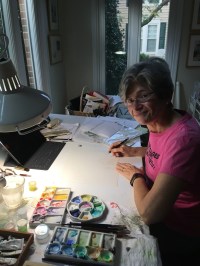
“I’ve decided that this is going to be my best decade!” declares Lulu Delacre. She has just turned sixty and after thirty-eight years in the publishing industry, she has written or illustrated over thirty different books for young readers, making her one of the most prolific Latinx artists working today. Her latest book, Turning Pages is an autobiographical picture book by Supreme Court justice Sonia Sotomayor and arguably Delacre’s highest profile collaboration to date.
Delacre was born in Puerto Rico to Argentine parents who encouraged her love of drawing. After beginning her college career in the Fine Arts department of the University of Puerto Rico, she transferred to L’Ecole Supérieure d’Arts Graphiques in Paris, France. Delacre says she was inspired to apply for the school after learning that a famous Puerto Rican artist had trained there. Her father was skeptical, telling her she wouldn’t get in because of the quality of work required, but she was accepted into the third year of the five year program and eventually received a full scholarship to finish her degree after her family ran into financial hardship. Delacre studied many different artistic disciplines at the school, including typography and print-making, and the course included real-world assignments such as designing a new currency that she remembers as challenging and fun. Some of the more traditional European assignments had amusing results for a student from the Caribbean, she says.
“[For] one of my first assignments we had to illustrate the four seasons, and of course, I was coming from Puerto Rico. So, winter—I did something in pastel pinks and blues and everyone laughed, but of course it was a matter of perspective! I came from an island, I had never witnessed winter before, never in my life.”
Delacre says that she had no idea at that point that you could become a children’s book illustrator. “Books that we got in Puerto Rico were mostly fairy tales from Spain, which didn’t speak to me. The concept of the picture book was entirely foreign to me.” She discovered picture book illustration at an American gallery in Paris which was showing art from the book In the Night Kitchen by Maurice Sendak. “That was a revelation. I had no idea before that moment what I wanted to do.” Delacre had been focusing on graphic arts because she wanted to earn a living and recognized, “I was not at the level of a Picasso,” but now she had found the work that would become her passion.
After finishing school, Delacre moved to San Francisco with her husband, who was in the military. She had no contacts, but started knocking on doors and found work doing textbook illustrations and commercial artwork. When her family moved to Massachusetts, she started giving to the children’s section of the public library and taught herself to create picture books by analyzing examples such as Where the Wild Things Are. With no connections in publishing, Delacre had to hustle to break into the industry.
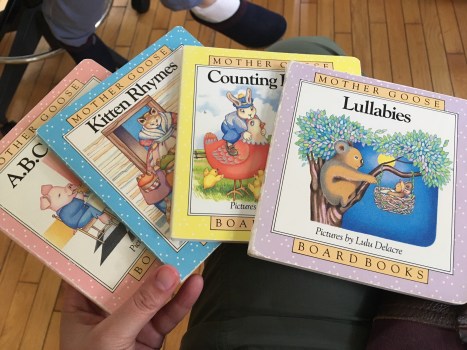
“In order to get into the field, I went to New York. I created two identical portfolios and made twenty-two appointments in five days, stayed at the Y, and by that Friday, I had my first job illustrating for Sesame Street magazine. From there, [I moved to] Simon & Schuster when they had Little Simon. I started illustrating public domain material like these [nursery rhyme] board books.”
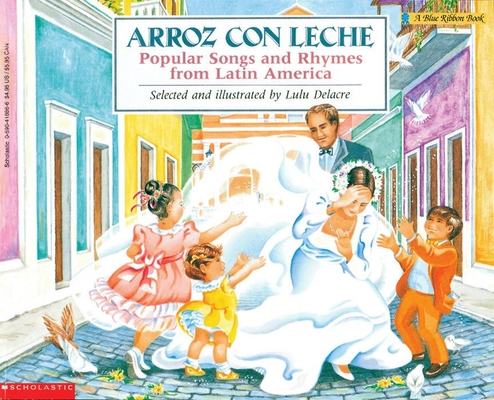
Delacre’s first book to incorporate Latinx culture was inspired by the birth of her daughters, to whom she wanted to introduce to traditional Latin American children’s rhymes. “I went to the library looking for a book of our folklore, from Latin America, our nursery rhymes, and I couldn’t find anything. Why do American kids get to have these books and kids that come from Spanish speaking countries don’t?” Delacre had recently published the Nathan and Nicholas Alexander books with Scholastic, so she went to her editor there and suggested the book of songs and rhymes that eventually became Arroz con leche, which turns thirty this year and is still in print.
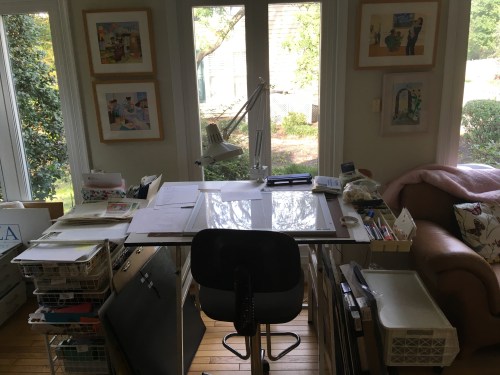
Delacre’s first books with Simon and Scholastic were done in colored pencils, over a thin layer of watercolor to make the process go a little faster. In her home studio in Maryland, she has two large art tables surrounded by materials, including colored pencils, acrylics, watercolors and collage materials. “I do everything the old-fashioned way,” she says. “I like to touch materials. I try to do things that the computers cannot do yet. That’s why I use collage and the textures, pressed leaves—things that the computer doesn’t do or doesn’t do as well.”
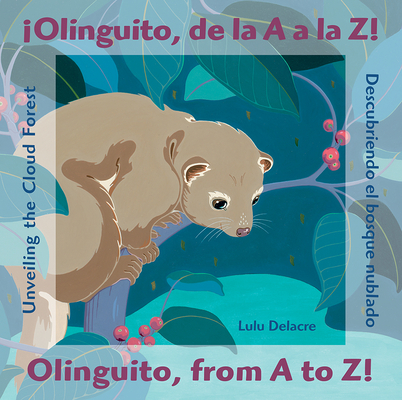
Delacre pushes herself to try new art styles and materials for each project she takes on. Salsa Stories has linoleum cuts because the stories are being told by characters who would have been familiar with that style of art in Puerto Rico in the 1950’s. Her book US in Progress pairs short stories with illustrations created from collaged newspaper, pencil drawings on acetate and texture created from tiny holes in rice paper. Olinguito A to Z, a Spanish alphabet book, was based on scientific information about the different animals who live in the Ecuadorian cloud forest. The different species were painted in flat colors, a graphic version of each animal that reaches back to Delacre’s work as a graphic designer. The background paper for each spread was created from actual leaves from the cloud forest. She also created the typography for the letters that appear on each page. “I created the letters because I wanted them to fit in a square to mirror the shape of the book. I wanted to show the kids what the mist looked like. In the cloud forest, you would see everything through the mist, so to reveal the true colors of the species, I gathered the mist in the squares surrounding the letters.”
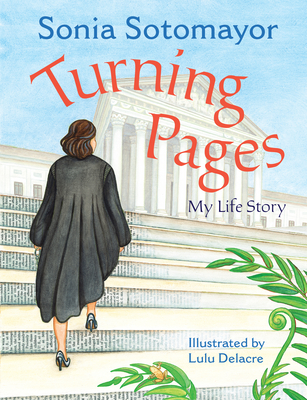
Delacre’s most exciting recent project is the picture book autobiography Turning Pages by United States Supreme Court Justice Sonia Sotomayor. She explains that the process of getting the assignment was a bit unusual. “I got an email from [editor] Jill Santopolo asking if I had an agent, and I said not any more, and so she goes, “I need to talk to you, can I call you tomorrow?” and I said sure and gave her my number. I get a call the next day and she begins by saying, “I have a somewhat secret project that needs to be fast tracked and we want you for it.” And then she explains about the project and I pause, it’s sinking in and I said “Why me?” I had never worked for this publisher, and I had never worked with her. And she answers, “’Because she chose you,’ meaning the justice. This is very rare—this is the very first time that the author handpicks me.” Delacre goes on to explain that Sotomayor was given a stack of picture books to look at when selecting an illustrator and that one of the reasons she chose Delacre was because the justice wanted the illustrations to be lifelike. “I know that one thing that was very important to her was to portray her mamá and her abuelita as close as possible to reality.” Sotomayor also appreciated that Delacre has a strong relationship with the island of Puerto Rico. Although the book mostly takes place in urban settings such as the Bronx, Delacre began each oil wash with a layer of green sap oil, because Sotomayor wanted the island to be present in the illustrations. The original artwork from Turning Pages can be seen in the Zimmerli Art Museum at Rutgers University through March 17, 2019.
Delacre says that her advice to Latinx illustrators trying to break into publishing is “Follow your heart. Tell the story that you really have within you and you really must tell. Don’t feel like you have to be like someone else. Just be yourself.” Delacre points out that unlike other children’s book illustrators such as Tomie DePaola, she doesn’t have a specific, recognizable art style. “In the beginning of my career, I thought it was a flaw because I understood if I didn’t have a certain style, I wasn’t as recognizable name wise. But I can’t be that way because I get bored doing the same thing over and over again. I have to push myself to try new things because each project is about learning for me. What can I do with this that I haven’t done before?” She is talking about using mono prints for her next project, in black and white, a major departure from her usual paint and colored pencils. “Now it’s like I don’t have to prove anything. You know, this is going to be my best decade and after that who knows? Maybe I’m not going to do another book. I’ll be creating, but something different. Every single project I do is really to reach a community that perhaps wasn’t finding their image in books. I’m always trying to create what is needed.”
 Cecilia Cackley is a Mexican-American playwright and puppeteer based in Washington, DC. A longtime bookseller, she is currently the Children’s/YA buyer and event coordinator for East City Bookshop on Capitol Hill. Find out more about her art at www.ceciliacackley.com or follow her on Twitter @citymousedc
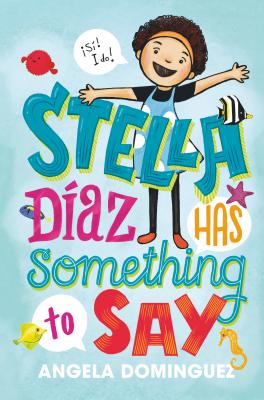 DESCRIPTION OF THE BOOK: Stella Diaz loves marine animals, especially her betta fish, Pancho. But Stella Diaz is not a betta fish. Betta fish like to be alone, while Stella loves spending time with her mom and brother and her best friend Jenny. Trouble is, Jenny is in another class this year, and Stella feels very lonely. When a new boy arrives in Stella’s class, she really wants to be his friend, but sometimes Stella accidentally speaks Spanish instead of English and pronounces words wrong, which makes her turn roja. Plus, she has to speak in front of her whole class for a big presentation at school! But she better get over her fears soon, because Stella Díaz has something to say!
 ABOUT THE AUTHOR:
  ABOUT THE REVIEWER: Jessica Agudelo is a Children’s Librarian at the New York Public Library. She has served on NYPL’s selection committee for its annual 100 Best Books for Kids list, most recently as a co-chair for the 2018 list. She contributes reviews for School Library Journal of English and Spanish language books for children and teens, and is a proud member of the Association of Library Services to Children, Young Adult Library Services Association, and REFORMA (the National Association to Promote Library and Information Services to Latinos and Spanish Speakers). Jessica is Colombian-American and born and raised in Queens, NY.
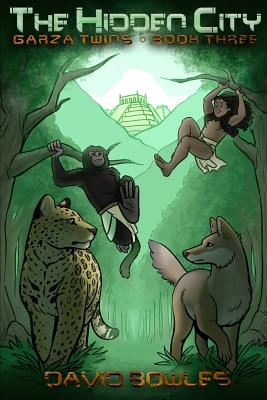 DESCRIPTION OF THE BOOK: When Carol and Johnny learn of the Ollamat, an ancient stone that can channel savage magic, they convince their parents to take them to the cloud forests of Oaxaca. With Pingo’s help, they search for the legendary city where it has been protected for a thousand years. But the twins aren’t the only ones hunting for the Ollamat. After it is stolen, they must travel through an emerald mirror into the beautiful yet dangerous Tlalocan: the paradise of the rain god. To retrieve the stone, they must face talking apes and forest elementals, rock worms and vicious elves, demons of lightning, and something even more unexpected: the souls of people they have watched die. As always, they are aided by allies old and new, though nothing can quite prepare them for the biggest foe of all – a member of their very family.
 ABOUT THE AUTHOR: A Mexican-American author from deep South Texas, David Bowles is an assistant professor at the University of Texas Rio Grande Valley. Recipient of awards from the American Library Association, Texas Institute of Letters and Texas Associated Press, he has written a dozen or so books, including Flower, Song, Dance: Aztec and Mayan Poetry, the critically acclaimed Feathered Serpent, Dark Heart of Sky: Mexican Myths, and They Call Me Güero: A Border Kid’s Poems. In 2019, Penguin will publish The Chupacabras of the Rio Grande, co-written with Adam Gidwitz, and Tu Books will release his steampunk graphic novel Clockwork Curandera. His work has also appeared in multiple venues such as Journal of Children’s Literature, Rattle, Strange Horizons, Apex Magazine, Nightmare, Asymptote, Translation Review, Metamorphoses, Huizache, Eye to the Telescope, and Southwestern American Literature. In April 2017, David was inducted into the Texas Institute of Letters for his literary work.
 ABOUT THE REVIEWER: Cris Rhodes is a lecturer in the English department at Sam Houston State University. She recently completed a Ph.D. in English with an emphasis on Latinx children’s literature. Her research explores the intersections between childhood activism and Latinx identities.
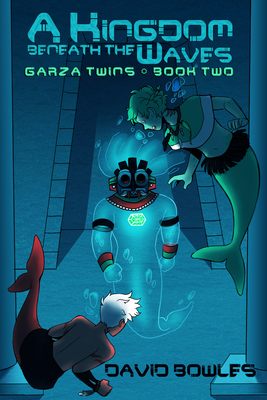 DESCRIPTION OF THE BOOK: The Garza family’s Christmas vacation in Mexico is cut short by the appearance of Pingo, one of the tzapame – Little People. The news is grim – a rogue prince from an ancient undersea kingdom is seeking the Shadow Stone, a device he will use to flood the world and wipe out humanity. Now Carol and Johnny must join a group of merfolk and travel into the deepest chasms of the Pacific Ocean to stop him and his monstrous army with their savage magic.
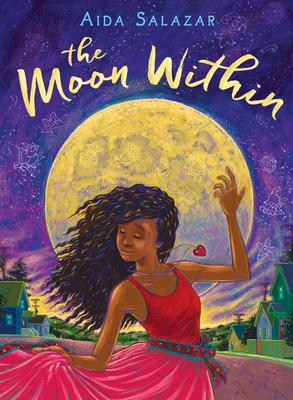 DESCRIPTION OF THE BOOK: Celi Rivera’s life swirls with questions. About her changing body. Her first attraction to a boy. And her best friend’s exploration of what it means to be genderfluid. But most of all, her mother’s insistence she have a moon ceremony when her first period arrives. It’s an ancestral Mexica ritual that Mima and her community have reclaimed, but Celi promises she will NOT be participating. Can she find the power within herself to take a stand for who she wants to be?
 ABOUT THE AUTHOR:
  ABOUT THE REVIEWER: Mimi Rankin has a Master’s Degree with Distinction in Children’s Literature from the University of Reading in the United Kingdom. She is currently a Marketing Manager for a company working with over 25 publishers worldwide. Her graduate research focused on claims of cultural authenticity in Hispanic Children’s Literature and her dissertation received highest marks.
 Latinxs in Kid Lit