How an Adult White Guy Came to Write About a Latino Teen

By William Hazelgrove

17239293The first question I get is usually: “How could you write in the voice of a thirteen year old Latino boy?” I am about as far as you can get culturally from a young adult Latino just barely hanging on with his mother. But of course, if you are a writer, you are so many people that biographers will never get it straight. It is the same way I wrote in the voice of an old African American man in Tobacco Sticks and in Mica Highways.

Voice is everything. Once you have the voice you have the novel. When I started The Pitcher, I wrote it in third person but quickly realized it would not work that way. It was boring and distant. So I started over and I knew it had to be first person, but who would tell the story? The old pitcher? The mother? No. The boy, Ricky would tell the story. And so I started to play around with his voice. Then I wrote one paragraph:

I never knew I had an arm until this guy calls out, “Hey, you want to try and get a ball in the hole, sonny?” I am only nine, but Mom says, “Come on, let’s play.” This carnival guy with no teeth and a fuming cigarette hands me five blue rubber balls and says I throw three in the hole, then we win a prize. He’s grinning, because he’s taken Mom’s five bucks and figures a sucker is born every minute. This really gets me , because we didn’t have any money after Fernando took off, and he only comes back to beat up Mom and steal our money. So I really wanted to get Mom back something, you know, for her five bucks.

And I had Ricky then. I had the novel. And where that voice came from is anyone’s guess. Maybe it is that kid who messed around in Baltimore City where I grew up. Maybe it was some of the Mexican guys I worked with in security. And the hard times Ricky and his mother go through are my own hard times. And the baseball is my son’s baseball and the coaches and parents are from nine years of being an assistant coach with my son. The immigration issues are from our time.

When I was thinking about writing The Pitcher, I was reading what was going on in Arizona at the time with immigration and the whole stop and ask people for their papers to deport them back to Mexico. When I wrote the mother character Maria I wanted her to have the same outrage that I felt reading about this practice of stopping people and demanding to see their papers. I wanted her to draw the conclusions that this was fundamentally un-American and I wanted her son Ricky to pick up on that especially since he was facing off with a Tea Party mom and her son.

I read a lot of accounts about Dream Kids in this country and how they had made their lives and then were in danger of being deported. That was really how I got the idea of making Ricky a Dream Kid. His mother did come over and make a life and now she was in danger of being deported.

Culturally, I knew Ricky because I know how it feels to be an outsider and to have all the odds stacked against you. Ricky’s dream of becoming an MLB pitcher is my own of becoming a novelist against immense odds.

Then again, maybe it was just Ricky flying around out there waiting to be born. But when The Latina Book Club made it their Monthly Selection or LatinoLA did a story on the immigration issues in the book or I stand up on a stage at the Latino Book Festival in Chicago and read my book that has to be translated to Spanish so the audience can understand what I am saying is…even I wonder how a I came to write a Latino novel.

 I guess I just did.
 

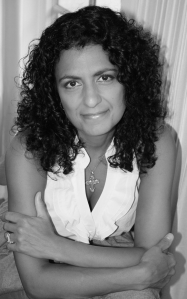
DSC_0020William Hazelgrove is the author of five novels, Ripples, Tobacco Sticks, which hit the National Bestseller List, Mica Highways, Rocket Man and The Pitcher. He was the Ernest Hemingway Writer in Residence where he wrote in the attic of Ernest Hemingway’s birthplace. He has written articles and reviews for USA Today and other publications. He has been the subject of interviews in NPR’s All Things Considered along with features in The New York Times, LA Times, Chicago Tribune, and the Chicago Sun Times, among others. His most recent novel, The Pitcher is a Junior Library Guild Selection. He runs a political cultural blog, The View From Hemingway’s Attic.


Let’s All Make the #WeNeedDiverseBooks Campaign an Ongoing Movement

By Patrick Flores-Scott

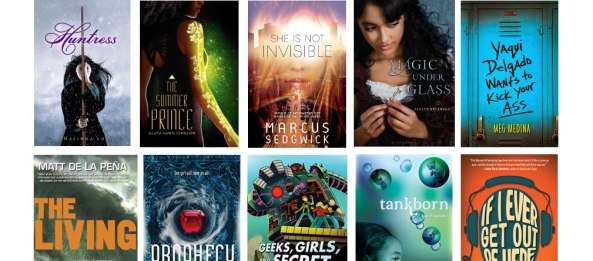
#WeNeedDiverseBooks. The trending hashtag is a channel for conversation around the huge problem of a lack of diversity in children’s literature. The problem has been noted in many recent articles and so have the reasons we need more books by diverse authors and books with complex, real diverse characters.

For many years I was lucky to be a public school teacher in very diverse schools. At different points I was both a general education classroom teacher and a reading specialist. As a classroom teacher, I was able to seek and find the books I wanted my class to hear and read. More often than not, these books had main characters of color. I had the time, energy, resources, and relationships that helped me find great books that my students loved.

My students, however, especially my reluctant readers, were not going to work so hard to find a book that would reflect the cultural, racial, socio-economic realities of their community. They were going to pick the available book, the one closest to their hand when it was time to leave the library, or the trendy book that made them look like they were in the reading “know.”

Embedded image permalink

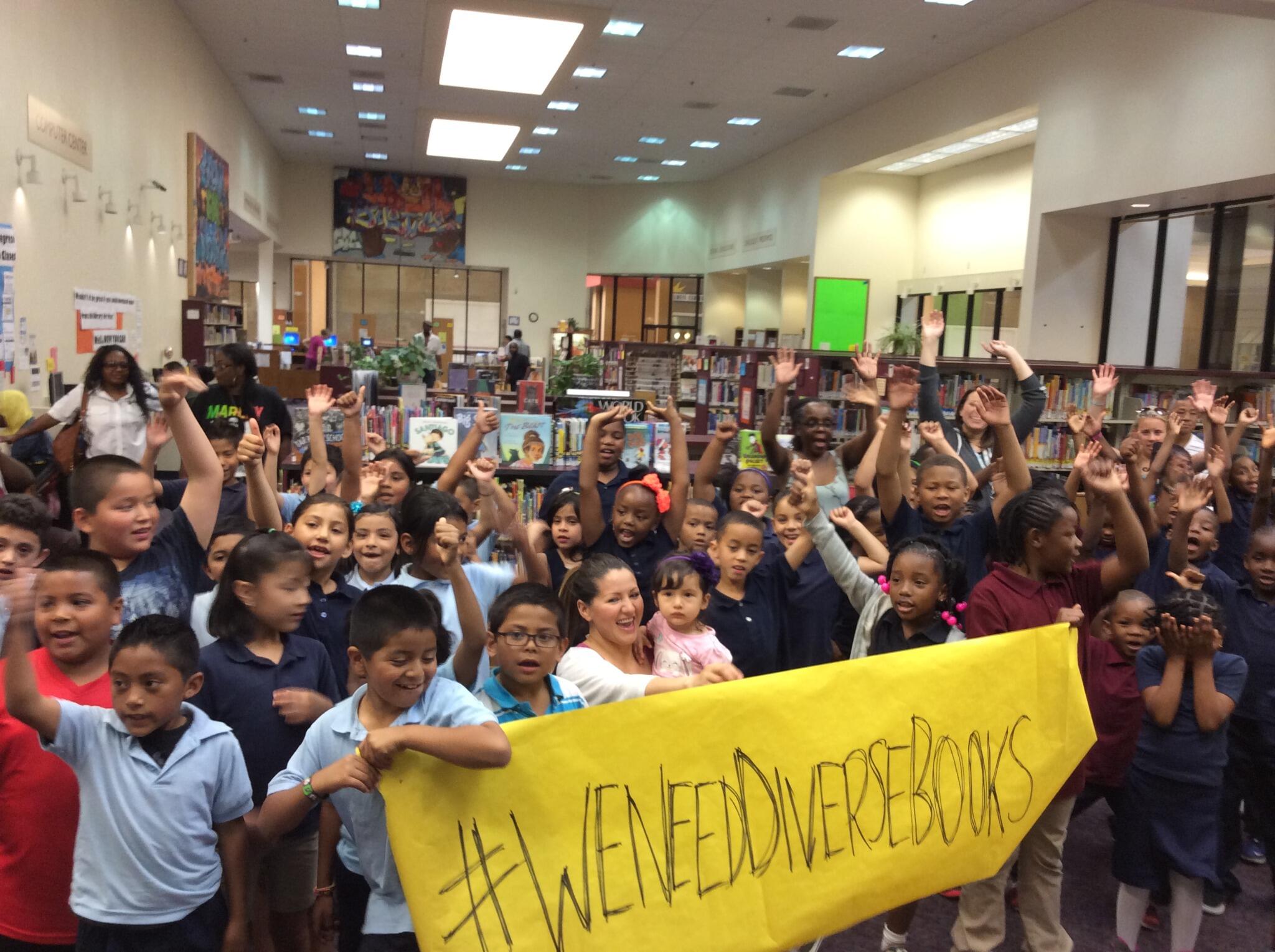
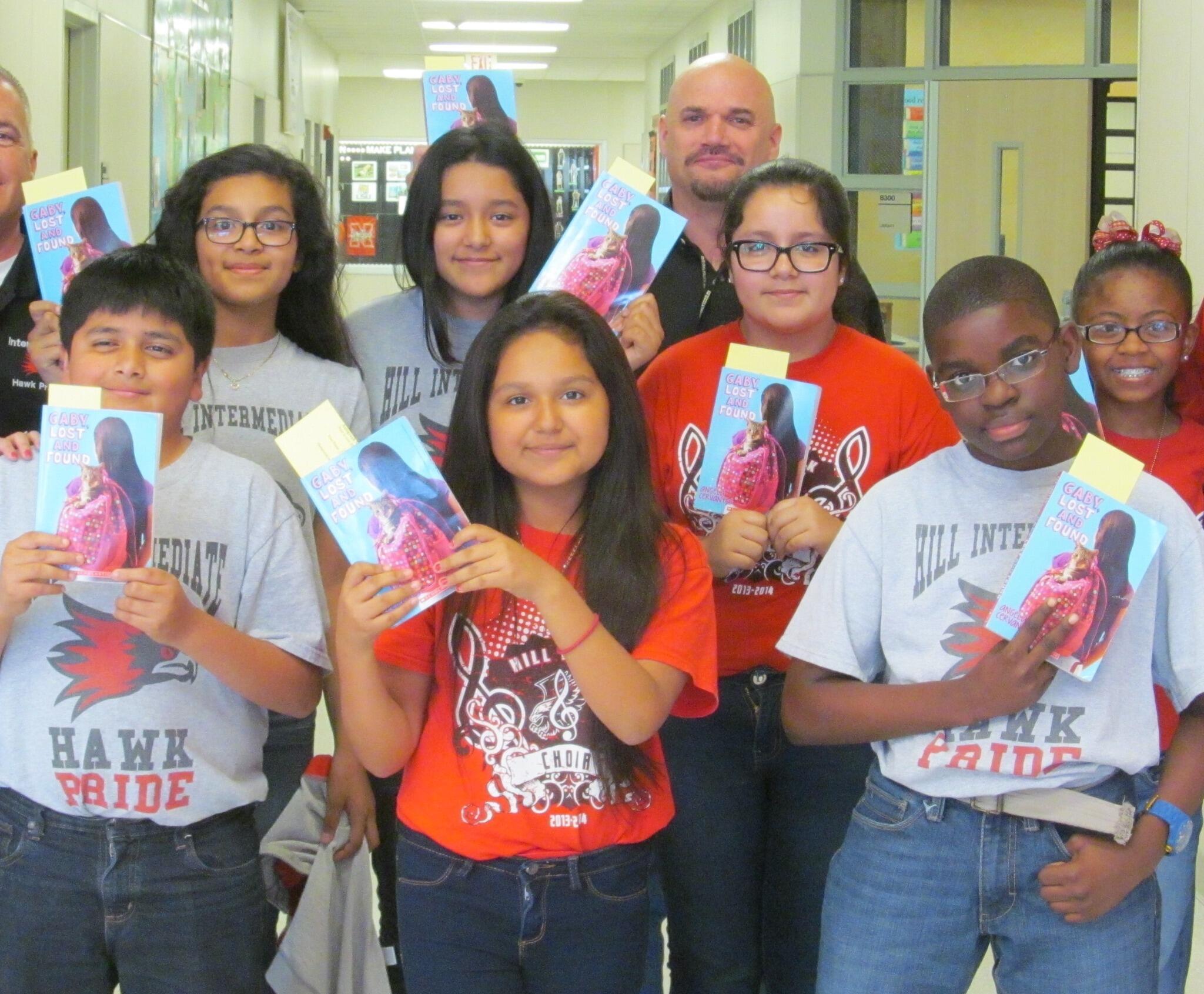
Author Angela Cervantes posted this picture on Twitter during the #WeNeedDiverseBooks Campaign.

Students need to be able to accidentally stumble their way into a great book that reflects their own background or one that opens their eyes to new characters and communities. They shouldn’t have to work for it. They shouldn’t have to fight for it. Kids have enough on their plate. Yes, some students are going to research authors, seek out new books and reading experiences, challenge their school librarian and make demands. Most fifth graders, however, are just struggling to make it through the day. They end up with the default book… and given the math of the situation, they’re going to walk out with another book by a white author with a white main character. Is this a tragedy? In the moment, no. That default book might be a great one. But this scene takes place over and over each day in most schools in the country and that great book–if the student is lucky–may just be another in a long line of books that reinforces the notion that great books are written by white authors and that white kids are the ones worthy of books written about them.  This notion is a toxic one, regardless of a student’s background.

Children’s books are a piece of a larger pie. A lack of diversity in film and television reinforces the notion that white stories are more relevant than non-white stories. The make-up the Senate (97 out 0f 100 are white) reinforces the notion that non-whites do not have a role in the highest levels of politics. Yes, there is the President, but his cabinet is made up of 70% white males. Kids see this. They see thousands of African American college athletes and they know that, in the vast majority of cases, these athletes are led to battle by white coaches. They know that the percentages of Black and Latino men in prison are crazily out of proportion with the population of Black and Latino men. Kids see all this. They take it in. The perceptions become realities for them.

My wife and I are the proud, exhausted parents of two rambunctious little boys. Their grandparents are Mexican-American on their mom’s side. My parents are white. My dad is from the U.S., my mom a Spanish-speaking Latina from South America. We will raise our boys to be proud of all that they are and proud of all the Latino, Caucasian, African-American, Asian and mixes of the aforementioned that make up their diverse extended family. While we will do our best to teach that the content of one’s character, not the color of one’s skin (one’s gender, sexual orientation, physical ability) is what is important, television, our political and judicial systems, sports…. And even the make-up of CHILDREN’S BOOKS, will send messages that complicate, skew, and even deem our parental message well-meaning, but just wrong.

Embedded image permalink

The Oakland Public Library in California posted lots of great pictures like this one on Twitter during the #WeNeedDiverseBooks Campaign.

What do we do about it? The #WeNeedDiverseBooks Movement (Can it please be a movement? We need more movements around here.) is a potentially very important call for change in the children’s book world. Now, we need to push for intentionality. Gatekeepers need to have their feet held to the fire. The Movement (!) needs to push publishers to set goals that trend their books in a more realistically diverse direction. It needs to push the industry to hire editors from diverse backgrounds and to hire and support diverse interns and entry-level assistants who can have the power to move books off the pile and into editors’ hands. The Movement needs to hold publishers accountable.

Institutions which support writers and illustrators, like my beloved SCBWI, need to recruit underrepresented writers to their conferences. (And to check out the percentage of white male panelists and speakers compared to the percentage of white male attendees.) Groups like SCBWI need to be pushed to intentionally foster and mentor a more diverse writing community.

The movement needs to push us published authors of all colors and stripes, to mentor diverse up-and-comers, to include pro-bono school visits to underfunded schools, and to write real, complex, fallible diverse characters who live the entirety of the American experience.

Members of The Movement need to request diverse books at their bookstores and libraries. We need to post reviews on Amazon and Goodreads and library websites. Members of the Movement need to advise book bloggers and to follow and support blogs like this one. We need to give diverse books as birthday presents and to talk about our favorites on the bus, at work, in line at the bookstore…

Members of The Movement need to push our political leaders to support the health, education and welfare of our future readers and writers.

Publishers, agents, bookstore workers, librarians, teachers, authors… there are bunches these folks out there doing the positive stuff that will make change possible. The Movement needs to support them and it needs to push for intentionality in those who mean well, but have not yet made the move to change.

PatrickFS1Patrick Flores-Scott was, until recently, a long-time public school teacher in Seattle, Washington. He’s now a stay-at-home dad and early morning writer in Ann Arbor, Michigan. Patrick’s first novel, Jumped In, has been named to a YALSA 2014 Best Fiction for Young Adults book, an NCSS/CBC Notable Book for the Social Studies and a Bank Street College Best Book of 2014. He is currently working on his second book, American Road Trip.

Jumped In was featured in Libros Latin@s on Thursday. Click here to see the overview.


Guest Post: Author Danette Vigilante on the Importance of Dream Seeds

By Danette Vigilante

When a dream seed is planted and watered everyday, it has no choice but to grow and blossom. You might be wondering what in the world a ‘dream seed’ is, so I’ll tell you.

A dream seed is usually planted deep inside you when you’re a child. It could come from the smallest of compliments such as, “You’re really good at (fill in the blank)” or “I really like (fill in the blank) about you.”

In my case, my dream seed came from the pen of my fifth grade teacher. This realization didn’t hit me until I was well into adulthood. Like, WELL into it. As a matter of fact, I went years being somewhat envious of people who spoke of a special teacher who had planted their dream seed early on in their lives.

We’ve all seen talk shows where a beloved teacher is surprised by an old student who grew up into an awesome adult doing awesome things all because of this teacher. Yes, I felt happy for these people, and even shed a tear because their meeting was so touching. Plus, I absolutely love when people achieve their goals in life. But I also held a question quietly inside. It’s a question I’m not too proud to admit I had. I wanted to know where my dream-seed-planting-teacher was when I was growing up. Wasn’t I good enough? Worthy enough? Wasn’t there a teacher somewhere in my young life who cared?

Getting back to my fifth grade teacher and what she wrote with her magic pen. It was one simple sentence on the back of my report card: “Danette needs help in reading.” Those five words ignited a fire in me, and I ran to the library in order to put it out. And by ‘put it out,’ I mean I began reading as if my life depended on it. To be honest, part of that was because I wanted to prove my teacher wrong. I needed help with reading? My attitude was, “Humph, I’ll show you.” Did I mention I was in fifth grade?

I’d spend whole days in my bedroom reading, and when it was time for bed, I read beneath the covers using a dollhouse lamp until I could no longer keep my eyes open.

I loved the smell of the library, the small creaking sound the books made when you first opened them. I loved peeking underneath the plastic covers to see what the “real” cover looked like. I especially loved how the library made me feel: independent and strong.

I’d look at all those shelves filled with books, catch my breath, and wonder which ones I would choose that day. Once decided, I’d pile them up and excitedly carry them home.

My dream seed began to take root in the form of a teeny, tiny thought— maybe one day I could write a book. The thought was almost silent, but it had always stayed by my side, patiently waiting.

You can imagine how overjoyed I was to finally recognize that I, too, had a teacher who had gifted me a dream seed. It doesn’t matter why I had “watered” it, the most important thing was that I did.

Danette_Vigilante_head_shot_high_resDanette Vigilante grew up in the Red Hook Houses in Brooklyn, New York. She now resides in Staten Island with her husband, two daughters, two puppies, and a cat with a bad attitude. Danette is the author of THE TROUBLE WITH HALF A MOON, a 2012-2013 Sunshine State Young Readers award nominee, and SAVING BABY DOE.

What We Talk About When We Talk About Diversity in YA

Or, what does that even mean?


By Zoraida Córdova

Brace yourselves. Here’s another blog post on the lack of diversity in YA. When we bring up these topics the common words I see are FEAR, UNCOMFORTABLE, GUILT.  If a white person brings up the subject then, “who are they to talk about it?” If a POC does it, we’ll be seen as a bunch of angry people. So, Catch 22. I get it. Writing these posts is HARD, but they should be written. Recently one of my favorite authors ever, Jenny Han, tweeted about diversity in YA. The thing is, we need to feel uncomfortable, and like Jenny said, “that’s the risk.”

Screenshot 2014-03-26 16.39.47

ecsaHere’s what you need to know about me. I was born in Ecuador. I moved to Queens, NY when I was 6. Being in America for 20 years makes me American. My public school experience is American. Yet, when people look at me and hear me speak, they are perplexed. Why? You got me.  The “Your English is so good!” “What are you?” “My friend is from Ecuador, do you know LUIS PABLO ESTEBAN SANTIAGO?” Spoiler alert: I don’t.

This difference wasn’t apparent to me from the beginning. Between grades 1-4, I was in bilingual classes. (My Little Mermaid Spanish didn’t get me to the top of the class right away.) All of my classmates had either emigrated from a Latin American country or had Latin American parents. Salvadorian, Peruvian, Puerto Rican, you name it. Guess what, we spoke English. We listened to the Spice Girls. We cut up our bangs like Lindsay Lohan in The Parent Trap. We watched TRL and taped the music videos. We learned the awesome moves to Christina Aguilera’s Genie in a Bottle (She’s half Ecuadorian, BTW). At home, sometimes I’d eat Chef Boyardi ravioli, sometimes I’d have rice and steak and beans.

So when I got to 5th grade, I was placed into the “regular” kids class. English only. Suddenly my friends also included Guyanese, Jamaican, African-American. Guess what, we still listened to shitty New photo 4 (1)Millennium pop and idolized Harriet the Spy.
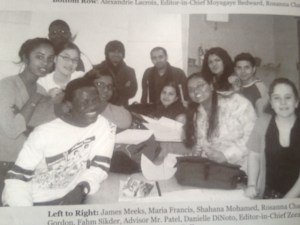
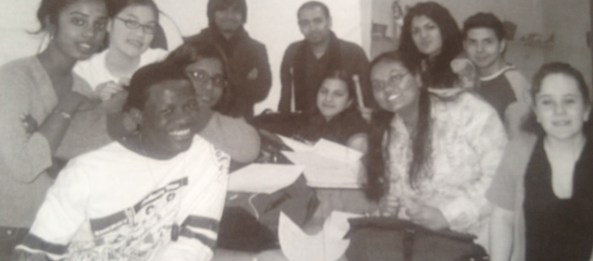
Junior high school and high school were also the same thing. Look at all the shades of brownness! Here are some pictures from my high school yearbook. Spoiler alert: I am still a nerd.

My experience growing up in neighborhoods that are already diverse gives me a different perspective. Could I have used more diverse characters in my current books? Yes. My trilogy centers around a white merman from Brooklyn. His love interest is mixed. His friends are mixed. Merpeople in my world come in all shades. But the answer is still yes. You can always add diverse characters into your books.

photo 3 (1)When people say they’re “afraid” they’re not going to give their “Other” character justice by writing from an experience other than an Anglo-American experience, I call bull. It is scary writing about an experience other than yours. However, unless your character has just moved to Kentucky from a remote town in Panama, then why are you afraid to write the experience of an otherwise straightforward character? Your character can still be named Danilo Cordova and the only research you have to do is “What does a teenage boy like?”

If your character is Nuyorican, then you’d have to do more research. Stereotypes need not apply. Because, here’s a little known secret, not all Latin experiences are the same. No matter where we were born, when we immigrated, where we were raised, we can’t be lumped into the same experience. This is not to say that every YA author should write a novel about how hard it is to grow up being brown, because I did it and my adolescence was pretty “average.”

If you’re writing a fantasy/sci-fi novel and there is not a single non-white person to be found, then my only question is “how come?” Here you have a chance to create a whole new world, where our carefully constructed American ideal of white-only beauty need not apply. When I read YA fantasy novels and the only time race is mentioned is when a new character comes in and has “chocolate” or “earth colored” skin, I just cringe. This mean everyone else I’ve been reading about is white. Not only is that lazy writing, it’s a limited way of thinking about a world that is supposed to be fantastical.

Screenshot 2014-03-26 17.01.57

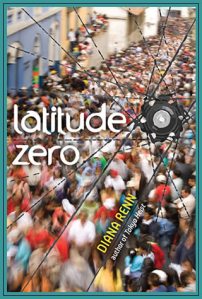
So how do we fix this? Well, lets talk about it. Let’s be friends. Reach out to someone who has a different experience as you. READ. I  to this date have yet to read a YA about a teenage Ecuadorian girl. Not even a slice of life story about a girl who falls in love and there’s a nice cover of them at the beach, or lying down on a lawn. I am, however, excited about Diana Renn’s upcoming YA thriller Latitude ZeroThe book takes place in Boston and in Ecuador. Diana is not Ecuadorian, but she wrote an exciting novel with diverse characters. She reached out and did her research. latitudecover

Here we go back to this FEAR concept. If you throw in a character named Chiquita Bonita in the middle of the scene, and she has hoop earrings and says “Ay, mami,” then you should be afraid because you’re propagating a stereotype. If you describe your Latina girl as “exotic,” “curvaceous,” “spicy,” or “saucy” then you are propagating a stereotype, or making gumbo IDK. If you’re like Britney Spears and equate a Latin male with “the bad boy type,” then you should be afraid because you’re propagating a stereotype. If you as an author can go on Google and research “how to kill someone and get away with it” because “your protagonist needs to know” then you can also try Googling about other American communities that are not your own.

There is a difference between being afraid to write about a culture that is not your own, and consciously creating a two dimensional stereotypical character.

Romeo and Juliet0001

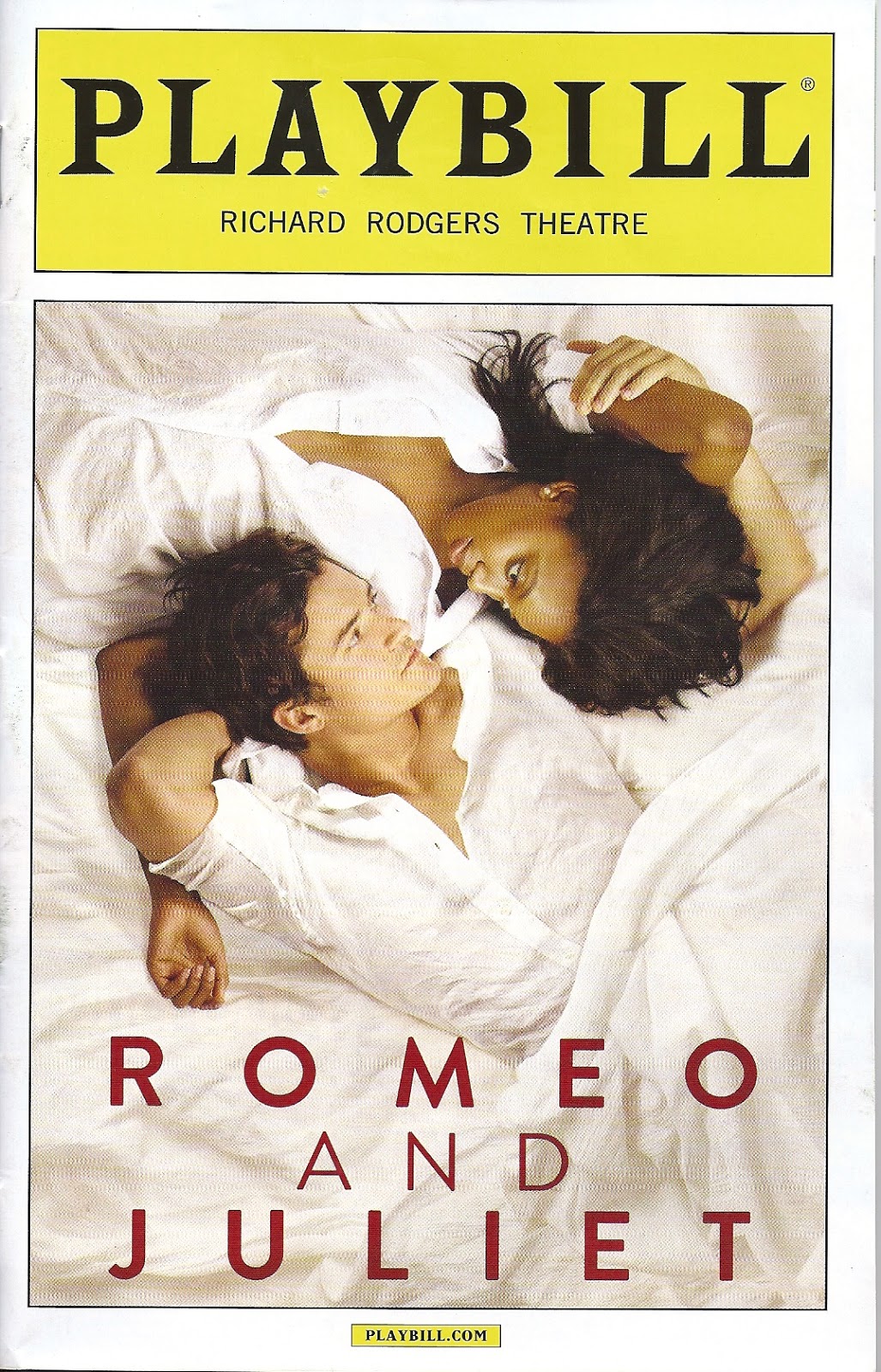
One of my favorite retellings of Romeo & Juliet is the most recent one on Broadway, partially because Orlando Bloom is shirtless but also because Juliet is black. They aren’t divided because of their skin color. This isn’t West Side Story. It’s not that one is brown and from the wrong side of the tracks, and the other one is nice and white, so they can’t be together. This is a story of feuding families that have been feuding so long they can’t even remember why or how it started. It’s that simple.

If you’re worried you’re still propagating a stereotype, then reach out. You’ll make a friend. You’ll learn something new. I am extremely lucky to have had diverse friends. I know that’s not the case for everyone and I know that if you’re not in a big city, chances are the POC in you neighborhood are marginalized. I’m not in Arizona where they’re trying to wipe out Mexican studies. I’m not in a tiny town in Ohio where there is one black kid in the class. I’m in NYC, which isn’t perfect and has a history of putting away their low income minorities to make room for gentrification. But my eyes are extremely open (and I got new glasses today) as to the future we need to create for Young Adult literature. It’s a team effort.

Maybe if we keep making it a point, when we talk about diverse characters in the coming years, it will be more than just a trend; it’ll be the new norm.


Edited: 3/31/14

*** Representation of Latin@s in media has been a personal focus for me.  This is not to say that “diversity” to me means only adding Latin@s to literature. The conversation extends to all marginalized people. Like I said, lets talk about it.

A Note For Authors on Jumping Genres

By Stephanie Guerra

Writing in a new genre after successfully publishing a book (or books) can be intimidating; why change what works? Some agents and publishers actively discourage genre-hopping, while others are interested in quality rather than consistency or brand-building.

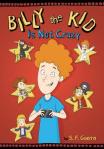
TORNI debuted in 2012 as a YA author of realistic fiction (Torn) and followed up in 2013 with a 90-degree turn to humorous, heavily-illustrated middle grade: Billy the Kid is Not Crazy. I have two more YA coming out next year and I’m finishing a picture book.

If you’re a writer drawn to similar genre shifts, I encourage you to follow your gut. The process can be both freeing and useful in developing range. You may have to rebuild your audience from scratch, which is intimidating. But you’ll end up with a broader audience, a reward in itself.

Billy the KidYou’ll also need to adjust your voice and mentality for your new audience. Transitioning from YA to MG, I had to get in touch with my booger-fart-joke side (it wasn’t that hard) and cut all edge out of my writing (a touch harder). Again, the work builds its own reward: increased range.

But I want to focus a spotlight on the positives, which I believe are the real essence of shifting genres. It’s a form of creative stretching, a way to access a different age or voice inside you, and a way to reengage with the “play” of writing. A YA author may discover a new sense of fun in MG or picture books. An MG author may find freedom in exploring the romance or more mature content possible in YA. A picture book author used to practicing economy with words may relish stretching out into a luxurious novel.

Consider one of the most beloved Latin@ authors of our times, Gary Soto. He’s produced excellent picture books, poetry, middle grade and YA novels, short stories, and adult works. Pam Muñoz Ryan, another Latin@ star, has ranged from picture books to award-winning YA. Jack Gantos, my personal hero, has created picture books, delightful middle-grade (Joey Pigza!), adult novels, and urban memoir.

Some other marvelous children’s authors who’ve changed genres: Madeleine L’Engle, Mark Twain, Roald Dahl, and Laurie Halse Anderson. Literary superheroes like E. B. White jumped from Charlotte’s Web to One Man’s Meat. Roald Dahl dabbled in memoir, adult short stories, suspense, erotica, and of course, children’s fiction. And C. S. Lewis wrote everything short of picture books. What better models could we have?

I like to view jumping genres, too, as an act of defiance to The Market. Conventional wisdom has it that it’s savvy to develop a brand and stick with it, to build an audience and churn out book-clones at the rate of one per year. Many authors do this very successfully, and there’s nothing wrong with it, if it’s fulfilling to the artist in question. But I’m unsettled by branding as a lens for the arts and as a concept imposed on authors by publishers. Branding seems to compete with the essence of what art is or should be. So I advocate stretching the brand. Or better yet, losing the term altogether.

I’d like to share a short (30 second) video of a really articulate 11-year-old reviewing my MG. Thank you, Garrison. Your review gives me confidence that jumping genres was the right choice.

Writing Tips and Diversity Points at the SCBWI Winter Conference

By Cindy L. Rodriguez

The Winter Conference of the Society of Children’s Book Writers and Illustrators in New York is kind of like a massive family reunion, with all 1,000+ people having a love of children’s literature in their blood. It’s very cool for me to break away from my full-time day job as a middle school teacher and attend this annual gathering of creative people who all want to be published or work in some capacity with kid lit. While this love of children’s literature is the common denominator at the conference, the attendants are diverse people with myriad interests. Because of this, my ears naturally perk up when speakers address diversity in publishing.

The SCBWI did not have a specific panel or break-out session dedicated to diversity in children’s publishing, but speakers included Raul Colón, Shadra Strickland, Jack Gantos, and Nikki Grimes. Also, the topic of diversity popped up throughout the conference as writers, illustrators, and editors offered great advice about craft.

During her Saturday session, Anica Rissi, an executive editor at Katherine Tegen Books, outlined seven essential things to remember about writing contemporary fiction.

  1. Just do it: write regularly. Make time for this in your life. Be fierce in protecting your writing time.
  2. Give the reader something to wonder about.
  3. Start with the story, not the back story. Throw us into the action.
  4. You need both external and internal tensions, a plot arc and an emotional arc. You need that emotional growth.
  5. Details should matter. Ask what is this book really about? Is every scene a part of that? When in doubt, take it out.
  6. You need to bring out relatable truths through your characters. Create timeless and timely essential relationships and show how the relationships change the character. During this part of her talk, she said, “Please don’t just write about white people and please don’t just write about straight people.” She added that diverse characters should not always be the “token best friend.” A writer should make every person in the novel “a real person,” she said.
  7. World building exists in contemporary fiction, too. Setting needs to be a character.

Later, Nancy Siscoe, a senior executive editor with Knopf Books for Young Readers, discussed seven essential things about writing the classic middle grade novel. They are:

  1. Audience: middle grade fiction is for readers 8-12 years old. It’s an age of independence, of becoming a person separate from your family. It’s an age of enthusiasm, optimism, and openness.
  2. Plot: Put your kid character in charge. Let them solve their own problems, keep them moving, keep the stakes high.
  3. Hope: You don’t need a happy ending, but you do have to have hope.
  4. Likeable characters: You want a main character your readers would want to be friends with, someone they will care about.
  5. Voice: Make it distinctive. It’s the quality that sets the tone and sets your book apart from others.
  6. Read it aloud: The writing should be smooth, clean, and clear. Middle grade books are often read aloud, so try it while writing.
  7. Heart: The quality that makes your own heart feel bigger and wiser and stronger for having taken the journey.
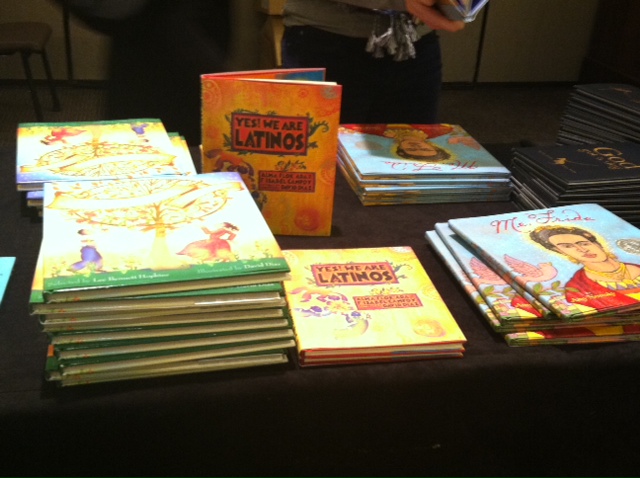
Some of the Latin@ titles at the book sale

Some of the Latin@ titles at the book sale

During her talk, Siscoe was asked about diversity. She responded by saying she is always on the lookout for diverse main characters. In fact, she said a “selling point” for the novel Unusual Chickens for the Exceptional Poultry Farmer, a middle grade debut by Kelly Jones set to release in 2015, was its Latina protagonist.

The final panel on Saturday was about book banning rather than craft. Susanna Reich, chair of the Children’s and Young Adult Book Committee for PEN American Center, floored me during this session. She said children’s and young adult books make up the vast majority of books on the ALA’s list of banned and challenged books. While I knew children’s books were often challenged, I didn’t realize that on the most recent list of the “Top 100 Banned/Challenged Books” from 2000-2009,” 72 of the top 100 are children’s and young adult books, with Harry Potter at the top of the list.

Reich also made the point that censorship isn’t only about removing books from shelves. Censorship also occurs when so few diverse titles make it onto the shelves. “It’s a form of censorship when the amount of multicultural kid lit published hasn’t increased in twenty years,” she said.

But what about those books that do make it onto the shelves? Well, it’s up to us to buy them. Reich quoted poet Alexis DeVeaux, who said, “Buying a book is a political act.” Reich challenged each of us to think about the books we choose to buy and read. Do we censor our book buying in any way? Do we make a conscious effort to read beyond our comfort zones? Do parents and teachers select books for their children and students that include diverse characters?

Multicultural books can speak to all kids, not only kids of color,” said Reich.

Hear, hear! More details from Reich’s talk can be found here on the SCBWI site.

At the end of an SCBWI conference, I am always exhausted in a good way, with a thousand things to consider as a reader, writer, parent, and teacher. This year, the speakers in the sessions I attended reinforced the idea that I can help to promote diversity in children’s literature in each of these roles. Not only can I broaden my own reading interests, but I can expand reading choices for my daughter and my students. By doing this, I will support diversity in kid lit and the members of my SCBWI familia who write, illustrate, edit, and publish books with diverse characters.