
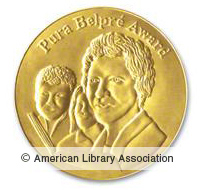
 The Pura Belpré Awards turns 20 this year! The milestone will be marked on Sunday, June 26, from 1:00-3:00 p.m. during the 2016 ALA Annual Conference in Orlando, FL. According to the award’s site, the celebration will feature speeches by the 2016 Pura Belpré award-winning authors and illustrators, book signings, light snacks, and entertainment. The event will also feature a silent auction of original artwork by Belpré award-winning illustrators, sales of the new commemorative book The Pura Belpré Award: Twenty Years of Outstanding Latino Children’s Literature, and a presentation by keynote speaker Carmen Agra Deedy.
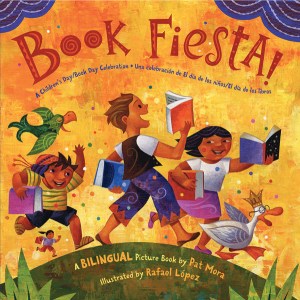
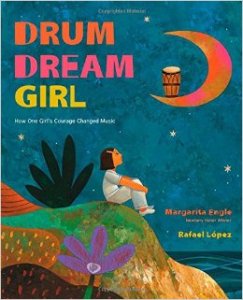 Leading up to the event, we will be highlighting the winners of the narrative and illustration awards. Today’s spotlight is on Rafael López, the winner of the 2010 Pura Belpré Illustration Award for Book Fiesta! Celebrate Children’s Day/Book Day, Celebremos El dia de lo niños/El día de los libros, written by Pat Mora, and the 2016 Pura Belpré Illustration Award for Drum Dream Girl, written by Margarita Engle. We featured Drum Dream Girl in a book talk and in a special report about a library event.

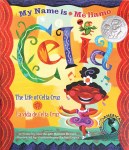
Rafael also received a Pura Belpré Illustration Honor three times: In 2014, for Tito Puente: Mambo King/Rey de Mambo, written by Monica Brown; in 2012, for The Cazuela that the Farm Maiden Stirred, written by Samantha R. Vamos; in 2006, for My Name is Celia/Me Llamo Celia: The Life of Celia Cruz/ La Vida de Celia Cruz, written by Monica Brown.
Book Fiesta!
Illustration Review by Lila Quintero Weaver
Book Fiesta! Celebrate Children’s Day/Book Day/ Celebremos El día de los niños/El Día de los libros, written by Pat Mora and illustrated by Rafael López, is a gem of a picture book that offers its wonders in two languages, English and Spanish.
Book Fiesta! exuberantly proclaims the joys of reading and introduces the concept of Día, an annual celebration of literature for children, founded by Pat Mora in 1996, and observed through special events by many libraries nationwide.
What Mexican painter, muralist, and illustrator Rafael López brings to a picture book must be seen and not just read about. His mastery as an illustrator extends to every aspect of the art: a strong concept, dynamic design, brilliant execution, and irresistible charm. It’s no wonder that the Pura Belpré committee recognized his work. Let’s take a closer look.
Used by permission from HarperCollins Children’s Books.
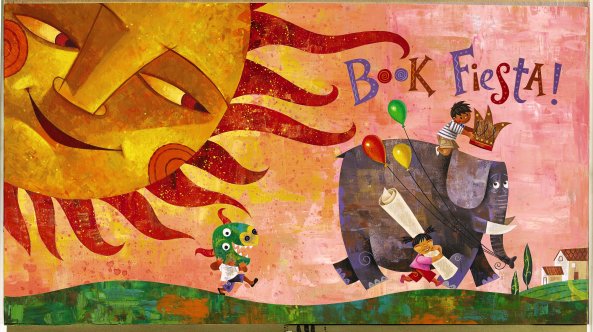
You don’t have to be an artist to appreciate López’s expert techniques, including his winning combination of hard-edged shapes and saturated colors, delivered through heavily textured paint and splashy accents, and supported by a golden undertone that unifies all of the spreads. In the pages above, a huge, friendly sun smiles down on the children, accompanied by a trotting elephant. Such charm!
Used by permission from HarperCollins Children’s Books.
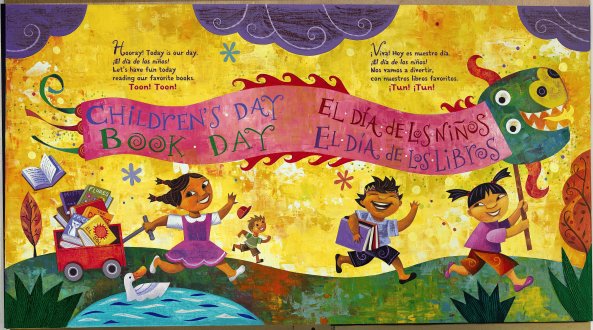
López champions diversity in his illustrations. Here, a parade of children follows a Chinese dragon whose tail doubles as a banner, announcing Día to one and all. Note the diversity represented in the races of the children. One child pulls a wagon full of books bearing titles in English and Spanish.
Used by permission from HarperCollins Children’s Books.
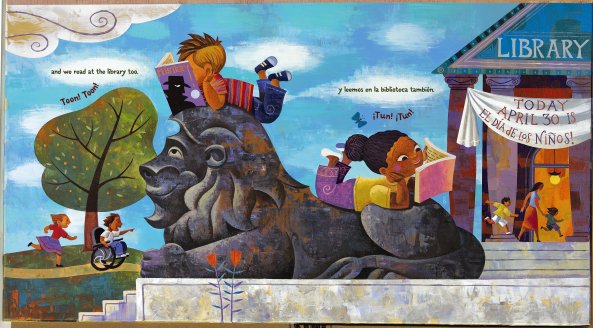
Outside the library, even the stone lion looks pleased to take part in Día. The children relaxing on the marble beast are immersed in their books. In the background, a boy in a wheelchair eagerly makes his way to the library—another evidence of the illustrator’s awareness of diverse representation.
Used by permission from HarperCollins Children’s Books.
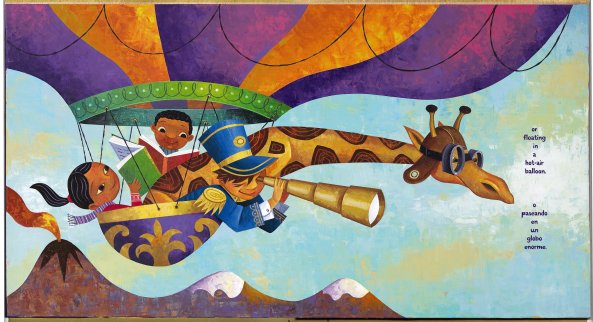
López amplifies Pat Mora’s words through many inventive means. Here, in a depiction of the glorious adventures made possible by reading, a hot-air balloon floats over a mountainous backdrop, complete with a smoking volcano. The pilot is a giraffe in old-fashioned aviator goggles. Elsewhere, books transport children by other means: on an airplane, a train, an automobile, a rowboat, on the back of an elephant, and even in a submarine. Simply put, stories hold the power to magically ferry readers to far-away places and imaginary lands. López brings this virtual travel to life through an enthralling variety of presentations and an engaging level of detail.
Used by permission from HarperCollins Children’s Books.
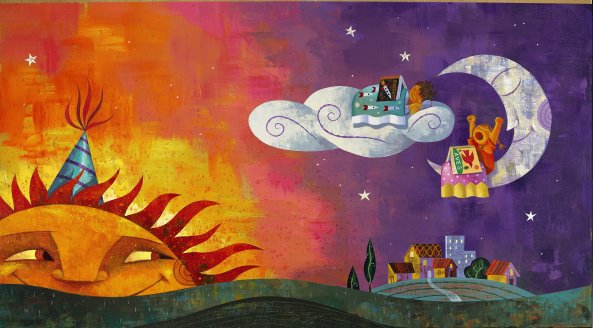
Reading in bed—what better way is there to top off a busy day? In a color-drenched scene, López presents two children indulging in this lovely pastime. One child, floating on a bed of clouds, has already fallen asleep, while the other is midway through a yawn. Her bed is supported by the curve of a crescent moon. López’s trademark brushwork fills the sky with vivid sunset hues that transition to the deep violet of late evening. It’s all grounded by rolling hills, painted in shades of teal, a color appropriate to the dying light. In the distance, the windows of buildings twinkle with warmly lit interiors, while cutout stars punctuate the heavens. Dreamy.
The richness of each spread in Book Fiesta! invites long looks and repeated views that reward readers with the new discoveries. Every page turn reveals a refreshing surprise, backgrounded by a palette that spans the rainbow. Thanks to Pat Mora’s wonderful vision and Rafael López’s dynamic illustrations, this picture book offers a perennial delight to readers of all ages.
Book Fiesta! Celebrate Children’s Day/Book Day; Celebremos el día de los niños/el día de lo libros. Text copyright ©2009 Pat Mora. Illustration copyright ©2009 Rafael López. Images used by permission of HarperCollins Children’s Books.
 About the illustrator:
Raised in Mexico City, Rafael López makes his home part of the year in San Miguel de Allende, Mexico, as well as in San Diego, California. He credits Mexican surrealism as a major artistic influence. Besides his Pura Belpré medals and honors, Rafael is also a double recipient of the Américas Award. For more about his work, including poster illustrations and a mural project in San Diego that is the subject of a new picture book, Maybe Something Beautiful, visit his official website.
TEACHING TIPS:
- Lead children in an imagination exercise based on the reading spots depicted in Book Fiesta. What are some places that you can take a book to? What are some places that a book takes you to? Ask students to include real-life and imaginary destinations.
- Devise a book parade, featuring wagons loaded with books, masks or disguises based on favorite characters, and banners heralding Día, or another book-related holiday or theme.
- Invite children to create illustrations based on López’s style. This can include painted backdrops and cutout figures, with an emphasis on strong shapes and bright colors.
Watch Rafael López’s thank you video for his most recent Pura Belpré medal, for Drum Dream Girl:
 DESCRIPTION (from Goodreads): Neftali finds beauty and wonder everywhere: in the oily colors of mud puddles; a lost glove, sailing on the wind; the music of birds and language. He loves to collect treasures, daydream, and write–pastimes his authoritarian father thinks are for fools. Against all odds, Neftali prevails against his father’s cruelty and his own crippling shyness to become one of the most widely read poets in the world, Pablo Neruda. This moving story about the birth of an artist is also a celebration of childhood, imagination, and the strength of the creative spirit.
 With the question poems, I had students discuss them in small groups and then create a dramatic presentation of their poem in any way they chose. If you want to share more of Neruda’s objects with a class, the
 Cecilia Cackley is a performing artist and children’s bookseller based in Washington DC where she creates puppet theater for adults and teaches playwriting and creative drama to children. Her bilingual children’s plays have been produced by GALA Hispanic Theatre and her interests in bilingual education, literacy, and immigrant advocacy all tend to find their way into her theatrical work. You can find more of her work at
  In Los Gatos Black on Halloween, the colors are layered, allowing some characters to be visible through the transparent ghosts and building up as more and more ghostly characters join what eventually becomes the monster ball in an old abandoned house. The color palette is dark and rich, contrasting the glowing moon and night sky with colored tombstones and the interior of the old mansion. Morales plays with scale and perspective to lend an otherworldly look to the spreads; sometimes we only see a pair of legs dangling over a broomstick or the round face of a ghost as its tail extends right off the page.
 The colors in Just a Minute are brighter and the spreads less crowded than Los Gatos Black on Halloween, but the story they tell is just as dynamic. This was Morales’ first project as both author and artist, and she keeps the story moving at a fast pace as Grandma goes from cleaning to cooking, to decorating. Subtle touches of color make Señor Calavera a less scary figure for the youngest readers, including the flowers for eyeballs and the expressive mouth that finally turns into a smile. As befits a heroine who is using action to delay Señor Calavera, Grandma Beetle’s poses are precise and sharp, whether she is placing cheese in a frying pan or leaning over to put pots in the oven. Grandma’s eyes and face express her cleverness and care as she watches Señor Calavera from across the room or gives a wink while chopping up fruit. Perspective shifts reinforce the upside-down nature of this story; the floor of Grandma’s house seems to tilt as we first see Señor Calavera in close-up, peeking over her shoulder and then far away in the corner of the room, stamping his foot in frustration. The little cat’s reactions to Señor Calavera are a humorous touch, and readers will enjoy finding it on each spread, looking curious, tentative or scared, depending on the page. Readers will love the final note left by Señor Calavera and cheer for Grandma Beetle, who was so resourceful in buying herself a little more time on Earth.
 Morales brings more texture and mixed media to the illustrations in Just in Case, her second effort as both author and artist. Perhaps because most of the action in the book takes place in the cemetery, rather than in Grandma’s house, the backgrounds are looser and the characters float around on the page. The new character Zelmiro the ghost blends in with the background color on each spread as he advises Señor Calavera on what to give Grandma Beetle for her birthday. The list of presents grows with the alphabet, and Morales keeps things interesting by not just including objects such as the accordion but also actions such as cosquillas (tickles) and natural phenomena like niebla (fog). One of my favorite things about this book is that it follows the Spanish, rather than the English alphabet, including letters I learned as a child, like ‘Ch’, ‘Ll’ and ‘Ñ’. Depending on where you are in the Spanish-speaking world, ‘ch’ and ‘ll’ aren’t taught as separate letters anymore, so it was nice to see them here! Some of the presents are words commonly taught in Spanish classes, such as ‘escalera’ or ‘semilla,’ but others are more colloquial and region-specific like ‘granizado’ and ‘ombligo.’ The specificity in both language and image are lovely. Careful readers will note that the historieta (comic book) that Señor Calavera gives Grandma is a handmade version of Morales’ earlier book Just a Minute and will also find the reason for the spectacular bicycle crash that ruins all the presents.
 Yuyi Morales
 The
The  DESCRIPTION FROM THE PUBLISHER: Anita de la Torre never questioned her freedom living in the Dominican Republic. But by her 12th birthday in 1960, most of her relatives have emigrated to the United States, her Tío Toni has disappeared without a trace, and the government’s secret police terrorize her remaining family because of their suspected opposition of el Trujillo’s dictatorship.
 DESCRIPTION FROM THE PUBLISHER: After Tyler’s father is injured in a tractor accident, his family is forced to hire migrant Mexican workers to help save their Vermont farm from foreclosure. Tyler isn’t sure what to make of these workers. Are they undocumented? And what about the three daughters, particularly Mari, the oldest, who is proud of her Mexican heritage but also increasingly connected to her American life. Her family lives in constant fear of being discovered by the authorities and sent back to the poverty they left behind in Mexico. Can Tyler and Mari find a way to be friends despite their differences?
 ABOUT THE AUTHOR:
  Latinxs in Kid Lit