Celebrating Pura Belpré Winners: Spotlight on Grandma’s Gift by Eric Velasquez

PuraBelpreAward

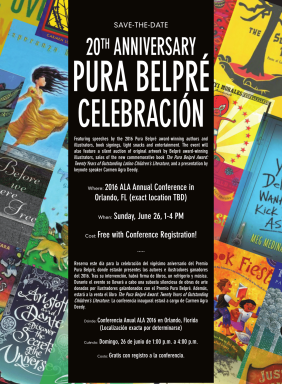
The Pura Belpré Awards turns 20 this year! The milestone will be marked on Sunday, June 26, from 1:00-3:00 p.m. during the 2016 ALA Annual Conference in Orlando, FL. According to the award’s site, the celebration will feature speeches by the 2016 Pura Belpré award-winning authors and illustrators, book signings, light snacks, and entertainment. The event will also feature a silent auction of original artwork by Belpré award-winning illustrators, sales of the new commemorative book The Pura Belpré Award: Twenty Years of Outstanding Latino Children’s Literature, and a presentation by keynote speaker Carmen Agra Deedy.

Leading up to the event, we will be highlighting the winners of the narrative and illustration awards. Today’s spotlight is on Eric Velasquez, the winner of the 2011 Pura Belpré Illustrator Award for Grandma’s Gift.


Review by Lila Quintero Weaver
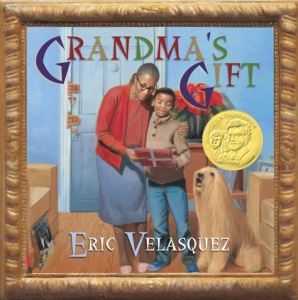
Grandma's GiftDESCRIPTION FROM THE BOOK JACKET: Every year, Eric spends his winter break with his grandmother in El Barrio while his parents are at work. There’s much to do to prepare for Christmas, including buying all the ingredients for Grandma’s famous pasteles, a special Puerto Rican holiday dish.

But Eric also has an assignment for school that requires a trip to the Metropolitan Museum of Art to see a new painting. Grandma and Eric are nervous about leaving El Barrio but are amazed by the museum and what they see in the painting—a familiar face in a work of art by the great painter Diego Velázquez. That day Eric’s world opens wider, and Grandma knows the perfect gift to start him on his new journey.

In this prequel to Grandma’s Records, Eric Velasquez brings readers back to a special day spent with his grandmother that would change his life forever.

MY TWO CENTS: Eric Velasquez is the award-winning illustrator of more than 25 children’s books, including three that he wrote. In Grandma’s Gift and Grandma’s Records, reviewed here, Eric brings to life childhood moments that illuminate the warm and meaningful relationship he enjoyed with his grandmother, a native of Puerto Rico and resident of El Barrio, a predominantly Puerto Rican neighborhood in East Harlem.

In a category where such books are woefully rare, both of Velasquez’s Grandma stories represent positive images of Afro-Latinx children and their families.

Although the story in Grandma’s Gift takes place inside a few square miles of contemporary New York City, it also casts a spotlight on a long-ago historical figure. Juan de Pareja was an enslaved man of African descent who worked in the studio of 17th-century Spanish master Diego Velázquez and who became a painter in his own right. When Eric was a boy, Velázquez’s luminous portrait of de Pareja was acquired by the Metropolitan Museum of Art for a price exceeding $5 million.

Grandma’s Gift contains two additional distinguishing aspects: elements of Puerto Rican culture preserved and passed down by the boy’s grandmother, and contrasting views between two physically proximate but culturally distant worlds, represented by El Barrio and the Metropolitan Museum of Art.
Used by permission from Bloomsbury Publishing, Inc.

Used by permission from Bloomsbury Publishing, Inc.

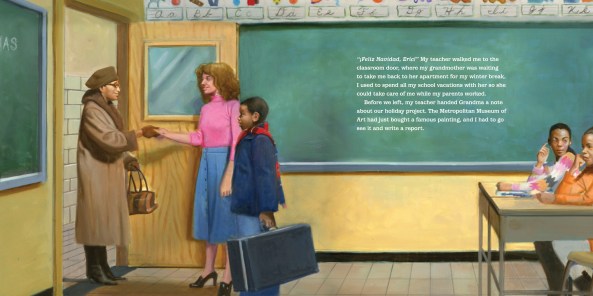
At the story’s beginning, Eric is leaving school for Christmas break, in the company of his grandmother. His school assignment, to be completed during the holidays, is a visit to the Velázquez exhibit. But first, grandmother and grandson go shopping at La Marqueta, once a central feature of El Barrio, composed of bustling shops tucked under a railroad trestle. At La Marqueta, it’s evident that Eric’s grandmother is a respected and beloved member of the community. Not only do butchers and greengrocers call her by title and name—Doña Carmen—they are also familiar with the high standards she expects from every cut of meat and vegetable she purchases. When the shopping is done, Eric and his grandmother return to her apartment, where she launches an elaborate preparation of traditional Puerto Rican holiday dishes. Here, she is clearly in her element, deftly handling each step of the cooking, filling, and rolling of the pasteles, much to the admiration of young Eric.
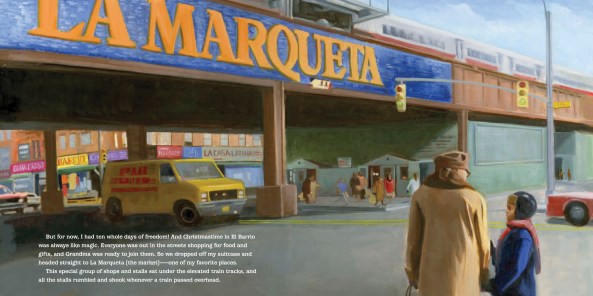
Used by permission from Bloomsbury Publishing, Inc.

Used by permission from Bloomsbury Publishing, Inc.

Nearly all of Doña Carmen’s dialogue is parenthetically translated into English, immediately behind her Spanish words. While this solution is not particularly elegant, it reflects the challenge that authors and publishers face in including authentic representations of a Spanish-speaking environment within an English text. The story translates greetings in Spanish by shopkeepers, words of wisdom spoken by the grandmother, and details relevant to the story, such as the names of the root vegetables used in making pasteles: calabaz, yautía, plátanos verdes, guineos verdes, papas.

El Barrio is a place that Eric’s grandmother comfortably navigates day after day. Here, her native tongue predominates, and everyone is a shade of brown. But when she and Eric head for the museum, a short bus ride away, they leave behind that familiar environment and land before the facade of the Metropolitan, cloaked in cultural status and imposing architecture. As Eric notes, there’s no one “from Puerto Rico on the streets and no one was speaking in Spanish.” At this point, Eric becomes her guide in this English-speaking world, translating the signs and captions that they encounter, stepping into a role that second- or third-generation immigrant children often play in their elders’ lives.
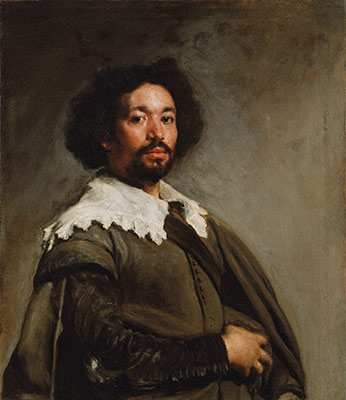
Juan de Pareja, by Diego Velázquez

Juan de Pareja, by Diego Velázquez

The highlight of the story arrives when Eric comes face to face with the portrait of Juan de Pareja, hanging in its gilded frame in one of the august exhibition halls of the museum. As a young person of color in the 1970s, he has never seen a member of his own people elevated to such a status: “He seemed so real—much like someone we might see walking around El Barrio. I couldn’t believe that this was a painting in a museum.” Eric is amazed and proud to learn that Juan de Pareja eventually achieved freedom and became a painter in his own right. For Eric, this discovery is a revelation that sparks artistic fire. On Christmas Eve, after everyone enjoys a traditional holiday dinner, Eric sits under the Christmas tree and opens his grandmother’s gift. It’s a sketchbook and a set of colored pencils. He immediately begins to draw a self-portrait. Through this gift, Eric’s grandmother expresses a clear vote of confidence in her grandson’s dreams, underscoring that he, too—a child of El Barrio, an Afro Latino—can follow in the footsteps of Juan de Pareja.
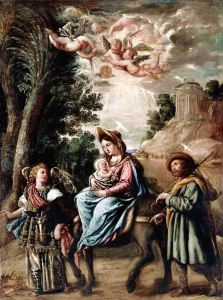
Flight into Egypt, by Juan de Pareja

Flight into Egypt, by Juan de Pareja

This touching, autobiographical story is richly illustrated in Velasquez’s photorealistic style, which authentically depicts settings and brings dimension to each character. Eric imbues his subjects with individually distinct physical characteristics, lending to each an air of nobility. He lovingly paints his grandmother as a lady of dignified bearing and warmth, usually dressed in subdued colors. But he often lavishes this humanizing treatment even on background characters, such as fellow passengers on the train and a nameless guard at the museum. In most of the illustrations, Eric employs a wide and vivid range of hues, but like Diego Velázquez, he sometimes falls back on a deliberately limited palette. When the boy and his grandmother stand before the portrait of Juan de Pareja, the rich browns of the ancient oil painting harmoniously come together with the rich browns of the grandmother’s clothing, as well as the skin tones of all three figures. He puts this deft touch with a monochromatic palette to great effect in the story’s electric moment of revelation, as the child Eric looks on the portrait of Juan de Pareja and grasps a new possibility for his future.
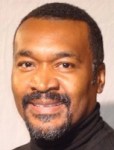
Eric VelasquezABOUT THE AUTHOR-ILLUSTRATOR: Eric Velasquez is an Afro-Puerto Rican illustrator born in Spanish Harlem. He attended the High School of Art and Design, the School of Visual Arts, and the famous Art Students League in New York City. As a children’s book illustrator, Velasquez has collaborated with many writers, receiving a nomination for the 1999 NAACP Image Award in Children’s Literature and the 1999 Coretta Scott King/John Steptoe Award for New Talent for The Piano Man. For more information, and to view a gallery of his beautiful book covers, visit his official website.


ADDITIONAL RESOURCES:

Learn more about El Barrio from the definitive museum that bears the same name.

After decades of decline, La Marqueta is attempting a comeback. (This article is in Spanish.)

Here, a resident of El Barrio relates her memories of La Marqueta during its heyday.

See the official page for the Juan de Pareja portrait on The Met’s website.


Lila Quintero Weaver is the author-illustrator of Darkroom: A Memoir in Black & White. She was born in Buenos Aires, Argentina. Darkroom recounts her family’s immigrant experience in small-town Alabama during the tumultuous 1960s. It is her first major publication. Lila is a graduate of the University of Alabama. She and her husband, Paul, are the parents of three grown children. She can also be found on her own websiteFacebookTwitter and Goodreads.


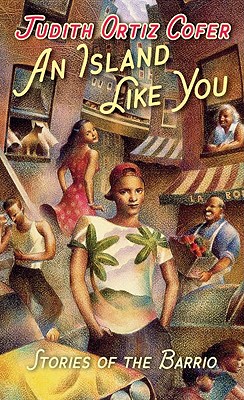
Celebrating Pura Belpré Award Winners: Spotlight on An Island Like You: Stories of the Barrio by Judith Ortiz Cofer


PuraBelpreAwardThe Pura Belpré Awards turns 20 this year! The milestone will be marked on Sunday, June 26, from 1:00-3:00 p.m. during the 2016 ALA Annual Conference in Orlando, FL. According to the award’s site, the celebration will feature speeches by the 2016 Pura Belpré award-winning authors and illustrators, book signings, light snacks, and entertainment. The event will also feature a silent auction of original artwork by Belpré award-winning illustrators, sales of the new commemorative book The Pura Belpré Award: Twenty Years of Outstanding Latino Children’s Literature, and a presentation by keynote speaker Carmen Agra Deedy

Leading up to the event, we will be highlighting the winners of the narrative and illustration awards. Today’s spotlight is on Judith Ortiz Cofer, the winner of the 1996 Pura Belpré Narrative Award for An Island Like You: Stories of the Barrio.

Review by Marianne Snow Campbell

DESCRIPTION FROM THE PUBLISHER: Rita is exiled to Puerto Rico for a summer with her grandparents after her parents catch her with a boy. Luis sits atop a six-foot mountain of hubcaps in his father’s junkyard, working off a sentence for breaking and entering. Sandra tries to reconcile her looks to the conventional Latino notion of beauty. And Arturo, different from his macho classmates, fantasizes about escaping his community. They are the teenagers of the barrio – and this is their world.

MY TWO CENTS: Winner of the very first Pura Belpré medal for narrative in 1996, An Island Like You: Stories of the Barrio consists of twelve short stories, each describing episodes in the lives of Stateside Puerto Rican teenagers living in Paterson, New Jersey. The prose is spare and straightforward, yet wonderfully descriptive in its simplicity, and Judith Ortiz Cofer captures the rawness and honesty of the characters’ feelings as she describes their deeds and inner thoughts or lets them narrate for themselves. Their voices seize the humor of teenage awkwardness; clashes with family members who, as the younger generation see it, are mentally “stuck” in Puerto Rico; the anger, confusion, and despair that lead to unwise or even dangerous behaviors. Although readers can certainly learn lessons from the characters’ actions, An Island Like You is never didactic. Rather, these stories are simply about life as it really happens – people make choices and face consequences.

What I enjoy most about this book are its explorations of identity. What can it mean to be a young person living in El Barrio in Paterson? The variety of stories and narrators presents readers with multiple perspectives, showing them that, although all of the book’s characters share an environment and a heritage, their experiences are hardly monolithic. Arturo, who loves poetry and wants nothing to do with his peers, feels trapped in El Barrio. Connie is annoyed that she has to look after her grandmother, who’s visiting from Puerto Rico. Anita gets involved with an older man. These multifaceted characters, all facing different conflicts, illustrate the panorama of identities that can exist in one community.

Moreover, some characters appear in more than one story, narrating their own episode first and then playing a supporting role in someone else’s tale. For example, “The One Who Watches” depicts Doris’s dealings with her friend Yolanda, who has started skipping school and shoplifting. While Doris is horrified by Yolanda’s behavior, she’s equally scared of losing her friend and must decide whether she wants to keep “following Yolanda into trouble” (117). Later, we meet Yolanda again, this time as the narrator of her own story, “Don José de la Mancha.” Two years after her father’s death, her mother has started seeing another man, and Yolanda must reconcile her lingering grief with her mother’s new-found happiness.

Seeing Yolanda through two sets of eyes – Doris’s and her own – demonstrates the complexity of her character. These dual snapshots of her experience show us that we never know what’s really going on in someone’s head or their life. If we had only seen Yolanda through Doris’s eyes, we might judge her for her reckless behavior, but witnessing her struggle to get over her father’s death helps us understand that pain and conflict that might be guiding her. By considering these different perspectives, young readers can enhance their powers of empathy. Engaging with these stories can allow them to enter others’ heads, to understand why they think and act the way they do. Judith Ortiz Cofer sums up this act exquisitely in a poem, “Day in the Barrio,” which acts as a foreword to this book:

At the day’s end,

you scale the seven flights to an oasis on the roof,

high above the city noise, where you can think

to the rhythms of your own band. Discordant notes rise

with the traffic at five, mellow to a bolero at sundown.

Keeping company with the pigeons, you watch the people below,

flowing in currents on the street where you live,

each one alone in a crowd,

each one an island like you.

 TEACHING TIPS: An Island Like You lends itself beautifully to a jigsaw-style literary discussion. Instead of immediately requiring students to read the whole book, have each student read a different short story and analyze the main character of that story. What are her/his feelings about living in El Barrio? What kinds of struggles does s/he face? Does s/he overcome them? If so, how, or if not, why not? Do you relate to her/him? After getting to know her/his character, each student can then pair up with a classmate and compare/contrast characters to get an initial feel for the diversity of experiences represented in these stories. Discussing the characters aloud instead of in writing might make this analysis more authentic and natural, like students are talking about their peers rather than imaginary beings.

RESOURCES:

Judith Ortiz Cofer’s website

Interview with Judith Ortiz Cofer from Heinemann Publishing

Feature on Judith Ortiz Cofer at Vamos a Leer

Review of An Island Like You at All Brown All Around

Judith Ortiz CoferABOUT THE AUTHOR: Judith Ortiz Cofer was born in Hormigueros, Puerto Rico and grew up in Paterson, New Jersey, two locations that have inspired her work. She has written for all ages – children’s and young adult books including ¡A bailar! / Let’s Dance! (2011), The Poet Upstairs (2012), Animal Jamboree (2012), Call Me Maria (2006), and If I Could Fly (2011), and books of poetry and prose for adults, including The Meaning of Consuelo (2003) and the Pulitzer Prize-nominated The Latin Deli (1993). Her work has won various prizes and honors, such as the Pushcart Prize and the O. Henry Prize and has appeared in several literary anthologies. Moreover, she has received fellowships at Oxford University and the Bread Loaf Writers’ Conference. Currently, she lives in Georgia and is the Regents’ and Franklin Professor of English and Creative Writing, Emerita.


MarianneMarianne Snow Campbell is a doctoral student at The University of Georgia, where she researches nonfiction children’s books about Latinx and Latin American topics and teaches an undergraduate course on children’s literature. Before graduate school, she taught pre-K and Kindergarten in Texas, her home state. She misses teaching, loves critters, and can also be found on Twitter and Facebook.

The Pura Belpré Award: Continuing Belpré’s Legacy of Lighting the Storyteller’s Candle–Part 1


Portrait by Robert Liu-Trujillo. Read more about the portrait and his projects at http://investigateconversateillustrate.blogspot.com Permission to post given by artist.

Portrait by Robert Liu-Trujillo. Read more about the portrait and his projects at http://investigateconversateillustrate.blogspot.com Permission to post given by artist.


By Sujei Lugo & Dr. Sonia Alejandra Rodríguez

By now, we are all familiar with the various conversations about the need for children of color and Native children to see themselves represented in the stories they read. However, not many know that these discussions, as they pertain to Latinx children, have been taking place since the early 1920s when Pura Belpré became the first Puerto Rican librarian in the New York Public Library system. Clearly, the context for dialogues around diversity were different because it was a different time; however, the urgency surrounding issues of representation, advocacy, and empowerment as they relate to Latinx children have many similarities.

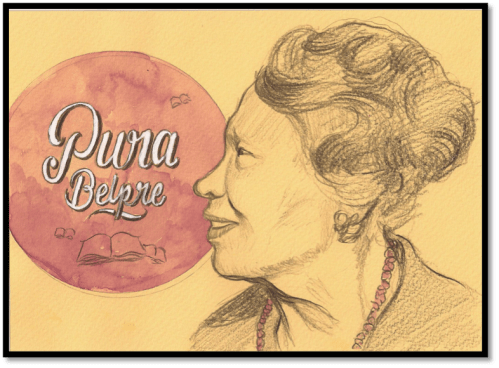
Unfortunately, Belpré’s legacy is not one that is well known. Robert Liu-Trujillo, illustrator of the beautiful Belpré portrait on this post, says “I didn’t hear anything about Ms. Belpré until I was in my 30s. Once I realized that there was a really interesting person behind the award, I was really surprised that I’d never heard of her before. From what I’ve read about her and seen through my research, she was a revolutionary figure in children’s education and storytelling.” Trujillo is right to call Belpré a “revolutionary figure” because she indeed was.

Her innovative use of Puerto Rican folklore to reach predominantly Spanish-speaking Puerto Rican children in New York City revolutionized the role of public libraries in the life of these children. Through her storytimes, her puppeteering, and her written works, Belpré set a high standard for how libraries should tailor their programs and services for the communities and peoples in which they’re located. Her commitment and advocacy to bridge her Puerto Rican community to the library, and vice versa, showcases the roots of critical children’s librarianship and inclusion, and not assimilation, of marginalized voices into the field. Much work still needs to be done to bring Belpré’s legacy to the front and highlight the many ways she’s revolutionized storytelling, librarianship, and children’s books for Latinx children.

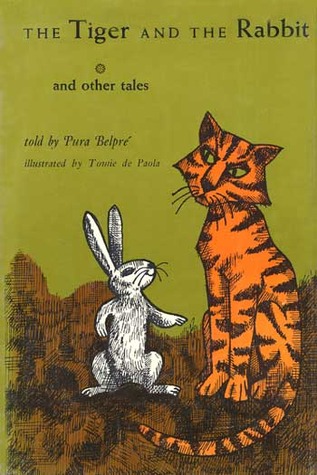
The Tiger and the Rabbit and Other Tales    Juan Bobo and the Queen's Necklace: A Puerto Rican Folk Tale    7380556

In “Pura Belpré Lights the Storyteller’s Candle: Reframing the Legacy of a Legend and What it Means for the Fields of Latina/o Studies and Children’s Literature,” Marilisa Jiménez-García discusses the various roles Belpré inhabited and the ways her contributions as a librarian and a writer, for example, can be read as subversive political acts. Jiménez-García says of Belpré as a storyteller, “she occupied as a kind of weaver of history, [she] encouraged children to defy assimilation along with the textual and national boundaries created by the dominant culture” (Jimenez-Garcia 113). In other words, through her use of Puerto Rican folklore, Belpré was teaching young Puerto Rican children to embrace their cultural identity and to challenge dominant narratives that depicted them as less than.

Jiménez-García further argues that “Belpré’s interventions within U.S. children’s literature constitute an attempt at cultural preservation, and even further, as an attempt to establish historical memory within the U.S. for Puerto Rican children” (115). In this way, Belpré used her writing to bring to the forefront a Puerto Rican heritage necessary for the identity construction of Puerto Rican children in the U.S. In The Stories I Read to the Children: The Life and Writing of Pura Belpré, the Legendary Storyteller, Children’s Author, and the New York Pubic Librarian (2013) Lisa Sánchez González writes, “In all of her work—including her work as a public librarian–she aimed to ensure that working-class bilingual and bicultural children had rightful access to what is still too often a privilege: Literacy, and with it, free and public access to good books” (17).

Jiménez-García’s and Sánchez González’s research inform us that Belpré was telling, writing, and performing stories that centered Puerto Rican culture and folklore, that she created a space at the NYPL and made Puerto Rican children the center of it, and that she was committed to making books available to children. In this way, Belpré led her own revolution.

Belpré’s legacy is incomparable, and 2016 marks the 20th anniversary of the children’s literary award named after her–the Pura Belpré Award. The award was established in 1996 by co-founders Oralia Garza de Cortés and Sandra Rios Balderrama. According to the award website, the Pura Belpré Award is “presented to a Latino/Latina writer and illustrator whose work best portrays, affirms, and celebrates the Latino cultural experience in an outstanding work of literature for children and youth.” By establishing an award that highlights Latina/o writers and illustrators creating works about Latina/o experiences, Garza de Cortés and Rios Balderrama carved a space dedicated to the empowerment and the future of Latinx children. Belpré’s legacy as a librarian, a writer, and a puppeteer demonstrate the importance of storytelling as a means of resisting and challenging oppressive dominant narratives. The Pura Belpré Award allows us to continue this revolution and give Latinx children and youth an opportunity to transform the world around them.

REFORMA (The National Association to Promote Library and Information Services to Latinos and the Spanish Speaking) along with the Association for Library Service to Children (ALSC) are joining efforts to hold a special celebration for the Pura Belpré 20th Anniversary Celebración at this year, ALA (American Library Association) Annual Conference in Orlando, Florida. The event will feature speeches by the 2016 Pura Belpré Award medal and honor winning authors and illustrators, David Bowles, Antonio Castro L., Angela Dominguez, Margarita Engle, Rafael López, Meg Medina, and Duncan Tonatiuh. It will also include book signing, a silent auction of original art by Latinx children’s illustrators, a new commemorative book for sale, The Pura Belpré Award: Twenty Years of Outstanding Latino Children’s Literature, and a keynote by author and storyteller, Carmen Agra Deedy.

Final Save the Date-1

The event promises to be a well-rounded celebración to recognize the award that lay ground to the recognition of Latinx children’s books creators within the youth literature field and the trajectory of the award, its past winners and honors, and the constant supporters of Latinx children’s literature.

For Part 2 of this post, which will run tomorrow, we spoke to members of the Pura Belpré Award Committee to get their insight on the momentous occasion that is the 20th anniversary of the Pura Belpré Award. Their interviews provide us with an insight to their motivations for creating the award, to the need of an award dedicated to Latinx children’s books written and illustrated by Latinx, the future of the award, and a look back at favorite award moments from the last 20 years. Tomorrow, read extensive interviews with Co-founder Oralia Garza de Cortés, Co-founder Sandra Rios Balderrama, and past committee member Celia C. Pérez.


SujeiLugoSujei Lugo was born in New Jersey and raised in her parents’ rural hometown in Puerto Rico. She earned her Master’s in Library and Information Science degree from the Graduate School of Information Sciences and Technologies at the University of Puerto Rico and is a doctoral candidate in Library and Information Science at Simmons College, focusing her research on Latino librarianship and identity. She has worked as a librarian at the Puerto Rican Collection at the University of Puerto Rico, the Nilita Vientós Gastón House-Library in San Juan, Puerto Rico, and the University of Puerto Rico Elementary School Library. Sujei currently works as a children’s librarian at the Boston Public Library. She is a member ofREFORMA (The National Association to Promote Library Services to Latinos and the Spanish-speaking), American Library Association, and Association of Library Service to Children. She is the editor of Litwin Books/Library Juice Press series on Critical Race Studies and Multiculturalism in LIS. Sujei can also be found on Twitter, Letterboxd and Goodreads.

FullSizeRender (1)Dr. Sonia Alejandra Rodríguez’s research focuses on the various roles that healing plays in Latinx children’s and young adult literature. She currently teaches composition and literature at a community college in Chicago. She also teaches poetry to 6th graders and drama to 2nd graders as a teaching artist through a local arts organization. She is working on her middle grade book. Follow Sonia on Instagram @latinxkidlit

Author Samantha Mabry on her Debut Novel, a Student’s Shrug, and Straddling Two Cultures


By Samantha Mabry

I teach English at a community college in downtown Dallas. Currently, some of my students are reading a book entitled Midnight in Mexico: A Reporter’s Journey Through a Country’s Descent Into Darkness by Alfredo Corchado. In his book, Corchado, who was born in the Mexican state of Durango and raised in California and El Paso, Texas, writes mostly about his own reporting on the drug trade and corruption in Mexico, but there’s also an interesting, underlying theme he explores regarding identity: what it means to straddle two worlds, to have a foot on each side of the border, but to never feel fully rooted, truly at home in either place. As he puts it, he can sometimes feel too American when he’s in Mexico and too Mexican when he’s in America.

Among my students, discussions have taken place regarding what it means to be a part of two cultures. When I ask if they’re able to relate to Corchado, many nod their heads, and one girl said, “Absolutely.” She then elaborated: “At home, I’m Mexican. At school, I’m American.” Then she shrugged. Like, obviously. She made it seem like it was pretty easy to understand what the different expectations are in different spheres of her life and that it took little effort and not a whole lot of thought to navigate those spheres.

I keep thinking about this student –in particular, that shrug. Like, what’s in that shrug? What does that shrug mean? I want there to be something deep in that shrug because I am critical by nature and like for things like shrugs to mean something, to be symbolic, to say something about what it means to be a Mexican-American young woman living in Texas right this minute. I keep thinking about all the comments I could have followed up with: Okay, so you’re Mexican in one place and American in another. Is there an identity that feels more true to you? Are you more Mexican than American? Would you say you are Mexican-American? Would you call yourself Chicana? Latina? Hispanic? Do these words, these markers of identity, matter to you, or am I just really wanting them to matter??

My mother is Mexican-American, though I think she would say she’s just American. Or Hispanic. My dad’s mother was from Puerto Rico, and his dad was white. I’m light olive-skinned with brown hair and brown eyes, but my last name, Mabry, is European. I first heard Spanish at my grandmother’s house but learned it properly in a classroom. I call myself mestiza because that’s what really rings true for me. I think that identity matters, and I think that –particularly for those from mixed backgrounds or with migrations or diaspora in their histories –identity can be fluid. I think that many Latinx people, like Alfredo Corchado, are standing with one foot here and one foot there. Some of them may be standing with an imbalance: one foot rooted in one place more heavily than the other. Some may feel as if they have many limbs, all which are reaching across geography and back into time. Some may feel, however, like they’re not straddling at all. It is not my place, of course, to tell another Latinx person how to be or how to feel.

In my book, A Fierce and Subtle Poison, both of the main characters are of mixed backgrounds, racially and culturally. They are a mix of white and non-white. Lucas, the narrator looks white, has a white kid’s name, but there’s something else there, tugging in his blood. Isabel is the product of an English father and native Puerto Rican mother, and sides with her mother when it comes to her identity. I specifically tried to make their histories and their identities complex. They are influenced –haunted and inspired, inspired or haunted –by their past. They are trying to fix centuries-old errors and clear new paths.

So…after all that, we’re back to the shrug. Is it simple, or is it complex? Is it a small gesture that signifies nothing, or something brimming with meaning? Maybe it’s simple: with these people, I am this one thing; with those people, I am this other thing. It’s easy to figure out. Simple, simple. Or maybe it’s complex: a gesture so full that words pale. It’s obvious that I want it to be the latter, but who cares what I want? I wrote a book about complex identities, one that I hoped explored nuance, but of course that’s not the only way to write about identity.  Someone –maybe me, maybe not –needs to write the story about the Mexican-American girl who is Mexican at home and American everywhere else. And maybe she is wildly complicated but not because of that, but because of all the other things that go on in a young woman’s life.

FOR MORE INFORMATION about A Fierce and Subtle Poison, which releases April 12, 2016 with Algonquin Young Readers, check your local public library, your local bookstore or IndieBound. Also, check out GoodreadsAmazon, and Barnes & Noble.


Samanth Mabry author photo

Samantha Mabry grew up in Texas playing bass guitar along to vinyl records, writing fan letters to rock stars, and reading big, big books, and credits her tendency toward magical thinking to her Grandmother Garcia, who would wash money in the kitchen sink to rinse off any bad spirits. She teaches writing and Latino literature at a community college in Dallas, Texas, where she lives with her husband, a historian, and her pets, including a cat named Mouse. A Fierce and Subtle Poison is her first novel.

Book Review: Sofi and the Magic, Musical Mural/Sofi y el Mágico Mural Musical


Reviewed by Sujei Lugo

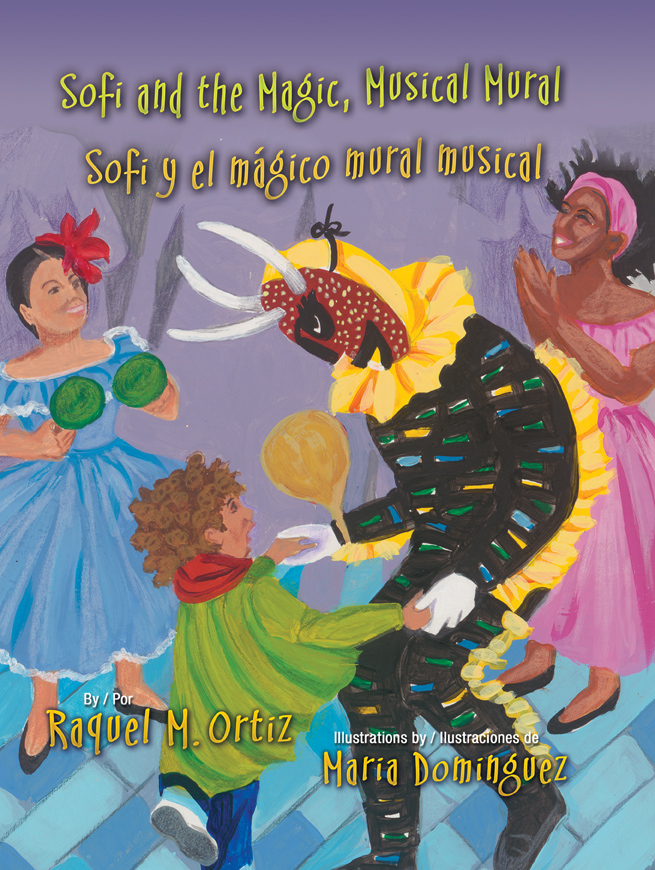
Sofi-and-the-Magic-Musical-MuralDESCRIPTION FROM THE PUBLISHER: When Sofi walks through her barrio to the local store, she always passes a huge mural with images from Puerto Rico: musicians, dancers, tropical flowers and—her least favorite—a vejigante, a character from carnival that wears a scary mask. One day on her way home from the bodega, she stops in front of the mural. Is one of the dancers inviting her to be his partner? “Okay, let’s dance,” Sofi giggles, and suddenly she’s in Old San Juan, surrounded by dancers and musicians playing bongos, tambourines and güiros. She begins to dance and sing with her new friends, but her pleasure turns to fear when the vejigante—wearing a black jumper with yellow fringe and a red, three-horned mask—spins her around and around! What does he want from her? How can she get away?

MY TWO CENTS: In this debut bilingual picture book, author Raquel M. Ortiz and illustrator Maria Dominguez capture the story of an imaginative girl and her magical and musical encounter with a neighborhood mural. Inspired by a mural located in South Bronx, New York, Ortiz and Dominguez give us a story that celebrates Puerto Rican traditions, community-based art, and city life.

Our young protagonist Sofía is lying on her bed feeling pretty bored. Her mom asks her to go to the bodega at the end of the block to get some milk and to remember that she should “not talk to ANYONE!” Sofía gets her scarf and coat, nods to her mom, and embarks on her journey to get the half-gallon of milk. Strolling along the sidewalk, she looks at the huge mural painted on a nearby building. She is stunned by its size and the colorful images of musicians, dancers, amapola flowers, and her least favorite, a vejigante. While returning from the bodega, Sofia can’t help admiring the mural once again. This is when she notices that one of the musicians, a plenero, is extending his hand to her to dance, breaking the wall between reality, art, and imagination. In a heartbeat, Sofía finds herself inside the mural, starting a whimsical experience that will bring her close to her Puerto Rican heritage.

Reading and seeing images of things that I grew up with put a smile on my face. From the plena song “Porque la plena viene de Ponce, viene de barrio de San Antón” to the carnival song “¡Toco-toco, toco-toco! ¡Vejigante come coco!”, I couldn’t help singing along with all the plenas and remembering the presence of plena songs in family gatherings, “navidad” parties, cultural “festivales”, carnivals, and even street protests. No wonder it is known as the  “periódico cantado” (sung newspapers), telling everyday stories all year long.

We also meet the famous vejigante, wearing its colorful outfit and a scary mask made from coconut shell (although some are made from papier-mâché). The vejigante is a mischievous folkloric character that resembles a buffoon or the devil, and which became a symbol of Puerto Rican cultural identity. In the story, Sofi plays and dances with the vejigante that she once saw as scary. She ends up wearing his outfit and flies around the Puerto Rican landscape going through El Yunque rainforest, and landing at the church plaza in Old San Juan. Here the author metaphorically portrays how through art, music, and traditions we can “fly” to the island of Puerto Rico, and demonstrates the deep connections that exist between the Puerto Rican diaspora and the island.

In terms of layout and illustrations, the bilingual text is located on the left side of the book with small illustrations dividing the English and Spanish texts and whole-page illustrations accompanying the text on the right side. The illustrator based her design and images on the original mural and conversations with the students that drew the images for mural. From soft colors for the city and bright and vivid colors for the mural, Dominguez’s paintings transport us from a wintry day in New York City to a sunny day in Puerto Rico.

Using The Pueblo Sings/El Pueblo Cantor mural as an inspiration for this picture book communicates the power of art, music, literature, and images to represent a community and tell its stories of resistance. The 7th- and 8th-grade students that designed the mural embraced the process of community building, public art, and history. It was created with and for the Puerto Rican community that has lived in New York City for decades. The mural’s statement is about the existence of the people and is a representation of their stories. It brings identification to the neighborhood and informs visitors about the living, breathing community located there. It is exciting to see the author centering the narrative on a young Puerto Rican girl who experiences this connection with her culture, traditions, and family, and then back to herself. In so doing, this book gives a powerful testament to how children can experience these connections and embrace them as their own.    

The book includes author and illustrator biographical notes, a glossary, and information about the mural.

TEACHING TIPS: The bilingual picture book is recommended for children ages 4 to 8. It works as a read aloud and for early independent readers. At home or at the library, librarians, parents, grandparents or other caregivers can read the story aloud in English, Spanish, or both, while teaching new words, concepts and discussing the different images. Teachers can include the discussion of Puerto Rican history, traditions, and music in their curriculum. 

IMG_4360-2

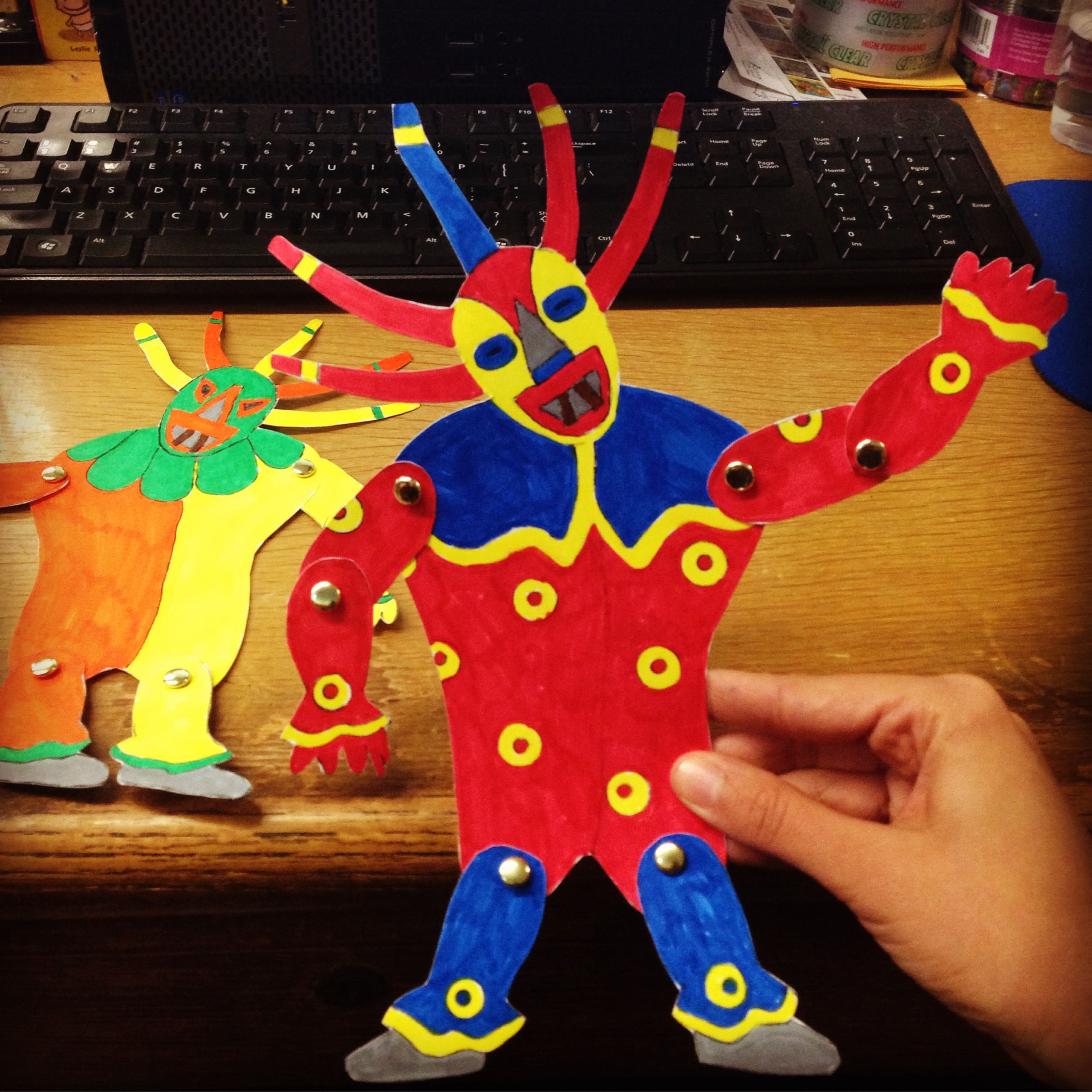
Vejigantes puppets I created for a library program. I explained to the children the meaning of vejigantes and how I grew up seeing them almost everywhere back in Puerto Rico.


Since the main focus of the story and its inspiration is a mural, children can create their own small-scale cardboard murals. Adults should encourage children to use elements from their community or their personal or family stories as inspiration. Moving activities to the street, adults can stroll down the neighborhood with children to view community murals, posing such questions as: Who created this mural? Who is it about? What does it represent? Does it represent the community where it is located? What type of murals should our neighborhood have? This will create a conversation about public art, public space, and community.

AUTHOR & ILLUSTRATOR: Raquel M. Ortiz was born and raised in Lorain, Ohio, and has been making art and telling stories since she was little. She holds a Ph.D. in Social Anthropology from the University of Salamanca and has worked at The Brooklyn Museum, the Allen Memorial Art Museum and El Museo del Barrio. Raquel is the author of El Arte de la Identidad, the documentary Memories of the Wall: Education and Enrichment through Community Murals and textbooks and educational materials for children in Puerto Rico and the United States. She lives in New York City with her family and is a professor at Boricua College.

Maria Dominguez moved from Cataño, Puerto Rico to New York City when she was five year old. She began her artistic career as a muralist with Cityarts in 1982. Over the past twenty-five years, Dominguez has created over twenty public art murals and worked with the Metropolitan Transportation Authority of New York City, Artmaker, Inc. and Brooklyn Connect. The recipient of grants from the National Endowment for the Arts and the New York Foundation for the Arts, she has also headed El Museo del Barrio’s Education Department. She currently teaches art in New York City’s Public School System.

FOR MORE INFORMATION about Sofi and the Magic, Musical Mural/Sofi y el Mágico Mural Musical, check your local public library, your local bookstore or IndieBound. Also, check out GoodreadsAmazon, and Barnes & Noble.


SujeiLugoSujei Lugo was born in New Jersey and raised in her parents’ rural hometown in Puerto Rico. She earned her Master’s in Library and Information Science degree from the Graduate School of Information Sciences and Technologies at the University of Puerto Rico and is a doctoral candidate in Library and Information Science at Simmons College, focusing her research on Latino librarianship and identity. She has worked as a librarian at the Puerto Rican Collection at the University of Puerto Rico, the Nilita Vientós Gastón House-Library in San Juan, Puerto Rico, and the University of Puerto Rico Elementary School Library. Sujei currently works as a children’s librarian at the Boston Public Library. She is a member of REFORMA (The National Association to Promote Library Services to Latinos and the Spanish-speaking), American Library Association, and Association of Library Service to Children. She is the editor of Litwin Books/Library Juice Press series on Critical Race Studies and Multiculturalism in LIS. Sujei can also be found on Twitter, Letterboxd and Goodreads.

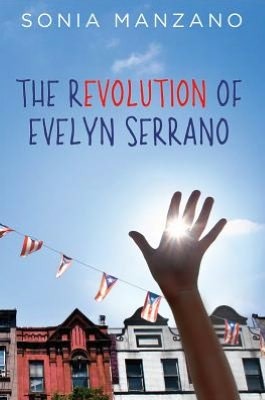
Book Review: The Revolution of Evelyn Serrano by Sonia Manzano

Evelyn overBy Sonia Alejandra Rodriguez

DESCRIPTION FROM THE BOOK JACKET: There are two secrets Evelyn Serrano is keeping from her Mami and Papo: her true feelings about growing up in her Spanish Harlem neighborhood, and her attitude about Abuela, her sassy grandmother who’s come from Puerto Rico to live with them. Then, like an urgent ticking clock, events erupt that change everything. The Young Lords, a Puerto Rican activist group, dump garbage in the street and set it on fire, igniting a powerful protest. When Abuela steps in to take charge, Evelyn is thrust into the action. Tempers flare, loyalties are tested. Through it all, Evelyn learns important truths about her Latino heritage and the history makers who shaped a nation. Infused with actual news accounts from the time period, Sonia Manzano has crafted a gripping work of fiction based on her own life growing up during a fiery, unforgettable time in America, when young Latinos took control of their destinies.

MY TWO CENTS: The Revolution of Evelyn Serrano (a Pura Belpré Author Honor Book) by Sonia Manzano  opens with a frustrated fourteen year old Evelyn getting ready for her summer job at the Five-and-Dime. Her desire to fit in to American society and distance herself from her Puerto Rican heritage is disrupted when her Abuela comes to stay with them. Abuela’s orange hair and bright clothes make her anything but the traditional grandmother Evelyn expected. Abuela taking over Evelyn’s bedroom with makeup, hair rollers, and flashy clothes is only the first of many changes that serves to transform Evelyn’s understanding of her own identity.

While Abuela’s presence creates tension in the Serrano household, a new youth group arrives to challenge discriminations against their neighborhood. The Sanitation Department eventually stops picking up the garbage, and as it continues to accumulate, so does the tension around the Young Lords’ intent to politicize El Barrio. The rise of the Young Lord’s movement gives Abuela and Evelyn an opportunity to discuss the relationship between what is presently happening in their community and the Ponce Massacre (1937) of which Abuela has kept newspaper clippings. The Young Lords organize El Barrio in a way that Evelyn has never experienced, and their demonstrations and marches provide El Barrio with a visibility they later utilize to demand social change. As the political situation intensifies in El Barrio, Evelyn and Abuela become more involved with the Young Lords. Their involvement creates a rift between them and Evelyn’s mother, but it is through all of this process that Evelyn recognizes the importance of her Puerto Rican heritage.

Among many things, Manzano’s The Revolution of Evelyn Serrano is a historical young adult novel. (Re)tellings and (re)imaginings of history are currently a popular strategy in Latina/o Children’s and Young Adult Literature. Like Juan Felipe Herrera’s Downtown Boy (2005) and Bejamin Alire Saenz’s Aristotle and Dante Discover the Secrets of the Universe (2012), Manzano asks that today’s young adult reader travel back to a time when their grandparents and/or parents were children and adolescents.

This literary move to focus on a historical event is brilliant for many reasons. First, it asks Latina/o readers to examine their own background as a way to understand their present identity. In The Revolution of Evelyn Serrano, it is extremely significant that there are moments of reflection that help Evelyn understand that her presence in El Barrio is not coincidence. In other words, Evelyn needed to learn her parents’ and grandparents’ journeys to understand her own identity and her relationship to El Barrio.

Secondly, novels like Manzano’s center stories that have remained marginalized in mainstream history books. Evelyn is such a wonderful character precisely because she sounds and behaves like a typical teenager. At the beginning of the novel, Evelyn wants nothing to do with her parents and their stories. She is embarrassed of them and her community—and this right here is a very honest and common feeling (that too often remains silent) among Latino children and teenagers of (im)migrant parents. Throughout the novel, Evelyn learns to center her Puerto Rican culture as a way to find empowerment rather than to feel embarrassed by it.

Lastly, Manzano’s novels, and others like hers, create intergenerational discussions around issues of discrimination and gender (to name a few themes present in Evelyn Serrano). In other words, novels like these emphasize that significant social change requires a community talking to one another. While the Young Lords were central in the mobilization of El Barrio, it was also with the support of their elders and younger members that they were able to stand strong against the discrimination the community faced.

The Revolution of Evelyn Serrano presents a genuine story of identity formation for a young Latina coming of age at a moment in U.S. history when Latinos are violently forced to assimilate into mainstream society or risk their lives by speaking up and challenging the discrimination they experience.

TEACHING TIPS: When teaching The Revolution of Evelyn Serrano, it will be helpful to provide a historical context for the novel from which to guide student discussion. Manzano provides a bit of this discussion in her afterward where she explains that the events in the novel are based on true events. The Young Lords: A Reader (2010) edited by Darrel Enck-Wanzer and Palante: Voices and Photographs of the Young Lords, 1969-1971 (2011) are excellent resources for educators to learn more about the group’s history, motivations, and outcomes. Pairing the novel with some of the essays in these sources for more advanced or older students can also provide a basis for discussing race, class, and gender both within the party and in the context of the US.

A thematic approach to teaching Manzano’s novel can be one way to broadly discuss the Civil Rights Movement and relating topics. Novels like Rita Williams-Garcia’s One Crazy Summer (2011) about three young African American sisters and their adventures with the Black Panthers and children’s books like Monica Brown’s Side by Side: The Story of Dolores Huerta and Cesar Chavez (2010) about the leaders of the farm workers’ movement can provide rich conversations about the array of issues impacting people of color at this time. Discussing children’s and YA books on the Civil Rights movement not only allows students to learn more about specific racial discrimination and community empowerment but also creates opportunities for students to discuss how those issues impact them now.

Another approach to teaching the novel is to discuss characters and character development. Evelyn’s relationship with her abuela is a complicated one because they have different personalities and because Abuela represents a cultural heritage Evelyn wishes to avoid. Their relationship, however, is central in the novel. Other YA novels like Claudia Guadalupe Martinez’s The Smell of Old Lady Perfume (2008) and Sandra Cisneros’s Caramelo (2003) present similar granddaughter/grandmother relationships wherein both characters engage and learn from one another. Asking students to interview their grandparents or a family elder could be a possible assignment for students of any age to participate in an exercise similar to the character development of the protagonists they read.

AUTHOR (from her website)Sonia Manzano has been a presence on Public Television since the 1970’s. Raised in the South Bronx, she attended the High School of Performing Arts. A scholarship took her to Carnegie Mellon University in Pittsburgh, and in her junior year, she came to New York to star in the original production of the off-Broadway show, Godspell. Within a year Sonia was cast as “Maria” on Sesame Street. After ten years as an actress, Sonia began writing scripts for the series and has fifteen Emmy Awards as part of the Sesame Street writing staff. Sonia also wrote for the Peabody Award winning children’s series, Little Bill, for Nickelodeon and for a short time wrote a parenting column for the Sesame Workshop web site called Talking Outloud. In addition to The Revolution of Evelyn Serrano, Manzano has written two picture books: No Dogs Allowed! and A Box Full of Kittens.

FOR MORE INFORMATION ABOUT The Revolution of Evelyn Serrano visit your local library or bookstore. Also check out worldcat.orgindiebound.orggoodreads.comamazon.com, and barnesandnoble.com.

headshotSonia Alejandra Rodríguez has been an avid reader since childhood. Her literary world was first transformed when she read Rudolfo Anaya’s Bless me, Última as a high school student and then again as a college freshman when she was given a copy of Sandra Cisneros’s The House on Mango Street. Sonia’s academic life and activism are committed to making diverse literature available to children and youth of color. Sonia received her B.A. in English from the University of Illinois at Urbana-Champaign. She is currently a PhD candidate at the University of California, Riverside, where she focuses her dissertation on healing processes in Latina/o Children’s and Young Adult Literature.