Book Review: My Little Car by Gary Soto

MyLittleCarCoverBy Sujei Lugo

DESCRIPTION FROM THE BOOK JACKET: Teresa’s grandfather—her abuelo—gives her a fantastic little car for her birthday and she can’t wait to show it off to everybody. The car is so cool that the other bikes on the sidewalk part for her and even grown-ups turn their heads as she goes by. Teresa promises she’ll always take care of her beautiful carrito, but some promises are hard to keep. When Teresa’s abuelo comes to visit, will he even recognize his beautiful present?

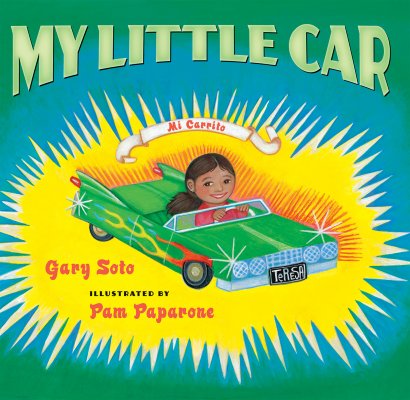
MY TWO CENTS: Through a shiny book cover of a girl riding a little car with a big smile, Gary Soto and Pam Paparone introduce us to a Chicana first-grader named Teresa. Her confidence and pride are enhanced when she receives a toy lowrider for her birthday, a customized car originated by Chicanos in California. Paparone’s bright acrylic illustrations strongly complement Soto’s words to project the subculture surrounding lowriders and other features distinctive of some Chicano and Latino neighborhoods and their communities.

When we first meet Teresa she is feeling embarrassed by her tricycle, thinking that it was a toy for “little kids.” For her birthday, she receives a beautiful lowrider with a personalized plate from her abuelito, giving her an immediate sense of independence and the confidence of being recognized as a big girl. Through this gift and Teresa’s relationship to it, Soto presents us with two important themes: the obvious one is the importance of taking responsibility and care of your belongings and the second one is presented in a more nuanced way, and perhaps silently aimed to parents: how easy it is to break the “gendering” of toys and roles.

Once Teresa receives her carrito, she pedals non-stop down the sidewalk, around her neighborhood, and she even takes it to the playground car show, where she wins first place. But as the days pass, she becomes careless with her carrito: she leaves it out in the rain, it gets pooped on by birds, it’s crushed by her dad’s truck, and it even gets sticky from spilled soda. Her mother and grandfather get preachy and stern while teaching Teresa the importance of taking responsibility of her belongings and the preaching works: in the end she learns her lesson.

Interestingly, the book never gets preachy when dealing with the gender stereotyping of toys. We live in a society where we are constantly presented with gender-stereotyped toys in books, movies, TV shows, commercials, and stores. In this book we have a Chicana girl who disrupts the gender norms around cars as toys solely for boys, and who challenges the machismo present in Latino communities. Gary Soto shows formidable restraint by not including a single line in the book that says that girls should or shouldn’t do certain things. He just provides us with a story that normalizes girls liking toy cars by showing Teresa being happy with her gift and using it without any limits. Surely this portrayal is one that car-loving kids from any gender will identify with.

TEACHING TIPS: This picture book works well as a read aloud for parents, guardians, and librarians. It can be used to teach about responsibility and ownership, while at the same time, children can learn some words in Spanish. The book includes a glossary of the few words in Spanish incorporated throughout the story.

Spanish and Language Arts teachers (Pre-K-2nd grade) can use the text to not only teach Spanish words, but also to develop classroom activities, such as sequence of events, vocabulary, and alternate endings to the story. It is also useful to incorporate Mexican-American Studies to elementary school classrooms.

LEXILE: N/A

AUTHOR: Gary Soto is a Mexican-American author, who has written picture books, chapter books, poetry collections, young adult books, plays and novels. Soto, raised in Fresno, California, has a B.A. in English from Cal State and a M.F.A. from the University of California, Irvine. He has received several awards, including the 1977 Bess Hokin Prize, the Levinson Award, the Literature Award from the Hispanic Heritage Foundation, the American Book Award from the Before Columbus Foundation, the Andrew Carnegie Medal from the American Library Association and the Beatty Award for his book, Baseball in April. He is also the recipient of fellowships from the California Arts Council, the Guggenheim Foundation and the National Endowment for the Arts. In addition to his work as a writer, Gary Soto has taught English to Spanish-speakers as a volunteer. He divides his time between Berkeley, California and his hometown of Fresno.

Some of his selected books are: The Skirt, Pacific Crossing, Chato and the Party Animals, Baseball in April and Other Stories, Neighborhood Odes, Too Many Tamales, Chato’s Kitchen, Taking Sides, Off and Running, Cat’s Meow and Chato Goes Cruisin’.

ILLUSTRATOR: Pam Paparone is an illustrator of many books for children, such as: Raindrop Plop by Wendy Cheyette Lewison, I Like Cats by Patricia Hubbell, Flip, Float, Fly: Seeds on the Move by JoAnn Early Macken, The Tattletale by Lynn Downey and Of Number and Stars: The Story of Hypatia by D. Anne Love. She is also the author and illustrator of Cinco Patitos/Five Little Ducks and Who Built the Ark?  Her paintings have appeared on the cover of The New Yorker. Pam Paparone lives in Philadelphia, Pennsylvania.

My Little Car was one of commended titles of the 2007 Américas Award for Children’s and Young Adult Literature. For more information about My Little Car visit your local library or bookstore. Also check out WorldCat.org, Indiebound.org, Goodreads, Amazon and Barnes and Noble.
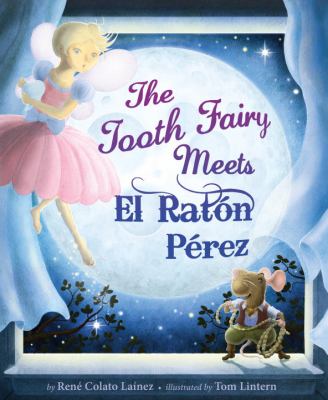
Book Review: The Tooth Fairy Meets El Ratón Pérez by René Colato Laínez

By Lila Quintero Weaver  the tooth fairy meets el raton perez

DESCRIPTION FROM RANDOM HOUSEThe Tooth Fairy has some competition. Meet El Ratón Pérez, the charming and adventurous mouse who collects children’s teeth in Spain and Latin America.

When both the Tooth Fairy and El Ratón Pérez arrive to claim Miguelito’s tooth, sparks fly under the Mexican-American boy’s pillow. Who will rightfully claim his tooth?
This magical tale introduces a legendary Latino character to a new audience and provides a fresh take on the familiar childhood experience of losing one’s tooth.

MY TWO CENTSWhat happens when beloved cultural traditions clash? Rene Colato Lainez’s flair for bilingual storytelling and Tom Lintern’s eye-popping illustrations combine in a winning picture book that addresses this question. Children will rejoice over the conclusion: there is no need to choose between the two!

The story revolves around double claims on Miguelito’s lost tooth.  Now that he lives in the United States, he’s inside the Tooth Fairy’s jurisdiction. But her Hispanic counterpart, El Ratón Pérez, is not ready to relinquish his duty to Latino children, even when they move across the border. One night in Miguelito’s bedroom, there’s a showdown between the rivals. Never fear—the tussle is well spiced with humor. Still, things get out of hand and Miguelito’s tooth lands on a high shelf, out of reach. It takes cooperation between the fairy and the ratón to retrieve the tooth, and this convinces them that future conflict is not necessary. From now on, Miguelito and other children can enjoy the toothy traditions of both cultures.

Like all picture books, the fun of this story is in repeated readings. Children will enjoy comparing the working methods and backdrops of these tiny tooth warriors. The rich color illustrations reinforce such observations. The Tooth Fairy lives in a castle. El Ratón Pérez makes his home in a cave. She searches the skies for a twinkling star that signals when a tooth is ready for retrieval. The signal he looks for is a moonbeam. Each has his or her tool of the trade; hers is a wand, his is a rope.

This is a wonderful text for children in transition between two cultures. It emphasizes the value of preserving old traditions and the joy of adding new ones.  The same lesson can be applied to other customs across nationalities, such as how birthdays and holidays are celebrated.

Spanish words and phrases are sprinkled throughout the book, always paired with the English translation. The publisher has provided a glossary.

TEACHING TIPSWe can do no better than the website dedicated to The Tooth Fairy Meets El Ratón Pérez that the author, a kindergarten teacher, has already put together! It includes a curriculum guide, creator interviews and other helpful features.

Here are a few additional resources.

The Centro Virtual Cervantes published a gallery of 79 illustrations featuring El Ratón Pérez.

Here are some craft ideas related to the Tooth Fairy.

An adorable tooth fairy pillow from MmmCrafts. And here’s another from the always reliable Martha Stewart.

Plus, how about a cute box for the tooth?

If you know where to find craft instructions for high quality El Ratón Pérez projects, please let us know!

AUTHOR: René Colato Laínez is a native of El Salvador who has written many books for young children. He teaches kindergarten in California. Want to learn more about him? Check out his interview on this blog!  

ILLUSTRATORTom Lintern is a storyboard artist, commercial illustrator and occasional illustrator of children’s books. View his impressive portfolio and more on his official site

A Conversation with René Colato Laínez

By Lila Quintero Weaver  portada-juguemos-futbol-football

If you are not acquainted with the picture books of René Colato Laínez, get thee to a bookstore right away! A Salvadoran transplant who teaches kindergarten in California, René writes joyful, bilingual picture books that children everywhere adore. I am delighted to share a one-on-one conversation with René about his life and work.

Lila: René, on your website, you express that the goal of your writing is “to produce good multicultural children’s literature; stories where minority children are portrayed in a positive way, where they can see themselves as heroes, and where they can dream and have hopes for the future. I want to write authentic stories of Latin American children living in the United States.”

As a collaborator on Latin@s in Kid Lit, a blog that exists to promote those very goals, I say BRAVO! Now for a question: What led you to adopt these goals?

René: I came to the United States when I was 14 years old. In my country, I was a smart student. I had good grades and many dreams to accomplish. In the United States, I did not know the new language. I felt lost and many times I thought that I would never be able to accomplish my goals. The inspiration to write books with a positive message to minority children came from my own life experience. I worked hard and never gave up. Yes! I accomplished my dreams. I am a teacher and an author. I want to tell minority children that they can accomplish anything they want. With “ganas” you can conquer the highest mountain.

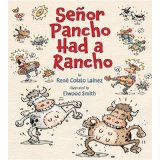
Senor Pancho

Lila: Let me brag on your latest book. Señor Pancho Had a Rancho has received glowing reviews. It was named a top picture book by Chicago Public Library and was included in the Cuatrogatos Foundation anthology, De Raices y Sueños. I could keep going, but let me pause to ask: What inspired you to create what’s essentially a Spanish version of “Old McDonald Had a Farm”?

René: One day my ESL (English as a Second Language) teacher told us that we could learn English through music. She played the song of a man named McDonald and he had many farm animals. When I listened to the song, I was confused when the dog barked woof woof instead of gua gua. My teacher told me that in English farm animals made English sounds. I said to myself, “If I bring my perro from El Salvador, he has to learn English too!” Later on, when I became a teacher, I played the song with my kindergarteners, but I always added the Spanish sounds. After having so much fun with my students, I decided to write a book about both English and Spanish farm animals, where they could have a great time speaking two languages.

Lila: Please share a bit about your childhood experiences of immigration from El Salvador.

René: I left the country with my father, due the civil war. Along with thousands of Salvadorans, my family was looking for a better place where we could be safe from the war. But I had a happy life as a child. I loved to go to school and read all the comics books from Mexico and Argentina, like El Chapulín Colorado and Mafalda. Since first grade, I wanted to become a teacher. My favorite books were Don Quijote and Las Telerañas de Carlota. I was so surprised to find my favorite book in English, here in the United States—Charlotte’s Web.

Lila: You teach kindergarten in a California school full of Latino children. How has this influenced your writing? Is teaching what led you to write picture books in the first place?

René: In high school and college, I wrote many drafts of novels. But when I came to the classroom, I discovered picture books and soon fell in love with them. I started to write my own books for my students and they called me “El Maestro lleno de Cuentos” (“The Teacher Full of Stories”). Later on, after receiving advice from many teachers and talented authors such us Alma Flor Ada, Isabel Campoy and Amada Irma Pérez, I decided to submit my work for publication.

Lila: Your books consistently offer bilingual texts. Why is this important to you?

René: I love bilingual books because you can share them with families who speak Spanish, English or both. They can also be great tools to speak and learn to read a second language. When I started to submit my manuscripts, I always envisioned them as bilingual books—books that I could share with my students, their parents, my family here in the United States, and all my relatives and friends in El Salvador.

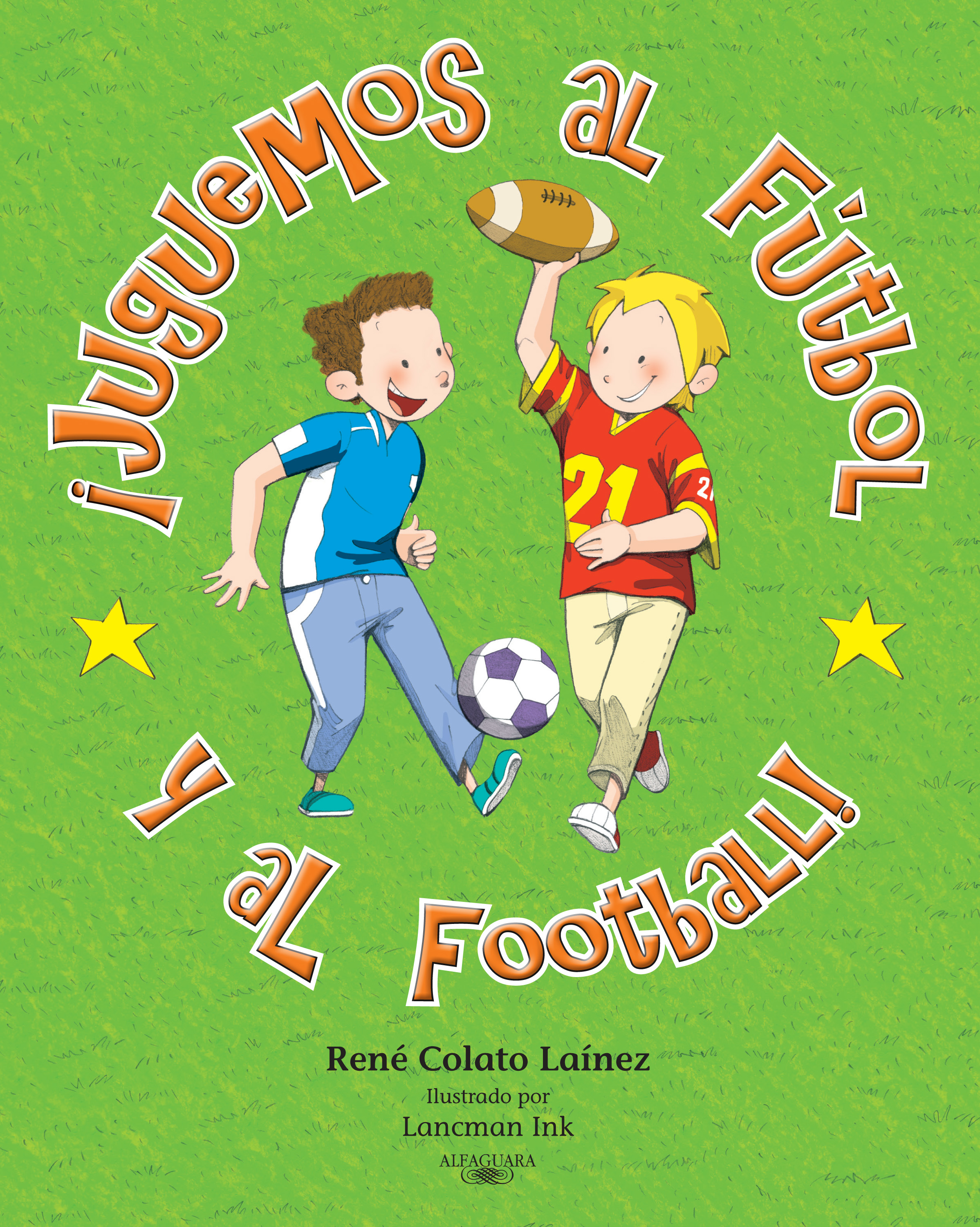
Lila: Your writings frequently celebrate the happy coexistence of Latino and non-Latino cultures. This occurs in The Tooth Fairy Meets El Ratón Pérez and in Juguemos al Fútbol/ Let’s Play Football (coming out this month in the bilingual hardcover edition), to name just two examples. What inspires your multicultural bent?

René: Latino children usually live in two worlds in the United States. They speak English and Spanish and celebrate holidays from the two cultures. Many times people fight to see which language or culture is most important. I love them both and in my books I want to tell children that instead of deciding which culture is better, we can celebrate both and have double the fun.

Lila: Writing a picture book looks easy only to those who have never tried it. What’s it like for you? Do you wait for inspiration to strike or do you have a disciplined routine?

René: Writing picture books is so much fun for me. It was not easy at first but I read tons of them until I was ready to write my own stories for publication. I usually start with the problem or idea for a story. Then I think it over, again and again, and begin to create the story in my mind. When I have something solid, I begin to write it. Many incidents in the classroom help me with ideas for new stories.

Lila: You graduated from the prestigious Vermont College of Writing for Children & Young Adults and have published at least nine books. That’s a lot of experience! Can you share some hints for aspiring writers?

René: Never give up, believe in yourself, and work hard for your dreams. Take creative writing classes and join critique groups. If you are writing children’s books, it is always a great idea to join SCBWI, Society of Children’s Book Writers and Illustrators. Submit your work and learn from rejection letters. Believe in your stories, because you are the only one who can tell and write them. 

renecolatolainezRené Colato Laínez is a native of El Salvador. He is the award-winning author of many picture books and the recipient of honors that include the Latino Book Award, the Paterson Prize for Books for Young People, the California Collection for Elementary Readers, the Tejas Star Book Award Selection, and the New Mexico Book Award. He is listed among “Top Ten New Latino Authors to Watch (and Read)” by the site Latinostories.com*. He received a degree from the Vermont College MFA program in Writing for Children and Young Adults. René’s full-time profession is teaching kindergarten in California. For more information, please visit his official author site

Comadres y Compadres: A Guest Blogger Reports

By Yadhira Gonzalez-Taylor

An eclectic group of writers, editors, and publishers, most of Latino heritage, gathered at Las Comadres y Compadres 2nd Annual Writers Conference at Medgar Evers College in Brooklyn on Saturday, October 5, 2013.

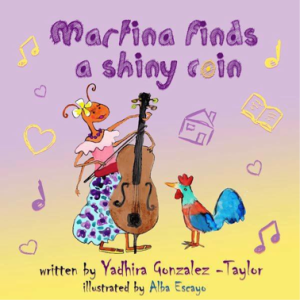
I am fairly new to creative writing, having just published an illustrated children’s book, Martina Finds a Shiny Coin. I networked, made new friends, and was impressed with the panels, which offered a wealth of information for writers at any stage of their writing careers. Panels ranged from self-publishing to presenting quality proposals for agents and major publishing houses. They had great craft shops on creating literature of all genres and for all ages.

The conference focused on the need for Latin@ literature and how Latin@s are underrepresented as an ethnic group in this industry. We live in the most diverse nation in the world, yet we are underrepresented in the stories we read to ourselves and our children and grandchildren. Even more alarming is the fact that, in the age of diversity and equal opportunity employment, we are underrepresented in the editing, publishing, and promotional arms of the literary industry.

At the conference, representatives from Random House, editors, and small press publishers all seemed to have the same message for the aspiring and published authors—there is an open invitation to produce quality material that suits the beautiful blend that is the Latino culture. Latin@ writers of all genres are invited to produce quality fiction, nonfiction, memoir, and children’s literature geared toward a population that is thriving and growing more each day in the United States.

As a writer and attorney working with at risk-youth in New York City, I see it as my Martina Shiny Coinresponsibility to produce this literature.

As a mother of three children, I have felt frustrated at not finding literature that reflects them or me. By pure coincidence, what began as an afternoon project with my five-year-old became a retelling of my very favorite Caribbean folktale, La Cucarachita Martina y el Raton Perez. One day, my husband asked me if there were any Puerto Rican folktales I could share with her, and immediately la cucarachita Martina came to mind. I heard it a thousand times growing up and even participated in my kindergarten class’s rendition of the fable/folktale.

I frequently told my daughter the original version, or at least what I remembered of it, that my grandmother recited to me when I was growing up in rural Caguas, Puerto Rico. When we traveled to my grandmother’s funeral in 2011, my daughter, then three, asked me if a tiny house nestled in the mountains was Martina’s. Of course, I told her it was, but explained that Martina was very busy and could not have visitors.

After telling the story many times, we sat and rewrote it, adding all sorts of ideas that popped into our heads. We made Martina a cellist because my daughter is a cellist. We made her an avid reader, and a dancer, and a singer of bomba y plena. We sent Martina on a journey of self-discovery after she found the shiny coin. We based Martina’s world in my world, the place where I lived for many years, Parcelas Viejas, in El Barrio Borinquen, Caguas, PR.

The book carries the folktale’s original message of self-acceptance no matter what. The story also sends the message to appreciate all gifts, not just the ones that make you look good. Of course, this is not just a message for Latin@ children but for all children!

In addition to writing Latin@ children’s literature, I am also compelled to seek out and promote contemporary authors who are producing similar literature.

It is a fact that communities thrive economically when residents invest in local business. There are many ways to do this, including visiting small bookstores like La Casa Azul in El Barrio NYC, which caters to our cultural needs. Other ways include supporting and attending Latin@ author readings and signings, or donating to, or volunteering for literary organizations like Las Comadres or any other non-for-profit organization that furthers the mission of promoting Latin@ literature.

We must commit to investing in Latin@ literature for our own sake and the literacy of our children.

YadhiraYadhira Gonzalez-Taylor is a public service attorney working with at-risk youth in NYC. Before working with young people she worked as prosecutor for Bronx County.  Martina Finds a Shiny Coin is her first children’s book. It was illustrated by Alba Escayo, a Spanish Artist who has ancestral roots in Cuba. Yadhira lives with her family in New York.  Follow her on twitter at @ygonzaleztaylor or Martina the character on twitter at @martinascoin.