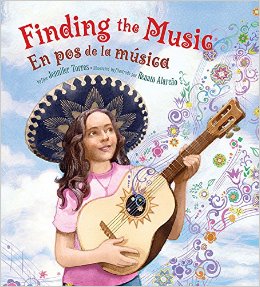
Book Review: Finding the Music/En Pos de la Música by Jennifer Torres


finding the music coverBy Sujei Lugo

DESCRIPTION FROM THE BOOK JACKET: Above Reyna’s favorite booth in her family’s restaurant hangs the old vihuela, a small guitar-like instrument, that belonged to her abuelito when he was in a mariachi band. Reyna has never heard the vihuela played, but her mamá treasures the instrument as a reminder of abuelito and his music. One noisy day in the restaurant, Reyna accidentally damages the vihuela. Determined to get it repaired before Mamá notices, Reyna sets out to search her neighborhood for someone who can help her fix the instrument. Little does Reyna know that along the way she will find herself growing closer to abuelito and to the power of his music.

MY TWO CENTS: From the winner of the 2011 Lee & Low Books New Voices Award, here we have a bilingual story filled with charm that showcases the power of music as an intergenerational unifier.

Every weekend, Reyna hangs out at her mom’s restaurant, Cielito Lindo, reading and enjoying the cast of characters that visit the place. One day, she accidentally breaks her grandfather’s precious vihuela that hanged on one of the restaurant’s walls. Reyna never met her abuelito, but her mother’s tales about him and the way he played the vihuela are near and dear to her. Reyna knows she must embark on a journey to fix her abuelo’s beloved instrument.

This journey will bring her to learn, first hand, about his legacy and the importance of music and the power of community engagement. Throughout each page, and Reyna’s conversation with different community members, her abuelo’s presence can be felt. Jennifer Torres uses Reyna’s journey as a great portrayal of how meaningful everyday life is for a community. The vihuela becomes a powerful artifact that jump-starts the memory of the past, the important history of the community that tends to be invisible but is so essential to understanding the present. The broken vihuela reveals other anecdotes from the past that will help Reyna see the bigger picture of who her abuelo was and how the community remains united through their shared past. And it is through oral history and the passing of this knowledge that Reyna becomes aware of the real importance behind the vihuela and why it was hanging on the wall. The breaking of the vihuela is not a tragedy, but the catalyst for Reyna to better understand where she came from and get closer to her mother and her community.

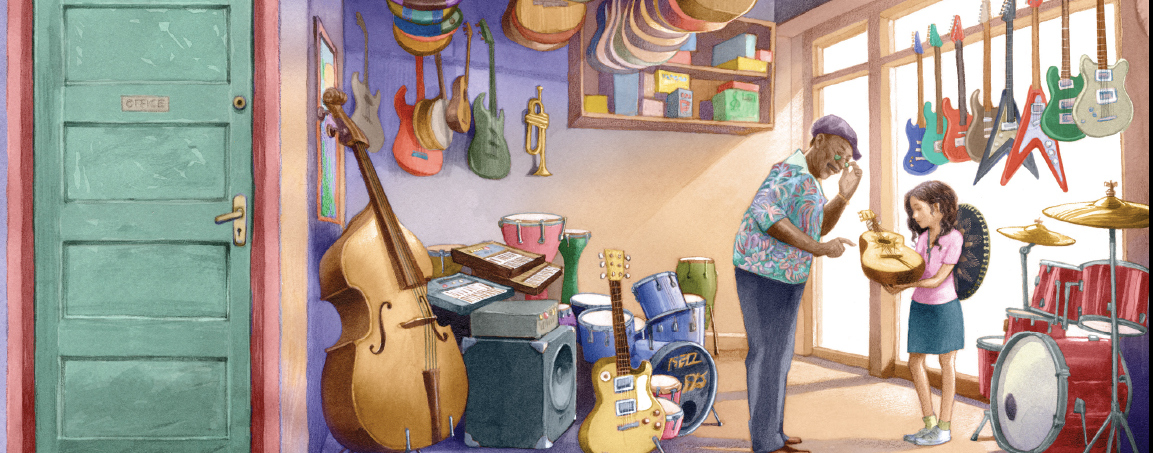
The realistic illustrations by Renato Alarcão, enhance the warmth of the tale and allow readers to see the characters’ expressions and feelings. Each image is filled with pastel colors and a consummated care to portray the connection and relations of the characters. The illustrations really echo a phrase said by Reyna’s mother at the beginning of the story, “these are the sounds of happy lives.” The illustrations truly convey the sounds of these lives.

Torres’s first picture book, Finding the Music/En Pos de la Música, is a solid work that is very much welcomed. The importance of oral history, the unifying qualities of music and the importance of preserving the artifacts that trigger the remembrance of who we were are all important concepts to help spark the curiosity of children among their own families and communities. We are in a constant search of adequate representation and we sometimes fail to see that in our own stories lie strong narratives that empower us and unite us.

*The book includes a glossary and pronunciation guide. The backstory of the Cielito Lindo and author’s note about mariachi music and band are also apprehended. Spanish translation by Alexis Romay.
musicstore
TEACHING TIPS: 
This bilingual picture book is recommended for children ages 4-9, and works well for early readers and as a read aloud with musical interventions as a bonus. Librarians, parents, grandparents, and caregivers can read with the young ones in English, Spanish, or both, while practicing or learning new vocabulary, identifying the different images and community components presented through the illustrations. It’s also a perfect book for a StoryWalk, given that our main character walks around her neighborhood finding some clues and stories about her abuelo. StoryWalk allows people to visit different points (parks, local stores, buildings) around the neighborhood where pages of the books are spread, they would walk to one point to another to follow the story.

Language Arts, Social Studies, Arts, and Music educators can collaborate in the development of different activities: vocabulary and writing activities, discussions and conversations regarding community, neighborhoods and Mexican, Chicano, and Latino history; the incorporation of drawings with writing activities; and the history of Mexican folk music. The author includes helpful activities for the Language Arts classroom: Story Map and Mini-Memoir. On the publisher’s website, you can access teaching guides developed for this book and other resources.

AUTHOR & ILLUSTRATOR:

Jennifer Torres is a freelance journalist, author, and coordinator of a community-wide literacy initiative at University of the Pacific, California. She studied journalism at Northwestern University, Illinois and at University of Westminster, London, England. Torres also worked as reporter for The Record newspaper, covering education, immigration, and other issues related to children and families. FINDING THE MUSIC/EN POS DE LA MÚSICA is her first picture book and her first middle grade novel, STEF SOTO, TACO QUEEN, will be published in Fall 2016.

Renato Alarcão is a graphic designer, illustrator and professor of visual arts. He studied in the Illustration as a Visual Essay program at the School of Visual Arts of New York and at The Center for Book Arts. In addition to his work as an illustrator, Alarcão has collaborated in different youth arts projects and has presented lectures on illustration, creativity, and artistic techniques. He has presented his work in exhibitions at the American Institute for the Graphic Arts, the American Society of Illustrators, the New York Public Library, the Skirball Cultural Center of Los Angeles, the Biennale of Illustrations in Bratislava, where he won the NOMA Prize for Illustrated Book. Some of his illustrated books: RED RIDIN’ IN THE HOOD: AND OTHER CUENTOS by Patricia Santos Marcantonio, SOCCER STAR by Mina Javaherbin, ROBERTO’S TRIP TO THE TOP by John B. Paterson & John Paterson, ELLA ENFEITIÇADA by Gail Carson Levine, Andiana Figueiredo.

FOR MORE INFORMATION ABOUT Finding the Music/En Pos de la Música visit your local library or bookstore. Also, check out WorldCat.orgIndieBound.orgGoodreadsAmazon, and Barnes & Noble.

Teacher-Author Diana Lee Santamaria On Promoting Literacy & Self-Publishing

Childrens book, school, teach, kids, learning, DLee's World, DLee, Diana Santamaria Childrens book, buy now, learn colors, teach, DLee's World, DLee, by Diana Santamaria Childrens book, teach counting, lesson plans, DLee's World, DLee, by Diana Santamaria Childrens book, teach counting, lesson plans, DLee's World, DLee, by Diana Santamaria

By Diana Lee Santamaria

Hi, everyone! I am so honored to be a guest writer on Latin@s in Kid Lit. My name is Diana Lee Santamaria and I am a newly self-published children’s author of DLee’s World Books. DLee’s World is a series of learning books that I created for children ages three to five. Since I struggled with issues of illiteracy growing up, I designed my books with bright colors, playful rhyme schemes, and diverse characters to promote literacy, diversity, and most importantly, fun.

Literacy is extremely important to me considering that more and more children
seem to display a lack of interest in literacy education. As a result, according to the most recent statistics
on literacy provided by the National Center of Educational Statistics, about 50% of adults in the United States read at or below basic proficiency level. Therefore, issues of literacy are still a huge factor in our society today. Who knows where I would have been, had my father not taught me? If he never realized my problem and wasn’t so determined for me not to follow in his educational struggles, I may not have graduated from college, become a teacher, or even a children’s writer.  Therefore, I created my books with the intent to help increase children’s interest in literacy at an early age. Literacy is all around us, from reading a sign while driving to ordering take-out. We are constantly put in positions where we have to read and show that we comprehend what we read. It is vital, therefore, that we promote reading and learning in children while they are young to aid in chances of future success.

The first four DLee’s World books are entitled DLee’s Color Hunt, DLee’s Outdoor Countdown, DLee’s First Day of School, and DLee’s Nighttime Scare. These books touch upon learning objectives, such as primary and secondary colors, counting and numeral recognition, dealing with new experiences, and fears of the dark. As an educator for seven years with a Master’s Degree in Early Childhood Education, I used my professional experiences, educational background, along with my own childhood experiences to bring each and every story to life. Currently I have written eleven other DLee stories, which I will hopefully be publishing within the next few years. In my mind the story possibilities with DLee’s World are endless. Since I have taught preschool for many years now, I know first-hand what objectives and relevant topics are typical and important to learn for that age group. As a result, I have a journal dedicated to those ideas, which I am consistently referring back to.

I officially self-published and began marketing in August of 2014. I chose to self-publish after doing lots of research and speaking to fellow educators and professionals who had also published literary works of art. The articles that I was finding shared a lot of negative aspects on attempting to publish through a large publishing company. I kept reading about the difficulty in getting a company to publish children’s literature even if your book is worthwhile. But that was not the only downside. From what I read and found to be true through my own research, most publishing houses do not accept unsolicited manuscripts; therefore I would have had to find an agent. Now although I found a list of agents through the Society of Children’s Book Writers (SCWBI), which I became a member of, everything takes time and everything costs money. I wasn’t sure if I wanted to wait for a response considering that I may never get one or be waiting months on months. Additionally, I read about publishing through a larger company and the issue of not having full rights to your work. So I definitely considered the option of publishing the traditional route. But after all things considered, I decided to self-publish. My thoughts were that I would self-publish and market myself enough to build a following of parents and children that would eventually lead me to traditional publishing routes. My thinking was and still is that if I build enough of a fan base maybe a publishing company will come find me. Who knows how far fetched that is, but I figure I have nothing to lose. Hence, why I decided to give self-publishing a shot. Even still, I did send my work out to some publishing companies in hopes of a response. I have yet to receive one, but I remain positive!

latina, author, teacher, latina, authorIt’s ironic because if you would have asked me what I would be doing when I got out of college, I would have never imagined I would be a teacher, let alone a children’s writer. As an undergrad, I studied Speech Communications and always had a passion for all areas of the arts. I loved writing poetry, drawing, painting, singing, and acting. My dream, however, was to become a famous singer and later an actress! But I thought it would be more realistic to get a career in public relations relating to entertainment. Then, while I was doing an internship at a small entertainment company, I came across a woman who mentioned teaching and that idea sewed a seed that led me to pursue a pre-kindergarten to third grade teaching certification. From there, I began teaching and decided to earn a master’s degree in children's book series, latina, authorearly childhood education. While teaching, I was always reading to my students and at times was lacking the literary resources that not only hit the topic I wanted to teach but also relevancy to increase connection and overall understanding for my students. So one day, I decided to write a silly story about shapes. I wrote the story and then just left it there until one day, I read it to a friend. She really enjoyed the story and encouraged me to keep writing. I never really considered myself a writer, but that night I went home and the words began to pour out of me! I started analyzing the children in my classroom, the books they enjoyed along with the standards required for preschoolers to learn. And that is how DLee’s World came to be.

teacher, latina, author, From the use of my childhood nickname (given to me by my mother), to the use of my childhood image along with images of those who have impacted in my life, DLee’s World is very much a part of me. I have dedicated much time and effort to perfect DLee’s World books so that they are not only educational and fun for children but also useful for parents and educators. Subsequently, I have devised lesson plans that coincide with each learning book, available for free download on my website.

Recently, I have been doing free readings at libraries, schools, and bookstores throughout the New York, New Jersey, and Pennsylvania areas. It’s been such a fun experience, and I’ve been receiving many positive reviews from both parents and kids! I absolutely love what I am doing and hope to continue to share my efforts with children, parents, and teachers worldwide. My books can be found on www.dleesworld.com and Amazon.

Book Review: Salsa: Un poema para cocinar / Salsa: A Cooking Poem by Jorge Argueta


By Marianne Snow

DESCRIPTION (from Goodreads): In this new cooking poem, Jorge Argueta brings us a fun and easy recipe for a yummy salsa. A young boy and his sister gather the ingredients and grind them up in a molcajete, just like their ancestors used to do, singing and dancing all the while. The children imagine that their ingredients are different parts of an orchestra — the tomatoes are bongos and kettledrums, the onion, a maraca, the cloves of garlic, trumpets, and the cilantro, the conductor. They chop and then grind these ingredients in the molcajete, along with red chili peppers for the “hotness” that is so delicious, finally adding a squeeze of lime and a sprinkle of salt. When they are finished, their mother warms tortillas and their father lays out plates, as the whole family, including the cat and dog, dance salsa in mouth-watering anticipation.

Winner of the International Latino Book Award for Guacamole, Jorge Argueta‘s text is complemented by the rich, earthy illustrations of Duncan Tonatiuh, winner of the Pura Belpré Award. His interest in honoring the art of the past in contemporary contexts is evident in these wonderful illustrations, which evoke the pre-Columbian Mixtec codex.

MY TWO CENTS: Here’s another Jorge Argueta picture book that’ll make you hungry! Argueta has created several bilingual poetry books that celebrate traditional Latin American dishes – including Guacamole, Sopa de frijoles / Bean Soup, and Arroz con leche / Rice Pudding – and Salsa is just as mouth-watering. I love how he uses beautiful language to stir the senses, appealing to readers’ taste and smell with scrumptious descriptions of vegetables and herbs; sound by drawing comparisons between ingredients and musical instruments; and touch by weaving together the acts of cooking and dancing.

As a lover of spicy food, I particularly enjoy Argueta’s ode to hot chiles, complete with imagery that clearly evokes the crackly, wrinkled skin and the tingly burn of the peppers. Here’s a little taste:

Hay chiles con cara de abuelo

y chiles con cara de abuela.

Hay chiles rojos

como llamitas.

Al morderlos nos calientan la lengua

como si tuviéramos en la boca una lucecita.


There are chilies with faces like a grandfather

and chilies with faces like a grandmother.

There are red chilies

like little flames.

When we bite one our tongue gets hot,

as if we had a tiny light on in our mouth.


I really wish I had some salsa right now.

Meanwhile, Duncan Tonatiuh’s signature illustration style, which hearkens back to pre-Columbian Mixtec art, captures readers’ sense of sight and beautifully reminds us of Mexico and Central America’s past while celebrating a contemporary family coming together to prepare a meal. Inviting Tonatiuh to illustrate this book is a perfect choice, since his historically inspired images reflect Argueta’s description of the history of the molcajete, the mortar and pestle crafted from volcanic rock that people have long used to grind vegetables and spices. This connection of the past and present through both words and illustrations makes Salsa an especially delicious dish for me.

(My much loved molcajete.)

TEACHING TIPS: This book is an invitation for several meaningful hands-on learning activities. Students and teachers can write up bilingual recipes for salsa using the ingredients Argueta presents in the poem and then make a tasty, healthy snack to eat and share with others at school. If children have family members or friends who have experience using a molcajete to make salsa, teachers can invite these special guests to demonstrate their techniques – a perfect opportunity to welcome students’ home lives and funds of knowledge into the classroom. Afterwards, everyone can write their own food poems utilizing some of the various literary devices – similes, metaphors, rich imagery, synesthesia – that Argueta employs.

Additionally, Salsa is an excellent springboard for a science lesson about composting and plant growth. When the family in the poem finishes making their salsa, the son takes leftover lime seeds and vegetable peels outside and buries them in a hole in the ground:

Las entierro para que se conviertan en abono,

Children can do the same when they finish their own salsa, making hypotheses about what will happen to the seeds and foods scraps and then observing the changes that occur as weeks pass. Will the vegetable matter decompose and turn into soil? Will new plants emerge from the seeds? You’ll have to try it and see!

ABOUT THE AUTHOR (from Salsa’s book jacket): Jorge Argueta is an award-winning author of picture books and poetry for young children. He has won the International Latino Book Award, the Américas Book Award, the NAPPA Gold Award, and the Independent Publisher Book Award for Multicultural Fiction for Juveniles. His books have also been named Américas Award Commended Titles, USBBY Outstanding International Books, Kirkus Reviews Best Children’s Books, and Cooperative Children’s Book Center Choices. A native Salvadoran and Pipil Nahua Indian, Jorge spent much of his life in rural El Salvador. He now lives in San Francisco.

LINKS / OTHER INFO: Here are a couple of fascinating videos that teachers can use to supplement the book:

https://www.youtube.com/watch?v=Za_2VWD4nU4

FOR MORE INFORMATION ABOUT Salsa visit your local library or bookstore. Also, check out WorldCat.orgIndieBound.orgGoodreadsAmazon, and Barnes & Noble.


MarianneMarianne Snow is a doctoral student at the University of Georgia, where she researches Latin@ picture books, representations of Latin@ people in nonfiction children’s texts, and library services for Spanish-speaking children and families. Before moving to Georgia, she taught Pre-K and Kindergarten in her home state of Texas and got her master’s degree in Teaching English to Speakers of Other Languages (TESOL) at Texas A&M University. In her spare time, she enjoys obnoxiously pining for Texas, exploring Georgia, re-learning Spanish, and blogging at Critical Children’s Lit.

Happiness as a Social Justice Issue in Latin@ Kid Lit

By Sonia Alejandra Rodriguez

In the years that I’ve been researching and writing about Latina/o kid’s literature, I’ve gone back and forth about the impact that “happy endings” have on the stories and young readers. Because I focus specifically on realistic fiction, narratives that capture lived experiences, I found the happy endings to be a bit misleading. Real stories on deportation and family separation, for example, do not always get a happy ending and especially not as immediately as books make it seem. In general, happy endings are an essential component of children’s illustrated texts. That is, picture books for children tend to have happy endings because a book that tells children, for example, that “life sucks” and encourages them to give up would probably not fare well in the industry. Within this genre, happy endings also function as a way to preserve a child’s innocence. There is something both beautiful and problematic about the genre’s desire to protect children from “growing up too fast,” from the “dangers of the real world,” and whatnot. In this way, the happy ending allows children to explore the world through books with the guarantee that they will be safe, that everything will work out, and that they will be protected. However, not all children are seen as inherently innocent and therefore their access to protection and safety is limited and certainly not guaranteed.

Because Latina/o kid’s lit as a genre has done an exceptional job at pointing out the marginality, discrimination, and uncertainty that Latina/o children face in this country I had often found the happy endings in some of these texts disconcerting. The reconciliation between the oppressions experienced by a Latino child protagonist and the happy ending was too simple. I was afraid that those endings would mislead or further discourage real children who were undergoing similar situations as those portrayed in the books but who were not experiencing the happy endings. My concern was also that the happy endings minimized the urgency of the topics being discussed.

I have found that the most beneficial way to understand happiness in Latina/o kid’s books is to read it as part of the story rather than the ending. In other words, happiness is a piece of a much larger story and not just the end. This understanding is particularly important when teaching Latina/o kid’s books dealing with social justice issues. It is significant to note that the happy endings do not suggest that the oppressions the characters experience have also ended. Furthermore, characters’ happiness does not suggest that they are not being oppressed. These caveats on happy endings may seem unnecessary and a bit of a downer; however, happy endings in kid’s picture books assume that children access happiness equally when, in fact, this is not the case. Because of this, happy endings in children’s picture books with social justice themes further present an opportunity to discuss happiness as a social justice issue.

1016493As important as it is to contest happy endings, it is also important to protect Latino children’s right to happiness. I became more aware of this significance upon giving a presentation on Juan Felipe Herrera’s Super Cilantro Girl where I was asked if the story’s ending undermined Esmeralda’s agency. Super Cilantro Girl tells the story of Esmeralda Sinfronteras and her transformation into a giant green superhero set to rescue her mother from an ICE detention center. Upon learning that her mother has been detained at the border, Esmeralda taps into the power of cilantro and gradually changes into Super Cilantro Girl. Bigger than a bus, taller than a house, and with the power of cilantro and flight, Esmeralda breaks her mother out of the detention center and brings her home. Super Cilantro Girl disrupts the anti-immigration policies that seek to separate her family by becoming bigger, stronger, and more heroic than the system. At the end of the story, however, it turns out that Esmeralda was dreaming and did not change into Super Cilantro Girl nor did she rescue her mother. Despite that, though, Esmeralda’s mother returns. In my presentation, I claimed that Esmeralda’s transformation exemplified how the body can be a site of healing. What does the ending then suggest about Esmeralda’s healing process and agency if her transformation into a superhero was just a dream? It was then suggested that I’d have a more productive reading of Super Cilantro Girl if I talked about it as magical realism and/or science fiction.
While an argument can be made to read Super Cilantro Girl as magical realism and/or science fiction, I choose not to because there is something difficult about reading Esmeralda’s dream of rescuing her mother from ICE as fantastical. Despite having been a dream, there is agency and power in Esmeralda’s ability to see herself as a superhero with the strength to fight ICE and reunite her family. Regardless of ICE’s threat, Esmeralda can imagine herself as powerful and, ultimately, happy. Esmeralda’s happiness upon rescuing her mother is an important part of her healing process. Again, happiness needs to be understood as part of the narrative and not the end point. Super Cilantro Girl demonstrates how happiness and imagination function to promote hope and resilience despite the systemic oppressions that hinder Esmeralda’s life. Challenging happy endings and reading happiness as a social justice issue present opportunities to further understand how childhood in the United States is racialized and how Latina/o kid’s lit creates alternative narratives.


headshotSonia Alejandra Rodríguez has been an avid reader since childhood. Her literary world was first transformed when she read Rudolfo Anaya’s Bless Me, Última as a high school student and then again as a college freshman when she was given a copy of Sandra Cisneros’s The House on Mango Street. Sonia’s academic life and activism are committed to making diverse literature available to children and youth of color. Sonia received her B.A. in English from the University of Illinois at Urbana-Champaign. She is currently a PhD candidate at the University of California, Riverside, where she focuses her dissertation on healing processes in Latina/o Children’s and Young Adult Literature.

Guest Post: A Sock Thief in the Making

DON’T MISS THE BOOK GIVEAWAY! THE INFO IS AT THE BOTTOM OF THIS ARTICLE.

COVER

By Ana Crespo

Sometimes I wonder what the reaction of my younger self would be if I could tell her that, at almost 40, I am investing in a career as a children’s book writer… in English.

“Awesome!” my enthusiastic five-year-old self would probably scream. Pequena1

“But you don’t speak English,” the realistic 10-year-old me would point out.

“Ha! You don’t even like to read,” the sarcastic teenager would mention. (It’s true. I didn’t. Learn about how I became a reader here.)

“You’re studying to be a journalist. Your job is to expose the facts and allow your readers to form their own opinions, not to create stories,” the determined 20-year-old me would explain.

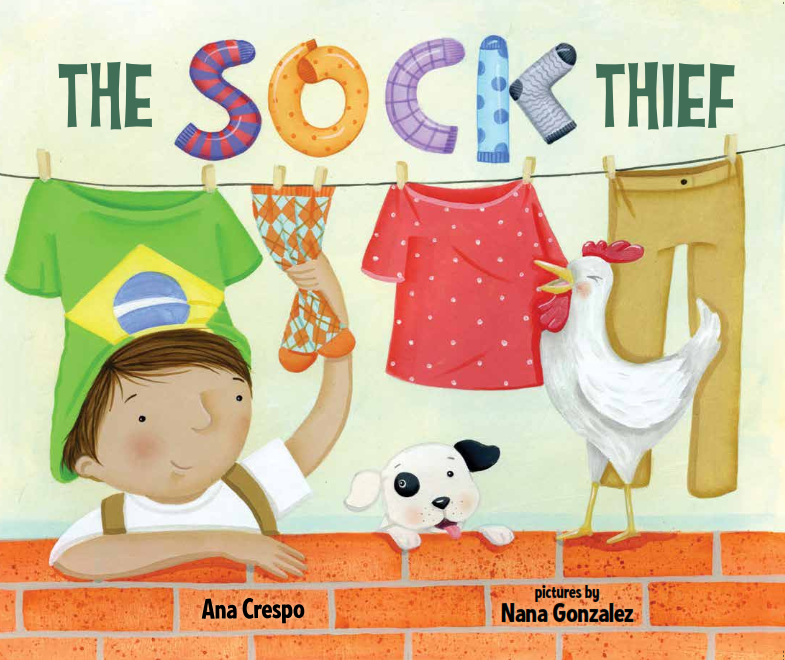
Certainly, I never thought I would one day publish any book, let alone a children’s book, in English. Yet THE SOCK THIEF has been in the making since I was that enthusiastic five-year old in Rio de Janeiro, Brazil. It started when my father tucked me into bed each night and shared stories of his childhood.

PapaiAlthough my paternal grandmother came from a wealthy family, my grandfather didn’t, and their five kids lived a frugal life. This included not owning a soccer ball, a very expensive item in the 1960s, in Rio. My father and his older brother had to be creative. They would sneak into my grandmother’s bedroom, take a pair of women’s hose, stuff it with newspaper, and make a soccer ball.

Don’t ask me why, but that story stuck in the back of that enthusiastic five-year old’s mind and resurfaced in the wanna-be children’s writer I eventually became. I had wanted to write a story with a Brazilian character since I started writing for kids in 2012. During a local SCBWI conference, a speaker mentioned something that brought back the long-forgotten memory. It wasn’t a story yet, just a memory with potential.

Then, I remembered something else from long ago. One day, watching a famous Brazilian TV show called Fantástico, I learned about a kid who had to walk a huge number of miles to reach school every day. I was a middle-class kid, riding on a comfortable school bus over paved roads, completely sheltered. That different reality, unthinkable to me up until then, left a strong impression. Maybe it sat in the back of my mind, by my father’s childhood story. Together, they started to form a plot.

Although I felt there was still something missing in the plot, I wrote THE SOCK THIEF (or MONDAY IS SOCK DAY, its first title) and submitted it to two different agents. And received two rejections. It wasn’t until I found that missing something that the manuscript received some attention.

One of the things that surprised me when I first moved to the United States was the way animal sounds are represented in written English. While in English a dog says “woof, woof,” in Portuguese, it says “au, au, au.” I imagined the difference would be a surprise to others as well, and decided to add it to THE SOCK THIEF. In my opinion, it gave the story a unique flavor.

A year after the idea first sprouted, I met my future editor at the same local SCBWI conference. I had paid for a manuscript critique, which included a 10-minute, face-to-face, in-depth analysis of THE SOCK THIEF. My editor thought the story was interesting. However, it was only after she learned that making soccer balls out of socks was a real practice in Brazil that her interest really sparked.

After the conference came the cutting, and cutting, and cutting of words. In the original text, I carefully described the process of making a soccer ball out of newspaper-stuffed socks. It was a tedious and confusing text, better shown through illustrations. I fixed some weird sentences. I added an author’s note. And I submitted my revised manuscript.

I crossed my fingers, lit some candles, held on to my figa, and tied some Nosso Senhor do Bonfim bracelets around my wrists. Okay, maybe I’m exaggerating a little. The point is that, although I really wanted a positive response, I had received so many rejections in the past, for this and other manuscripts, that I wasn’t keeping my hopes up too much.

In fact, I had set up a mental deadline. If I didn’t receive a positive reaction to my work, I was going to give up. The submission process is very stressful and the fact that it usually comes with rejections doesn’t really help. I never expected that the positive reaction I was hoping for would come in the form of a publishing offer, but it did.

From that point on, everything was new and exciting–the illustrator choice (Nana Gonzalez’s grandpa used to make soccer balls out of socks in Argentina!), the first drafts, the adjustments to the text, the illustrations in color, the adjustments to the text, the front cover reveal, the adjustments to the text, the first book review (a bit nerve-wrecking!), the scheduling of school visits, the book promotion… And, during it all, I sold four more books to Albert Whitman & Company–even more excitement.

While this journey would be exhilarating no matter what, to me it’s particularly rewarding because writing in English doesn’t come easily. No matter how long I’ve lived in the US, or how many college degrees I hold, or how much work experience I have, sometimes, I still sound foreign. I’m not talking (or writing, I should say) about my accent. It’s the word choices, the sentence structure, the weird use of prepositions. I’ve been through many funny and embarrassing moments thanks to the complexity of the English language…but that’s a whole different story.

***

A BOOK GIVEAWAY!

To celebrate the upcoming release of THE SOCK THIEF, we’re launching an amazing giveaway.  Sign up for a chance to win a copy of the book, plus a total of six copies to be donated to two elementary schools of your choice (three copies to each school). This giveaway was made possible thanks to a donation from Albert Whitman & Company.  To sign up for a chance to win and to check out the terms and conditions of the giveaway, visit the giveaway page on Ana Crespo’s website.

 ***

AnaCrespo_PURPLEAna Crespo is the author of THE SOCK THIEF (Albert Whitmam & Company, March 2015), JP AND THE GIANT OCTOPUS and JP AND THE POLKA-DOTTED ALIENS (Albert Whitman and Company, September 2015). Before investing in a career as a writer, Ana worked as an academic advisor and a translator. She holds a bachelor’s degree in Journalism and a Master of Education in Career and Technology Education. To find out more about Ana, visit her website. You may also find her tweeting away at Twitter , or sharing news on Facebook.


Guest Post: The Universality of Being an Outsider


by Jacqueline Jules

1956Family

Jacqueline Jules’ family in 1956

In my small Virginia town, like many places in the 1960s south, the first question people asked upon meeting was “What church do you go to?”

As a child, I remember fielding that question from parents of new friends and hearing my mother answer it in grocery stores.

“We’re Jewish,” I would explain politely. “We go to a synagogue.”

The response was generally a startled one. People would stare like I was a new species at the zoo.

“Oh my! I don’t think I’ve ever met a Jewish person before!”

From there, I’d often have to answer a series of questions about my “Jewish Church.”

I had been taught from a young age that I represented my religion. If I was impolite, all Jews would be considered rude. I had to be on my best behavior at all times so that others would not have a reason to dislike Jewish people. On many occasions, I also had to explain why Jews didn’t believe in Jesus and why I wasn’t terrified of going to hell. And the questions were just as likely to come from adults as other children.

Growing up, Christmas and Easter were never seasons of joy for me. They were times when the questions intensified. Why didn’t I celebrate Christmas? Didn’t the Jews kill Jesus? I learned early on that the Christmas spirit did not extend to Jewish children.

To add to my stranger status, my parents were not Southern born. Mom was a Northerner from Rochester, New York. Dad was from Switzerland and spoke with a thick German accent. He came to the US after World War II and was not a citizen when I was born. His name was Otto. In small-town Southern culture, having foreign roots set my family apart even in our tiny Jewish community.

So feelings of being “different” are quite familiar to me. I know what it is like to be the child of an immigrant. To be embarrassed in public when people ask your father to repeat something three times because they can’t understand what he is saying. To hear a parent talk of a homeland missed deeply. To long for relatives abroad who were only a part of our lives through letters and very occasional visits. To feel alone, apart from others who are comfortable in their skin and their surroundings.

Years later, when I took a position as a librarian in an elementary school with a large immigrant population, I identified with my students immediately. I had watched my own father struggle with the English language, which he learned in adulthood, at age 32. To his credit, he became quite fluent, but he still made some mistakes with grammar and pronunciation. Misunderstandings occurred in family conversations when my father did not understand a nuance or a cultural reference. Or we didn’t understand the perspective he was coming from. He didn’t approve of everything American. I recall what fun he made of sliced white bread which he compared to eating a sponge, and how excited he was when we found bakeries that sold French bread. And I remember how much my father hated turkey. He thought it tasted dry and he insisted my mother serve lamb or duck on Thanksgiving. I also remember that he didn’t care for pumpkin pie. In his mind, pies should be filled with fruit, gooseberries in particular.

The first Thanksgiving I taught at Timber Lane Elementary, a Title I school in Fairfax County, Virginia, I noticed right away that my immigrant students were not interested in my Thanksgiving lessons. Up until then, my story times had been received warmly. Seeing that my English-language learners enjoyed repetitive songs and choruses, I had quickly adopted them into my curriculum. My students had enjoyed songs about animals, the seasons, the five senses, etc. Why did they hate my turkey songs?

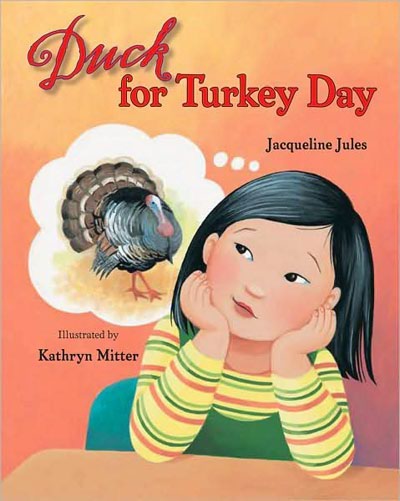
DuckforTurkeyDaybyJJulesA student gently explained: “We don’t have that kind of Thanksgiving dinner in my house.” Suddenly, I stopped being a teacher and returned to my own childhood, where I had been informed that turkey and pumpkin pie were the correct meal choices. These memories led to my first book with Albert Whitman Publishers, Duck for Turkey Day, about young Tuyet, who is worried that her Vietnamese-American family is breaking the rules for Thanksgiving. While the emotions of this book belong to my own childhood, they were deeply shared by the kids I taught. Making my characters Vietnamese-American gave me the opportunity to show how much I identified with my students, along with the universality of the problem. It also made my story current. My experiences as a Jewish child of a German-Swiss in the 1960s south are historical now. While I have shared my Jewish heritage in many of my books, I don’t want everything I write to be limited to my own particular, and not necessarily, universal experiences. Growing up as an outsider myself has naturally made me empathetic to other minorities in America. And it has made me downright indignant that so few children’s books reflect the lives of children who are not white, Christian, and middle-class.

All too often, books with non-majority characters portray their lives as a situation requiring great explanation. As a young Jewish mother in the 1980s, I was annoyed that most Jewish holiday books described traditions in such detail, they read like nonfiction. Not every Christmas story describes the Nativity. Most Easter stories are about bunnies, not the Resurrection. Why can’t Jewish children have light-hearted picture books that celebrate the joy of their culture, too?

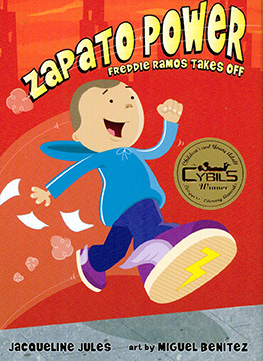
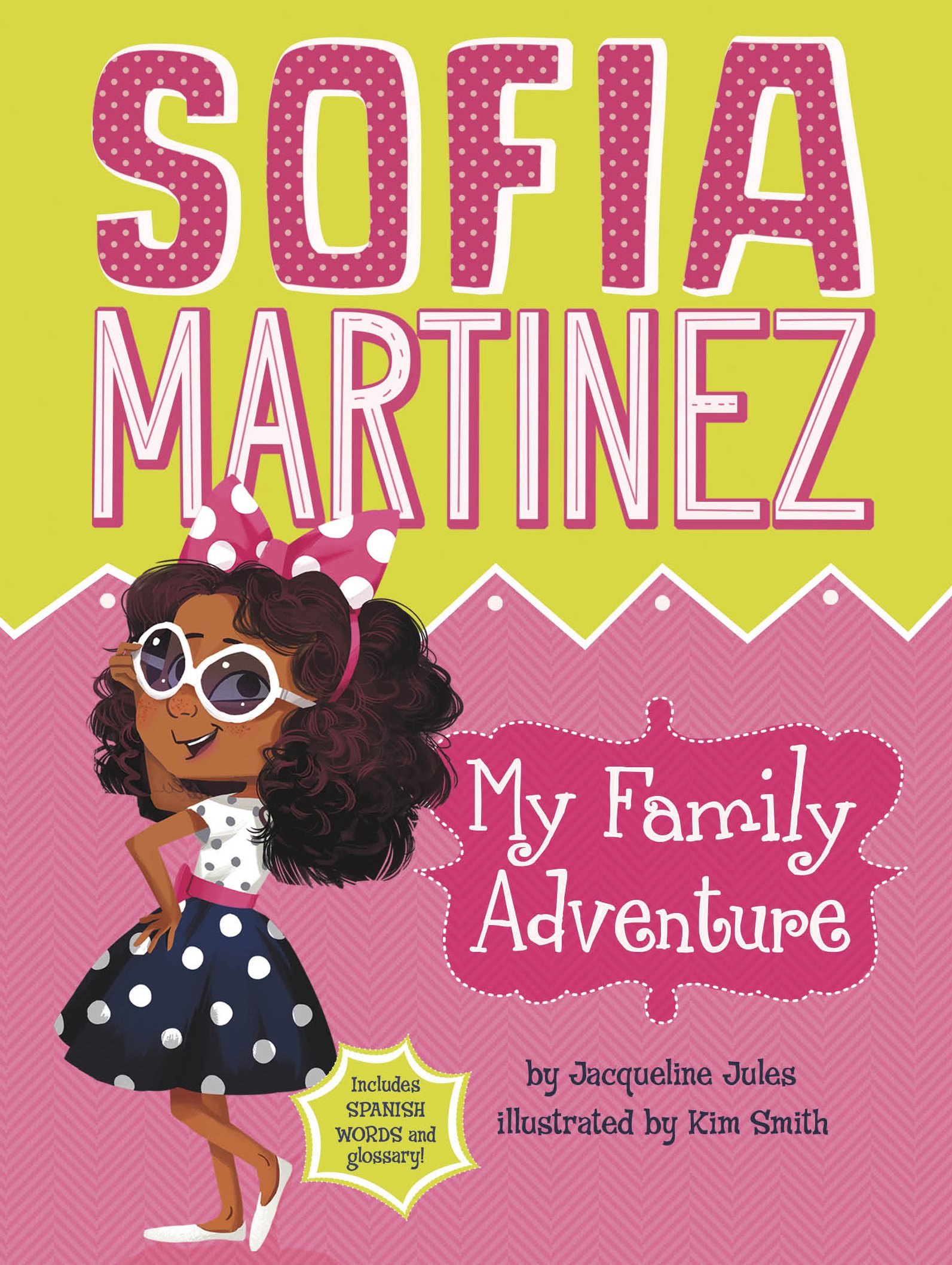
ZapatowithStickerAnd why can’t children of color have books, particularly easy readers, where they see themselves enjoying life? Why is minority status always the problem in a story rather than just one facet of a particular person’s existence? In my Zapato Power books, a chapter book series about a boy with super-powered purple sneakers, the main character, Freddie Ramos, is Latino. He lives an urban apartment life in a close-knit immigrant community, just like most of the students I taught. But that is not the plot of his stories. Freddie is mostly concerned with how he will solve mysteries and be a hero with his super speed. And in my new series, Sofia Martinez, my main character is a spirited Latina who wants more attention from her large, loving family. I taught many Sofias. Her family eats tamales at Christmas. She uses Spanish phrases in her conversations. And she deserves to learn to read with books that show her family life as fun and normal, not a particular ethnic challenge to be overcome.SofiaMartinezFamilyAdventure

Many authors say they write the books they would have liked to see as a child. I do that. But I also write stories I wish I had been able to give my students when I taught—books that show it is okay to be who you are.


JJulesWebPic

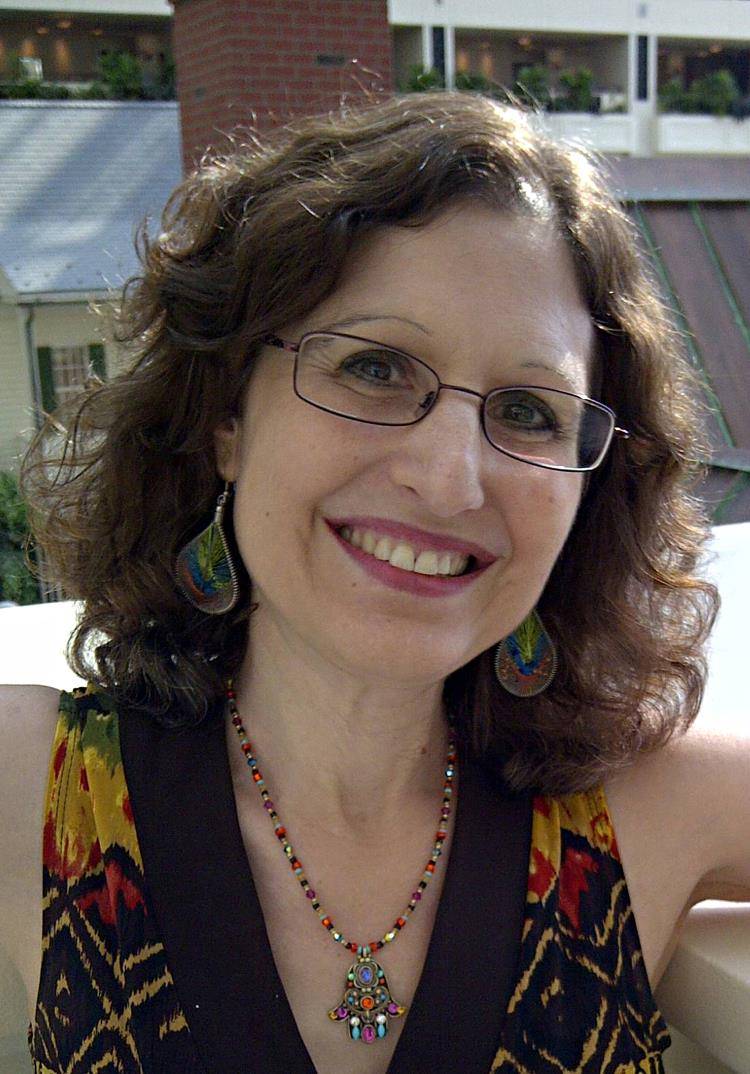
Jacqueline Jules is the award-winning author of 30 books, including No English, Duck for Turkey Day, Zapato Power, Never Say a Mean Word Again, and the recently released Sofia Martinez series. After  many years as a librarian and teacher, she now works full-time as an author and poet at her home in Northern Virginia. Find her on Facebook and at her official author site.