La Casa Azul: El Barrio’s Independent Bookstore

By: Zoraida Córdova


La Casa Azul 4

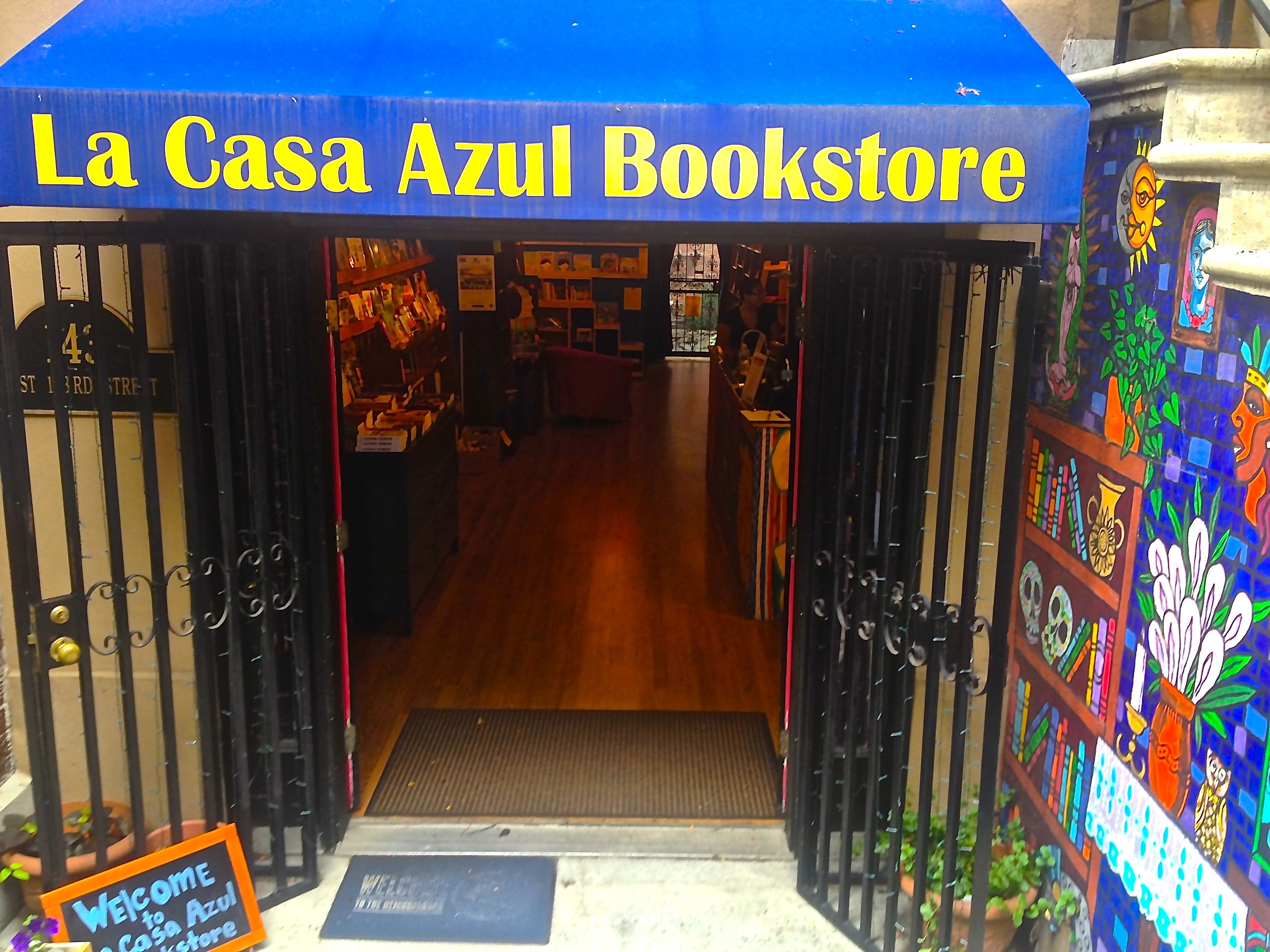
Entrance. Photo by Z.C.


La Casa Azul Vega

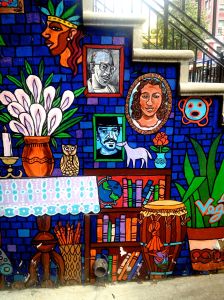
Manny Vega’s mural. Photo Z.C.

El Barrio, or East Harlem, is home to La Casa Azul, named after Frida Khalo’s home-turned-museum. Raising “40k in 40 days” through a crowd-funded campaign, Aurora Anaya-Cerda was able to open the doors to the store in June of 2012. It’s encouraging to see that the public is willing to contribute to bring these projects to life. I remember keeping up with the bookstore’s progress on Lucha Libros. From painting to building shelves, it was exciting to know that this kind of indie was coming to a neighborhood that otherwise doesn’t have access to a wide range of Libros Latinos. In a city that is 28.6% Latino, there is a huge need for access to these books.
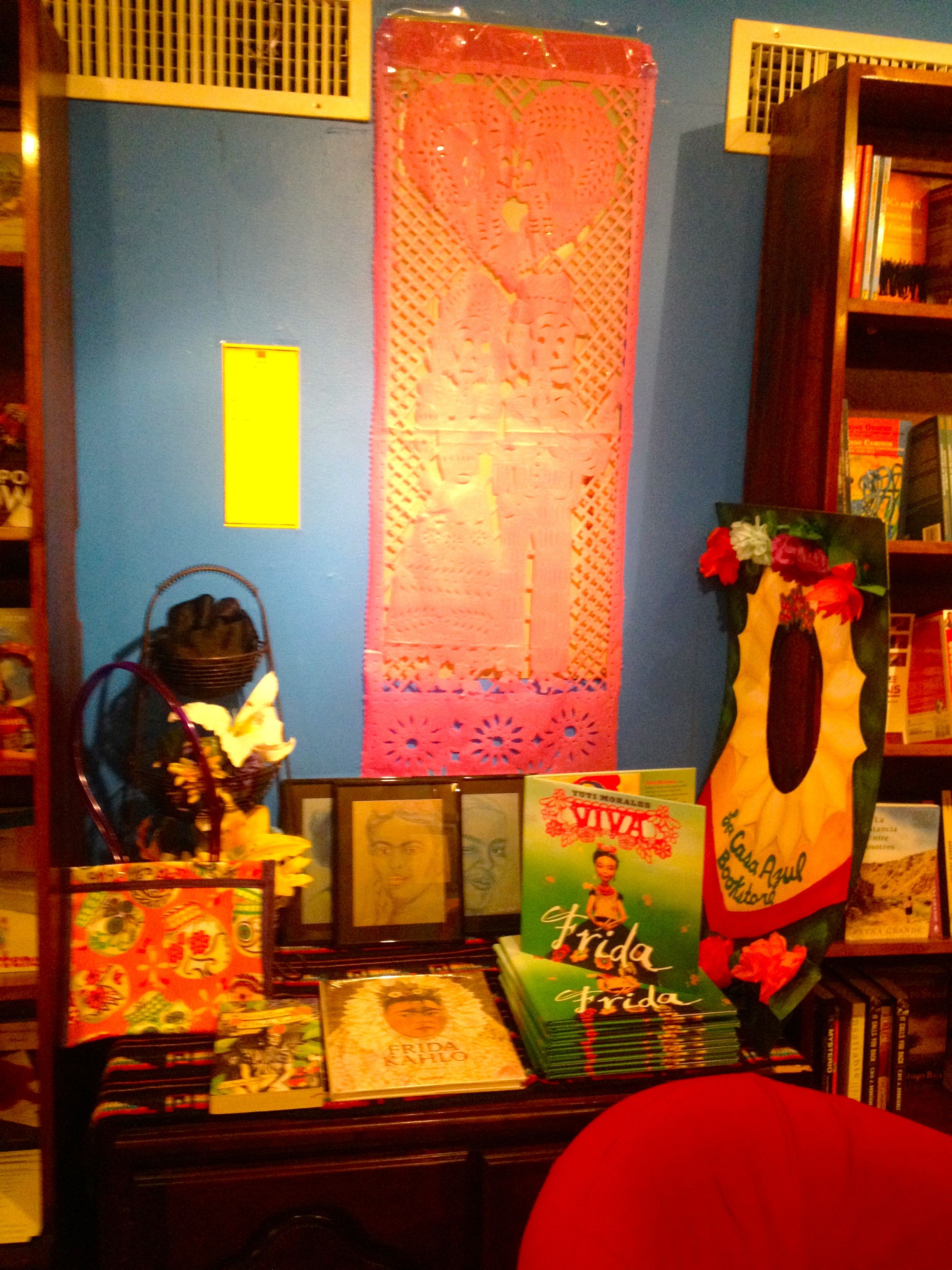
La Casa Azul 1

All things Frida Khalo. Photo Z.C.

So, how do you visit? To get to La Casa Azul, take the 6 train to 103rd street in Manhattan. This lets you off onto an area lined with bars, restaurants, bodegas, a botanica, and schoolyards. The neighborhood is also home to El Museo Del Barrio, if you’re in the mood for more art. But first, go to La Casa Azul. Make a left on Lex and a right at a bright blue awning. Down the steps you’re greeted by a gorgeous art installation by Manny Vega. You can see the process of his work here.

Once inside, the bookstore is warm and inviting. Aurora Anaya-Cerda is there with another employee stacking books. Named and inspired by Frida Khalo’s home, La Casa Azul has many references to her that range from paintings, to art books, to art installations. LCA even has its own exhibit/gallery. Their current showcase is called “A Ribbon Around a Bomb,” by Suhaly Bautista, The Earth Warrior. I’m excited to see what the next art display will be.

La Casa Azul 2

Shelves. Photo Z.C.

The great thing that you can see about La Casa Azul, is that it’s not just about the book events, but about community. Take a look at the events calendar for a wide selection of family-friendly music events, book readings and signings, literary conferences, volunteer outreach, and even BYOB paint parties.  They recently held a book drive for young immigrant children in New York. In addition to these events, La Casa Azul is available for space rental. Because of all of these things, La Casa Azul is important. I’d like to think that the independent bookstore is making a comeback, despite the threat of the digital age. Sure, you can get a book on your smart device or tablet, but there’s something special about being able to congregate in a safe space that embraces Latino culture.

The next time you’re uptown, stop by and pick up a couple of books.
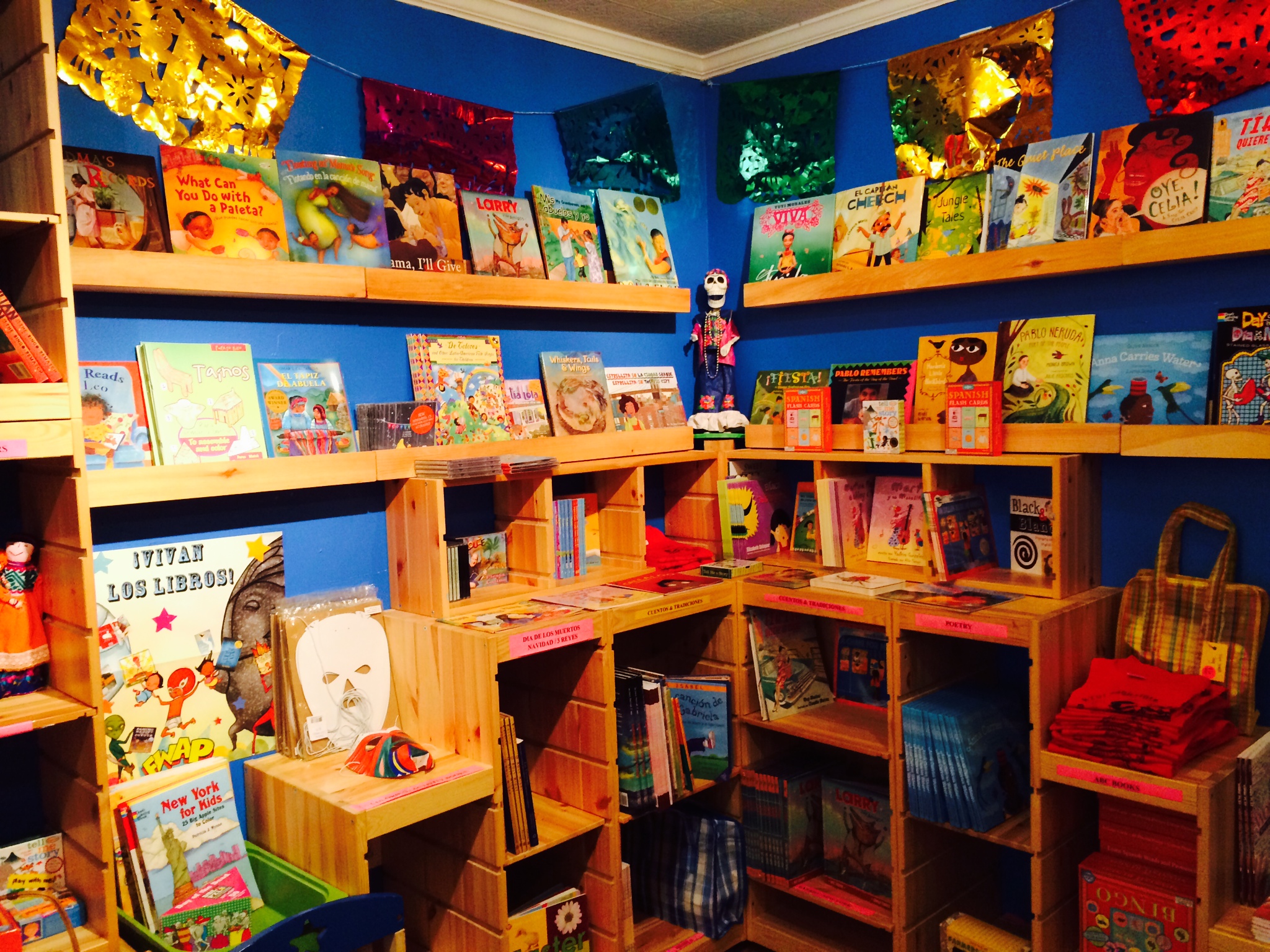
photo

Kid Lit section. Photo by L.L.

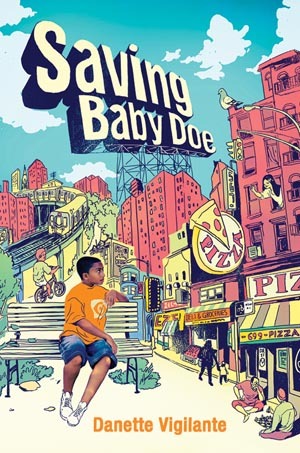
Book Review: Saving Baby Doe by Danette Vigilante

Saving Baby DoeBy Cindy L. Rodriguez

On Monday, author Danette Vigilante wrote about dream seeds and how she turned a teacher’s comment into a challgenge to become a better reader. Today, we celebrate her latest novel Saving Baby Doe.

DESCRIPTION FROM THE BOOK JACKET: Lionel and Anisa are the best of friends and have seen each other through some pretty tough times–Anisa’s dad died and Lionel’s dad left, which is like a death for Lionel. They stick together no matter what. So when Lionel suggests a detour through a local construction site on their way home one day, Anisa doesn’t say no. And that’s where Lionel and Anisa make a startling discovery–a baby abandoned in a Porta-Potti. Anisa and Lionel spring into action. And in Saving Baby Doe, they end up saving so much more.

MY TWO CENTS: Danette Vigilante pulls the reader right into this novel from the opening scene of a scared young woman is giving birth to her child in a Porta-Potti on a construction site. Soon after, Lionel and Anisa discover the baby, after playing in the closed-off site, and they decide to save “Baby Doe.” This is a middle grade novel that addresses some tough issues. In addition to the abandoned baby, the author explores the effects on children of absentee fathers and drug dealing. At the heart of it all is Lionel, who tries to do the right thing in the worst of situations.

While the issues are serious, Lionel responds to them as only a middle-schooler would. The real possibility of severe consequences doesn’t prevent him from launching into an ill-conceived plan to retrieve the baby from the hospital so that she doesn’t end up in foster care. While reading, I caught myself thinking, “Lionel, what are you doing? This is a bad idea!” Of course, he knows this, too, but he goes ahead anyway. In this way, Vigilante perfectly captures the middle school mind and creates tension through the narrative.

Then, there’s the end of Chapter 10, which I totally did not see coming. I probably should have, but I was wrapped up in Lionel’s plan to steal the baby and sell drugs to support her and then…chapter 10! Whoa! Well played! I’m not going to spoil it, but the story takes an important turn. That’s all I’ll say about that.

One of the many things I loved about this novel was the diversity within Lionel’s community. They all struggle financially, but they’re all individually-drawn people. Some work hard at “regular” jobs, while others choose quick money. Some are ultra-religious, while others are not. Some of the kids go to public school, while others go to the “genius” private school. Characters vary in terms of age, race, ethnicity, and experience, all of which creates a rich, real setting for Lionel and Anisa story to unfold.

TEACHING TIPS: In addition to all of the expected language arts lessons, this novel would work well in a health class since it deals with sex education (a lecture given by Lionel’s mom), child birth, the possible results of not seeking medical care, and the Safe Haven laws. Fiction is often reserved for language arts classes, but this type of realistic novel is ideal for blending fiction and nonfiction in health, where teachers and students tackle these serious issues.

LEXILE: N/A

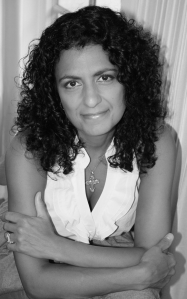
Danette_Vigilante_head_shot_high_resAUTHORDanette Vigilante grew up in the Red Hook Houses in Brooklyn, New York. She now resides in Staten Island with her husband, two daughters, two puppies and a cat with a bad attitude. Danette is the author of THE TROUBLE WITH HALF A MOON, a 2012-2013 Sunshine State Young Readers award nominee, and SAVING BABY DOE.

FOR MORE INFORMATION about Saving Baby Doevisit your local library or book store. Also, check out IndieBound.org,  GoodreadsAmazon.com, and Barnes and Noble.com.


Future of Latino/a Lit Is Being Written Now

For our first set of posts, each of us will respond to the question: “Why Latin@ Kid Lit?” to address why we created a site dedicated to celebrating books by, for, or about Latin@s.

By Zoraida Córdova

Why Latin@ Kid Lit?

Well, why not?

Growing up in Hollis, Queens, I never thought of myself as a minority. Personally, I think that word is crap. Are we minor things? Less-than things? Not at all, but this is what they (the proverbial they) call it.

I had my friends, some fourth-generation Irish, some Filipino immigrants, some Guyanese, Jamaican, Mexican, Mexican-Haitian, and the list goes on and on. But this is NYC and diversity is not foreign to us.

This same diversity was not reflected in the television I watched or books I read. My favorite shows were Charmed, Buffy the Vampire Slayer, and Dawson’s Creek. My favorite books were by Sarah Dessen. I was a freshman in high school and I had encountered zero characters who look like me, as I recently noted over at Diversity in YA.

The House on Mango StreetI’d like to think that Latino Lit has come in waves. First, THE HOUSE ON MANGO STREET by Sandra Cisneros and HOW THE GARCIA GIRLS LOST THEIR ACCENTS by Julia Alvarez, and while those stories are still relevant, they might not pertain to the kids who have already assimilated. I moved to New York when I was six; this Fall I will be celebrating 20 years here. While I most definitely know where I come from, my identity very much belongs to New York.

I want to see myself in the books I read.

Junot Diaz says, “Every single immigrant we have, undocumented or documented, is a future American. That’s just the truth of it.” And he’s 100% right. The future of Latin@ Lit is being written right now. I believe that not every book with a Hispanic or Latin@ character has to be an “issue” book. Not all of us have issues with our heritage. We just are.

Some good examples of this are GOING BOVINE by Libbra Bray,  SEAN GRISWOLD’S HEAD by Lindsay Leavitt,  and YAQUI DELGADO WANTS TO KICK YOUR ASS by Meg Medina. Each of these novels has Latin@ characters, but the story is not centered on being Latin@.

Going BovineSean Griswold's HeadYaqui Delgado Wants to Kick Your Ass

In GOING BOVINE, Paul Ignacio “Gonzo” Gonzales is a video-game-playing hypochondriac who has an overbearing Mexican mother. He’s dealing with lots of issues, but being Latino doesn’t seem to be one of them. The MC in SEAN GRISWOLD’S HEAD, Payton Gritas, is half-Colombian. Hers is a story of family and first love. Along the way, her ethnicity is mentioned, but it’s not the center of the narrative. In Medina’s novel, the MC is a Cuban-American–the new girl in school who is bullied by another Latina. Of course, the story includes plenty of background and action that touches upon Latin@ culture, but the central issue is not about racial or ethnic discovery.

We need stories that are as diverse as the Latin@ community, stories about Latin@s like me who are as American as they are Latin@. This is one of the things I want to explore in this blog with wonderful writers and readers like yourself.

Happy reading,

Zoraida

(Zor-eye-duh)