
By Cindy L. Rodriguez
This is the second in an occasional series about middle grade Latinx authors. We decided to shine a spotlight on middle grade writers and their novels because, often, they are “stuck in the middle”–sandwiched between and overlooked for picture books and young adult novels. The middle grades are a crucial time in child development socially, emotionally, and academically. The books that speak to these young readers tend to have lots of heart and great voices that capture all that is awkward and brilliant about that time.
Today, we highlight Celia C. Pérez.
Inspired by punk and her love of writing, Celia C. Pérez has been making zines for longer than some of you have been alive. Her favorite zine supplies are her long-arm stapler, glue sticks, animal clip art (to which she likes adding speech bubbles), and watercolor pencils. She still listens to punk music, and she’ll never stop picking cilantro out of her food at restaurants. Her zines and writing have been featured in The Horn Book Magazine, Latina, El Andar, Venus Zine, and NPR’s Talk of the Nation and Along for the Ride. Celia is the daughter of a Mexican mother and a Cuban father. Originally from Miami, Florida, she now lives in Chicago with her family and works as a community college librarian. She owns two sets of worry dolls because you can never have too many. The First Rule of Punk is her first book for young readers.
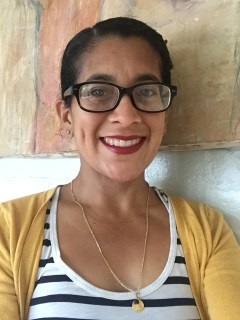 Celia C. Pérez
Q. Who or what inspired you to become a writer?
A. I’ve loved writing for as long as I can remember. I think for me it just went hand in hand with being a reader. The earliest memory I have of writing something and realizing writing might be something I was good at was when I was in the third grade. All the third graders had to write an essay about what our school meant to us. One essay would be picked and that student would get to read it at our graduation. Mine was chosen. I don’t have the essay anymore and it’s been so long that I can’t remember what Comstock meant to me, but I do remember that it was the first time I felt like perhaps my writing held some power. And as someone who grew up a quiet, shy child of immigrant parents, it really was that sense of power it gave me that kept me writing throughout my life.
Q. Why do you choose to write middle grade novels?
A. I love middle grade books above all others! My fondest memories of my life as a reader start in the later years of elementary school so I have a soft spot for middle grade. I think that age range that middle grade covers (eight or nine to twelve) is such a vibrant and varied period of life. It’s this time of life when kids are teetering between childhood and adolescence and all the contrasts and clashing emotions that are part of those stages. They’re often still full of wonder and curiosity and innocence but also full of difficult questions and realizations about the world around them that aren’t always pleasant. There’s just so much to discover and explore there.
Q. What are some of your favorite middle grade novels?
A. I love the Pacy Lin books by Grace Lin (Year of the Rat, Year of the Dog, and Dumpling Days); When You Reach Me by Rebecca Stead; Enchanted Air by Margarita Engle; Ninth Ward by Jewell Parker Rhodes. Oldies that are dear to my heart are Jennifer, Hecate, Macbeth, William McKinley, and Me, Elizabeth by E.L. Konigsburg. I love Harriet the Spy by Louise Fitzhugh (and will always associate dumbwaiters and egg creams with her), but I remember especially enjoying Nobody’s Family Is Going to Change. Although, to be honest, I feel like that’s a book I would probably have to reread because she’s a white woman writing an African American family. I also have a soft spot for my earliest favorites like Witch’s Sister by Phyllis Reynolds Naylor, The Witch of Blackbird Pond by Elizabeth George Speare, and the Anastasia Krupnik books by Lois Lowry. I’m always afraid I’m leaving something out, and I likely am.
Q. If you could give your middle-grade self some advice, what would it be?
A. Oh, boy. I have a lot of advice for my middle grade self but let’s start with these:
Keep everything you write even if you think it’s terrible. You’ll be happy you did.
Your voice is worth listening to. Don’t be afraid to express yourself.
You’re a good athlete. Stop reading during P.E. and play!
Q. Please finish this sentence: “Middle grade novels are important because…”
A. Middle grade novels are important because more than any other type of book I believe they give young readers the keys to discovering their place in the world.
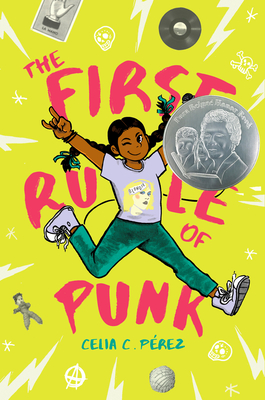
Come back on Thursday to see our review of THE FIRST RULE OF PUNK!
 Cindy L. Rodriguez was a newspaper reporter for The Hartford Courant and researcher at The Boston Globe before becoming a public school teacher. She is now a reading specialist at a Connecticut middle school. Cindy is a U.S.-born Latina of Puerto Rican and Brazilian descent. She has degrees from UConn and CCSU. Her debut contemporary YA novel, When Reason Breaks, released with Bloomsbury Children’s Books (2015). She will have an essay in Life Inside My Mind, which releases 4/10/2018 with Simon Pulse. She can also be found on Facebook, Twitter, and Goodreads.

 Those stories are American stories, and I hope that readers will recognize them in
  From the
  Latinxs in Kid Lit