
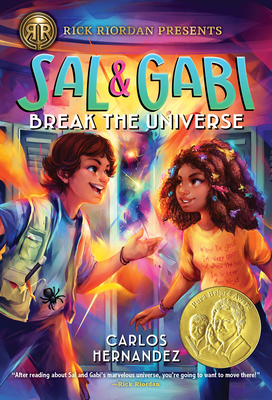
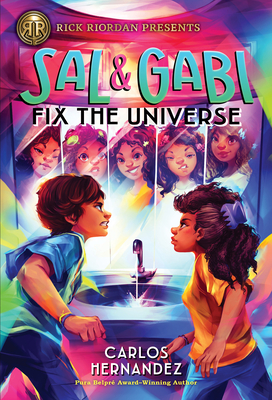
(Left: The paperback cover of Sal & Gabi Break the Universe with the 2020 Pura Belpré Award sticker. Right: The sequel, Sal & Gabi Fix the Universe, released May 5, 2020.)
Review by Toni Margarita Plummer
DESCRIPTION OF THE BOOK: Best-selling author Rick Riordan presents a brilliant sci-fi romp with Cuban influence that poses this question: What would you do if you had the power to reach through time and space and retrieve anything you want, including your mother, who is no longer living (in this universe, anyway)?
How did a raw chicken get inside Yasmany’s locker?
When Sal Vidon meets Gabi Real for the first time, it isn’t under the best of circumstances. Sal is in the principal’s office for the third time in three days, and it’s still the first week of school. Gabi, student council president and editor of the school paper, is there to support her friend Yasmany, who just picked a fight with Sal. She is determined to prove that somehow, Sal planted a raw chicken in Yasmany’s locker, even though nobody saw him do it and the bloody poultry has since mysteriously disappeared.
Sal prides himself on being an excellent magician, but for this sleight of hand, he relied on a talent no one would guess . . . except maybe Gabi, whose sharp eyes never miss a trick. When Gabi learns that he’s capable of conjuring things much bigger than a chicken—including his dead mother—and she takes it all in stride, Sal knows that she is someone he can work with. There’s only one slight problem: their manipulation of time and space could put the entire universe at risk.
A sassy entropy sweeper, a documentary about wedgies, a principal who wears a Venetian bauta mask, and heaping platefuls of Cuban food are just some of the delights that await in his mind-blowing novel gift-wrapped in love and laughter.
MY TWO CENTS: This is Carlos Hernandez’s first middle grade novel, published by the Rick Riordan Presents imprint at Disney. The imprint publishes books which draw from the mythology or folklore of underrepresented cultures. Unlike other books they’ve published, and Rick Riordan’s own books, Sal & Gabi Break the Universe doesn’t involve a half-god protagonist and aloof or sinister gods. Hernandez isn’t drawing from any mythology for his fantasy world, but rather from science and the idea of parallel universes, which is really refreshing. The Cuban aspect is there, absolutely. The book is set in Miami and we see Cuban culture everywhere, from the language to the food to the mannerisms. Sal is the best and most charming narrator we can hope for, taking us on a vibrant journey as he starts at a new school in a new city.
Culeco Academy of the Arts is not Hogwarts. There’s no magic or super powers. But artistic and creative kids will be itching to enroll! Students take classes in Textile Arts (costumes!), Health Science and the Practice of Wellness (rock-climbing!), and Theater Workshop (dancing, puppets, kata!). Detention is one big educational party.
An important but not defining part of Sal’s character is that he has diabetes, and we see how that affects his life and choices in very concrete ways. Some of the characters, including a teacher, need to be educated on what having diabetes means. Once they get it, they see that although he has some limitations, Sal is a kid just like any other. Scratch that. He’s a talented magician who always has a trick up his sleeve, especially his GOTCHA! stamp. Oh, and he can also open portals into other universes.
What stands out most in the novel are the relationships. Sal’s classmate, Gabi, a future lawyer, is a fantastic character who wears her feminism proudly and literally (all her T-shirts bear inspiring lines from women). The friendship she and Sal build is tentative at first, but cements over the course of the novel. It’s a beautiful thing to witness these two resilient and utterly delightful young people join forces to help each other. The relationships they have with their families are also wonderfully rendered. Sal lives in a big house he calls the Coral Castle with scientist Papi and principal American Stepmom who likes to say, “Phew!” Gabi spends a lot of time with her mother and her many Dads (an entertaining lot!) at the hospital, where her baby brother is in the NICU. I loved the interactions between these families as well. It’s all so intriguing, in fact, that whatever cosmic danger is brewing due to not-closing portals seems to take a back seat. And despite the book’s title, nothing catastrophic actually happens.
One word of caution: Sal’s mother passed away some years ago and he misses her so much that sometimes he inadvertently brings back an alternate Mami, who he calls Mami Muerta. If you are considering giving this to a child who has lost a parent or someone else close, you may want to consider how that particular child will respond to this aspect of the story. On the one hand, it’s maybe comforting, and mind-expanding, to think your loved one exists in other universes, just slightly different. On the other, it could be a little unnerving. Sal’s grief over his late mother is very real and sympathetic, as are his conflicted feelings about wanting her back while also knowing that his father has moved on and is very much in love with his new wife, who happens to be a lovely woman.
There is a lot of compassion to go around in this novel. Even the bully gets a chance to show there’s more to him than what meets the eye. Carlos Hernandez has created a universe infused with possibility, with love, and with acceptance. It’s a place that holds both true sadness and genuine laughs. This debut is an engaging and fun-filled read for middle schoolers.
 ABOUT THE AUTHOR: Carlos Hernandez has published more than thirty works of fiction, poetry, and drama, most notably a book of short stories for adults entitled The Assimilated Cuban’s Guide to Quantum Santeria. He is an English professor at City University of New York, and he loves to both play games and design them. He lives with his wife, Claire, in Queens, New York.
 ABOUT THE REVIEWER: Toni Margarita Plummer is a Macondista and the author of the story collection The Bolero of Andi Rowe. She hails from South El Monte, a working-class suburb of Los Angeles, and works as an acquiring editor at an independent publisher in New York City. Toni lives with her family in the Hudson Valley.
 Here is the publisher’s description:
 Cindy L. Rodriguez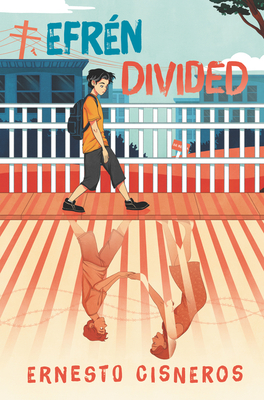
 Q. Who or what inspired you to become a writer?
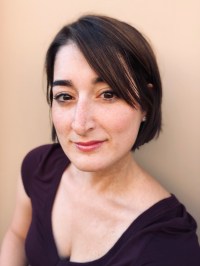 Q. Who or what inspired you to become a writer?
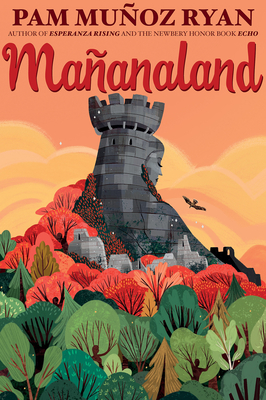 DESCRIPTION OF THE BOOK:
  ABOUT THE AUTHOR:
  ABOUT THE REVIEWER: Cris Rhodes is an assistant professor of English at Shippensburg University of Pennsylvania. She teaches courses of writing, culturally diverse literature, and ethnic literatures. In addition to teaching, Cris’s scholarship focuses on Latinx youth and their literature or related media. She also has a particular scholarly interest in activism and the ways that young Latinxs advocate for themselves and their communities
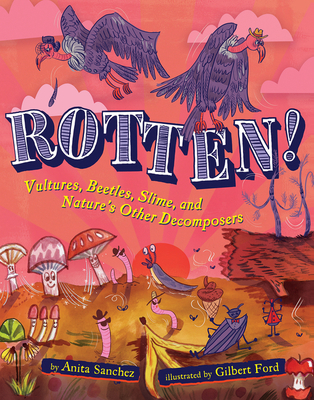 DESCRIPTION OF THE BOOK: What’s that terrible smell? Plug your nose! Run! Something smells…rotten! But rotten isn’t always bad. If nothing ever rotted, nothing could live. Decomposition seems like the last stop on the food chain, but it’s just the beginning. When dead things rot, they give life to a host of other creatures. So who are these decomposers? Sharks and vultures feast on animal carcasses. Worms, maggots, and dung beetles devour decaying plant and animal matter. Decomposition is happening everywhere: oceans, forests, in your backyard—even between your teeth! It’s nature’s way of creating energy for all living things. So unplug your nose! Open this book to uncover the dirty rotten truth about one of nature’s most fascinating processes.
 ABOUT THE AUTHOR: (from the dust jacket) Anita Sanchez loves to explore nature, even the stinky, slimy parts of it. She dug into the world of rot by creating a compost pile, viewing vultures, watching worms, and even swimming with (very small) sharks. Check out her blog about unloved plants and animals at
  ABOUT THE ILLUSTRATOR: (from the dust jacket) Gilbert Ford feels spoiled rotten for getting to spend all his time drawing. He is the author and illustrator of The Marvelous Thing That Came from a Spring and How the Cookie Crumbled. He has also illustrated the award-winning Mr. Ferris and His Wheel, Soldier Song, Itch!, and many middle grade novels. He lives and works in Brooklyn, New York. Learn more about his work at
  ABOUT THE REVIEWER: Emily R. Aguiló-Pérez is an Assistant Professor of English (Children’s Literature) at West Chester University of Pennsylvania. Her teaching and research are in the areas of children’s literature (particularly Latinx literature), girlhood studies, and children’s cultures. Her published work has focused on girlhood as represented in literature and Puerto Rican girls’ identity formation with Barbie dolls. She has presented research on Latinx children’s books at various conferences and has served on children’s book award committees such as the 2017 Lee Bennett Hopkins Poetry Award and the 2018 Pura Belpré Award. Currently, she is part of the Pennsylvania Center for the Book’s “A Baker’s Dozen” committee.
 Latinxs in Kid Lit