Libros Latin@s: Zack Delacruz: Me and My Big Mouth by Jeff Anderson


24612691By Cecilia Cackley 

DESCRIPTION (from Goodreads): Zack Delacruz is unnoticed at his middle school—and that’s just the way he likes it. But a school assembly, a typhoon of spit, and an uncharacteristic moment of bravery are all it takes to change everything. Suddenly Zack is in charge of the class fundraiser. Worse, his partner is the school’s biggest bully! If they don’t sell all the chocolate bars, there will be no dance for the sixth grade.  Zack never wanted to be a hero, but with his classmates’ hopes on the line, can he save the day? Zack Delacruz: Me and My Big Mouth releases August 14, 2015.

MY TWO CENTS: This is a light, fun read for kids who are curious about middle school and looking for something along the same lines as Diary of a Wimpy Kid, but without pictures. Zack is your typical “don’t bother me, I’m invisible” kid until a chain of events has him organizing a class fundraiser and trying to solve all the problems that come with it. The bullying part of the story is actually pretty minimal and the side characters fit easily into stock school types, nicknames and all. The supportive adults in the story (particularly Zack’s dad) smooth the way when necessary, but the fun part of the book is the building of cooperation between Zack and his classmates and watching him tackle every new disaster that hits.

TEACHING TIPS: This is probably best for elementary readers and could make a nice classroom read aloud. It could also work as a literature circle book, with discussions about the choices characters make and how their perceptions of each other change over the course of the book. There are math connections to be made with the fundraiser aspect and plenty of kids will see themselves reflected in Zack and his challenges.

ABOUT THE AUTHOR: Jeff Anderson has been sharing writing strategies with teachers and students for over 25 years. Whether presenting at national conferences like NCTE, ASCD, or in classrooms or writing his books for teachers or middle grade readers, Jeff’s passion for writing and grammar inspires teachers and young writers to soar. When he’s not writing with his “revising” dogs at home near downtown San Antonio, Texas, he’s walking, talking, or doing staff development around the US (and sometimes New Zealand).

RESOURCES:

An interview with Jeff Anderson: http://readingyear.blogspot.com/2015/03/an-interview-with-jeff-anderson-about.html

A blog post on the process of writing the book: http://pawlpblog.org/2015/06/03/guest-post-how-i-became-a-middle-grade-author-its-not-a-lone-pursuit-with-jeff-anderson/

FOR MORE INFORMATION ABOUT Zack Delacruz: Me and My Big Mouth, visit your local library or bookstore. Also, check out WorldCat.orgIndieBound.orgGoodreadsAmazon, and Barnes & Noble.


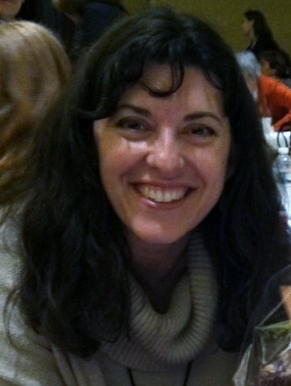
Cackley_headshotCecilia Cackley is a performing artist and children’s bookseller based in Washington DC where she creates puppet theater for adults and teaches playwriting and creative drama to children. Her bilingual children’s plays have been produced by GALA Hispanic Theatre and her interests in bilingual education, literacy, and immigrant advocacy all tend to find their way into her theatrical work. You can find more of her work at www.witsendpuppets.com.

Book Review: Pickle: The (Formerly) Anonymous Prank Club of Fountain Point Middle School by Kim Baker


13170031By Kimberly Mach

DESCRIPTION FROM THE BACK OF THE BOOK:

Dear Parents and Teachers:

This is a work of fiction. There is no Prank and Trick Association at Fountain Point Middle School. And you absolutely will not find instructions on how to log in to a top-secret prank instruction website anywhere on these pages. All we do is make pickles. OK?

Sincerely,

Ben Diaz

President, The League of Pickle Makers

MY TWO CENTS: Now, if the description above won’t get a child to pick up a book, I’m not sure what will.

Kim Baker had me laughing from the first page. The book opens with this line: Can I trust you? She had me hooked right there, with all that the question implies.

There are so many ways to talk about Pickle because it really is a perfect middle-grade novel. Kids will laugh out loud, and they may even go scrambling to create their own prank clubs. Beyond the laughter, they will identify with the ever-changing landscape of middle school friendships. Ben Diaz, the main character, creates a Prank Club, under the guise of a Pickle Makers Club. Due to an earlier incident, Ben does not invite his best friend Oliver into the club. (Oliver’s grandmother is the school principal and Oliver, well, Ben thinks Oliver just can’t be trusted to keep the secret.) Reading it, I found myself wondering what the halls of my school would look like if there were bubbles in the fountains or impromptu parties in the classrooms. Throughout the mayhem, lessons are woven in. Ben learns about himself, his new friends, and just how ‘off’ we can be when we try to label each other, but most of all he learns what kind of friendship he and Oliver really have. Spoiler alert: It’s made of the strong stuff. There are lessons here in action and reaction, consequences and the impact of our decisions, and they are all told masterfully through the eyes and comedy of young Ben Diaz.

As an adult reader, what resonated with me was the very real problem of what isn’t in our history books. For Pioneer Day, Ben and his friends have to present something pickled for the Pioneer Fair. If they don’t, they will lose their funding from the PTA and that will be the end of the Pickle Club and the secret Prank Club.

What to do? Ben turns to his family. They frequently serve escabeche, or pickled vegetables, at their Mexican restaurant. Ben sees that escabeche can be their entry for the fair. Then Ben hesitates. He asks the kind of question that many of our children who do not see themselves reflected on the pages of history books wonder about: Were there Mexican pioneers?

Ben goes on to say: “I’ve never seen any in the pictures. It’s always just a bunch of white guys.” And then later, the realization that, “It doesn’t mean they weren’t there.” Ben begins searching.

The time period for our children is different from that of my youth. In my youth, we may have asked the question, but because of available resources, we probably could not have answered it, at least not in a timely fashion. The internet has allowed people and organizations to post information and share resources in a much more efficient manner. When Ben wonders about pioneers from Mexico, he does not have to go far to find that reliable source. Instead of spending an afternoon at the town hall archives, he can answer it with the click of a button. As an adult, I could not escape the implications of Ben’s memory when he recalls being criticized in kindergarten for using the brown paper to make his Pilgrims for Thanksgiving. There are so many who were skimmed over in the history books, but the information is there if we ask the questions. Step one is teaching our children to ask. Where are the women in this picture? Who worked in the factories? Why does this city have a Spanish name? What happened when native peoples went to reservations? Ben chooses to share an authentic pickling recipe from Mexico. It may not be the pickle recipe people were expecting at the fair, but it is delicious and the scene, of course, is memorable. Trust me, you’ll be cheering for him when he has a conversation with Principal Lebonsky about traditional recipes.

TEACHING TIPS: This book would be an excellent read-aloud in the classroom, appropriate for grades 3-6. It can be enjoyed for the humor and story, or a teacher can choose to take the lessons further.

Language Arts: Life-size character sketches are one extension idea. Brief descriptions of each character are on the front jacket of the book. Many children will see themselves reflected in the personalities and the ethnicities of Ben and his friends. Traits can be filled in as readers follow the story, with life-size versions being presented at the end.

Social Studies: Many upper elementary and early middle school grades study pioneer days as part of their curriculum. Reading Pickle may encourage students to ask the important questions and to look more deeply at the pictures of people in their own state and communities.

The escabeche could be the beginning to a small unit on preserving food both in the past and now. Compare and contrast, how did Native Americans preserve food? When were other methods introduced?  What are traditional foods of the region? How are they preserved today?  The possibilities are endless here.

Enjoy the book. Readers of all ages will love it. When you are done, visit Kim Baker’s website at http://kimbakerbooks.com/ and enjoy her voice and humor there.

Pickle is Kim Baker’s debut novel and has already received five awards including the Louisiana Young Reader’s Choice 2015 nominee, 2014-2015 Texas Blue Bonnet Award Nominee, and the 2013 SCBWI West Crystal Kite award.

FOR MORE INFORMATION ABOUT Pickle visit your local library or bookstore. Also, check out WorldCat.orgIndieBound.orgGoodreadsAmazon, and Barnes & Noble.


Kimberly Mach has been teaching for sixteen years and holds two teaching certificates in elementary and secondary education. Her teaching experience ranges from grades five to twelve, but she currently teaches Language Arts to middle school students. It is a job she loves. The opportunity to share good books with students is one that every teacher should have. She feels privileged to be able to share them on a daily basis.
Mixed Up: Author Kim Baker Navigates a Bicultural Narrative

By Kim Baker

I’m bicultural. My grandparents on my mom’s side eloped and migrated from Mexico to New Mexico where they had babies and my grandpa worked in the coal mines until, lungs destroyed, they moved again to East Los Angeles for better weather. My uncle can tell you about how cramped it was with all the kids in the backseat. Sunshine couldn’t save my grandpa, but most of my family is still around the area. My dad is Anglo and from Texas. His side of the family has been in the states so long, nobody knows for sure from where they originally migrated. So, like lots of people, I’ve got a mixed ethnicity. Culture is a weird thing. It’s shared customs and distinct experiences. I’m ridiculously pale, and I have my husband’s surname so people are often surprised to hear about my Mexican heritage. When people do find out (and I’m pretty open about it), sometimes we play stereotype bingo and they ask questions to see if I meet their preconceived qualifications (Do I have a big family? Yes. Do I like spicy foods? …Yes. Do I listen to mariachi? Please stop.).

I consider myself Latina, and proud. This is me, the grouchy one covering her face in front, with a small portion of my family. My cousin Joey is mortified that I share this picture because he is self-conscious about how much leg he’s showing in those cutoffs.

Maciasfamily

Now I feel guilty about sharing it, so I will also tell you that later that day I threw up an Orange Julius at the mall and tried to hide it under a t-shirt rack. That’s worse than knobby knees.

When I was a lonely kid, books were my escape. I never really saw myself in books until I was older. There’d be bits in stories here and there (e.g. A kid in the book loved horses, and I was a horse nut. Harriet was overly curious about people? Me, too!). And maybe, in part, because of how I didn’t see myself as a whole in books as a kid, I often feel different and separate from those around me. Feeling abnormal in itself is a pretty shared understanding (We’re ALL weirdos!), but having a bicultural identity certainly magnifies the experience. Granted, I was getting most of my books from a Wyoming library that underestimated its Latino population by at least a few, so there were probably more stories out there than I wasn’t finding.

I grew up in Wyoming, where I could count the other non-Anglo kids at my school on one hand. My mom missed her family, missed the sunshine, missed seeing people like her, so we’d drive to East L.A. in the summertime to visit. My grandma and aunts would make all of the foods we couldn’t get in Wyoming and bring my favorite orejas from the panadería. Some of my cousins would tease me about my pale skin (I look just like my dad.), so I’d sit on the porch and watch my also shy uncle tend his jasmine and geraniums while the rest of the family visited inside. You could hear them laughing all the way down the block. We’d go back to Wyoming and I’d ride horses, trudge through snow, and eat American foods. The taco shells and beans in my hometown grocery store were labeled as “Spanish Foods.” I always felt a bit disconnected and different, no matter where I was. My parents split up and I lived with my mom in New Mexico and California. I was in primarily Latino communities, but still stood apart because of my Anglo features. Kids called me gringa and worse. I read more. My school didn’t have a library, the town didn’t have a bookstore, and the public library’s shelves were pretty spare, but I found what I could. I identified with S.E. Hinton’s The Outsiders being from the wrong side of the tracks, but found nothing about Mexican-American kids or mixed culture kids. I would have been overjoyed to find Isabel Quintero’s Gabi, A Girl in Pieces as a teen.

13170031The protagonist in my first book, Pickle, is straight up Mexican American. The main character in my next novel is a mixed Latino like me, and writing has been a little bit more of a personal journey. I’ve taken a little longer with it, because I want to do it right. There’s so much I want to include, and I’m still working on how much serves the story. I know that there are other writers out there who balance between environments and depend on cultural code-switching to find their way. And there are kids that are looking for those stories, that need them. Books are touchstones. Identity, displacement, and belonging are important themes in middle grade and YA fiction that can reach all readers. The crazy thing about the loneliness of feeling different from our peers is that it’s probably one of our most communal traits. So, as a writer, I’ll continue to write about Latino kids and put little pieces of myself and my world in there. I implore you to do the same. And putting your truth into stories isn’t necessarily autobiographical. I think the best stories come from combining what you love with what you wish there was a story about.

Every kid should be able to find mirrors on the bookshelves, and it’s especially crucial for those of us who might struggle to fit into their worlds. Let’s put more stories out there, because you can’t always tell who might need them.


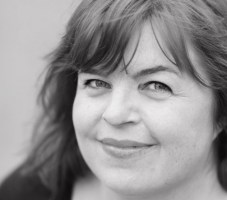
BakerBWheadshotKim’s debut middle grade novel, Pickle (Macmillan), was a finalist for the 2013 Children’s Choice Awards, Book of the Year (5th and 6th grade), one of Mamiverse’s Top 50 Latino Children’s Books You Should Know, and the recipient of the 2013 SCBWI Crystal Kite West award. She lives with her family in Seattle and can often be found in the woods, despite a chronic fear of bears. Find out more at www.kimbakerbooks.com.
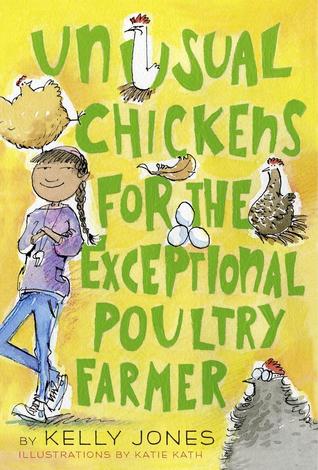
Book Review: Unusual Chickens for the Exceptional Poultry Farmer by Kelly Jones

22639675By Cindy L. Rodriguez

DESCRIPTION OF THE BOOK: Twelve-year-old Sophie Brown feels like a fish out of water when she and her parents move from Los Angeles to the farm they’ve inherited from a great-uncle. But farm life gets more interesting when a cranky chicken appears and Sophie discovers the hen can move objects with the power of her little chicken brain: jam jars, the latch to her henhouse, the entire henhouse….

And then more of her great-uncle’s unusual chickens come home to roost. Determined, resourceful Sophie learns to care for her flock, earning money for chicken feed, collecting eggs. But when a respected local farmer tries to steal them, Sophie must find a way to keep them (and their superpowers) safe.

Unusual Chickens for the Exceptional Poultry Farmer releases May 12 with Knopf Books for Young Readers.

MY TWO CENTS: It’s easy to love Sophie, the half-Latina main character in this middle grade novel that upgrades the “new girl in town” idea by adding cool, magical chickens and letters from the beyond. Sophie and her parents move from Los Angeles to a farm, left to them by her late Great-Uncle Jim. The farm, though, is “more like a big, boring garden. Dead-looking grapevines and blackbirds and junk piles and bugs, that’s it.” Sophie’s family is trying to start over after her dad lost his job.

In the novel, author Kelly Jones addresses issues such as unemployment, racism, and classism, but never in a heavy-handed way. Through her letters to her abuela, Uncle Jim, and Agnes from Redwood Farm Supply, Sophie talks about her family’s financial problems and the small town’s lack of diversity. “There aren’t any people around here–especially no brown people.” In another chapter, Sophie writes, “even though Mom was born here and speaks perfect English, she says you have to be twice as honest and neighborly when everyone assumes you’re an undocumented immigrant.” These moments, though, are not preachy. Instead, they are presented as things Sophie observes or wonders about as she navigates her bicultural reality and being the new girl–a city girl transplanted to a weed-choked farm with magical chickens.

And, for the record, the chickens are awesome. My favorite is the angry, telekinetic chicken. He’s so cute somehow even though he’s got the “if looks could kill” face all the time. Being responsible for the chickens helps Sophie to settle in and connect with her new surroundings. Caring for the chickens, and working hard to keep them safe from a thief, allows Sophie to develop her confidence.

What I really love about Sophie is that she’s a strong girl, but she’s also a quiet girl who isn’t afraid to admit when she’s sad or lonely. Being strong doesn’t always mean wielding weapons; sometimes it means going after a chicken thief or speaking in front of a crowd, even though it scares you. I think lots of middle grade readers will love this novel, which also has great illustrations, information about chickens throughout, and even a recipe for migas!

TEACHING TIPS: Language arts teachers could easily include this novel in a thematic literature circles unit with other stories about moving to new places, whether it’s to a new town or a new country.

Since Sophie writes letters throughout the novel, students could write and send personal letters to friends or family and formal business letters to local companies. In this electronic age, writing, sending, and receiving letters could be a fun activity for this generation of students, who may have seldom done this, if at all.

Asking a local farmer to visit the classroom, or taking students on a field trip, would be a wonderful experiential activity, especially for city students (like Sophie) who may have never visited a farm.

A classroom fiesta, complete with lots of eggs-based dishes and migas, using the recipe in the book, would be a wonderful and tasty way to end a unit.

Kelly JonesABOUT THE AUTHOR: Kelly Jones is a curious person, interested in chickens, magic, farm life, spies, sewing, the odd everyday bits of history, how to make sauerkraut, how to walk goats, superheroes and what makes them so super, recipes to make with a lot of eggs, anything with ghosts (particularly friendly ghosts), how to draw chickens that actually look like chickens, and any story she’s never heard before.

She’s also a writer: Her debut novel Unusual Chickens for the Exceptional Poultry Farmer, about twelve-year-old Sophie and her magical chickens, is forthcoming from Knopf Books For Young Readers in May of 2015.

Her second book, Glamour, is set in 1818, England, about sixteen-year-old Annis, who would like to become a spy like her father and who does not see why the War Office should put up such a fuss (with bonus magical dressmaking!) is forthcoming from Knopf Books for Young Readers in Spring of 2017.

FOR MORE INFORMATION ABOUT Unusual Chickens for the Exceptional Poultry Farmer visit your local library or bookstore. Also, check out WorldCat.orgIndieBound.orgGoodreadsAmazon, and Barnes & Noble.

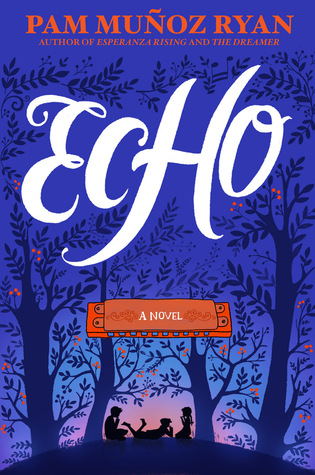
Book Review: Echo by Pam Muñoz Ryan


22749539By Cecilia Cackley

DESCRIPTION (from Goodreads): Music, magic, and a real-life miracle meld in this genre-defying masterpiece from storytelling maestro Pam Muñoz Ryan.

Lost and alone in a forbidden forest, Otto meets three mysterious sisters and suddenly finds himself entwined in a puzzling quest involving a prophecy, a promise, and a harmonica.

Decades later, Friedrich in Germany, Mike in Pennsylvania, and Ivy in California each, in turn, become interwoven when the very same harmonica lands in their lives. All the children face daunting challenges: rescuing a father, protecting a brother, holding a family together. And ultimately, pulled by the invisible thread of destiny, their suspenseful solo stories converge in an orchestral crescendo.

Richly imagined and masterfully crafted, Echo pushes the boundaries of genre and form, and shows us what is possible in how we tell stories. The result is an impassioned, uplifting, and virtuosic tour de force that will resound in your heart long after the last note has been struck.

MY TWO CENTS: Muñoz Ryan hits a sweet spot of historical fiction combined with a tiny bit of fantasy and a whole lot of heart in this new title. While the three separate narratives might seem overwhelming at first, they are never long-winded and large text and good formatting make things easy on the eyes. Muñoz Ryan introduces the reader to less familiar aspects of well-known historical events: laws regarding children with birth ‘defects’ in 1930’s Germany, conditions for orphans during the Depression in the US, and the segregation of schools in California for children of Mexican descent during World War II. All three main characters are easy to root for and their strength and determination makes happy coincidences and the final destination feel earned rather than magical. That harmonica though…what can I say? The power of music is mighty, a point Muñoz Ryan makes very clear. This is a great choice for middle grade readers, especially fans of historical fiction or stories involving music.

TEACHING TIPS: The historical settings make this a great title to connect to social studies units. It would also be a wonderful classroom read aloud. Teachers could assign groups to compile additional background research on the historical events mentioned in the text or on the harmonica and other musical instruments. Audio recordings would also be a great addition to the experience of the story.

ABOUT THE AUTHOR: Pam Muñoz Ryan has written over thirty books for young people, from picture books for the very young to young adult novels, including the award winning Esperanza Rising, Becoming Naomi Leon, Riding Freedom, Paint the Wind, and The Dreamer. She is the National Education Association’s Author recipient of the Civil and Human Rights Award, the Virginia Hamilton award for Multicultural Literature, and is twice the recipient of the Willa Cather Literary Award for writing. She was born and raised in Bakersfield, California (formerly Pam Bell), received her bachelor’s and master’s degrees at San Diego State University and now lives in North San Diego County with her family.

LINKS/OTHER INFO:

SLJ interview

Publisher’s Weekly interview

FOR MORE INFORMATION about Echo, visit your local library or bookstore. Also check out WorldCat.orgIndieBound.orgGoodreadsAmazon, and Barnes & Noble.


Cackley_headshotCecilia Cackley is a performing artist and children’s bookseller based in Washington DC where she creates puppet theater for adults and teaches playwriting and creative drama to children. Her bilingual children’s plays have been produced by GALA Hispanic Theatre and her interests in bilingual education, literacy, and immigrant advocacy all tend to find their way into her theatrical work. You can find more of her work at www.witsendpuppets.com.

Book Review: Ask My Mood Ring How I Feel by Diana López

16131067By Kimberly Mach

DESCRIPTION FROM THE BOOK JACKET: The only thing I knew for sure was that I had issues. Lots of issues. No wonder my mood ring kept changing! It went from black for tense to pink for uncertain to white for frustrated. I kept waiting to see blue, the color for calmness and peace, but no such luck. With all the craziness in my life, I couldn’t see blue if I looked at the sky.

MY TWO CENTSAsk My Mood Ring How I Feel, by Diana Lopez, is an excellent middle grade novel for a teen book group or for an individual read.

Author Diana Lopez remembers what it’s like to be a middle school girl. Rarely have I read a book that made me feel so connected to my eighth grade self. The excitement, the fear, the boys, the uncertainty of everyone’s confidence, the loyalty of friends, the changing body, Lopez gets it all. On top of that, she shows us that kids deal with real problems, too. Our kids face real problems, like having a parent with cancer.

The book opens with Erica’s (Chia’s) mom buying bathing suits before their summer vacation. Mom shows Erica and her younger sister, Carmen, nine new bikinis. Then she throws the bottoms away. Soon the girls learn their mother has breast cancer and is due to have a mastectomy. Summer vacation plans have changed.

Before the surgery, the family makes a pilgrimage to La Virgen de San Juan del Valle. Each member of the family leaves a special object as an offering, prays for God and La Virgen to help mom, and then makes a promesa.  The promesa is a thank-you promise to God and La Virgen in acknowledgment of their help and healing.

This is where I fell in love with Erica’s character. Erica takes her time deciding what her promesa, or promise, will be. While at the shrine she discovers el cuarto de Milagros, or the miracle room, “where people share stories and make offerings.” It is here where Erica sees a newspaper article and a picture of the Race for the Cure. Erica’s promesa is to walk the 5k and raise money for breast cancer research.

Erica returns to school in the fall to face many challenges in her eighth grade year. Throughout them her mood ring changes color. Erica relies on the ring to tell her what she is feeling instead of listening to her heart. Her friends, the Robins, remain a constant support throughout the story. Erica deals with boys and homework, then goes home and deals with her mother’s illness, all while trying to work on her promesa. Erica takes on the role of an adult covering most of the house chores and taking care of her younger brother as her mother recovers from surgery and then faces radiation treatment. Very quickly Erica starts missing assignments and her grades, especially in math, plummet.  When a counselor calls a meeting with the family at school, Erica finally shares what she has been struggling with. When at last her teachers and her parents are on the same page, Erica gets the help she needs.

The book concludes with Erica and many of her friends completing her promesa. She trusts herself to know and understand her own feelings. She does not rely on her mood ring anymore to tell her how she feels.

TEACHING TIPS: The two most beneficial ways this book could be used are through book talks and book clubs. If a teacher or librarian book talks this book, students will gravitate toward it. Most of the readers will be girls, but I think that’s what it’s designed to do. Even as an adult reading it, I felt the same kinship and recognition I had felt when I read Are You There God? It’s me, Margaret when I was eleven years old. It’s about a girl growing and changing and dealing with the trials of middle school. The only difference is that students will also recognize the struggle of a family dealing with cancer, and we get characters from diverse backgrounds, which all our children need.

The second way I see this book being effective is for a teen girl book club. Again, the driving force for me was the honesty with which Erica (Chia) looked at her friends, her family, and her challenges with school. All girls will recognize this. They will see themselves and their friends in this book.

In a Social Studies and Language Arts classes, teachers can use the book as a launching point for their own students’ service projects as well as a geographic study of San Antonio. You may visit the church of La Virgen de San Juan del Valle on line at http://www.olsjbasilica.org/  There are links to the history of the church, as well as information on pilgrimages and pictures of the basilica – including the mural that Erica describes seeing.

Teachers may even create math problems from the book. How much money did Erica raise? How much do local teams in Race for the Cure raise? Was Erica’s achievement similar to this or greater?

An awareness of breast cancer and the organizations that raise money for research may also be used in an extension of science curriculum.

ABOUT THE AUTHOR: You may visit the author website for Diana Lopez at http://www.dianalopezbooks.com/Home_Page.html She does have teacher resource links for her middle grade novel Confetti Girl and her young adult novel Choke. (None were listed for Ask My Mood Ring How I Feel at the time of this writing.) A talented writer living in Texas, Lopez has two writing awards under her belt. She spent time teaching at the middle school level and currently teaches at the university level. She continues to find stories in the pages of life and we look forward to reading more!

FOR MORE INFORMATION about Ask My Mood Ring How I Feel, visit your local library or bookstore. Also check out IndieBound.orgWorldCat.orgGoodreadsAmazon, and Barnes & Noble.


Kimberly Mach (2)Kimberly Mach has been teaching for sixteen years and holds two teaching certificates in elementary and secondary education. Her teaching experience ranges from grades five to twelve, but she currently teaches Language Arts to middle school students. It is a job she loves. The opportunity to share good books with students is one that every teacher should have. She feels privileged to be able to share them on a daily basis.