
Review by Araceli Méndez Hintermeister
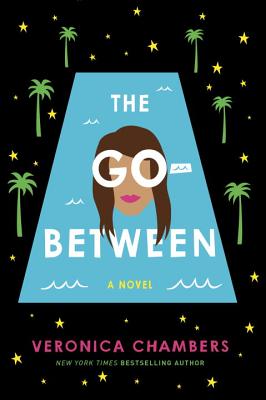 DESCRIPTION OF THE BOOK: She is the envy of every teenage girl in Mexico City. Her mother is a glamorous telenovela actress. Her father is the go-to voiceover talent for blockbuster films. Hers is a world of private planes, chauffeurs, paparazzi and gossip columnists. Meet Camilla del Valle, or Cammi to those who know her best.
When Cammi’s mom gets cast in an American television show and the family moves to LA, things change, and quickly. Her mom’s first role is playing a not-so-glamorous maid in a sitcom. Her dad tries to find work, but dreams about returning to Mexico. And at the posh, private Polestar Academy, Cammi’s new friends assume she is a scholarship kid, the daughter of a domestic.
At first Cammi thinks that playing along with the stereotypes will teach her new friends a lesson. But the more she lies, the more she wonders: Is she only fooling herself?
MY TWO CENTS: Like many immigrants, Cammi came to her new home in Los Angeles by plane. But unlike most immigrants, her mother’s job security as a telenovela star and her family’s wealth made her transition much smoother. Cammi does share in the immigrant story and her experiences begin to overlap with those of many other Mexican immigrants. Unfortunately, it is the stereotyping and xenophobia that she encounters the most. She is judged by her wealthy classmates at her new private school, immediately labeled as a scholarship kid who is low-income with parents in low-paying and stereotypical jobs and in need of handouts.
For Cammi, this is a great departure from what she usually has to deal with. No one is vying to know her to get closer to her famous mother. Instead, her mother is not the center of attention and she leaves her paparazzi world behind. However, in search of an escape, Cammi begins to promote the stereotypes that are often perpetuated about Mexicans. So in looking out for herself, Cammi forgets about her community and her roots.
It takes long for Cammi to learn her lesson. If it wasn’t for other Mexican immigrants and Mexican-Americans who have to fight regularly to defeat the stereotypes and get others to see beyond them, she may not have known how her actions perpetuated racism. Albeit slowly, Cammi learns to understand her role not only as a Mexican, but as an immigrant and compatriota to her community.
TEACHING TIPS: Cammi brings into perspective that not all immigrants come into this country in the same manner or with the same opportunities. Some immigrants come with established work or educational opportunities, while others may have left those exact opportunities behind to immigrate to the United States. While Cammi is perhaps not the best role model for the majority of the book, she does allow us to question a diversity of immigrants and their experiences. In a time when our political discord says that immigrants from Mexico are the worst of the pack, what is Cammi bringing to light? Cammi’s story is merely one of many.
RECOMMENDED READING:
- My Immigration Story edited by Raul Ramos y Sanchez
- The Prince of Los Cocuyos: A Miami Childhood by Richard Blanco, Ecco, 2015
- In the Country We Love: My Family Divided by Diane Guerrero, St. Martin’s Griffin, 2017
- The Book of Unknown Americans by Cristina Henriquez, Vintage, 2015
- How the Garcia Girls Lost Their Accents by Julia Alvarez, Algonquin Books, 2010
- The House on Mango Street by Sandra Cisneros, Vintage, 2011
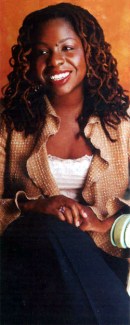 ABOUT THE AUTHOR: Veronica Chambers is a prolific author, best known for her critically acclaimed memoir, Mama’s Girl which has been a course adopted by hundreds of high schools and colleges throughout the country. The New Yorker called Mama’s Girl, “a troubling testament to grit and mother love… one of the finest and most evenhanded in the genre in recent years.” Born in Panama and raised in Brooklyn, her work often reflects her Afro-Latina heritage.
She coauthored the award-winning memoir Yes Chef with chef Marcus Samuelsson as well as Samuelsson’s young adult memoir Make It Messy, and has collaborated on four New York Times bestsellers, most recently 32 Yolks, which she cowrote with chef Eric Ripert. She has been a senior editor at the New York Times Magazine, Newsweek, and Glamour. Born in Panama and raised in Brooklyn, she writes often about her Afro-Latina heritage. She speaks, reads, and writes Spanish, but she is truly fluent in Spanglish. She is currently a JSK Knight fellow at Stanford University.
 ABOUT THE REVIEWER: Araceli Méndez Hintermeister is a librarian and archivist with a background in public, academic, and culinary libraries.She has an MA in history and MLIS from Simmons College where she focused her studies on the role of libraries and archives in the cultural preservation of the U.S.-Mexican border. Additionally, she holds a BA in Ethnic Studies from Brown University. Her research is greatly influenced by her hometown of Laredo, TX which has led her to work in serving immigrants and underrepresented communities. Her current work involves exploring cultural identity through oral history in her project, Third Culture. You can find Araceli on Instagram.

 a creator stay focused on your projects, all the while managing the challenges of depression?
 FXS: Finding Cheryl Klein was either a blessing or very fortunate depending on your world view. Writing is both solitary and communal and on the communal side my writing got exactly what it needed when it got Cheryl. Her editorial genius complemented all my writing lacks while allowing me to remain true to my writing voice and my writing vision (and reminding me of that voice and vision when I strayed). Yes, there were many times when the editing process was very hard and even at times discouraging but I never lost faith that Cheryl wanted what was best for the book and for the future reader and that kept me going. What I would like to convey to young writers is that they do all they can to enjoy the actual process of writing, of being alone with the work, and have patience with regards to the results they hope to attain. Those results may or may not come, but the process of creating a work that is beautiful and true is still worth the effort. Most of all, find a way to tell your story that is unique to you. Finding that uniqueness takes a lot of honesty and it takes a lot of practice and all the mistakes and rejections that you get will only make you a better writer and a better person if you see writing not as the publication of a book or the recognition that comes with it but as a way of life you are called to live.
 FXS: I’m re-reading Rudolfo Anaya’s Bless me, Ultima. Rudolfo Anaya is in many ways the father of Mexican-American literature and there is so much to learn from him about the presentation of the Mexican-American experience in a novel. One of my favorite books I always recommend to YA writers is The Book Thief by Markus Zusak because, well, there’s an author who found a way to tell an interesting story about a serious situation in a unique way. But I would also encourage YA writers to read all kinds of books, not just YA. Read fiction and non-fiction works that have nothing to do with what you are writing and you will be surprised by how they ultimately do. Read especially those books where the author’s soul touches yours.
 Francisco X. Stork is the author of Marcelo in the Real World, winner of the Schneider Family Book Award for Teens and the Once Upon a World Award; The Last Summer of the Death Warriors, which was named to the YALSA Best Fiction for Teens list and won the Amelia Elizabeth Walden Award; Irises; and The Memory of Light, which received four starred reviews. He lives near Boston with his wife. You can find him online at
 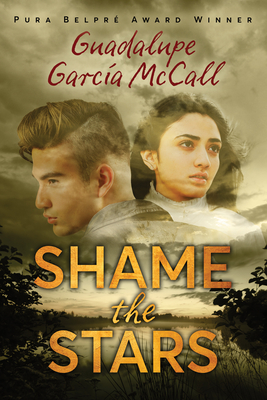 Poetry is my corazón, my coraje, my fuerza. So it came as no surprise to me that when the child of my heart, my beloved Joaquín del Toro, the embodiment of the men in my life, my courageous father, my brave husband, and my own three daring sons, first spoke to me, he spoke to me in verse.
 ABOUT THE AUTHOR:
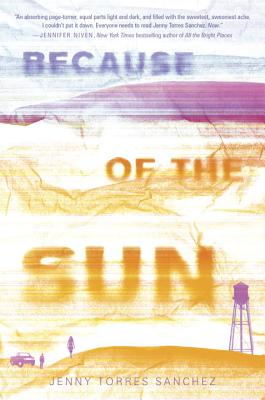 Years later, a story did come to me about a boy named Paulo living on that border. I tried writing it, but it never panned out and I abandoned the idea. Years later, another story came to me about an empty and unfeeling girl named Dani. Her story merged with that long ago abandoned one about Paulo. They meet as Dani is walking in the desert. He sees in her something he knows well: tragedy. And he feels drawn to her in that way we sometimes are to those who might share a similar pain. So he helps Dani and introduces her to his grandmother, who also helps her.
 JENNY TORRES SANCHEZ is a full-time writer and former English teacher. She was born in Brooklyn, New York, but has lived on the border of two worlds her whole life. She lives in Orlando, Florida, with her husband and children. She is the author of
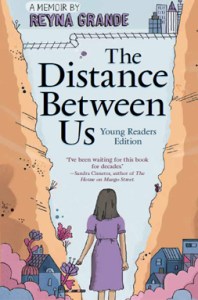
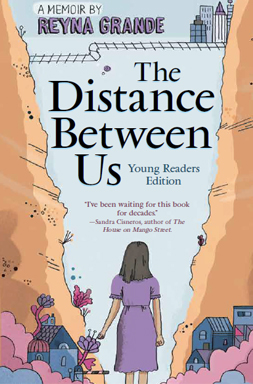
 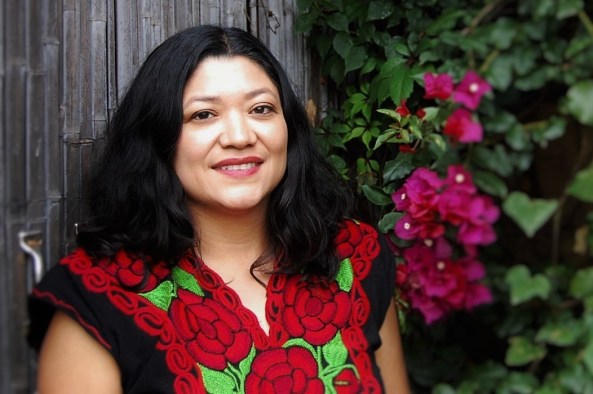 In my memoir, The Distance Between Us, I write about my experience as a border crosser. Borders have always been a part of my life. It saddens me to see that the world—instead of tearing down border walls—is actually building more of them. There are more border barriers today than ever before. In 1989 there were only 15 border walls in the world. Today there are more than 63, and counting.


 Latinxs in Kid Lit