Book Review: Pickle: The (Formerly) Anonymous Prank Club of Fountain Point Middle School by Kim Baker


13170031By Kimberly Mach

DESCRIPTION FROM THE BACK OF THE BOOK:

Dear Parents and Teachers:

This is a work of fiction. There is no Prank and Trick Association at Fountain Point Middle School. And you absolutely will not find instructions on how to log in to a top-secret prank instruction website anywhere on these pages. All we do is make pickles. OK?

Sincerely,

Ben Diaz

President, The League of Pickle Makers

MY TWO CENTS: Now, if the description above won’t get a child to pick up a book, I’m not sure what will.

Kim Baker had me laughing from the first page. The book opens with this line: Can I trust you? She had me hooked right there, with all that the question implies.

There are so many ways to talk about Pickle because it really is a perfect middle-grade novel. Kids will laugh out loud, and they may even go scrambling to create their own prank clubs. Beyond the laughter, they will identify with the ever-changing landscape of middle school friendships. Ben Diaz, the main character, creates a Prank Club, under the guise of a Pickle Makers Club. Due to an earlier incident, Ben does not invite his best friend Oliver into the club. (Oliver’s grandmother is the school principal and Oliver, well, Ben thinks Oliver just can’t be trusted to keep the secret.) Reading it, I found myself wondering what the halls of my school would look like if there were bubbles in the fountains or impromptu parties in the classrooms. Throughout the mayhem, lessons are woven in. Ben learns about himself, his new friends, and just how ‘off’ we can be when we try to label each other, but most of all he learns what kind of friendship he and Oliver really have. Spoiler alert: It’s made of the strong stuff. There are lessons here in action and reaction, consequences and the impact of our decisions, and they are all told masterfully through the eyes and comedy of young Ben Diaz.

As an adult reader, what resonated with me was the very real problem of what isn’t in our history books. For Pioneer Day, Ben and his friends have to present something pickled for the Pioneer Fair. If they don’t, they will lose their funding from the PTA and that will be the end of the Pickle Club and the secret Prank Club.

What to do? Ben turns to his family. They frequently serve escabeche, or pickled vegetables, at their Mexican restaurant. Ben sees that escabeche can be their entry for the fair. Then Ben hesitates. He asks the kind of question that many of our children who do not see themselves reflected on the pages of history books wonder about: Were there Mexican pioneers?

Ben goes on to say: “I’ve never seen any in the pictures. It’s always just a bunch of white guys.” And then later, the realization that, “It doesn’t mean they weren’t there.” Ben begins searching.

The time period for our children is different from that of my youth. In my youth, we may have asked the question, but because of available resources, we probably could not have answered it, at least not in a timely fashion. The internet has allowed people and organizations to post information and share resources in a much more efficient manner. When Ben wonders about pioneers from Mexico, he does not have to go far to find that reliable source. Instead of spending an afternoon at the town hall archives, he can answer it with the click of a button. As an adult, I could not escape the implications of Ben’s memory when he recalls being criticized in kindergarten for using the brown paper to make his Pilgrims for Thanksgiving. There are so many who were skimmed over in the history books, but the information is there if we ask the questions. Step one is teaching our children to ask. Where are the women in this picture? Who worked in the factories? Why does this city have a Spanish name? What happened when native peoples went to reservations? Ben chooses to share an authentic pickling recipe from Mexico. It may not be the pickle recipe people were expecting at the fair, but it is delicious and the scene, of course, is memorable. Trust me, you’ll be cheering for him when he has a conversation with Principal Lebonsky about traditional recipes.

TEACHING TIPS: This book would be an excellent read-aloud in the classroom, appropriate for grades 3-6. It can be enjoyed for the humor and story, or a teacher can choose to take the lessons further.

Language Arts: Life-size character sketches are one extension idea. Brief descriptions of each character are on the front jacket of the book. Many children will see themselves reflected in the personalities and the ethnicities of Ben and his friends. Traits can be filled in as readers follow the story, with life-size versions being presented at the end.

Social Studies: Many upper elementary and early middle school grades study pioneer days as part of their curriculum. Reading Pickle may encourage students to ask the important questions and to look more deeply at the pictures of people in their own state and communities.

The escabeche could be the beginning to a small unit on preserving food both in the past and now. Compare and contrast, how did Native Americans preserve food? When were other methods introduced?  What are traditional foods of the region? How are they preserved today?  The possibilities are endless here.

Enjoy the book. Readers of all ages will love it. When you are done, visit Kim Baker’s website at http://kimbakerbooks.com/ and enjoy her voice and humor there.

Pickle is Kim Baker’s debut novel and has already received five awards including the Louisiana Young Reader’s Choice 2015 nominee, 2014-2015 Texas Blue Bonnet Award Nominee, and the 2013 SCBWI West Crystal Kite award.

FOR MORE INFORMATION ABOUT Pickle visit your local library or bookstore. Also, check out WorldCat.orgIndieBound.orgGoodreadsAmazon, and Barnes & Noble.


Kimberly Mach has been teaching for sixteen years and holds two teaching certificates in elementary and secondary education. Her teaching experience ranges from grades five to twelve, but she currently teaches Language Arts to middle school students. It is a job she loves. The opportunity to share good books with students is one that every teacher should have. She feels privileged to be able to share them on a daily basis.

Mixed Up: Author Kim Baker Navigates a Bicultural Narrative

By Kim Baker

I’m bicultural. My grandparents on my mom’s side eloped and migrated from Mexico to New Mexico where they had babies and my grandpa worked in the coal mines until, lungs destroyed, they moved again to East Los Angeles for better weather. My uncle can tell you about how cramped it was with all the kids in the backseat. Sunshine couldn’t save my grandpa, but most of my family is still around the area. My dad is Anglo and from Texas. His side of the family has been in the states so long, nobody knows for sure from where they originally migrated. So, like lots of people, I’ve got a mixed ethnicity. Culture is a weird thing. It’s shared customs and distinct experiences. I’m ridiculously pale, and I have my husband’s surname so people are often surprised to hear about my Mexican heritage. When people do find out (and I’m pretty open about it), sometimes we play stereotype bingo and they ask questions to see if I meet their preconceived qualifications (Do I have a big family? Yes. Do I like spicy foods? …Yes. Do I listen to mariachi? Please stop.).

I consider myself Latina, and proud. This is me, the grouchy one covering her face in front, with a small portion of my family. My cousin Joey is mortified that I share this picture because he is self-conscious about how much leg he’s showing in those cutoffs.

Maciasfamily

Now I feel guilty about sharing it, so I will also tell you that later that day I threw up an Orange Julius at the mall and tried to hide it under a t-shirt rack. That’s worse than knobby knees.

When I was a lonely kid, books were my escape. I never really saw myself in books until I was older. There’d be bits in stories here and there (e.g. A kid in the book loved horses, and I was a horse nut. Harriet was overly curious about people? Me, too!). And maybe, in part, because of how I didn’t see myself as a whole in books as a kid, I often feel different and separate from those around me. Feeling abnormal in itself is a pretty shared understanding (We’re ALL weirdos!), but having a bicultural identity certainly magnifies the experience. Granted, I was getting most of my books from a Wyoming library that underestimated its Latino population by at least a few, so there were probably more stories out there than I wasn’t finding.

I grew up in Wyoming, where I could count the other non-Anglo kids at my school on one hand. My mom missed her family, missed the sunshine, missed seeing people like her, so we’d drive to East L.A. in the summertime to visit. My grandma and aunts would make all of the foods we couldn’t get in Wyoming and bring my favorite orejas from the panadería. Some of my cousins would tease me about my pale skin (I look just like my dad.), so I’d sit on the porch and watch my also shy uncle tend his jasmine and geraniums while the rest of the family visited inside. You could hear them laughing all the way down the block. We’d go back to Wyoming and I’d ride horses, trudge through snow, and eat American foods. The taco shells and beans in my hometown grocery store were labeled as “Spanish Foods.” I always felt a bit disconnected and different, no matter where I was. My parents split up and I lived with my mom in New Mexico and California. I was in primarily Latino communities, but still stood apart because of my Anglo features. Kids called me gringa and worse. I read more. My school didn’t have a library, the town didn’t have a bookstore, and the public library’s shelves were pretty spare, but I found what I could. I identified with S.E. Hinton’s The Outsiders being from the wrong side of the tracks, but found nothing about Mexican-American kids or mixed culture kids. I would have been overjoyed to find Isabel Quintero’s Gabi, A Girl in Pieces as a teen.

13170031The protagonist in my first book, Pickle, is straight up Mexican American. The main character in my next novel is a mixed Latino like me, and writing has been a little bit more of a personal journey. I’ve taken a little longer with it, because I want to do it right. There’s so much I want to include, and I’m still working on how much serves the story. I know that there are other writers out there who balance between environments and depend on cultural code-switching to find their way. And there are kids that are looking for those stories, that need them. Books are touchstones. Identity, displacement, and belonging are important themes in middle grade and YA fiction that can reach all readers. The crazy thing about the loneliness of feeling different from our peers is that it’s probably one of our most communal traits. So, as a writer, I’ll continue to write about Latino kids and put little pieces of myself and my world in there. I implore you to do the same. And putting your truth into stories isn’t necessarily autobiographical. I think the best stories come from combining what you love with what you wish there was a story about.

Every kid should be able to find mirrors on the bookshelves, and it’s especially crucial for those of us who might struggle to fit into their worlds. Let’s put more stories out there, because you can’t always tell who might need them.


BakerBWheadshotKim’s debut middle grade novel, Pickle (Macmillan), was a finalist for the 2013 Children’s Choice Awards, Book of the Year (5th and 6th grade), one of Mamiverse’s Top 50 Latino Children’s Books You Should Know, and the recipient of the 2013 SCBWI Crystal Kite West award. She lives with her family in Seattle and can often be found in the woods, despite a chronic fear of bears. Find out more at www.kimbakerbooks.com.
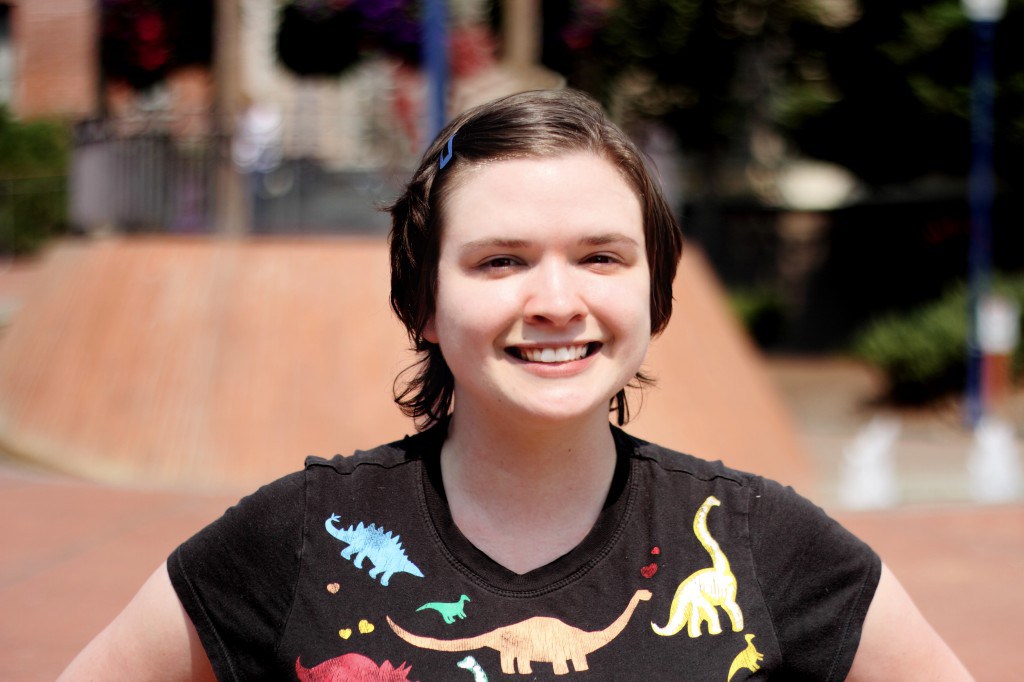
Author Robin Herrera Sees Her Grandma in Herself & Her Storytelling

By Robin Herrera

Sometimes when I look in the mirror, I see my grandma. Especially now that I have shorter hair, because as long as I knew her, she wore her hair short. Strangely, it wasn’t until a few years after she died that I noticed the resemblance between us.

She was short, too, like me—I’m the shortest in my family at (barely) 5’3”. We both have round faces and eyes that crinkle into small slits when we smile.

Now, years after her death, years after I’ve forgiven her for not telling me how bad her cancer really was, I wish I’d talked to her more. I know only snippets of my grandma’s life growing up in Colorado during the Great Depression. She was the youngest girl of 16 children, the second youngest altogether. Her parents were Joseph and Josephine Herrera. (On a baptismal document I found in my grandma’s things, their name was misspelled as Herreda.) And though she told me she’d left home at a young age, family was clearly very important to her, if the dozens of photo albums she left behind were any indication.

Robin Herrera  img001

When my siblings and I were younger, Grandma told us a story of our uncle Chris (Christobel). One night, near midnight, he was driving across a long bridge. Halfway across, he glanced over at the passenger’s seat to see a woman, dressed all in white, sitting there. She had her face turned toward the window, and Uncle Chris could see her shoulders shaking as she sobbed softly. He reached out a hand to comfort her, but before he could touch her, he looked down at her hands, in her lap. They were skeleton hands.

Though Chris was terrified, he kept driving. Somehow he knew that if he could make it to the other side of the bridge, the ghostly woman would disappear. He drove faster and faster, but out of the corner of his eye he saw the woman slowly turning her head to face him. Chris knew what her face would look like. It would be a skull, and if he looked, he would die. So he kept his eyes forward and kept driving until he crossed the bridge. Only then did he dare look at the passenger’s seat and see that the woman had vanished.

Grandma called the woman La Llorona. I didn’t know until later that La Llorona was a common Mexican folktale, and that Grandma’s tale was just a version of it. But for a long time, I was terrified of La Llorona, and impressed that my uncle Chris had been smart enough not to fall victim to her.

This is one of the few ties to my Mexican heritage that I have. I remember other things, too, like making tortillas on Grandma’s tortilla press, then heating them up and smothering them in butter. When my aunt Lupe visited, she and Grandma would occasionally lapse into Spanish, spoken so quickly that I’d sometimes stand in the kitchen with them, listening in awe. (I’m terrible at learning other languages.) Aunt Lupe, more than Grandma, always called me mija. I didn’t know what it truly meant until I looked it up in college, but I knew it was a term of endearment, because she used it on all the grandkids (mijo for the boys).

When my Grandma died, I felt like I’d lost that last connection with my Mexican heritage. My dad had already died by that point, but he was biracial and, I think due to circumstances in his childhood I can’t ask him about, wasn’t fluent in Spanish. Aunt Lupe is gone now, too, or I would talk to her about my grandma and their childhood together. (Though I’m not sure she’d tell me the truth. Grandma probably wouldn’t have either, to be fair.)

Now, as a writer, I miss my grandma terribly. I like to think she’d be proud of me, and that she’d see a bit of herself in my book, though to my knowledge, she never lived in a trailer park. What I hope she’d see is a portrait of a poor family, flawed but, for the most part, happy. Because that is what I remember most about my grandma. She showed me how to be poor.

Like the characters in my book, we shopped at thrift stores for most of our clothing (and dishes, and various housewares). Every week Grandma went grocery shopping at the local Grocery Outlet, which we called the Canned Food Store, and picked up what was on sale. When she died, her cupboards were still stocked with about a hundred different cans of food. She made sure we never went hungry.

But more than anything, she taught me that being poor wasn’t a terrible thing. I didn’t even begin to realize that I was poor until late in high school, after a conversation with my sister. This will sound cheesy, but Grandma made me feel rich in other ways.

I wonder, sometimes, where I get my love of writing and making up stories. My mother went to school for art, so for a long time, I thought that might be it. But I think it came from my grandmother, who told me stories (though often embellished) of her childhood (and ghost women) from an early age. I’ll leave you with one of my favorites, which she would often tell as a joke if I asked for a story. Of course, you have to imagine it’s being told by a short, round-faced Mexican woman who is being as over dramatic as possible:

It was a dark and stormy night. The soldiers were gathered around the campfire. Suddenly the captain stood up and said, “Diego! Tell us one of your famous stories!” Slowly, Diego stood up and said, “It was a dark and stormy night. The soldiers were gathered around the campfire…” (Repeat forever.)


18405519Robin Herrera was born in Eureka, California. She has degrees from Mills College and Vermont College of Fine Arts. She now lives in Oregon. Her debut novel, Hope Is A Ferris Wheel, was published in 2014 by Amulet Books.