
By Cindy L. Rodriguez
This is the ninth in an occasional series about middle grade Latinx authors. We decided to shine a spotlight on middle grade writers and their novels because, often, they are “stuck in the middle”–sandwiched between and overlooked for picture books and young adult novels. The middle grades are a crucial time in child development socially, emotionally, and academically. The books that speak to these young readers tend to have lots of heart and great voices that capture all that is awkward and brilliant about that time.
Today, we highlight Aida Salazar.
Aida Salazar is a writer, arts advocate and home-schooling mother whose writings for adults and children explore issues of identity and social justice. She is the author of the forthcoming middle grade verse novels, THE MOON WITHIN (Feb. 26, 2019), THE LAND OF THE CRANES (Spring, 2020), the forthcoming bio picture book JOVITA WORE PANTS: THE STORY OF A REVOLUTIONARY FIGHTER (Fall, 2020). All books published by Arthur A. Levine Books / Scholastic. Her story, BY THE LIGHT OF THE MOON, was adapted into a ballet production by the Sonoma Conservatory of Dance and is the first Xicana-themed ballet in history. She lives with her family of artists in a teal house in Oakland, CA.
The Moon Within is her debut novel, which releases on Tuesday!! Here is the publisher’s description:
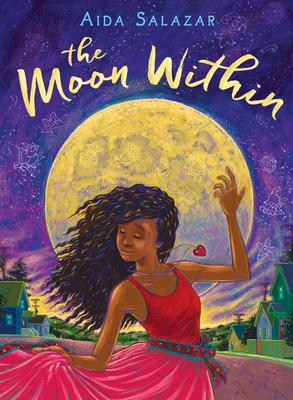 Celi Rivera’s life swirls with questions. About her changing body. Her first attraction to a boy. And her best friend’s exploration of what it means to be genderfluid.
But most of all, her mother’s insistence she have a moon ceremony when her first period arrives. It’s an ancestral Mexica ritual that Mima and her community have reclaimed, but Celi promises she will NOT be participating. Can she find the power within herself to take a stand for who she wants to be?
Aida Salazar
 Q. Who or what inspired you to become a writer?
A. I began to write when I was thirteen years old after the suicide of my seventeen-year-old sister. Poetry was my first refuge. It was the place where I began to express and unravel the pain I felt in my grief over losing my beautiful sister in such an incomprehensible way. Poetry, too, was how I made sense of the simultaneous changes happening to my body, to my mind, inside my community and life. That creative connection was special and it quietly flowed through me and accompanied me while I navigated high school and began college and tried to discover what I wanted to be and do with my life. It remained tucked away in my journals until I was 18 when, for the first time, I read the work of other Latinx writers while in a Latinx literature course. That class not only saved me from academic probation (because I got an A to balance out my terrible grades) but it revolutionized my existence as a Xicana and my own writing that had been hidden in those journals. It was as if the work of Sandra Cisneros, Helena Maria Viramontes, Rudolfo Anaya, Lorna Dee Cervantes, among others, gave me permission to share my own writing with a very Xicana perspective with the world. I could dare call myself a writer because I had their great example.
Q. Why do you choose to write middle grade novels?
A. Middle grade is a tremendously fertile space from which to write because there is a unique tension between two worlds. Middle grade readers, I think, possess the innocence, rich sense of wonder and play inherent in childhood, while at the same time, they are discovering deeper feelings and learning about things beyond their immediate lives that push against childhood. There are so many questions that beg to be answered, so many stories that beg to explore those questions and a new, almost magical, awareness that enfolds as they bloom into wiser beings.
Q. What are some of your favorite middle grade novels?
A. There are so many! I am especially drawn to stories from people of diverse backgrounds, those that break from the white, heteronormative literary cannon. I loved Bird in a Box and The Red Pencil by Andrea Davis Pinkney – it was actually after reading the latter that I was inspired to write The Moon Within in verse; Echo by Pam Muñoz Ryan is a masterpiece (as is just about anything she writes); As Brave As You by Jason Reynolds; Margarita Engle’s Hurricane Dancers; See You in the Cosmos by Jack Cheng; One Shadow on the Wall by Leah Henderson, Front Desk by Kelly Yang; A Long Walk to Water by Linda Sue Park; and Shooting Kabul by N.H. Senzai; George by Alex Gino; some older titles that are evergreen for me – Bud Not Buddy by Christopher Paul Curtis, Locomotion by Jaqueline Woodson, and Roll of Thunder, Hear My Cry by Mildred D. Taylor. However, the middle grade novels emerging from Las Musas (the first kidlit debut group of Latinx writers) have me most excited because they are opening the cannon wider than we have ever seen. Look for great middle grade stories by Anna Meriano, Emma Otheguy, Jennifer Cervantes, Yamile Saied Mendez, Hilda Solis, Mary Louise Sanchez and Claribel Ortega!
Q. If you could give your middle-grade self some advice, what would it be?
A. Don’t be afraid to believe in your poems though they may seem awful and as if they could help no one. Believe in their pain and in their heart because one day that very vulnerability will touch someone else’s life in ways you least expect. And when that magical moment comes, you will realize the meaning in the risk you took in believing.
Q. Please finish this sentence: Middle grade novels are important because…
A. Middle grade novels are important because they can be the source of inquiry, of discovery, of refuge, of delight, and inspiration while on the tight rope between childhood and adolescence.

Cindy L. Rodriguez was a newspaper reporter for The Hartford Courant and researcher at The Boston Globe before becoming a public school teacher. She is now a reading specialist at a Connecticut middle school. Cindy is a U.S.-born Latina of Puerto Rican and Brazilian descent. She has degrees from UConn and CCSU. Her debut contemporary YA novel, When Reason Breaks (Bloomsbury 2015). She also has an essay in Life Inside My Mind (Simon Pulse 2018). She can be found on Facebook, Twitter, and Goodreads.
 DESCRIPTION OF THE BOOK:
  ABOUT THE AUTHOR (from
  ABOUT THE TRANSLATOR: A Mexican-American author from deep South Texas, David Bowles is an assistant professor at the University of Texas Rio Grande Valley. Recipient of awards from the American Library Association, Texas Institute of Letters and Texas Associated Press, he has written a dozen or so books, including Flower, Song, Dance: Aztec and Mayan Poetry, the critically acclaimed Feathered Serpent, Dark Heart of Sky: Mexican Myths, and They Call Me Güero: A Border Kid’s Poems. In 2019, Penguin will publish The Chupacabras of the Rio Grande, co-written with Adam Gidwitz, and Tu Books will release his steampunk graphic novel Clockwork Curandera. His work has also appeared in multiple venues such as Journal of Children’s Literature, Rattle, Strange Horizons, Apex Magazine, Nightmare, Asymptote, Translation Review, Metamorphoses, Huizache, Eye to the Telescope, and Southwestern American Literature. In April 2017, David was inducted into the Texas Institute of Letters for his literary work.
 ABOUT THE REVIEWER: Katrina Ortega (M.L.I.S.) is the Young Adult Librarian at the Hamilton Grange Branch of the New York Public Library. Originally from El Paso, Texas, she has lived in New York City for six years. She is a strong advocate of continuing education (in all of its forms) and is very interested in learning new ways that public libraries can provide higher education to all. She is also very interested in working with non-traditional communities in the library, particularly incarcerated and homeless populations. While pursuing her own higher education, she received two Bachelors of Arts degrees (in English and in History), a Masters of Arts in English, and a Masters of Library and Information Sciences. Katrina loves reading most anything, but particularly loves literary fiction, YA novels, and any type of graphic novel or comic. She’s also an Anglophile when it comes to film and TV, and is a sucker for British period pieces. In her free time, if she’s not reading, Katrina loves to walk around New York, looking for good places to eat.
 DESCRIPTION OF THE BOOK:
 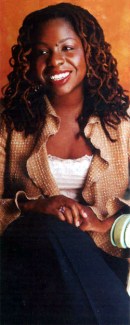 ABOUT THE AUTHOR:
 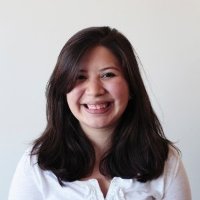 ABOUT THE REVIEWER: Araceli Méndez Hintermeister is a librarian and archivist with a background in public, academic, and culinary libraries.She has an MA in history and MLIS from Simmons College where she focused her studies on the role of libraries and archives in the cultural preservation of the U.S.-Mexican border. Additionally, she holds a BA in Ethnic Studies from Brown University. Her research is greatly influenced by her hometown of Laredo, TX which has led her to work in serving immigrants and underrepresented communities. Her current work involves exploring cultural identity through oral history in her project,
 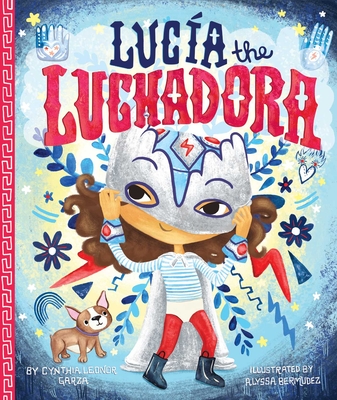 DESCRIPTION OF THE BOOK: Lucía zips through the playground in her cape just like the boys, but when they tell her “girls can’t be superheroes,” suddenly she doesn’t feel so mighty. That’s when her beloved abuela reveals a dazzling secret: Lucía comes from a family of luchadoras, the bold and valiant women of the Mexican lucha libre tradition. Cloaked in a flashy new disguise, Lucía returns as a recess sensation! But when she’s confronted with a case of injustice, Lucía must decide if she can stay true to the ways of the luchadora and fight for what is right, even if it means breaking the sacred rule of never revealing the identity behind her mask. A story about courage and cultural legacy, Lucía the Luchadora is full of pluck, daring, and heart.
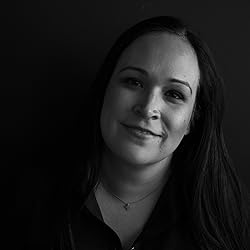 ABOUT THE AUTHOR (from her website): I’m a writer and write all sorts of things. My debut picture book
 ABOUT THE REVIEWER: Sanjuana C. Rodriguez is an Assistant Professor of Literacy and Reading Education in the Elementary and Early Childhood Department at Kennesaw State University. Her research interests include the early literacy development of culturally and linguistically diverse students, early writing development, literacy development of students who are emergent bilinguals, and Latinx children’s literature. She has published in journals such as Journal of Language and Literacy Education, Language Arts, and Language Arts Journal of Michigan.
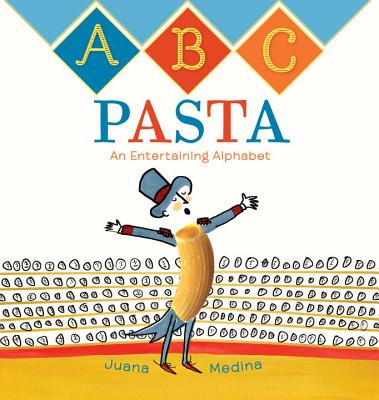 DESCRIPTION OF THE BOOK:
 ABOUT THE AUTHOR:
  ABOUT THE REVIEWER: Cecilia Cackley is a performing artist and children’s bookseller based in Washington DC where she creates puppet theater for adults and teaches playwriting and creative drama to children. Her bilingual children’s plays have been produced by GALA Hispanic Theatre and her interests in bilingual education, literacy, and immigrant advocacy all tend to find their way into her theatrical work. You can find more of her work at
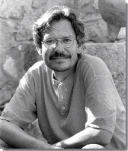 Benjamin Alire Sáenz is a scholar, a teacher of creative writing, and a prize-winning poet and novelist. Along with other distinctions, his 2012 novel Aristotle and Dante Discover the Secrets of the Universe won the Pura Belpré Award, the Stonewall Award, and the Lambda Literary Award. Our review is
  It was a no-brainer, clearly. Tan obvio. The trick now was to hit on the right story. I was hasta el cuello en research into Aztec and Maya literature at the time, and it occurred to me that a journey through the nine levels of Mictlan/Xibalba (the Mesoamerican Underworld) would make for a great hero quest. I cast about for the right characters for a while, until I started paying close attention to the fantastic friendship between my youngest son and middle daughter. With a few tweaks to age and interests, they became templates for the Garza twins.
 Of course, this is only the beginning for me and the twins. Book two, A Kingdom Beneath the Waves, will be out in late April. This time, Johnny and Carol Garza find themselves plunging deeply into the Pacific Ocean to stop a renegade prince of the merfolk and his allies—among them the water elementals the Aztecs called tlaloqueh—from recovering the Shadow Stone, a device that can flood the planet.
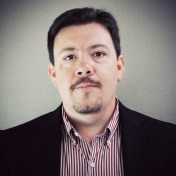 A product of an ethnically diverse family with Latino roots,
  Latinxs in Kid Lit