It’s Not So Scary! The Day of the Dead and Children’s Media


By Cris Rhodes

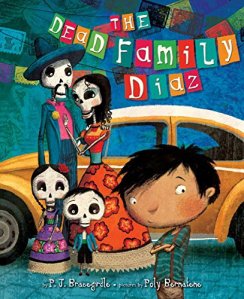
deadfamilydiazWith the Day of the Dead this weekend, I am reminded of recent children’s media, like P.J. Bracegirdle’s The Dead Family Diaz and Jorge Gutierrez’s film The Book of Life, that juxtapose the fraught topic of death against the colorful backdrop of the Day of the Dead. Through their fanciful visuals, full of lush, opulent colors and whimsical and endearing skeleton figures, books and films for children about the Day of the Dead repurpose traditionally scary imagery and repackage it as a beautiful celebration of both death and Mexican culture. While skeletons and death are often regarded as nightmare fuel in children’s literature and media, Day of the Dead narratives embrace the terrifying and show their readers and watchers that these spooky things aren’t so scary after all.

In recent years, for many Mexicans living in Mexico and abroad, Day of the Dead celebrations have come to symbolize something integral to the Mexican cultural identity. The Day of the Dead epitomizes Mexico’s complicated relationship with death and the afterlife, a tradition that finds its roots in the pre-Colombian celebrations of the days of the dead that allowed for the agrarian Mesoamericans to appeal to their bygone ancestors for a fruitful crop. The celebration as it manifests itself today comes from a blending of cultures; while many of the more traditional elements still pay homage to their Mesoamerican foundations, it’s becoming increasingly more common to find hybridized Day of the Dead celebrations throughout the U.S.
cocoFurthermore, mainstream American media have even started a push to officially recognize the Day of the Dead and its unique qualities, as evidenced by the forthcoming Disney/Pixar film Coco, directed by Toy Story 3’s Lee Unkrich with Mexican-American cartoonist Lalo Alcaraz acting as a cultural advisor. Despite Disney’s ill-fated bid to trademark the Day of the Dead in 2013, the company has persisted in making a Day of the Dead-themed film, which stands to be Disney/Pixar’s first film to feature a Latino protagonist. While very few details about Coco have been released, I choose to be optimistic and hope that it, like so many other Day of the Dead narratives, use the potentially terrifying images of skeletons and the similarly scary as reclaimed images that celebrate Mexican culture and its myriad qualities.

While many people tend to conflate the Day of the Dead and Halloween (as evidenced by the released dates of both Day of the Dead-centered films, Coco and The Book of Life, in either October and November), the two are entirely separate celebrations. But the Day of the Dead’s proximity to Halloween, and Halloween’s typically more frightening imagery, often makes the Day of the Dead guilty by association. However, Day of the Dead picture books and films erase fear of the dead through their bookoflifeheart-warming and endearing depictions of living children and their interactions with their deceased loved ones. In these books and the film, The Book of Life, skeletons act as a bridge between the living and the dead. While they epitomize death, skeletons (or calaveras) also connect to the living—take for example Erich Haeger’s Rosita y Conchita—in this bilingual picture book, the Day of the Dead allows the living Conchita to interact with her deceased, and skeletal, twin sister, Rosita. Skeletons also
hint to the inherent festive nature of the Day of the Dead, like the dancing skeletons in Richard Keep’s Clatter Bash! Or the festival-attending skeleton family in Bracegirdle’s The Dead Family DiazMost importantly, in these Day of the Dead narratives, none of the characters are ever truly afraid of the dead or of death. Skeletons become a common occurrence in Day of the Dead narratives, and they act as a motif throughout these texts and in The Book of Life.

By introducing the child viewer to books and to films like The Book of Life, any negative emotions connected to death are suspended. In the film’s afterworld, called the Land of the Remembered, a new world for death is created in the colorful landscapes and festive atmosphere. The Land of the Remembered is a place where memory acts as a source of life. By invoking the positivity of memory even in the absence of death, The Book of Life emphasizes that death is nothing to be feared. In this world, death is not scary nor is it a definitive ending. In the Land of the Remembered, Manolo, the film’s protagonist, is reunited with his immediate family and his ancestors. He sees his death as a necessary event that will allow him to exist with his true love, Maria. It is only after he learns that Maria has not really died and is not in the Land of the Remembered that the festivity of this place is temporarily lost, but it is regained once La Muerte, a goddess of death, and the other gods restore Manolo’s life at the end of the film.

9607766   865485

Ultimately, what these narratives illuminate for their young audiences is that death and all of its tenants are nothing to fear. Though other children’s books and films that explore themes related to death are often viewed as controversial (like the often-banned Bridge to Terabithia, or books that are purposefully frightening like the Goosebumps series), the celebratory nature of Day of the Dead stories provides a positive counter-narrative to the scary and off-putting norm. Teachers and librarians could and should encourage their readers to pick up Day of the Dead books like these, because they explore death and Mexican culture in a positive way. As we gear up to celebrate our own loved ones passed on this Day of the Dead, it would behoove us to take a look at Day of the Dead picture books and The Book of Life, or to eagerly anticipate Coco, as an apt way to celebrate this unique holiday.
 

CrisRhodesCris Rhodes is a graduate student at Texas A&M University – Corpus Christi where she divides her time between working on her thesis project about Chicana young adult literature, teaching first year composition to her beloved students, and working at her university’s Writing Center. She received her B.A. from Longwood University in her home state of Virginia, where she discovered her love of children’s literature and began her journey studying Latino children’s and young adult literature through an independent study of the stereotypical depictions of Latinos in young adult literature.
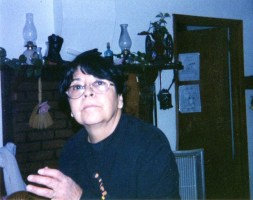
Author Robin Herrera Sees Her Grandma in Herself & Her Storytelling

By Robin Herrera

Sometimes when I look in the mirror, I see my grandma. Especially now that I have shorter hair, because as long as I knew her, she wore her hair short. Strangely, it wasn’t until a few years after she died that I noticed the resemblance between us.

She was short, too, like me—I’m the shortest in my family at (barely) 5’3”. We both have round faces and eyes that crinkle into small slits when we smile.

Now, years after her death, years after I’ve forgiven her for not telling me how bad her cancer really was, I wish I’d talked to her more. I know only snippets of my grandma’s life growing up in Colorado during the Great Depression. She was the youngest girl of 16 children, the second youngest altogether. Her parents were Joseph and Josephine Herrera. (On a baptismal document I found in my grandma’s things, their name was misspelled as Herreda.) And though she told me she’d left home at a young age, family was clearly very important to her, if the dozens of photo albums she left behind were any indication.

Robin Herrera  img001

When my siblings and I were younger, Grandma told us a story of our uncle Chris (Christobel). One night, near midnight, he was driving across a long bridge. Halfway across, he glanced over at the passenger’s seat to see a woman, dressed all in white, sitting there. She had her face turned toward the window, and Uncle Chris could see her shoulders shaking as she sobbed softly. He reached out a hand to comfort her, but before he could touch her, he looked down at her hands, in her lap. They were skeleton hands.

Though Chris was terrified, he kept driving. Somehow he knew that if he could make it to the other side of the bridge, the ghostly woman would disappear. He drove faster and faster, but out of the corner of his eye he saw the woman slowly turning her head to face him. Chris knew what her face would look like. It would be a skull, and if he looked, he would die. So he kept his eyes forward and kept driving until he crossed the bridge. Only then did he dare look at the passenger’s seat and see that the woman had vanished.

Grandma called the woman La Llorona. I didn’t know until later that La Llorona was a common Mexican folktale, and that Grandma’s tale was just a version of it. But for a long time, I was terrified of La Llorona, and impressed that my uncle Chris had been smart enough not to fall victim to her.

This is one of the few ties to my Mexican heritage that I have. I remember other things, too, like making tortillas on Grandma’s tortilla press, then heating them up and smothering them in butter. When my aunt Lupe visited, she and Grandma would occasionally lapse into Spanish, spoken so quickly that I’d sometimes stand in the kitchen with them, listening in awe. (I’m terrible at learning other languages.) Aunt Lupe, more than Grandma, always called me mija. I didn’t know what it truly meant until I looked it up in college, but I knew it was a term of endearment, because she used it on all the grandkids (mijo for the boys).

When my Grandma died, I felt like I’d lost that last connection with my Mexican heritage. My dad had already died by that point, but he was biracial and, I think due to circumstances in his childhood I can’t ask him about, wasn’t fluent in Spanish. Aunt Lupe is gone now, too, or I would talk to her about my grandma and their childhood together. (Though I’m not sure she’d tell me the truth. Grandma probably wouldn’t have either, to be fair.)

Now, as a writer, I miss my grandma terribly. I like to think she’d be proud of me, and that she’d see a bit of herself in my book, though to my knowledge, she never lived in a trailer park. What I hope she’d see is a portrait of a poor family, flawed but, for the most part, happy. Because that is what I remember most about my grandma. She showed me how to be poor.

Like the characters in my book, we shopped at thrift stores for most of our clothing (and dishes, and various housewares). Every week Grandma went grocery shopping at the local Grocery Outlet, which we called the Canned Food Store, and picked up what was on sale. When she died, her cupboards were still stocked with about a hundred different cans of food. She made sure we never went hungry.

But more than anything, she taught me that being poor wasn’t a terrible thing. I didn’t even begin to realize that I was poor until late in high school, after a conversation with my sister. This will sound cheesy, but Grandma made me feel rich in other ways.

I wonder, sometimes, where I get my love of writing and making up stories. My mother went to school for art, so for a long time, I thought that might be it. But I think it came from my grandmother, who told me stories (though often embellished) of her childhood (and ghost women) from an early age. I’ll leave you with one of my favorites, which she would often tell as a joke if I asked for a story. Of course, you have to imagine it’s being told by a short, round-faced Mexican woman who is being as over dramatic as possible:

It was a dark and stormy night. The soldiers were gathered around the campfire. Suddenly the captain stood up and said, “Diego! Tell us one of your famous stories!” Slowly, Diego stood up and said, “It was a dark and stormy night. The soldiers were gathered around the campfire…” (Repeat forever.)


18405519Robin Herrera was born in Eureka, California. She has degrees from Mills College and Vermont College of Fine Arts. She now lives in Oregon. Her debut novel, Hope Is A Ferris Wheel, was published in 2014 by Amulet Books.

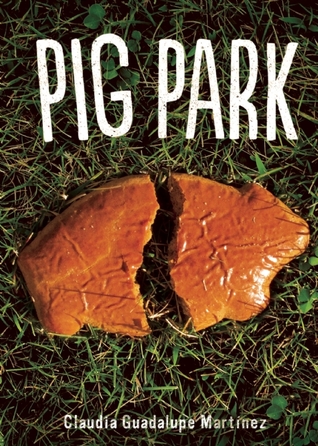
Pig Park and the Cosmic Race: Diversity and Identity in My New YA Novel

By Claudia Guadalupe Martinez

As a kid, I assumed everyone around me was Mexican. I lived less than a mile from the Texas-Mexico border, so we pretty much were Mexican. This neighborhood inspired my first novel, The Smell of Old Lady Perfume–a world vastly different from the one that surrounds my protagonist, Masi Burciaga, in my new novel Pig Park. Masi’s cast of neighbors runs the gamut from the Nowaks to the Wongs.

2236319Nevertheless, Mexican identity is something I thought very much about as I wrote. Two-thirds of the Latino population in the U.S. was of Mexican descent in the last Census, and I can’t help asking myself what it means to be Mexican these days. I didn’t grow up purposefully Mexi-centric. I was a product of my environment. I’d never had the opportunity to truly interact with non-Mexicans, non-Mexican Latinos, or Mexicans with experiences significantly different from mine until I moved to California for college.
Even then, the diversity I experienced was a somewhat artificial one created by a college admissions team. California was still the Southwest, and my new community and I still shared many experiences. But seriously, since I barely knew how to drive, I can hardly say I experienced L.A.

Chicago would be different. One day, I cashed in my airline miles and set off to visit a friend there. I walked into a coffee shop and stumbled onto a flier for an apartment rental. So began my long-term relationship with the city and neighborhood that would inspire Pig Park.

My new Chicago landlady occasionally referred to my neighborhood as Mexican, but my neighbors included Mexicans, African Americans, Filipinos, Puerto Ricans, and miscellaneous white folks. Everyone just mixed it up.

18528311Mexicans have formed communities in Chicago since the 1850’s. And, while a 2012 Census study from the Manhattan Institute for Policy Research named Chicago the most segregated city in America, Chicagoland’s Mexican population is massive enough at 1.4 million that some neighborhood overflow is to be expected. This is how diversity develops naturally. Scholar José Vasconcelos talked about Mexicans as “the cosmic race;” behind it was the idea that we actually have a little bit of everything in us, that we like to mix it up, eventually transcending racial and ethnic categories.
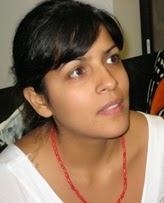
Life happened, as it is wont to do. I eventually got married, moved into a house in a new neighborhood, and became a mom. My husband is of the sort who wouldn’t be caught dead putting ketchup on a hot dog and gladly plays tour guide to visiting family and friends, introducing them to the many surprises of our city. He is a Chicagoan through and through. He is also of Guatemalan and Salvadoran descent. As such, I don’t know if my two-year daughter and my son (who will be born this October) will consider themselves Mexican or not. After all, identity is a fluid thing, partially assumed and partially assigned. My husband and I hope they consider themselves whatever they want, and are never made to feel that they can’t.

I wrote Pig Park recognizing that the world my children will be a part of isn’t exactly one thing, and that this is the type of world many kids are increasingly growing up in.

CGMTZ_photoby neus raffols_color_CROPPEDClaudia Guadalupe Martinez is the author of The Smell of Old Lady Perfume (Cinco Puntos, 2008) and Pig Park (Cinco Puntos, 2014). She grew up in sunny El Paso, Texas, where she learned that letters form words from reading the subtitles of old westerns with her father. She now lives and writes in Chicago.

Book Review: Tortilla Sun by Jennifer Cervantes

By Kimberly Mach

7175992DESCRIPTION FROM THE BOOK JACKET: When twelve-year-old Izzy discovers a beat-up baseball marked with the partially obscured phrase “Because… magic,” she is determined to figure out the missing words. Could her father have written them? What secrets does this old ball have to tell? Her mom certainly isn’t sharing any – especially when it comes to Izzy’s father, who died before she was born.
But when Izzy spends the summer in her Nana’s remote New Mexico village, she discovers long-buried secrets that come alive in an enchanted landscape of majestic mountains , whispering winds, and tortilla suns. Izzy finds herself on an adventure to connect the hidden pieces of her past. And just maybe she will discover the missing words that could change her life forever…but only is she can learn to create a few words of her own.

MY TWO CENTS: Tortilla Sun by Jennifer Cervantes is a perfect middle grade novel. It is well-constructed, has all the required pieces, and that little extra something that keeps you thinking about the story long after you’ve read it.  It is a book I am looking forward to sharing with my grade six students in a book talk.

What I loved most were the surprising elements, the pieces I didn’t expect. I didn’t expect to meet a master storyteller as a character. Socorro, almost mythic in description, appears and guides both Izzy and the members of the village with her wisdom and tales of the people. In fact, she helps Izzy, an aspiring writer, find her way to write and finish the stories she’s been struggling with. With Socorro’s guidance and the help of Nana and her new friends, Izzy is able to find her own cuento, or story. The characters are as rich and varied as village life, like the members of a large family. In fact, one of my favorite scenes is when six of the characters, ranging in age from Nana to young Maggie, play baseball together. Mrs. Castillo with her shiny nails surprises them all and hits a homerun.

I didn’t expect to find the essence of baseball in here either–the magic and lore, the homerun, and those bits that capture our imagination. The story starts with Izzy finding an old baseball.  She is certain it belonged to her father. Every stitch in that baseball is a thread of her story, of her cuento. In that story, there is healing and forgiveness, and it is one of the pieces that stayed with me long after the first read.

Finally, I didn’t expect to come away craving empanadas. When Izzy took her first bite my mouth started watering. Cervantes is expert at describing the smells of cooking and giving us the taste for many Mexican-American dishes through Izzy’s first experience with them. She even includes at the end a recipe for her own Nana’s tortillas, a recipe pulled from her own family history.

Jennifer Cervantes creates characters in Tortilla Sun that move into your heart and stay there. I want to go to Nana’s. I want to run my fingers over the Saltillo mosaic tiled floors and smell the snap and sizzle of the tortillas cooking. I want to run down the same path that Izzy and Mateo took, and then I want to come back and sleep in that hammock. It is hard to believe this is a debut novel. Nana, Izzy’s grandmother, tells her at one point, “Sometimes you can’t see the magic; you just know it’s there because you can feel it.” That is the way I feel about this MG novel. Each time I see it on my shelf, I remember the characters, the sounds, and the smells. You can feel the magic in this story, that certain something that brings it all to life. I look forward to reading Jennifer Cervantes’ next novel, and I hope there will be many more.

TEACHING TIPS: Jennifer Cervantes provides discussion questions for Tortilla Sun on her website. Also, I see mostly social studies connections here and opportunities for interdisciplinary learning.

Geography: Any teacher who is not from the southwest may use portions of the text to teach about that area. Why are hot air balloons popular in New Mexico? Where is the Rio Grande River? What is the terrain like? What does it mean to live in a desert? Simply learning that a desert does not only consist of drifting sand dunes would be a good use here.

Study of culture and the family unit: There are two grandmothers in the story who play vital roles in the lives of young people. A study of the nuclear family and extended family would be a good fit. The role of grandmothers and grandparents in societies today would also be a good fit. In Tortilla Sun there are both multigenerational households and nuclear families: Izzy, her grandmother and mother, Mateo and his parents, and then Maggie and her grandmother, Gip. Unlike some novels, the family unit, although broken at the beginning (Izzy and her mother live alone), becomes the mainstay of the whole story.

Study of Mexican-American culture: Izzy rediscovers her roots and forms her identity in this story. She does not come to New Mexico with a strong sense of who she is. It’s her grandmother, Nana, who teaches her about the religion, the Saltillo tiles, the food, and even a bit of the history. A historian at heart, I was fascinated about why the doorways in her house were so low and narrow in Nana’s house. Izzy even discovers there is more to her name than she first thought.

In Language Arts there are a variety of lessons that could be drawn from the novel from close reading particular passages. Foreshadowing , figurative language, and story structure can be a focus of these reads. In addition, advice on how to start and finish writing a story using practical strategies can be found. Izzy begins her own stories by using index cards. Soon the index cards can be laid out together and she has a full story with a beginning, middle, and end.

AUTHOR: Jennifer Cervantes currently resides in New Mexico with her family, which she calls The Land of Enchantment. Tortilla Sun  is her first novel. For more information about Jennifer and her upcoming works please visit her website: http://www.jennifercervantes.com/index.html

FOR MORE INFORMATION ABOUT Tortilla Sun, visit your local library or bookstore. Also check out worldcat.orgindiebound.orggoodreads.comamazon.com, and barnesandnoble.com.


Kimberly Mach (2)Kimberly Mach has been teaching for sixteen years and holds two teaching certificates in elementary and secondary education. Her teaching experience ranges from grades five to twelve, but she currently teaches Language Arts to middle school students. It is a job she loves. The opportunity to share good books with students is one that every teacher should have. She feels privileged to be able to share them on a daily basis.


Book Review: Niño Wrestles the World by Yuyi Morales

By Sujei Lugo

DESCRIPTION FROM THE BOOK JACKET: Señoras y señores, put your hands together for the fantastic, spectacular, one of a kind…Niño! In a single move, he takes down his  competition! No opponent is a challenge for the cunning skills of Niño, world champion lucha libre competitor!

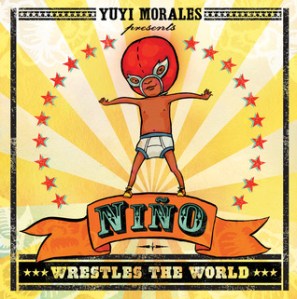
MY TWO CENTS: As soon as you take a glimpse of the book cover, you know that Yuyi Morales is presenting you with a treat of pint-sized lucha. The colorful and mixed-media artwork and its wrestling match layout, capture the energy and enthusiasm of the characters and lucha libre itself. Written in English with a dash of Spanish words and onomatopoeias, readers are exposed to an action-packed picture book filled with elements of Mexican and other Spanish-speaking cultures.

NiñoWrestlestheWorldCover“¡Niño! ¡Niño! ¡Niño!” It is through this chant that we are introduced to Niño, a paleta eater, toy-loving, and acrobatic boy. Once Niño puts on his luchador mask, contenders such as La Momia de Guanajuato, La Llorona and Cabeza Olmeca, line up to challenge him. With his playful lucha style, Niño challenges his opponents with puzzles, dolls, marbles, popsicles and tickles, showing how Morales playfully incorporates childhood glee into this wonderful homage to lucha libre. At the end of the story we also meet Niño’s toddler sisters, who are mischievous and loud and drive Niño crazy! This is where Yuyi Morales uses the opportunity to capture and address siblings’ relationships, while showcasing the “best move” to defeat sibling rivalry.

I could not deny that it crossed my mind that Niño Wrestles the World, plays as a homage and retelling of the legacy of Mexican lucha icon, El Santo. Like El Santo, once Niño puts on his luchador mask, he never takes it off. Like El Santo, in his movies, Niño challenges the mummy of Guanajuato, the llorona, and aliens. And you could say that when later in the book Niño joins his sisters and challenges new opponents, we are seeing a retelling of adventures where El Santo joins fellow luchadores Blue Demon and Mil Máscaras. Setting the wonderful El Santo references aside, in this picture book we have a fun and energetic story and lovable characters that will release the inner luchador or luchadora in kids and adults of all ages.

Niño Wrestles the World is the 2014 Pura Belpré Illustrator Winner and was named a highly commended title by the 2014 Charlotte Zolotow Award. It was also included in a series of list such as A Fuse #8 Production 100 Magnificent Children’s Books 2013, School Library Journal Top 10 Latino-themed Books of 2013, Fanfare (Horn Book’s list of the best books for young people published in 2013), Center for the Study Multicultural Children’s Literature Best Multicultural Books of 2013 and Latinas for Latino Lit Remarkable Latino Children’s Literature of 2013.

TEACHING TIPS: While early readers and kids between the ages of 4-8 might enjoy reading this picture book, it is through the activity of reading aloud that its energy and humor really stands out. Adults and childrens’ librarians can read the book, while teaching new vocabulary and words in Spanish to kids.

Language Arts, Visual Arts, and Social Studies teachers (pre-school- 2nd grade) could also use Niño Wrestles the World with their students. The book is filled with fun onomatopoeias, adjectives and words in Spanish, which will attract students to the language learning process. Art teachers can collaborate with Language Arts teachers with the masks of the different characters of the story. Templates of different lucha masks are available on Yuyi Morales’ website, or you can be creative with your own mask!

The elements of Mexican culture exposed through Niño’s opponents, the trading-card-style information of each opponent (includes pronunciation), and Yuyi Morales’ illustrations provide the opportunity to incorporate them into Social Studies curricula. Educators should be provided with resources and materials that will serve as tools to bring multiethnic/multicultural exposure and discussion into the classroom. This is especially relevant now since Mexican American and Latin@ Studies curricula and books are constantly challenged in the U.S. public education system.

LEXILE: N/A

AUTHOR: Yuyi Morales is a Mexican author, illustrator, artist, and puppet maker. She has a bachelor’s degree in Psychology and Physical Education from the University of Xalapa, México and used to host her own Spanish-language radio program for children in San Francisco, California.

She has won numerous awards for her children’s books such as the Tomás Rivera Mexican American Children’s Book Award for Just a Minute: A Trickster Tale and Counting Book (2004) and Los Gatos Black on Halloween (2008), the Pura Belpré Author Honor for Just in Case: A Trickster Tale and Spanish Alphabet Book (2009), the Pura Belpré Illustrator Award for Just a Minute: A Trickster Tale and Counting Book (2004), Just in Case: A Trickster Tale and Spanish Alphabet Book (2009) and Los Gatos Black on Halloween (2008), and Pura Belpré Illustrator Honor for My Abuelita (2010) and Harvesting Hope: The Story of Cesar Chavez (2004).

Morales divides her time between the San Francisco area and Veracruz, Mexico. Her lastest picture book Viva Frida! will be released in September 2014.

For more information about Niño Wrestles the World visit your local library or bookstore. Also check out Macmillan Publishers, Goodreads, Indiebound.org, WorldCat.org, Amazon, and Barnes and Noble.  

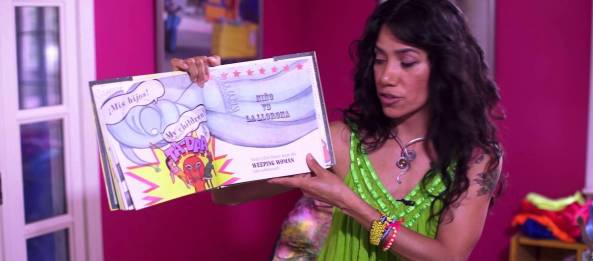
Enjoy this video of Yuyi Morales reading Niño Wrestles the World!