Book Review: Last Night I Sang to the Monster by Benjamin Alire Sáenz

6413788By Sonia Alejandra Rodriguez

DESCRIPTION OF THE BOOK: Zach is eighteen. He is bright and articulate. He’s also an alcoholic and in rehab instead of high school, but he doesn’t remember how he got there. He’s not sure he wants to remember. Something bad must have happened. Something really, really bad. Remembering sucks and being alive – well, what’s up with that? 

MY TWO CENTS: Benjamin Alire Saenz’s Last Night I Sang to the Monster (2009) is a powerful and heart-wrenching story of a young man’s encounter with trauma and violence and his journey toward healing. Eighteen-year-old Zach wakes up in a rehabilitation center far from his home in El Paso, TX for what he thinks is his abuse of alcohol, but in reality, he cannot remember why he’s there or how he got there. Throughout the narrative, Zach reflects on moments in his life that might have led to his arrival at a rehabilitation center. His therapist/counselor, Adam, encourages him to remember the event that landed him at the center so that he can begin healing; however, the pain is too great and Zach remains emotionally paralyzed for much of the novel. At the center, Zach meets a diverse group of people that struggle with addiction and mental illness, and he is forced to contend with his own struggles; however, his refusal to remember leaves him more vulnerable to pain. He meets an older man, Rafael, who is at the center seeking treatment for his alcoholism, which worsened after the death of his son. Zach looks at Rafael as a father figure, and in return, Rafael provides advice and guidance for processing pain and trauma. Rafael shares with Zach that one of the ways to get the “monster” to stop hurting is to sing to it. When Rafael leaves the center, Zach is distraught and appears to be spiraling down again. Zach must learn to sing to the monster if he wishes to find healing and one day leave the center.

Last Night I Sang to the Monster is a beautiful novel. Through Saenz’s prose the reader is privy to Zach’s inner pain and struggle. Saenz’s captures the complex relationship between addiction and trauma in such a way that the reader cannot escape until we know that Zach will be okay. It is obvious through Zach’s memories that varying forms of violence have always been a part of his upbringing, and it is once they culminate into a catastrophic event, that he is forced to deal with it. The importance of remembering is palpable throughout the novel. As a reader, I begged Zach to remember so that I could understand why he’s at the rehabilitation center; however, as Zach recounted his story, I felt that maybe remembering would be too painful. The reader’s investment in a character is a sign of an incredible author and remarkable story. Last Night addresses an abundance of issues ranging from alcoholism, abuse, and death to think about ways of healing and living differently. As a part of Latina/o young adult literature, Saenz’s novel stands out not only because of its wonderful prose but because the issue of addiction and its consequences on the self and others is a conversation that requires more attention.  Overall, Last Night I Sang to the Monster demands to be read multiple times in order to really appreciate Zach’s healing process and Saenz’s marvelous words.

One of the aspects of the novel that I find most appealing is the discussions of how trauma and healing affect families. Zach’s alcoholism extends from a much longer history of abuse in his family, and he is forced to contend with this reality when his brother murders his parents. Saenz captures the perplexity of surviving a traumatic event and suggests that such survival does not always mean one has healed. Zach’s healing process is far from linear, and at times, it feels as if he is not moving or is instead regressing. However, it is precisely these movements or lack thereof that make the novel feel that much more real. Dealing with trauma on an individual, familial, and communal level is an on-going process. Zach’s often refusal and fear to face his monster further reveals how difficult healing can be. That the title itself suggests that Zach eventually sings to the monster simultaneously sheds light on the role that hope plays in healing processes. A few other Latina/o young adult texts that deal with issues of healing, trauma, addiction, and/or illness include Isabel Quintero’s Gabi A Girl in Pieces, Juan Felipe Herrera’s Downtown Boy, E.E. Charlon-Trujillo’s Fat Angie, and Gloria Velazquez’s Tyrone’s Betrayal.

AUTHOR: Benjamin Alire Sáenz is an award-winning American poet, novelist and writer of children’s books. He was born at Old Picacho, New Mexico, the fourth of seven children, and was raised on a small farm near Mesilla, New Mexico. He graduated from Las Cruces High School in 1972. That fall, he entered St. Thomas Seminary in Denver, Colorado where he received a B.A. degree in Humanities and Philosophy in 1977. He studied Theology at the University of Louvain in Leuven, Belgium from 1977 to 1981. He was a priest for a few years in El Paso, Texas before leaving the order. In 1985, he returned to school, and studied English and Creative Writing at the University of Texas at El Paso where he earned an M.A. degree in Creative Writing. He studied as a PhD student at the University of Iowa and Stanford University. Before completing his Ph.D., he moved back to the border and began teaching at the University of Texas at El Paso in the bilingual MFA program. He continues to teach in the Creative Writing Department at the University of Texas at El Paso.

FOR MORE INFORMATION about Last Night I Sang to the Monster, visit your local library or bookstore. Also check out worldcat.org, indiebound,org, goodreads.com, barnesandnoble.com, and amazon.com.

headshotSonia Alejandra Rodríguez has been an avid reader since childhood. Her literary world was first transformed when she read Rudolfo Anaya’s Bless Me, Última as a high school student and then again as a college freshman when she was given a copy of Sandra Cisneros’s The House on Mango Street. Sonia’s academic life and activism are committed to making diverse literature available to children and youth of color. Sonia received her B.A. in English from the University of Illinois at Urbana-Champaign. She is currently a PhD candidate at the University of California, Riverside, where she focuses her dissertation on healing processes in Latina/o Children’s and Young Adult Literature.

Overflowing with Thanks, Bookwise

WNDB_ButtonThis is the week when we as bloggers pause to give thanks, starting with the fact that we have so many amazing readers–readers who care about Latin@ kid lit as much as we do! We appreciate each one of your clicks, comments, social-media shares, and other forms of participation. If you’ve been silent up to now, let us hear from you soon. We value your partnership.

Another thing we’re super grateful for this Thanksgiving is the emergence and explosive growth of the We Need Diverse Books campaign. Ceilings are cracking under the pressure of this push and all of us stand to benefit, so thank you to the bright minds that dreamed it up.

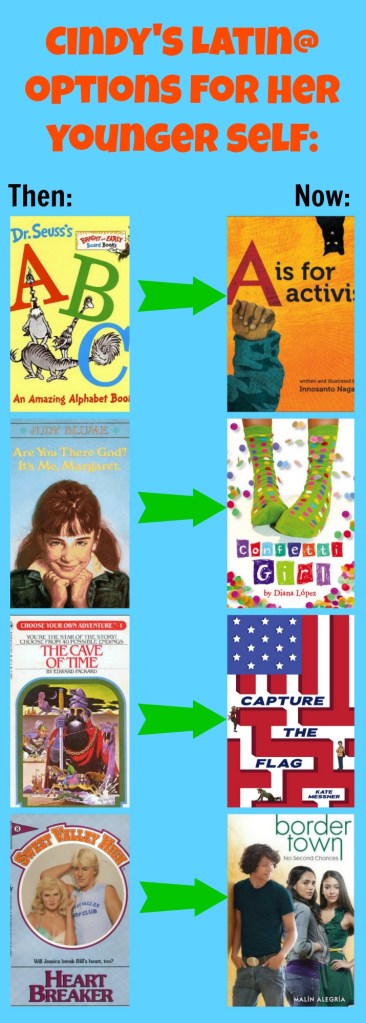
Another reason to feel grateful in 2014 is that Latin@ kid lit is in much better shape than it was in years past. As we reflect back on our own or our children’s bookshelves, we’re delighted that kids today have a growing number of Latino options.

To demonstrate this point, check out a few of Cindy‘s beloved titles from her childhood, matched by current Latino options.

Cindy's Latino Option Collage

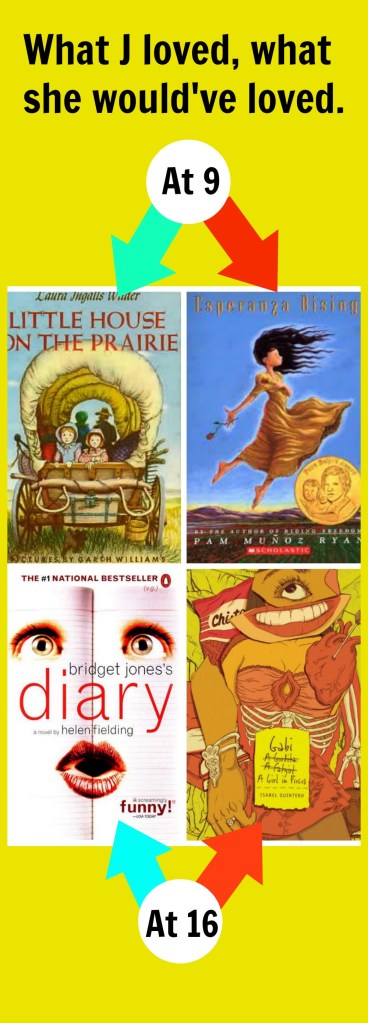
I, Lila, decided to frame this comparison through my oldest daughter’s experience. “J” was a 1980s baby who read late into the night by the light of her digital alarm clock, so you know she was crazy about books. Here are a couple of J’s favorites, matched with contemporary Latino options she would’ve loved.

What She Loved Collage

Now for expressions of thanks from two other members of the team.

Zoraida

2014 has been crazy for me. I work full time, launched the last book in my trilogy, wrote, sold and launched a New Adult romance. And I’m still not done yet. Despite a crazy work schedule, I am thankful that I do have a support system that allows me to find time to write. I have a wonderful network of friends and a boyfriend who knows me extremely well. I’m thankful that I get to be part of a wonderful group of writers here at Latin@s in Kid Lit, but most importantly that we’re getting the conversation rolling about issues dear to our hearts. I hope the next year brings even better things for us all.

LOTL.v3

Sujei

Growing up in Puerto Rico, Thanksgiving in my family seemed like “Eating Turkey with Fried Plantains Day.” Considering that November is Native American Heritage Month, I find deeper reasons to feel thankful. In my late teens, I started questioning the impact of this “first meal,” and saw it more as the beginning of genocide, colonialism, and the suffering of our indigenous people and ancestors. I’m thankful for books that teach us the real story and those that talk about Native people in the present tense and show us that they live everyday lives. Books that highlight these realities disrupt the narrative of old-school texts, which often historicize and stereotype indigenous people.

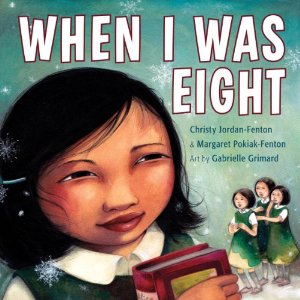
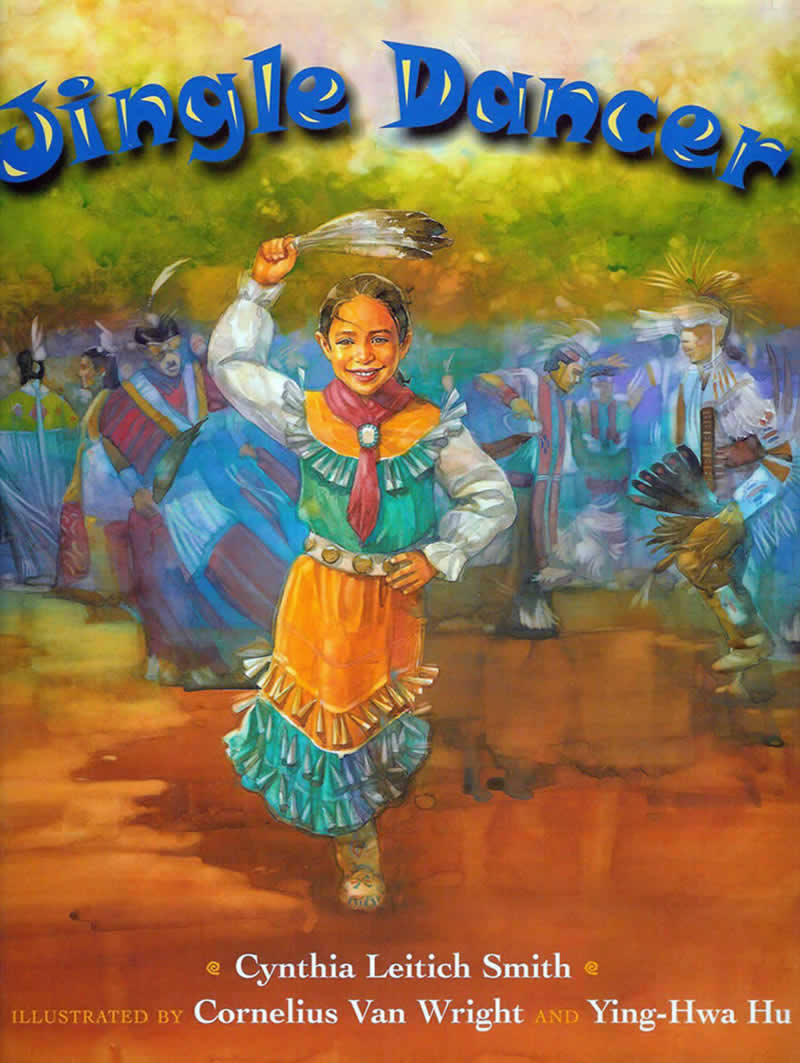
Here are three of Sujei’s recommendations for children’s books that honor the experiences and history of Native Americans.

People Shall Continue When I was 8 JingleCover_hi-res

Our mission is to promote diversity in children’s books, specifically Latin@ books and creators. So when you’re thinking about ways to diversify your kid lit bookshelves, explore our archives for reviews and posts. We’re so thankful that you care about Latino representation in children’s and teen’s books, and we want to continue serving those interests.

Happy Thanksgiving!

Book Review: Stranger (The Change #1) by Rachel Manija Brown and Sherwood Smith

By Eileen Fontenot

16034526DESCRIPTION FROM GOODREADS: Many generations ago, a mysterious cataclysm struck the world. Governments collapsed and people scattered, to rebuild where they could. A mutation, “the Change,” arose, granting some people unique powers. Though the area once called Los Angeles retains its cultural diversity, its technological marvels have faded into legend. “Las Anclas” now resembles a Wild West frontier town… where the Sheriff possesses superhuman strength, the doctor can warp time to heal his patients, and the distant ruins of an ancient city bristle with deadly crystalline trees that take their jewel-like colors from the clothes of the people they killed.

Teenage prospector Ross Juarez’s best find ever – an ancient book he doesn’t know how to read – nearly costs him his life when a bounty hunter is set on him to kill him and steal the book. Ross barely makes it to Las Anclas, bringing with him a precious artifact, a power no one has ever had before, and a whole lot of trouble.

MY TWO CENTS: After finishing an ARC of this book, which was officially released 11/13/14, I was pleasantly surprised to realize that unlike many sci-fi/fantasy books I enjoy so much, this one left a very pleasant feeling and hope for the future and not a lurking doom cloud of worry about what humanity will be like once we destroy the environment/bomb ourselves silly/let computers take over. Yes, there are terrible creatures lurking in the desert, but Las Anclas has an abundance of people who are working together to protect each other from those dangers.

But yes, there is still bigotry among certain people in power against those with “the Change,” but all does not seem completely hopeless. There are some teenagers with their own Changes – along with respected adults – who are fighting for acceptance. As for non-traditional male/female relationships, the people of Las Anclas are quite easy going; being gay or considering polyamory is very normalized behavior. In addition to the variety of relationships and differences among the characters that contemporary readers would recognize, the racial diversity of the cast of characters is not tokenized and does not feel forced in any way.

Teens who may not see themselves represented very often in sci-fi/fantasy novels can surely find a character that speaks to them – whether they are in a non-traditional romantic relationship, physically disabled, or experiencing mental illness. Or just feeling out of place and out of step with the so-called “normals” favored in society.

TEACHING TIPS: Youth services/teen librarians and high school teachers and librarians can encourage readers to write their own short stories and experiment with different points of view, like this book does. Teens and their instructors can discuss what using this narrative technique does to a plot, setting, and character development.

For teachers with an artistic bent, get the teens to draw or write about the flora and fauna of the future. A good tie-in would be a conversation about the ecological implications of war and how that would change what animals and plants look like and how they would behave. The drawings and ideas can range from silly to serious.

And finally, it would be interesting to find out what teens felt about building a positive society in the face of such challenges – a kind of positive utopia that existed in this novel. What would they do to become effective leaders in a harsh world, with little resources? What compromises would they be willing to make?

AUTHORS: From Goodreads: Rachel Manija Brown is the author of all sorts of stories in all sorts of genres. She has also written television, plays, video games, and a comic strip meant to be silk-screened on to a scarf. In her other identity, she is a trauma/PTSD therapist. She writes urban fantasy for adults under the name of Lia Silver.

From cahreviews.blogspot.com: Sherwood Smith began her publishing career in 1986, writing mostly for young adults and children. Smith studied in Austria for a year, earning a masters in history. She worked many jobs, from bartender to the film industry, then turned to teaching for twenty years, working with children from second grade to high school. To date she’s published over forty books and been nominated for several awards, including the Nebula, the Mythopoeic Fantasy Award, and an Anne Lindbergh Honor Book.

FOR MORE INFORMATION ABOUT Stranger (The Change #1) visit your local public library, your local bookstore, barnesandnoble.com, amazon.com, goodreads.com or indiebound.com.


Eileenfontenot headshot Fontenot is a recent graduate of Simmons College Graduate School of Library and Information Science in Boston. She works at a public library and is interested in community service and working toward social justice. A sci-fi/fantasy fan, Eileen was formerly a newspaper writer and editor.

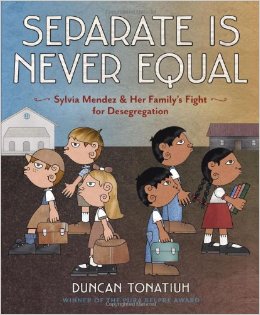
Book Review: Separate is Never Equal: Sylvia Mendez and Her Family’s Fight for Desegregation by Duncan Tonatiuh

Reviewed by Lila Quintero Weaver

Separate is Never Equal 2

DESCRIPTION OF THE BOOK: When her family moved to the town of Westminster, California, young Sylvia Mendez was excited about enrolling in her neighborhood school. But she and her brothers were turned away and told they had to attend the Mexican school instead. Sylvia could not understand why—she was an American citizen who spoke perfect English. Why were the children of Mexican families forced to attend a separate school? Unable to get a satisfactory answer from the school board, the Mendez family decided to take matters into their own hands and organize a lawsuit.

In the end, the Mendez family’s efforts helped bring an end to segregated schooling in California in 1947, seven years before the landmark Supreme Court ruling in Brown v. Board of Education ended segregation in schools across America.

Using his signature illustration style and incorporating his interviews with Sylvia Mendez, as well as information from court files and news accounts, Duncan Tonatiuh tells the inspiring story of the Mendez family’s fight for justice and equality.

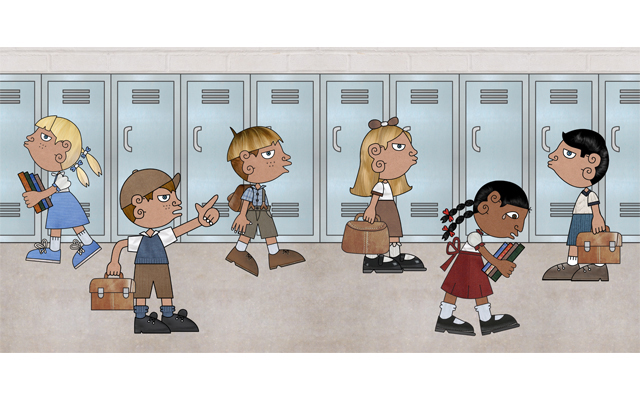
MY TWO CENTS: Kudos to Duncan Tonatiuh for shining a bright spotlight on a consequential, but often overlooked chapter of American civil rights, and bringing this true story of Latinos fighting for racial justice to young readers. The book features Tonatiuh’s trademark, award-winning illustration and his retelling of the facts.

In the mid-1940s, when the action takes place, Sylvia Mendez is nine years old. She’s the daughter of Gonzalo Mendez, a Mexican-born, naturalized citizen of the United States, and his wife, Felicitas, from Puerto Rico. When the Mendez family moves from Santa Ana, California, to a farming community in Orange County, Sylvia and her brothers are not permitted to enroll in the neighborhood school and are instead sent to a school designated for Mexicans, which is farther from home. Unlike the white children’s school, it’s dirty, crowded and lacks a playground. The students eat lunch outdoors next to a fly-infested cow pasture. To top it off, the teachers seem indifferent, as if Mexican children weren’t worth the bother.

The Mendez family launches a campaign to demand equal education for their children. Sylvia’s father first pursues answers from officials all the way up the line to the board of education, but no one offers a credible explanation. The common refrain is “that is how it is done.” Mr. Mendez organizes members of the Mexican community and hires a lawyer to challenge the discriminatory practices in court. Young Sylvia is in the courtroom during the proceedings, where she hears statements by a school official about the supposedly lice-ridden, inferior nature of Mexicans. It takes two court cases to settle the outcome. The judge’s final ruling states that “public education must be open to all children by unified school association regardless of lineage.”

After Sylvia’s parents successfully face down California’s version of Jim Crow laws, she enrolls in the neighborhood school, shattering longstanding color barriers. In the corresponding page spread, a white boy tells Sylvia, “You don’t belong here,” and Sylvia is shown with a bowed head and a tear sliding down her cheek. Reminded by her mother of the long fight they undertook to win her right to equal schooling, Sylvia perseveres, proving herself as steely as her parents. In the closing pages, she and other brown-skinned children are shown side-by-side with white classmates in the school playground.

Separate is Never Equal spread

Tonatiuh’s account highlights the exemplary character of Mr. and Mrs. Mendez. Every movement for justice has its heroes and pioneers, and the Mendez family richly deserves that level of recognition. Taking up the fight involved considerable personal risk. They used their life savings to kickstart the legal fund. Eventually, they received wider support. Leading the charge took Mr. Mendez away from the farm for long stretches, leaving Mrs. Mendez to perform farming tasks that her husband normally would have handled. As the story shows, many Mexican families in the community declined to join the lawsuit, for fear of economic retribution. “No queremos problemas,” they said.

The California campaign for educational equality, spearheaded by the Mendez case, ultimately led to the 1954 ruling on Brown v. Board of Education. The victory illuminated by Separate is Never Equal belongs in a clear line of prominent milestones of American civil rights. How fortunate that someone with Tonatiuh’s skill has brought it out of the shadows.

TEACHING RESOURCES: Beyond the importance of the story, Tonatiuh’s groundbreaking illustrations deserve readers’ attention. His drawings marry childlike innocence with characteristics of ancient Mixtec art. (See my review of Pancho Rabbit and the Coyote: A Migrant’s Tale for a fuller discussion of his style.) In Separate is Never Equal, the illustrations take on the added dimension of historical details from the 20th century. Teachers may want to provide students with photographs from the era to demonstrate how carefully Tonatiuh researched and reproduced clothing, hairstyles, automobile models, and other authenticating markers of the 1940s.

As is generally the case with nonfiction picture books, younger readers will likely need adult guidance to understand sections of the story that deal with legal proceedings and other points of the Mendez’s battle.

This book presents powerful opportunities for teaching empathy and strengthening awareness of the pain that racism inflicts. One scene shows a public swimming pool with a sign stating, “No Dogs or Mexicans Allowed.” Mexican children look longingly through the fence at the white children frolicking in the pool. Teachers can pose discussion questions such as, “Imagine yourself on both sides of the fence. How would you feel in either situation?” Consider comparing Sylvia Mendez’s experiences with those of Ruby Bridges, the young African American girl who integrated New Orleans schools in 1960.

A section in the back of the book includes an author’s note, a glossary, a bibliography and explanatory details about methodology. Much of Tonatiuh’s research came from court documents and extensive interviews with Sylvia Mendez. Glossary entries include a handful of Spanish phrases used in the book and historical terms that round out the context. One example is the origin of “separate but equal,” a phrase plucked from the 1896 ruling by the U.S. Supreme Court in the Plessy v. Ferguson case, which laid the foundation for decades of Jim Crow laws.

In 2010, Sylvia Mendez received the Presidential Medal of Freedom. She is interviewed on this video, which highlights points of the story told in the book and shows photographs of her as a child and of the schools in question.

Duncan Tonatiuh

Duncan Tonatiuh  was born and raised in Mexico. He studied art in the United States. His picture book Pancho Rabbit and The Coyote: A Migrant’s Tale won the 2014 Tomás Rivera Mexican American children’s book award, and two honors for text and illustration from the Pura Belpré Award. Read more about Duncan on his official website.

Book Review: Enrique’s Journey by Sonia Nazario

By Lila Quintero Weaver

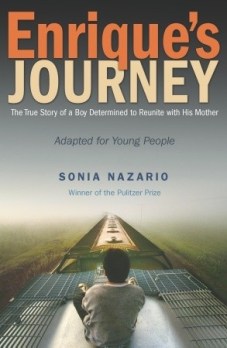
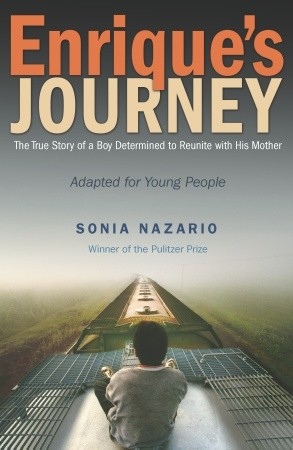
Enrique's JourneyPUBLISHER’S DESCRIPTION: Based on the Los Angeles Times newspaper series that won two Pulitzer Prizes, this astonishing story puts a human face on the ongoing debate about immigration reform in the United States. Now a beloved classic, this page-turner about the power of family is a popular text in classrooms and a touchstone for communities across the country to engage in meaningful discussions about this essential American subject.
Enrique’s Journey recounts the unforgettable quest of a Honduran boy looking for his mother, eleven years after she is forced to leave her starving family to find work in the United States. Braving unimaginable peril, often clinging to the sides and tops of freight trains, Enrique travels through hostile worlds full of thugs, bandits, and corrupt cops. But he pushes forward, relying on his wit, courage, hope, and the kindness of strangers.

MY TWO CENTS: The best creative non-fiction takes you straight down into the messy, contradictory, gut-wrenching heart of a subject, and awakens your appreciation for its complexity. By every measure, Enrique’s Journey is such a book. It’s the riveting epic of a Honduran teenager driven to escape intolerable conditions and fueled by the hope of crossing the border into the United States. The original version was published in 2007 as adult nonfiction. This edition, adapted for readers as young as the seventh grade, was released in 2013. It also updates the story. (Young-reader adaptations are a growing trend in nonfiction publishing.)

As Enrique launches his eighth attempt to reach the United States by means of train hopping, the risks are clearer than ever to him: death, dismemberment, robbery, extortion, and sexual victimization. But the way he sees it, staying in Honduras presents its own bleak and terrifying future. Gangs and violence are rampant, poverty is entrenched, and opportunities for work and self-betterment are virtually nonexistent. Worst of all, Enrique’s mother, Lourdes, has been absent from his life for an achingly long time. A single mother with no dependable means of support, she left for the United States when Enrique was five, entrusting her two children into the care of relatives. Enrique’s sister has weathered the eleven-year separation reasonably well, but it takes a heavy toll on the young boy. During his teen years in Honduras, he spirals down into serious drug use and antisocial behavior. As his life grows ever more troubled, Enrique imagines that reuniting with his mother will repair the hole in his heart.

In this vivid and comprehensive account, Sonia Nazario retraces Enrique’s eighth attempt, following his 1,800-mile route through the heart of Mexico, an odyssey lasting 47 days. She expands the picture to cover conditions facing others on a similar migratory path. The chapters are embedded with fascinating micro stories of places and people who assist, deter, or exploit the thousands of Central Americans flowing northward through Mexico on train roofs and other modes of transportation. The narrative captures the flavor of distinct geographic zones. The most notorious stretch is Chiapas, in extreme southern Mexico. Chiapas is dense with gangs, bandits, immigration patrols, and unsympathetic residents who look down on the migrants as the “stinking undocumented.” In this region, migrants are easy targets of crime, since as a rule, they’re too fearful to report it, and in many cases, the police collude with the criminals. At one point, gang members chase Enrique along the top of a moving train. After they catch and beat him, he jumps off the train and sustains a serious injury.

Migrants like Enrique also encounter good-hearted people, who are typically quite poor themselves. Some of them make it a regular practice to toss food and water to migrants clinging to the roofs of passing trains. Some even open their homes to strangers with nowhere to shelter between train departures. There are agencies and churches that offer assistance, including a few that give the severely injured a place to heal. These accounts of compassion touched me to the core. I was also moved by the camaraderie that develops among train riders, who often sacrificially share with strangers whatever small comfort they can—blankets, food, water. Although they pool resources, exchange information, and organize lookout duty so others can sleep, individual migrants often find themselves in terrifying circumstances beyond the reach of kind, but equally vulnerable, strangers.

When Enrique arrives at the border with Texas, he’s finally able to call his mother, yet his ordeal is far from over. After many complications and long delays, Enrique makes a perilous crossing. There is no fairy-tale reunion. His anger over the heartbreaking separation spills out in words and self-destructive actions. Gradually, things get better as Enrique matures, finds work, and begins to seek legal status.

For kids who like dystopian stories, here’s a true-to-life dystopia to check against those from fantasy. This book is not light reading, nor is it meant to be. Most young readers will endure the gritty parts if only to find out what happens to Enrique, who, like teens everywhere, holds a mix of dreams and demons. Some readers may have a hard time getting past the controversies that swirl around undocumented immigrants, but the slant of this book is not toward proposing policy or resolving debates. By concentrating on the story of one boy from a broken society—a boy whose resilience and courage seem at times superhuman in the face of nearly insurmountable odds—Sonia Nazario brings deep human dimension to a thorny issue of our times.

ADDITIONAL RESOURCES: In the official website for Enrique’s Journey, under the tab Educator Resources, teachers can locate extensive lesson plans and activities across the disciplines, along with a list of recommended movies and documentaries. The publisher has also released a Spanish edition, La Travesía de Enrique, and the site includes lessons geared toward students of Spanish.

Sonia Nazario has been a frequent guest on television and radio shows, including On Point, with Tom Ashbrook. Her views were featured in an op-ed piece in the New York Times.

Enrique’s Journey is being used as a text across America. This report focuses on the book’s impact in college classrooms.

Which Way Home is one of the movies on the publisher’s recommended list. Here is a radio piece about it.

In 2014 the number of unaccompanied children and youth attempting to cross our southern border reached crisis proportions, demonstrating the need to understand what drives Enrique and thousands more like him to make the journey.

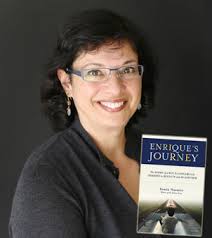
Sonia NazarioSONIA NAZARIO is an award-winning journalist with more than 20 years in the industry. Enrique’s Journey is her first book-length project. Her official bio can be read here.


Book Review: The Summer Prince by Alaya Dawn Johnson

By Eileen Fontenot

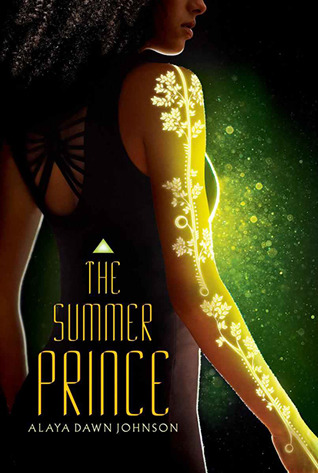
13453104DESCRIPTION OF THE BOOK: The lush city of Palmares Três shimmers with tech and tradition, with screaming gossip casters and practiced politicians. In the midst of this vibrant metropolis, June Costa creates art that’s sure to make her legendary. But her dreams of fame become something more when she meets Enki, the bold new Summer King. The whole city falls in love with him (including June’s best friend, Gil). But June sees more to Enki than amber eyes and a lethal samba. She sees a fellow artist.

Together, they will stage explosive, dramatic projects that Palmares Três will never forget. They will add fuel to a growing rebellion against the government’s strict limits on new tech. And June will fall deeply, unfortunately in love with Enki. Because like all Summer Kings before him, Enki is destined to die.

Pulsing with the beat of futuristic Brazil, burning with passions of its characters, and overflowing with ideas, this fiery novel with leave you eager for more from Alaya Dawn Johnson.

MY TWO CENTS: As readers, we experience the yearlong events of The Summer Prince through the eyes of the protagonist, June Costa, a waka (under 30) artist who is growing up in a lush oasis in a post-apocalyptic Brazil. She and her closest friend, Gil, become enamored with the new Summer King, Enki, who is from the verde, the poverty-stricken part of the city. What begins as a rebellious lark – being a grafiteiro, making public art in support of Enki (who is a figurehead for the Aunties who really run the city and is destined to give his life in choosing a new Queen) – leads to a game of higher stakes for June. She grapples with many adult issues – being in a love triangle, struggling with self identity and parents’ expectations, grappling with unjust grandes (the society’s elders) and their traditions, and ultimately being a force that will decide the direction Palmares Três will take in the future. Will the youth rise up and overthrow the corrupt elders and begin a new era that balances humanity with technology?

This is not a pat, easy coming-of-age novel. June is not altogether sympathetic, but most of her actions are understandable. She is portrayed, especially early on in the book, as a somewhat self-centered youth, bent on fame and the coveted Queen’s Award, which is awarded to the best young artist in the city. She must decide just what is she willing to sacrifice to become famous, to create, to win. As she gets involved deeper and deeper with Enki, she must choose to be cowed by the Aunties’ pressure to conform or to help facilitate real change within the city.

Although the book discusses the effects of extreme technology and bio-modifications on humans’ bodies, it does so in a somewhat oblique way. Johnson chooses to focus more on June’s personal struggle with her mother and step-mother and the death of her father, the sacrifices she makes for her art and the love she has for both Enki as a lover and Gil as a friend, while accepting that both Enki and Gil also love each other. June comes to realize that even though you may lose the ones you love the most, they can still be with you in spirit – through what they have left behind in your beloved city, with its music, knowledge and history.

We’d also like to note that while Johnson’s novel received lots of praise when it released in 2013, it was also criticized by some for its portrayal of Brazil and its culture. For that view, please see this post by Ana Grilo, a Brazilian living in the UK and half of The Book Smugglers team.

TEACHING TIPS: This book would be wonderful for an older teen book talk, especially for those who create art or are interested in it. (I suggest older teens because there are some sex scenes, and the book’s themes are for more mature minds.) Wakas of Palmares Três love body art, so talk leaders could pair the book discussion with a make your own temporary tattoo craft. A type of LED sign features very prominently in the climax, so if you’re feeling particularly adventurous or techy, have the teens collaborate on their own sign, which then could be hung in your teen space.

Facilitators could take a few other tacks with their talk, one of which would be discussing the types of love that can be experienced – platonic, familial, romantic, even the respect you come to have for a frenemy – who is embodied in Bebel, June’s talented rival for the Queen’s Award. Teens may want to share their thoughts on romance – the types of conflict they’ve experienced or what things they have done in pursuit of love. If the members of your group want to share mistakes they’ve made, that may help their peers understand they are not alone. Teens who have lost a parent may also benefit from joining in a book talk of The Summer Prince. June loses her beloved father before most of the events of the novel, and it is a recurring theme throughout the book – her difficult acceptance of his death and her mother’s resulting remarriage to an Auntie. Teens in “step” households can share their struggles and successes with living in blended families.

If these ideas don’t grab you, facilitators may choose to ask the teens to discuss their thoughts on the future of technology and how or if they would choose to strike a harmonious balance between the two. Who in the group identifies as more “techy” and who identifies as more of an “analog” type person? Where do they foresee technology going in the future, when they are adults? What sort of restraints should be put on tech, if any? What sort of bio-mods would they want implanted in their bodies? What would they want these mods to do? Communicate with computers directly without a visible interface? Change their appearance? Give them an unusually long life?

AUTHOR (from her website): Alaya (rhymes with “papaya”) lives, writes, cooks, and (perhaps most importantly) eats in Mexico City. Her literary loves are all forms of speculative fiction, historical fiction, and the occasional highbrow novel. She plays the guitar badly and eats very well, particularly during canning season. She has published five novels for adults and young adults, including The Summer Prince, which was longlisted for the National Book Award in 2013.

FOR MORE INFORMATION ABOUT The Summer Prince, visit your local library or bookstore. You can also check out goodreads.com, indiebound.com, amazon.com or barnesandnoble.com.


fontenot headshotEileen Fontenot is a recent graduate of Simmons College Graduate School of Library and Information Science in Boston. She works at a public library and is interested in community service and working toward social justice. A sci-fi/fantasy fan, Eileen was formerly a newspaper writer and editor.