Book Review: Finding the Music/En Pos de la Música by Jennifer Torres


finding the music coverBy Sujei Lugo

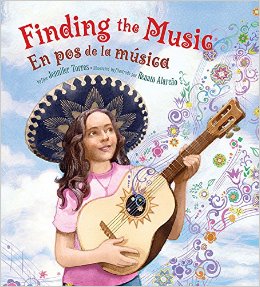
DESCRIPTION FROM THE BOOK JACKET: Above Reyna’s favorite booth in her family’s restaurant hangs the old vihuela, a small guitar-like instrument, that belonged to her abuelito when he was in a mariachi band. Reyna has never heard the vihuela played, but her mamá treasures the instrument as a reminder of abuelito and his music. One noisy day in the restaurant, Reyna accidentally damages the vihuela. Determined to get it repaired before Mamá notices, Reyna sets out to search her neighborhood for someone who can help her fix the instrument. Little does Reyna know that along the way she will find herself growing closer to abuelito and to the power of his music.

MY TWO CENTS: From the winner of the 2011 Lee & Low Books New Voices Award, here we have a bilingual story filled with charm that showcases the power of music as an intergenerational unifier.

Every weekend, Reyna hangs out at her mom’s restaurant, Cielito Lindo, reading and enjoying the cast of characters that visit the place. One day, she accidentally breaks her grandfather’s precious vihuela that hanged on one of the restaurant’s walls. Reyna never met her abuelito, but her mother’s tales about him and the way he played the vihuela are near and dear to her. Reyna knows she must embark on a journey to fix her abuelo’s beloved instrument.

This journey will bring her to learn, first hand, about his legacy and the importance of music and the power of community engagement. Throughout each page, and Reyna’s conversation with different community members, her abuelo’s presence can be felt. Jennifer Torres uses Reyna’s journey as a great portrayal of how meaningful everyday life is for a community. The vihuela becomes a powerful artifact that jump-starts the memory of the past, the important history of the community that tends to be invisible but is so essential to understanding the present. The broken vihuela reveals other anecdotes from the past that will help Reyna see the bigger picture of who her abuelo was and how the community remains united through their shared past. And it is through oral history and the passing of this knowledge that Reyna becomes aware of the real importance behind the vihuela and why it was hanging on the wall. The breaking of the vihuela is not a tragedy, but the catalyst for Reyna to better understand where she came from and get closer to her mother and her community.

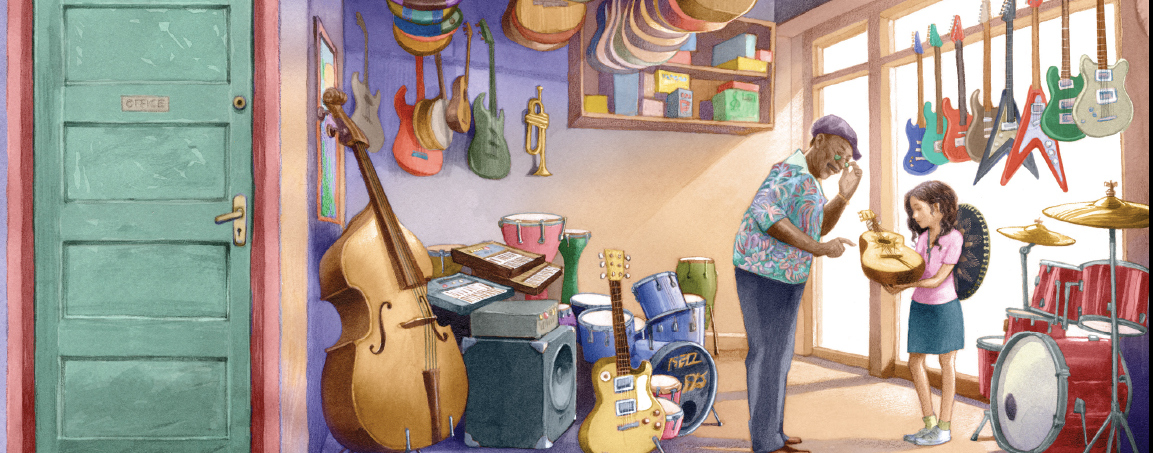
The realistic illustrations by Renato Alarcão, enhance the warmth of the tale and allow readers to see the characters’ expressions and feelings. Each image is filled with pastel colors and a consummated care to portray the connection and relations of the characters. The illustrations really echo a phrase said by Reyna’s mother at the beginning of the story, “these are the sounds of happy lives.” The illustrations truly convey the sounds of these lives.

Torres’s first picture book, Finding the Music/En Pos de la Música, is a solid work that is very much welcomed. The importance of oral history, the unifying qualities of music and the importance of preserving the artifacts that trigger the remembrance of who we were are all important concepts to help spark the curiosity of children among their own families and communities. We are in a constant search of adequate representation and we sometimes fail to see that in our own stories lie strong narratives that empower us and unite us.

*The book includes a glossary and pronunciation guide. The backstory of the Cielito Lindo and author’s note about mariachi music and band are also apprehended. Spanish translation by Alexis Romay.
musicstore
TEACHING TIPS: 
This bilingual picture book is recommended for children ages 4-9, and works well for early readers and as a read aloud with musical interventions as a bonus. Librarians, parents, grandparents, and caregivers can read with the young ones in English, Spanish, or both, while practicing or learning new vocabulary, identifying the different images and community components presented through the illustrations. It’s also a perfect book for a StoryWalk, given that our main character walks around her neighborhood finding some clues and stories about her abuelo. StoryWalk allows people to visit different points (parks, local stores, buildings) around the neighborhood where pages of the books are spread, they would walk to one point to another to follow the story.

Language Arts, Social Studies, Arts, and Music educators can collaborate in the development of different activities: vocabulary and writing activities, discussions and conversations regarding community, neighborhoods and Mexican, Chicano, and Latino history; the incorporation of drawings with writing activities; and the history of Mexican folk music. The author includes helpful activities for the Language Arts classroom: Story Map and Mini-Memoir. On the publisher’s website, you can access teaching guides developed for this book and other resources.

AUTHOR & ILLUSTRATOR:

Jennifer Torres is a freelance journalist, author, and coordinator of a community-wide literacy initiative at University of the Pacific, California. She studied journalism at Northwestern University, Illinois and at University of Westminster, London, England. Torres also worked as reporter for The Record newspaper, covering education, immigration, and other issues related to children and families. FINDING THE MUSIC/EN POS DE LA MÚSICA is her first picture book and her first middle grade novel, STEF SOTO, TACO QUEEN, will be published in Fall 2016.

Renato Alarcão is a graphic designer, illustrator and professor of visual arts. He studied in the Illustration as a Visual Essay program at the School of Visual Arts of New York and at The Center for Book Arts. In addition to his work as an illustrator, Alarcão has collaborated in different youth arts projects and has presented lectures on illustration, creativity, and artistic techniques. He has presented his work in exhibitions at the American Institute for the Graphic Arts, the American Society of Illustrators, the New York Public Library, the Skirball Cultural Center of Los Angeles, the Biennale of Illustrations in Bratislava, where he won the NOMA Prize for Illustrated Book. Some of his illustrated books: RED RIDIN’ IN THE HOOD: AND OTHER CUENTOS by Patricia Santos Marcantonio, SOCCER STAR by Mina Javaherbin, ROBERTO’S TRIP TO THE TOP by John B. Paterson & John Paterson, ELLA ENFEITIÇADA by Gail Carson Levine, Andiana Figueiredo.

FOR MORE INFORMATION ABOUT Finding the Music/En Pos de la Música visit your local library or bookstore. Also, check out WorldCat.orgIndieBound.orgGoodreadsAmazon, and Barnes & Noble.

Book Review: Max Loves Muñecas! by Zetta Elliott

Reviewed by Ashley Hope Pérez MaxLovesMunecasCOVER

PUBLISHER’S DESCRIPTION: Max wants to visit a beautiful boutique that sells handmade dolls, but he worries that other children will tease him. When he finally finds the courage to enter the store, Max meets Señor Pepe who has been making dolls since he was a boy in Honduras. Señor Pepe shares his story with Max and reminds him that, “There is no shame in making something beautiful with your hands. Sewing is a skill—just like hitting a baseball or fixing a car.” 

MY TWO CENTS: Max Loves Muñecas interweaves a number of topics: resisting the constraints of traditional gender roles, child homelessness, resourcefulness and resilience, and the value of cooperation and generosity. In the hands of a lesser writer, these many focal points might overpower a slim chapter book of 72 pages, but Zetta Elliott creates a richly textured narrative world and situations that give readers opportunities to pause, consider their own lives, and reflect on the power of individual choices.

The first and last chapters of the book focus on Max, a young American boy intrigued by the intricacy and beauty of the dolls in a neighborhood shop run by Señor Pepe. Despite his interest, Max fears teasing by his classmates; in fact, the book’s title comes from the teasing he endures. By the end of this book, however, Zetta Elliott turns “Max loves muñecas!” from a taunt into an affirmation as Señor Pepe invites Max to work as his apprentice. Although “Max loves muñecas!” powerfully captures a key shift in the book, it is somewhat misleading as a title because Max’s story serves primarily as a frame for Señor Pepe’s telling of his own experiences as a young boy in Honduras, which are the focus of the eight central chapters of the book.

MaxLovesMunecasImage1We first learn of Pepe’s life as a poor but happy boy living with a loving grandmother who earns money by cleaning a wealthy family’s home and selling rag dolls to tourists. When Pepe’s grandmother passes away, neighbors make arrangements and send a telegram, but no one comes to get him. After three days, the landlord sends him away. With nothing but a blanket, his grandmother’s sewing basket, and a handful of coins, Pepe strikes out on his own.

He briefly joins a band of street boys living under an overpass where each has a special skill he contributes to the group, but he remembers his grandmother’s admonitions: “You are not a street boy. You do not drift from place to place like a weed in the sea” (15). After a night on the streets, Pepe stops to help an elderly woman struggling to open the shutters to her doll shop. So begins his relationship with Señora Beatriz, who cautiously invites him into her shop, intrigued by his delight at the beauty of her dolls and impressed with his good manners and facility with simple sewing tasks. Pepe finds a place in her heart—and her home—and continues to develop his love for making beautiful things.

But of course there are bumps along the way, a number of which center on the difficulty of balaMaxLovesMunecasImage2ncing good intentions and generosity to others with responsibility and a concern for appearances. When Señora Beatriz sends Pepe out for lunch on their first day together, Melky, one of the street boys, recognizes him and runs over to join him. Pepe becomes preoccupied with Melky’s disheveled appearance, worrying that the señora might think he is a street boy, too, if she sees him with Melky. Pepe understands the boy’s hungry glances at the lunch bag, but his fear over damaging his opportunity with Señora Beatriz is what drives him to share his food: “If I give you some of my lunch, you have to promise to go away. You can’t let the señora see you—ever!” (33).
Later, when the señora goes out of town for the night, Pepe’s desire to surprise her leads him to attempt to finish a wedding dress using her cantankerous sewing machine. When it jams, his efforts to fix it result in a broken piece. Fearing a return to the streets if the señora discovers his disobedience and damage of the machine, he searches out Primo, the leader of the street boys, who is also an expert tinkerer. Primo can’t repair the broken piece without seeing the whole machine, and a new round of dilemmas opens up for Pepe as Melky and Primo follow him back to the señora’s house. He knows the señora would not want strangers in her house and worries that the street boys might get up to mischief, but he can’t see any way out of his problem without help. Far from wanting to steal from the señora, Primo and Melky fall in lMaxLovesMunecasImage3ove with the beautiful fabrics and deck themselves out in tiaras and veils. Primo succeeds at fixing the sewing machine, but the boys are so tired from their efforts they fall asleep at the kitchen table.


Once Señora Beatriz’s initial displeasure wears off, she is impressed by Primo’s technical abilities, charmed by young Melky, and pleased with the initiative and cooperation of all three boys. Ultimately, although only little Melky goes to school, all three boys gain the chance for a better life through their work for Señora Beatriz.

TEACHING TIPS: Max Loves Muñecas! is a good choice for upper elementary readers to explore on their own, and it would make an excellent read-aloud text (one chapter per session) for students across the elementary grades. The story highlights the boys’ spontaneous interest in dolls and fine fabrics, and it shows how following one’s passions can open doors. Max Loves Muñecas! also creates openings for students to discuss differences regarding schooling and child poverty in different communities and at different times. Finally, the book offers a number of scenarios where the “right” choice is relatively ambiguous, and these scenarios are ripe for exploration in conversation, journaling, drawing, or reenactment.

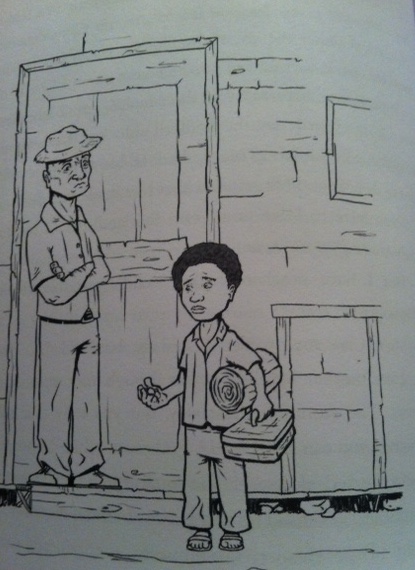
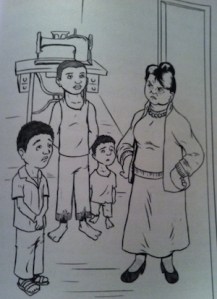
Although the handful of simple illustrations scattered through the book help provide a visual reference point for Pepe and Max’s adventures, there is still plenty of room for imagining and recreating scenes from the story. Students may especially benefit from guided exercises to help them imagine perspectives and experiences different from their own. Start with questions like, “What do you think Melky feels when Pepe makes him promise to never come to the señora’s shop?” or “Why is the señora disappointed when she first returns from her trip?” but take time exploring the other perspectives involved in a given moment in the narrative. When supported, even young children can stretch their capacity for empathy and perspective-taking beyond identifying with the protagonist.

MaxLovesMunecas_Zetta Zetta Elliott is the award-winning author of stories for children, YA novels, and poetry, plays, and essays for adults. Born and raised in Canada, she has lived in the US for 20 years and earned a PhD in American Studies from NYU in 2003. Her picture book, Bird, won the Honor Award in Lee & Low Books’ New Voices Contest and the Paterson Prize for Books for Young Readers. Her latest YA novel, The Deep, was published in November 2013. She is an advocate for greater diversity and equity in publishing, and to this end she has published several illustrated books for younger readers—including Max Loves Muñecas—under her own imprint, Rosetta Press. She currently lives in Brooklyn. Visit her online at www.zettaelliott.com

MaxLovesMunecas_MauricioPhotoMauricio J. Flores was born in 1988 in Tegucigalpa, Honduras, where he currently resides. Trained as an architect, he has worked extensively as a freelance illustrator and web designer. When he’s not drawing, he enjoys listening to a vast spectrum of music genres, studying languages, and reading epic fantasy novels and comics. Visit him at http://mjflores.visioncomicshn.com/.

Book Review: Pickle: The (Formerly) Anonymous Prank Club of Fountain Point Middle School by Kim Baker


13170031By Kimberly Mach

DESCRIPTION FROM THE BACK OF THE BOOK:

Dear Parents and Teachers:

This is a work of fiction. There is no Prank and Trick Association at Fountain Point Middle School. And you absolutely will not find instructions on how to log in to a top-secret prank instruction website anywhere on these pages. All we do is make pickles. OK?

Sincerely,

Ben Diaz

President, The League of Pickle Makers

MY TWO CENTS: Now, if the description above won’t get a child to pick up a book, I’m not sure what will.

Kim Baker had me laughing from the first page. The book opens with this line: Can I trust you? She had me hooked right there, with all that the question implies.

There are so many ways to talk about Pickle because it really is a perfect middle-grade novel. Kids will laugh out loud, and they may even go scrambling to create their own prank clubs. Beyond the laughter, they will identify with the ever-changing landscape of middle school friendships. Ben Diaz, the main character, creates a Prank Club, under the guise of a Pickle Makers Club. Due to an earlier incident, Ben does not invite his best friend Oliver into the club. (Oliver’s grandmother is the school principal and Oliver, well, Ben thinks Oliver just can’t be trusted to keep the secret.) Reading it, I found myself wondering what the halls of my school would look like if there were bubbles in the fountains or impromptu parties in the classrooms. Throughout the mayhem, lessons are woven in. Ben learns about himself, his new friends, and just how ‘off’ we can be when we try to label each other, but most of all he learns what kind of friendship he and Oliver really have. Spoiler alert: It’s made of the strong stuff. There are lessons here in action and reaction, consequences and the impact of our decisions, and they are all told masterfully through the eyes and comedy of young Ben Diaz.

As an adult reader, what resonated with me was the very real problem of what isn’t in our history books. For Pioneer Day, Ben and his friends have to present something pickled for the Pioneer Fair. If they don’t, they will lose their funding from the PTA and that will be the end of the Pickle Club and the secret Prank Club.

What to do? Ben turns to his family. They frequently serve escabeche, or pickled vegetables, at their Mexican restaurant. Ben sees that escabeche can be their entry for the fair. Then Ben hesitates. He asks the kind of question that many of our children who do not see themselves reflected on the pages of history books wonder about: Were there Mexican pioneers?

Ben goes on to say: “I’ve never seen any in the pictures. It’s always just a bunch of white guys.” And then later, the realization that, “It doesn’t mean they weren’t there.” Ben begins searching.

The time period for our children is different from that of my youth. In my youth, we may have asked the question, but because of available resources, we probably could not have answered it, at least not in a timely fashion. The internet has allowed people and organizations to post information and share resources in a much more efficient manner. When Ben wonders about pioneers from Mexico, he does not have to go far to find that reliable source. Instead of spending an afternoon at the town hall archives, he can answer it with the click of a button. As an adult, I could not escape the implications of Ben’s memory when he recalls being criticized in kindergarten for using the brown paper to make his Pilgrims for Thanksgiving. There are so many who were skimmed over in the history books, but the information is there if we ask the questions. Step one is teaching our children to ask. Where are the women in this picture? Who worked in the factories? Why does this city have a Spanish name? What happened when native peoples went to reservations? Ben chooses to share an authentic pickling recipe from Mexico. It may not be the pickle recipe people were expecting at the fair, but it is delicious and the scene, of course, is memorable. Trust me, you’ll be cheering for him when he has a conversation with Principal Lebonsky about traditional recipes.

TEACHING TIPS: This book would be an excellent read-aloud in the classroom, appropriate for grades 3-6. It can be enjoyed for the humor and story, or a teacher can choose to take the lessons further.

Language Arts: Life-size character sketches are one extension idea. Brief descriptions of each character are on the front jacket of the book. Many children will see themselves reflected in the personalities and the ethnicities of Ben and his friends. Traits can be filled in as readers follow the story, with life-size versions being presented at the end.

Social Studies: Many upper elementary and early middle school grades study pioneer days as part of their curriculum. Reading Pickle may encourage students to ask the important questions and to look more deeply at the pictures of people in their own state and communities.

The escabeche could be the beginning to a small unit on preserving food both in the past and now. Compare and contrast, how did Native Americans preserve food? When were other methods introduced?  What are traditional foods of the region? How are they preserved today?  The possibilities are endless here.

Enjoy the book. Readers of all ages will love it. When you are done, visit Kim Baker’s website at http://kimbakerbooks.com/ and enjoy her voice and humor there.

Pickle is Kim Baker’s debut novel and has already received five awards including the Louisiana Young Reader’s Choice 2015 nominee, 2014-2015 Texas Blue Bonnet Award Nominee, and the 2013 SCBWI West Crystal Kite award.

FOR MORE INFORMATION ABOUT Pickle visit your local library or bookstore. Also, check out WorldCat.orgIndieBound.orgGoodreadsAmazon, and Barnes & Noble.


Kimberly Mach has been teaching for sixteen years and holds two teaching certificates in elementary and secondary education. Her teaching experience ranges from grades five to twelve, but she currently teaches Language Arts to middle school students. It is a job she loves. The opportunity to share good books with students is one that every teacher should have. She feels privileged to be able to share them on a daily basis.
Book Review: Unusual Chickens for the Exceptional Poultry Farmer by Kelly Jones

22639675By Cindy L. Rodriguez

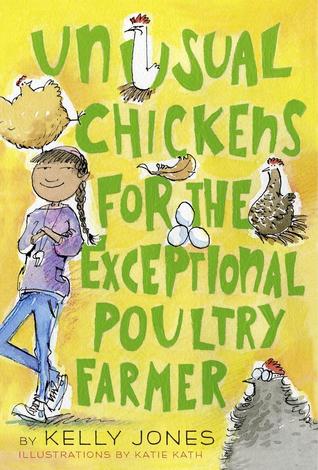
DESCRIPTION OF THE BOOK: Twelve-year-old Sophie Brown feels like a fish out of water when she and her parents move from Los Angeles to the farm they’ve inherited from a great-uncle. But farm life gets more interesting when a cranky chicken appears and Sophie discovers the hen can move objects with the power of her little chicken brain: jam jars, the latch to her henhouse, the entire henhouse….

And then more of her great-uncle’s unusual chickens come home to roost. Determined, resourceful Sophie learns to care for her flock, earning money for chicken feed, collecting eggs. But when a respected local farmer tries to steal them, Sophie must find a way to keep them (and their superpowers) safe.

Unusual Chickens for the Exceptional Poultry Farmer releases May 12 with Knopf Books for Young Readers.

MY TWO CENTS: It’s easy to love Sophie, the half-Latina main character in this middle grade novel that upgrades the “new girl in town” idea by adding cool, magical chickens and letters from the beyond. Sophie and her parents move from Los Angeles to a farm, left to them by her late Great-Uncle Jim. The farm, though, is “more like a big, boring garden. Dead-looking grapevines and blackbirds and junk piles and bugs, that’s it.” Sophie’s family is trying to start over after her dad lost his job.

In the novel, author Kelly Jones addresses issues such as unemployment, racism, and classism, but never in a heavy-handed way. Through her letters to her abuela, Uncle Jim, and Agnes from Redwood Farm Supply, Sophie talks about her family’s financial problems and the small town’s lack of diversity. “There aren’t any people around here–especially no brown people.” In another chapter, Sophie writes, “even though Mom was born here and speaks perfect English, she says you have to be twice as honest and neighborly when everyone assumes you’re an undocumented immigrant.” These moments, though, are not preachy. Instead, they are presented as things Sophie observes or wonders about as she navigates her bicultural reality and being the new girl–a city girl transplanted to a weed-choked farm with magical chickens.

And, for the record, the chickens are awesome. My favorite is the angry, telekinetic chicken. He’s so cute somehow even though he’s got the “if looks could kill” face all the time. Being responsible for the chickens helps Sophie to settle in and connect with her new surroundings. Caring for the chickens, and working hard to keep them safe from a thief, allows Sophie to develop her confidence.

What I really love about Sophie is that she’s a strong girl, but she’s also a quiet girl who isn’t afraid to admit when she’s sad or lonely. Being strong doesn’t always mean wielding weapons; sometimes it means going after a chicken thief or speaking in front of a crowd, even though it scares you. I think lots of middle grade readers will love this novel, which also has great illustrations, information about chickens throughout, and even a recipe for migas!

TEACHING TIPS: Language arts teachers could easily include this novel in a thematic literature circles unit with other stories about moving to new places, whether it’s to a new town or a new country.

Since Sophie writes letters throughout the novel, students could write and send personal letters to friends or family and formal business letters to local companies. In this electronic age, writing, sending, and receiving letters could be a fun activity for this generation of students, who may have seldom done this, if at all.

Asking a local farmer to visit the classroom, or taking students on a field trip, would be a wonderful experiential activity, especially for city students (like Sophie) who may have never visited a farm.

A classroom fiesta, complete with lots of eggs-based dishes and migas, using the recipe in the book, would be a wonderful and tasty way to end a unit.

Kelly JonesABOUT THE AUTHOR: Kelly Jones is a curious person, interested in chickens, magic, farm life, spies, sewing, the odd everyday bits of history, how to make sauerkraut, how to walk goats, superheroes and what makes them so super, recipes to make with a lot of eggs, anything with ghosts (particularly friendly ghosts), how to draw chickens that actually look like chickens, and any story she’s never heard before.

She’s also a writer: Her debut novel Unusual Chickens for the Exceptional Poultry Farmer, about twelve-year-old Sophie and her magical chickens, is forthcoming from Knopf Books For Young Readers in May of 2015.

Her second book, Glamour, is set in 1818, England, about sixteen-year-old Annis, who would like to become a spy like her father and who does not see why the War Office should put up such a fuss (with bonus magical dressmaking!) is forthcoming from Knopf Books for Young Readers in Spring of 2017.

FOR MORE INFORMATION ABOUT Unusual Chickens for the Exceptional Poultry Farmer visit your local library or bookstore. Also, check out WorldCat.orgIndieBound.orgGoodreadsAmazon, and Barnes & Noble.

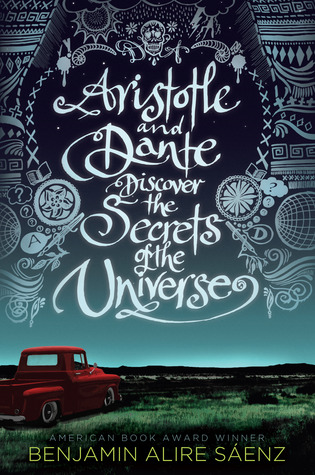
Book Review: Aristotle and Dante Discover the Secrets of the Universe by Benjamin Alire Sáenz

12000020By Eileen Fontenot

DESCRIPTION FROM THE PUBLISHER: Aristotle is an angry teen with a brother in prison. Dante is a know-it-all who has an unusual way of looking at the world. When the two meet at the swimming pool, they seem to have nothing in common. But as the loners start spending time together, they discover that they share a special friendship—the kind that changes lives and lasts a lifetime. And it is through this friendship that Ari and Dante will learn the most important truths about themselves and the kind of people they want to be.

MY TWO CENTS: This book is a four-time award winner–and well deserved! What a moving book. Even days after I finished it, I would still think of Ari and Dante and their friendship, which grows into deeper feelings–how much they influenced each other’s lives over the course of a year, with events tenderly captured by Sáenz. The romantic type of love is not the only one Sáenz touches upon; familial love is also an important topic in the book. Both Dante’s and Ari’s relationships with their families are as complicated as their relationship with each other.

The story is set in 1987 and told from the point of view of Ari–despite this, the reader gains a full picture of Dante. We learn of Dante’s sweet quirks (like his distaste of wearing shoes) and his passion for literature and art. When Dante and Ari meet, Ari is cut off from others. His parents won’t talk about the details of his older brother’s incarceration, and his father is still fighting his demons stemming from his time fighting in Vietnam. He has no real friends. Dante’s openness and delight in the simple pleasures in life helps Ari break out of his self-enforced wall, ostensibly to hide his confusing emotions.

Sáenz packs in so much emotion in such simple and spare dialogue that conveys so much. There are no superfluous words; Sáenz’s writing is lean and packs a powerful emotional punch.

TEACHING TIPS: I would recommend this book to anyone – whether teenager or adult – who ever felt different. And that it’s OK to be that way. This is a universal tale. But besides being just a beautiful love story, the book’s themes include dealing with the feelings that come with an incarcerated sibling, a parent with emotional scars from war, and the challenges that come with being gay, male, and Mexican American. This book is for anyone who feels as if there’s not enough compassion in the world.

If librarians and teachers want to try a writing exercise inspired by this book, I would ask teens who have read the book if they can attempt to reproduce Sáenz’s succinct writing style. You can tell them it’s kind of like writing dialogue on Twitter or that it’s very close to poetry. Ask them to communicate as much as they can with as few words as possible.

AUTHOR (DESCRIPTION FROM INDIEBOUND): Benjamin Alire Sáenz is an American Book Award–winning author of poetry and prose for adults and teens. Aristotle and Dante Discover the Secrets of the Universe was a Printz Honor Book, the Stonewall Award winner, the Pura Belpré Award winner, and won the Lambda Literary Award for Children’s/Young Adult Fiction. Everything Begins and Ends at the Kentucky Club won the PEN/Faulkner Award for Fiction. His first novel for teens, Sammy and Juliana in Hollywood, was an ALA Top Ten Book for Young Adults and a finalist for the Los Angeles Times Book Prize. His second book for teens, He Forgot to Say Goodbye, won the Tomás Rivera Mexican American Children’s Book Award, the Southwest Book Award, and was named a New York Public Library Book for the Teen Age. He teaches creative writing at the University of Texas, El Paso.

FOR MORE INFORMATION ABOUT Aristotle and Dante Discover the Secrets of the Universe visit your local library or bookstore. Also, check out WorldCat.orgIndieBound.orgGoodreadsAmazon, and Barnes & Noble.


Eileenfontenot headshot Fontenot is a recent graduate of Simmons College Graduate School of Library and Information Science in Boston. She works at a public library and is interested in community service and working toward social justice. A sci-fi/fantasy fan, Eileen was formerly a newspaper writer and editor.

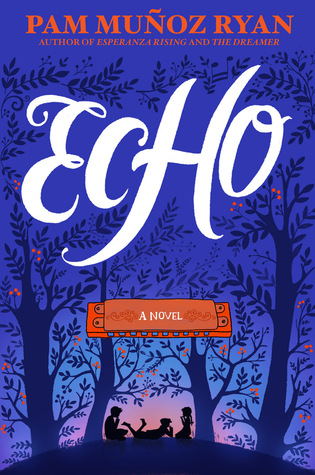
Book Review: Echo by Pam Muñoz Ryan


22749539By Cecilia Cackley

DESCRIPTION (from Goodreads): Music, magic, and a real-life miracle meld in this genre-defying masterpiece from storytelling maestro Pam Muñoz Ryan.

Lost and alone in a forbidden forest, Otto meets three mysterious sisters and suddenly finds himself entwined in a puzzling quest involving a prophecy, a promise, and a harmonica.

Decades later, Friedrich in Germany, Mike in Pennsylvania, and Ivy in California each, in turn, become interwoven when the very same harmonica lands in their lives. All the children face daunting challenges: rescuing a father, protecting a brother, holding a family together. And ultimately, pulled by the invisible thread of destiny, their suspenseful solo stories converge in an orchestral crescendo.

Richly imagined and masterfully crafted, Echo pushes the boundaries of genre and form, and shows us what is possible in how we tell stories. The result is an impassioned, uplifting, and virtuosic tour de force that will resound in your heart long after the last note has been struck.

MY TWO CENTS: Muñoz Ryan hits a sweet spot of historical fiction combined with a tiny bit of fantasy and a whole lot of heart in this new title. While the three separate narratives might seem overwhelming at first, they are never long-winded and large text and good formatting make things easy on the eyes. Muñoz Ryan introduces the reader to less familiar aspects of well-known historical events: laws regarding children with birth ‘defects’ in 1930’s Germany, conditions for orphans during the Depression in the US, and the segregation of schools in California for children of Mexican descent during World War II. All three main characters are easy to root for and their strength and determination makes happy coincidences and the final destination feel earned rather than magical. That harmonica though…what can I say? The power of music is mighty, a point Muñoz Ryan makes very clear. This is a great choice for middle grade readers, especially fans of historical fiction or stories involving music.

TEACHING TIPS: The historical settings make this a great title to connect to social studies units. It would also be a wonderful classroom read aloud. Teachers could assign groups to compile additional background research on the historical events mentioned in the text or on the harmonica and other musical instruments. Audio recordings would also be a great addition to the experience of the story.

ABOUT THE AUTHOR: Pam Muñoz Ryan has written over thirty books for young people, from picture books for the very young to young adult novels, including the award winning Esperanza Rising, Becoming Naomi Leon, Riding Freedom, Paint the Wind, and The Dreamer. She is the National Education Association’s Author recipient of the Civil and Human Rights Award, the Virginia Hamilton award for Multicultural Literature, and is twice the recipient of the Willa Cather Literary Award for writing. She was born and raised in Bakersfield, California (formerly Pam Bell), received her bachelor’s and master’s degrees at San Diego State University and now lives in North San Diego County with her family.

LINKS/OTHER INFO:

SLJ interview

Publisher’s Weekly interview

FOR MORE INFORMATION about Echo, visit your local library or bookstore. Also check out WorldCat.orgIndieBound.orgGoodreadsAmazon, and Barnes & Noble.


Cackley_headshotCecilia Cackley is a performing artist and children’s bookseller based in Washington DC where she creates puppet theater for adults and teaches playwriting and creative drama to children. Her bilingual children’s plays have been produced by GALA Hispanic Theatre and her interests in bilingual education, literacy, and immigrant advocacy all tend to find their way into her theatrical work. You can find more of her work at www.witsendpuppets.com.