
The Pura Belpré Awards turns 20 this year! The milestone will be marked on Sunday, June 26, from 1:00-3:00 p.m. during the 2016 ALA Annual Conference in Orlando, FL. According to the award’s site, the celebration will feature speeches by the 2016 Pura Belpré award-winning authors and illustrators, book signings, light snacks, and entertainment. The event will also feature a silent auction of original artwork by Belpré award-winning illustrators, sales of the new commemorative book The Pura Belpré Award: Twenty Years of Outstanding Latino Children’s Literature, and a presentation by keynote speaker Carmen Agra Deedy.
Leading up to the event, we will be highlighting the winners of the narrative and illustration awards. Today’s spotlight is on Victor Martinez’s Parrot in the Oven: Mi Vida, winner in the narrative category in 1998.
Review by Cecilia Cackley
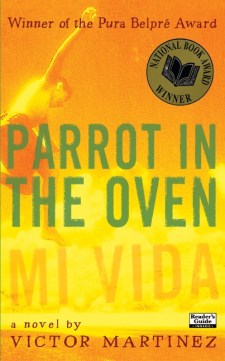 DESCRIPTION (from GoodReads): Dad believed people were like money. You could be a thousand-dollar person or a hundred-dollar person – even a ten-, five-, or one-dollar person. Below that, everybody was just nickels and dimes. To my dad, we were pennies.
Fourteen-year old Manny Hernandez wants to be more than just a penny. He wants to be a vato firme, the kind of guy people respect. But that’s not easy when your father is abusive, your brother can’t hold a job, and your mother scrubs the house as if she can wash her troubles away.
In Manny’s neighborhood, the way to get respect is to be in a gang. But Manny’s not sure that joining a gang is the solution. Because, after all, it’s his life – and he wants to be the one to decide what happens to it.
MY TWO CENTS: The subtitle of this book translates as ‘my life’ and that’s exactly what it is. Narrator Manny Hernandez tells the reader the details of his life without leaving out any of the tough, ugly parts—and it’s the truth in everything that gives the book its poetry. Manny is an honest character, confessing his struggles and fears to us and not apologizing for anything. Manny guides the reader through his family, neighborhood, and school, detailing everyone’s struggles, disappointments and moments of peace. This is not a book where there are always clear sides of good and evil, or winners and losers. Manny joins a gang and goes through a violent initiation, but almost immediately afterward, when he sees a fellow gang member rob someone, he realizes that he is not a person who hurts others like that and returns home to his family. Like most teenagers, Manny is just trying to survive and figure out his life and the truth of that is what makes his story so compelling.
Parrot in the Oven was published in 1996 (It won the Pura Belpré Medal in 1998 and the National Book Award in 1996). Although several of the Newbery honor titles that year touched on difficult subjects such as abuse, drugs and historical violence, it would be four more years before the Michael L. Printz award was established to specifically honor literature for teens. Since then, YA literature has received a lot more recognition and the debate about what is appropriate for teens to read and what we should be honoring with awards has become much more heated. Victor Martinez knew what was important: for teens to have books that told them the truth and let them know that whatever they were struggling with in their lives, they would figure it out and they were not alone. Parrot in the Oven is one of those books and we are lucky to be able to share it with readers today.
TEACHING TIPS: Parrot in the Oven provides lots of opportunity for discussion, making it an ideal book to read as a class. Because the book is organized into chapters that each tell about a different place, person, or experience, it serves as a good example text for students doing writing projects. Just as Manny writes about his grandmother’s garden, a boxing match, his sister’s miscarriage, you can encourage students to pick a place or experience of their own and try to describe it in detail, the way Manny does his own life.
Relationships are also central to Manny. Students could work in small groups to discuss Manny’s relationship with his different family members, teachers, and people in the neighborhood, and search the text to find evidence for how he feels about these people and interacts with them.
The ending of Parrot in the Oven is satisfying but not entirely definitive. Manny has seemingly made a choice about his future, but we don’t see any results of that choice. This provides an opportunity for students to imagine what Manny might be doing in a year or three years, and write a short piece showing how his choices have changed or not changed his life.
*****
 Victor Martinez was born and raised in Fresno, California, the fourth in a family of twelve children. He attended California State University at Fresno and Stanford University, and has worked as a field laborer, welder, truck driver, firefighter, teacher, and office clerk. His poems, short stories, and essays have appeared in journals and anthologies. Mr. Martinez was awarded the 1996 National Book Award for Young People’s Literature for Parrot in the Oven, his first novel. Mr. Martinez lived in San Francisco, California, where he helped to found the poetry collective Humanizarte. He passed away in 2011.
ADDITIONAL RESOURCES:
Click here for a review from Teaching Latin America Through Literature.
Here’s a printable lesson plan from HarperCollins.
For book guides and lesson plans from Teaching Books, click here.
 Cecilia Cackley is a performing artist and children’s bookseller based in Washington DC where she creates puppet theater for adults and teaches playwriting and creative drama to children. Her bilingual children’s plays have been produced by GALA Hispanic Theatre and her interests in bilingual education, literacy, and immigrant advocacy all tend to find their way into her theatrical work. You can find more of her work at www.witsendpuppets.com.
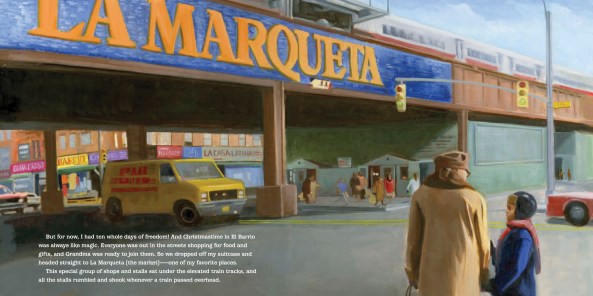
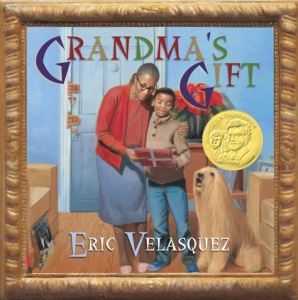 DESCRIPTION FROM THE BOOK JACKET: Every year, Eric spends his winter break with his grandmother in El Barrio while his parents are at work. There’s much to do to prepare for Christmas, including buying all the ingredients for Grandma’s famous pasteles, a special Puerto Rican holiday dish.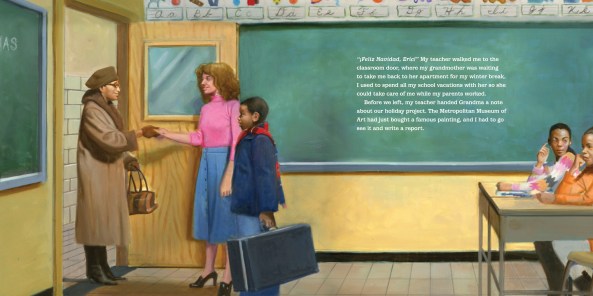
 ABOUT THE AUTHOR-ILLUSTRATOR: Eric Velasquez is an Afro-Puerto Rican illustrator born in Spanish Harlem. He attended the High School of Art and Design, the School of Visual Arts, and the famous Art Students League in New York City. As a children’s book illustrator, Velasquez has collaborated with many writers, receiving a nomination for the 1999 NAACP Image Award in Children’s Literature and the 1999 Coretta Scott King/John Steptoe Award for New Talent for The Piano Man. For more information, and to view a gallery of his beautiful book covers, visit
  Lila Quintero Weaver
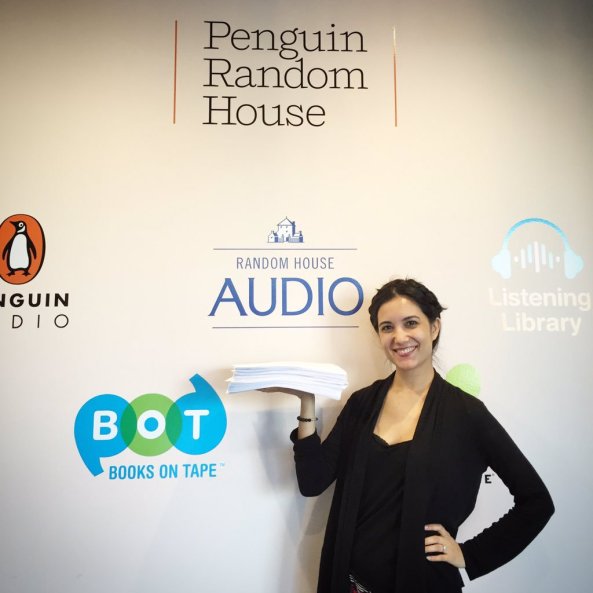
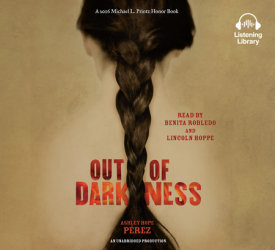 I have been listening to audiobooks for nearly three decades, so it was something of a dream come true to see Out of Darkness go into production shortly after it received a Printz Honor. Before production began, though, I found myself wondering if my strong opinions about narration, pronunciation, and the like would get in the way—or set me up for disappointment. What if the narrator’s voice didn’t match the texture or tone I’d imagined in writing?

 DESCRIPTION FROM THE PUBLISHER: Sixth graders Dominic, Loop, and Z stumble upon a new magic shop in town and can’t wait to spend their summer mastering cool tricks to gain access to the Vault, a key holders-only back room bound to hold all kinds of secrets. And once they get in, they set their sights even higher: a huge competition at the end of the summer. They work on their card tricks, sleights, and vanishing acts, trying to come up with the most awesome routines possible….Problem is, the trip is expensive, and it’s money that each guy’s family just doesn’t have.
 Marianne Snow Campbell


 Reviewed by Marianne Snow Campbell
 ABOUT THE AUTHOR: Angela was born and raised in Kansas. Most of her childhood was spent in Topeka, Kansas living in the Mexican-American community of Oakland. Her family also spent a lot of time in El Dorado and Wichita visiting a slew of aunts, uncles and cousins on weekends.
 Latinxs in Kid Lit