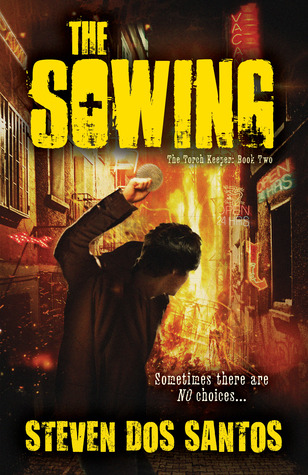
Book Review: The Sowing: The Torch Keeper Series, Book Two by Steven Dos Santos

17342414By Eileen Fontenot

DESCRIPTION FROM THE BOOK JACKET: “This time, there are no choices. Lucian “Lucky” Spark leads a double life. By day, he trains to become one of the Establishment elite. At night, he sabotages his oppressors from within, seeking to avenge the murder of his love, Digory Tycho, and rescue his imprisoned brother. But when he embarks on a risky plot to assassinate members of the Establishment hierarchy, Lucky is thrust into the war between the Establishment and the rebellion, where the lines between friend and foe are blurred beyond recognition. His only chance for survival lies in facing the secrets of the Sowing, a mystery rooted in the ashes of the apocalyptic past that threatens to destroy Lucky’s last hope for the future.”

MY TWO CENTS: Wow. When I say, the action doesn’t stop, well, it just doesn’t stop. The reader is taken immediately to a dramatic fight a couple of months after newly minted Imposer Lucky finishes the trials, portrayed in the first book, The Culling. The series is set in a post-apocalyptic future in which the totalitarian Establishment, led by Cassius Thorn, really enjoys keeping Parish citizens downtrodden.

We continue to view the world through Lucky’s eyes – including struggle to protect his little brother, Cole, and the injustices he must now pretend to participate in, while actively working toward positive change. We can see that Lucky has grown and matured, but is weighed by his constant terror of losing Cole. As he is forced to return to the Trials, this time as an Incentive, he experiences old horrors in new ways – and we learn more about the mysteries of the first book as well. There are a couple shocking twists, that I won’t mention here, but suffice it to say, this is one entertaining read. And readers can see that a bigger story line is building – bound to shake up Lucky’s already precarious situation.

The amazing thing about this series, besides the edge-of-your-seat suspense that gives the reader inventively gory payoffs, is that the sexuality of the LGBTQ characters are treated totally matter of factly. In this horrific version of our future, at least society recognizes that love is love. I think LGBTQ teens who love dystopian thrillers like The Hunger Games will enjoy a similar story that focuses on sympathetic characters that just happen to be gay. Dos Santos doesn’t make a big deal out of his characters’ sexuality. Normalizing this aspect of society is a long time coming; I think today’s teens deserve to envision a future without a closet and this series supports that idea. Although it would be nice if the other parts of the future didn’t go down the drain!

This series would be great as a pick for a LGBTQ teen book group, whether for high school or in a public library. It’s an excellent counterpoint for LGBTQ books that are serious or that focuses on sexuality as the actual story. Teens will also understand Lucky’s growth and his love of family. But, most of all, it’s just a fun read.

AUTHOR: Steven dos Santos was born in New York City and raised in south Florida. He began writing at 7, but didn’t become a professional writer until after graduating with a communications degree and then spending time working in the field of law. The two books of The Torch Keeper series are his first professionally published works, and The Culling has been added to the 2014 ALA GLBTQ’s Rainbow Project Reading List. He’s currently at work writing the final book in The Torch Keeper series.

FOR MORE INFORMATION ABOUT Dos Santos and The Sowing, visit your local library or bookstore. Online he can be found at stevendossantos.com, worldcat.org, goodreads.com, indiebound.org, barnesandnoble.com and amazon.com.

fontenot headshotEileen Fontenot is a recent graduate of Simmons College Graduate School of Library and Information Science in Boston. She works at a public library and is interested in community service and working toward social justice. A sci-fi/fantasy fan, Eileen was formerly a newspaper writer and editor.
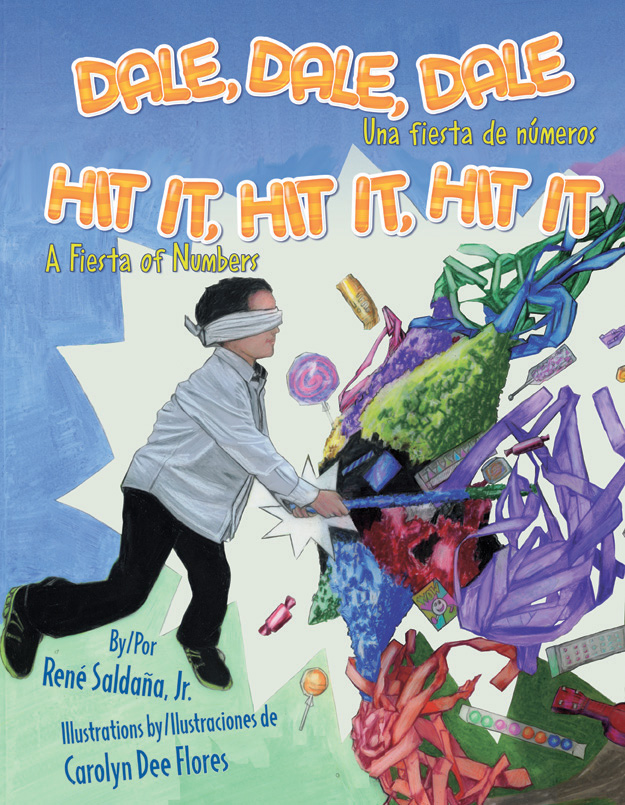
Book Review: Dale, Dale, Dale: Una fiesta de números/Hit it, Hit it, Hit it: A fiesta of numbers by René Saldaña, Jr.

By Sujei Lugo

DaleDaleDaleCoverDESCRIPTION FROM THE BOOK (provided by publisher): In this bilingual counting picture book, a young boy counts to twelve in anticipation of his birthday party: one piñata filled with candy; two hours until the party; three tables set for all the guests, etc.

MY TWO CENTS: Using simple text interwoven with a birthday party theme, René Saldaña, Jr. creates a fun bilingual counting book that makes us want to join the party. Carolyn Dee Flores’s illustrations are filled with photorealism and vibrant colors, supporting Saldaña’s words, and they successfully capture the excitement of children’s birthday parties. In what is definitely a welcomed surprise, Dale, Dale, Dale/ Hit it, Hit it, Hit it not only illustrates an adequate counting story, but decides to tell a good tale about sharing and enjoying a special day with your loved ones.

Our young protagonist is Mateo, a boy who anxiously awaits his birthday party and who uses this opportunity to practice counting throughout his special day. From “one piñata filled with candy” to “twelve children ready to swing at the piñata,” readers can count along with Mateo in Spanish and English. The items that the boy chooses to count include party supplies, colorful toys, lucha libre masks, musical instruments, and his own cousins. The picture book doesn’t limit readers to count only Mateo’s choices, but places other elements that can be counted throughout each page.

This bilingual book provides simple sentences in Spanish and English, which early readers, whether in one language or both, can easily follow. Although the translation of some words is problematic for language learners, for example, niños/guests, it isn’t a limitation to learn and practice words in two different languages.

As a picture book, the photorealistic illustrations can be seen by some as a weakness at the moment to capture children’s attention. But Flores plays well with vibrant colors to encourage young readers to focus on the story and stimulate them, not only to count, but also to identify different colors displayed on every page. The educational content of the book will inspire children to count everything around them and will motivate them to be even more excited to have their own birthday party.

TEACHING TIPS: As early readers or as a read aloud, this bilingual picture book works well for children ages 4-6. Parents, caregivers, and librarians can read in Spanish, English, or both, while encouraging young ones to practice their counting skills and color identification. Children can also point out what they like about birthday parties and collaborate to plan their next one. A song is included in the story, which can be useful if you include a piñata in your party.

Teachers can plan learning activities to combine math and language arts. Students can learn new vocabulary words, numbers, colors, and Spanish-English language meaning. Activities that develop memory and concentration can be done with second graders, including sequence of events and pairing numbers with items mentioned in the book.

AUTHOR & ILLUSTRATOR: René Saldaña, Jr. is a Latino young adult and children’s books writer and Language and Literacy professor at Texas Tech University. He holds a B.A. from Bob Jones University, a M.A. from Clemson University, and a Ph.D. in English and Creative Writing from Georgia State University.

He is the author of several books, including his semi-autobiographical novel The Jumping Tree (2001), Finding Our Way: Stories (2003), the Junior Library Guild selection The Whole Sky Full of Stars (2007),  A Good Long Way (2010), the collection of short stories Dancing with the Devil and Other Tales from Beyond/Bailando con el Diablo y otros cuentos del más allá (2012), and the bilingual Mickey Rangel mystery series.

Carolyn Dee Flores, a former computer analyst, is a writer, illustrator, musician, and composer. She attended the International School of Bangkok, Thailand and Naha, Okinawa, Japan, and Trinity University, where she studied Engineering, Philosophy and Art. Flores began her painting career as a muralist and oil painter, before switching over to children’s books illustration.

She has illustrated several other children’s books, including Canta, Rana, Canta/Sing, Froggie, Sing (2013), Peggy Caravantes’s Daughter of Two Nations (2013).

For more information about Dale, Dale, Dale: Una fiesta de números/Hit it, Hit it, Hit it: A fiesta of numbers (2014), visit your local library or bookstore. Also check out worldcat.org, goodreads.com, indiebound.org, and Arte Público Press.


Book Review: Dalia’s Wondrous Hair/El Cabello Maravilloso de Dalia by Laura Lacámara

By Sujei Lugo

18654384DESCRIPTION FROM THE BOOK: A Cuban girl transforms her long and unruly hair into a garden.

MY TWO CENTS: In this bilingual picture book, with a Spanish translation by Gabriela Baeza Ventura, Laura Lacámara brings us a whimsical Caribbean tale of a young Cuban girl and her luxuriant hair. Lacámara’s colorful illustrations express the joyful spirit of the main character and transport us to the sunny, tropical Caribbean.

The story introduces us to Dalia, a young girl who one day wakes up and finds out that her hair has grown straight up and as tall as a Cuban royal palm tree. Many children would panic with such news, but Dalia can’t hold the excitement of her new wondrous hair. She then embarks on a journey to add to her hair different natural elements of a Caribbean tropical island, such as wild tamarind, coontie plant, and violet leaves. Her purpose is to show her mother the different types of “trees” she can recreate using her hair, ending with a beautiful and unique one.

What stands out in this picture book is Lacámara’s ability to portray through her paintings the endearing relationship between Dalia and her mother and their lives in harmony with nature. The expressions on their faces capture the happiness and warmth of a loving mother and daughter bond. Other characters in the book, Señora Dominguez, Señora Soledad and Soledad’s daughters, all play supporting roles to Dalia’s “hairy” journey and to their connection to the natural world. Through this all-women set of characters, we see a growing sense of community and a sympathetic portrayal of peculiar characters we can encounter in a rural neighborhood.

By situating their home in rural Cuba, the author incorporates the Caribbean’s particular flora and fauna into the story. Through beautiful landscapes that fill the book with a graphical sense of the fresh air and natural environment of this tropical island, the book introduces young readers to different components of the natural world: royal palms, sugar cane fields, wild tamarinds, moonflowers, coontie plants, wild violets, caterpillars, birds, fireflies, ponds, and the ocean. Even the characters’ clothing are filled with flowers and leaf patterns, giving us powerful images that convey a reverence to the natural world.

According to a statement on the first page, the publication of Dalia’s Wondrous Hair/El Cabello Maravilloso de Dalia was funded by a grant from the city of Houston through the Houston Arts Alliance and published by Piñata Books, the children’s literature imprint of Arte Público Press. We should acknowledge their efforts, along with other great publishers,  to continuously provide a space for the publication of Latino/a authors and illustrators.

TEACHING TIPS: This bilingual picture book is recommended for children ages 4-7. It works well as a read aloud and for early readers. At home or at the library, librarians, parents, grandparents, family members or guardians can read with their young ones in English, Spanish or both, while teaching new words and identifying different colors, animals, and plants. The author provides a guide to create your own butterfly garden at home, a fun activity for everyone to enjoy.

Language Arts, Science, and Art teachers can create different activities where students can learn new words, identify adjectives mentioned throughout the story, and learn about different types of plants, trees, and animals. The book includes notes of Cuban natural world references (in English and Spanish) that are part of their stories, with a description. Art teachers can use this book to incorporate science to their classrooms. Students can draw, paint, or use different materials to create their own version of Dalia’s hair, using as reference words learned and natural elements of the story. 

AUTHOR: Laura Lacámara is a Cuban-born children’s books author and illustrator. Lacámara holds a Bachelor of Fine Arts in Drawing and Painting from California State University, Long Beach and studied printmaking at Self Help Graphics in East Los Angeles. Her love for writing and illustrating children’s books grew when she signed up for a children’s book illustration class at Otis College of Art and Design in Los Angeles, California.

She is the author of Floating on Mama’s Song/Flotando en la Canción de Mamá (Junior Library Guild Selection, Fall 2010 & Tejas Star Book Award finalist 2011-12) and illustrator of The Runaway Piggy/El Cochinito Fugitivo (winner of 2012 Tejas Star Book Award) and Alicia’s Fruity Drinks/Las Aguas Frescas de Alicia.

Laura Lacámara is an active member of the Society of Children’s Book Writers and Illustrators (SCBWI) and frequently serves as a presenter at conferences, book festivals, and schools. She currently lives in Southern California.

FOR MORE INFORMATION ABOUT Dalia’s Wondrous Hair/El Cabello Maravilloso de Dalia, visit your local library or bookstore. Also check out worldcat.org, indiebound.orggoodreads.comamazon.com, and barnesandnoble.com.

Book Review: I Lived on Butterfly Hill by Marjorie Agosin

By Sarah Hannah Gómez

18048909DESCRIPTION FROM THE BOOK JACKET: Celeste Marconi is a dreamer. She lives peacefully among friends and neighbors and family in the idyllic town of Valparaiso, Chile–until the time comes when even Celeste, with her head in the clouds, can’t deny the political unrest that is sweeping through the country. Warships are spotted in the harbor and schoolmates disappear from class without a word. Celeste doesn’t quite know what is happening, but one thing is clear: no one is safe, not anymore.

The country has been taken over by a government that declares artists, protestors, and anyone who helps the needy to be considered “subversive” and dangerous to Chile’s future. So Celeste’s parents–her educated, generous, kind parents–must go into hiding before they, too, “disappear.” To protect their daughter, they send her to America.

As Celeste adapts to her new life in Maine, she never stops dreaming of Chile. But even after democracy is restored to her home country, questions remain: Will her parents reemerge from hiding? Will she ever be truly safe again?

Accented with interior artwork, steeped in the history of Pinochet’s catastrophic takeover of Chile, and based on many true events, this multicultural ode to the power of revolution, words, and love is both indelibly brave and heartwrenchingly graceful.

MY TWO CENTS: This reads like a pretty classic middle grade novel in the tradition of Sharon Creech or Patricia Reilly Giff. Celeste has a very sweet and thoughtful way about her, and she narrates the day-to-day of her life with the eye of a girl who is young but observant. There is some beautiful scene setting in her house, where her grandmother, nanny, mother, and father dote on her; and at school, where she has a great teacher and the usual smattering of fun, doofy, and snobbish classmates. She has an idyllic life and loves it—until the president is assassinated and the dictator takes over.

Agosín does a good job of showing how this type of takeover happens gradually and all at once, and Celeste observes different things happening – like some classmates not showing up for school or the adults in her life all of a sudden being worried about her safety – and only slowly begins to put them together as being related to the same thing. When she moves to Maine, Celeste remains very observant and thoughtful about everything. Her descriptions are just beautiful.

But that’s also a weakness in the book – Celeste is so thoughtful that it doesn’t always feel like she has any emotion. Her parents have to go into hiding and she says she’s sad, but you don’t necessarily see it – the quality and style of her narration and her observations don’t change much depending on her mood. And it doesn’t help that the last quarter of the book goes from lyrical and fairly realistic to a totally Disney TV movie ending.

That said, there is plenty of good in this book. Latin@s? Check. And, unlike any books I remember reading from my childhood or much during my adulthood, Celeste’s family is also Jewish – her grandmother speaks to her in German and reminisces about escaping the Holocaust by coming to Chile. That parallel is what really gives the book its emotional impact. Celeste is very attached to her grandmother, and knowing that the grandmother is watching a country unravel for the second time is poignant. Acknowledging that part of Latin American history and giving Jewish-Latinas a heroine to root for is a great strength of this book, especially since it manages to use Spanish, Chilean cultural traditions, and Jewish traditions in a way that neither over explains to those of us who know it already nor under explains to those who are unfamiliar.

I would hand this book to any little girl who is already a fan of classic middle grade characters who love to write, like Betsy Ray or Harriet M. Welsch, or to fans of books by Julia Alvarez or Jeanne Birdsall.

AUTHOR: Marjorie Agosín was born in Maryland and raised in Chile. She and her parents, Moises and Frida Agosín, moved to the United States due to the overthrow of the Chilean government by General Pinochet’s military coup. Coming from a South American country and being Jewish, Agosín’s writings demonstrate a unique blending of these cultures. Agosín is well known as a poet, critic, and human activist. She is also a well-known spokesperson for the plight and priorities of women in Third World countries. Her deep social concerns and accomplishments have earned her many awards and recognitions, and she has gained an international reputation among contemporary women of color.

FOR MORE INFORMATION ABOUT I Lived on Butterfly Hill, visit your local library or bookstore. Also check out worldcat.org, indiebound.org, goodreads.com, amazon.com, and barnesandnoble.com.


HannahSarah Hannah Gómez is a school librarian in Northern California with a passion for promoting diverse literature to tweens and teens of all colors. She has an MA from the Center for the Study of Children’s Literature and an MS in library and information science from Simmons College. She blogs at her own website and at YALSA’s The Hub. She is working on a novel and a screenplay.

Book Review: The Lightning Dreamer by Margarita Engle

By Lila Quintero WeaverLightning Dreamer notable

DESCRIPTION FROM THE BOOK JACKET: Tula is a girl who yearns for words, who falls in love with stories, but in Cuba, girls are not allowed an education. No, Tula is expected to marry well—even though she’s filled with guilt at the thought of the slaves Mamá will buy with the money gained by marrying Tula to the highest bidder.

Then one day, hidden in the dusty corner of a convent library, Tula discovers the banned books of a rebel poet. The poems speak to the deepest part of her soul, giving her a language with which to write of the injustice around her. In a country that isn’t free, the most daring abolitionists are poets who can veil their work with metaphors, and Tula becomes just that.

In powerful, haunting verses of her own, Margarita Engle evokes the voice of Gertrudis Gómez de Avellaneda, known as Tula, a young woman who was brave enough to speak up for those who could not.

MY TWO CENTS: The novel begins in 1827. Tula’s mother, who twice made the mistake of marrying for love, is desperate to prevent her thirteen-year-old daughter from taking a similar path. Mamá’s motivations are clear-cut. A wealthy connection through Tula is the family’s only hope for propping up their shaky economic status. In 19th-century colonial Cuba, arranged marriages are the social norm, but Tula’s mother worries that a girl who buries her nose in books will not attract the right kind of husband–a rich one.

Who is Tula? Margarita Engle is acclaimed for novels in verse that bring to life history’s outliers, young men and women from previous centuries who thought and acted in surprisingly modern ways, and Tula stands tall among them. She’s based on Gertrudis Gómez de Avellaneda, a Cuban poet who championed liberty for all humans and wrote Sab, an abolitionist novel, the first of its kind in Spanish. Sab predated Uncle Tom’s Cabin, the Harriet Beecher Stowe classic, by eleven years. Avellaneda’s importance as an abolitionist and feminist writer is not widely known in English-speaking America. The Lightning Dreamer corrects this oversight and imagines Avellaneda’s formative years, just as she began to discover the life-changing force of poetry.

Marriageability is not the only issue that arises from Tula’s penchant for reading. She happens upon the forbidden poetry of José María Heredia, whose sharp observations awaken Tula’s passion for justice. In colonial Cuba, injustice is everywhere. Her eyes take in the plight of African slaves, biracial babies abandoned to the convent, lovers kept apart by miscegenation taboos, and girls like herself, doomed to business arrangements thinly masquerading as marriages. Tula expresses her ardor for justice through poetry, which she burns to keep her mother from discovering.

When Tula refuses the marriage that her grandfather arranges, she must rise to meet a string of new challenges. The inheritance is lost and her family is condemned to relative poverty. For a while, Tula finds refuge in a storyteller’s community, where she becomes entangled in an unrequited love. She moves away from the countryside to Havana, where she supports herself through tutoring. In 1836, her brother, Manuel, warns her that their mother is cooking up another arranged match. Tula flees for Spain, expecting to find greater social and creative freedom there.

The Lightning Dreamer is written in free verse and is voiced through multiple characters. Tula is the most frequent speaker. Short segments provide other characters’ point of view. A partial list includes Tula’s mother; Manuel; Caridad, the freed slave who works for the family; the nuns who offer Tula space to read and write in peace; and Sab. Each character speaks in first person. I imagine them as a series of stage players delivering brief and sometimes prejudicial monologues reflecting on Tula’s choices. This approach perfectly suits the fictionalized treatment of a young poet. The language is spare and often stunning, capturing vivid images and profound interiority, as in this excerpt:

When we visit my grandfather

on his sugar plantation,

I see how luxurious

my mother’s childhood

must have been,

surrounded by beautiful

emerald green sugar fields

harvested

by row after row

of sweating slaves.

How can one place

be so lovely

and so sorrowful

all at the same time?

READING LEVEL: 12 and up

TEACHING TIPSThe Lightning Dreamer is an ideal jumping off point for exploring a wide array of subjects suggested in the novel. These range from colonialism, to New World slavery and racism, to patriarchal societies and the history of women’s political movements. At the back of the book, extensive notes provide comparisons between the historical Avellaneda and Tula, her fictionalized counterpart. This section also includes Spanish and translated excerpts of Avellaneda’s poetry and a bibliography of related sources.

Margarita contributed a guest post to Latin@s in Kid Lit that illuminates her love of biographical writing.

Henry Louis Gates’ PBS series, Black in Latin America, may be of interest for classroom use, in conjunction with the reading of The Lightning Dreamer. The episode “Cuba: The Next Revolution” focuses on the ongoing struggle by Afro Cubans to overcome centuries of racism. There’s no mention of Avellaneda in this one-hour documentary film; nevertheless, interviews and scenery enriched my reading. The film is particularly effective in its treatment of Cuba’s history of slavery and the role of freed slaves in the protracted battle for independence from Spain. The ruins of sugar plantations dating back to the book’s era starkly reminded me of Tula’s world.

RECOGNITION FOR THE LIGHTNING DREAMER: Awards and honors continue to flood in. They include:

2014 Pura Belpré Honor Book

School Library Journal’s Top Ten Latino-themed Books for 2013

YALSA 2014 Best Fiction for Young Adults

For a full list of awards and more information, please visit Margarita’s author website. I also recommend following her on Facebook, where she frequently posts updates on appearances, interviews and release dates for new books.

MargaritaTHE AUTHOR: Margarita Engle is a native of California and the author of many children’s and young adult books. She is the daughter of an American father and a Cuban mother. Childhood visits to her extended family in Cuba influenced her interest in tropical nature, leading to her formal study of agronomy and botany. She is the winner of the first Newbery Honor ever awarded to a Latino/a. Her award winning young adult novels in verse include The Surrender Tree, The Poet Slave of Cuba, Tropical Secrets, and The Firefly Letters.

FOR MORE INFORMATION ABOUT The Lightning Dreamer, visit your local library or bookstore. Also check out worldcat.org, indiebound.org, goodreads.com, amazon.com, barnesandnoble.com, and Houghton Mifflin/Harcourt.


Book Review: The Secret Side of Empty by Maria E. Andreu

By Stephanie Guerra

18079898DESCRIPTION FROM THE BOOK JACKET: M.T. is undocumented. But she keeps that a secret. As a straight-A student with a budding romance and loyal best friend, M.T.’s life seems as apple-pie American as her blondish hair and pale skin. But she hides two facts to the contrary: her full name of Monserrat Thalia and her status as an undocumented immigrant.

But it’s getting harder to hide now that M.T.’s a senior. Her school’s National Honor Society wants her to plan their trip abroad, her best friend won’t stop bugging her to get her driver’s license, and all everyone talks about is where they want to go to college. M.T. is pretty sure she can’t go to college, and with high school ending and her family life unraveling, she’s staring down a future that just seems

In the end, M.T. will need to trust herself and others to stake a claim in the life that she wants

Told in M.T.’s darkly funny voice and full of nuanced characters, The Secret Side of Empty is a poignant but unsentimental look at what it’s like to live as an “illegal” immigrant, how we’re shaped by the secrets we keep, and how the human spirit ultimately always triumphs.

MY TWO CENTS: This is an ambitious book, taking on a range of powerful topics including immigration, domestic abuse, and suicide. Maria Andreu approaches her themes head on and unflinchingly. Her writing is raw and honest, and as a result, the book engages at a deeper level than the average YA.

Monserrat Thalia, or M. T., is a conflicted, loveable character and a convincing portrait of a teen struggling with the challenges of “illegal” immigrant status. M. T. is from Argentina, but her desire for rootedness, her grief, and her uneasy relationship with America and Americans all speak to common threads experienced by immigrants from many cultures. As M. T. approaches high school graduation, the differences between her situation and that of her friends emerge in stark contrast: because of her undocumented status, she has no possibility of a degree, and no chance for a job and the trappings of a “successful” life. Meanwhile, her friends are college and career bound.

As M. T. grows increasingly bleak about her dead-end future, even contemplating suicide, her father enters his own spiral of immigration-related frustration, inadequacy, and violence. The book raises provocative questions: When does disciplinary hitting cross a line into abuse? How frequently or severely must violent episodes occur to justify a call for help? What are the products of intersecting adult insecurity, fear of deportation, cultural background, and violence?

I applaud Maria Andreu for taking a courageous look at all these questions through a snapshot of M. T.’s senior year. Andreu’s writing is clean and accessible with sharp-edged wit and darkly ironic undertones sure to appeal to teen readers. Characterizations are strong, with a special flair for finely drawn secondary characters. Best of all, no easy answers are offered. This book calls for thoughtful discussion, and is ideal for illuminating and humanizing an experience that many readers understand only through media coverage and political debate.

Maria AndreuAUTHORMaria E. Andreu is the author of the novel The Secret Side of Empty, the story of a teen girl who is American in every way but one: on paper. She was brought to the U.S. as a baby and is now undocumented in the eyes of the law. The author draws on her own experiences as an undocumented teen to give a glimpse into the fear, frustration and, ultimately, the strength that comes from being “illegal” in your own home.

Now a citizen thanks to legislation in the 1980s, Maria resides in a New York City suburb with all her “two’s”: her two children, two dogs and two cats. She speaks on the subject of immigration and its effect on individuals, especially children. When not writing or speaking, you can find her babying her iris garden and reading post apocalyptic fiction. You can also find her on Facebook and Twitter.

FOR MORE INFORMATION ABOUT The Secret Side of Empty, visit your local library or bookstore. Also, check out worldcat.org, indiebound.org, goodreads.com, amazon.com, and barnesandnoble.com.