
By Kimberly Mach
 DESCRIPTION: Twelve-year old Ana Rosa is a blossoming writer growing up in the Dominican Republic, a country where words are feared. Yet there is so much inspiration all around her – watching her brother search for a future, learning to dance and to love, and finding out what it means to be part of a community – that Ana Rosa must write it all down. As she struggles to find her own voice and a way to make it heard, Ana Rosa realizes the power of her words to transform the world around her – and to transcend the most unthinkable of tragedies.
MY TWO CENTS: The message here is understanding free speech and the power of words. Even though this is the key to the whole story, I found myself loving the book for other reasons, too.
The Color of My Words, by Lynn Joseph, is told through poetry and prose. The start of each chapter is a poem written by Ana Rosa, with the final poem, The Color of My Words, lending itself to the title.
It was a surprising read for me because I got more than I expected. Reading the novel allowed me a window into Dominican culture in a way that films and textbooks have not. Perhaps it’s that the story is about the lives of one family and their neighbors in one village. Their traditions, their laughter, and their struggles were tangible to me because Lynn Joseph brought those characters to life. When I closed the book the colors and rhythm of the culture stayed with me as much as the message.
Joseph shows us that there is poverty in the DR, but the people here are not poor. These are, in fact, two different things. For the majority of Dominicans, economic struggle is part of life. It is real and ever-present. In the opening of the story, Ana Rosa says she can’t have a notebook of her own because the cost is equal to “two whole dinners” for her family. Despite this, it’s the richness of life with family and friends that abounds. At the end of every two weeks, on pay day, there is a celebration, a fiesta. “On fiesta days, people forgot their roofs that leaked rain, and the jobs that were closing down, and the tourists that didn’t come this year, and how much they missed husbands and brothers who worked hard in Nueva York and sent money home by Western Union. On fiesta days, there were no problemas!”
One of the most memorable moments of the book for me is when Ana Rosa shares with us what it is like to dance the merengue on these fiesta days. She describes the music that flows through the limbs of her Papi, straight into the ground, and how one seems to pull the beat from the other. It is a unique point of view because Ana Rosa cannot dance. When others dance at fiesta Ana Rosa serves food and takes care of the babies. It is her father, her Papi, who finally teaches her how to feel the music, a music that is a constant rhythm in the lives of her family and neighbors. In a moving scene that takes the reader from the back porch to the beach near their home, Papi teaches Ana Rosa to feel the world around her, to listen to the sea and find the rhythms there.
This strength and new courage give Ana Rosa the confidence to use her words and write an article about the rights of the village being infringed on by the government. This action terrifies Mami because people who speak against the government in their country often pay a steep price. This is where the powerful message comes in. Lynn Joseph constructs this story in a way that will grab students and help them to understand both the power of words and the sacred freedom of speech. After reading The Color of My Words, they will be less likely to take that right for granted.
TEACHING TIPS: The social studies connections abound, but they go beyond culture and geography. The real connection when students finish this book will be made in civics and government. What citizens of the United States enjoy as the first amendment, the freedom of speech, religion, and assembly, is not consistent throughout the world. In some countries, citizens cannot speak their own mind. The penalties are stiff ranging from fines to imprisonment and even death. For students to read about characters who risk so much to speak their minds, in voice or print, will be humbling and allow them to gain a new understanding and appreciation for the right to free speech. Students will come away from this book understanding that no system is perfect, but those that protect and honor a citizen’s right to speak, allow debate and political discourse, are respectful of our human dignity.
In Language Arts, the novel may be used in several ways, including a study in poetry. Ana Rosa’s poetry uses several different rhyme schemes throughout the book and her topics are varied. She writes about wash day with Mami, her desire to record her thoughts on paper, and the colors in an election year. After students have read the book, they may reexamine these poems and read them in a new light. There are multiple passages in which a study of figurative language can be used. Among my top picks here would be the scenes where Papi teaches Ana Rosa to dance, where Ana Rosa shares with us the feelings of her first crush, and the scenes where she is writing and the freedom she feels in being able to put words to paper. Chapters may be used in isolation as well, but I would make sure to have a copy of the book nearby because students will want to read it once they get the experience of one chapter!
AUTHOR: Lynn Joseph has a wealth of experiences that she brings to her writing. Lynn was fortunate to spend time in both Trinidad and the United States when she was younger. According to her website, she loves to travel and meet people in new places. This is undoubtedly where her stories come from. When she goes to a new place she experiences it fully, and fortunately for her readers, she chooses to share it through the power of story. She is the author of several picture books and Flowers in the Sky, a young adult novel. The Color of My Words was a Notable Book for a Global Society, an ALA Notable Children’s Book, and won the Américas Award for Children’s and Young Adult Literature. For more information, please visit her website which contains a full interview and tips for student writers.
FOR MORE INFORMATION ABOUT The Color of My Words, visit your local library or bookstore. Also check out worldcat.org, indiebound.org, goodreads.com, amazon.com, and barnesandnoble.com.
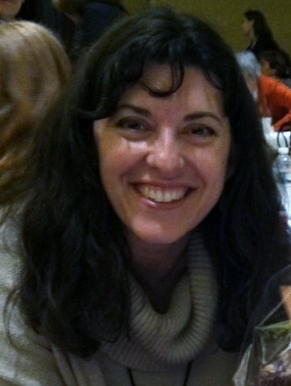 Kimberly Mach has been teaching for sixteen years and holds two teaching certificates in elementary and secondary education. Her teaching experience ranges from grades five to twelve, but she currently teaches Language Arts to middle school students. It is a job she loves. The opportunity to share good books with students is one that every teacher should have. She feels privileged to be able to share them on a daily basis.
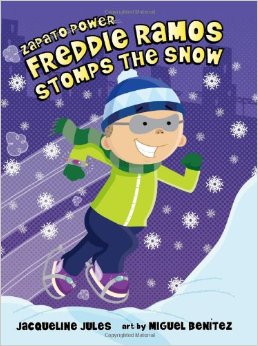 DESCRIPTION FROM THE BOOK JACKET: The snow’s no match for zapato power! A blizzard in March? It’s happening in Starwood Park! Luckily there’s a snow day at school because Freddie’s helping Mr. Vaslov clear the sidewalks with his latest invention—zapatos made just for the snow!


 Latinxs in Kid Lit