Pitch Fiesta Update: 15 Writers Matched with Mentors to Prepare for the Event

We’re excited to provide an update on Latin@s in Kid Lit’s first Pitch Fiesta. The deadline for submissions was October 3. We received 21 entries and reduced that number to 15 viable contenders representing middle grade and young adult–realistic, science fiction, fantasy, magical realism, LGBTQ, and Southern Gothic.

So, here’s the thing. We had no idea how many entries to expect. I (Cindy) thought we’d get maybe a half-dozen, which the LiKL crew could easily manage to review and prepare for pitching. So, when we ended up with 15!! viable entries, we flashed the bat signal at our kid lit writer friends. For those of you who don’t know, the kid lit community is awesome, and in no time, we had enough people ready to mentor our writers.

Here’s the process: Each mentor has been matched with a writer. The mentor will review the writer’s query and first pages with a critical eye. The mentor will email comments, thoughts, questions, concerns, suggestions, etc. to the writer. The two will work to make the query and first pages as clean and agent-ready as possible. Polished queries will be posted on our site on November 12-13 for the agents’ review. We hope “I’ve got to have it” type sparks will fly and matches will be made between writers and agents! These sparks of love over a manuscript will eventually lead to more books by and about Latin@s!

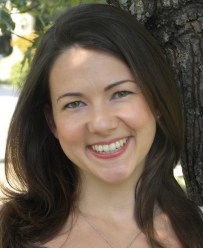
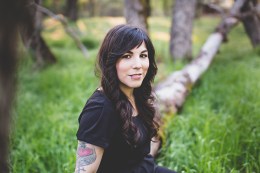
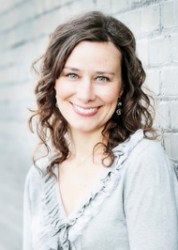
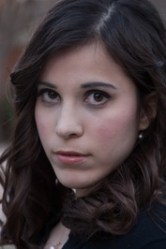
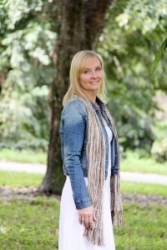
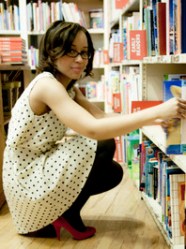
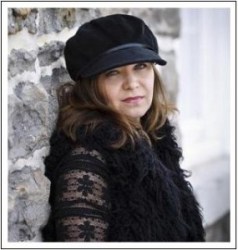
For now, though, there’s work to be done. Still, we wanted to publicly say, THANK YOU!!! to the authors who stepped up to help! Many are members of the Fearless Fifteeners, the Diversity League, and/or the We Need Diverse Books Team. They all support diversity in children’s literature and want to “pay forward” the help they received on the path to publishing. Below are all of the mentors. Names and titles match with photos going lef to right. If you click on the photos, you will be taken to the authors’ websites for more information.

Cindy L. Rodriguez: WHEN REASON BREAKS (Bloomsbury)

Ashley Hope Pérez: WHAT CAN’T WAIT and THE KNIFE AND THE BUTTERFLY (Carolrhoda Books)

Zoraida Córdova: THE VICIOUS DEEP trilogy (Sourcebooks Fire) and LUCK ON THE LINE (Diversion Books)

Heather Marie: THE GATEWAY THROUGH WHICH THEY CAME (Curiosity Quills Press)

Kelly Jones: UNUSUAL CHICKENS FOR THE EXCEPTIONAL POULTRY FARMER (Knopf Books for Young Readers)

Erin Entrada Kelly: BLACKBIRD FLY (Greenwillow Books)

A.L. Sonnichsen: RED BUTTERFLY (Simon and Schuster Books for Young Readers)

Anna-Marie McLemore: THE WEIGHT OF FEATHERS (Thomas Dunne)

Ronald L. Smith: HOODOO (Clarion)

Kerry O’Malley Cerra: JUST A DROP OF WATER (Sky Pony Press)

Dhonielle Clayton: TINY PRETTY THINGS (HarperTeen) and THE BELLES (Disney-Hyperion)

Holly Bodger: 5 TO 1 (Knopf Books for Young Readers)

Kristy Shen and Bryce Leung: LITTLE MISS EVIL (Spencer Hill Middle Grade)

Carrie Firestone: The title of Carrie’s debut novel hasn’t been finalized, but she will be published in 2016 by Little Brown & Co.

  2012AuthorPhoto500pixels  317988_632439229822_92623787_n

Heather-AuthorPhotos-3-WEBSIZE  Kelly Jones  Erin Entrada Kelly A.L. Sonnichsen Anna-Marie McLemoreRonald L. SmithKerry CerraDhonielle Clayton Holly Bodger Kristy and Bryce  profile photo


Shine a Bright Spotlight on Unsold Diverse Books: An Idea Inspired by Hollywood’s Black List

By Patrick Flores-Scott

I’m happy to have the opportunity to be blogging here at Latin@s in Kid Lit!

Once again, I’ve got the We Need Diverse Books movement on my mind.

If you’re reading this post, I’m sure you’re very aware that children’s literature does not reflect the true diversity of this land. And you’re very likely to agree that it must.  And you can explain the myriad reasons why it must. And you’ve most likely asked yourself, How do we fix this? And I bet you’ve got ideas.

It’s going to take many ideas from myriad sources and a lot of people working together in every phase of the publishing industry to make change happen.

I’d like to use this post to throw one possible idea into that mix. For many reasons, I’m not the guy to put this one into action, but I think it’s an idea worthy of consideration, and it would be very cool if someone ran with it.

The idea is stolen from Hollywood. It’s called the Black List. I’m not referring to the mid-last-century process of blacklisting supposed Hollywood communists and those who refused to name names, in an effort to keep them from ever working in this town again. And I’m not referring to NBC’s TV show, The Blacklist. I’m referring to the Black List, which is a list of the best unsold scripts for each calendar year. Simple as that.

The List was started by Franklin Leonard in an effort to bring attention to scripts that otherwise, may never have seen the light of day, and in an attempt to create a path to success for yet-to-be-produced screenwriters.

Check out this link to an interview with Franklin Leonard. It’s is a great introduction to the Black List.

In the interview, Franklin Leonard states that:

“…the more that we can do to shine a very bright spotlight on people doing ambitious and very high quality work, the more likely it is that those scripts get made. I think the role we play is to shine that bright spotlight and say, “Here’s a bunch of stuff that maybe you overlooked, that maybe you loved but you didn’t pull the trigger on for whatever reason; it might be worth taking a second look.”

He goes on to say that’s exactly what happens when the list comes out each year. There are meetings all over Hollywood where executives go over the list and reconsider scripts they’d previously passed on, or they find new scripts that they then request from writers and agents.

Since 2005, over two-hundred films that made it onto a Black List have been produced. Some of them include Argo, American Hustle, The Descendants, Juno, The Wolf of Wall Street, Slumdog Millionaire, The Social Network, and The Wrestler.

In an attempt to start a dialogue, here are some ideas about how the Black List could work in the world of kid lit:

The Kid List (or whatever it’s going to be called) committee would solicit manuscripts from writers from underrepresented backgrounds, or manuscripts with underrepresented main characters, regardless of the writer’s background.

The purpose of The Kid List would be to connect publishers with manuscripts that an esteemed committee would deem worthy of publication. It would also be a vehicle for connecting unrepresented writers with agents. Furthermore, the list could be used as a form of mentorship for writers of promising manuscripts that do not make the list. These writers would be given quality feedback and the opportunity to resubmit to the list the following year.

The manuscripts could be sent from agents or from individuals who do not yet have representation. I picture manuscripts coming from unpublished writers, but I think it’d also be appropriate for a published author to submit a manuscript that has gone through the traditional editorial submission process without garnering a deal.

At the end of the year, the committee would create a list made up of  (whatever number) of manuscripts that they feel are worthy of publication. I picture the list being unveiled by the committee during one of the major book conventions.

The make-up of the selection committee would be crucial to the success of The Kid List. In order to shine that spotlight that Franklin Leonard talks about, the folks on the committee would need to be bright lights in their own right. They should be influential librarians, well-regarded booksellers and big-name authors. It would be a major time commitment—maybe like being a member of the BFYA committee—but I think there are enough big-time players out there who value diversity in children’s literature and who would like to play a role in making that diversity happen.

Recruiting a selection committee, creating its rules and structures… all that, would be a big challenge for some dynamic, driven passionate individuals. Are you one of them?

My big fear would be that the list would come out… and nothing would happen. Editors and agents would greet it with a big whatever. I just don’t think that’d be the case. I truly believe that, for the most part, editors would like to publish more “diverse books.” But change is hard. People need a nudge. They need help. They need to be educated and they need someone they respect telling them it’s okay to go for it. But more than all that, The Kid List would create marketing buzz for books before they’re even sold. What publisher wouldn’t want a piece of that?

I could picture the first Kid List coming out and one book being published off that list. It might not seem like much, but editors and agents would know that a cool book from an unknown author was sold, at least in part, because of The Kid List. They’d check it out a little closer the next year and maybe then a few more books would be published because of The List. From there, it’s not hard seeing a time and place where The Kid List has done for diversity in kid lit what the Black List has done for Hollywood.

And it’s not hard to picture young writers from diverse backgrounds, inspired by the idea that there’s a path that I can take to get a book published. And the characters in that book can look like I do.

There it is. One idea. Let me know what you think. Or don’t, and just go for it.

PatrickFS1Patrick Flores-Scott was, until recently, a long-time public school teacher in Seattle, Washington. He’s now a stay-at-home dad and early morning writer in Ann Arbor, Michigan. Patrick’s first novel, Jumped In, has been named to a YALSA 2014 Best Fiction for Young Adults book, an NCSS/CBC Notable Book for the Social Studies and a Bank Street College Best Book of 2014. He is currently working on his second book, American Road Trip.

La Casa Azul: El Barrio’s Independent Bookstore

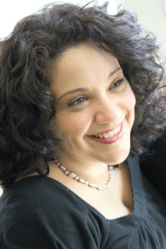
By: Zoraida Córdova


La Casa Azul 4

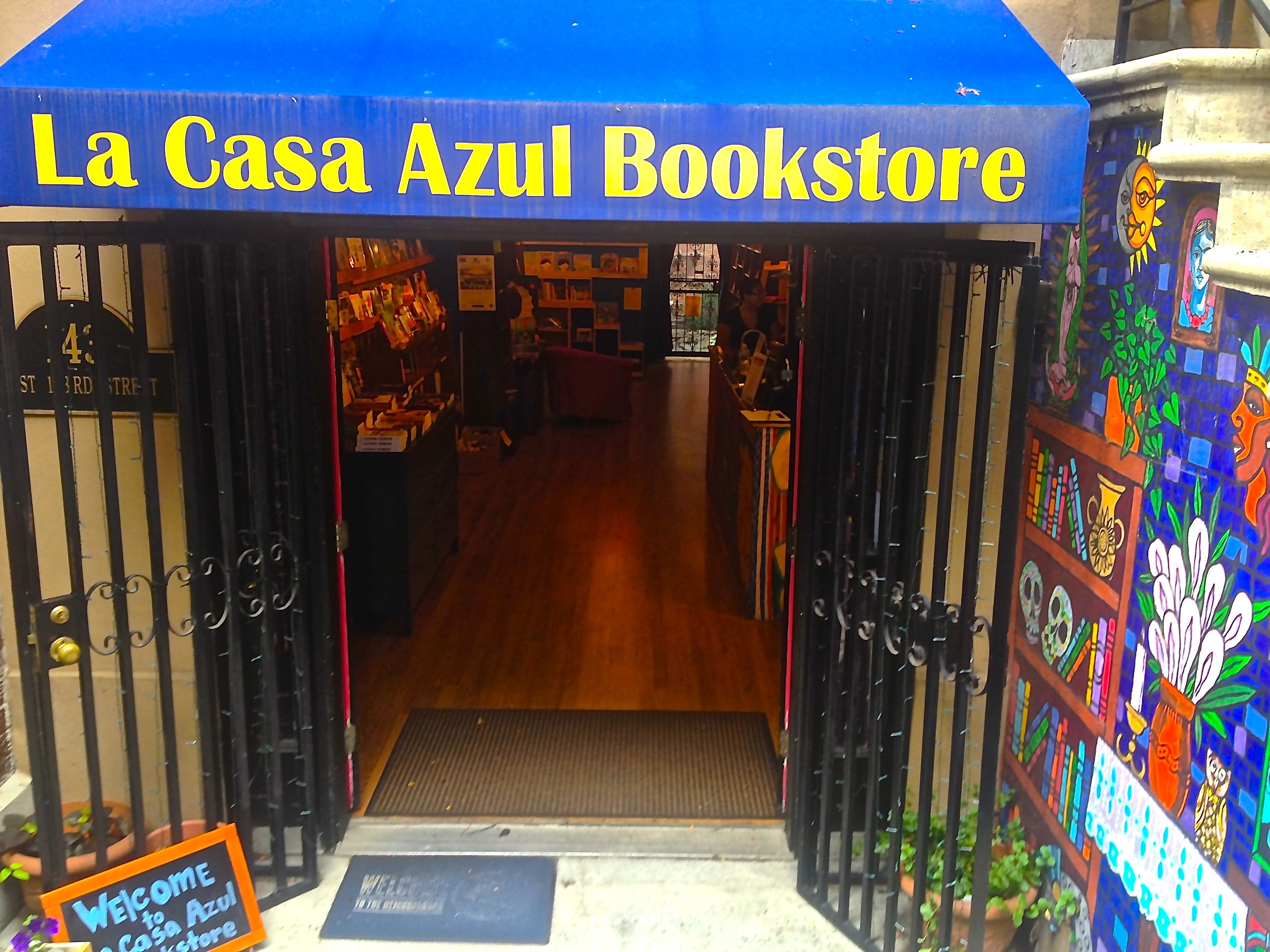
Entrance. Photo by Z.C.


La Casa Azul Vega

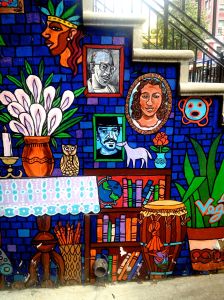
Manny Vega’s mural. Photo Z.C.

El Barrio, or East Harlem, is home to La Casa Azul, named after Frida Khalo’s home-turned-museum. Raising “40k in 40 days” through a crowd-funded campaign, Aurora Anaya-Cerda was able to open the doors to the store in June of 2012. It’s encouraging to see that the public is willing to contribute to bring these projects to life. I remember keeping up with the bookstore’s progress on Lucha Libros. From painting to building shelves, it was exciting to know that this kind of indie was coming to a neighborhood that otherwise doesn’t have access to a wide range of Libros Latinos. In a city that is 28.6% Latino, there is a huge need for access to these books.

La Casa Azul 1

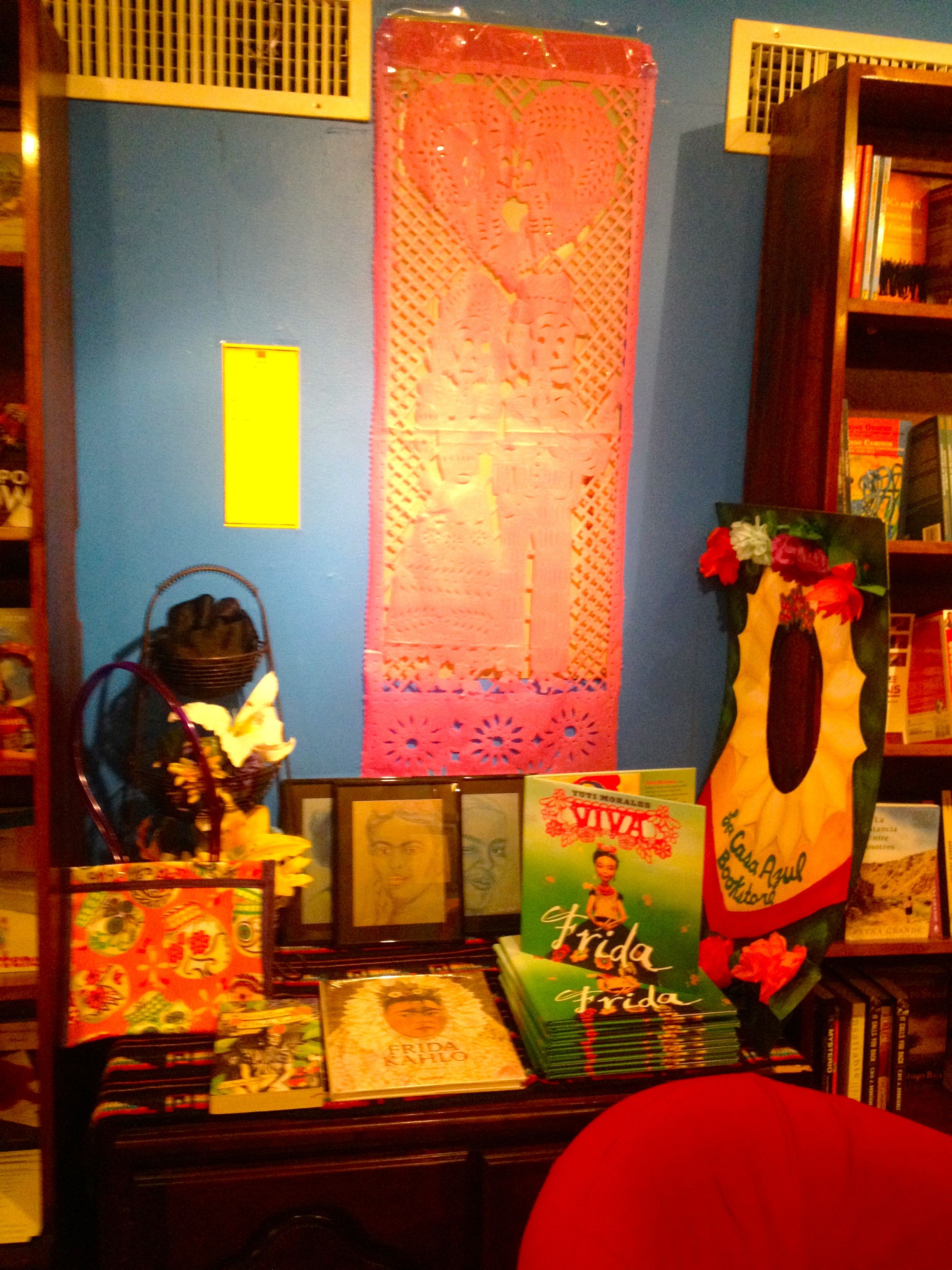
All things Frida Khalo. Photo Z.C.

So, how do you visit? To get to La Casa Azul, take the 6 train to 103rd street in Manhattan. This lets you off onto an area lined with bars, restaurants, bodegas, a botanica, and schoolyards. The neighborhood is also home to El Museo Del Barrio, if you’re in the mood for more art. But first, go to La Casa Azul. Make a left on Lex and a right at a bright blue awning. Down the steps you’re greeted by a gorgeous art installation by Manny Vega. You can see the process of his work here.

Once inside, the bookstore is warm and inviting. Aurora Anaya-Cerda is there with another employee stacking books. Named and inspired by Frida Khalo’s home, La Casa Azul has many references to her that range from paintings, to art books, to art installations. LCA even has its own exhibit/gallery. Their current showcase is called “A Ribbon Around a Bomb,” by Suhaly Bautista, The Earth Warrior. I’m excited to see what the next art display will be.

La Casa Azul 2

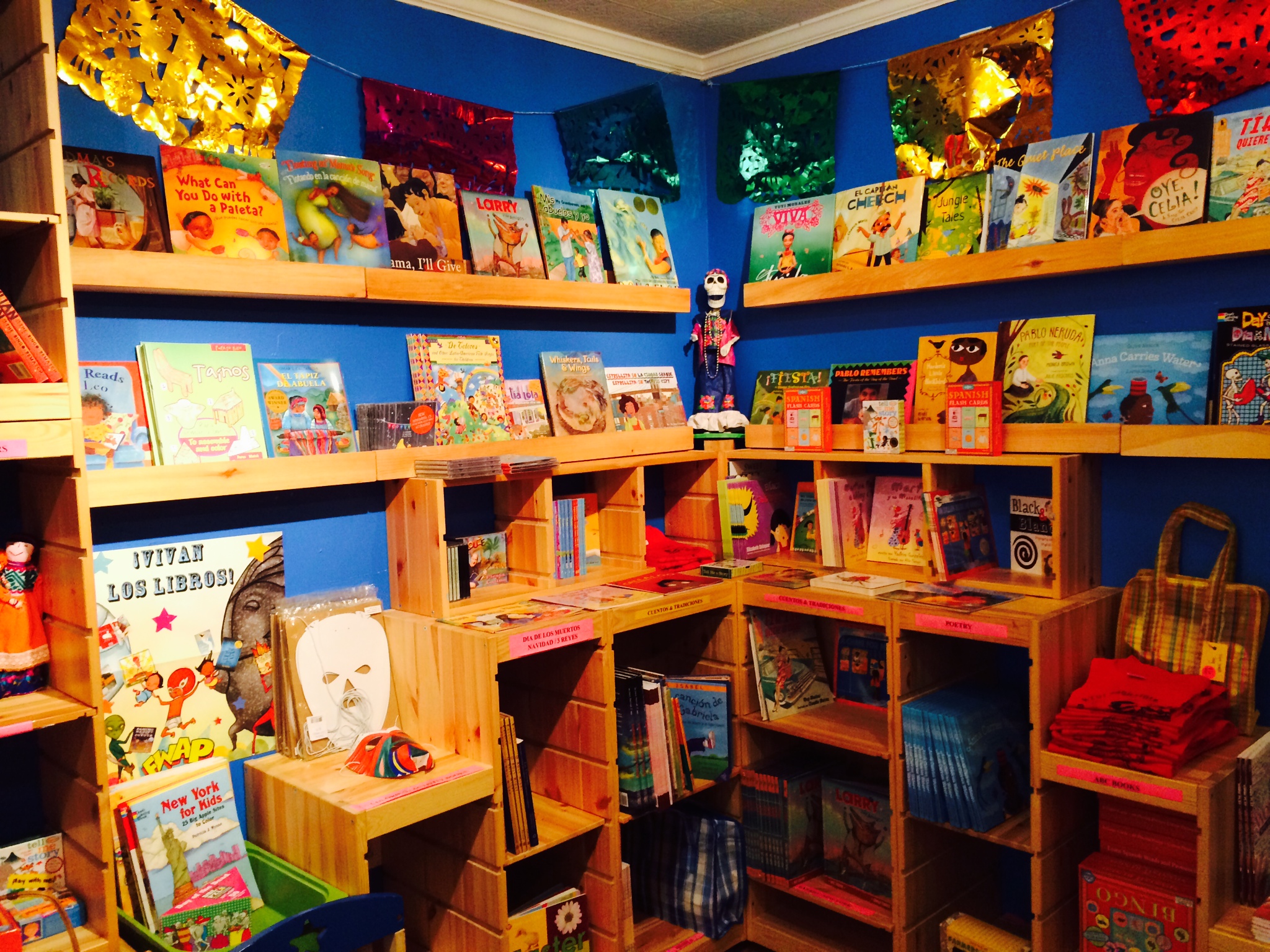
Shelves. Photo Z.C.

The great thing that you can see about La Casa Azul, is that it’s not just about the book events, but about community. Take a look at the events calendar for a wide selection of family-friendly music events, book readings and signings, literary conferences, volunteer outreach, and even BYOB paint parties.  They recently held a book drive for young immigrant children in New York. In addition to these events, La Casa Azul is available for space rental. Because of all of these things, La Casa Azul is important. I’d like to think that the independent bookstore is making a comeback, despite the threat of the digital age. Sure, you can get a book on your smart device or tablet, but there’s something special about being able to congregate in a safe space that embraces Latino culture.

The next time you’re uptown, stop by and pick up a couple of books.

photo

Kid Lit section. Photo by L.L.

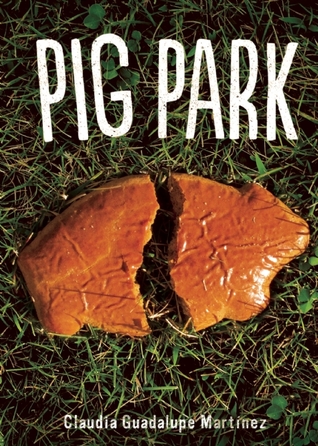
Pig Park and the Cosmic Race: Diversity and Identity in My New YA Novel

By Claudia Guadalupe Martinez

As a kid, I assumed everyone around me was Mexican. I lived less than a mile from the Texas-Mexico border, so we pretty much were Mexican. This neighborhood inspired my first novel, The Smell of Old Lady Perfume–a world vastly different from the one that surrounds my protagonist, Masi Burciaga, in my new novel Pig Park. Masi’s cast of neighbors runs the gamut from the Nowaks to the Wongs.

2236319Nevertheless, Mexican identity is something I thought very much about as I wrote. Two-thirds of the Latino population in the U.S. was of Mexican descent in the last Census, and I can’t help asking myself what it means to be Mexican these days. I didn’t grow up purposefully Mexi-centric. I was a product of my environment. I’d never had the opportunity to truly interact with non-Mexicans, non-Mexican Latinos, or Mexicans with experiences significantly different from mine until I moved to California for college.
Even then, the diversity I experienced was a somewhat artificial one created by a college admissions team. California was still the Southwest, and my new community and I still shared many experiences. But seriously, since I barely knew how to drive, I can hardly say I experienced L.A.

Chicago would be different. One day, I cashed in my airline miles and set off to visit a friend there. I walked into a coffee shop and stumbled onto a flier for an apartment rental. So began my long-term relationship with the city and neighborhood that would inspire Pig Park.

My new Chicago landlady occasionally referred to my neighborhood as Mexican, but my neighbors included Mexicans, African Americans, Filipinos, Puerto Ricans, and miscellaneous white folks. Everyone just mixed it up.

18528311Mexicans have formed communities in Chicago since the 1850’s. And, while a 2012 Census study from the Manhattan Institute for Policy Research named Chicago the most segregated city in America, Chicagoland’s Mexican population is massive enough at 1.4 million that some neighborhood overflow is to be expected. This is how diversity develops naturally. Scholar José Vasconcelos talked about Mexicans as “the cosmic race;” behind it was the idea that we actually have a little bit of everything in us, that we like to mix it up, eventually transcending racial and ethnic categories.
Life happened, as it is wont to do. I eventually got married, moved into a house in a new neighborhood, and became a mom. My husband is of the sort who wouldn’t be caught dead putting ketchup on a hot dog and gladly plays tour guide to visiting family and friends, introducing them to the many surprises of our city. He is a Chicagoan through and through. He is also of Guatemalan and Salvadoran descent. As such, I don’t know if my two-year daughter and my son (who will be born this October) will consider themselves Mexican or not. After all, identity is a fluid thing, partially assumed and partially assigned. My husband and I hope they consider themselves whatever they want, and are never made to feel that they can’t.

I wrote Pig Park recognizing that the world my children will be a part of isn’t exactly one thing, and that this is the type of world many kids are increasingly growing up in.

CGMTZ_photoby neus raffols_color_CROPPEDClaudia Guadalupe Martinez is the author of The Smell of Old Lady Perfume (Cinco Puntos, 2008) and Pig Park (Cinco Puntos, 2014). She grew up in sunny El Paso, Texas, where she learned that letters form words from reading the subtitles of old westerns with her father. She now lives and writes in Chicago.

2014 Reading Challenge: July & August Update

If you want to diversify your TBR pile, this is the perfect month to do it since it is National Hispanic Heritage Month. Our challenge is heading into its final months, but it’s never too late to join us. Here are the guidelines: read one book a month that is written by a Latin@ author (any subject) or a book written by anyone that has Latin@ characters, themes, settings, etc. You’re not required to review–only read and enjoy and let us know what you have read! If you do post a review somewhere, we will link it to the book covers below. If you choose not to review, we will link the covers to Goodreads. Explore our book lists or past book talks (Libros Latin@s) for suggestions.

Also, since this is National Banned Books Week, you can choose from the Latin@ titles that have been challenged, according to this list kept by the National Council of Teachers of English. Here they are:

Always Running Before We Were Free  Bless Me, Ultima  95127  9328  7133770  94064

And here are some of the titles read by our Reading Challenge participants:

106281  17928557  18405521  18651917  18166935  17643  1369609  17870787  288563  15893258  18654377  1274318  20702546  12000020  13436375  1258175  Moony Luna/Luna, lunita lunera  16670129  15791044  6098251  378653  2376261


Scholastic Celebrates Hispanic Heritage Month With Some Favorite Books

By Roany Molina

Hispanic Heritage Month officially kicked off Monday – September 15th – and lasts until October 15th. To celebrate, we compiled some of our favorite characters and stories from all over Latin America in a Colección Herencia Hispana / Hispanic Heritage Collection. Each book is rich with beautiful language, stories, myths, art, and foods.


Award winning author and illustrator Yuyi Morales does it again with her captivating children’s book, Niño Wrestles the World. Niño, the unstoppable masked child wrestler, contends against a series of abnormal opponents. Niño defeats them all with ease, but it isn’t until the clock chimes that he is faced with his most difficult challenge, Las Hermanitas (the little sisters). Morales is able to incorporate traditional Mexican beliefs and relate them to the country’s famous form of wrestling, commonly known as Lucha Libre, which requires wrestlers to mask their face to protect their identity. Her vibrant illustrations keep true to the classic pop-art style associated with Lucha Libre on posters and trading cards.  Mixed with the engrossing text, the combination of both storyline and artwork engages any reader. The tale is exciting and uses basic vocabulary for its young readers to follow along. From the uncommon opponents to the energetic fearlessness of Niño, Niño Wrestles the World depicts the story of an intelligent entertaining little boy who is able to teach its readers common Spanish words and phrases. Winning the Pura Belpré Award (2014), Yuyi Morales taps into both her creative power as an author and illustrator to create this delightful story.


Sabores De América is a new way to learn and look at the foods we eat. Written by Ana María Pavez and Constanza Recart, Sabores , originally published in Chile, has been distributed all over the world and is the winner of the Skipping Stone Award and the White Ravens Award (2010). The text is appealing to reader’s grades 4 and up but the book is an amazingly useful as a reference for readers of all ages. The book’s sophisticated water color art work, designed by Isabel Hojas, makes it friendly and relatable to a younger audience. This non-fiction book can also be used as an excellent classroom resource for any teacher looking to inspire cultural curiosity in the classroom. Students will learn about Latin America’s contribution to the world through the use of intriguing historical facts and recipes. A glossary about Mesoamerican culture and a map of the region are included.


The Cazuela That the Farm Maiden Stirred makes vocabulary building fun with its tribute to the nursery rhyme, “The House That Jack Built.” Written by Samantha R. Vamos and illustrated by Rafael López, each page engages the audience into wanting to help the farm maiden stir the cazuela (stewpot). Once she begins the task, all the farm animals desire to contribute in some way. Whether, it’s the cow that produces the milk or the donkey that give the duck a ride to the market to buy sugar, each animal participates in creating the final tasty dish. The cooking process becomes a festive event when everyone begins to sing and dance. Distracted by the joy of the party, the animals and the farm maiden forget to keep an eye on the cazuela and it begins to bubble over. Who will be the one to notice? Vamos and López’s combined efforts creates a delicious educational cultural celebration. An added bonus is the Arroz Con Leche recipe, better known as Rice Pudding, towards the final pages of the book. The Cazuela That the Farm Maiden Stirred, is an enjoyable read that can get any tummy rumbling.


La difunta familia Diaz by P.J. Bracegirdle and illustrated by Polly Bernatene is a playful and humorous tale that explores the two side of Día de los Muertos – the living and the dead. The story revolves around Angelito, a sweet little boy – a dead little boy— living happily with his dead family. They have a well-kept home strewn with family portraits, a skeleton dog, and their whole neighborhood is “dead” – the birds, butterflies, the flowers on the dining room table, and the moon in the sky. In short, the afterlife is good. However, Angelito is anxious about Día de los Muertos and all the horrors of the living! However, an unexpected friendship will soon alter his point of view.  La difunta familia Diaz’s is a fantastic book that lightheartedly introduce children to this famous holiday.


In celebration of Hispanic Heritage Month, finish the following sentence and you could win a FREE Hispanic Heritage Poster and 25 Spanish and bilingual books.  “In Latin America, I would like to travel to ____ and taste ____.”  Click HERE and then post your answer in the comments. You have until Sunday, September 21, 2014 at 11:59pm EST to post your answer. Remember, your answer must include the answer to the question “In Latin America, I would like to travel to ____ and taste ____.”  For the official rules, click here.

Stay tuned for more exciting Hispanic Heritage Special Features from Club Leo en Español throughout the next 30 days!

Club Leo en Español supports your classroom with fun and affordable books that connect children’s home language and learning. Our books include amazing series, original titles, and winners of the Pura Belpré Award, which celebrates the remarkable contributions of artists who give voice to the Latino community through children’s literature.

Club Leo en Español apoya tu salón de clases con libros divertidos y asequibles que conectan la lengua materna y el aprendizaje de los niños. Nuestra colección incluye increíbles series, títulos originales y ganadores del Premio Pura Belpré, que celebra los extraordinarios aportes de artistas que dan voz a la comunidad latina a través de la literatura infantil.