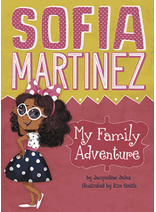
Book Review: The Sofia Martinez series by Jacqueline Jules

By Ashley Hope Pérez

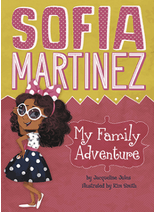
This review is based on an advance reader’s copy of My Family Adventure, which is a multi-story volume with “Picture Perfect,” “Abuela’s Birthday,” and “The Missing Mouse.” These texts are also sold as separate early chapter books.

PUBLISHER’S DESCRIPTION: Growing up in a big family, 7-year-old Sofia Martinez is used to fighting for attention. Her outgoing personality mixed with her confidence and fiery passion for everything she does gets her that attention — even if it’s sometimes mixed with trouble. Sofia is a little stubborn and a lot mischievous, so you can imagine the fun she creates in this early chapter book series. A few Spanish words and phrases are intermixed throughout the story, bringing the importance of Sofia’s culture to life. Discussion questions, writing prompts, and a glossary complete each book.

MY TWO CENTS: The Sofia Martinez series is a lovely addition to the world of early chapter books. All newly published in 2015, each of the books can stand alone, and they needn’t be read in any particular order. Lively main character Sofia keeps herself in the middle of the action in her loving, playful extended family, and her adventures are light and joyful with a touch of mischief. The charming illustrations by Kim Smith will bring giggles to young readers.

SofiaM_Pink

Suited well to the needs, interests, and sense of humor of early readers, the books will have broad appeal for the K-2 crowd. Although the prominence of pink in the book design may attract more girls and turn off some boys, my son enjoyed reading the stories. He especially like what he called Sofia’s “tricks.”

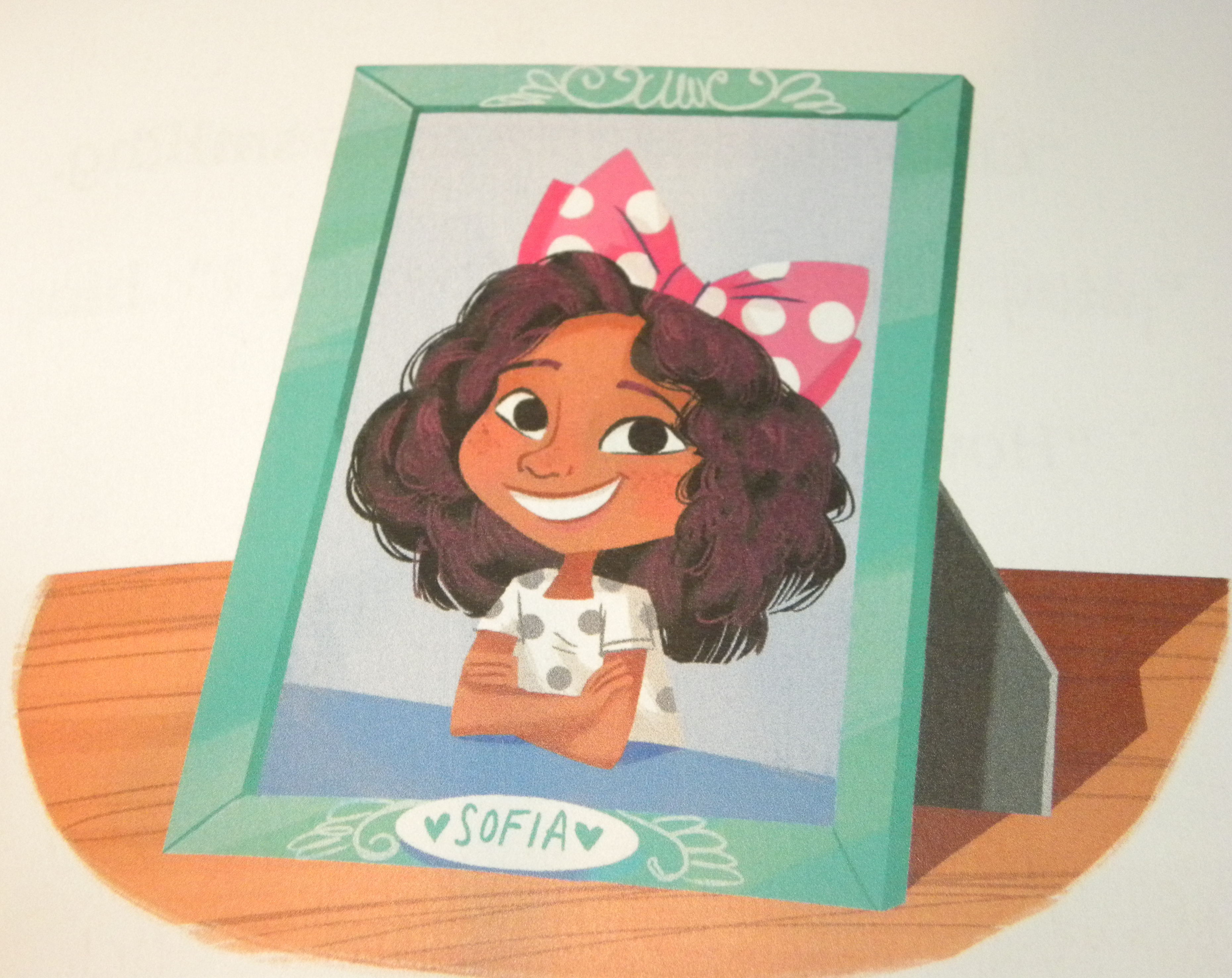
In “Picture Perfect,” Sofia decides to switch her school photo with one of her sister’s, and she’s disappointed when no one notices the swap. The same evening, a baby cousin gets tons of attention because of the enormous pink bow she’s wearing in her hair. When picture days rolls back around, Sofia is determined that this time she’ll stand out. Any guesses as to what Sofia borrows to put in her hair on picture day?SofiaM_bow
“Abuela’s Birthday” centers on Sofia’s (very messy) plan to make a piñata for her grandmother’s birthday. Once the mess is cleaned up, she persuades Tía Carmen for one more chance, and with the help of her cousins and siblings, Sofia makes a great piñata. Even the surprise inside of the piñata—playing cards instead of candy—shows Sofia’s creativity.

In “The Missing Mouse,” Sofia gets advice from Abuela and help from her cousin and sisters to recapture a runaway classroom pet without disturbing her mother while she gives a piano lesson. The solution involves a good deal of creativity and improvisation. A bucket, some blocks, peanut butter, and a few shrieks from her sisters are also involved.

Kim Smith’s illustrations bring the accessible language of the stories to life. Sofia is at the center of most of the drawings—and her freckles and expressive face had me enchanted from the start. But my favorite illustration of all might be this one from “Abuela’s Birthday”:
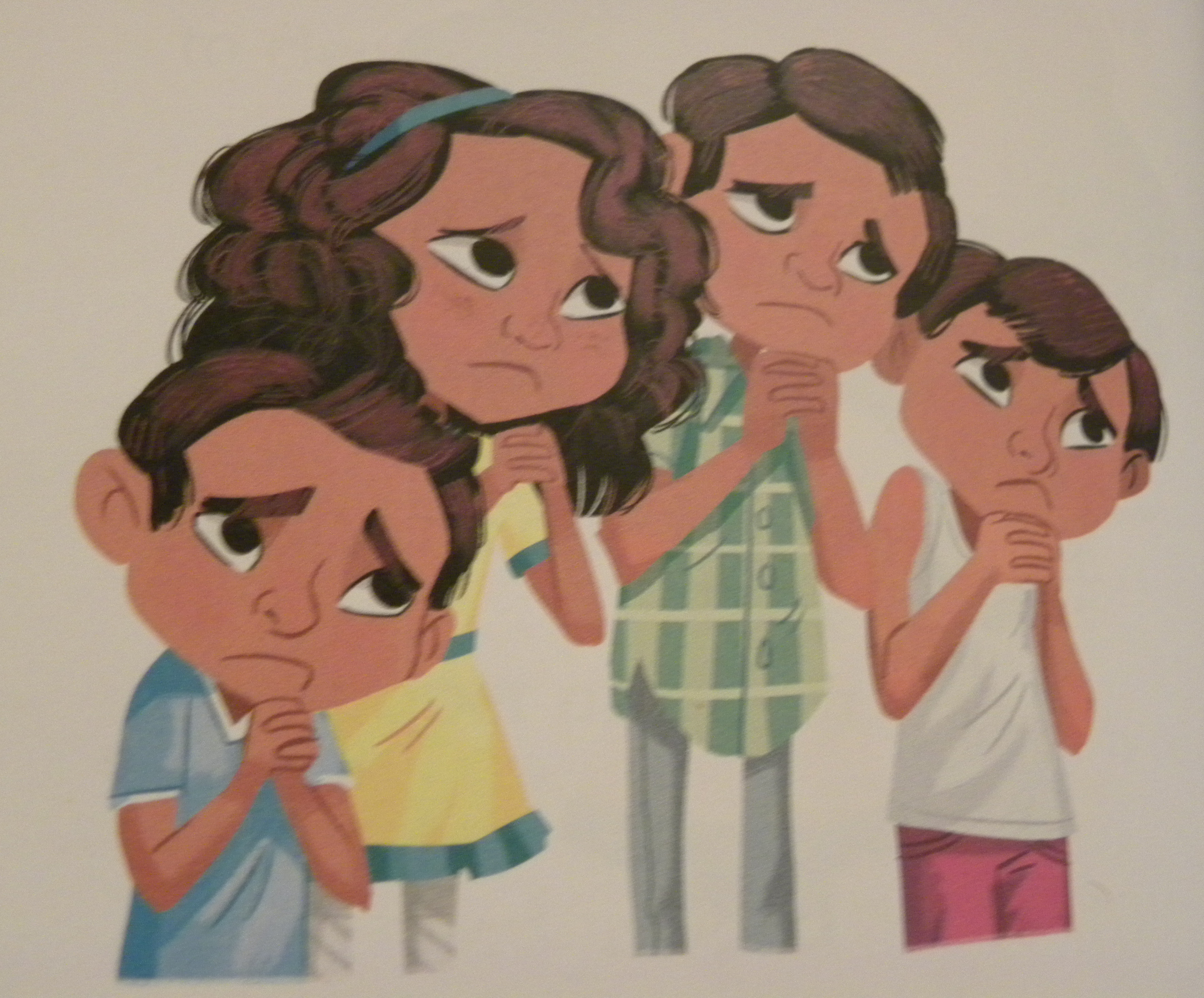
SofiaM_Please?It’d be hard to deny those four a chance to try again with the piñata endeavor.

The production of these books is especially thoughtful. The use of pink for words in Spanish produces an effect much like what Sofia achieves by wearing an enormous bow for her school picture. It marks Spanish as special–and very much part of Sofia’s world.

SofiaM_SampleText

In general I’m not much of a fan of glossaries, but here, I think it works well as a support for teachers and students not familiar with the Spanish, and a glossary is definitely preferable to embedded translations.

When readers graduate from the world of Sofia Martinez, they can dip right into Jacqueline Jules’s Freddie Ramos/Zapato Power series for slightly more independent readers (grades 1-3).

TEACHING TIPS: The Sofia Martinez series is a great match for students in K-2 (possibly stretching upward a bit for students who have literacy skills in Spanish but are transitioning to reading in English). Think of readers who are beginning to read on their own and for whom the idea of a chapter book has appeal. The advance reader’s copy did not have the discussion questions or writing prompts mentioned in the publisher’s description, so I can’t comment on those.

Instead, I’d like to talk a bit about the linguistic opportunities offered by the series. The change in color for Spanish words inScreen Shot 2015-01-31 at 10.32.36 PMphrases in the Sofia Martinez books will help young bilingual readers recognize when they should apply what they know about Spanish decoding and pronunciation and when they should follow the norms of English. I can imagine this as a confidence builder for Spanish-speaking students learning English in bilingual, ESL, or English-only settings (“Look! You already know these words in Spanish!”). Teachers in English-only classrooms might consider making their Spanish-speaking students “experts” on the Spanish words and phrases when sharing the stories in small or large group. Non-Spanish speakers may take pride in knowing the “secret” words in the story and, with a little coaching, will be able to handle the small amount of Spanish even when reading aloud.
Teachers might pause students on pages where we see Sofia’s “I’m getting an idea” facial expression. What do they think will happen next? When she gets into a pickle, as in “Abuela’s Birthday” and “The Missing Mouse,” ask students to suggest, draw, or journal about the solutions they would try to solve the problem. In Spanish-English bilingual classrooms, students might also experiment with using Spanish their own stories. Using the color switch technique from Sofia Martinez can strengthen students’ sense of pride in their Spanish abilities while also signaling to monolingual guests or administrators that the movement between English and Spanish is intentional and linguistically appropriate. More importantly, this narrative tactic is culturally relevant to the young people sharing their stories.

Above all, have fun with Sofia!

SofiaM_JJpublicityphoto

Jacqueline Jules is the award-winning author of more than twenty children’s books, many of which were inspired by her work as a teacher and librarian. She is also an accomplished poet. When not reading, writing, or teaching, Jacqueline enjoys taking long walks, attending the theater, and spending time with her family. She lives in Northern Virginia.

 

SofiaM_KimSmith

Kim Smith has worked in magazines, advertising, animation, and children’s gaming. She studied illustration at the Alberta College of Art and Design and is the illustrator of several children’s books and the designer for the cover of the middle-grade novel How to Make a Million. She lives in Calgary, Alberta.

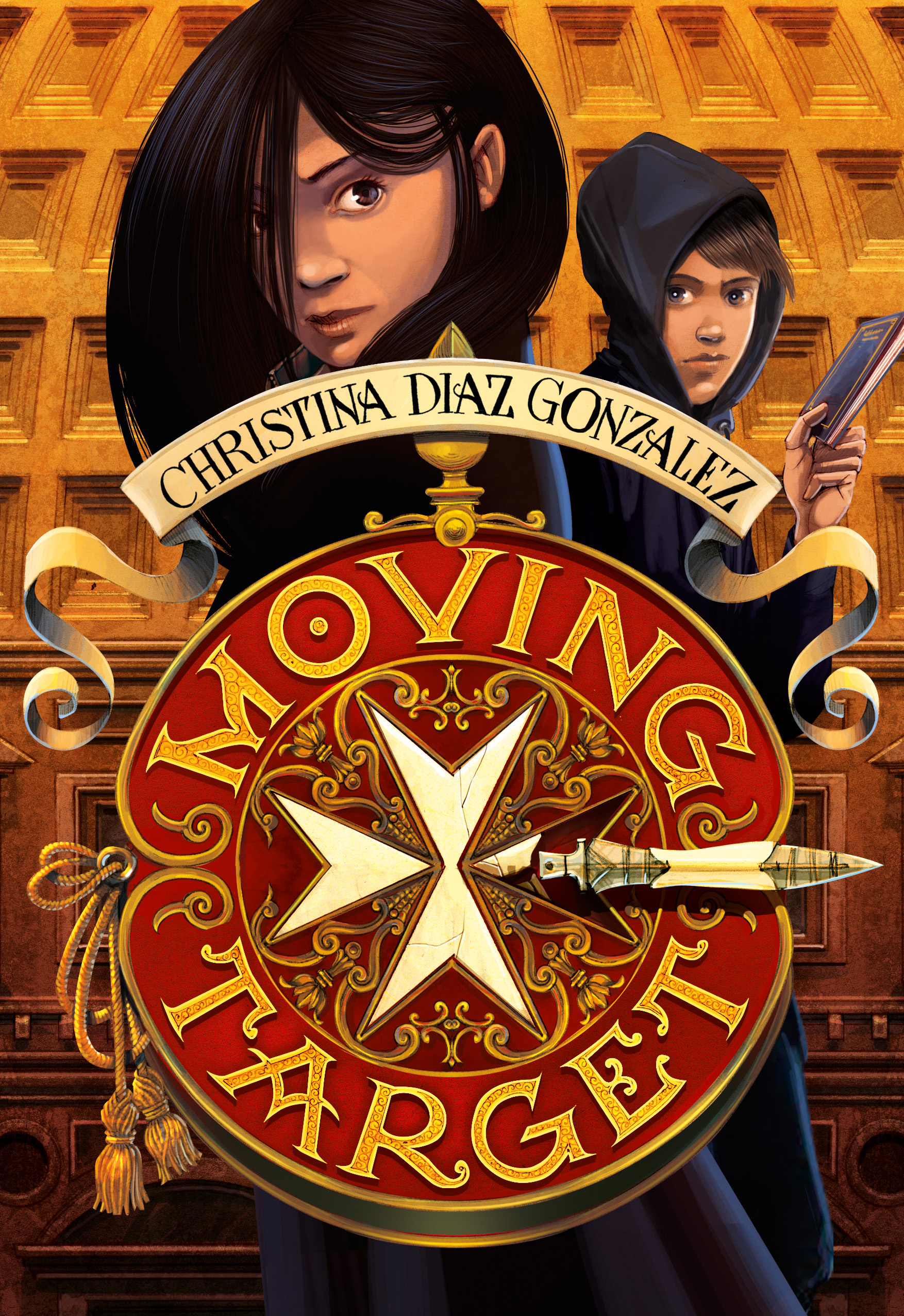
Cover Reveal: MOVING TARGET by Christina Diaz Gonzalez

By Cindy L. Rodriguez

We’re really excited to reveal the cover for Christina Diaz Gonzalez’s latest middle grade novel, Moving Target, which will be out with Scholastic in September.

Here’s the description:

Cassie Arroyo, an American studying in Rome, has her world ripped apart when someone tries to kill her father, an art history professor at an Italian university. Is she their next target?

Cassie sets out to uncover what is happening, only to learn that she is a member of an ancient bloodline that enables her to use the Spear of Destiny–a legendary object that can alter the future. Now running from a secret organization intent on killing those from her bloodline, Cassie must—with the help of some friends—decipher the clues that will lead her to the Spear because her life, and the fate of the world, depend on it.

Christina Diaz Gonzalez has created a fast-paced thrill-ride of a book, rich with riddles and myth, that young readers will not want to put down.

Sounds awesome, right?

Before we get to the big reveal, here’s some information about the author, who has two other wonderful middle grade novels.

About the author:

Christina GonzalezChristina Diaz Gonzalez is the award-winning author of two historical fiction novels, THE RED UMBRELLA and A THUNDEROUS WHISPER. Her upcoming book, MOVING TARGET (to be released by Scholastic in September 2015) is a high-stakes, action/adventure story featuring a strong, twelve year-old, Latina girl who discovers she is part of ancient bloodline that can control destiny. Christina’s books have received numerous honors and recognitions including the American Library Association’s Best Fiction for Young Adults, the Florida Book Award, the Nebraska Book Award, a Notable Social Studies Book and the International Reading Association’s Teacher’s Choice Award. Reviewers from publications such as Publisher’s Weekly, The Miami Herald, School Library Journal and The Washington Post have called her novels engrossing, compelling and inspirational.

Christina’s reaction to the cover:

When I first saw the cover for Moving Target, I was simply floored as to how perfect it was for the book. I seriously love it! The incredibly talented Iacopo Bruno has captured the look and feel of my characters in the best possible way. I am so excited to finally show it off to the world!

Are you ready?

*

*

*

*

*

Here’s the cover!

*

*

*

*

*

*

Moving Target


GORGEOUS! We’ll be talking with Christina more about her new novel as it gets closer to release. So, stay tuned…

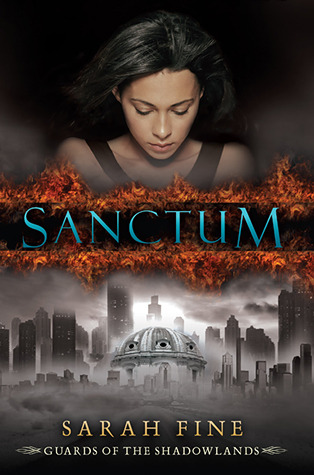
Book Review: Sanctum: Guards of the Shadowlands, Book One by Sarah Fine

13482750By Cindy L. Rodriguez

This month we are taking a look at Latin@s in science fiction and fantasy. On Monday, we had a Q&A with Sarah Fine, author of the Guards of the Shadowlands series. Today, we take a closer look at her debut novel, first of the series, Sanctum, which features a 17-year-old Latina protagonist.

DESCRIPTION OF THE BOOK“My plan: Get into the city. Get Nadia. Find a way out. Simple.”

A week ago, seventeen-year-old Lela Santos’s best friend, Nadia, killed herself. Today, thanks to a farewell ritual gone awry, Lela is standing in paradise, looking upon a vast gated city in the distance—hell. No one willingly walks through the Suicide Gates, into a place smothered in darkness and infested with depraved creatures. But Lela isn’t just anyone—she’s determined to save her best friend’s soul, even if it means sacrificing her eternal afterlife.

As Lela struggles to find Nadia, she’s captured by the Guards, enormous, not-quite-human creatures that patrol the dark city’s endless streets. Their all-too-human leader, Malachi, is unlike them in every way except one: his deadly efficiency. When he meets Lela, Malachi forms his own plan: get her out of the city, even if it means she must leave Nadia behind. Malachi knows something Lela doesn’t—the dark city isn’t the worst place Lela could end up, and he will stop at nothing to keep her from that fate.

MY TWO CENTS: Sanctum by Sarah Fine offers an engaging blend of fantasy, action, romance, and contemporary social issues, sure to appeal to a variety of readers. Protagonist Lela Santos has spent most of her life in foster homes and the sexual abuse she suffers at one causes her to attempt suicide. Her abuser interrupts the suicide, but Lela was gone long enough to glimpse hell. When her best friend Nadia kills herself and Lela dies accidentally soon after, she is determined to save her friend from the city that preys on souls’ worst fears, insecurities, and vices.

Problem is: Lela doesn’t belong there. The city won’t sustain her, which puts her at risk of dying–again.

Another problem: Creepy creatures called Mazikin claim broken souls and are preparing to bust out of the city. The fights are fierce between the Mazikin and the Guards, and Lela proves to be a badass even before any formal fight training.

Yet another problem: Lela is falling in love with Malachi, the leader of the Guards. And while the romantic tension between them is hotter than Hades itself, a love affair in this setting isn’t likely to last. Plus, Lela is still healing from traumas experienced in her mortal life, which means she doesn’t easily trust people even in the afterlife.

One of the things I liked most about Sanctum was the development of the characters’ emotional journeys through pain and into healing. They all suffered so severely in life they decided to commit suicide, and that decision landed them in a place that continues their torment. Still, as difficult as it is, in life and this afterlife, some are able to overcome the worst experiences and find purpose in life and even love. I won’t give away what happens when Lela finds Nadia, but I will say I wasn’t entirely surprised at Nadia’s response to the rescue effort. The point that we all heal at our own pace is an important one to remember (in real life) when trying to help people with mental health issues.

TEACHING TIPS: One thing the Common Core State Standards asks is for students to compare different treatments of the same subject or analyze how one work of literature has influenced another. One way Sanctum could be used in the classroom, even if only parts are used, is to compare Fine’s version of hell with other versions of hell and purgatory in literature. Discussions about the afterlife and the particular fate of those who commit suicide would be appropriate in higher level English classes that consider the Bible’s influence on literature and history/social studies courses that include a comparative study of religions.

AUTHOR: Sarah Fine is the author of the Guards of the Shadowlands, a YA urban fantasy series (Skyscape/Amazon Children’s Publishing), including Sanctum (October 2012) and Fractured (October 2013). The third and final book in this series comes out in October 2014. In May 2014, Putnam/Penguin published Scan, the first of two thrillers she co-authored with Walter Jury. Her gothic young adult novel Of Metal and Wishes will be published by McElderry/Simon & Schuster in August 2014. When she’s not writing, she’s psychologizing. Sometimes she does both at the same time. The results are unpredictable.

Author Meg Medina Talks About Writing Villains


By Lila Quintero Weaver

Meg Medina knows how to connect. When she writes, her words crackle with strong storytelling and believable characters. When she stands at a microphone, her Cuban-American-inflected vitality will reduce you to tears—of laughter. You can imagine how much her young readers love her. So do we! And we’re delighted to present an interview with Meg about her latest book.

First, here’s an introduction to her earlier work. She’s the author of a picture book, Tía Isa Wants a Car, winner of the 2012 Ezra Jack Keats New Writers Award; a middle-grade novel, Milagros: Girl from Away; and a previous novel for young adults, The Girl Who Could Silence the Wind.

Tia Isa Wants a Car      Milagros: Girl from Away      The Girl Who Could Silence the Wind

Meg’s most recent contribution to YA bookshelves is the Kirkus starred Yaqui Delgado Wants to Kick Your Ass (Candlewick, 2013), a gripping story set in Queens, NY, where sophomore Piddy Sanchez lands after a crosstown move. Readers come to know Piddy at her best and worst, as she grapples with a new high school environment. Let’s just say that everything gets dicier when she enters a bully’s lair.

What can we learn from Meg’s gift for storytelling? For one thing, she writes with a keen eye toward characterization. Her eponymous villain, Yaqui Delgado, is a craft lesson on legs. Happily, Meg has agreed to unpack a bit of her villain-making magic for us.

Latin@s in Kid Lit: Meg, thank you for talking to us about craft. Your novel Yaqui Delgado Wants to Kick Your Ass puts the protagonist in a terrible bind. Before we discuss Yaqui, can you give us a better sense of who Piddy is and how she lands in this fix?

Meg: Unfortunately, Piddy is at a new school. Essentially, she’s the little gazelle that got separated from the herd. Never good. Up until that point, she’s an ordinary girl. She’s bright, engaged in school, but like lots of us at 16, she’s struggling with her mother and is starting to question the choices her parents have made. The fact that she gets targeted is purely random. A horrible fact of bullying is that it has very little to do with the victim. Kids can get bullied for virtually any reason…for being smart or for being slow; for being unattractive or for being too attractive; for being poor or for having too much money. The reason for the attack usually resides in what makes the bully nervous or insecure. Kids can easily forget that. It’s easy to internalize the message that they are in some way a loser.

Latin@s in Kid Lit: You give readers a wicked combination of physical and cyber-bullying. How did you become interested in girl bullies? Can you share tips about using hot-button issues in fiction?

Meg: To be honest, I don’t think about hot button issues to write about. They change too quickly! In this case, I had been invited to write a short story for an anthology about Latinas as a turning point in their lives. As I thought about turning points in my own life, I decided to base the story on a bullying incident I lived through long ago, mostly because it made such a lasting negative impact on how I saw myself and how I moved through the world. The anthology project died, but my editor at Candlewick asked me to turn the story into a novel. I layered in new characters and dimensions that hadn’t been part of the story, and I added in the details that are part of bullying today, such as YouTube and social media.

Yaqui Delgado Wants to Kick Your Ass

Latin@s in Kid Lit: Yaqui fits a certain type of inner-city bad girl that many of us know only from the movies, but by the end of the story, she’s achieved a dimensional status that satisfies and amazes. What was your process like for keeping Yaqui from collapsing into stereotype?

Meg: I really just concentrated on writing the truth about my own bully long ago. My feelings were a strange mix of hatred, dread, and admiration for all her power. The fact is, no one is all good or bad, and the gloriously bad character is often charismatic or fearless in a way that’s really interesting. Also, no one behaves so violently or poorly without a reason. We don’t have to excuse a character’s awful behavior, but it helps to understand it. I dabbed all of those things on Yaqui as a character to make her compelling, and to make her a worthy foe.

Latin@s in Kid Lit: Through much of the story, Yaqui remains aloof and doesn’t enter Piddy’s space until the right moment. Your portrayal of her evokes a wolf silhouetted against the moon. Chilling. Please share more about enhancing dread through this technique.

Meg: Well, dread is actually the perfect word. I worked on dread inside Piddy as character and inside the reader. For the reader, watching Yaqui circle closer is like watching the fin cut through the surface of the water behind a swimmer at the beach. Oh no! Something horrible is coming, but you can’t stop it. In this case, it’s not an ocean, but a school and neighborhood, places where we think we ought to be safe. In terms of building dread inside of Piddy, I tried to recreate the feelings we might have when we’re in a room or social situation with someone we really dislike. Think of how that goes: You avoid eye contact. You try your best to think of something else, to look calm, to avoid the spot where that person is standing. But all you can think of is that person and the awkwardness of being nearby. Their presence becomes oppressive.

Latin@s in Kid Lit: There’s a powerful scene where Piddy begins to adopt Yaqui’s look. She pulls her hair back into a severe bun and plucks her brows to a thin line. She puts on dark lipstick and steps back to admire her handiwork as “expressionless and strangely vicious.” It’s a horrifying turn of events. Can you talk about pushing your protagonist this close to the edge of villainy?

Meg: Pain can lead us to some terrible places. In Piddy’s case, she tries on the Yaqui costume, so to speak, as a way to explore and protect herself. If you’re scary and vicious, who will bother you? I took her to that edge because as a writer you always make sure the stakes are very high for your character. I was after a problem that threatened her very sense of who she was, a problem so tangled that an easy answer was hard for her – and for the reader – to solve.

Latin@s in Kid Lit: Piddy’s best friend, Mitzi, has moved, too. She’s blossoming in the paradise of the suburbs and is mostly unavailable to Piddy. She reminds us of what Piddy’s life used to be. What else does sweet Mitzi contribute? What do apprentice writers need to know about using secondary characters for the benefit of the story’s arc?

Meg: Yes, Mitzi definitely shows us the “old” Piddy. She wasn’t in my first draft except in that sentence that refers to Piddy’s friend moving away. But as I worked on the manuscript, I built up scenes to show the old Piddy and also to keep a path open for the way back. I also liked how she worked as yet another version of a normal Latina girl: brainy, scientific, sports-impaired, middle class.

Photo credit: Petite Shards Productions

Photo credit: Petite Shards Productions

Latin@s in Kid Lit: Meg, mil gracias! We celebrate your achievements in Latin@ kid lit and look forward to your next book!

To learn more about Meg’s work, the latest on her author appearances and much more of interest to readers and writers, please visit and follow her blog.