
Reviewed by Maria Ramos-Chertok
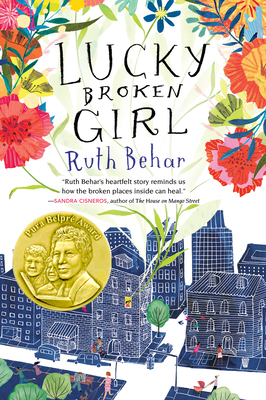 DESCRIPTION FROM THE PUBLISHERS: Ruthie Mizrahi and her family recently emigrated from Castro’s Cuba to New York City. Just when she’s finally beginning to gain confidence in her mastery of English—and enjoying her reign as her neighborhood’s hopscotch queen—a horrific car accident leaves her in a body cast and confined her to her bed for a long recovery. As Ruthie’s world shrinks because of her inability to move, her powers of observation and her heart grow larger and she comes to understand how fragile life is, how vulnerable we all are as human beings, and how friends, neighbors, and the power of the arts can sweeten even the worst of times.
MY TWO CENTS: I read this book and couldn’t put it down and then gave it to my 11-year-old son to read and he couldn’t put it down. His review was, “It’s really good,” and while I wholeheartedly agree with him, I’ll elaborate. Ruth Behar does a great job capturing the voice and thoughts of a young girl immigrating to the United States from Cuba. Ruti, the young protagonist, shares her insights about what it is like to be smart, yet treated as if she were “dumb” because she can’t speak English.
As a reader, I found myself joyfully cheering for her to succeed and then devastated when she is injured in an accident, only to find myself re-engaged in rooting for her as she embarks on a journey to regain to her childhood body and the ease of movement she once had. I fell in love with her bohemian neighbor whose child-like appreciation for fun and non-traditional ways of living made me want to copy his interior design tips and decorate my house with piñatas. Behar doesn’t sugar coat the immense challenges of immigrant life, including financial troubles, family tensions and jealousies. Nor does she hide the emotional complexity of love, sacrifice and resentment that Ruti’s mother experiences when she finds herself in the role of 24-hour caretaker for her bed-bound daughter. Behar is also able to capture the volatility of friendships and did a great job bringing me along as Ruti first adores a girlfriend, then feels betrayed by her, and ultimately understands her motivations. The added texture to the story is that Ruti is a Cuban-Jew, which adds another dimension to her arrival in the United States as she encounters friends from different religious (and cultural) backgrounds. As she experiences the beauty of multicultural friendship, she also learns about the boundaries such friendships can have.
In writing with such honesty, Behar allows the reader to examine his/her own assumptions, biases and prejudices and pushes us to consider what is gained by the immigrant experience, but also what is lost in that transition. This book would have automatic appeal to an immigrant child, but clearly a much wider appeal given that both my son and I are U.S. born and we were immediately captivated by the story Behar has to tell.
TEACHING TIPS: This book is a wonderful companion to courses related to English, U.S History, Social Studies, Civics/Civic Engagement, Religious Studies, Economics and Health. I’d recommend assigning a few chapters at a time and bringing students along the various stages of Ruti’s arrival in the United States. It is a particularly compelling story to use for any discussion of immigration into the United States and what life is like from the perspective of a young immigrant. There are rich conversations to be had related to assumptions, biases and prejudices. It is also a great way to teach empathy, as readers get a sense of what it is like to be in need of care taking and to be the care taker as they are learning about life from the perspective of a newcomer.
From an economic standpoint, there are many layers of lessons and conversations that can be facilitated about the role of consumerism and “wanting” something. What are the actual costs of the thing and what are the hidden costs and the opportunity costs? In this regard, I’m thinking, in particular, about the role that the family automobile played in Ruti’s life.
There are also discussions about the impact of making choices: the choices to drink, how much to drink, whether to drive when drinking and what the consequences of various choices can be.
There are also some very rich conversations to have about friendship:
- How do you know when someone is your friend?
- What’s the difference between a friend and an acquaintance?
- What role do friends play during hard times?
- What happens if something happens to a friend that is hard for you to deal with?
FOR MORE INFORMATION about Lucky Broken Girl, check your local public library, your local bookstore or IndieBound. Also, check out Goodreads, Amazon, and Barnes & Noble.
 ABOUT THE AUTHOR (from her website): As a storyteller, traveler, memoirist, poet, teacher, and public speaker, Ruth Behar is acclaimed for the compassion she brings to her quest to understand the depth of the human experience. She now makes her fiction debut with Lucky Broken Girl, a novel for young readers about how the worst of wounds can teach a child a lesson about the fragile, precious beauty of life. Born in Havana, Cuba, she grew up in New York, and has also lived in Spain and Mexico. Her recent memoirs for adults, An Island Called Home and Traveling Heavy, explore her return journeys to Cuba and her search for home as an immigrant and a traveler. She was the first Latina to win a MacArthur “Genius” Grant, and her honors also include a John Simon Guggenheim Fellowship, a Distinguished Alumna Award from Wesleyan University, and an honorary doctorate in Humane Letters from the Hebrew Union College. She is an anthropology professor at the University of Michigan and lives in Ann Arbor, Michigan.
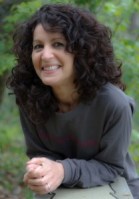 ABOUT THE REVIEWER: Maria Ramos-Chertok is a writer who lives in Mill Valley, CA. She is the founder and facilitator of The Butterfly Series, a writing and creative arts workshop for women who want to explore what’s next in their life journey. Her work, most recently, has appeared in San Francisco’s 2016 Listen to Your Mother show (www.listentoyourmothershow.com) and in the Apogee Journal of Colombia University. Her piece Meet me by the River will be published in Deborah Santana’s anthology All the Women in my Family Sing (2017) and she will be reading in San Francisco’s LitCrawl in October 2016. For more information please visit www.mariaramoschertok.com

 “My name is Marisol McDonald, and I don’t match. At least, that’s what everyone tells me.”
 When Isobel is invited to Aunt Luisa’s for Hanukkah, she’s not sure what to expect. Aunt Luisa has recently arrived from Mexico. “At Aunt Luisa’s you’ll get to celebrate the Hanukkah Moon,” Isobel’s father promises. Isobel’s days at Aunt Luisa’s are filled with fun and surprises — a new camera, a dreidel pinata filled with sweets, and a mysterious late night visit to welcome the luna nueva, the new moon that appears on Hanukkah. An unusual Hanukkah story with a multi-cultural focus, this title celebrates a little-known custom of the Latin-Jewish community.
 Jalapeno bagels are the delicious coming together of two cultures as the son of a Jewish baker and his Mexican wife decides what to bring to school for International Day. This warm story, illustrated by rich watercolors, comes complete with recipes for all the items that Pablo helps his parents make. Full color.
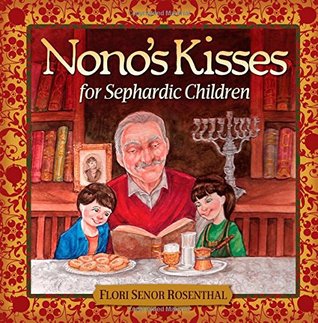 “Nono’s Kisses for Sephardic Children” is Flori Senor Rosenthal’s first of the Legacy and Literacy Scholastics Series. The book contains beautiful illustrations representing Ladino phrases. It was written to teach and encourage the usage of the Ladino language to children between the ages of 4 and 9. However, all ages will enjoy it and find it useful. Ladino or Judeo-Spanish is the language of Sephardic Jews. According to the United Nations, it is an endangered language. With each Ladino phrase found in the book, there is a question relating to its picture. This question, engages the parent and child into conversation. Ladino vocabulary words, pronunciations and English translations are provided to be used in these and other conversations and games between parents and their children. To make the learning experience even more fun, there is a hidden butterfly, in every illustration, to be found by the child. Ms. Senor Rosenthal’s father inspired her to write “Nono’s Kisses for Sephardic Children”. She wrote it to honor a tradition known specifically to Sephardic Jews. The book is an extraordinary teaching and learning tool for Ladino, and the Sephardic culture. However, those interested in the Spanish language and its history will also find this book interesting. Ms. Senor Rosenthal believes that her series will spark renewed interest in the Ladino language with the goal of having it removed from the endangered language list.
 Lola Levine likes writing in her diario, sipping her mom’s cafe con leche, eating her dad’s matzo ball soup, and playing soccer with her team, the Orange Smoothies. So what if she doesn’t always fit in?
 An eleven-year-old’s world is upended by political turmoil in this “lyrically ambitious tale of exile and reunification” (Kirkus Reviews) from an award-winning poet, based on true events in Chile.
 Emily is a Jewish girl from the suburbs of New York. Her mother has family in Puerto Rico, but Emily has never had contact with them- ever. Then Emily’s grandmother dies and Emily is forced to go to the Caribbean for her funeral. Buttoned-up Emily wants nothing to do with her big, noisy Puerto Rican family, until a special person shows her that one dance can change the beat of your heart.
 Shirin is an Iranian princess; Ingrid, a German-Canadian eccentric; and Vivien, a Cuban-Jewish New Yorker culinary phenom. The three are roommates at a Swiss boarding school, where they spend their summers learning more than French and European culture. As the girls’ paths cross and merge—summers together, school years separate—they navigate social and cultural differences and learn the confusing and conflicting legacies of their families’ pasts. In the spirit of The Sisterhood of the Traveling Pants, Shirin, Ingrid, and Vivien grow together even when they are apart, forming unbreakable bonds along the way.
 AUTHOR: Marjorie Agosín was born in Maryland and raised in Chile. She and her parents, Moises and Frida Agosín, moved to the United States due to the overthrow of the Chilean government by General Pinochet’s military coup. Coming from a South American country and being Jewish, Agosín’s writings demonstrate a unique blending of these cultures. Agosín is well known as a poet, critic, and human activist. She is also a well-known spokesperson for the plight and priorities of women in Third World countries. Her deep social concerns and accomplishments have earned her many awards and recognitions, and she has gained an international reputation among contemporary women of color.
 Latinxs in Kid Lit