Spotlight on Latina Illustrators Part 1: Angela Dominguez, Juana Medina, and Ana Aranda

By Cecilia Cackley

This is the first in a series of posts spotlighting Latina illustrators of picture books. Some of these artists have been creating children’s books for many years, while others will have their first book out this year. Some of them live in the US, while others live overseas. They come from many different cultural backgrounds, but are all passionate about connecting with readers through art and story. Please look for their books at bookstores and libraries!

Angela Dominguez
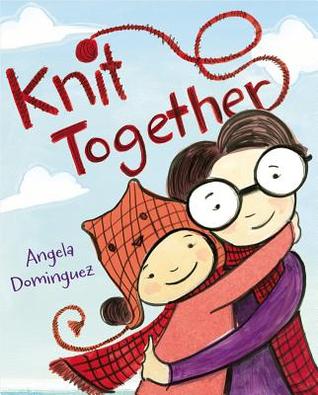
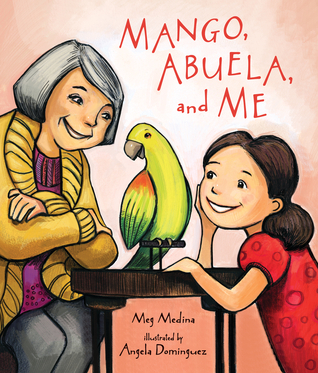
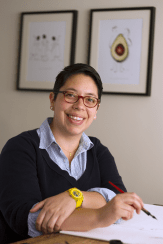
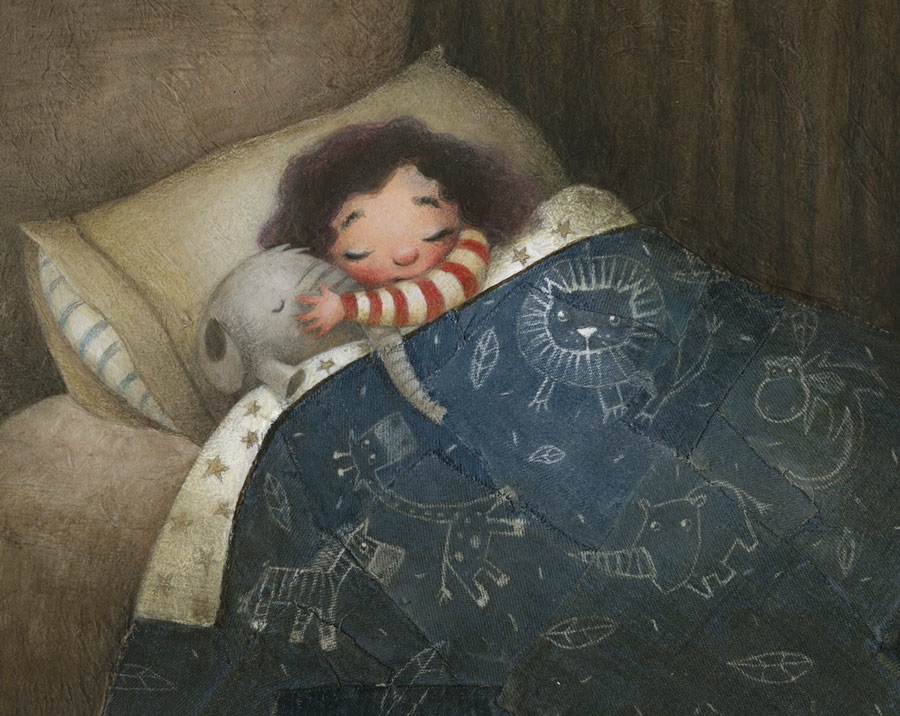
Angela DominguezAngela Dominguez was born in Mexico City, grew up in the great state of Texas, and lived in San Francisco. She’s the author and illustrator of picture books such as Let’s Go Hugo!, Santiago Stays, Knit Together, and Maria Had a Little Llama, which received the American Library Association Pura Belpré Illustration Honor. Recently, she received her second Pura Belpré Honor for her illustrations in Mango, Abuela, and Me written by Meg Medina. Her new books How do you Say?/Como se Dice?  and Marta, Big and Small (by Jen Arena), will both be published later this year. To see more of Angela’s work, visit her website, blog or twitter.

Q: What inspired you to become an artist?

A: Like many of my artist friends, I’ve always liked to draw. Growing up, I was obsessed with books and art in general. I’d spend evenings watching VHS tapes and drawing all night (if I wasn’t doing homework). Still, I didn’t really consider art something I could do professionally until high school. Fortunately, my high school really had a great art program and teachers who were supportive. Then I received a partial scholarship to Savannah College of Art and Design based on my skills and academics. That sort of sealed my fate as a professional artist.

Q: Tell us about your favorite artistic medium.

A: I still love drawing with pencil. It feels so good in my hand. I even love the way a freshly sharpened pencil smells. I also enjoy working with ink especially with a dip pen and brush. I just like how there is less control. It forces you to work boldly and confidently. My last favorite medium is tissue paper. I just really enjoy collage and the texture it produces. It’s really fun to work with all three at the same time. In graduate school when I saw that Evaline Ness worked that way, I was inspired to do it even more!

Q: Please finish the sentence “Picture books are important because…”

A: Picture books are important because they can speak universal truths to people of all ages. They can make you cry and laugh all in the same little book. (Also there are pictures!)

14933584  17245526  22504706  15937128  23153010  25066557  24727082  25688982


Juana Medina

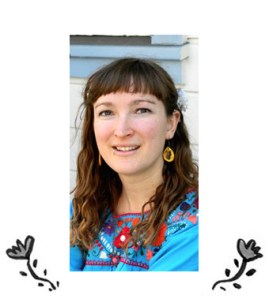
Photo by Silvia Baptiste

Photo by Silvia Baptiste

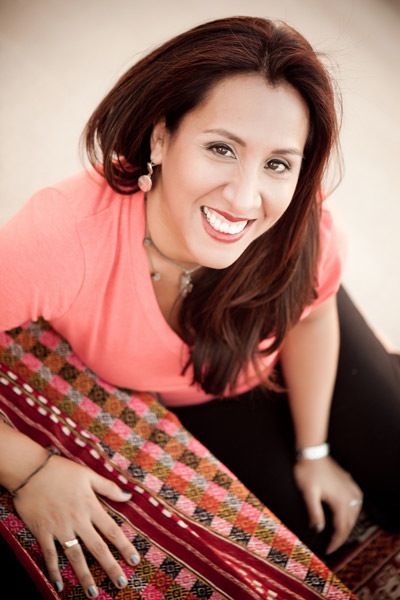
Juana Medina was born in Bogotá, Colombia, where she grew up, getting in a lot of trouble for drawing cartoons of her teachers.

Eventually, all that drawing (and trouble) paid off. Juana studied at the Rhode Island School of Design – RISD (where she has also taught). She has done illustration & animation work for clients in the U.S., Latin America, & Europe.

She now lives in Washington, DC. where she teaches at George Washington University. Juana draws and writes stories from a big and old drafting table, in an even older -but not much bigger- apartment.  Juana is the illustrator of the picture book Smick! by Doreen Cronin. Her new books 1 Big Salad: A Delicious Counting Book and Juana and Lucas will be published later this year. You can find out more about Juana on her website and blog.

Q: What inspired you to become an artist?

A: I grew up in a family where pretty much everyone had some kind of artistic outlet; my grandfather was a great draftsman, my grandma was a fantastic carpenter, my aunt a potter… everyone found a way to use arts as a way to express themselves, so it took me a while to realize not everyone in the world did this! Moreover, I went to a school that valued arts very much. So for the longest time, I thought art was just one more fabulous aspect of being human. I didn’t think of art or my ability to draw as super powers; they were simply an added feature, almost as a bonus language. Now that I recognize not everyone draws, I have dedicated a lot of time to using this ability as best as possible, to tell stories.

Q: Tell us about your favorite artistic medium.

A:  Ink is one of my favorite mediums, because I find it very expressive. I enjoy the high contrast between the stark white paper and the very dark black ink; it makes it very exciting to see lines and traces -almost magically- appear on the page.

Q: Please finish the sentence “Picture books are important because…”

A:  Picture books are important because they don’t require more than visuals -and a handful of words- to understand a story. And understanding a story can lead to a shared experience with those who have also read the book. This not only serves for entertainment purposes, but allows us to learn about other people’s feelings, struggles, and dreams. Picture books also allow us to see the world through a different point of view and they tend to teach us things we perhaps didn’t know about, like how people live in villages we’ve never visited, or what dinosaurs used to eat, or how giant squids live in the darkest, deepest waters in the ocean, all valuable lessons to be learned.

22522295


Ana Aranda

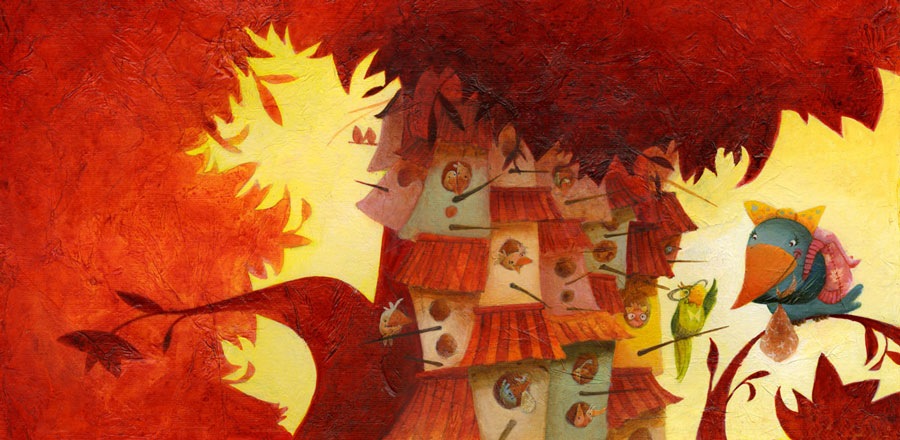
Ana ArandaAna Aranda was born and raised in Mexico City, where she studied design. From there, she moved to France, where she lived for three years while doing her undergraduate studies in illustration. Ana now lives in San Francisco thanks to a grant from the Mexican Fund for Culture and Arts (FONCA). Her biggest inspirations are her childhood memories, the vibrant colors of Mexico, and music. Her work focuses on transforming the every day into fantastical situations, and often includes images from nature and whimsical creatures. Ana’s work has been featured in different galleries and museums in the United States, France, Mexico and Italy. In San Francisco, she has painted murals in the Mission District, for the Consulate General of Mexico, and for the prestigious de Young Museum. Ana’s illustrations can be found in picture books published in France and Italy. Some of her forthcoming titles include “J’ai Mal à Mon Écorce” (Éditions du Jasmin, France, 2015). She also illustrated ¡Celebracion! by Susan Middleton Elya, coming in 2016 and The Chupacabra ate the Candleabra by Marc Tyler Nobleman, coming in 2017.

Q:  What inspired you to become an artist?

A: When I was a little girl, I lived in a colorful city in Mexico called Cuernavaca, also known as the “City of Eternal Springtime”. My childhood memories in this city full of flowers always inspire me to create colorful and joyful pieces for children of all ages.

I have also been very inspired by my family, teachers, Mexican muralists and printmakers, growing up learning about women artists such as Remedios Vario and Leonora Carrington.

Q: Tell us about your favorite artistic medium.

A: I first learned to use acrylics when I was around 14 years old and fell in love with it! Since then I’ve been playing with bright colors and mixing that technique with others such as pigments, scratchboards, etc. I’m in love with color and finding how every color can be part of an emotional experience.

Q: Please finish this sentence: “Picture books are important because…”
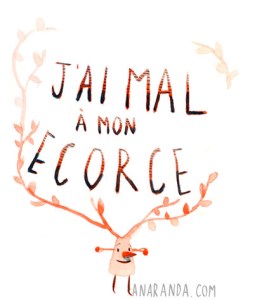
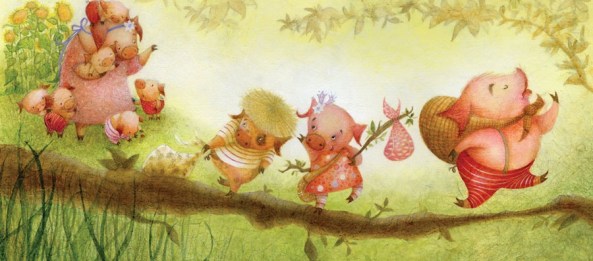
Ana Aranda Cover


A: Picture books are important because they help you travel to different worlds!


Books to Check Out:

Dominguez, Angela. Lets Go Hugo

Dominguez, Angela. Maria Had a Little Llama

Dominguez, Angela. Santiago Stays

Dominguez, Angela. Knit Together

Medina, Meg. Mango, Abuela and Me

Brown, Monica. Lola Levine is NOT Mean!

Elya, Susan Middleton. ¡Celebracion!  (coming Fall 2016)

Cronin, Doreen. Smick!

Medina, Juana. 1 Big Salad: A Delicious Counting Book (coming Summer 2016)

Illustrator Joe Cepeda Talks to Latin@s in Kid Lit, Part 2

By Lila Quintero Weaver

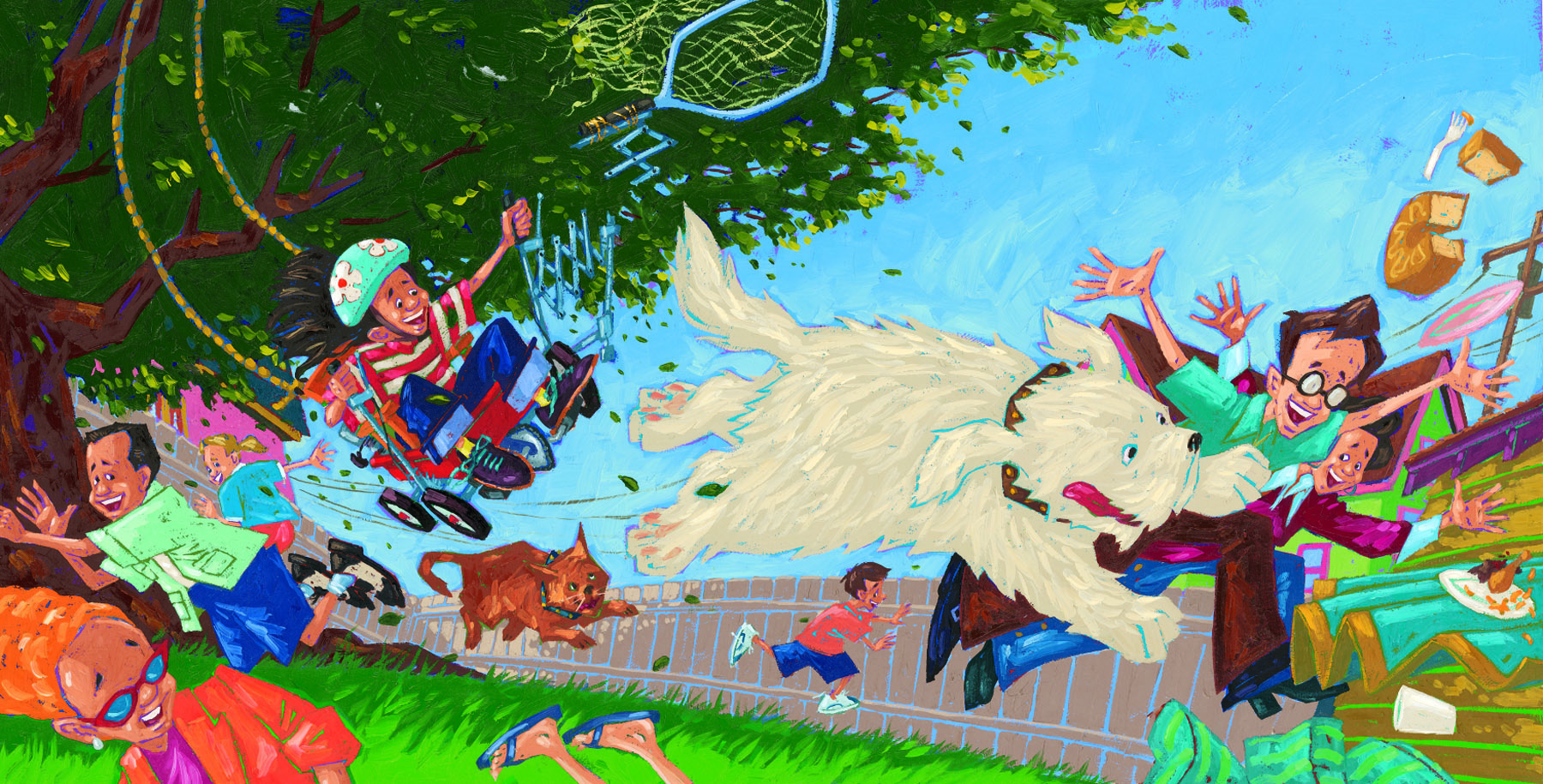
We’re continuing a fascinating conversation with acclaimed illustrator Joe Cepeda. His work graces many Latin@-themed children’s books. Did you miss the first installment? Go here.

Lila: When did your interest in art begin? How did you train for a career in illustration?

Joe: When I was young, I enjoyed drawing enough that my mom enrolled me at the Los Angeles Music and Art School in East Los Angeles, a small jewel of a place where I first tried painting. By my teens, though, I stopped going and after graduating high school found myself headed to college to study engineering. It took me awhile before I changed all of that. Initially, I thought I’d be an editorial cartoonist, but as soon as I got a brush back in my hand, I realized I wanted to do something that had an artfulness to it as well. Illustration afforded the perfect combination of content and creative articulation for me.

swing_leopoldo1

To be honest, my training was largely guided toward editorial work. I sort of fell into children’s books. Creating a piece for a magazine article is much like doing work for a cover. There is a certain amount of seduction employed in influencing a magazine reader to stop and read an article, much the way you’d want someone to pick up a book off a shelf. A combination of abstraction, mystery, emotion, and information might play a role in creating that single image that will lure the audience in.

From the books I’ve illustrated, I pretty much taught myself sequential image-making and continue to do that. With a portfolio largely lacking any real samples that reflected page-turning sensibilities, it was very fortunate that I was signed up to illustrate those first books. I believe that it was an inclination to write a picture as much as illustrate one that may have been evident to my first editors and art directors. They seem to have responded to that and took a risk. I’m grateful to them for doing so.

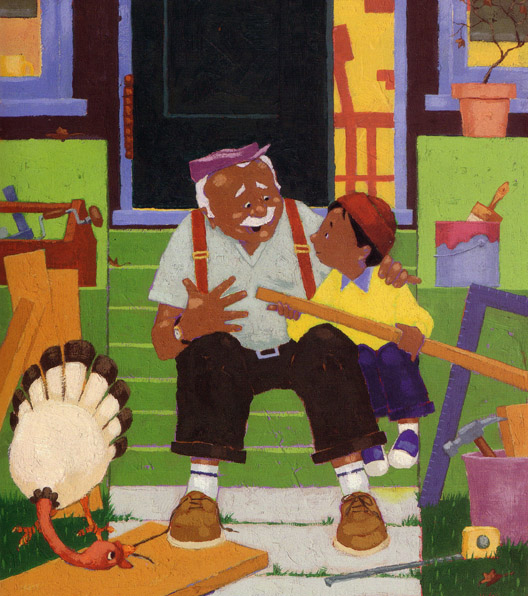
GraciasGrandfather_72cropped

Lila: Most of us have no idea how an illustrator goes about his work. Can you give us a tour of the process?

Joe: In many ways, the real work is done throughout the sketch phase. For editorial work, I usually create a few alternate ideas for a director to choose from. The sketches need to be tight enough for the director to envision the finished art.

For books, the sketch process is more comprehensive. The first sketches are thumbnails in which I mostly brainstorm, trying to find the basic rhythm, character introduction, action, choreography of the story, etc. The second phase of sketches, laid out as a dummy (a design/template that allows you to see the whole book planned out) focuses on the essential content of the story, as well as soundly composing the images. This is the working plan to be shared with editors and art directors. It’s important to understand that this design is as much for others as it is for oneself. This is where mistakes are caught.

Finally, in the last draft of sketches, details are included to a more specific degree. The emotions of your images many times are expressed in the details of your illustrations. It’s where things become funny, scary, thrilling, suspenseful, etc. This shouldn’t be confused with complexity—a simple picture has as much power as an ornate one. Once the dummy is okayed, it’s on to the finished work. Almost all of my books have been executed as oil paintings over acrylic under-paintings on illustration board. A recent book I illustrated was delivered as digitally rendered finishes. Whatever your medium of choice, the more confident you are of your plan, the more enjoyable the last part of the process will be. I leave color out of the initial plans because I prefer to be responsive when it comes to that, leaving a level of spontaneity for the end.

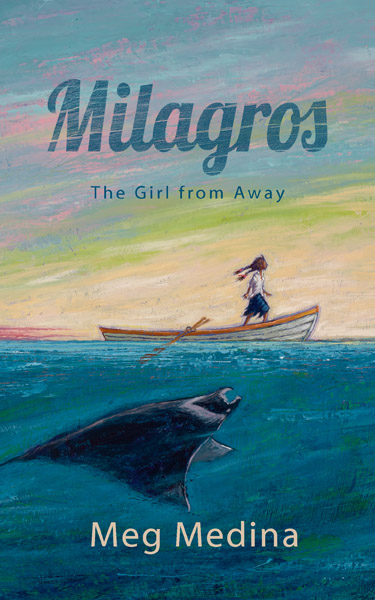
Milagros_jacket_finish72Lila: Let’s close out this conversation by returning to a book cover, the one you recently did for the e-book version of Meg Medina’s Milagros: A Girl from Away. It’s breathtaking, truly exceptional. I know Meg was thrilled with it!

Joe: Thanks for the kind words. Milagros is a great story and it was a wonderful opportunity to illustrate the cover of the e-book. After reading the manuscript, I couldn’t help responding to Milagros as a girl between two worlds. It’s the “between” part that intrigued me as a source for creating a provocative image. Milagros is not only traveling from one place to another, as she does in the story, she’s also between the clarity of a wide-open sky and the deep mystery and profundity of the ocean. The magical realism of the story, in my mind, calls for a more symbolic and open-ended image. Alternative ideas depicted Milagros closer to the viewer, larger in the design. This would emphasize Milagros more. A reader might respond to that kind of image, “That girl looks like me, i want to read about her.” It’s certainly popular to create covers that are more character-based, but, I’m glad that we decided to go the other way, that is, emphasizing the mystery, the peril of the journey, and the hopefulness and optimism of Milagros’ spirit. A reader here might ask, “Where is that girl going? What is she facing? Is she lost? Is she on her way somewhere? Is she safe? Will she get there? What will she find? Keeping her small in the design also helps the reader ask, “Who is she?” My first sketches didn’t include the manta ray, inclined to depict Milagros navigating her way alone, but, as we discussed, it’s a central part of the story. I’m glad mantas are such mysterious and, perhaps, very poetic creatures. I wanted it to have an ambiguous posture… is it a threat to her, or is it a witness, or, even something more? For me, the more questions you ask when looking at a cover, the better a cover does its job.

“““““““`

To learn more about Joe’s craftsmanship and illustration technique, see this extensive interview by Kathleen Temean.

Want to see Joe in his studio and hear more of his story? Here’s a video interview, worth the double click-through!

http://www.youtube.com/watch?v=ExxVgkZeX0o


The Road to Publishing: Juana Martinez-Neal on Landing an Agent

By Lila Q. Weaver

Since Juana Martinez-Neal is an illustrator, writers might be tempted to skip her how-I-landed-an-agent story. Don’t! Anyone seeking professional success will find value here. In the following interview, she shares her journey to the 2012 Showcase Portfolio Grand Prize at the SCBWI Los Angeles conference, a coup that led to agent representation and many great opportunities. No matter your craft, Juana’s approach serves as a model of careful study and preparation, which on top of her brilliant art skills, gave her the winning edge. In today’s competitive world of publishing, that’s a lesson we can all put to good use.

Latin@s in Kid Lit: Were you a published illustrator before winning the portfolio award at the SCBWI conference? If so, how did you get jobs?

Juana: Before the Portfolio Grand Prize, I was published by smaller publishers, the educational market, and advertising companies. My jobs would come from paid, online portfolios, such as childrensillustrators.com. I would also email samples to art directors that accepted email submissions. I never got around to sending postcards to a mailing list. That was a mistake! I would also attend SCBWI regional and national conferences. Whenever these conferences offered portfolio shows, I entered mine and paid for critiques. Critiques are a great way to put your work in front of editors and art directors.

Latin@s in Kid LitHow did you prepare for the SCBWI portfolio show? The competition must have been fierce!

Juana: Illustration, much like writing and every other profession, requires everyday practice. If you rush to get twelve new pieces ready a month or two before a portfolio show, chances are, your pieces will be decent. But decent doesn’t win a show. You must work everyday, year round.

The selection process is simple and repeats every year that I attend the SCBWI LA Conference. A month-and-a-half beforehand, I select fifteen to eighteen favorite pieces from everything I’ve done within the last twelve months. After printing them at 8.5” x 11”, I meet with my illustrator friends, who help me choose eight to twelve of the strongest ones. On my blog, I have a series of posts about portfolios, including how to put together a children’s illustrator portfolio, a comparison of my 2011 and 2012 portfolios, and a how-to on mounting artwork

Image

Most of the time, we recognize outstanding work before we produce outstanding work. Ira Glass said it beautifully here:

“What nobody tells people who are beginners — and I really wish someone had told this to me . . . is that all of us who do creative work, we get into itbecause we have good taste. But there is this gap. For the first couple years you make stuff, and it’s just not that good. It’s trying to be good, it has potential, but it’s not. But your taste, the thing that got you into the game, is still killer. And your taste is why your work disappoints you. A lot of people never get past this phase. They quit. Most people I know who do interesting, creative work went through years of this. We know our work doesn’t have this special thing that we want it to have. We all go through this. And if you are just starting out or you are still in this phase, you gotta know it’s normal and the most important thing you can do is do a lot of work. Put yourself on a deadline so that every week you will finish one story. It is only by going through a volume of work that you will close that gap, and your work will be as good as your ambitions. And I took longer to figure out how to do this than anyone I’ve ever met. It’s gonna take awhile. It’s normal to take awhile. You’ve just gotta fight your way through.” –  Ira Glass on Storytelling: http://www.youtube.com/watch?v=BI23U7U2aUY

When we put this into practice, there comes a time when our work starts matching our expectations. Our hand starts painting what our brain has envisioned. At that point, we may be ready. I didn’t know I was ready to win when I did. I knew my portfolio was decent, and I knew that eventually I would win—but not that year. I thought: I will win in 2014. I gave myself two more years.

In 2012, I was pregnant and putting my portfolio out because the following year I would have a baby to take care of and would have to miss the conference. There is an action of letting go that generates energy. That energy makes things happen and surprises us in the most wonderful ways.

Latin@s in Kid LitAfter you won the portfolio award, did agents approach you at the conference or through e-mails and phone calls? Tell us a little bit about that.Image 3

Juana: Agents can approach you all different ways if they are interested. In my case, I met Stefanie Von Borstel, of Full Circle Literary, at the Portfolio Showcase. She had been one of the judges and enjoyed looking at my work. We talked during the conference a few times and stayed in touch. Three months later, we signed a contract.

I think it’s important to meet the agents you are interested in. Listen to yourself during that first call or meeting. You need to feel comfortable and communicate easily with her/him. You will be working with that person for what you hope is the rest of your career. We are all so eager to get representation that sometimes we may let warning signs slide. Please don’t. Listen to them. You don’t want to waste time.

Latin@s in Kid LitYour experience shows how helpful conference attendance can be for connecting with agents.

Juana: If there are agents presenting at breakout sessions, go listen to them. You’ll get a great sense of who they are and how they work. You will be able to tell if you could work together. Personality counts. I’ve seen some rather quiet, introverted friends with agents that are their complete opposites. Their relationships work wonderfully. They complement each other.

Latin@s in Kid LitWhat difference has it made to your work to have an agent representing you?

Juana: Having Stefanie as my agent has improved my work. Her comments come from someone who knows this industry so well. She helps me find direction when I’m feeling a bit confused. An agent will help you polish your manuscripts and dummies and get them ready for editors and art directors. I also love the fact that they will take care of the contracts. There is so much I am not aware of when it comes to legal matters.

Latin@s in Kid Lit: What are some other tips for illustrators on getting the attention of art directors and agents?

  • Create work consistently, continuously.
  • Stay busy. If you have no paid projects, give yourself assignments regularly. Set some deadlines for yourself.
  • Keep your portfolio updated. Post new work regularly, but post only your BEST work.
  • Mail postcards consistently, every three to four months. Be critical when selecting names. A mailing list of 80 can be very effective. Send postcards to anyone you would love to work with.
  • Look into agents’ clients and books. Follow them on Twitter. See if your work is a good match. Keep in mind that if they have someone with a style too similar to yours, chances are, you won’t be picked. Why have two artists that do almost the same work?

******

Image 2Juana Martinez-Neal was born in Lima, Peru, to an artistic family. At 16, she was already laying the groundwork for a career in children’s illustration. She now lives in the United States. Her work has been featured in Babybug, Ladybug and Iguana magazines, and recently made the cover of the SCBWI Bulletin. See more of Juana’s glorious gallery at her website, where you can also take advantage of detailed tutorials on portfolio selection and assembly and read fascinating illustrator interviews.