
By Cecilia Cackley
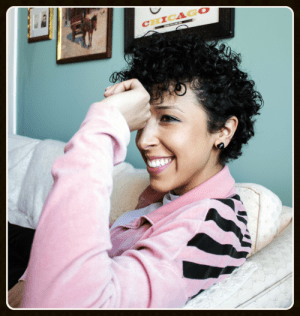 Jacqueline Alcántara was featured in a previous round-up of Latina illustrators here on Latinxs in Kid Lit. When I found out she was also the inaugural recipient of a mentorship from the We Need Diverse Books organization, I wanted to find out more about her experience in the program and how it affected her work. Alcántara worked with the illustrator Carolyn Dee Flores (who has also participated in a Latina Illustrators post) as her mentor and recently announced her second book deal. She will illustrate the book Freedom Soup by Tami Charles, which will be released by Candlewick Books in 2019. She will also illustrate The Field by Baptiste Paul, which is scheduled to release with NorthSouth Books in Spring 2018.
How did you hear about the WNDB mentorship and what made you decide to apply?
A friend/illustrator in my critique group forwarded me the email announcing the mentorship. He knew my work included a lot of diverse characters and knew that my interests were in pursuing projects that featured diverse main characters, so thankfully, he assumed I would be a good fit! At that time, I knew that I needed someone to help guide me, give me feedback on my work, grow my network, and help me build confidence. I wasn’t sure if that would be a friend, agent, editor, or mentor but was doing everything I could to find relationships like that. I decided to apply because it was honestly exactly what I was looking for!
What has been the best part about working with your WNDB mentor?
I think the best part of a mentor/mentee relationship is that there’s no other reason you are working together, other than to improve your work and career. Relationships with other people in the industry, i.e. agents, editors, fellow illustrators, etc are wonderful and critical as well, but there are quickly a lot of other factors those people can be thinking about in addition to your work when giving you advice or suggestions. Conversations with my mentor helped not only to allow me to see a path for myself within the industry, but also to see my strengths and weaknesses as an artist. Carolyn is brutally honest, which I love. She has really wonderful instincts and fantastic advice. I believe a lot in instincts and trusting my gut, but working alone and pursing this dream can become really difficult. Carolyn is always reminding me to trust my instincts and to have fun! So I built up a lot of confidence in myself relatively quickly once we started working together. Not only confidence in my actual illustrations, but in goals, ideas, and direction of my career. I also felt a pressure to succeed, now that I had not only Carolyn, but WNDB holding me accountable! When you work for yourself, there is no one to push you or hold you accountable, so it requires a lot of self confidence and motivation. The boost I got from WNDB was great for that, but I also knew I finally had the resources to make it happen!
The next best part of working with my mentor was that fact that Carolyn introduced me to Adriana Domínguez at last winter’s SCBWI conference. Adriana and I continued talking for months after that and I ultimately signed with her and Full Circle Literary over the summer. That was the best possible outcome from the mentorship, and it actually happened! Relatively soon after working with Adriana, I got my first picture book offer. I’m very happy to share that I’m now working on 2 books, one with North South and the second with Candlewick. The first will be released in 2018, and the second in 2019. I cannot wait for them to come out!
What other artists and writers do you consider your greatest influences (kidlit or not)?
In the kid lit world, my greatest influences are Chris Raschka, Patricia Pollacco, Chris Van Allsburg, and Kadir Nelson. As for traditional artists I’m a bit cliche; Picasso, Matisse, and Redon are some top favorites. Picasso’s sketchbooks are a constant source of inspiration for me. Redon and Matisse, I love their use of color and the imagination they brought into their work. I’ve also been in love with Japanese Ukiyo-e art since I was young. I think a lot of my energy and inspiration also comes from music. I have music on constantly in my studio, different genres depending on what I’m doing, but there’s a lot of electronic, disco/soul, hip hop. My favorite writer (currently) is Neil Gaiman.
You were a high school art teacher at one point. Do you think your students influenced your work, and if so, how?
I taught high school art for a short time before school funding was cut significantly in Illinois. Our department (along with many art departments state-wide) saw massive cuts, so I took the opportunity to push my own artistic career. I will always be influenced by my time teaching (I hope to still have teaching opportunities in the future) and the students I had! Remembering a personality, hairstyle, attitude, or name for character can be inspiration—or remembering a conversation or story a student shared about their life. I left teaching wanting to be a successful working artist, but I also wanted to do work that would directly influence, inspire, and speak to children.
What advice would you give other Latinx artists who might want to apply for the WNDB program?
Be open to everything. Participating in this program has led to so many other relationships and opportunities, and has launched my career. WNDB has really opened the door for a lot of people, beyond those who have received mentorships or grants. They are bringing the issue to the forefront of the industry, and editors and agents are definitely listening and searching for new diverse talented writers and illustrators. It’s been so encouraging. It’s an industry that can seem daunting and a job that seems too good to be true. It takes a lot of patience and time, but it’s really important work, so if you are thinking of pursuing it, get involved ASAP! It’s much more fun to do with a network of people around you, and SCBWI (the Society of Children’s Book Writers and Illustrators), WNDB and others are all fantastic ways to do so.
 Cecilia Cackley is a performing artist and children’s bookseller based in Washington, DC, where she creates puppet theater for adults and teaches playwriting and creative drama to children. Her bilingual children’s plays have been produced by GALA Hispanic Theatre and her interests in bilingual education, literacy, and immigrant advocacy all tend to find their way into her theatrical work. You can find more of her work at www.witsendpuppets.com.
 Ana writes: “This cover design was created in watercolor, inks and gouache. I’m so happy to share with everyone the face of an unknown, mysterious and mischievous creature: the chupacabra!”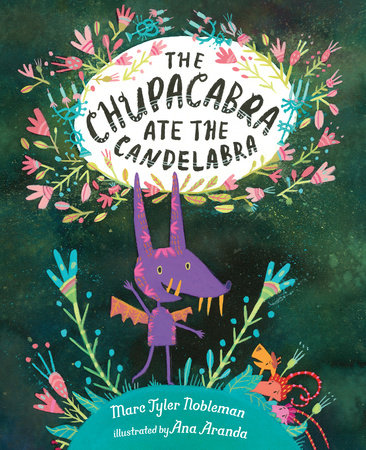
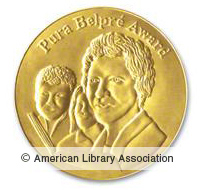 The
The 
 ABOUT THE AUTHOR-ILLUSTRATOR (from her
  Marianne Snow Campbell
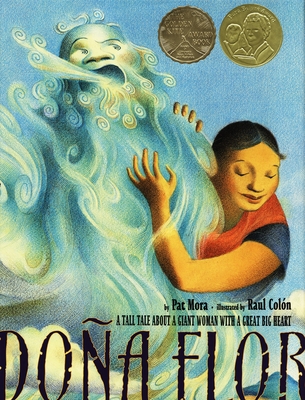 DESCRIPTION FROM THE PUBLISHER: Doña Flor is a giant lady who lives in a tiny village in the American Southwest. Popular with her neighbors, she lets the children use her flowers as trumpets and her leftover tortillas as rafts. Flor loves to read, too, and she can often be found reading aloud to the children.
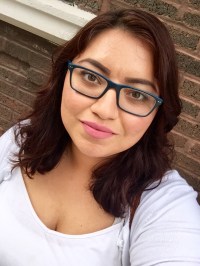 Dr. Sonia Alejandra Rodriguez’s research focuses on the various roles that healing plays in Latinx children’s and young adult literature. She currently teaches composition and literature at a community college in Chicago. She also teaches poetry to 6th graders and drama to 2nd graders as a teaching artist through a local arts organization. She is working on her middle grade book. Follow Sonia on Instagram @latinxkidlit


 Dr. Sonia Alejandra Rodriguez’s research focuses on the various roles that healing plays in Latinx children’s and young adult literature. She currently teaches composition and literature at a community college in Chicago. She also teaches poetry to 6th graders and drama to 2nd graders as a teaching artist through a local arts organization. She is working on her middle grade book. Follow Sonia on Instagram @latinxkidlit
 In Los Gatos Black on Halloween, the colors are layered, allowing some characters to be visible through the transparent ghosts and building up as more and more ghostly characters join what eventually becomes the monster ball in an old abandoned house. The color palette is dark and rich, contrasting the glowing moon and night sky with colored tombstones and the interior of the old mansion. Morales plays with scale and perspective to lend an otherworldly look to the spreads; sometimes we only see a pair of legs dangling over a broomstick or the round face of a ghost as its tail extends right off the page.
 The colors in Just a Minute are brighter and the spreads less crowded than Los Gatos Black on Halloween, but the story they tell is just as dynamic. This was Morales’ first project as both author and artist, and she keeps the story moving at a fast pace as Grandma goes from cleaning to cooking, to decorating. Subtle touches of color make Señor Calavera a less scary figure for the youngest readers, including the flowers for eyeballs and the expressive mouth that finally turns into a smile. As befits a heroine who is using action to delay Señor Calavera, Grandma Beetle’s poses are precise and sharp, whether she is placing cheese in a frying pan or leaning over to put pots in the oven. Grandma’s eyes and face express her cleverness and care as she watches Señor Calavera from across the room or gives a wink while chopping up fruit. Perspective shifts reinforce the upside-down nature of this story; the floor of Grandma’s house seems to tilt as we first see Señor Calavera in close-up, peeking over her shoulder and then far away in the corner of the room, stamping his foot in frustration. The little cat’s reactions to Señor Calavera are a humorous touch, and readers will enjoy finding it on each spread, looking curious, tentative or scared, depending on the page. Readers will love the final note left by Señor Calavera and cheer for Grandma Beetle, who was so resourceful in buying herself a little more time on Earth.
 Morales brings more texture and mixed media to the illustrations in Just in Case, her second effort as both author and artist. Perhaps because most of the action in the book takes place in the cemetery, rather than in Grandma’s house, the backgrounds are looser and the characters float around on the page. The new character Zelmiro the ghost blends in with the background color on each spread as he advises Señor Calavera on what to give Grandma Beetle for her birthday. The list of presents grows with the alphabet, and Morales keeps things interesting by not just including objects such as the accordion but also actions such as cosquillas (tickles) and natural phenomena like niebla (fog). One of my favorite things about this book is that it follows the Spanish, rather than the English alphabet, including letters I learned as a child, like ‘Ch’, ‘Ll’ and ‘Ñ’. Depending on where you are in the Spanish-speaking world, ‘ch’ and ‘ll’ aren’t taught as separate letters anymore, so it was nice to see them here! Some of the presents are words commonly taught in Spanish classes, such as ‘escalera’ or ‘semilla,’ but others are more colloquial and region-specific like ‘granizado’ and ‘ombligo.’ The specificity in both language and image are lovely. Careful readers will note that the historieta (comic book) that Señor Calavera gives Grandma is a handmade version of Morales’ earlier book Just a Minute and will also find the reason for the spectacular bicycle crash that ruins all the presents.
 Yuyi Morales
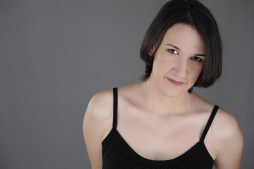 Cecilia Cackley is a performing artist and children’s bookseller based in Washington DC where she creates puppet theater for adults and teaches playwriting and creative drama to children. Her bilingual children’s plays have been produced by GALA Hispanic Theatre and her interests in bilingual education, literacy, and immigrant advocacy all tend to find their way into her theatrical work. You can find more of her work at
  Latinxs in Kid Lit