
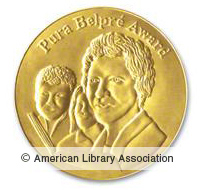
 The Pura Belpré Awards turns 20 this year! The milestone will be marked on Sunday, June 26, from 1:00-3:00 p.m. during the 2016 ALA Annual Conference in Orlando, FL. According to the award’s site, the celebration will feature speeches by the 2016 Pura Belpré award-winning authors and illustrators, book signings, light snacks, and entertainment. The event will also feature a silent auction of original artwork by Belpré award-winning illustrators, sales of the new commemorative book The Pura Belpré Award: Twenty Years of Outstanding Latino Children’s Literature, and a presentation by keynote speaker Carmen Agra Deedy
Leading up to the event, we will be highlighting the winners of the narrative and illustration awards. Today’s spotlight is on Raul Colón, the winner of the 2006 Pura Belpré Illustration Award for Doña Flor: A Tall Tale About a Giant Woman with a Great Big Heart. Colón also received Pura Belpré Illustration Honors for Portraits of Hispanic American Heroes and My Name is Gabito: The Life of Gabriel García Márquez/Me llamo Gabito: la vida de Gabriel García Márquez.
Review by Sonia Alejandra Rodriguez
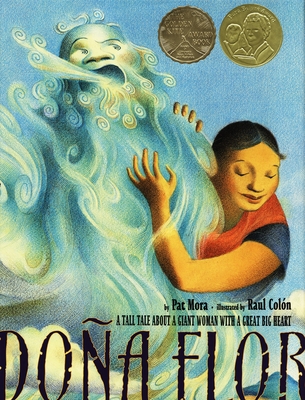 DESCRIPTION FROM THE PUBLISHER: Doña Flor is a giant lady who lives in a tiny village in the American Southwest. Popular with her neighbors, she lets the children use her flowers as trumpets and her leftover tortillas as rafts. Flor loves to read, too, and she can often be found reading aloud to the children.
One day, all the villagers hear a terrifying noise: it sounds like a huge animal bellowing just outside their village. Everyone is afraid, but not Flor. She wants to protect her beloved neighbors, so with the help of her animal friends, she sets off for the highest mesa to find the creature. Soon enough, though, the joke is on Flor and her friends, who come to rescue her, as she discovers the small secret behind that great big noise.
The creators of Tomás and the Library Lady, Pat Mora and Raul Colón, have once again joined together. This time they present a heartwarming and humorous original tall tale—peppered with Spanish words and phrases—about a giant lady with a great big heart.
MY TWO CENTS: Doña Flor, written by Pat Mora and illustrated by Raul Colón, tells the story of a giant woman that sleeps on clouds and makes piles of big tortillas. She protects her village from harm and she must do just that when the villagers inform her that a giant mountain lion threatens their safety. The biography of Raul Colón included on the dust jacket describes his illustrations as “an intriguing combination of watercolor washes, etching, and colored and litho pencils.”
When I look at Colón’s illustrations, the etchings remind me of fingerprints. The loops, the arches, the whorls, and all the lines that we might associate with fingerprints are visible in Colón’s illustrations. I am not familiar with techniques or the technicalities of etching and in saying that the illustrations remind me of fingerprints I do not mean to devalue the art in any way. My favorite illustration in this story is of Doña Flor using her thumb to carve out a riverbed in the village. Doña Flor is in a squatting position with her white skirt covering her thighs, and she has used her thumb to make a squiggly path for the water while the villagers look on. The riverbed has the details I associated with the fingerprints which, in this case, could be Doña Flor’s own prints.
Colón’s illustrations are beautiful, colorful, and magical. That I saw fingerprints when I looked closely at his illustrations speaks to the uniqueness of his art. While Doña Flor wears a blue shirt in most of the illustrations sometimes the shirt looks like it is embroidered and sometimes it looks like a plain T-shirt. The clouds on one page look round and fluffy and in the illustration where she’s made her bed of clouds it appears like she’s left her own fingerprints on the clouds she has gathered. Despite the uniqueness I see in his illustrations, there is certainly a sense of cohesion throughout the story. I’ve decided to focus on the etchings, the lines, and how much they appear like fingerprints because as I examined his illustrations, I also got the thought that our stories are as unique as our fingerprints. Colón’s illustrations in Doña Flor affirmed that for me. I couldn’t help but connect the details I saw in his art to the significance of the Pura Belpré award and the necessity for more Latinx children’s and young adult literature by and for Latinx.
TEACHING TIPS:
- For younger readers: Ask younger readers to pick their favorite illustration and to pick a part of the image they’d like to recreate. For example, in the illustration with Doña Flor making the river, students can attempt to recreate the river, the clouds, the trees and hills, etc. Ask students to outline their chosen part and to fill it in by dabbing their fingerprints. This will recreate the etching effect they see in the illustrations.
- For middle grade readers: Discuss with students the effect and affect of etching. Does the etching force the reader to focus in a certain direction or a certain part of the page? How do the illustrations make you feel? For example, in the illustration where Doña Flor hugs the wind the lines of the etchings point in the same direction, making it appear like she is floating away with the wind.
- For young adult readers: By the end of the story Doña Flor learns that the loud roaring frightening the village is coming from a small puma roaring into a hollow log. Discuss with students the importance of perceptions and misconceptions. How might we connect the villagers’ fear and the puma’s amplified roars to racial/ethnic stereotypes?
 Dr. Sonia Alejandra Rodriguez’s research focuses on the various roles that healing plays in Latinx children’s and young adult literature. She currently teaches composition and literature at a community college in Chicago. She also teaches poetry to 6th graders and drama to 2nd graders as a teaching artist through a local arts organization. She is working on her middle grade book. Follow Sonia on Instagram @latinxkidlit


 Dr. Sonia Alejandra Rodriguez’s research focuses on the various roles that healing plays in Latinx children’s and young adult literature. She currently teaches composition and literature at a community college in Chicago. She also teaches poetry to 6th graders and drama to 2nd graders as a teaching artist through a local arts organization. She is working on her middle grade book. Follow Sonia on Instagram @latinxkidlit
 In Los Gatos Black on Halloween, the colors are layered, allowing some characters to be visible through the transparent ghosts and building up as more and more ghostly characters join what eventually becomes the monster ball in an old abandoned house. The color palette is dark and rich, contrasting the glowing moon and night sky with colored tombstones and the interior of the old mansion. Morales plays with scale and perspective to lend an otherworldly look to the spreads; sometimes we only see a pair of legs dangling over a broomstick or the round face of a ghost as its tail extends right off the page.
 The colors in Just a Minute are brighter and the spreads less crowded than Los Gatos Black on Halloween, but the story they tell is just as dynamic. This was Morales’ first project as both author and artist, and she keeps the story moving at a fast pace as Grandma goes from cleaning to cooking, to decorating. Subtle touches of color make Señor Calavera a less scary figure for the youngest readers, including the flowers for eyeballs and the expressive mouth that finally turns into a smile. As befits a heroine who is using action to delay Señor Calavera, Grandma Beetle’s poses are precise and sharp, whether she is placing cheese in a frying pan or leaning over to put pots in the oven. Grandma’s eyes and face express her cleverness and care as she watches Señor Calavera from across the room or gives a wink while chopping up fruit. Perspective shifts reinforce the upside-down nature of this story; the floor of Grandma’s house seems to tilt as we first see Señor Calavera in close-up, peeking over her shoulder and then far away in the corner of the room, stamping his foot in frustration. The little cat’s reactions to Señor Calavera are a humorous touch, and readers will enjoy finding it on each spread, looking curious, tentative or scared, depending on the page. Readers will love the final note left by Señor Calavera and cheer for Grandma Beetle, who was so resourceful in buying herself a little more time on Earth.
 Morales brings more texture and mixed media to the illustrations in Just in Case, her second effort as both author and artist. Perhaps because most of the action in the book takes place in the cemetery, rather than in Grandma’s house, the backgrounds are looser and the characters float around on the page. The new character Zelmiro the ghost blends in with the background color on each spread as he advises Señor Calavera on what to give Grandma Beetle for her birthday. The list of presents grows with the alphabet, and Morales keeps things interesting by not just including objects such as the accordion but also actions such as cosquillas (tickles) and natural phenomena like niebla (fog). One of my favorite things about this book is that it follows the Spanish, rather than the English alphabet, including letters I learned as a child, like ‘Ch’, ‘Ll’ and ‘Ñ’. Depending on where you are in the Spanish-speaking world, ‘ch’ and ‘ll’ aren’t taught as separate letters anymore, so it was nice to see them here! Some of the presents are words commonly taught in Spanish classes, such as ‘escalera’ or ‘semilla,’ but others are more colloquial and region-specific like ‘granizado’ and ‘ombligo.’ The specificity in both language and image are lovely. Careful readers will note that the historieta (comic book) that Señor Calavera gives Grandma is a handmade version of Morales’ earlier book Just a Minute and will also find the reason for the spectacular bicycle crash that ruins all the presents.
 Yuyi Morales
 Cecilia Cackley is a performing artist and children’s bookseller based in Washington DC where she creates puppet theater for adults and teaches playwriting and creative drama to children. Her bilingual children’s plays have been produced by GALA Hispanic Theatre and her interests in bilingual education, literacy, and immigrant advocacy all tend to find their way into her theatrical work. You can find more of her work at


 Cuban-born



 Writer, illustrator, baseball lover! Learn more about Matt Tavares and his books at
  Latinxs in Kid Lit