Guest Post: How to Create Diverse Characters

by Kimberly Mitchell

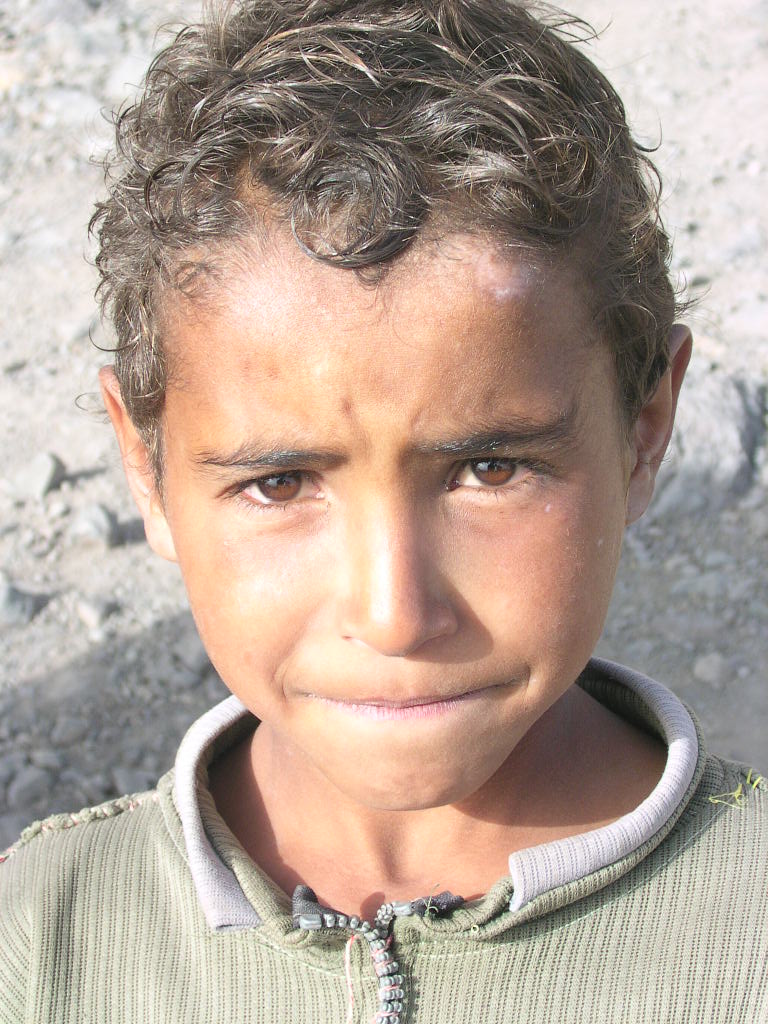
YemeniBoy

A boy from Taiz, Yemen

With the launch of the #weneeddiversebooks campaign last spring, the idea of diversity in children’s writing is everywhere these days. As the diverse books movement moves forward, all writers of kid lit should consider how to create diversity in their work.

Creating characters outside your race and ethnicity can sound daunting. It doesn’t have to be this way. My characters often represent cultures and races outside my own. In Traders of Incense, my protagonist is an Arab boy, based on my time spent in Yemen. In Pen and Quin and the Mystery of the Painted Book, Pen and Quin are Mexican American twins. My motivation behind creating these protagonists stems from my desire to connect with readers and view the world through the eyes of others.

Here are some suggestions on how to create authentic, diverse characters.

1) Mine your own background and experience.

I’ve had the chance to travel to some spectacular places, from Yemen to Peru. The people I’ve met and the cultures I’ve experienced changed the way I view the world.

Where have you traveled? It doesn’t have to be as dramatic as the Middle East. Perhaps you grew up in the South and now live in the Northeast, or vice versa. Or you came from a predominantly majority town and now work with people from different backgrounds.

Use these experiences as launching points for characters and settings in your work.

2) Consider your relationships.

Who do you hang out with? Are your friends, colleagues, and mentors different from you ethnically, economically, or culturally? If not, now is the time to examine those relationships and diversify! It’s difficult to write diverse characters when your own life doesn’t reflect diversity.

If you want to create characters outside your own experience and do so in an authentic way, you must reach out to people different from yourself with an open mind and heart. Be open with your intentions as a writer, but be authentic in your desire to develop the relationship. People love to talk about their families and traditions if you let them. My friends from other cultures and backgrounds have been great sources for me to draw on when creating my characters. Enjoy making new friends and learning new things!

3) Cultivate familiarity.

As you create your diverse characters, you must be familiar with the background and family you’ve chosen for them. Cultivating familiarity means putting yourself in a position to really know what it’s like to be your character.

It could mean studying a new language, traveling to a new city, or finding those places in your own city where your character would live, work, and play. Get familiar with it until it feels natural to you. Until that happens, your characters won’t feel authentic.

4) Do your research – and not just on Google.

Let me say that Google Earth is an amazing invention. I have used it countless times in my own work. A 360-degree street view? Yes! However, the internet cannot provide all the information you need to create your characters.

Doing your research should include finding places and people like your characters and talking to them, participating in events, and reading stories similar to your own, especially when those stories reflect the types of characters you’re creating.

5) Authenticate through readers.

This one is huge for writers creating characters outside their own backgrounds. If possible, I always include beta readers with ethnicities or backgrounds similar to my characters and ask them to read the story with an eye toward that aspect of the work.

For my story that includes Mexican-American protagonists, I asked friends who are Mexican and American, and now raising their Mexican American sons, to read the story. Listen carefully to the response of your readers, and be willing to tweak the story according to their response.

6) Be prepared for kickbacks.

As hard as you try, you won’t fully be able to escape criticism. There will always be people who question your ability to write a story about a Latina girl if you aren’t Latina, or who claim you can’t speak for a Muslim boy if you’re not Muslim.

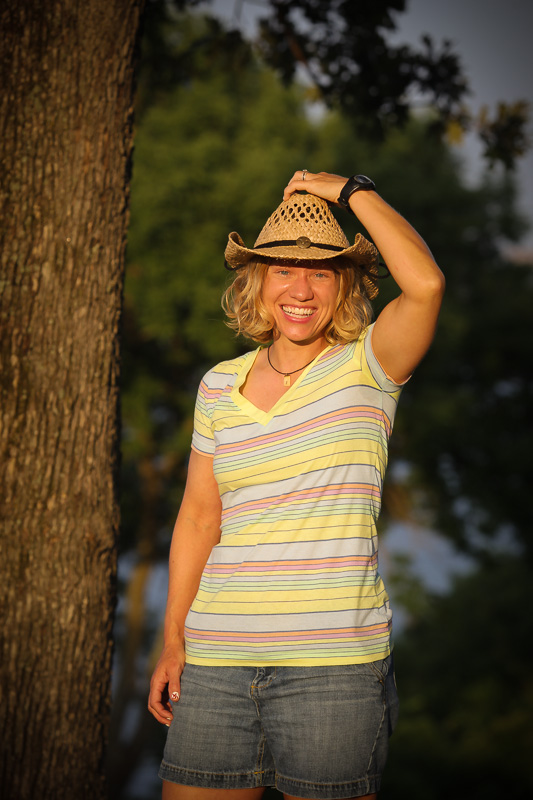
OLYMPUS DIGITAL CAMERA

The author with a Yemeni friend

Certainly you want to avoid stereotyping as much as possible, but if you use your experiences, relationships, research and authentic readers well, you’ll be able to weed out many of the difficulties of writing across diverse backgrounds.

7) Love your characters and your story. Let them speak for themselves.

As writers, we get to choose the types of characters we create. We can’t let the fear of stepping outside of ourselves dictate our choices. The alternative would be simply staying within the comfort of your own race, background, gender, ethnicity, social status and nationality.

And I, for one, refuse to do that. The children we write for deserve better.

KimberlyMitchell2014Kimberly Mitchell loves journeys, real or imagined. She has traveled to five continents and speaks four languages. Kimberly is represented by Marlene Stringer of the Stringer Literary Agency and hopes to find publishers for her middle-grade novels soon. She lives in Northwest Arkansas with her husband and the best souvenir she ever found, a Yemeni cat.

More Libros Latin@s: 24 YA & MG Novels By/About Latinos in 2015!

Just when you thought your To-Be-Read list couldn’t get any longer, here we have 24 young adult and middle grade novels to be released in 2015 that are all by and/or about Latin@s. While they all share this aspect, you’ll see the novels are diverse, representing these genres: horror, fantasy, contemporary, science-fiction, memoir, magical realism, romance, and historical. Authors include award winners Margarita Engle, and Pam Muñoz Ryan, as well as NY Times Bestselling authors Kierra Cass and Anna Banks. Alongside these authors are many debuts, which are *starred* in the list below. If you click on the cover image, you will go to the book’s Goodreads page, so you can easily add them to your TBR list! And if you’re adding them, you are likely interested in diverse kid lit and should, therefore, consider participating in the We Need Diverse Books reading challenge. Happy reading!!

*SHUTTER by Courtney Alameda

20757532Micheline Helsing is a tetrachromat—a girl who sees the auras of the undead in a prismatic spectrum. As one of the last descendants of the Van Helsing lineage, she has trained since childhood to destroy monsters both corporeal and spiritual: the corporeal undead go down by the bullet, the spiritual undead by the lens. With an analog SLR camera as her best weapon, Micheline exorcises ghosts by capturing their spiritual energy on film. She’s aided by her crew: Oliver, a techno-whiz and the boy who developed her camera’s technology; Jude, who can predict death; and Ryder, the boy Micheline has known and loved forever.

When a routine ghost hunt goes awry, Micheline and the boys are infected with a curse known as a soulchain. As the ghostly chains spread through their bodies, Micheline learns that if she doesn’t exorcise her entity in seven days or less, she and her friends will die. Now pursued as a renegade agent by her monster-hunting father, Leonard Helsing, she must track and destroy an entity more powerful than anything she’s faced before . . . or die trying.

JOYRIDE by Anna Banks
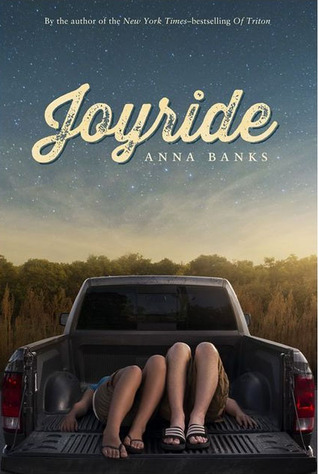
22718685A popular guy and a shy girl with a secret become unlikely accomplices for midnight pranking, and are soon in over their heads—with the law and with each other—in this sparkling standalone from NYT-bestselling author Anna Banks.

It’s been years since Carly Vega’s parents were deported. She lives with her brother, studies hard, and works at a convenience store to contribute to getting her parents back from Mexico.

Arden Moss used to be the star quarterback at school. He dated popular blondes and had fun with his older sister, Amber. But now Amber’s dead, and Arden blames his father, the town sheriff who wouldn’t acknowledge Amber’s mental illness. Arden refuses to fulfill whatever his conservative father expects.

All Carly wants is to stay under the radar and do what her family expects. All Arden wants is to NOT do what his family expects. When their paths cross, they each realize they’ve been living according to others. Carly and Arden’s journey toward their true hearts—and one another—is funny, romantic, and sometimes harsh.

24527773THE SMOKING MIRROR by David Bowles

Carol and Johnny Garza are 12-year-old twins whose lives in a small Texas town are forever changed by their mother’s unexplained disappearance. Shipped off to relatives in Mexico by their grieving father, the twins soon learn that their mother is a nagual, a shapeshifter, and that they have inherited her powers. In order to rescue her, they will have to descend into the Aztec underworld and face the dangers that await them.

HOSTAGE by Rachel Manija Brown and Sherwood Smith

23899848Welcome back to Las Anclas, a frontier town in the post-apocalyptic Wild West. In Las Anclas, the skull-faced sheriff possesses superhuman strength, the doctor can speed up time, and the squirrels can teleport sandwiches out of your hands.

In book one, Stranger, teenage prospector Ross Juarez stumbled into town half-dead, bringing with him a precious artifact, a power no one has ever had before, and a whole lot of trouble— including an invasion by Voske, the king of Gold Point. The town defeated Voske’s army, with the deciding blow struck by Ross, but at a great cost.

In Hostage, a team sent by King Voske captures Ross and takes him to Gold Point. There he meets Kerry, Voske’s teenage daughter, who has been trained to be as ruthless as her father. While his friends in Las Anclas desperately try to rescue him, Ross is forced to engage in a battle of wills with the king himself.
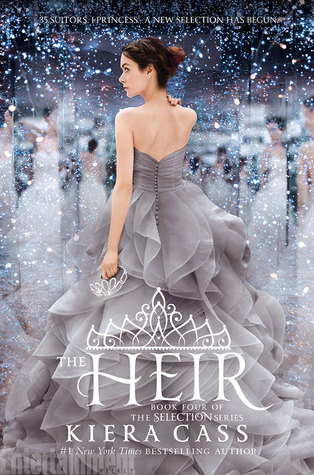
22918050THE HEIR by Kierra Cass

Twenty years ago, America Singer entered the Selection and won Prince Maxon’s heart. Now the time has come for Princess Eadlyn to hold a Selection of her own. Eadlyn doesn’t expect her Selection to be anything like her parents’ fairy-tale love story. But as the competition begins, she may discover that finding her own happily ever after isn’t as impossible as she always thought.
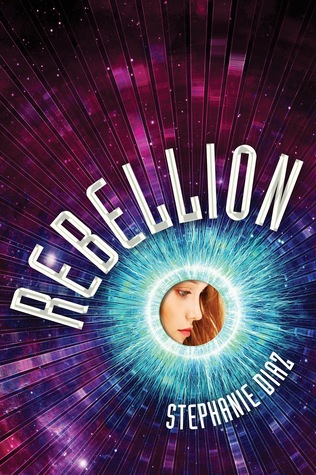


18625184REBELLION by Stephanie Diaz

It’s been seven days since Clementine and Logan, along with their allies, retreated into hiding on the Surface. The rebels may have won one battle against Commander Charlie, but the fight is far from finished. He has vowed to find a way to win—no matter the cost. Do the rebels have what it takes to defeat him…and put an end to this war?

As Clementine and Logan enter a desperate race against time to defeat Commander Charlie—and attempt to weaken his power within his own ranks—they find themselves in a terrifying endgame that pits them against a brutal enemy, and each other. With every step, Clementine draws closer to losing Logan…and losing control of herself.

ENCHANTED AIR by Margarita Engle

23309551In this poetic memoir, Margarita Engle, the first Latina woman to receive a Newbery Honor, tells of growing up as a child of two cultures during the Cold War.

Margarita is a girl from two worlds. Her heart lies in Cuba, her mother’s tropical island country, a place so lush with vibrant life that it seems like a fairy tale kingdom. But most of the time she lives in Los Angeles, lonely in the noisy city and dreaming of the summers when she can take a plane through the enchanted air to her beloved island. Words and images are her constant companions, friendly and comforting when the children at school are not.

Then a revolution breaks out in Cuba. Margarita fears for her far-away family. When the hostility between Cuba and the United States erupts at the Bay of Pigs Invasion, Margarita’s worlds collide in the worst way possible. How can the two countries she loves hate each other so much? And will she ever get to visit her beautiful island again?

*THE GIRL AT MIDNIGHT by Melissa Grey
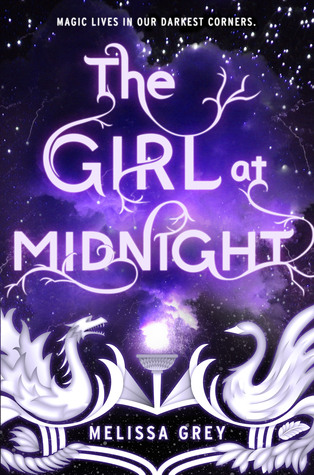
20345202

Beneath the streets of New York City live the Avicen, an ancient race of people with feathers for hair and magic running through their veins. Age-old enchantments keep them hidden from humans. All but one. Echo is a runaway pickpocket who survives by selling stolen treasures on the black market, and the Avicen are the only family she’s ever known.

Echo is clever and daring, and at times she can be brash, but above all else she’s fiercely loyal. So when a centuries-old war crests on the borders of her home, she decides it’s time to act.

Legend has it that there is a way to end the conflict once and for all: find the Firebird, a mythical entity believed to possess power the likes of which the world has never seen. It will be no easy task, but if life as a thief has taught Echo anything, it’s how to hunt down what she wants . . . and how to take it.

But some jobs aren’t as straightforward as they seem. And this one might just set the world on fire.

22504701ROLLER GIRL by Victoria Jamieson

For most of her twelve years, Astrid has done everything with her best friend Nicole. But after Astrid falls in love with roller derby and signs up for derby camp, Nicole decides to go to dance camp instead. And so begins the most difficult summer of Astrid’s life as she struggles to keep up with the older girls at camp, hang on to the friend she feels slipping away, and cautiously embark on a new friendship. As the end of summer nears and her first roller derby bout (and junior high!) draws closer, Astrid realizes that maybe she is strong enough to handle the bout, a lost friendship, and middle school… in short, strong enough to be a roller girl.

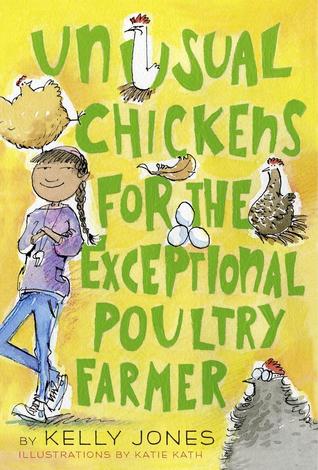
*UNUSUAL CHICKENS FOR THE EXCEPTIONAL POULTRY FARMER by Kelly Jones
22639675

Twelve-year-old Sophie Brown feels like a fish out of water when she and her parents move from Los Angeles to the farm they’ve inherited from a great-uncle. But farm life gets more interesting when a cranky chicken appears and Sophie discovers the hen can move objects with the power of her little chicken brain: jam jars, the latch to her henhouse, the entire henhouse…

And then more of her great-uncle’s unusual chickens come home to roost. Determined, resourceful Sophie learns to care for her flock, earning money for chicken feed, collecting eggs. But when a respected local farmer tries to steal them, Sophie must find a way to keep them (and their superpowers) safe.

Told in letters to Sophie’s abuela, quizzes, a chicken-care correspondence course, to-do lists, and more, Unusual Chickens is a quirky, clucky classic in the making.

SURVIVING SANTIAGO by Lyn Miller-Lachman

23013839To sixteen-year-old Tina Aguilar, love is the all and the everything.

As such, Tina is less than thrilled to return to her homeland of Santiago, Chile, for the first time in eight years to visit her father, the man who betrayed her and her mother’s love through his political obsession and alcoholism. Tina is not surprised to find Papá physically crippled from his time as a political prisoner, but she is disappointed and confused by his constant avoidance of her company. So when Frankie, a mysterious, crush-worthy boy, quickly shows interest in her, Tina does not hesitate to embrace his affection.

However, Frankie’s reason for being in Tina’s neighborhood is far from incidental or innocent, and the web of deception surrounding Tina begins to spin out of control. Tina’s heart is already in turmoil, but adding her and her family’s survival into the mix brings her to the edge of truth and discovery.

Fans of Gringolandia will recognize the Aguilar family as they continue their story of survival and redemption.

ECHO by Pam Muñoz Ryan
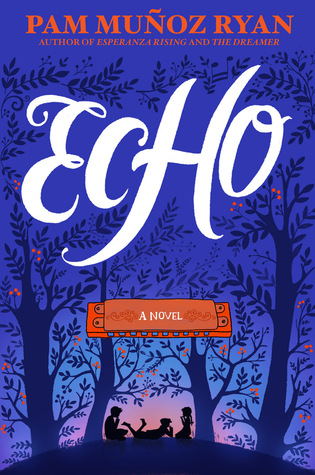
22749539Music, magic, and a real-life miracle meld in this genre-defying masterpiece from storytelling maestro Pam Muñoz Ryan.

Lost and alone a forbidden forest, Otto meets three mysterious sisters and suddenly finds himself entwined in a puzzling quest involving a prophecy, a promise, and a harmonica.

Decades later, Friedrich in Germany, Mike in Pennsylvania, and Ivy in California each, in turn, become interwoven when the very same harmonica lands in their lives. All the children face daunting challenges: rescuing a father, protecting a brother, holding a family together. And ultimately, pulled by the invisible thread of destiny, their suspenseful solo stories converge in an orchestral crescendo.

SHADOWSHAPER by Daniel José Older

22295304Sierra Santiago was looking forward to a fun summer of making art, hanging out with her friends, and skating around Brooklyn. But then a weird zombie guy crashes the first party of the season. Sierra’s near-comatose abuelo begins to say “No importa” over and over. And when the graffiti murals in Bed-Stuy start to weep…. Well, something stranger than the usual New York mayhem is going on

Sierra soon discovers a supernatural order called the Shadowshapers, who connect with spirits via paintings, music, and stories. Her grandfather once shared the order’s secrets with an anthropologist, Dr. Jonathan Wick, who turned the Caribbean magic to his own foul ends. Now Wick wants to become the ultimate Shadowshaper by killing all the others, one by one. With the help of her friends and the hot graffiti artist Robbie, Sierra must dodge Wick’s supernatural creations, harness her own Shadowshaping abilities, and save her family’s past, present, and future.

*WHEN REASON BREAKS by Cindy L. Rodriguez

22032788A Goth girl with an attitude problem, Elizabeth Davis must learn to control her anger before it destroys her. Emily Delgado appears to be a smart, sweet girl, with a normal life, but as depression clutches at her, she struggles to feel normal. Both girls are in Ms. Diaz’s English class, where they connect to the words of Emily Dickinson. Both are hovering on the edge of an emotional precipice. One of them will attempt suicide. And with Dickinson’s poetry as their guide, both girls must conquer their personal demons to ever be happy.

In an emotionally taut novel with a richly diverse cast of characters, readers will relish in the poetry of Emily Dickinson and be completely swept up in the turmoil of two girls grappling with demons beyond their control.

*MORE HAPPY THAN NOT by Adam Silvera
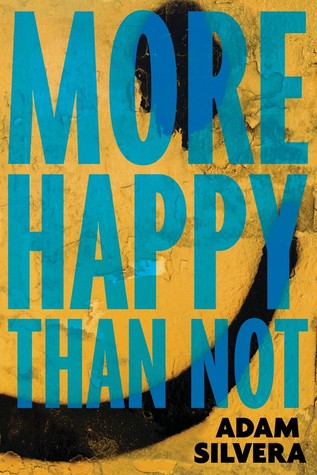
19542841The Leteo Institute’s revolutionary memory-relief procedure seems too good to be true to Aaron Soto — miracle cure-alls don’t tend to pop up in the Bronx projects. But Aaron can’t forget how he’s grown up poor or how his friends aren’t always there for him. Like after his father committed suicide in their one bedroom apartment. Aaron has the support of his patient girlfriend, if not necessarily his distant brother and overworked mother, but it’s not enough.

Then Thomas shows up. He has a sweet movie-watching setup on his roof, and he doesn’t mind Aaron’s obsession with a popular fantasy series. There are nicknames, inside jokes. Most importantly, Thomas doesn’t mind talking about Aaron’s past. But Aaron’s newfound happiness isn’t welcome on his block. Since he’s can’t stay away from Thomas or suddenly stop being gay, Aaron must turn to Leteo to straighten himself out, even if it means forgetting who he is.

*HOLLYWOOD WITCH HUNTER by Valerie Tejeda
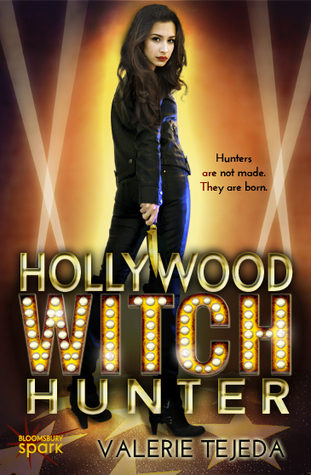
23202520From the moment she first learned the truth about witches…she knew she was born to fight them.

Now, at sixteen, Iris is the lone girl on the Witch Hunters Special Ops Team.

But when Iris meets a boy named Arlo, he might just be the key to preventing an evil uprising in Southern California.

Together they’re ready to protect the human race at all costs. Because that’s what witch hunters do.

Welcome to Hollywood.

HUNTERS OF CHAOS by Crystal Velasquez

23309533Ana’s average, suburban life is turned upside down when she’s offered a place at the exclusive boarding school in New Mexico that both of her late parents attended. As she struggles to navigate the wealthy cliques of her new school, mysterious things begin to occur: sudden power failures, terrible storms, and even an earthquake!

Ana soon learns that she and three other girls with Chinese, Navajo, and Egyptian heritages harbor connections to priceless objects in the school’s museum, and the museum’s curator, Ms.Benitez, is adamant that the girls understand their ancestry.

It turns out that the school sits on top of a mysterious temple, the ancient meeting place of the dangerous Brotherhood of Chaos. And when one of the priceless museum objects is shattered, the girls find out exactly why their heritage is so important: they have the power to turn into wild cats! Now in their powerful forms of jaguar, tiger, puma, and lion they must work together to fight the chaos spirits unleashed in the ensuing battle and uncover the terrifying plans of those who would reconvene the Brotherhood of Chaos.

These titles do not yet have final covers, but we have provided as much information as we could find. Some of them are already listed on Goodreads.

OUT OF DARKNESS by Ashley Hope Pérez. This title is not yet listed on Goodreads, but Ashley wrote a post for us about the historical event at the heart of this story.

Zoraida Córdova’s LABYRINTH LOST in which a teen girl in family of powerful Brujas, accidentally banishes them in a bid to avoid her own magical destiny, then ventures into the otherworldly land of Los Lagos to save them, with the mysterious but alluring Nova as her guide, who seems to have an agenda all his own.

MOVING TARGET by Christina Diaz Gonzalez. It’s a middle-grade novel pitched as “Percy Jackson meets The Da Vinci Code.” In the story, a 12-year-old girl studying in Rome discovers she is a member of an ancient bloodline enabling her to use a legendary object that can alter the future.

THE WEIGHT OF FEATHERS by Anna-Marie McLemore, in which two teenagers from rival families of traveling performers fall in love despite impossible odds.

NEVER, ALWAYS, SOMETIMES by Adi Alsaid, described on GoodReads as “two best friends, a boy and girl, make a list of the cliché things they will never do their senior year.”

NAKED by Stacey Trombley: When tough teenager Anna ran away to New York, she never knew how bad things would get. After surviving as a prostitute, a terrifying incident leaves her damaged inside and out, and she returns home to the parents she was sure wouldn’t want her anymore.

Now she has a chance to be normal again. Back in school, she meets a boy who seems too good to be true. Cute, kind, trusting. But what will he do when he finds out the truth about her past? And when a dark figure from New York comes looking for Anna, she realizes she must face her secrets…before they destroy her.

If we’re missing any, please let us know in the comments!

Which ones are you planning to read?

In the Studio with Illustrator John Parra

by Lila Quintero Weaver

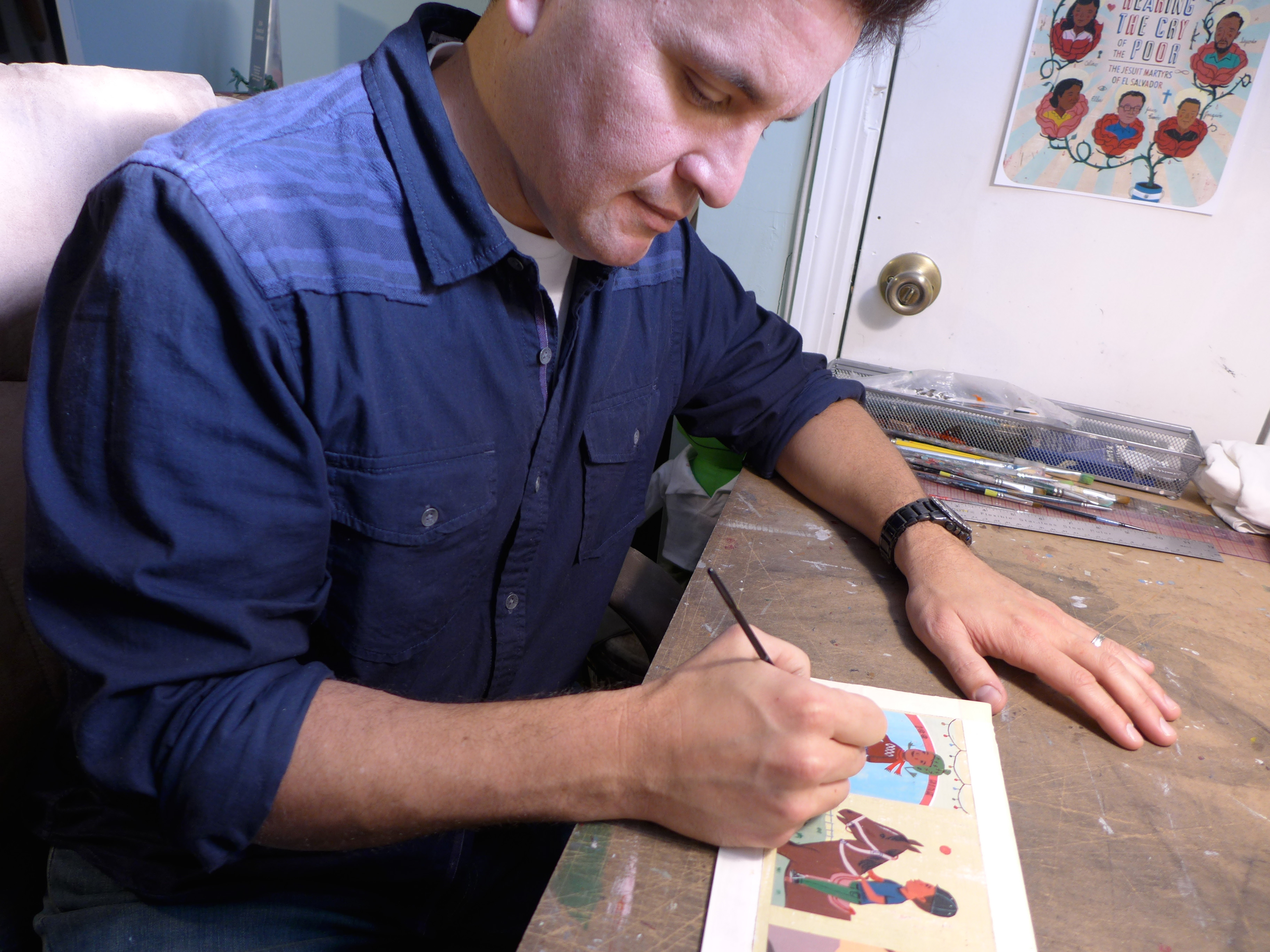
Parra in the studio

John Parra in his studio in Queens, NY. All photos by Caitlin C. Weaver

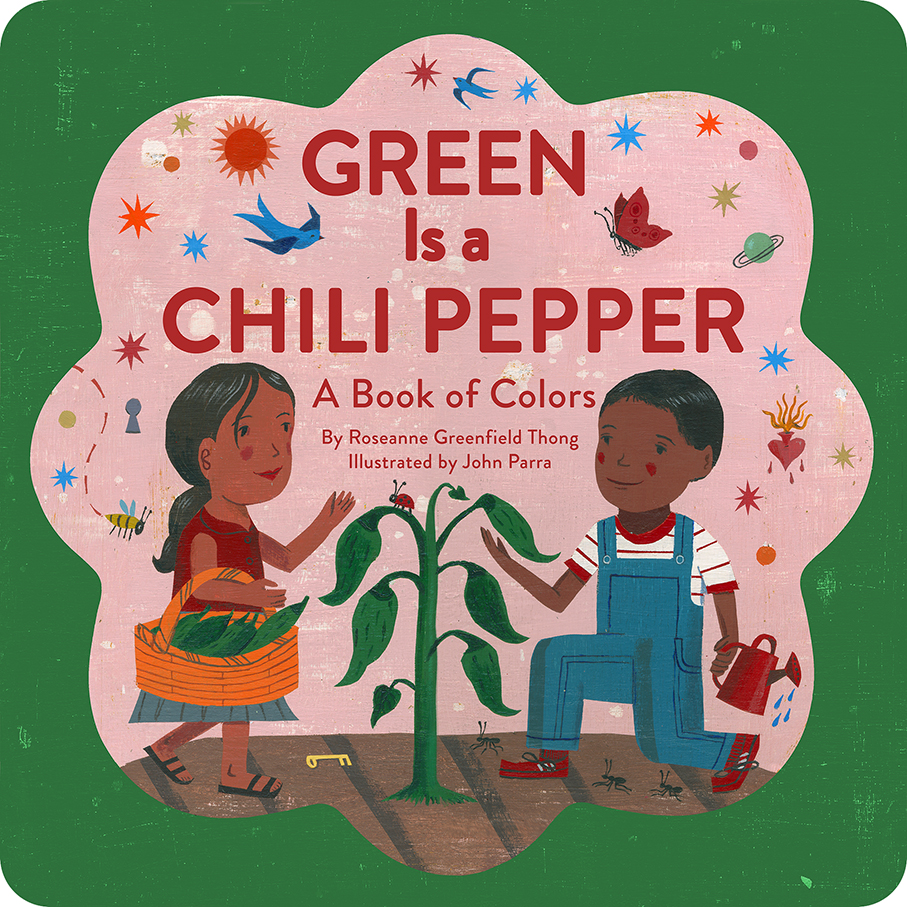
8-1/2"x11" jacket mech.  Green is a Chile Pepper.Cover

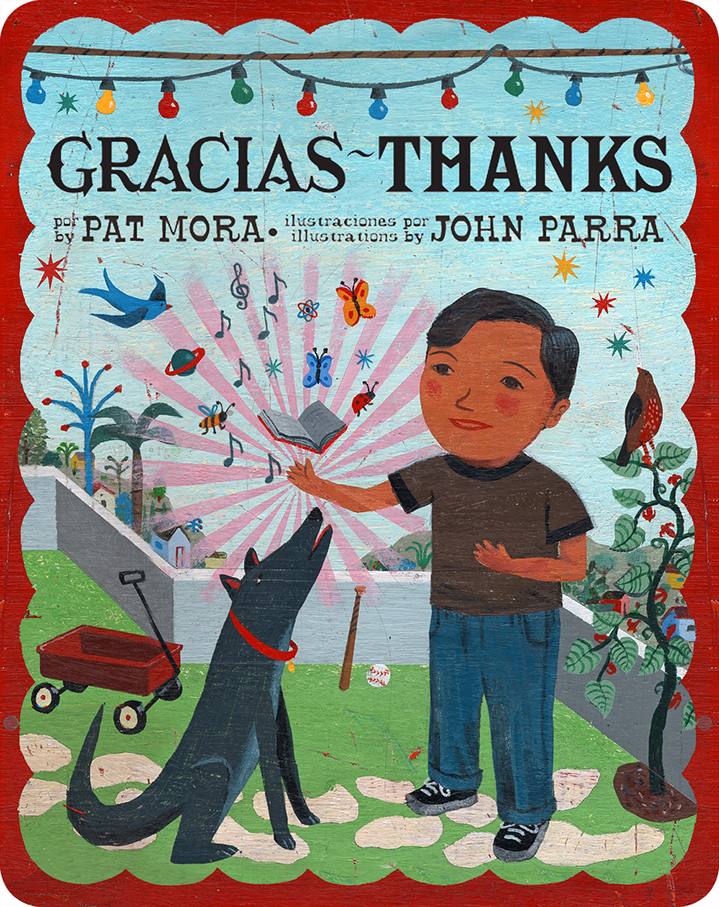
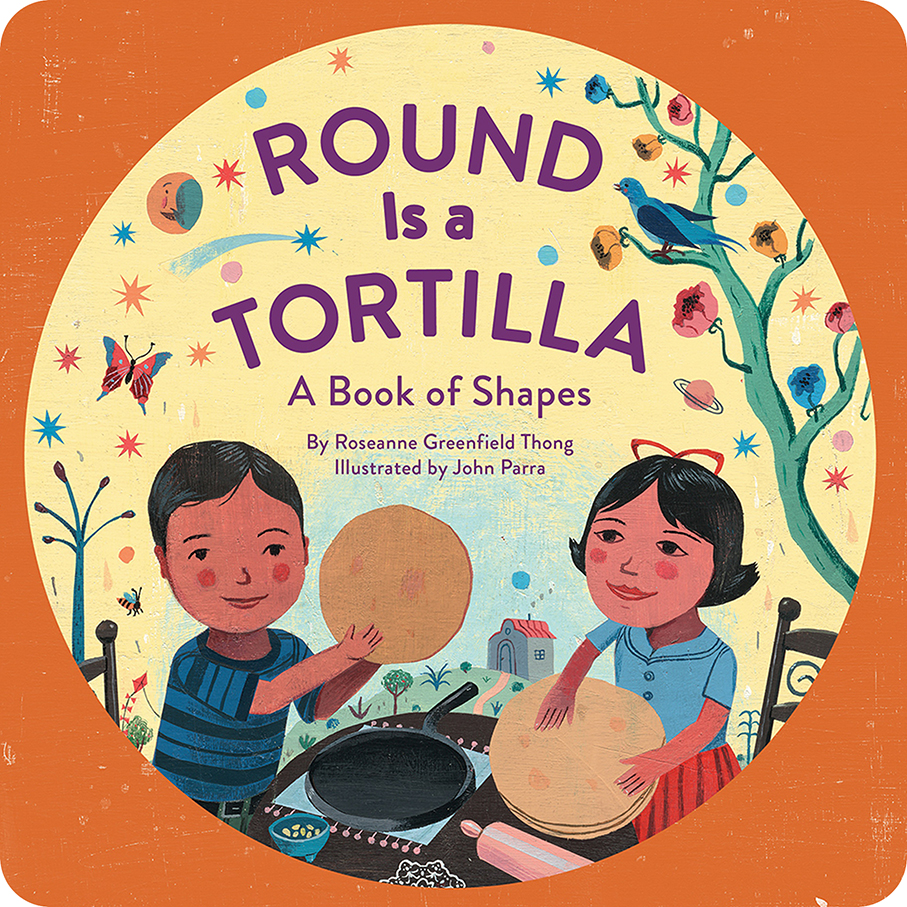
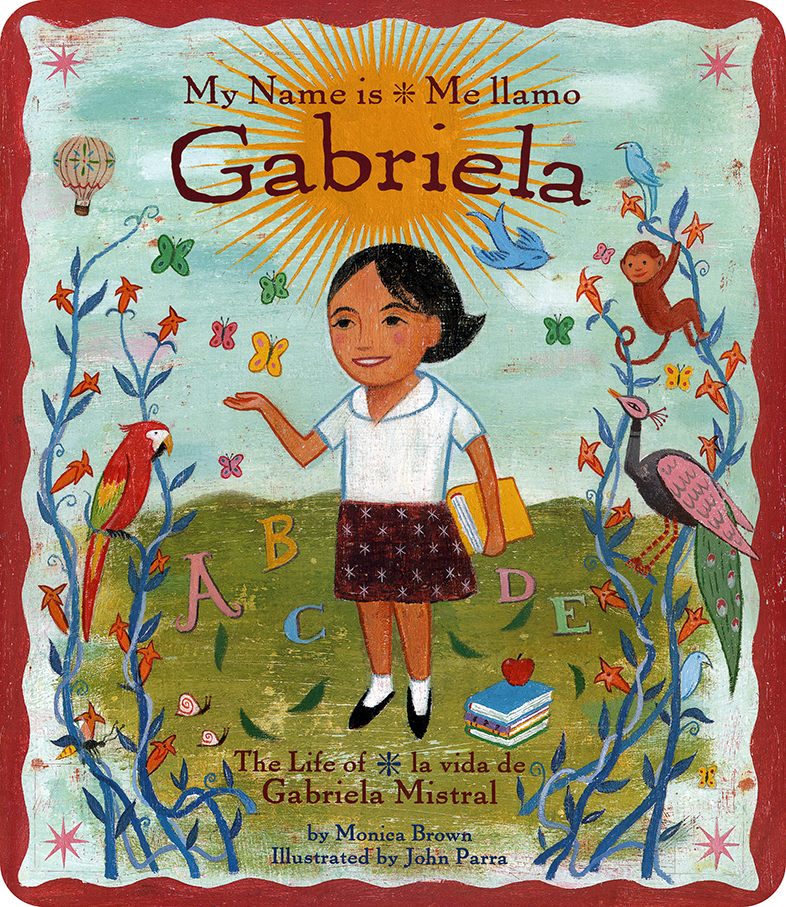
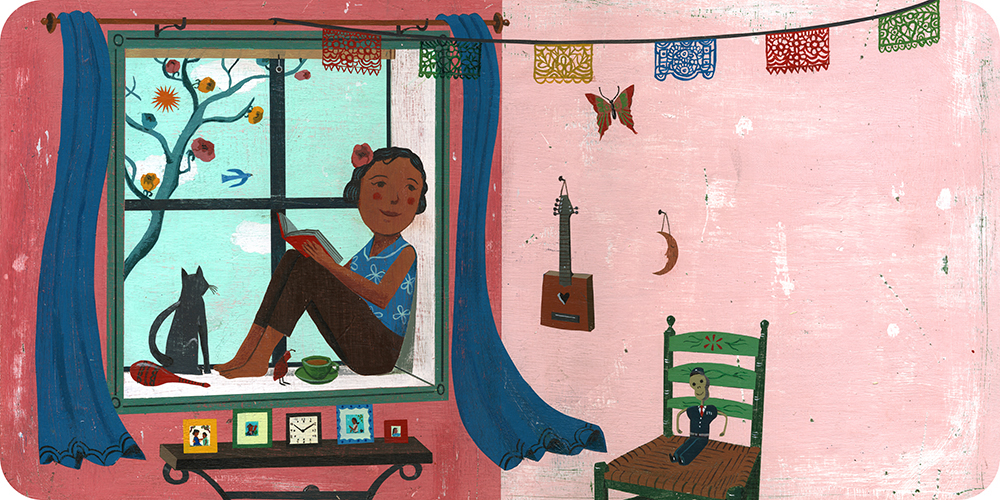
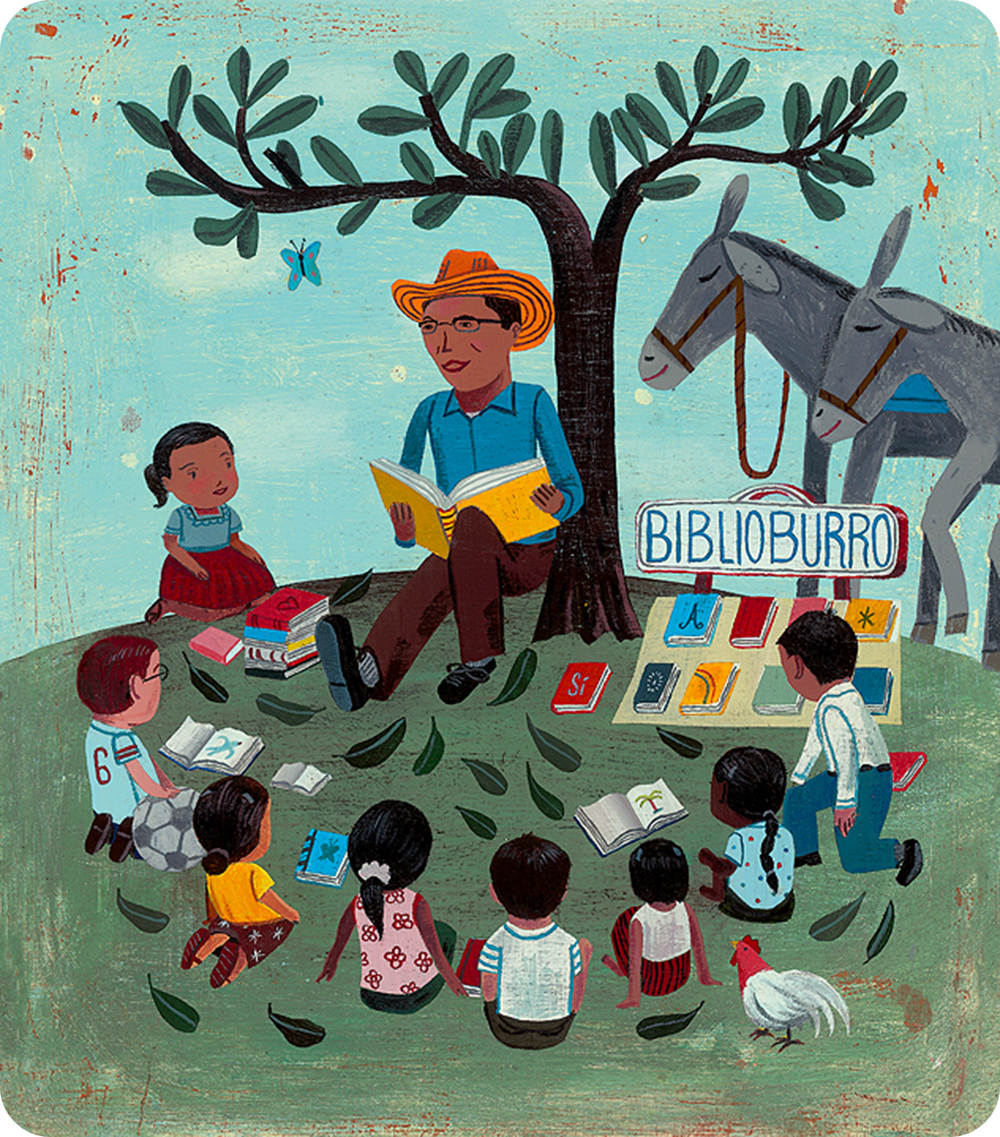
Magic flows from the paintbrushes of John Parra, the award-winning illustrator of a growing number of Latino-themed picture books and other illustration work. Here at Latin@s in Kid Lit, we’re ardent fans of John’s art, drenched as it is in color and rich detail, and affirming in its depiction of positive community and family life within Latino settings. Plus, it’s gorgeous—plain and simple—and we can’t resist wondering what’s behind the magic. John invited us into his studio and we had questions.

Waiting for the Biblioburro.Cover

Lila: Every children’s book you’ve illustrated bears your unmistakable stamp. Developing a personal style doesn’t happen overnight. What’s the story behind yours? 

John: My art style really came together in my final year of attending art school. I was fortunate early in my art training to have some amazing teachers and mentors who taught me the traditional fine art techniques of realism, perspective, color theory, and composition. During my mid-college years, I began experimenting more with techniques, such as mixed media, collage, and printmaking. These techniques enabled me to open up and develop a more unique and distinctive visual palette and approach in my work. I also began studying different styles of art genres. I fell in love with folk and outsider art. However, I still felt something was missing as far as an emotional connection to the work I was creating. That changed after a conversation I had with a visiting artist to our school named Salomón Huerta. He was a graduate of our school whose work reflected his Hispanic background and culture. Immediately I felt a connection and a light bulb went off in my head that I, too, could infuse my background, culture, and personality into my work. The first project I did was a series of paintings based on El Dia de los Muertos. I was so excited about the project that I just never stopped. As years have gone by, my work has gradually been updated but still holds on to those inspirational roots from that earlier period.

Round is a Tortilla.Cover    My Name is Gabriela.Cover

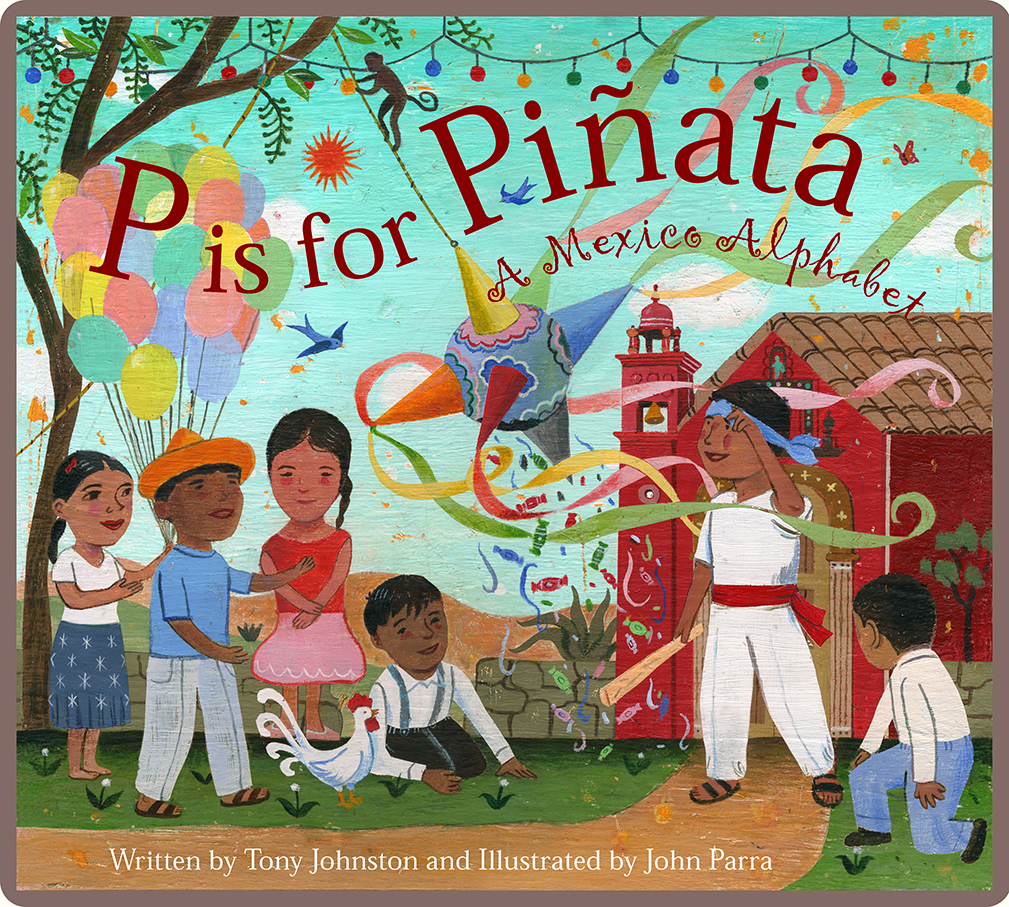
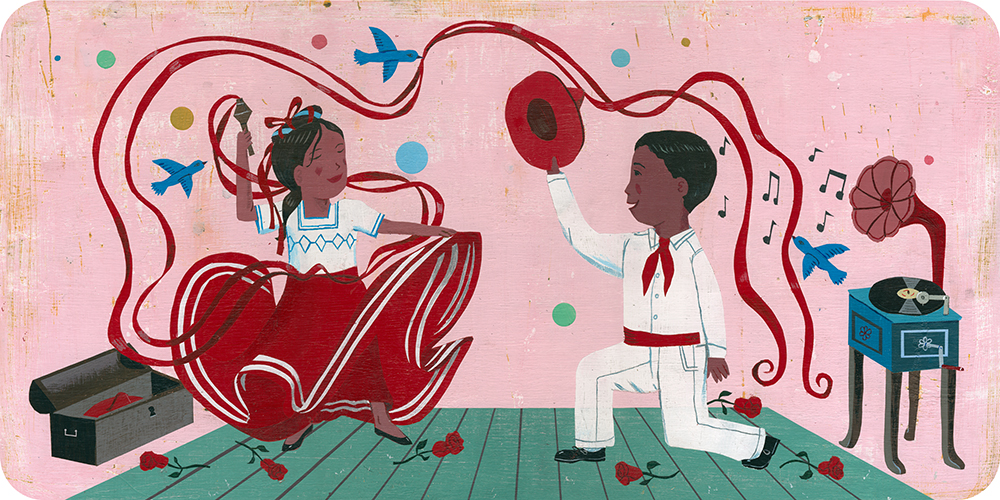
Lila: It must take scads of research to achieve the “rings true” effect of your illustrations. For example, in P is for Piñata, the illustrations cover a wide range of subject matter, from Aztec deities to cacao pods to folkloric dance. What is your research process like? 

P is for Pinata.CoverJohn: The first step I do when beginning a project is researching for visual photo references, first through the web, then in books in my library. I tend to look for images not just about the main subject but also in its regional geography, architecture, plants, animals, and anything else that could be related and connected to the issue. I then may delve in and read historical and background info through articles and books. Sometimes there is a good documentary on the topic to gain some insight as well. If possible, speaking to someone with firsthand knowledge of the subject can also bring a wealth of ideas. To me it is very important to be true to the source material when working on a project. I feel blessed to be creating this art, but it is a responsibility to accurately portray the content, otherwise you might fall into stereotypes or misleading subject matters.

Folklorico Dance

Lila: The characters in your scenes include a wide range of skin tones, an important acknowledgment of ethnic diversity within Latino populations–kudos to you for that!  

John:. Growing up, I always had a diverse group of family and friends. To me, it seems pretty normal to extend that into my work. I also just enjoy seeing diversity. I think it’s important that all people are represented and as we say, invited to the party.

pg5.Ventanas

Lila: One fascinating component to your book illustration is the practice of hiding  “Easter eggs.” Please elaborate! 

John: I often add funny or inside references in my work for my family and friends to find. One example of this is that I always include a self-portrait character, representing myself as a child, in all my books. I will not give away which character it is, it will be up to the viewer now to find and guess.

Skeleton Dance

Lila: The world of publishing needs more highly skilled Latin@ creators. Based on your experience, what advice would you give to a young person considering illustration as a career? 

John: You could probably devote a series of articles to just this one question. Starting out as a new artist can be challenging, with many artistic directions and choices to make. Based on my experience working in the field of freelance illustration, I recommend developing the following four areas.

1. Focus on your artwork and make it as exceptional as possible. It should be a reflection of what you like and have interest in. Create your own voice and style that connects the work to you.

2. Use print promotion and social media to display your work. It is very important to get your art out there in the public. Your artwork should be easily accessible to view online. Blogs, Facebook, and illustration annual competitions can be very helpful for ideas, as well as for showcasing your work. Be consistent, announce successes, and bring awareness to your projects.

3. Include a group of artist friends and colleagues to meet with regularly.  This way, you can discuss ideas and potential projects to work on, perhaps even collaborative ones.

4. The business side: Learn as much as possible about contracts and billing. Whether or not you have someone to represent you, it is always important to read as best you can about what you are getting into.

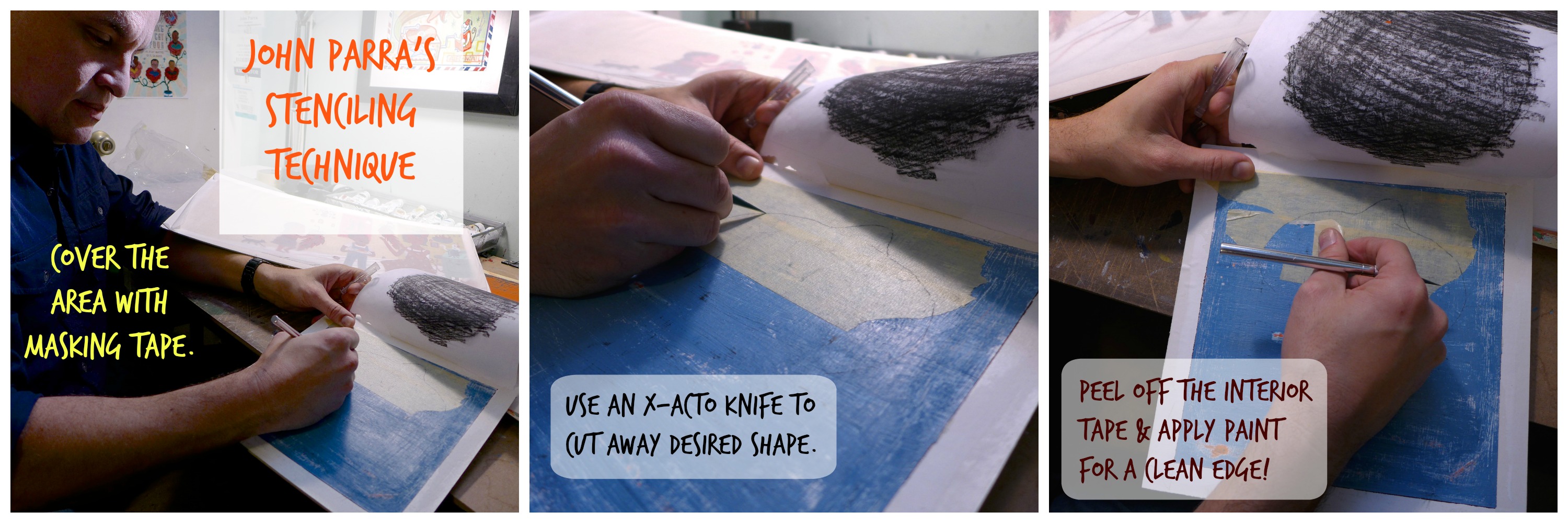
Parra Stenciling Technique


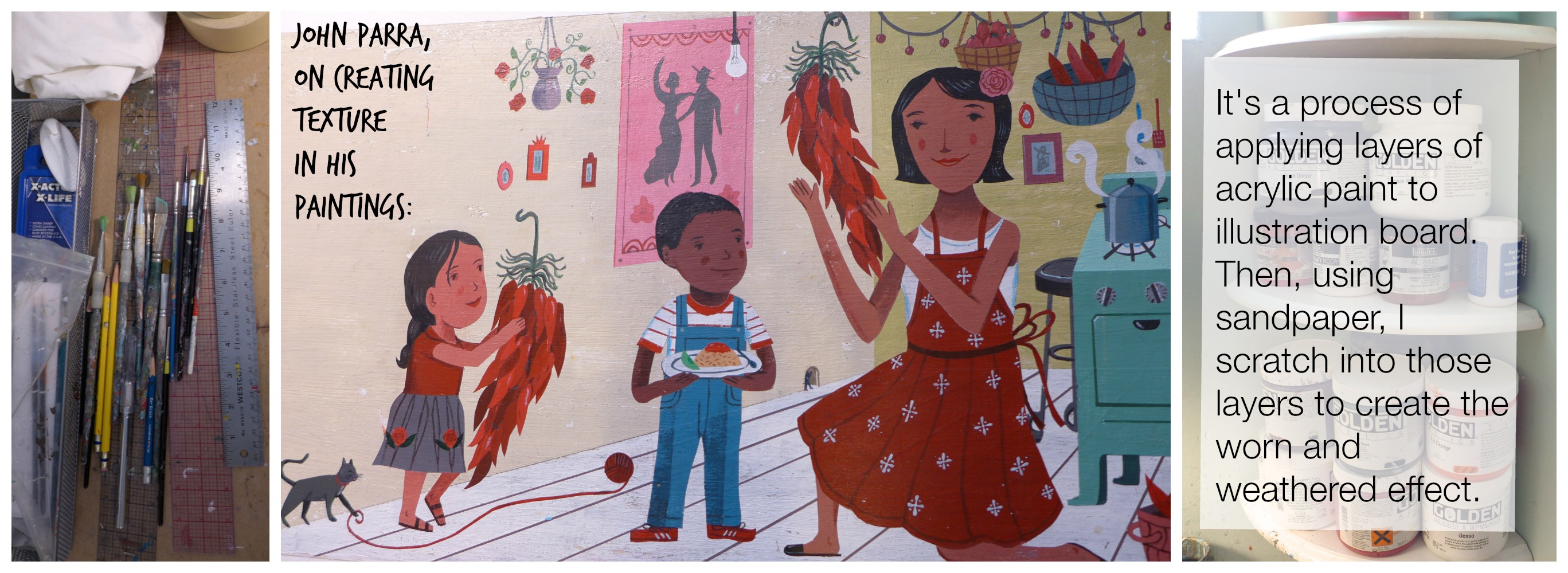
Weathered effect CollageLila: If you could sit down for a long session of shoptalk with one or more illustrators, living or dead, who would they be, and what would you ask?

John: I am a fan of other illustrators as well as anyone else who loves the genre. One of the perks of my job is that I have been able to meet so many other artists whose work I have admired for many years. There are, however, two artists who have passed on whom I would have loved to have sat down and talked shop with. They are Virginia Lee Burton and Maurice Sendak. Both had such an impact on me at an early age, since their books were part of the first illustrations introduced to me. I would love to ask their ideas and intentions when they were working on their most famous stories, plus to see their studio space and how they worked would be wonderfully inspirational.

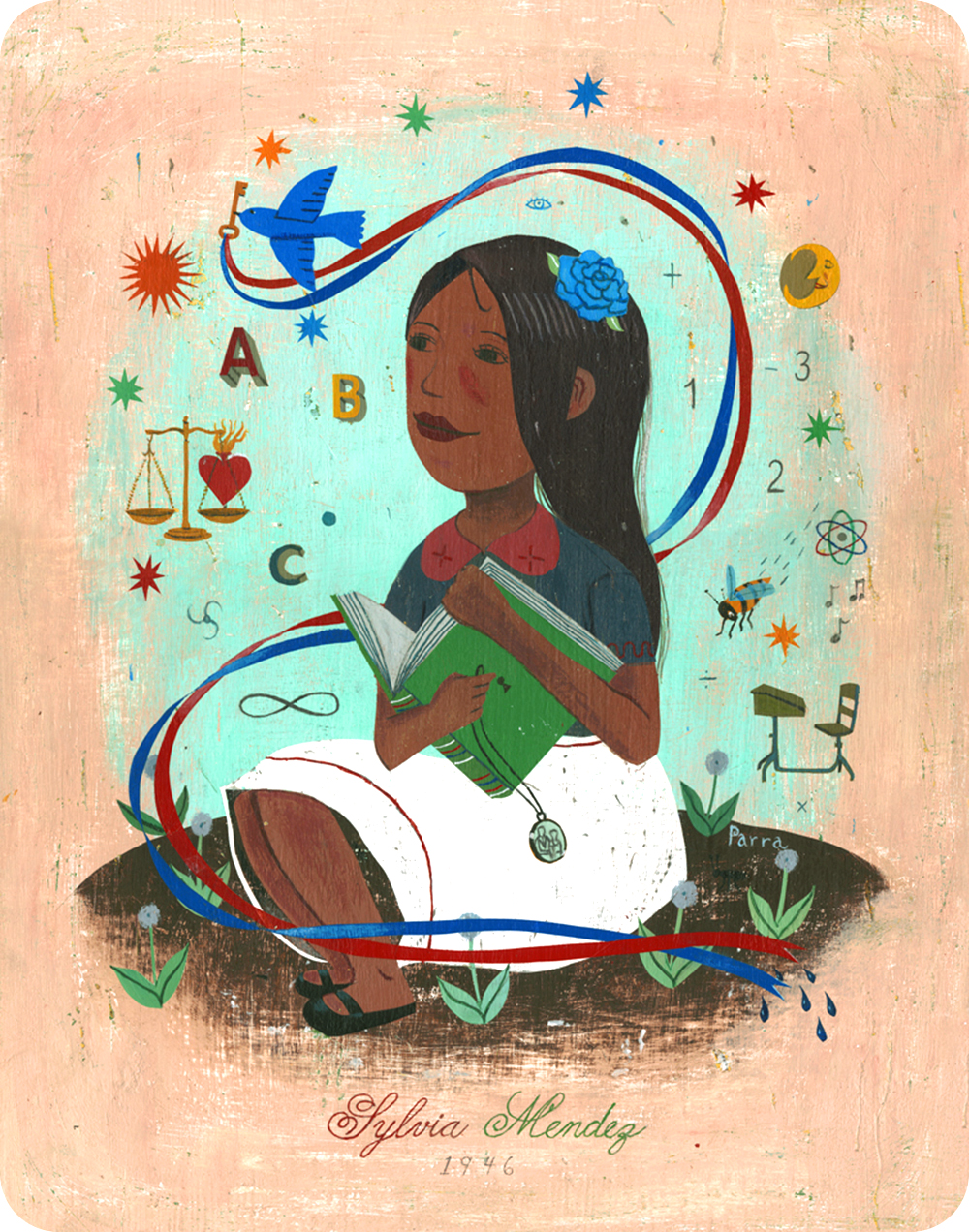
SylviaMendezVer.2  BiblioBurro.Reading2Kids

Lila: As you know, the diversity movement in children’s publishing picked up significant steam in 2014. What were opportunities like for Latin@ illustrators when you started your career? Have you seen changes? 

John: I believe the We Need Diverse Books initiative and Walter Dean Myers’ essay in the The New York Times came at a turning point in bringing awareness to examining and appreciating the beauty and diversity in multicultural books. When I began as an illustrator eighteen years ago, there did not seem to be as many projects geared to a diverse population. Over the last few years I have seen progress and greater opportunities for artists with varied voices and backgrounds to shine. I look forward to seeing even more done as we continue to expand and celebrate these wonderful talents.

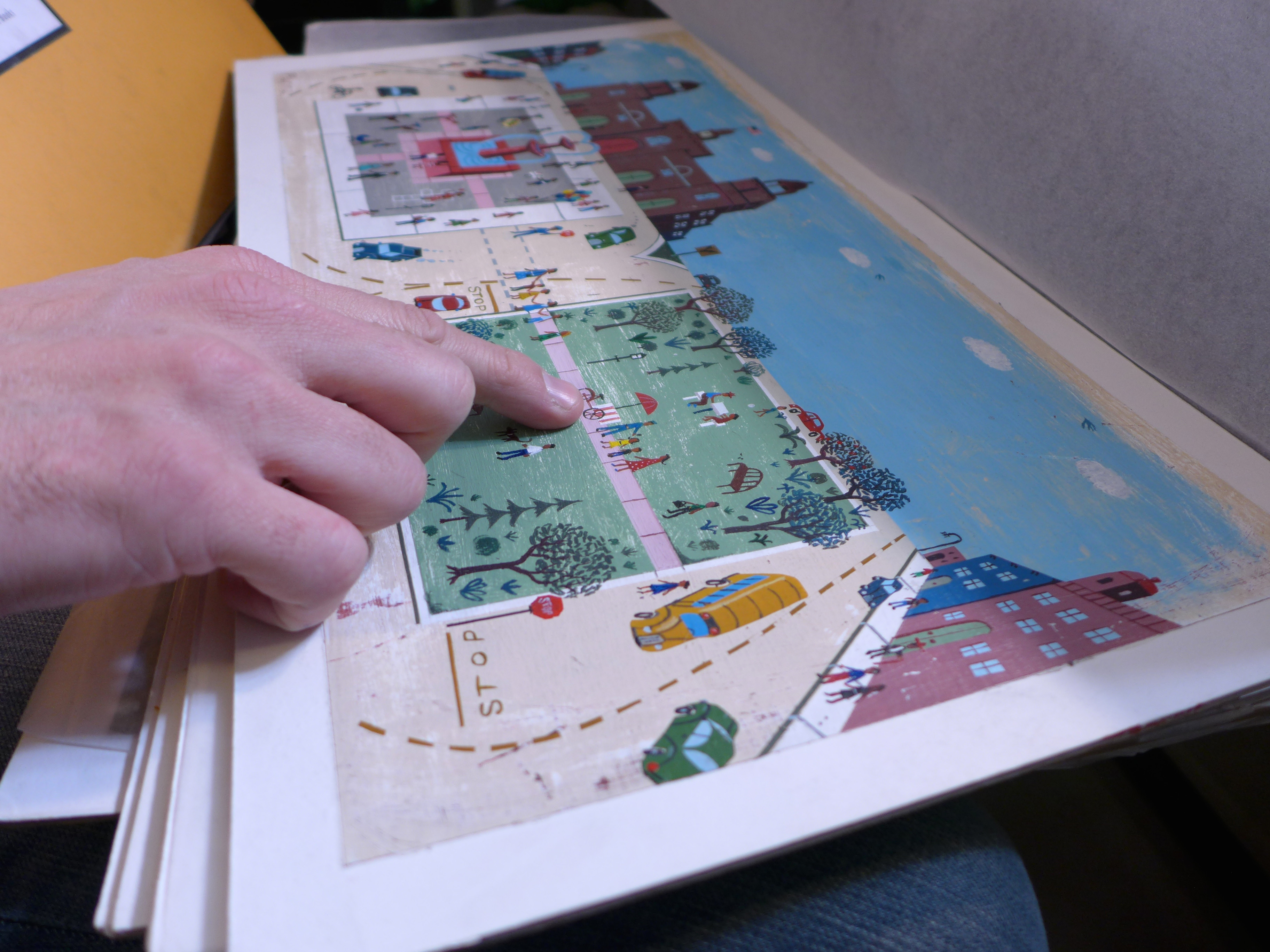
Parra page layout

Printer markings indicate page borders. John often uses a limited palette of hues, individually selected for each book.

Lila: Not long ago, I came upon a museum exhibit of Mexican retablos and ex-votos. Is it my imagination, or does your art contain echoes of this beautiful sub-genre of naive art? 

Yes! I am a big fan of retablos and ex-votos art. These paintings have that wonderful folk-art tradition of weaving in harrowing stories and miraculous tales.  Many of them actually weave text right into the works themselves. A favorite of mine is Mexican retablo artist Alfredo Vilchis. You can find many of his pieces in a great little book entitled: Infinitas Gracias: Contemporary Mexican Votive Painting.

Lila: We’re looking forward to the next John Parra book! What’s in the pipeline? 

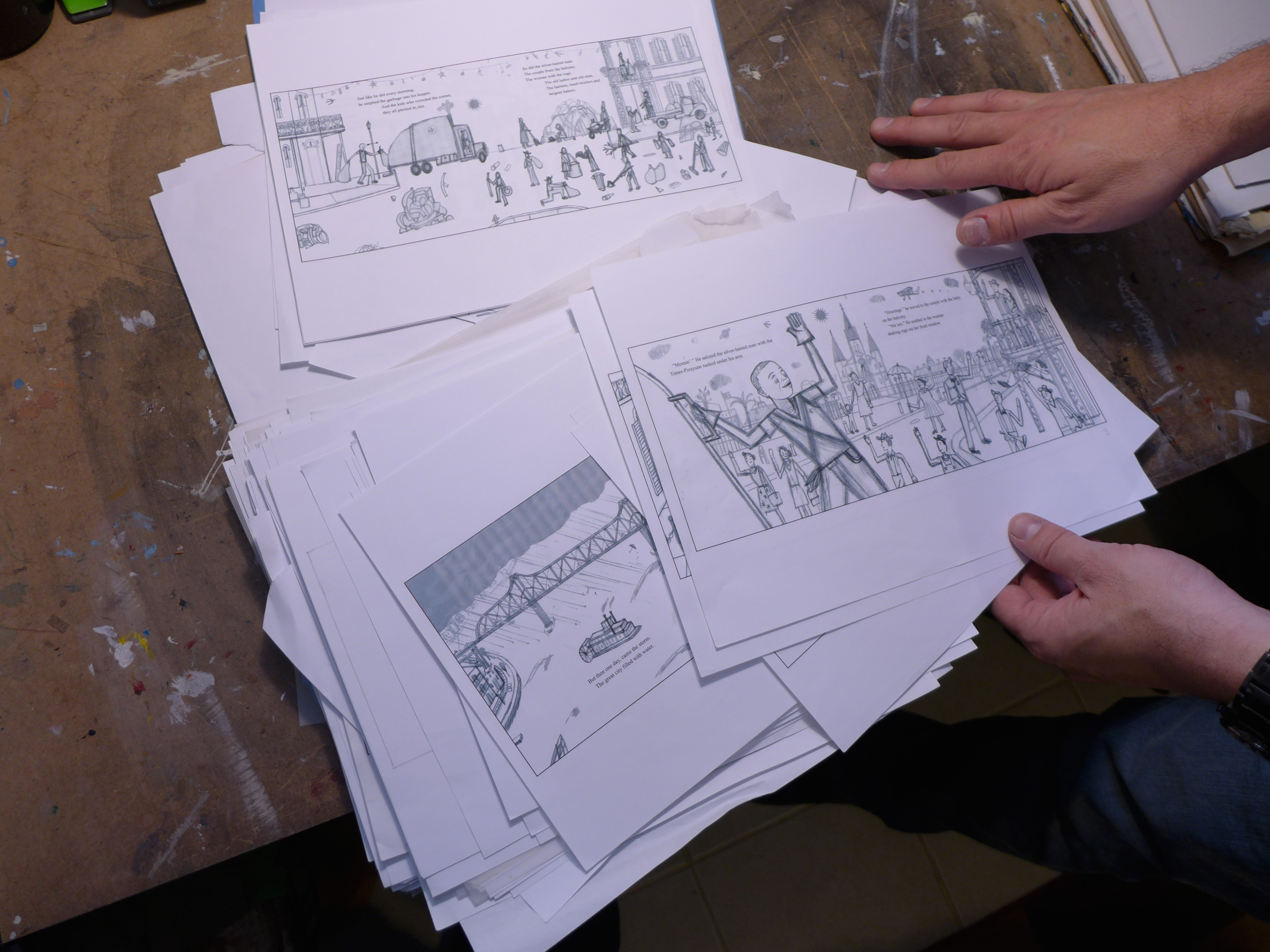
Parra sketches

Sketches from John’s newest project., Marvelous Cornelius.

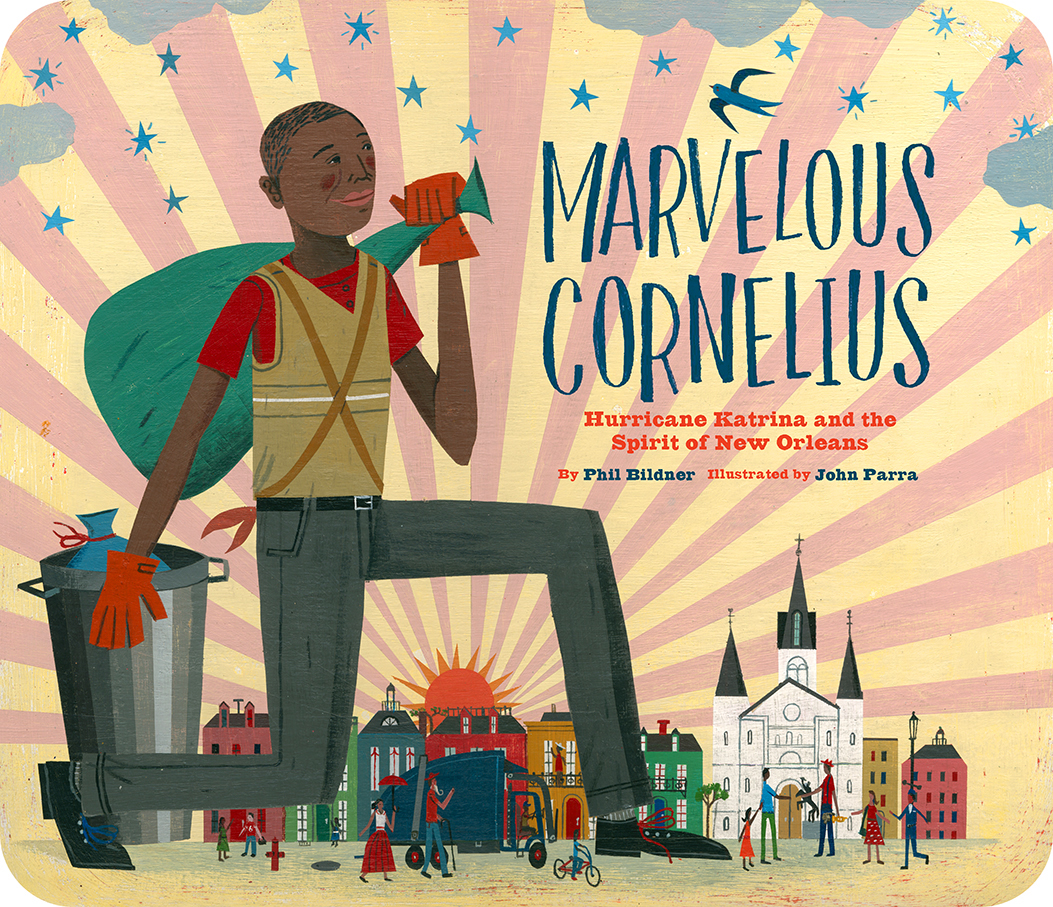
John: I do have a new children’s book that I finished recently coming out this summer (2015) with Chronicle Books. It is titled: Marvelous Cornelius: Hurricane Katrina and the Spirit of New Orleans, written by Phil Bildner. The story is about a real-life gentleman named Cornelius Washington, a sanitation worker in New Orleans. He was considered a local folk hero and known in the neighborhood and the French Quarter by his positive and charismatic personality. As the book develops, the story goes into the events of Hurricane Katrina. We then see the effects on Cornelius and his neighborhood, as he reacts and resolves what to do after the storm.

Marvelous Cornelius 1.Cover[Note: Catch more views from Marvelous Cornelius on the Latin@s in Kid Lit Pinterest boards!]

John: Another exciting event will be an artist presentation scheduled this coming year in June. It will be an artist lecture, workshop, and book signing at The Metropolitan Museum of Art here in New York City. I am really looking forward to it. It is a dream to be a part of such an amazing and historic institution.

As for new work, I am also starting a big new illustration project with details that I hope to share soon.

Parra paintbrushJohn Parra is an acclaimed illustrator, fine artist, designer and educator. His children’s book illustrations have  received many awards, among them, The Golden Kite Award from The Society of Children’s Book Writers and Illustrators; The Pura Belpré Honor Award; The Américas Book Award; Commended Title from CLASP, The International Latino Book Award; The Christopher Award. John grew up in Santa Barbara, California, where his artistic life began. He now resides in Queens, NY, with his wife, Maria. Keep up with John’s work through his website.

Studio views

Views of the studio reveal original pieces, as well as John’s guitars from a band he played with in California. Although he holds on to a few illustrations that he feels especially attached to, many are sold in galleries or through his website. A recent exhibit of originals in Brazil sold out!


Guest Post: Why I’m Not Interested in a Mexican Katniss

By Guinevere Zoyana Thomas

Earlier this year, Matt de la Peña asked the publishing industry one of the most thought-provoking questions ever: “Where is the African American Harry Potter or the Mexican Katniss?

His question was part of a conversation about why there aren’t that many POC equivalents to such iconic characters in YA and MG.

There doesn’t seem to be a good enough excuse for there not to be more Latino characters in kid lit especially with the Latino population rapidly growing, so to say there isn’t a market for it is just undetermined fabrication. I, for one, identify as an Afro-Cubana who would gladly buy a book from a Latina author that featured a Latina protagonist in a heartbeat!

But the truth is, I’m not sure I want a Mexican Katniss or a black Harry Potter or even an Asian Percy Jackson. A small part of me feels that if I say I do, I’d be telling the world that in order for a POC character to be great, we’d  have to follow thedefault” archetype. Everybody knows it: white, skinny, Christian, hetero, and because girls are so popular in YA, born female.

Comparisons are wonderful, because, I mean, who doesn’t want to be compared to what’s considered a great character, but I think it’s more than fair to say that boys and girls of color have earned the chance to be the models of their own standards, and, unfortunately, the only ones who don’t think about how representation in kid lit is important are the ones who are swimming in characters dedicated to their own images.

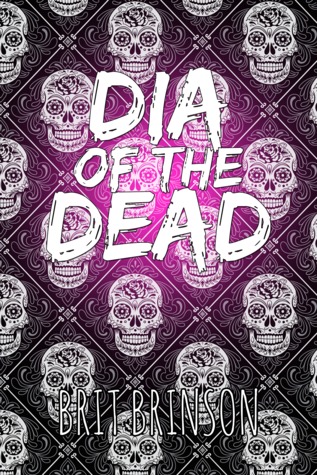
23117815One YA book that stood out to me this year was Dia of the Dead by Brit Brinson. It had zombies, it had action, and it definitely had drama. But most importantly to me, it had something that’s always left out of the conversation about Latinos in fiction–an Afro-Latina protagonist named Dia.

Her character was so amazingly memorable and struggled with the many things most Afro-Latinas go through in terms of identity that it was too hard to draw a comparison to another character in a similar situation who just happens to be a non-white Latina. All I could really give her credit for was being Dia, and isn’t that what we’re all really looking for in a character?

I don’t think we need a Mexican Katniss, but instead a chance to be on a bookshelf next to Katniss in our own stories with our own myths and legends. And it wouldn’t hurt if she had an amazing name like Citlalli, or even Amaryllis.

What I hope for her is to be a character that is a hero all on her own, clearing her own path and setting her own standard.

About the Blogger/Aspiring writer:

GuinevereGuinevere Zoyana Thomas is one half of the ever so silent and deadly “Twinjas” @Twinja Book Reviews. When she isn’t perfecting back handsprings or working on her red belt in Tang Soo Do, she’s going H.A.M. editing her diverse time-travel YA novel under the pseudonym “GL Tomas.”

Facebook for Twinja Book Reviews 

Facebook for GL Thomas

Tumblr for Twinja Book Reviews

Twitter 

Author Blog 

Book Blog

“A poet, América knows, belongs everywhere”: Healing & Latin@ Children’s Literature

By Sonia Alejandra Rodriguez

As a child what I desired most was to be rescued from the violence I experienced at home. I was undocumented and domestic violence was far too common. While I now know that these are real experiences for many Latino homes, these were secrets that I walked around with for fear that my family would be separated if I said anything. Retrospectively, what I probably needed, aside from the violence to stop, was to understand why the violence was happening in the first place. There was nothing or no one around to explain my feelings of anxiety, fear, and/or self-hate around the violence I witnessed and then internalized. At the time, shows like “Boy Meets World,” “Saved by the Bell,” and “Full House” only reaffirmed for me that my family was different, did not belong, or that there was something wrong us. I was reading a lot, too, but I only got more and more frustrated that the books I read did not speak to my reality. I was obsessed with Beverly Cleary’s Ramona because she was everything I wanted to be—free, adventurous, and happy. And while characters like Ramona fueled my imagination they explained nothing about the violence I endured.

My investment in Latina/o children’s and young adult literature stems from my desire to explain why violence is more prevalent in certain communities than it is in others. But it is also driven by what I have seen is the genre’s potential to provide paths toward healing for Latina/o children and young adults. Recent conversations about the need for diversity in children’s literature have discussed at length the impact that being or not being represented in books can have on a child’s self-esteem and where they see themselves positioned in society. These conversations have made visible the discrimination within publishing industries and the ways that children of color stand to lose the most. Diversity is important to my project simply because stories about children of color can save their lives.

696056I was first introduced to Luis J. Rodriguez’s América is Her Name as a graduate student and it was the first children’s book I read with a Latina protagonist. I was a taken aback that a kid’s book actually talked about immigration and included scenes of violence. Mainstream children’s literature is no stranger to violence, gruesomeness, monsters, and the like; however, it is out of the ordinary to see a story about immigration, gang violence, and abuse at home that does not depend on stereotypes or is read as ethnography. América Soliz, the protagonist, is a recent immigrant from Oaxaca, Mexico to Pilsen, Illinois— one of Chicago’s predominantly Mexican communities— who struggles to find a voice in a place that seeks to silence her. Throughout the text, the reader is privy to the discrimination she faces in the classroom, the violence in her community, and the patriarchal oppression in her home. What I found most powerful about the book was that América is given a tool to challenge the oppressions around her. Poetry becomes her outlet, and it allows her to process the violence she witnesses and experiences. In this way, the violence does not overwhelm her, but instead, she is able to find strength despite it. Rodriguez’s book opened a new world of children’s books for me, and it allowed me to see this genre as having the potential to create social change.

One of the biggest personal challenges that América faces is feeling like she does not belong. As an undocumented student in an ESL classroom, her fear is reaffirmed by her teachers:

Yesterday as [América] passed Miss Gable and Miss Williams in the hallway, she heard Miss Gable whisper, “She’s an illegal.” How can that be—how can anyone be illegal! She is Mixteco, an ancient tribe that was here before the Spanish, before the blue-eyed, even before this government that now calls her “illegal.” How can a girl called América not belong in America? (n.p)

América’s genuine question signals a history of systemic oppression demarcating who gets to belong and who is excluded from the American imaginary. By tracing her indigenous roots, América seeks to challenge who can lay claim to the land her teachers wish to erase her from. Upon first reading Rodríguez’s book, I found América’s question rather painful. Even though América is a child, her teachers have no qualms about criminalizing and excluding her. At nine years old, there is very little that América can do to challenge her teachers’ ignorance and discrimination; however, the tension in the classroom shifts when Mr. Aponte, a Puerto Rican poet, visits America’s class. Mr. Aponte encourages the class to write poetry about what they know and in whatever language they feel comfortable. América writes about Oaxaca and shares her poetry with her family. Eventually, her mother and younger siblings take part in writing. At the end of the book, Ms. Gable gives América a high mark on one of her poems, which brings great joy to América and her family.

While América remains undocumented at the end of the story, she finds that her poetry gives her a sense of belonging that she did not feel at the beginning. She says: “A real poet. That sounds good to the Mixteca girl, who some people say doesn’t belong here. A poet, América knows, belongs everywhere” (n.p.). Writing has given America a way to challenge and transform the oppressions around her. Her poetry serves as a voice and power that she lacked and has since shared with her family. When I teach this book, I am very careful about talking about the conclusion as the “happy ending.” Instead, I encourage my students to read this moment as part of América’s healing process. Leaving the book with the assumption that everything works out for América is a disservice to the book and those like it. The fears and perils of immigration do not go away because América learned to write poetry. Instead, what she has learned is a set of skills that will help her express how immigration impacts her identity and will help her challenge a system that seeks to exclude her. Reading the ending as a moment in a much larger healing process instead of a resolution further allows me to demonstrate how Latina/o kids lit can transform the lives of Latina/o children and young adults.

If a book like América is Her Name had been available to me as a child, I can imagine it having made a real difference. Feeling excluded or not belonging is a very common theme within traditional coming-of-age stories. However, those feelings become rationalized as “growing pains” or generalized as “everyone feels left out,” or they become a lesson on “not everyone is going to like you.” These motifs often learned in mainstream coming of age stories and in common (mis)understandings of American childhood do not capture América’s experience. América is excluded for specific political and historical reasons. If she were a real child, she will probably be excluded her entire life because she is an (im)migrant. Even if she were to gain legal citizenship, someone will someday ask her “where are you from?” and assume that she does not belong. When I talk about Latina/o children’s books as having the potential to heal, I mean it in reference to these specific moments of exclusion and violence that unfortunately are a reality for Latina/o children. How do we teach our children to answer questions like “where are you from?” or to respond to comments like “you don’t look American”? How do we make them feel like they belong when the world around them may be telling them otherwise? Latina/o children’s literature does not have all of the answers but it is creating conversations on the topics that still require much attention.

Other Latina/o children’s books with immigration as a theme:

52390  1006426  2235722  465967  8101398  1266138  580207  2195327

headshotSonia Alejandra Rodríguez has been an avid reader since childhood. Her literary world was first transformed when she read Rudolfo Anaya’s Bless me, Última as a high school student and then again as a college freshman when she was given a copy of Sandra Cisneros’s The House on Mango Street. Sonia’s academic life and activism are committed to making diverse literature available to children and youth of color. Sonia received her B.A. in English from the University of Illinois at Urbana-Champaign. She is currently a PhD candidate at the University of California, Riverside, where she focuses her dissertation on healing processes in Latina/o Children’s and Young Adult Literature.
Rachel Manija Brown & Sherwood Smith on Collaborating & Bucking the ‘Received Wisdom’ of Publishing Diversity

By Eileen Fontenot

16034526This post-apocalyptic, western-tinged adventure is more character-driven than you may expect. A diverse group of teenagers in Las Anclas narrate the story in third-person point of view–Ross, the stranger in town, who has a valuable item coveted by several factions and experiences PTSD episodes after escaping death from a bounty hunter; Mia, the town engineer who helps Ross in his new life; Jennie, a Ranger that is “Changed,” that is, has some sort of superhuman powers; Yuki, a former prince that struggles with settling down in LA and with his boyfriend, Paco; and Felicite, a scheming climber, lusting after power but also hiding a secret of her own.

This narration style does not detract from the action scenes, which find the characters battling deadly–and extremely crafty–desert animals and a neighboring army, which has a bloody history with the city of Las Anclas. Co-authors Rachel Manija Brown and Sherwood Smith, however, portray most of the characters as well intentioned; even the least sympathetic main character did merit some empathy by the end of the novel. Nearly all of LA’s citizens are trying to make their town a better place to live in the way they feel is best – even if they can’t agree on what course that will take. But one thing they are not prejudiced against is non-traditional relationships. Same-sex and polyamorous relationships are accepted; Change powers have become the new issue that divides the community. The book’s dearth of white main characters is noteworthy as well.

Smith, who has authored more than forty books and been nominated for several awards, including the Nebula and the Mythopoeic Fantasy Award, and Manija Brown, TV, comic strip, urban fantasy and video game writer and PTSD/trauma therapist, were kind enough to answer a few questions about this and future writing they’ll share and getting diverse works published.

Eileen: I’ve really enjoyed reading Stranger, especially the five POV characters. Any particular reason why you decided to write the novel in this way? How do you feel this structure lends itself to this genre/setting, etc.?

Rachel: It has multiple points of view (POVs) because it’s about a community, not a lone individual. The post-apocalyptic town of Las Anclas is very community-oriented—for better and for worse—so we wanted the structure to reflect that.

We also thought it was fun, for both us and our readers. Different people notice different things, and speak in different voices. For instance, Yuki Nakamura, who loves animals, was born on a ship, and is very introverted, always notices the wildlife, thinks in nautical metaphors, and only focuses on the people he actually cares about. Felicite Wolfe is the mayor’s ambitious daughter, so she pays close attention to everyone around her in order to make a good impression on them, manipulate them, or gain some knowledge she might be able use later.

Sherwood: While Mia, the youngest town engineer in Las Anclas’s history, keeps getting locked inside her head, sometimes spinning around so much in questions that she doesn’t know how to act when it comes to socializing. Poor Mia! She was the most fun to write about.

Rachel: The POV characters rotate throughout the series. Ross, Mia, and Jennie have POVs in all four books, but the other POVs switch off, with old POV characters dropping out and new ones taking their place.

Eileen: You have a co-author, Sherwood Smith–how did you come to work with her? Did you experience any challenges/benefits working with a co-author? What was the process the two of you used to write the novel? Did you each take character(s) and only write their chapters?

20140830_154107

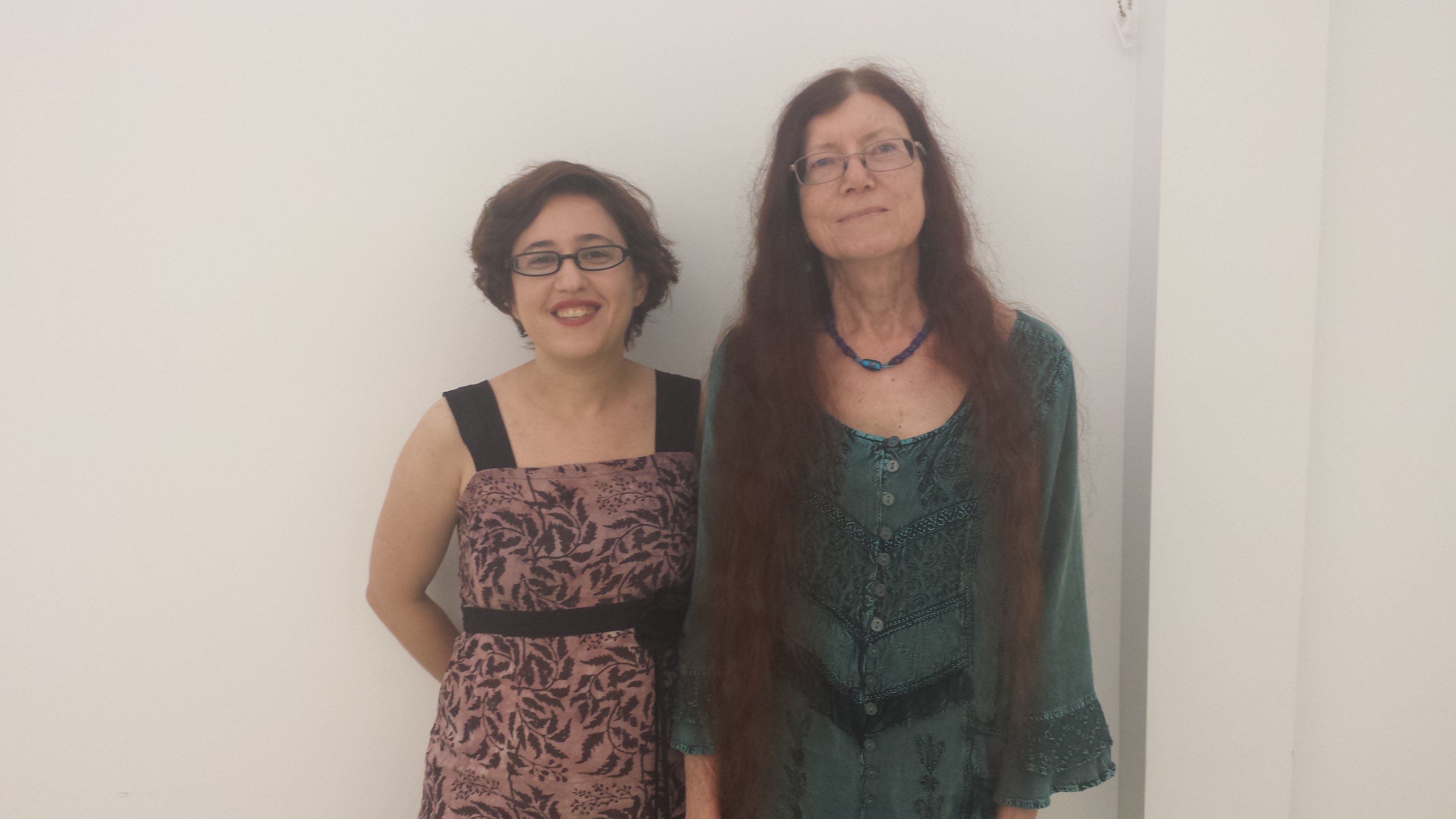
Rachel Manija Brown (l) and Sherwood Smith (r)

Rachel: We both used to write TV, and we met to collaborate on a TV series. It didn’t sell, but we enjoyed working together so much that we kept on writing together.

Both of us write all the characters. We outline the story in advance, then literally sit next to each other at the computer, one typing (usually Sherwood; she’s much faster than me) while we alternately dictate the story. Any given sentence may have been written by both of us.

Sherwood: I have done several collaborations, and enjoyed them all, though each is very different. The fun part of writing with Rachel is that we never get writer’s block, because as soon as one of us runs out of ideas, whether on a single sentence or in a scene, the other either picks up with it and zooms ahead, or we can talk it out. Sometimes act it out!

Eileen: I see that you are a PTSD/trauma therapist, and one of the characters appears to be experiencing PTSD. What are your thoughts on including a character struggling with a mental condition? For you, is it similar and as important as including many characters of diversity?

Rachel: I definitely think that mental conditions are an aspect of diversity. But that’s not all there is to it. Ross’s experiences with PTSD are largely autobiographical. I don’t mean that they’re based on my clients, I mean that they’re based on what I went through as a teenager. I wanted to show that you can go through a lot of trauma and have it affect you–even affect you a lot– and not have it ruin your life, or mean that you can never be happy or never find love.

Sherwood: I agree with Rachel. There are aspects of Ross that also come out of my own childhood experiences. Rachel and I discovered that though our lives were very different, we shared certain emotional responses to situations that can cause symptoms of PTSD. This, in turn, made me very aware of similar emotional responses in students during the years that I taught, and though I am not trained as Rachel is, experience caused me to read up on the subject, and to seek ways to help kids feel a sense of safety, and agency.

Eileen: Stranger is incredibly multi-racial and diverse in many ways. What are your thoughts on getting your book published? I know from reading you and Sherwood’s PW blog post that you had at least one agent request that this diversity be toned down somewhat. Can you tell our readers a bit how you overcame this? Any advice for other authors who are marketing their diverse book or trying to get it seen by agents/publishers?

Rachel: Yes, an agent had trouble with Yuki being gay. In general, we had difficulty with the fact that gay and lesbian romances are just as important as straight romances. It’s also extremely unusual for a YA dystopia to have all the POV characters be people of color. We really had to persist to make the book available to readers.

Sherwood: I think it’s important to note that we do not believe that any of the agents or editors who asked, or hinted, or expressed doubts, about the diversity of our characters are bigots or anti-gay. It’s just that there has been such a strong “received wisdom” in marketing that protagonists must be straight and white or the book won’t sell. And publishers are primarily in the business of selling books. This received wisdom was probably true in 1950, but we don’t believe it is true today.

Rachel: Persistence is the key. If you want to go the traditional publishing route, be incredibly persistent. If you choose to self-publish, hire someone skilled to do the cover, and research how keywords and other important self-publishing techniques work. And know that there are readers out there who will really, really want to read your book. Luckily, nowadays it’s much easier to get it to them.

Eileen: I have read that Stranger is Book One in a series. What’s the status of the series and can you give us any juicy tidbits about what’s to come? Are you working on anything other than this series?

Rachel: Stranger stands on its own, but it’s also the first of a four-book series.

Book two is Hostage, in which we spend time in Gold Point, the city ruled with an iron fist by King Voske, the villain of Stranger, and meet a surprising new point of view character. Book three is Rebel, in which Ross’s past comes back to haunt him. The new point of view character in this book is someone we met back in book one, but maybe not someone expected to get a point of view. Book four is Traitor, in which all the plot threads and characters from the first three books come together in a battle for the future of Las Anclas. The new point of view character is someone whose perspective you may have been waiting for.

I’m currently working on the third Werewolf Marines book, Partner. That’s urban fantasy for adults under the pen name Lia Silver. It’s also diverse and also involves PTSD, but contains too much sex to be suitable for younger readers.

Sherwood: I’m working on the sequel to Lhind the Thief, which is YA fantasy with a character not quite human. It’s called Lhind the Spy, and it explores questions like belonging, what love is, the consequences of power—but these are also meant to be fun, so there will be chases, and magical razzle-dazzle, and an elaborate dinner party for powerful people that goes very, very wrong. That will be published through Book View Café, a consortium of writers who have been publishing work that is difficult for New York publishing to categorize. For DAW, I have been writing A Sword Named Truth, which is the first of a series about teenage allies, many of them in positions of power, who have to try to overcome personal and cultural conditioning to work together against a very, very powerful enemy.

Rachel and I also have other projects planned, which we will write together.