
Review by Jessica Agudelo
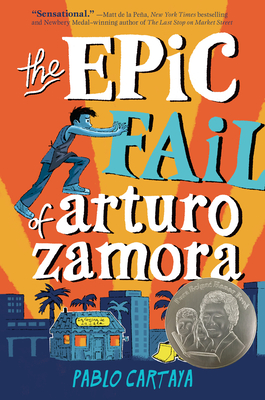 DESCRIPTION OF THE BOOK: Save the restaurant. Save the town. Get the girl. Make Abuela proud. Can thirteen-year-old Arturo Zamora do it all or is he in for a BIG, EPIC FAIL? For Arturo, summertime in Miami means playing basketball until dark, sipping mango smoothies, and keeping cool under banyan trees. And maybe a few shifts as junior lunchtime dishwasher at Abuela’s restaurant. Maybe. But this summer also includes Carmen, a poetry enthusiast who moves into Arturo’s apartment complex and turns his stomach into a deep fryer. He almost doesn’t notice the smarmy land developer who rolls into town and threatens to change it. Arturo refuses to let his family and community go down without a fight, and as he schemes with Carmen, Arturo discovers the power of poetry and protest through untold family stories and the work of José Martí.
MY TWO CENTS: Much to my delight, there were a number of titles released in 2017 that filled me with pride and transported me back to my days as a middle school book worm. The Epic Fail of Arturo Zamora was among them. Arturo’s story possesses familiar hallmarks of coming of age tales, a first crush, a crummy summer job as a dishwasher (albeit at his family’s beloved restaurant, La Cocina de la Isla), and self-discovery. With equal measures of humor and heart, Pablo Cartaya’s middle grade debut is sure to leave readers anxious for an invite to the Zamora family Sunday dinners. What truly makes The Epic Fail special, though, is how Cartaya burnishes deeper themes like family, community, gentrification, and cultural identity with nuance and irresistible charm.
When Wilfrido Pipo, a villainous real estate developer, saunters into Canal Grove looking to build a luxurious high rise, Arturo and his family fear the move will drastically alter their Miami neighborhood. Pipo intends to buy the city-owned lot next to La Cocina, which the Zamoras also planned to bid on, hoping to expand their restaurant. In order to convince community members to back his development plan, Pipo throws fancy events and raffles off all-expenses-paid trips. Arturo senses Pipo’s duplicitous nature and is spurred into action by Vanessa, his activist cousin, and Carmen, his new crush. Together, they hatch plans, one involving a Hulk disguise, to further investigate Pipo’s shady background and resist his ambitions. Gentrification and activism are timely topics, but their weightiness can feel overwhelming and disheartening, especially in light of news about Dreamers, to name one example. Cartaya does his best to impart readers with some hope. Arturo and his family picket and attend public forums at city hall, actions which, whatever the ultimate result, display a sense of agency, a power Arturo realizes he possesses.
At one protest, Vanessa holds a picket sign reading “Family is Community-Community is Family,” a succinct summation of two overarching themes. For Cartaya, family is not just those related by blood, but those with whom you choose to spend time, and sometimes, inadvertently share space. We readily throw longtime friends under the family umbrella, but Cartaya implores readers to consider neighbors, even the most eccentric among them, as members of our extended families. La Cocina itself is an extension of the family’s dining room, where an array of regulars eat, local businesses build partnerships (the restaurant buys its meat and greens from area vendors), and everyone is welcome.
Cartaya’s portrayal of an ample list of secondary characters is one of his greatest successes. He depicts a variety of personalities using distinct and vivid details, bringing the community of Canal Grove to life. Whether it is Arturo’s best friend Bren, a hopeless dork perpetually trying to look and sound like Pitbull, or Aunt Tuti, who has a penchant for dramatics, but is a fierce defender of her family, readers will surely recognize at least one, if not many, of Cartaya’s characters. Arturo may be the hero of the story, but it is the people around him who inspire his actions and give his mission purpose. His fight to save the family restaurant is also a fight for the preservation of his hometown, a love he shares with the people of his community, who, in turn, make that community a place worth loving. In one passage, Arturo wonders where Pipo’s own family might be, “All that success and I never heard him talk about anyone who he cared about.” Arturo’s realization reminded me of Harry Potter’s own assessment of Voldemort in Order of the Phoenix, whom he pities for being equally rootless. A poignant message about community that traverses Hogwarts and Canal Grove.
As Arturo’s Abuela’s health declines, she gives Arturo a box of photos and letters from his Abuelo, which reference the poet José Martí. The poet is a link to his grandfather and his Cuban heritage. Arturo is pulled in by Martí, a figure emblematic of embracing multiple cultures and causes. Growing up in the U.S. has resulted in Arturo’s imperfect Spanish, and yet, he “sometimes used Spanish words when English words couldn’t fully explain what I needed to say.” Although awkward in many aspects of his life, Arturo moves through his multitudes with spectacular ease. The narrative of struggling to balance cultural identities has shifted. Of course, stories about cultural struggle are necessary, but it was wonderful to see Arturo just be himself. It allowed me to let out a deep breath I didn’t realize I was holding in.
I could go on and on about The Epic Fail of Arturo Zamora. How touched I was by the depictions of Abuela’s tenderness, his mom’s quiet struggle becoming matriarch of the family, Arturo’s admiration for Carmen’s colorful braces, and of course, the food (recipes included as backmatter). This novel was a true joy to read from beginning to end. A rare feat, even in children’s literature.
 ABOUT THE AUTHOR: Pablo Cartaya is the author of the acclaimed middle-grade novel, The Epic Fail of Arturo Zamora (Viking, 2017); Marcus Vega Doesn’t Speak Spanish (Viking, 2018); and two forthcoming titles in 2019 and 2020 also to be published by Viking. He is a Publisher’s Weekly “Flying Start” and has received starred reviews from Kirkus, Booklist, and Publisher’s Weekly. For his performance recording the audiobook of his novel, Pablo received an Earphone Award from Audiofile Magazine and a Publisher’s Weekly Audiobooks starred review. He is the co-author of the picture book, Tina Cocolina: Queen of the Cupcakes (Random House, 2010), a contributor to the literary magazine, Miami Rail; the Spanish language editorial, Suburbano Ediciones; and a translator for the poetry chapbook, Cinco Poemas/Five Poems based on the work of poet Hyam Plutzik. Pablo visits schools and universities throughout the US and currently serves as faculty at Sierra Nevada College’s MFA in Creative Writing. http://www.pablocartaya.com / Twitter: @phcartaya
 ABOUT THE REVIEWER: Jessica Agudelo is a Children’s Librarian at the New York Public Library. She has served on NYPL’s selection committee for its annual Best Books for Kids list, and is currently a co-chair for the 2018 list. She contributes reviews of English and Spanish language books for School Library Journal and is a proud member of the Association of Library Services to Children and REFORMA (the National Association to Promote Library and Information Services to Latinos and Spanish Speakers). Jessica is Colombian-American and was born and raised in Queens, NY.
 FROM THE BOOK JACKET: In the tradition of Before I Fall and If I Stay, this tour de force from acclaimed author Adam Silvera, whose debut the New York Times called “profound,” reminds us that there’s no life without death, no love without loss—and that it’s possible to change your whole world in a day.
 ABOUT THE AUTHOR: Adam Silvera was born and raised in the Bronx. He has worked in the publishing industry as a children’s bookseller, marketing assistant at a literary development company, and book reviewer of children’s and young adult novels. His debut novel, More Happy Than Not, received multiple starred reviews and is a New York Times bestseller. Visit his
  ABOUT THE REVIEWER: Lila Quintero Weaver is the author-illustrator of Darkroom: A Memoir in Black & White. She was born in Buenos Aires, Argentina. Darkroom recounts her family’s immigrant experience in small-town Alabama during the tumultuous 1960s. It is her first major publication and will be available in Spanish in January 2018. Her next book is a middle-grade novel scheduled for release in July 2018 (Candlewick). Lila is a graduate of the University of Alabama. She and her husband, Paul, are the parents of three grown children. She can also be found on her own
 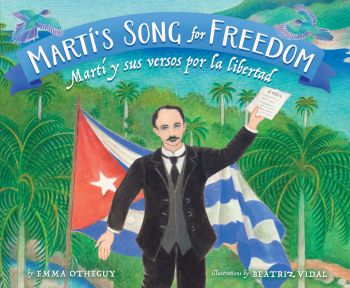 DESCRIPTION OF THE BOOK: As a young boy, Jose Martí traveled to the countryside of Cuba and fell in love with the natural beauty of the land. During this trip he also witnessed the cruelties of slavery on sugar plantations. From that moment, Martí began to fight for the abolishment of slavery and for Cuban independence from Spain through his writing. By age seventeen, he was declared an enemy of Spain and was forced to leave his beloved island. Martí traveled the world and eventually settled in New York City. But the longer he stayed away from his homeland, the sicker and weaker he became. On doctor’s orders he traveled to the Catskill Mountains, where nature inspired him once again to fight for freedom. Here is a beautiful tribute to Jose Martí, written in verse with excerpts from his seminal work, Versos sencillos. He will always be remembered as a courageous fighter for freedom and peace among all men and women.
 ABOUT THE AUTHOR: Emma Otheguy is a children’s book author and a historian of Spain and colonial Latin America. She is a member of the Bank Street Writers Lab, and her short story “Fairies in Town” was awarded a Magazine Merit Honor by the Society of Children’s Book Writers and Illustrators (SCBWI). Otheguy lives with her husband in New York City. Martí’s Song for Freedom/Martí y sus versos por la libertad is her picture book debut. You can find her online at
  ABOUT THE ILLUSTRATOR: Beatriz Vidal was born in Argentina and attended the Faculty of Philosophy and Humanities of Cordoba University. In New York, she studied painting and design with Ilonka Karasz for several years. During that time, her career as an illustrator began with designs for Unicef cards and record covers. She has illustrated many children’s books, including The Legend of El Dorado, A Library for Juana, Federico and the Magi’s Gift, and A Gift of Gracias. She divides her time between Buenos Aires and New York City.
 ABOUT THE REVIEWER: Chantel Acevedo’s novels include
  By Emma Otheguy
 My debut picture book, Martí’s Song for Freedom, is a biography of Cuban poet and national hero José Martí, but it is more importantly the story of the connections he made between Latin America and the United States, of how he loved Cuba while living in New York. This book honors Martí’s activism and his fight for justice, and it also tells the story of how Martí learned to go outside-over-there: how he found in the sighing pine trees the sound of the Cuban palmas reales he missed so much, how he lessened the distance between Cuba and New York. He came from everywhere and was on the road to every place, he knew how to dip under the sky and over the sea, how to close the gaps between divided worlds. He used poetry and passion to accomplish it. He too, would know about picture books, and his story is for every child who learns to share and hold our diverse cultures together.


 The Cuba I Know



 Latinxs in Kid Lit