
Review by Dora M. Guzmán
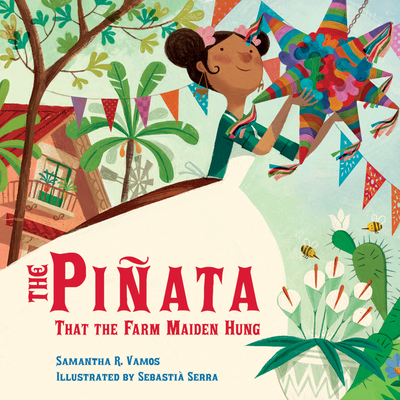 DESCRIPTION OF THE BOOK: A band of helpful animals joins the farm maiden, a farmer, and a boy in order to make a piñata from scratch and decorate the plaza. But then everyone falls asleep in the warm afternoon sun…
…and no one fills the pinata that the farm maiden hung.
How will they finish in time for the party? And who is the party for?
This bilingual story borrows the familiar structure of “The House that Jack Built” and is a companion title to The Cazuela That the Farm Maiden Stirred, a Pura Belpré Illustrator Honor Book.
MY TWO CENTS: This is a must-have addition to your classroom library and curriculum! It highlights the significance and collaboration in Latinx celebrations, traditions, and community. I am infatuated with this book’s integration of culture and overall style in a familiar story structure from the first book, The Cazuela that the Farm Maiden Stirred. The farm maiden and her community members, who include the boy, horse, cat, goose, farmer, and sheep, all partake in sharing their contribution to make the centerpiece of the celebration. In this case, the centerpiece is the piñata. There are other essential pieces to complete the celebration like alebrijes, cascarones, and papel picado. The author does not explicitly tell the reader who this party is for or why, but the characters are enthusiastically working together to get it right!
The author and illustrator, however, give readers a clue into this celebration by placing on the first page a young girl in her room who then walks outside, with the remaining characters peeking out of the house. This is a great stopping point for inferring and predicting before the story begins!
The deliberate shading and bold layers of color accentuate character features and the beauty in the environment as the characters are preparing for a celebration. Throughout the story line, words in Spanish are emphasized in bold print and their definitions are included at the end of the book. Cultural representations include alebrijes (wood carvings), cascarones (confetti in eggshells), and papel picado (tissue paper flags). Characters also share humor and collaboration as they work together to make this moment as special as they can, even when they all take a nap and forget to fill the piñata! No worries, because as they say “Teamwork makes the dream work,” and a dream it sure was! The birthday girl walks in and is surprised by the beautiful, thoughtful setup, but most of all there is an intricate and colorful piñata! The story ends at it should whenever a piñata is in the story- time to hit and break it! Readers are invited to sing along in Spanish and English to La Canción de la Piñata/ The Piñata Song, one that is reminiscent in many Latinx childhood memories.
Overall, I am forever grateful for this, a book that authentically reflects a Latinx culture. While there was an absence of food, except for the cake, it highlighted other parts of the celebration that are just as important. The words in this book brought life to Spanish vocabulary words and to the illustrations that married with the theme of collaboration, teamwork, and love for special moments like birthdays. Most of all, it solidifies the symbolic meaning of the piñata, which is an experience that is meant to be shared with those who bring you joy and happiness.
TEACHING TIPS: Many of these teaching moments can be implemented in a grades K-5 setting, with a focus on the primary grades.
- The repetitive nature in the text is perfect for reader participation and engagement in read alouds, especially in the early grade levels.
- Readers can develop their inferring abilities, especially with the illustrations.
- Focus on building vocabulary, not only focusing on the Spanish words that are introduced but also on verbs and descriptive language.
- Readers can be invited to learn more about other traditions, centerpieces, and components that are essential in other cultural celebrations.
- Students can learn to make a piñata!
- Included at the end of a book, is a step-by-step guide to make a piñata. This pairs well with a lesson on reading the procedural text.
- This book can also be combined in a unit to compare and contrast story lines and characters. Books in this unit can include The Cazuela That the Farm Maiden Stirred, as well as other stories similar to The House that Jack Built. Students can also be invited to write their own story that follows this structure.
 ABOUT THE AUTHOR: Samantha R. Vamos is the author of the companion title for this book, The Cazeula That the Farm Maiden Stirred, a Pura Belpré Illustrator Honor Book. She also wrote Alphabet Boats, Alphabet Trains, and Alphabet Trucks. She lives with her family in California.
Listen to Samantha R. Vamos talk about this book, The Piñata That the Farm Maiden Hung, on her publisher’s podcast.
Link: (https://charlesbridge.blogspot.com/2019/01/charlesbridge-unplugged-19-samantha.html)
 ABOUT THE ILLUSTRATOR: Sebastià Serra is an award-winning artist who has illustrated more than 70 children’s books in Spain, Italy, France, UK, Portugal, Taiwan, Brazil, and the United States. Also, he has worked as a graphic designer for several television shows, family theatre, and many museums and cultural institutions. He lives in Barcelona, Spain.
 ABOUT THE REVIEWER: Dora M. Guzmán is a bilingual reading specialist for grades K-3 and also teaches an undergraduate college course in Children’s Literature. When she is not sharing her love of reading with her students, you can find her in the nearest library, bookstore, or online, finding more great reads to add to her never ending “to read” pile
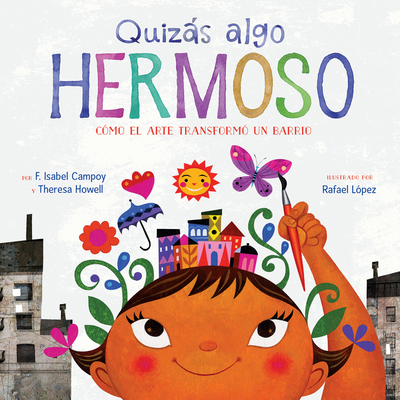 DESCRIPTION OF THE BOOK: Una edición en español lírica del aclamado e inspirador libro de cuentos ilustrados Quizás algo hermoso, ilustrado por el ganador de la medalla Pura Belpré, Rafael López.
 ABOUT THE AUTHORS (from the book):
  Theresa Howell
 ABOUT THE ILLUSTRATOR:
  ABOUT THE REVIEWER: Maria Ramos-Chertok is a writer, workshop leader and coach who facilitates The Butterfly Series, a writing and creative arts workshop for women who want to explore what’s next in their life journey. In December 2016, she won 1st place in the 2016 Intergenerational Story Contest for her piece, Family Recipes Should Never be Lost. Her work has appeared in the Apogee Journal, Entropy Magazine, and A Quiet Courage. Her piece Meet me by the River will be published in Deborah Santana’s forthcoming anthology All the Women in my Family Sing (Jan 2018)
 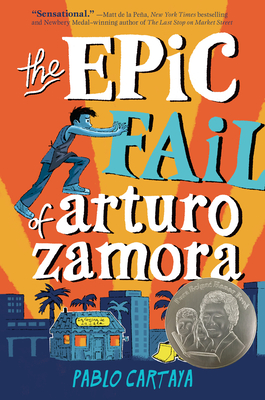 DESCRIPTION OF THE BOOK: Save the restaurant. Save the town. Get the girl. Make Abuela proud. Can thirteen-year-old Arturo Zamora do it all or is he in for a BIG, EPIC FAIL? For Arturo, summertime in Miami means playing basketball until dark, sipping mango smoothies, and keeping cool under banyan trees. And maybe a few shifts as junior lunchtime dishwasher at Abuela’s restaurant. Maybe. But this summer also includes Carmen, a poetry enthusiast who moves into Arturo’s apartment complex and turns his stomach into a deep fryer. He almost doesn’t notice the smarmy land developer who rolls into town and threatens to change it. Arturo refuses to let his family and community go down without a fight, and as he schemes with Carmen, Arturo discovers the power of poetry and protest through untold family stories and the work of José Martí.
 ABOUT THE AUTHOR: Pablo Cartaya is the author of the acclaimed middle-grade novel,
  ABOUT THE REVIEWER: Jessica Agudelo is a Children’s Librarian at the New York Public Library. She has served on NYPL’s selection committee for its annual Best Books for Kids list, and is currently a co-chair for the 2018 list. She contributes reviews of English and Spanish language books for School Library Journal and is a proud member of the Association of Library Services to Children and REFORMA (the National Association to Promote Library and Information Services to Latinos and Spanish Speakers). Jessica is Colombian-American and was born and raised in Queens, NY.
 “Coaches” or “mentors” have been crucial for the development of mankind since time immemorial. Older or wiser men and women took young wards under their wings to teach them hunting and gathering edible plants, or to pass down traditions important for survival. The concept was crystallized in ancient Greece, when Mentor, a friend of King Odysseus, stayed behind to take care of the king’s son, Telemachus. The boy and Mentor developed a trusted friendship, one whose importance can be observed in centuries of literature and movies. Think Arthur and Merlin. Leonardo Da Vinci and Raphael Sanzio. Or Daniel and Mr. Miyagi.

 Latinxs in Kid Lit