Guest Post by Author Cathy Camper: Lowriders in Space Blast Off!

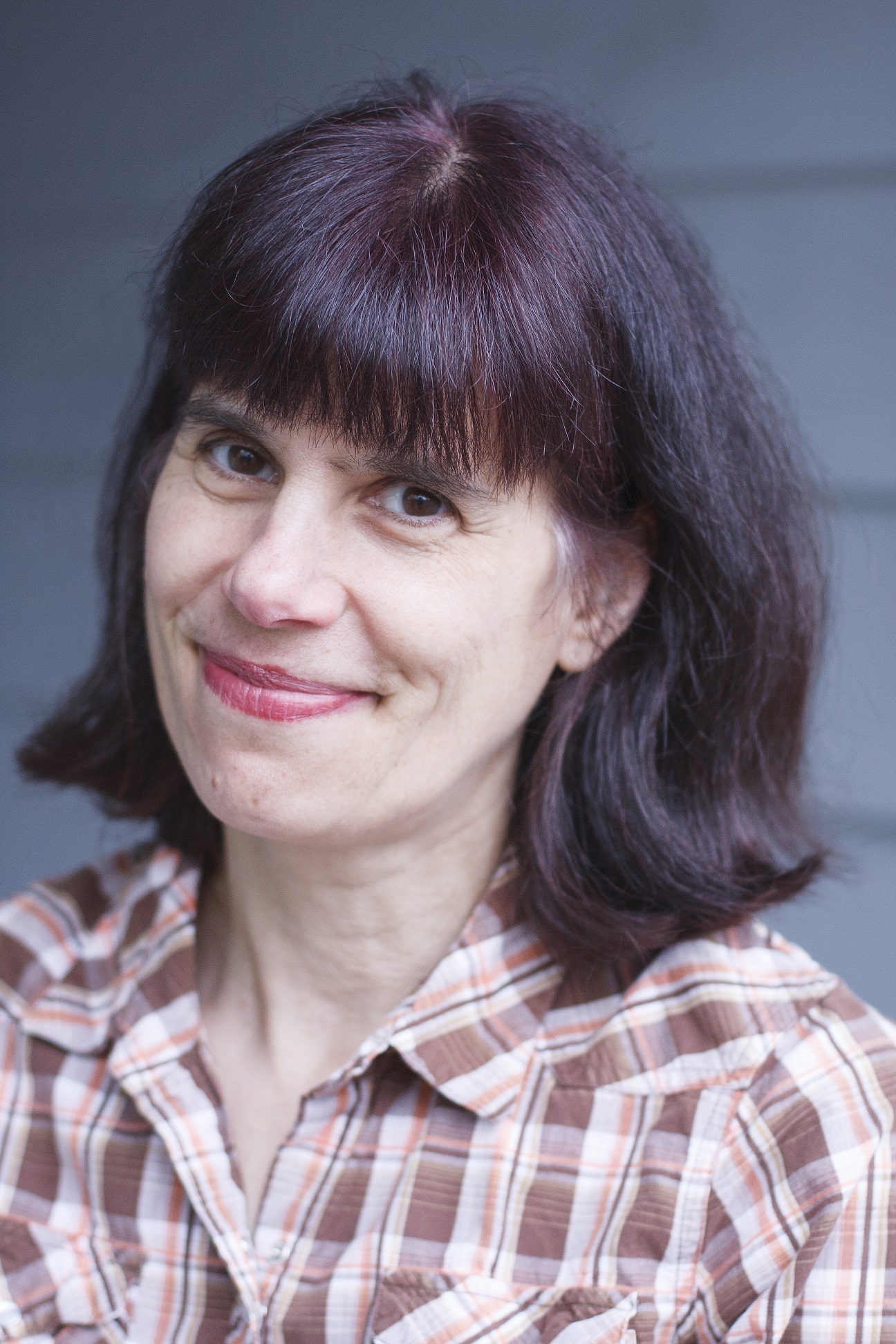
Cathy Camper_headshot_photo (c) Jayson Colomby_smBy Cathy Camper

Elirio Malaria (a mosquito), Flapjack Octopus and Lupe Impala work at a car dealership six days a week. Lupe’s the mechanic, Flapjack washes and buffs the cars, and Elirio details the cars with his beak. Their dream is to have a garage and a lowrider of their own:

            They’d seen some cars blast by fast,

             And others that could shift and drift,

            But they wanted a car that would go low and slow.

            Bajito y suavecito.

            A universal car contest gives them that opportunity. But not until their car gets customized by outer space! Pinstripes from Saturn, pompom asteroids, and star-capped hubcaps make their car an interstellar phenomena!

That’s how I pitched my graphic novel Lowriders in Space at Pitchapalooza in Portland, Oregon. Back when the book was just a manuscript and a vision in my head, I’d exhausted the list of graphic novel agents, and so winning this contest was like a dream come true. The prize was the advice of The Book Doctors, a husband-wife team who connected my project with an agent and eventually, an editor and publisher.

I’m a writer, artist and a youth services outreach librarian. I wrote Lowriders in Space because as an Arab American, I was fed up with the inability of mainstream comics and books to represent the diversity of kids I see everyday, kids who like me, don’t see themselves in books. When I first sent the script to the book’s artist, Raúl III, who is Latino, he told me, “This is the book I wanted to read as a child,” and he was as excited as I was to create it, and for the same reasons. Our editor at Chronicle Books, Ginee Seo, is Korean American, and she gets it too—like us she wants to give kids a book that meets them where they are.

I’d been working on the book since 2006, and was thrilled when the #WeNeedDiverseBooks campaign launched in May 2014. We’re hoping that when Lowriders comes out this fall, it kicks a big hole in the wall of racism of kids’ books, welcoming kids of all backgrounds to read it. We hope it encourages publishers to create more books by new authors and illustrators of color, and to inspire kids via reading our book, to become creators, too.

By 2050, one third of the US will live in English-Spanish speaking households—that’s our audience! The book’s also aimed at boys, because the literacy rate of boys is dropping, and like Jon Scieszka (who sponsors the Guys Read website), we want boys to read. We also envision that kids struggling to read, for whatever reasons, might find our book inviting. And it looks like adults are loving it, too, from all the reviews that have been popping up online.

Since I’m not Latina, it was crucial to me that our book was culturally correct. I did tons of research, read books, watched films, went to the Lowrider Magazine’s car show, and interviewed people. I’m also fortunate and forever grateful to have the help of many Latino friends and library co-workers, who read the manuscript, offered suggestions, and helped fine-tune the Spanish. One of the cartoonists I admire most is cartoon journalist Joe Sacco. His ability to go into places of high conflict, like Palestine and the Bosnian war and create detailed drawn and written records out of chaos humbles me. When I heard him speak, he mentioned that one of the things he tries to do is set his ego aside, and put the stories of those he’s writing about, up front. When I wrote Lowriders, I tried my best to emulate this goal, and to fight for, as best I could, what would make the story culturally relevant.

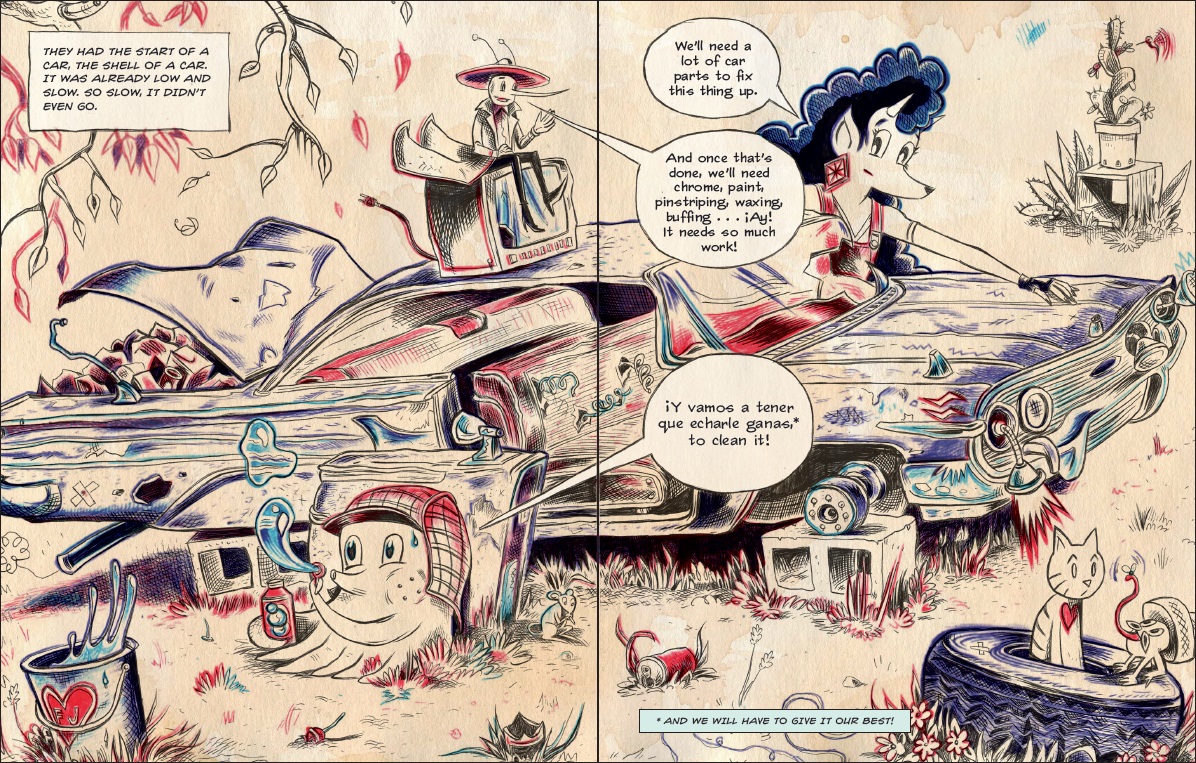
This goal included having the right illustrations. Traditionally in children’s books, the writer doesn’t choose an illustrator for the manuscript (though this is different in comics creation). I was warned along the way, “Choosing your own illustrator may work against you.” However, I felt it was crucial that Raúl illustrate this book, not only because he’s a brilliant artist (and if we’re saying we need more diverse kids books, we also need more diverse creators), but because his art added just the right touch of both cultural relevancy and the retro-nuevo feel the text demanded. Raúl told me that much of the setting and landscape is based on his childhood in El Paso, Texas. When he started sketching Flapjack Octopus, he said he couldn’t help but think of him in his pail as El Chavo del Ocho, sitting in his barrel—and so we changed Flappy’s name and look to reflect that.
Lowriders In Space_Int_2

Just as Raúl was able to make contributions to the text, I sometimes added context to the drawings. For example, it was important to me that our lowriders’ car had the Big Dipper on it. For the lowrider diaspora of Latinos and African Americans whom the book celebrates, the Big Dipper represents the path north, and more broadly, the path to freedom. What better symbol to have on a flying car’s license plate? Our book celebrates the influence of older comics, art, pop culture and car references that Raúl and I both love and wanted to share, including George Herriman’s Krazy Kat, the Hernandez BrothersLove and Rockets, Mad Magazine and Big Daddy Roth’s cars.

And then there’s the science – I love science! My first book Bugs Before Time was about giant prehistoric insects – including a sea scorpion as big as your mom. Why wouldn’t our graphic novel include science, when there really are things as wondrous as flapjack octopuses and braided rings of Saturn? The technology of cars is part of science, too, whether it’s learning how cars are buffed and painted, how air compressors make lowriders hop, or what vulcanizing does to make rubber tires strong.

We think Lowriders is going to read like something brand new, because of the unique, aligned intent of author, illustrator, and publisher and because of the crazy mix of culture, comics, and science our combined imaginations dreamed up. We hope you love it and it makes you laugh, and that you share your excitement with all the kids out there that might love it, too. When Lowriders in Space blasts off this fall, our real destination isn’t the outer galaxies, it’s to land in the hands of kids who deserve to see themselves in what they read, and to be read by everyone else so they experience how rich a culture of color can be.

Cathy Camper is a librarian focusing on outreach to schools and children in grades K-12. She lives in Portland, Oregon. Follow the book’s Facebook page for more news.

Coming soon on Latin@s in Kid Lit: A book talk on Lowriders in Space with more story details and more peeks at interior pages!
Q&A with Pura Belpré Award Winning Author Guadalupe Garcia McCall

By Lila Quintero Weaver

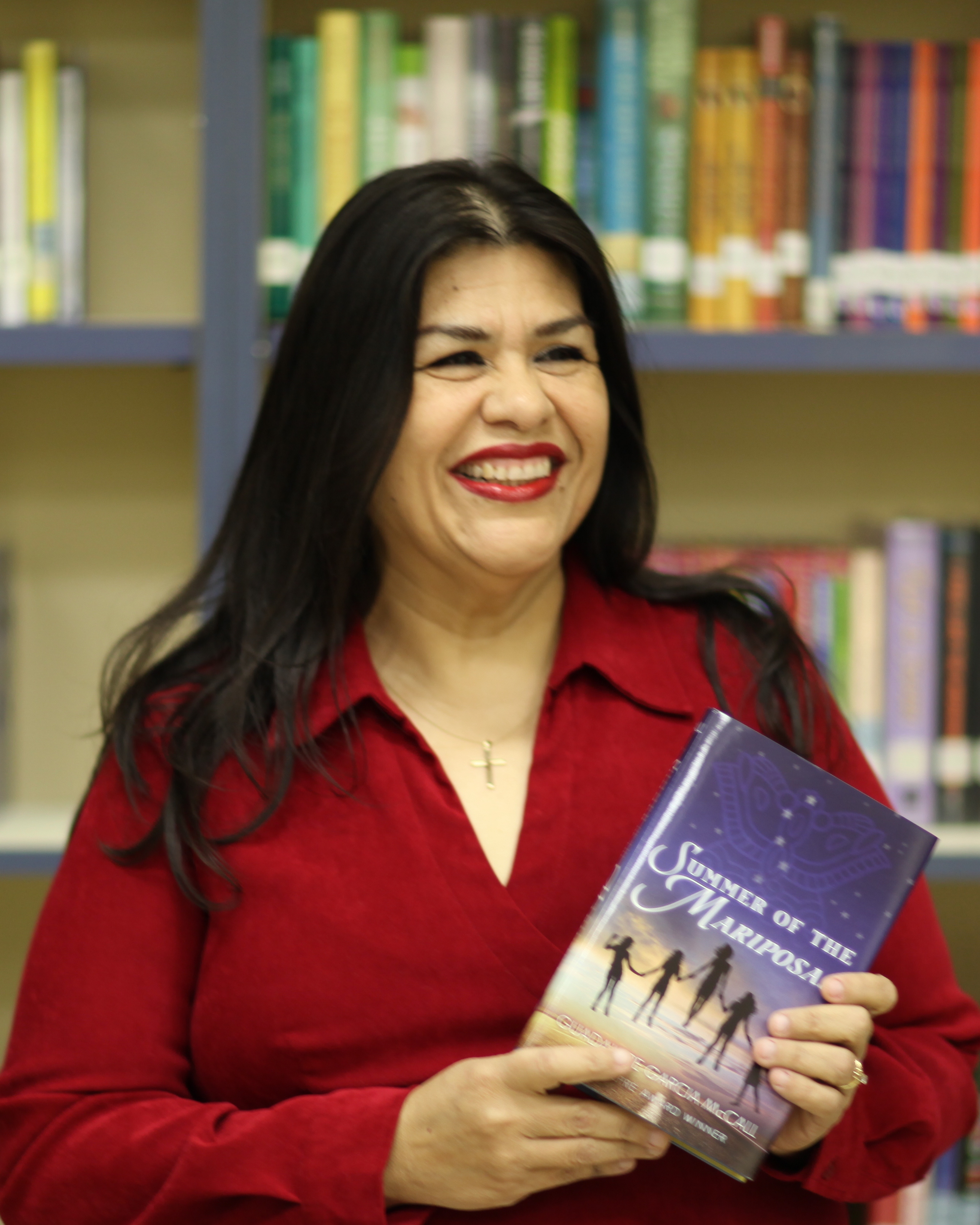
otherUNDERTHEMESQUITEtentativefrontcover3-18-10We’re excited to host a conversation with acclaimed author Guadalupe Garcia McCall. Her first book, Under the Mesquite, won the 2012 Pura Belpré Award and was a finalist for the William C. Morris Debut Award. Her newest work is Summer of the Mariposas, a rich work of fantasy fiction doubly inspired by Homer’s The Odyssey and the mythology of Mexico.

Lila: Guadalupe, congratulations on your wonderful writing career! Welcome to Latin@s in Kid Lit! Let’s get started with a question you’ve probably heard before:

Under the Mesquite is a powerfully intimate coming of age story told in verse. It’s a quiet book. On the other hand, Summer of the Mariposas is a high-energy road trip full of other-worldly characters and action scenes. Describe the paths that led to these diverse creative choices.

Guadalupe: Interestingly enough, both books were born out of my classroom experiences. Under the Mesquite came about because I was teaching my students how to write poetry. I wrote for them, as a way of modeling how easy and accessible poetry is if they focus on using their memories to write poems full of life’s experiences. After many years of teaching poetry (and collecting my little poems in my poetry unit folder), I realized that I had a good size collection of poems about my childhood which I could submit for publication. With the help of Emily Hazel, my editor at Lee & Low Books, that collection eventually evolved into Under the Mesquite.

After Under the Mesquite, I was bouncing around ideas for my next book, not really committed to anything, when one of my female students made the comment that all the books we read in class (we were studying Homer’s Odyssey) were about men—men having adventures, men defeating monsters, and men becoming heroes. This really upset my female students, and on her way out of my classroom, that same young lady told her friend, “It’s not fair. We need our own Odyssey!”

And that was it. That was my “light bulb” moment. Actually, it was more like a giant, blinding spotlight cast over a dark, neglected corner of our classroom that I couldn’t ignore as I drove home that afternoon. My girls were right. They needed to see themselves in literature. They needed their own stories to show the world that they are strong, and courageous, and smart. So I took out the sticky notes and started plotting out a Girl-Power adventure story using the Hero’s Journey just for them, for my “muchachas.” But as I worked on it, something else came to mind. Why use the same old Greek gods and monsters? Why not use our own mythology? We have just as many great characters to choose from in Mexican lore. And so it began, the frenzied scribbling and joyous giggling that comes when you first start plotting out a story—the discovery, the freedom, the breakthroughs—it’s all very intoxicating! I have to admit, I had a lot of fun writing Summer of the Mariposas because I knew my girls were hungry to read something like it.

Lila: Along with its supernatural elements, Summer of the Mariposas carries an understated but clear message of feminine strength and resilience. You force your characters to confront family challenges and heartbreaks. What do you hope to give young readers through this story?

FINALmariposas_cover_loGuadalupe: When I started writing Summer of the Mariposas, I wanted to tell a fun female story. However, I also knew I wanted to showcase the strength and resilience that it takes for a young lady to come of age and embrace womanhood in our society. I wanted young girls to believe in themselves and trust that a female is just as equipped to take care of herself and her loved ones as her male counterpart. That they are lacking nothing—that all young ladies have the courage to take life by force and the wisdom to attain their goals.

Lila: I’m sure you’ve been attuned to the recent conversation on diversity in literature, especially in children’s and YA publishing, which has stirred up a lot of media attention. One article quoted Matt de la Peña as saying, “Where’s the African American Harry Potter or the Mexican Katniss?” As a Latina writer, you must have well-formed opinions on this topic. What are your concerns? And what are your dreams for diversity in kid lit?

Guadalupe: Matt and I must be on the same wavelength because I asked a similar question about a year and a half ago, and I posted it on Facebook in a conversation with my publisher about gaps in children’s literature. We were talking about genre-specific gaps, and I asked a question along the lines of “Where is the Mexican-American Johnny Tremain?” I think it is very important that we start answering these questions. Not with words, but through action.

Listen, this fence is about to crumble. It’s got so many holes in it. The change in the face of our nation (diversity in our classrooms) is not forthcoming. The Change is here. The Change is upon us. We “have” diverse classrooms—and our students are missing the sound of their voice in the narratives available to them. It’s too late to “think” about it or “research” it or “plan” for it. No. It’s time to take action. Publishers need to be addressing the fact that there are not enough diverse children’s and YA books to fill the huge gaps in children’s literature. They need to be actively seeking out new and existing talent and publishing the books that will fill those gaps.

Lila: In addition to authoring books with strong Latino themes, you’ve also taught middle school (and now high school) in Texas. What are your thoughts about turning young Latinos into readers and writers?

Guadalupe: There is this great attitude in South Texas, especially along the Rio Grande Valley, border area, and that is that books are amazing and that their creators, namely authors, are ROCK STARS! The teachers, administrators, district personnel, and especially the community have made it their mission to make books and their creators accessible to children. They seek out grants and special programs and make every concerted effort to continue to feature books and their authors in their schools. They see reading and writing as the greatest assets, the most important tools in their children’s toolbox. I really admire that. I wish that was the case with every teacher, every administrator, every district, and every community in the world. Life would be sweet if we were all about education. I know that I’m being very naive here (with all the other problems to be solved in the world), but I do truly believe in building life-long learners through reading and writing! Reading and writing make up the foundation of learning, and a good book can draw a child in as well as any electronic gadget if presented in the right light, with the right attitude, and with the same attention corporations give to marketing video games, apps, and cell phones. It would mean flipping a Goliath of a paradigm on its ear, and the willingness to take on the fight, but it can and should be done, for our children’s sake!

Lila: Let’s get practical. You work a full-time job and yet somehow manage to write complex novels. What are the habits that help you produce? Is there a piece of writing advice that a mentor gave you which still rings true? What have you discovered on your own that guides you in attacking a new project?

Guadalupe: My habits? Well, I sit down every day to tap at those keys. Sometimes I take a cup of coffee to the porch and write as the sun rises on the weekends. Sometimes, I write the minute I get home from work. And sometimes, I pull over on the side of the road and write in my vehicle on the way to the grocery store because I don’t want to lose that terrific line. Most often, though, I get up in the middle of the night and write in my jammies because that’s when my brain wants to create.

Whatever the case may be, it’s important for me to write every day, to “touch the work every single day!” I heard that somewhere, or maybe I read it. I’m not sure which, but it’s very true. I find that the longer I stay away from writing, the harder it is to get back in the groove of it. It’s like being an athlete. If you don’t keep working out, you lose muscle, and you won’t win any races or bring any trophies home if you don’t work out every day. So this is the advice I pass on to my students,” Work out those writing muscles every day. Read. Write. Read. Write. Read. Write. Oh, and don’t be afraid to catch the latest movie or keep up with your favorite TV show. It’s good research! ”

Lila: Speaking of new projects, you must be working on something. What can you share about it?

Guadalupe: I am working on a YA historical set in Texas during the Mexican Revolution, after the discovery of the Plan de San Diego and all the strife and conflicts of that time period on this side of the border. It’s something that is very close to my heart because I think it’s an important time in “our history” that hasn’t been explored or talked about much in our classrooms. The maltreatment and persecution of Mexican Americans in South Texas during that time is either ignored or glossed over in our textbooks and there is literally little to nothing in YA fiction that touches on the struggles Hispanics experienced during that devastating time period in American history. I really can’t share too much of the plot except to say that it is my attempt at filling in a gap and answering the questions, “Where is the Mexican-American Johnny Tremain? Where is our historical perspective, our ancestral Mexican-American voice?”


IMG_2964 (2)Guadalupe Garcia McCall is the author of Under the Mesquite (Lee & Low Books), a novel in verse. Under the Mesquite received the prestigious Pura Belpre Author Award, was a William C. Morris Finalist and received the Ellen Hopkins Promising Poet Award, the Tomas Rivera Children’s Book Award, and was included in Kirkus Reviews’ Best Teen Books of 2011 among many other honors and accoladesHer second novel, Summer of the Mariposas (Tu Books, an imprint of Lee & Low Books), won a Westchester Young Adult Fiction Award, was an Andre Norton Award for Young Adult Science Fiction and Fantasy Finalist, and was included in the 2013 Amelia Bloomer Project List, the Texas Lone Star Reading List, and the 2012 School Library Journal’s Best Books of the Year.

Her poems for adults have appeared in more than twenty literary journals across the country and abroad, and her poems for children are included in The Poetry Friday AnthologyThe Poetry Friday Anthology for Middle School, and The Poetry Friday Anthology for Science. Ms. Garcia McCall was born in Piedras Negras, Coahuila, Mexico. She immigrated with her family to the United States when she was six years old and grew up in Eagle Pass, Texas (the setting of both her novels and most of her poems). She is currently a high school English teacher in the San Antonio area and lives in Somerset with her husband, Jim, 2 dogs (Baxter and Blanca), 1 cat (Luna), and her two (of three) college age sons, Steven and Jason.

Cover Reveal for When Reason Breaks, a 2015 Young Adult Debut

.

By Cindy L. Rodriguez

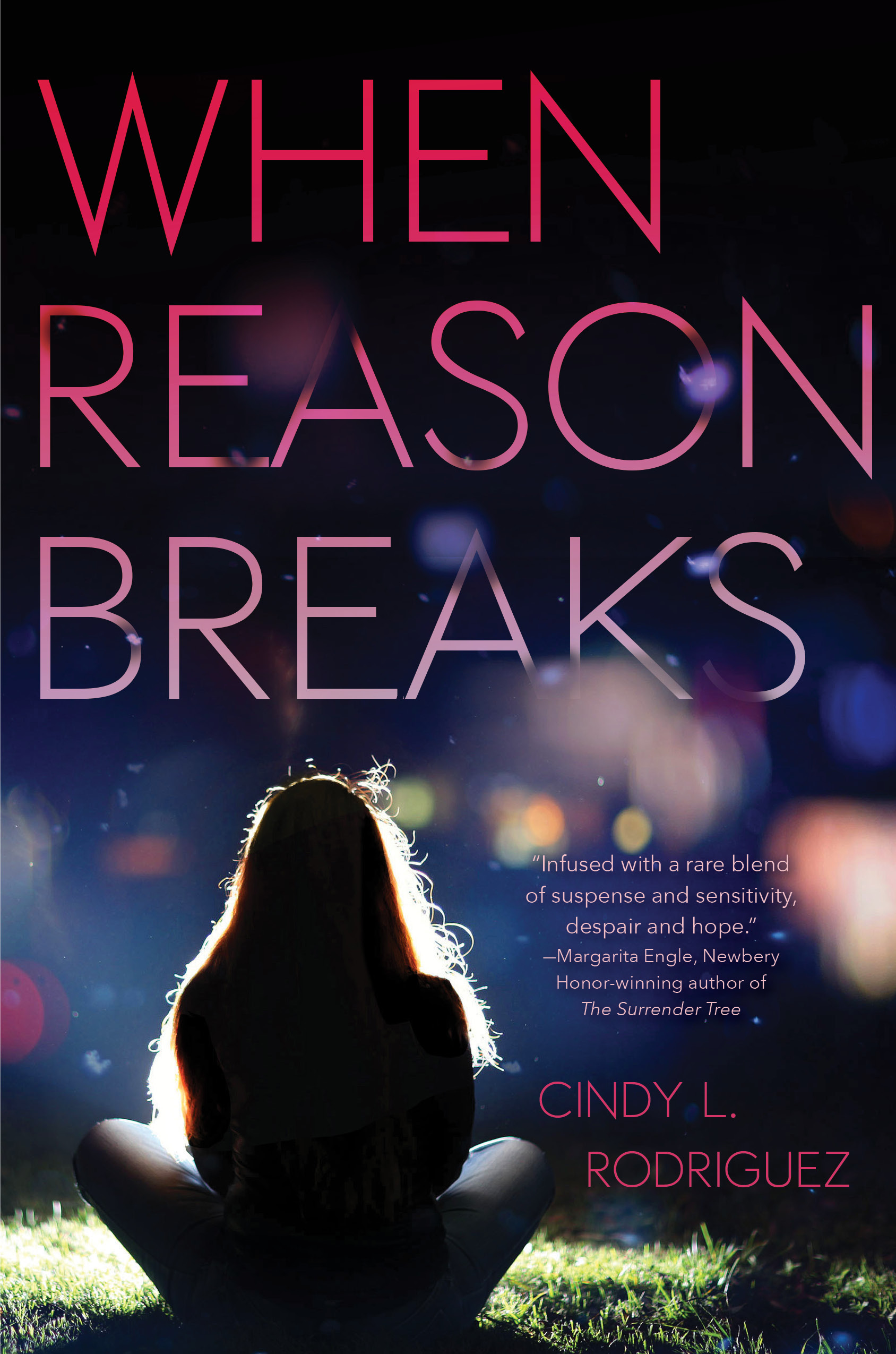
I’m really excited to reveal the cover for my debut novel, When Reason Breaks, which will be published 2/10/2015 by Bloomsbury USA Children’s Books. I’m equally thrilled to share it here because one of the main characters is Latina and the first blurb the novel received is from the wonderful, generous, super-talented Margarita Engle.

Before you scroll down to see the cover, here’s a description of the novel:

A Goth girl with an attitude problem, Elizabeth Davis must learn to control her anger before it destroys her. Emily Delgado appears to be a smart, sweet girl, with a normal life, but as depression clutches at her, she struggles to feel normal. Both girls are in Ms. Diaz’s English class, where they connect to the words of Emily Dickinson. Both are hovering on the edge of an emotional precipice. One of them will attempt suicide. And with Dickinson’s poetry as their guide, both girls must conquer their personal demons to ever be happy.

In an emotionally taut novel with a richly diverse cast of characters, readers will relish in the poetry of Emily Dickinson and be completely swept up in the turmoil of two girls grappling with demons beyond their control.

An extra tidbit for any big-time Emily Dickinson fans: Almost all of the characters represent a real person from ED’s life. Emily and Elizabeth represent Dickinson herself, sharing personal traits and experiences. Tomás Bowles represents Thomas Wentworth Higginson and Samuel Bowles, two important men in ED’s life, etc. You’ll have to read more in the author’s note!

So, now for the cover……………

*

*

*

*

Keep scrolling…(I was told to build suspense. Isn’t this suspenseful?)

*

*

*

*

TA-DA!!!!

*

*

*

*

WhenReasonBreaks_Comp

I love it for lots of reasons! The dark and light, focused and unfocused elements symbolize what the characters experience with their emotional and mental health issues. Same with how the letters start out solidly colored and then fade. Not seeing the girl’s face is also perfect since it’s a mystery as to which of the two girls attempts suicide. And here is the full quote from Margarita Engle, which will be included in its entirety on the back cover:

When Reason Breaks is infused with a rare blend of suspense and sensitivity, despair and hope. The poetic spirit of Emily Dickinson shines through the gloom of daily struggles faced by modern teens, as they discover the possibilities where they dwell.”

I’m so excited to share my debut novel with the world–starting now with a giveaway! One winner will receive a signed ARC of When Reason Breaks. Click on the Rafflecopter link below to enter. I’ll choose a winner in a week!

a Rafflecopter giveaway

CindyRodriguez150For more information about me and/or my debut novel, check out my website. You can also find me here on the About Us page and on Facebook, Twitter, and Goodreads.

When Reason Breaks is available for pre-order here:

Indiebound Barnes and Noble | Amazon Powell’s Book Depository | Books-A-Million

2014 Reading Challenge: June

Participants in our 2014 Latin@s in Kid Lit Reading Challenge are out of control in the best possible way! Take a look at the variety of books that were read in June, which happens to be the half-way point of the challenge. Now would be a great time to join us or renew your commitment to the challenge, which is to read one book a month that is written by a Latin@ author (any subject) or a book written by anyone that has Latin@ characters, themes, settings, etc. You’re not required to review–only read and enjoy and let us know what you have read! If you do post a review somewhere, we will link it to the book covers below. If you choose not to review, we will link the covers to Goodreads. For July, you may want to consider some of the new winners of the International Latino Book Awards.

6413788 16043528 13436375 9757257 18166935 13482750 8585924  17286899 18048909 15814459 11387515 862908 8811369 6789056  14740980 240298 465967  13610203  2282907  6084038  4080320  15953630  17171578  8455432  16057383  18654377  10351733  18654384  1861037  52390 1139921  18148193  321133  3308853  15791044  11129790  12921673313233169587  688161  1807231  424182  640476  15893258  2429455

The 2014 International Latino Book Awards Winners!!

Below are the first place winners of the 16th Annual International Latino Book Awards in the children’s, youth, and young adult categories. If you click on the images, you will be taken to Goodreads, Barnes and Noble, or Amazon for more information. The Awards are produced by Latino Literacy Now, an organization co-founded by Edward James Olmos and Kirk Whisler, and co-presented by Las Comadres para las Americas and Reforma, the National Association to Promote Library and Information Services to Latinos. The Awards were announced this past weekend, on June 28, in Las Vegas as part of the ALA Conference. For the complete list, which includes adult fiction, nonfiction, and second place and honorable mention winners, click hereCONGRATULATIONS TO ALL OF THE WINNERS!!

Best Latino Focused Children’s Picture Book: English

18296043

Best Latino Focused Children’s Book: Spanish or Bilingual

17265250  19483940

Best Children’s Fiction Book: English

Best Children’s Fiction Picture Book: Bilingual

17940785

Best Children’s Fiction Picture Book: Spanish

17802285

Best Children’s Nonfiction Picture Book

13610203

Best Educational Children’s Picture Book: English

15791044

Best Educational Children’s Picture Book: Spanish or Bilingual

Hola! Gracias! Adios!

Most Inspirational Children’s Picture Book: English

18371476

Most Inspirational Children’s Picture Book: Spanish or Bilingual

Pink Firetrucks

Best Youth Latino Focused Chapter Book

10436183  16670129

Best Youth Chapter Fiction Book: English

17166339

Best Youth Chapter Fiction Book: Spanish or Bilingual

Best Youth Chapter Nonfiction Book

Most Inspirational Chapter Book

The Adventures of Chubby Cheeks: The Pro Quest

Best Young Adult Latino Focused Book: English

15769992

Best Young Adult Latino Focused Book: Spanish or Bilingual

Los Pájaros No Tienen Fronteras by Edna Iturralde

Best Young Adult Fiction Book: English

15798660

Best Young Adult Fiction Book: Spanish or Bilingual

La Guarida de las Lechuzas by Antonio Ramos Revillas

Best Young Adult Nonfiction Book

Best Educational Young Adult Book

Most Inspirational Young Adult Book

15769992

Best Book Written by a Youth: English

15020431

Best Book Written by a Youth: Spanish or Bilingual

  Serendipity, Poems About Love in High School

Best Children’s Picture Book Translation: Spanish to English

17465058

Best Children’s Picture Book Translation: English to Spanish

Best Chapter/Young Adult Book Translation: English to Spanish

El Gusano de Tequila

Best First Book: Children’s and Youth


Book Review: Dale, Dale, Dale: Una fiesta de números/Hit it, Hit it, Hit it: A fiesta of numbers by René Saldaña, Jr.

By Sujei Lugo

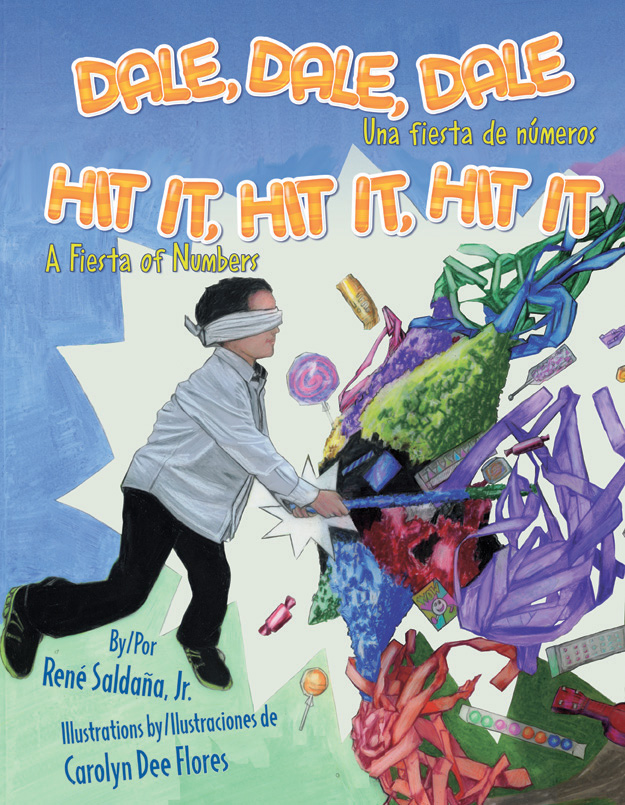
DaleDaleDaleCoverDESCRIPTION FROM THE BOOK (provided by publisher): In this bilingual counting picture book, a young boy counts to twelve in anticipation of his birthday party: one piñata filled with candy; two hours until the party; three tables set for all the guests, etc.

MY TWO CENTS: Using simple text interwoven with a birthday party theme, René Saldaña, Jr. creates a fun bilingual counting book that makes us want to join the party. Carolyn Dee Flores’s illustrations are filled with photorealism and vibrant colors, supporting Saldaña’s words, and they successfully capture the excitement of children’s birthday parties. In what is definitely a welcomed surprise, Dale, Dale, Dale/ Hit it, Hit it, Hit it not only illustrates an adequate counting story, but decides to tell a good tale about sharing and enjoying a special day with your loved ones.

Our young protagonist is Mateo, a boy who anxiously awaits his birthday party and who uses this opportunity to practice counting throughout his special day. From “one piñata filled with candy” to “twelve children ready to swing at the piñata,” readers can count along with Mateo in Spanish and English. The items that the boy chooses to count include party supplies, colorful toys, lucha libre masks, musical instruments, and his own cousins. The picture book doesn’t limit readers to count only Mateo’s choices, but places other elements that can be counted throughout each page.

This bilingual book provides simple sentences in Spanish and English, which early readers, whether in one language or both, can easily follow. Although the translation of some words is problematic for language learners, for example, niños/guests, it isn’t a limitation to learn and practice words in two different languages.

As a picture book, the photorealistic illustrations can be seen by some as a weakness at the moment to capture children’s attention. But Flores plays well with vibrant colors to encourage young readers to focus on the story and stimulate them, not only to count, but also to identify different colors displayed on every page. The educational content of the book will inspire children to count everything around them and will motivate them to be even more excited to have their own birthday party.

TEACHING TIPS: As early readers or as a read aloud, this bilingual picture book works well for children ages 4-6. Parents, caregivers, and librarians can read in Spanish, English, or both, while encouraging young ones to practice their counting skills and color identification. Children can also point out what they like about birthday parties and collaborate to plan their next one. A song is included in the story, which can be useful if you include a piñata in your party.

Teachers can plan learning activities to combine math and language arts. Students can learn new vocabulary words, numbers, colors, and Spanish-English language meaning. Activities that develop memory and concentration can be done with second graders, including sequence of events and pairing numbers with items mentioned in the book.

AUTHOR & ILLUSTRATOR: René Saldaña, Jr. is a Latino young adult and children’s books writer and Language and Literacy professor at Texas Tech University. He holds a B.A. from Bob Jones University, a M.A. from Clemson University, and a Ph.D. in English and Creative Writing from Georgia State University.

He is the author of several books, including his semi-autobiographical novel The Jumping Tree (2001), Finding Our Way: Stories (2003), the Junior Library Guild selection The Whole Sky Full of Stars (2007),  A Good Long Way (2010), the collection of short stories Dancing with the Devil and Other Tales from Beyond/Bailando con el Diablo y otros cuentos del más allá (2012), and the bilingual Mickey Rangel mystery series.

Carolyn Dee Flores, a former computer analyst, is a writer, illustrator, musician, and composer. She attended the International School of Bangkok, Thailand and Naha, Okinawa, Japan, and Trinity University, where she studied Engineering, Philosophy and Art. Flores began her painting career as a muralist and oil painter, before switching over to children’s books illustration.

She has illustrated several other children’s books, including Canta, Rana, Canta/Sing, Froggie, Sing (2013), Peggy Caravantes’s Daughter of Two Nations (2013).

For more information about Dale, Dale, Dale: Una fiesta de números/Hit it, Hit it, Hit it: A fiesta of numbers (2014), visit your local library or bookstore. Also check out worldcat.org, goodreads.com, indiebound.org, and Arte Público Press.