

Reviewed by Cecilia Cackley
DESCRIPTION OF THE BOOK (from Goodreads): Funny Bones tells the story of how the amusing calaveras—skeletons performing various everyday or festive activities—came to be. They are the creation of Mexican artist José Guadalupe (Lupe) Posada (1852–1913). In a country that was not known for freedom of speech, he first drew political cartoons, much to the amusement of the local population but not the politicians. He continued to draw cartoons throughout much of his life, but he is best known today for his calavera drawings. They have become synonymous with Mexico’s Día de los Muertos (Day of the Dead) festival. Juxtaposing his own art with that of Lupe’s, author Duncan Tonatiuh brings to light the remarkable life and work of a man whose art is beloved by many but whose name has remained in obscurity.
MY TWO CENTS: I can’t say enough good things about this book! Tonatiuh tells Posada’s life story simply, while still giving background information on events such as the Mexican Revolution for context. The pages showing a breakdown of the three distinct artistic processes that Posada used (lithography, engraving and etching) are especially helpful in visualizing exactly how he created his drawings. Tonatiuh’s signature profile figures, inspired by Mixtec codex imagery, fit nicely alongside Posada’s black and white skeletons. The full page reproductions of famous skeleton art alongside a question about what message Posada was communicating with his art push readers to consider the goals of the artist. A detailed author’s note, glossary, and bibliography are essential for those looking for further information. This is a great read aloud for younger kids that still has enough detail and big ideas for older readers.
TEACHING TIPS: This is going to be a marvelous read aloud for both art teachers and classroom teachers. While many people will likely choose to highlight it during National Hispanic Heritage Month or around Dia de Muertos, it should also be a good fit for classes studying political cartoons or art history. Tonatiuh’s fantastic spread at the end of the book showing skeletons doing present day activities is a wonderful prompt for students to create their own calaveras artwork. As our world becomes more global and art and culture make their way across borders, this book provides an opportunity to discuss the importance of crediting artists and researching the history of particular art and cultural traditions.
 ABOUT THE AUTHOR: Duncan was born in Mexico City and grew up in San Miguel de Allende. He graduated from Parsons The New School for Design and from Eugene Lang College in New York City in 2008. His work is inspired by Ancient Mexican art, particularly that of the Mixtec codex. His aim is to create images that honor the past, but that address contemporary issues that affect people of Mexican origin on both sides of the border. His book Pancho Rabbit and the Coyote: A Migrant’s Tale is the winner of the 2014 Tomás Rivera Mexican American children’s book award. It is also the first book to receive two honorable mentions, one for the illustrations and one for the text, from the Pura Belpré Award for a work that best portrays, affirms, and celebrates the Latino cultural experience in children’s books. The book was featured in USA Today, The Chicago Sun, The Houston Chronicle among other major publications because it deals with the controversial topic of immigration. His book Diego Rivera: His World and Ours won the 2012 Pura Belpré illustration award. It also won the 2012 Tomás Rivera. His first book Dear Primo: A Letter to My Cousin received an honorable mention from the Pura Belpré Award in 2011. It was named an Americas Award Commended Title and a Notable Book for a Global Society list.
LINKS:
Kirkus Prize Finalist Announcement
 Cecilia Cackley is a performing artist and children’s bookseller based in Washington DC where she creates puppet theater for adults and teaches playwriting and creative drama to children. Her bilingual children’s plays have been produced by GALA Hispanic Theatre and her interests in bilingual education, literacy, and immigrant advocacy all tend to find their way into her theatrical work. You can find more of her work at www.witsendpuppets.com.


 Marianne Snow is a doctoral student at the University of Georgia, where she researches Latin@ picture books, representations of Latin@ people in nonfiction children’s texts, and library services for Spanish-speaking children and families. Before moving to Georgia, she taught Pre-K and Kindergarten in her home state of Texas and got her master’s degree in Teaching English to Speakers of Other Languages (TESOL) at Texas A&M University. In her spare time, she enjoys obnoxiously pining for Texas, exploring Georgia, re-learning Spanish, and blogging at


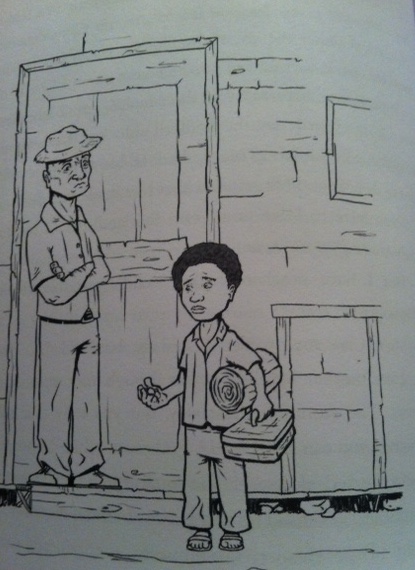
 ncing good intentions and generosity to others with responsibility and a concern for appearances. When Señora Beatriz sends Pepe out for lunch on their first day together, Melky, one of the street boys, recognizes him and runs over to join him. Pepe becomes preoccupied with Melky’s disheveled appearance, worrying that the señora might think he is a street boy, too, if she sees him with Melky. Pepe understands the boy’s hungry glances at the lunch bag, but his fear over damaging his opportunity with Señora Beatriz is what drives him to share his food: “If I give you some of my lunch, you have to promise to go away. You can’t let the señora see you—ever!” (33).
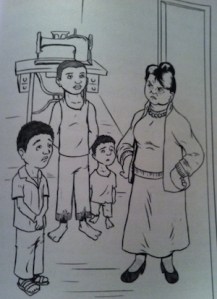 ove with the beautiful fabrics and deck themselves out in tiaras and veils. Primo succeeds at fixing the sewing machine, but the boys are so tired from their efforts they fall asleep at the kitchen table.

 As important as it is to contest happy endings, it is also important to protect Latino children’s right to happiness. I became more aware of this significance upon giving a presentation on Juan Felipe Herrera’s Super Cilantro Girl where I was asked if the story’s ending undermined Esmeralda’s agency. Super Cilantro Girl tells the story of Esmeralda Sinfronteras and her transformation into a giant green superhero set to rescue her mother from an ICE detention center. Upon learning that her mother has been detained at the border, Esmeralda taps into the power of cilantro and gradually changes into Super Cilantro Girl. Bigger than a bus, taller than a house, and with the power of cilantro and flight, Esmeralda breaks her mother out of the detention center and brings her home. Super Cilantro Girl disrupts the anti-immigration policies that seek to separate her family by becoming bigger, stronger, and more heroic than the system. At the end of the story, however, it turns out that Esmeralda was dreaming and did not change into Super Cilantro Girl nor did she rescue her mother. Despite that, though, Esmeralda’s mother returns. In my presentation, I claimed that Esmeralda’s transformation exemplified how the body can be a site of healing. What does the ending then suggest about Esmeralda’s healing process and agency if her transformation into a superhero was just a dream? It was then suggested that I’d have a more productive reading of Super Cilantro Girl if I talked about it as magical realism and/or science fiction.
 Latinxs in Kid Lit