Book Review: Sofi and the Magic, Musical Mural/Sofi y el Mágico Mural Musical


Reviewed by Sujei Lugo
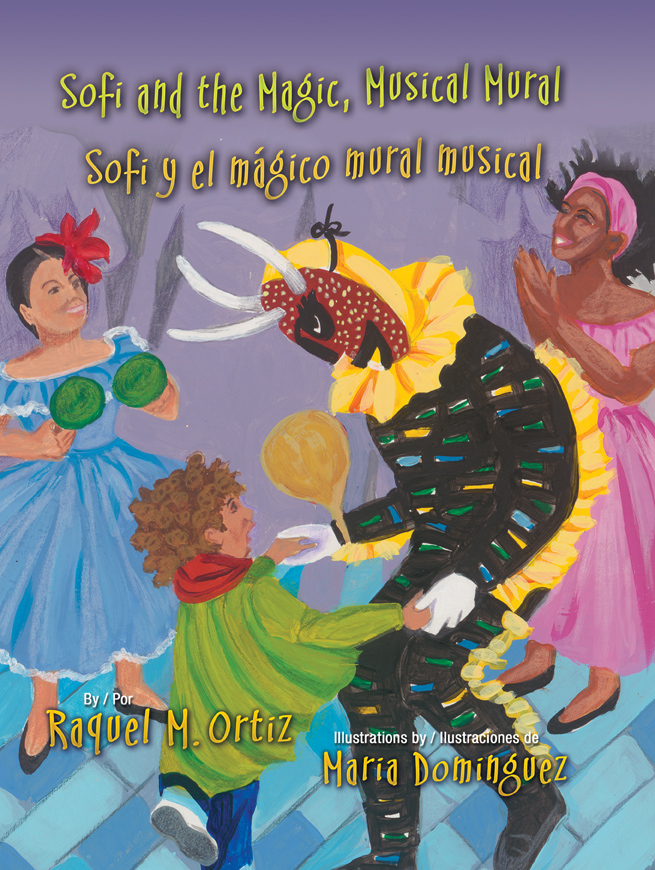
Sofi-and-the-Magic-Musical-MuralDESCRIPTION FROM THE PUBLISHER: When Sofi walks through her barrio to the local store, she always passes a huge mural with images from Puerto Rico: musicians, dancers, tropical flowers and—her least favorite—a vejigante, a character from carnival that wears a scary mask. One day on her way home from the bodega, she stops in front of the mural. Is one of the dancers inviting her to be his partner? “Okay, let’s dance,” Sofi giggles, and suddenly she’s in Old San Juan, surrounded by dancers and musicians playing bongos, tambourines and güiros. She begins to dance and sing with her new friends, but her pleasure turns to fear when the vejigante—wearing a black jumper with yellow fringe and a red, three-horned mask—spins her around and around! What does he want from her? How can she get away?

MY TWO CENTS: In this debut bilingual picture book, author Raquel M. Ortiz and illustrator Maria Dominguez capture the story of an imaginative girl and her magical and musical encounter with a neighborhood mural. Inspired by a mural located in South Bronx, New York, Ortiz and Dominguez give us a story that celebrates Puerto Rican traditions, community-based art, and city life.

Our young protagonist Sofía is lying on her bed feeling pretty bored. Her mom asks her to go to the bodega at the end of the block to get some milk and to remember that she should “not talk to ANYONE!” Sofía gets her scarf and coat, nods to her mom, and embarks on her journey to get the half-gallon of milk. Strolling along the sidewalk, she looks at the huge mural painted on a nearby building. She is stunned by its size and the colorful images of musicians, dancers, amapola flowers, and her least favorite, a vejigante. While returning from the bodega, Sofia can’t help admiring the mural once again. This is when she notices that one of the musicians, a plenero, is extending his hand to her to dance, breaking the wall between reality, art, and imagination. In a heartbeat, Sofía finds herself inside the mural, starting a whimsical experience that will bring her close to her Puerto Rican heritage.

Reading and seeing images of things that I grew up with put a smile on my face. From the plena song “Porque la plena viene de Ponce, viene de barrio de San Antón” to the carnival song “¡Toco-toco, toco-toco! ¡Vejigante come coco!”, I couldn’t help singing along with all the plenas and remembering the presence of plena songs in family gatherings, “navidad” parties, cultural “festivales”, carnivals, and even street protests. No wonder it is known as the  “periódico cantado” (sung newspapers), telling everyday stories all year long.

We also meet the famous vejigante, wearing its colorful outfit and a scary mask made from coconut shell (although some are made from papier-mâché). The vejigante is a mischievous folkloric character that resembles a buffoon or the devil, and which became a symbol of Puerto Rican cultural identity. In the story, Sofi plays and dances with the vejigante that she once saw as scary. She ends up wearing his outfit and flies around the Puerto Rican landscape going through El Yunque rainforest, and landing at the church plaza in Old San Juan. Here the author metaphorically portrays how through art, music, and traditions we can “fly” to the island of Puerto Rico, and demonstrates the deep connections that exist between the Puerto Rican diaspora and the island.

In terms of layout and illustrations, the bilingual text is located on the left side of the book with small illustrations dividing the English and Spanish texts and whole-page illustrations accompanying the text on the right side. The illustrator based her design and images on the original mural and conversations with the students that drew the images for mural. From soft colors for the city and bright and vivid colors for the mural, Dominguez’s paintings transport us from a wintry day in New York City to a sunny day in Puerto Rico.

Using The Pueblo Sings/El Pueblo Cantor mural as an inspiration for this picture book communicates the power of art, music, literature, and images to represent a community and tell its stories of resistance. The 7th- and 8th-grade students that designed the mural embraced the process of community building, public art, and history. It was created with and for the Puerto Rican community that has lived in New York City for decades. The mural’s statement is about the existence of the people and is a representation of their stories. It brings identification to the neighborhood and informs visitors about the living, breathing community located there. It is exciting to see the author centering the narrative on a young Puerto Rican girl who experiences this connection with her culture, traditions, and family, and then back to herself. In so doing, this book gives a powerful testament to how children can experience these connections and embrace them as their own.    

The book includes author and illustrator biographical notes, a glossary, and information about the mural.

TEACHING TIPS: The bilingual picture book is recommended for children ages 4 to 8. It works as a read aloud and for early independent readers. At home or at the library, librarians, parents, grandparents or other caregivers can read the story aloud in English, Spanish, or both, while teaching new words, concepts and discussing the different images. Teachers can include the discussion of Puerto Rican history, traditions, and music in their curriculum. 
IMG_4360-2

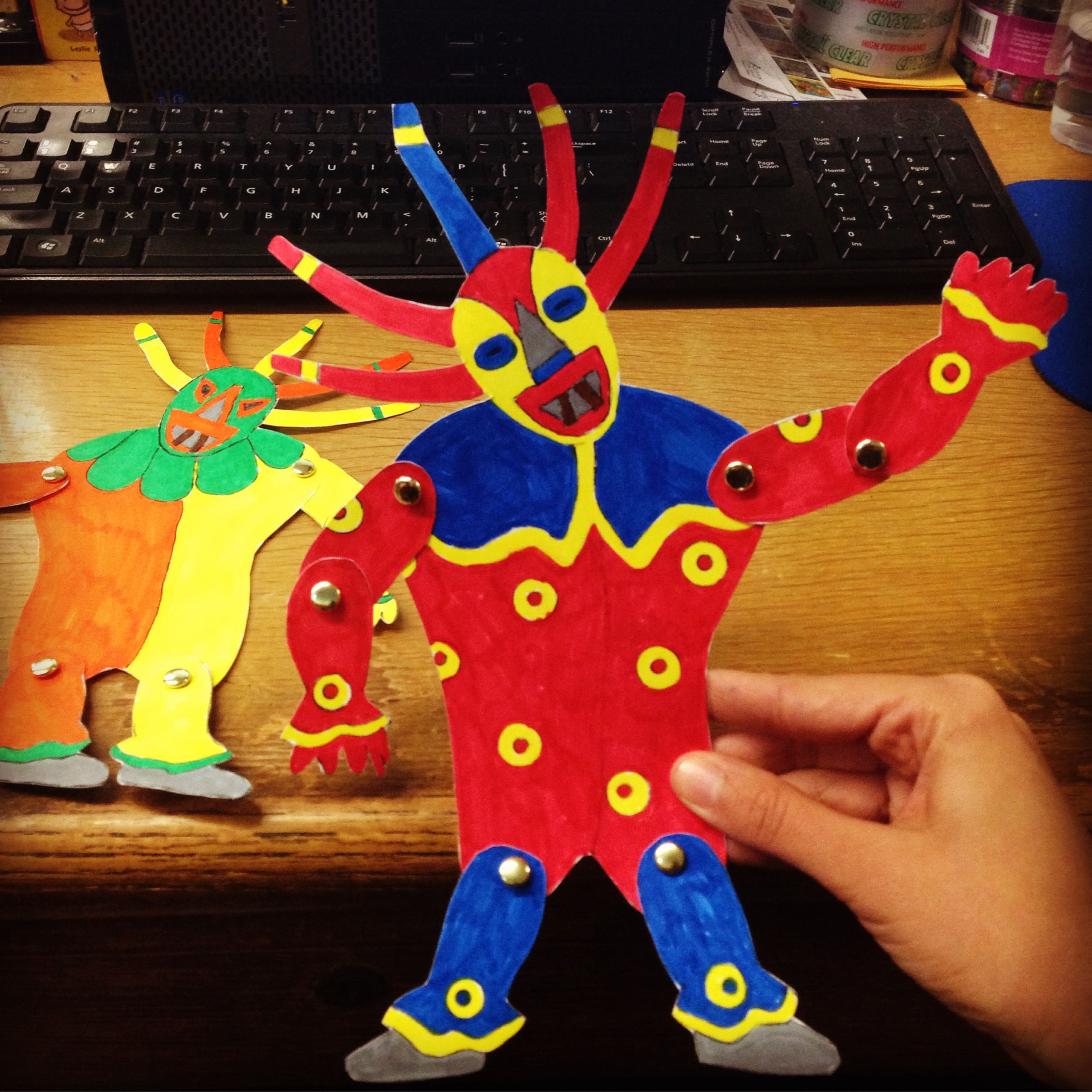
Vejigantes puppets I created for a library program. I explained to the children the meaning of vejigantes and how I grew up seeing them almost everywhere back in Puerto Rico.


Since the main focus of the story and its inspiration is a mural, children can create their own small-scale cardboard murals. Adults should encourage children to use elements from their community or their personal or family stories as inspiration. Moving activities to the street, adults can stroll down the neighborhood with children to view community murals, posing such questions as: Who created this mural? Who is it about? What does it represent? Does it represent the community where it is located? What type of murals should our neighborhood have? This will create a conversation about public art, public space, and community.

AUTHOR & ILLUSTRATOR: Raquel M. Ortiz was born and raised in Lorain, Ohio, and has been making art and telling stories since she was little. She holds a Ph.D. in Social Anthropology from the University of Salamanca and has worked at The Brooklyn Museum, the Allen Memorial Art Museum and El Museo del Barrio. Raquel is the author of El Arte de la Identidad, the documentary Memories of the Wall: Education and Enrichment through Community Murals and textbooks and educational materials for children in Puerto Rico and the United States. She lives in New York City with her family and is a professor at Boricua College.

Maria Dominguez moved from Cataño, Puerto Rico to New York City when she was five year old. She began her artistic career as a muralist with Cityarts in 1982. Over the past twenty-five years, Dominguez has created over twenty public art murals and worked with the Metropolitan Transportation Authority of New York City, Artmaker, Inc. and Brooklyn Connect. The recipient of grants from the National Endowment for the Arts and the New York Foundation for the Arts, she has also headed El Museo del Barrio’s Education Department. She currently teaches art in New York City’s Public School System.

FOR MORE INFORMATION about Sofi and the Magic, Musical Mural/Sofi y el Mágico Mural Musical, check your local public library, your local bookstore or IndieBound. Also, check out GoodreadsAmazon, and Barnes & Noble.


SujeiLugoSujei Lugo was born in New Jersey and raised in her parents’ rural hometown in Puerto Rico. She earned her Master’s in Library and Information Science degree from the Graduate School of Information Sciences and Technologies at the University of Puerto Rico and is a doctoral candidate in Library and Information Science at Simmons College, focusing her research on Latino librarianship and identity. She has worked as a librarian at the Puerto Rican Collection at the University of Puerto Rico, the Nilita Vientós Gastón House-Library in San Juan, Puerto Rico, and the University of Puerto Rico Elementary School Library. Sujei currently works as a children’s librarian at the Boston Public Library. She is a member of REFORMA (The National Association to Promote Library Services to Latinos and the Spanish-speaking), American Library Association, and Association of Library Service to Children. She is the editor of Litwin Books/Library Juice Press series on Critical Race Studies and Multiculturalism in LIS. Sujei can also be found on Twitter, Letterboxd and Goodreads.

Book Review: Francisco’s Kites by Alicia Z. Klepeis

25673458

Reviewed by Marianne Snow

DESCRIPTION OF THE BOOK (from Arte Público Press): Francisco looks out his bedroom window and thinks about his home back in El Salvador. He misses his friends and playing in the village’s park. He wants to fly a kite near his new home in the U.S., but his mother can’t afford one.

“If Mamá can’t buy me a kite, maybe I can make one,” he thinks. Picking up a bag, Francisco leaves the apartment in search of treasures that he can use for his project. He finds purple cellophane, a pile of string and a broken model airplane. In his apartment building’s recycling area, Francisco discovers other useful items that people have thrown away. He can’t wait to spread out all the goodies and start building his very own cometa!

Soon Francisco is testing his creation in Sunnydale Park. He makes it fly up and down, spin in the air, even make loops! The colorful toy catches the attention of a man who runs a recycled goods store. He wants to sell Francisco’s kites in his shop! But can Francisco really find enough material to make them? And will he be able to deliver them in time?

MY TWO CENTS: I love how Alicia Klepeis so deftly and unassumingly weaves together a variety of topics in this dual language book. With themes like homesickness, immigration, recycling, ingenuity, and family, Francisco’s Kites might easily become cluttered or scattered, but it’s not. Instead, it’s a simple story about a boy who creatively channels his past experiences – flying kites in his former home in El Salvador – to establish himself in windy Chicago, spend quality time with his mom, meet new people, and work on saving the earth. Readers will enjoy following the inventive Francisco, learning about kites, and maybe even picking up some information about Salvadoran food (pupusas – yum!). Meanwhile, Gary Undercuffler’s charmingly retro – but still fresh, clean, and colorful – illustrations add to the airy, buoyant tone of the book.

Another perk of this book is its message about recycling, which is delivered clearly without being heavy-handed. As they observe Francisco resourcefully collecting trash and other used objects to make kites, readers will learn about repurposing, a recycling strategy that anyone can try. These days, we know about the benefits of recycling, and no doubt children constantly hear about it at school. But many neighborhoods, towns, and even larger cities don’t have accessible, user-friendly services and resources like curbside pickup or community recycling bins. If kids don’t have access to these services at home, it’s important for them to learn about other options – like repurposing, which can provide them with fun, easy ways to help the earth and feel like they’re making a difference. When young readers pick up a book like Francisco’s Kites, who knows how they’ll be inspired?

TEACHING TIPS: Teachers who want to foster their students’ interests in recycling can use Francisco’s Kites as a platform for a hands-on, interdisciplinary learning unit. In addition to this book, teachers can share other texts about recycling of various genres and formats (non-fiction, poetry, news articles, videos), and students can discuss how repurposing used materials can not only prevent waste from piling up in landfills, but also help people save money as they reuse instead of buying new. Next comes collecting used materials – either at home or at school – and turning them into some kind of magnificent art project.

ABOUT THE AUTHOR (from her website): I arrived on this planet on a fall day in 1971. My mom delivered me at a big hospital in Boston, Massachusetts. She stayed home with me until I went to school. My dad was a 5th and 6th grade teacher. I spent my entire childhood in Woburn, Massachusetts on a quiet dead-end road. An only child, I was somewhat of a bookworm. I was always a bit nervous about school and spent a lot of my time doing homework until I graduated from college.

Right after I finished college, I got an internship at the National Geographic Society in Washington, D.C. I loved that job for many reasons. The work was interesting, I got to go to great films and concerts nearly every week and… I met my husband (a fellow intern) there. We’ve been married nearly 20 years now. When my internship ended, I started graduate school to become a teacher. I taught middle school geography for several years in Massachusetts. Then I moved to upstate New York and stayed home with my three children for about ten years before becoming a writer. I now write almost full-time for kids and plan to do that for as long as possible. I love this job!

FOR MORE INFORMATION about Francisco’s Kites, check your local public library, your local bookstore or IndieBound. Also, check out GoodreadsAmazon, and Barnes & Noble.


MarianneMarianne Snow is a doctoral student at the University of Georgia, where she researches Latin@ picture books, representations of Latin@ people in nonfiction children’s texts, and library services for Spanish-speaking children and families. Before moving to Georgia, she taught Pre-K and Kindergarten in her home state of Texas and got her master’s degree in Teaching English to Speakers of Other Languages (TESOL) at Texas A&M University. In her spare time, she enjoys obnoxiously pining for Texas, exploring Georgia, re-learning Spanish, and blogging at Critical Children’s Lit.
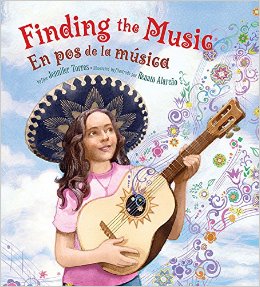
Book Review: Finding the Music/En Pos de la Música by Jennifer Torres


finding the music coverBy Sujei Lugo

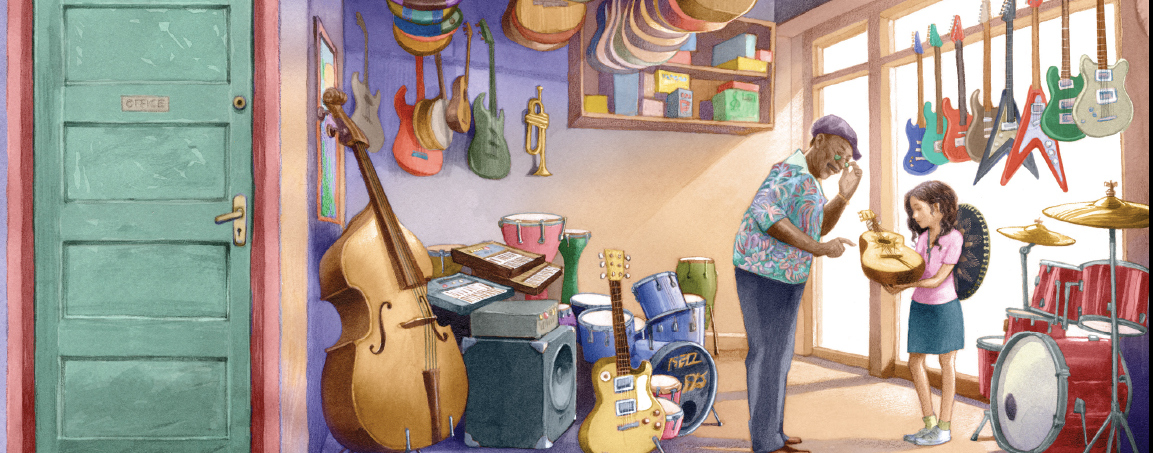
DESCRIPTION FROM THE BOOK JACKET: Above Reyna’s favorite booth in her family’s restaurant hangs the old vihuela, a small guitar-like instrument, that belonged to her abuelito when he was in a mariachi band. Reyna has never heard the vihuela played, but her mamá treasures the instrument as a reminder of abuelito and his music. One noisy day in the restaurant, Reyna accidentally damages the vihuela. Determined to get it repaired before Mamá notices, Reyna sets out to search her neighborhood for someone who can help her fix the instrument. Little does Reyna know that along the way she will find herself growing closer to abuelito and to the power of his music.

MY TWO CENTS: From the winner of the 2011 Lee & Low Books New Voices Award, here we have a bilingual story filled with charm that showcases the power of music as an intergenerational unifier.

Every weekend, Reyna hangs out at her mom’s restaurant, Cielito Lindo, reading and enjoying the cast of characters that visit the place. One day, she accidentally breaks her grandfather’s precious vihuela that hanged on one of the restaurant’s walls. Reyna never met her abuelito, but her mother’s tales about him and the way he played the vihuela are near and dear to her. Reyna knows she must embark on a journey to fix her abuelo’s beloved instrument.

This journey will bring her to learn, first hand, about his legacy and the importance of music and the power of community engagement. Throughout each page, and Reyna’s conversation with different community members, her abuelo’s presence can be felt. Jennifer Torres uses Reyna’s journey as a great portrayal of how meaningful everyday life is for a community. The vihuela becomes a powerful artifact that jump-starts the memory of the past, the important history of the community that tends to be invisible but is so essential to understanding the present. The broken vihuela reveals other anecdotes from the past that will help Reyna see the bigger picture of who her abuelo was and how the community remains united through their shared past. And it is through oral history and the passing of this knowledge that Reyna becomes aware of the real importance behind the vihuela and why it was hanging on the wall. The breaking of the vihuela is not a tragedy, but the catalyst for Reyna to better understand where she came from and get closer to her mother and her community.

The realistic illustrations by Renato Alarcão, enhance the warmth of the tale and allow readers to see the characters’ expressions and feelings. Each image is filled with pastel colors and a consummated care to portray the connection and relations of the characters. The illustrations really echo a phrase said by Reyna’s mother at the beginning of the story, “these are the sounds of happy lives.” The illustrations truly convey the sounds of these lives.

Torres’s first picture book, Finding the Music/En Pos de la Música, is a solid work that is very much welcomed. The importance of oral history, the unifying qualities of music and the importance of preserving the artifacts that trigger the remembrance of who we were are all important concepts to help spark the curiosity of children among their own families and communities. We are in a constant search of adequate representation and we sometimes fail to see that in our own stories lie strong narratives that empower us and unite us.

*The book includes a glossary and pronunciation guide. The backstory of the Cielito Lindo and author’s note about mariachi music and band are also apprehended. Spanish translation by Alexis Romay.

musicstore
TEACHING TIPS: 
This bilingual picture book is recommended for children ages 4-9, and works well for early readers and as a read aloud with musical interventions as a bonus. Librarians, parents, grandparents, and caregivers can read with the young ones in English, Spanish, or both, while practicing or learning new vocabulary, identifying the different images and community components presented through the illustrations. It’s also a perfect book for a StoryWalk, given that our main character walks around her neighborhood finding some clues and stories about her abuelo. StoryWalk allows people to visit different points (parks, local stores, buildings) around the neighborhood where pages of the books are spread, they would walk to one point to another to follow the story.

Language Arts, Social Studies, Arts, and Music educators can collaborate in the development of different activities: vocabulary and writing activities, discussions and conversations regarding community, neighborhoods and Mexican, Chicano, and Latino history; the incorporation of drawings with writing activities; and the history of Mexican folk music. The author includes helpful activities for the Language Arts classroom: Story Map and Mini-Memoir. On the publisher’s website, you can access teaching guides developed for this book and other resources.

AUTHOR & ILLUSTRATOR:

Jennifer Torres is a freelance journalist, author, and coordinator of a community-wide literacy initiative at University of the Pacific, California. She studied journalism at Northwestern University, Illinois and at University of Westminster, London, England. Torres also worked as reporter for The Record newspaper, covering education, immigration, and other issues related to children and families. FINDING THE MUSIC/EN POS DE LA MÚSICA is her first picture book and her first middle grade novel, STEF SOTO, TACO QUEEN, will be published in Fall 2016.

Renato Alarcão is a graphic designer, illustrator and professor of visual arts. He studied in the Illustration as a Visual Essay program at the School of Visual Arts of New York and at The Center for Book Arts. In addition to his work as an illustrator, Alarcão has collaborated in different youth arts projects and has presented lectures on illustration, creativity, and artistic techniques. He has presented his work in exhibitions at the American Institute for the Graphic Arts, the American Society of Illustrators, the New York Public Library, the Skirball Cultural Center of Los Angeles, the Biennale of Illustrations in Bratislava, where he won the NOMA Prize for Illustrated Book. Some of his illustrated books: RED RIDIN’ IN THE HOOD: AND OTHER CUENTOS by Patricia Santos Marcantonio, SOCCER STAR by Mina Javaherbin, ROBERTO’S TRIP TO THE TOP by John B. Paterson & John Paterson, ELLA ENFEITIÇADA by Gail Carson Levine, Andiana Figueiredo.

FOR MORE INFORMATION ABOUT Finding the Music/En Pos de la Música visit your local library or bookstore. Also, check out WorldCat.orgIndieBound.orgGoodreadsAmazon, and Barnes & Noble.

Book Review: Salsa: Un poema para cocinar / Salsa: A Cooking Poem by Jorge Argueta


By Marianne Snow

DESCRIPTION (from Goodreads): In this new cooking poem, Jorge Argueta brings us a fun and easy recipe for a yummy salsa. A young boy and his sister gather the ingredients and grind them up in a molcajete, just like their ancestors used to do, singing and dancing all the while. The children imagine that their ingredients are different parts of an orchestra — the tomatoes are bongos and kettledrums, the onion, a maraca, the cloves of garlic, trumpets, and the cilantro, the conductor. They chop and then grind these ingredients in the molcajete, along with red chili peppers for the “hotness” that is so delicious, finally adding a squeeze of lime and a sprinkle of salt. When they are finished, their mother warms tortillas and their father lays out plates, as the whole family, including the cat and dog, dance salsa in mouth-watering anticipation.

Winner of the International Latino Book Award for Guacamole, Jorge Argueta‘s text is complemented by the rich, earthy illustrations of Duncan Tonatiuh, winner of the Pura Belpré Award. His interest in honoring the art of the past in contemporary contexts is evident in these wonderful illustrations, which evoke the pre-Columbian Mixtec codex.

MY TWO CENTS: Here’s another Jorge Argueta picture book that’ll make you hungry! Argueta has created several bilingual poetry books that celebrate traditional Latin American dishes – including Guacamole, Sopa de frijoles / Bean Soup, and Arroz con leche / Rice Pudding – and Salsa is just as mouth-watering. I love how he uses beautiful language to stir the senses, appealing to readers’ taste and smell with scrumptious descriptions of vegetables and herbs; sound by drawing comparisons between ingredients and musical instruments; and touch by weaving together the acts of cooking and dancing.

As a lover of spicy food, I particularly enjoy Argueta’s ode to hot chiles, complete with imagery that clearly evokes the crackly, wrinkled skin and the tingly burn of the peppers. Here’s a little taste:

Hay chiles con cara de abuelo

y chiles con cara de abuela.

Hay chiles rojos

como llamitas.

Al morderlos nos calientan la lengua

como si tuviéramos en la boca una lucecita.


There are chilies with faces like a grandfather

and chilies with faces like a grandmother.

There are red chilies

like little flames.

When we bite one our tongue gets hot,

as if we had a tiny light on in our mouth.


I really wish I had some salsa right now.

Meanwhile, Duncan Tonatiuh’s signature illustration style, which hearkens back to pre-Columbian Mixtec art, captures readers’ sense of sight and beautifully reminds us of Mexico and Central America’s past while celebrating a contemporary family coming together to prepare a meal. Inviting Tonatiuh to illustrate this book is a perfect choice, since his historically inspired images reflect Argueta’s description of the history of the molcajete, the mortar and pestle crafted from volcanic rock that people have long used to grind vegetables and spices. This connection of the past and present through both words and illustrations makes Salsa an especially delicious dish for me.

(My much loved molcajete.)

TEACHING TIPS: This book is an invitation for several meaningful hands-on learning activities. Students and teachers can write up bilingual recipes for salsa using the ingredients Argueta presents in the poem and then make a tasty, healthy snack to eat and share with others at school. If children have family members or friends who have experience using a molcajete to make salsa, teachers can invite these special guests to demonstrate their techniques – a perfect opportunity to welcome students’ home lives and funds of knowledge into the classroom. Afterwards, everyone can write their own food poems utilizing some of the various literary devices – similes, metaphors, rich imagery, synesthesia – that Argueta employs.

Additionally, Salsa is an excellent springboard for a science lesson about composting and plant growth. When the family in the poem finishes making their salsa, the son takes leftover lime seeds and vegetable peels outside and buries them in a hole in the ground:

Las entierro para que se conviertan en abono,

Children can do the same when they finish their own salsa, making hypotheses about what will happen to the seeds and foods scraps and then observing the changes that occur as weeks pass. Will the vegetable matter decompose and turn into soil? Will new plants emerge from the seeds? You’ll have to try it and see!

ABOUT THE AUTHOR (from Salsa’s book jacket): Jorge Argueta is an award-winning author of picture books and poetry for young children. He has won the International Latino Book Award, the Américas Book Award, the NAPPA Gold Award, and the Independent Publisher Book Award for Multicultural Fiction for Juveniles. His books have also been named Américas Award Commended Titles, USBBY Outstanding International Books, Kirkus Reviews Best Children’s Books, and Cooperative Children’s Book Center Choices. A native Salvadoran and Pipil Nahua Indian, Jorge spent much of his life in rural El Salvador. He now lives in San Francisco.

LINKS / OTHER INFO: Here are a couple of fascinating videos that teachers can use to supplement the book:

https://www.youtube.com/watch?v=Za_2VWD4nU4

FOR MORE INFORMATION ABOUT Salsa visit your local library or bookstore. Also, check out WorldCat.orgIndieBound.orgGoodreadsAmazon, and Barnes & Noble.


MarianneMarianne Snow is a doctoral student at the University of Georgia, where she researches Latin@ picture books, representations of Latin@ people in nonfiction children’s texts, and library services for Spanish-speaking children and families. Before moving to Georgia, she taught Pre-K and Kindergarten in her home state of Texas and got her master’s degree in Teaching English to Speakers of Other Languages (TESOL) at Texas A&M University. In her spare time, she enjoys obnoxiously pining for Texas, exploring Georgia, re-learning Spanish, and blogging at Critical Children’s Lit.
Book Review: Talking with Mother Earth / Hablando con Madre Tierra by Jorge Argueta

By Marianne Snow

349744DESCRIPTION OF THE BOOK (from Goodreads): Tetl’s skin is brown, his eyes are black, and his hair is long. He’s different from the other children, whose taunts wound him deeply, leaving him confused and afraid. But Tetl’s grandmother knows the ancient teachings of their Aztec ancestors, and how they viewed the earth as alive with sacred meaning. With her help, he learns to listen to the mountains, wind, corn, and stones. Tetl’s journey from self-doubt to proud acceptance of his Nahuatl heritage is told in a series of powerful poems, beautifully expressed in both English and Spanish. Vivid illustrations celebrate nature’s redemptive powers, offering a perfect complement to the poignant story.

MY TWO CENTS: History books and other nonfiction texts often speak of the Americas’ original inhabitants in the past tense, as if they completely disappeared after Europeans swept across the land. For example, I remember learning that the Spanish defeated and killed (or married) all indigenous people when they invaded Mexico and Central America in the sixteenth century. Wrong. Despite facing frequent marginalization and discrimination by “mainstream” society, Nahua people, the diverse descendants of the Aztecs, still live in El Salvador, Mexico, and the United States today.

Talking with Mother Earth / Hablando con Madre Tierra – a stunning bilingual collection of autobiographical poems and winner of the illustrious International Latino and Américas Book Awards for outstanding works of Latin@ children’s literature – affirms and celebrates the complexity of a contemporary Nahua individual. In these simple yet profound poems, Jorge Tetl Argueta, who identifies as Pipil Nahua, provides us with a window into his childhood and sensitively explores issues of cultural identity from several different angles, including his spiritual beliefs, his connection to Mother Earth, ethnic pride, racial bullying, and history of the Nahua people. As they read his beautiful words, children with Nahua heritage might see reflections of themselves, while readers from other backgrounds can learn about cultural practices and perspectives that are different from their own.

Mirroring Argueta’s poems are Lucía Angela Pérez’s vibrant pastel drawings, simultaneously striking and soft, bold and soothing as they permeate each page. Prepare to be swallowed up in color as soon as you open the cover! Also, the illustrations sustain the theme of links between the present and past as they portray young Tetl standing side by side with his grandmother, his ancestors, and Aztec gods.

Another enticing feature of this book is its relatively unusual dual language format. Although we’re seeing more and more English-Spanish dual language books on the market these days, most of these books place the English text first on the page, above or before the Spanish text. While this positioning might not seem like a big deal, it can send a message to readers that English should be the first language in their lives – that it’s better than Spanish. Books that place Spanish first do pop up every once in awhile, however, and Talking with Mother Earth / Hablando con Madre Tierra is one of them, emphasizing to Spanish-speaking readers the importance of their linguistic skills.

So if you’re searching for a book that promotes empathy, beauty, linguistic diversity, cultural awareness, and positive self-image, look no further! If you enjoy it, be sure to check out Jorge Argueta’s other works for children – they’ll leave you smiling (and probably a little bit hungry).

TEACHING TIPS: Due to multifaceted subject matter in Talking with Mother Earth / Hablando con Madre Tierra, educators can choose to use the entire text or individual poems to start fruitful, critical discussions and lessons with their students. For example, teachers might draw upon “Indio” / “Indian” – an examination of racial bullying – when facilitating analyses of racism and discrimination in schools. Additionally, they might focus on Argueta’s poems on nature and Nahua spirituality to help students understand the diversity of religious beliefs and ethnicities in contemporary Latin America. Or they might highlight this book as a mentor text when encouraging students to write their own nature poetry.

The dual language format of Talking with Mother Earth / Hablando con Madre Tierra also makes it a valuable resource for Spanish and English learners – the abundance of words related to nature can help readers describe the earth bilingually. An added bonus is the inclusion of several Nahuatl words and phrases that illustrate Latin@ / Latin American linguistic diversity even further.

ABOUT THE AUTHOR (from his website): Jorge Tetl Argueta is a celebrated Salvadoran poet and writer whose bilingual children’s books have received numerous awards. His poetry has appeared in anthologies and textbooks. He won the Américas Book Award, among other awards, for his first collection of poems for children, A Movie in my Pillow. He was the Gold Medal Award winner in the 2005 National Parenting Publications Awards (NAPPA) for Moony Luna / Luna, Lunita, Lunera. His other works for children include Xochitl and the Flowers (2003 Américas Award Commended Title), Trees are Hanging from the Sky, Talking with Mother Earth, The Little Hen in the City, and The Fiesta of the Tortillas.

RELATED LINKS:


MarianneMarianne Snow is a doctoral student at the University of Georgia, where she researches Latin@ picture books, representations of Latin@ people in nonfiction children’s texts, and library services for Spanish-speaking children and families. Before moving to Georgia, she taught Pre-K and Kindergarten in her home state of Texas and got her master’s degree in Teaching English to Speakers of Other Languages (TESOL) at Texas A&M University. In her spare time, she enjoys obnoxiously pining for Texas, exploring Georgia, re-learning Spanish, and blogging at Critical Children’s Lit.

A Rich Year for Art-Related Kid Lit with Latino Flair

By Sujei Lugo and Lila Quintero Weaver

The year 2014 brought us three outstanding Latino children’s books celebrating art. Each book represents a distinct format: Draw! by Raúl Colón, is a wordless picture book; Viva Frida, by Yuyi Morales, is a poetic tribute to a beloved artist of worldwide importance; and Frida & Diego: Art, Love, Life, by Catherine Reef, is a work of non-fiction geared toward upper-level grades. These releases came in a year already brimming with strong Latino titles in children’s publishing, along with the We Need Diverse Books campaign, which challenges publishers and others in the book industry to question their views and roles regarding literature by and about people of color.

And guess what? Latin@s create art, too, so why shouldn’t they be celebrated in art-related books?

Children’s books that extol visual art serve to influence readers in significant ways. Through them, children can learn to appreciate art’s life-enriching power. They can also begin to see themselves as potential creators of art. Up to a certain age, most children freely produce drawings, collages, finger paintings, and other forms of artistic expression. But as kids reach the middle elementary years, inhibition seems to set in. Often, these kids stop making art because they have begun to see themselves as incapable. In fact, many great artists owe their success to a rediscovery of childlike abandon, to a time when the internal critic wasn’t peering over their shoulder. Also, Latin@ children are exposed to fewer artistic role models from within the community. What if good art books transmitted the opposite message–that anyone, from any culture, can create art? Great Latin@ artists already exist and kids need to become familiar with them. The following books make an ideal way to start delivering that message.

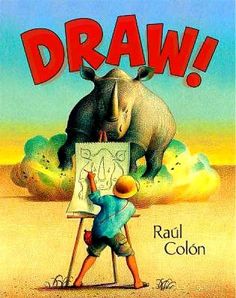
Draw!Draw! by Raúl Colón

In this lovely picture book based on Colón’s childhood, readers are transported through a flight of fancy to golden views of the African savanna, where an adventurous drawing session takes place. Initially, we see a boy drawing in his bedroom. His focus is on animals of the African grasslands. Three pages later, the boy is on the ground, somewhere on the African continent, among his subjects, observing them at close range, and capturing their likenesses with deft pencil strokes. Colón achieves this flight of imagination without the aid of words. The paintings in this book display a tender vintage feel in keeping with much of Colón’s acclaimed work in illustration. In every sense, Colón demonstrates a masterful command. His compositions are striking. He nails the anatomy of both human and wild animal subjects, as well as a wide array of studio techniques. These include the use of expressive, swirling textures and a tawny palette of hues, fitting for the story’s era and setting. This gem of a book landed on quite a few “best of” lists for 2014, including:

New York Times Best Illustrated Books of 2014

NPR Best Books of 2014: Children’s Books

Publishers Weekly Best Children’s Books of 2014: Picture Books

School Library Journal Best Books of 2014: Picture Books

School Library Journal’s Top 10 Latino Books of 2014

For extensive views of interior pages, see this article in SLJ.

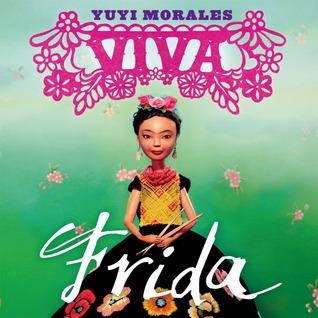
Viva FridaViva Frida, by Yuyi Morales

Viva Frida is Yuyi Morales’s love letter to Frida Kahlo. The depth of Morales’s admiration for the groundbreaking Mexican surrealist painter comes through in every expertly prepared page spread. Morales incorporates acrylic painting, stop-motion puppetry and other three-dimensional elements into a series of dioramas, photographed by her collaborator, Tim O’Meara. The result is eye-popping. Each spread bursts with jewel-like colors and captivating details, including Mexican textiles, bits of jewelry and animal fur. Clay figures representing Frida, her husband, Diego, and their animal friends are central to each diorama. Readers familiar with Kahlo’s work will recognize iconic elements in the injured fawn, the monkey, Frida’s famous eyebrows, her hand-shaped earrings and much more. A simple and brief poetic text in Spanish and English complements each page’s visual design. Viva Frida is a stunner that understandably caught the attention of important list-makers.

NPR Best Books of 2014: Children’s Books

Publishers Weekly Best Children’s Books of 2014: Picture Books

School Library Journal Best Books of 2014: Picture Books

 School Library Journal’s Top 10 Latino Books of 2014

Center for the Study of Multicultural Children’s Literature: Best Multicultural Books of 2014

For interior views, see the book’s official page.

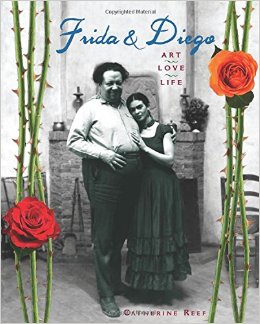
Frida and DiegoFrida & Diego: Art, Love, Life, by Catherine Reef

Frida & Diego: Art, Love, Life, by Catherine Reef, is a complex and satisfying portrayal of two giants of twentieth-century art and the development of their storied careers. The book relies on primary sources and seldom-seen photographs to describe the individual lives and work of each artist, as well as their combined lives. Reef weaves into this dual biography fascinating views of the political and social history of Mexico. Readers learn about Frida Kahlo’s medical odyssey. A childhood diagnosis of polio left her with an atrophied leg. As a young woman, she also suffered a debilitating accident that resulted in many surgeries and long periods of painful convalescence. Reef includes details of the couple’s complicated and often troubled marital life. These are not gratuitous digressions, however, since Frida’s body of work is in many ways a reflection of her physical and emotional suffering. Diego Rivera’s work as a muralist captures the era of upheaval that he lived in and reveals much about his devotion to socialist causes. The book includes behind-the-scenes stories of murals he painted in U.S. cities, which often became entangled in political controversy and resulted in conflict between Rivera and his patrons.

School Library Journal’s Top 10 Latino Books of 2014

Center for the Study of Multicultural Children’s Literature: Best Multicultural Books of 2014

These three books come from different perspectives, but their approaches overlap as they magnify works of art and what it takes to produce them. In his picture book, Raúl Colón uses imagination to portray the skills of a budding artist. Yuyi Morales’s tribute to Kahlo reflects the inner world of a powerfully emotional artist. Catherine Reef’s biography informs the reader of the complexity and suffering that composed Khalo’s internal make-up and that of her marital partner.

TEACHING TIPS

Draw! by Raúl Colón

Picture book, K-4

This picture book can be integrated into art and language-arts curricula. Teachers and librarians can use this book to encourage children to compose or tell their own illustrated stories. Art teachers will find a useful example of sound artistic practice in how Colón closely observes his subjects.

Viva Frida by Yuyi Morales

Picture book, K-3

Bilingual and ESL instructors can incorporate this book into their classroom to teach new vocabulary in English and Spanish. The text is brief and focuses on verbs. Teachers of language arts can employ the book’s model of short poetic sentences to suggest a story. In the art classroom, Viva Frida can inspire the creation of dioramas, costumed puppets and other three-dimensional works.

Frida & Diego: Art, Love, Life by Catherine Reef

Non-fiction, grades 9-12

This book holds rich possibilities as a classroom text for Mexican American studies, art history, and social studies. One of the key lessons is the importance in an artist’s life of historical context. Students of social studies can create a timeline of historical events, paralleled by notable developments in Frida’s and Diego’s life. The book includes a brief selection of reproductions for each artist and a list of resources for further study, which teachers can use as a basis for assignments. Art history classes may want to explore the work of other muralists and female painters of the twentieth century or of Mexican artists throughout the ages.

For further information on the creators, see the following:

An interview with Raul Colon at Illustration Friday

An interview with Catherine Reef at Teenreads

And please don’t miss this spectacular video featuring Yuyi Morales demonstrating the creation of Viva Frida!