
By Cecilia Cackley
This is the fourth in a series of posts spotlighting Latina illustrators of picture books. Some of these artists have been creating children’s books for many years, while others will have their first book out this year. They come from many different cultural backgrounds, but all are passionate about connecting with readers through art and story. Please look for their books at bookstores and libraries!
Carolyn Dee Flores
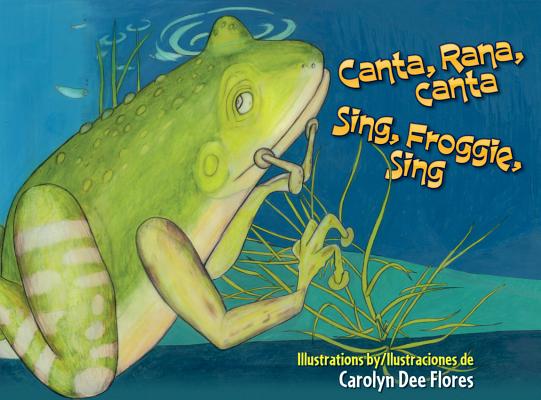
 Carolyn Dee Flores grew up around the world and now lives in San Antonio, Texas. She worked as a computer analyst, rock musician and composer prior to becoming an illustrator of children’s books. She illustrated Dale, dale, dale: una fiesta de números/Hit it, hit it, hit it: a fiesta of numbers and Canta, Rana, Canta/ Sing Froggie Sing, which were both named to the Tejas Star Reading list. Her illustrations for the book Daughter of Two Nations won a Skipping Stones Honor Award. Her most recent work can be seen in the book Una Sorpresa para Teresita/ A Surprise for Teresita, published in October 2016 by Piñata Books, an imprint of Arte Publico Press.
Q: What inspired you to become an artist?
A: My Uncle Rey. He was a professional artist. He made me realize it was something you could do. Be an artist for a living.
When I was little, I used to go over to my grandmother’s house and see his drawings and paintings framed on the wall and I would think, “How on earth does someone get that good?” Later, I found out he had gone to art school and become an artist for the Air Force. When he passed away, my aunt gave me his art books. I read every page … over and over and over. That’s when I first learned about Goya and Rembrandt and Velázquez. It meant everything to me.
Q: Tell us something about your favorite artistic medium.
A: Oil. Oil. And then oil. I am very excited about a new technique I developed for painting with oil on cardboard. It completely saturates the board until it looks like brushed felt. It also enables me to control the bleed and dry quickly. This is the first time I have been able to get those intense colors that you get with oil paints – in an illustration. I use this process in my new book “A Surprise for Teresita” which comes out this month.
Q: Please finish this sentence. “Picture books are important because…”
A: They are a child’s very first glimpse into all the possibilities of being a human being. Whether it is stepping into the Wizard of Oz, or a Dr. Seuss landscape, or playing with the pigeon in Mo Willems’s Don’t Let the Pigeon Drive the Bus – or going to a playground down the block – the reality for a child is the same. The world is full of color, and rhythm and courageous deeds and breathtaking imagination. Picture books affirm a child’s vision … forever. Nothing could be more important than that!


Christina Rodriguez
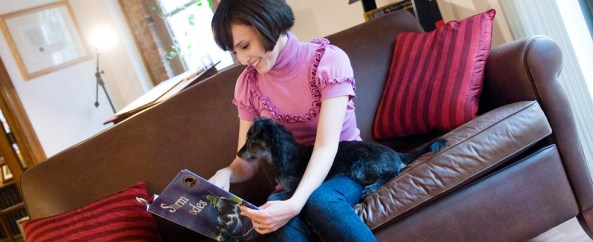
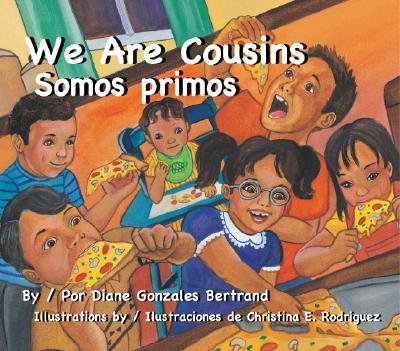
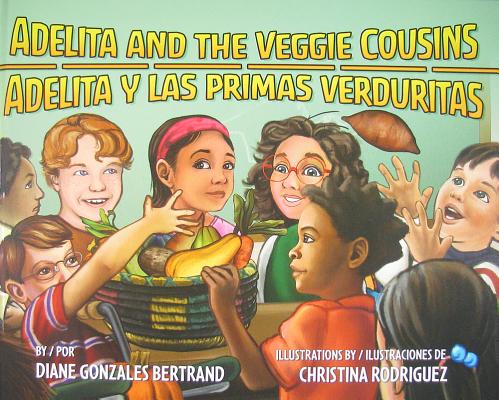
Christina Rodriguez lives in Rhode Island and has illustrated more than twelve books for children. She is a three time nominee for the Tejas Star Book Award. Among the books she has illustrated are Un día con mis tias/ A Day with my Aunts, Mayte and the Bogeyman, We are Cousins/ Somos primos, The Wishing Tree and Adelita and the Veggie Cousins.
Q: What inspired you to become an artist?
A: I became a children’s book illustrator thanks to the adults who steered me in that direction as a child: from my dad who taught me how to draw horses as a child, to my teachers who encouraged my love of art and reading, and finally to my mother for supporting my decision to go to art school at RISD. Without the continuous support of the role models in my life, I might not be where I am today.
Q: Tell us something about your favorite artistic medium.
A: I have two favorite mediums: digital and watercolors. Watercolor painting was one of the first techniques I learned, but I didn’t really get into it until college, when it became a safer alternative to oil paints (the fumes were giving me headaches). Most of my books are done in a mixture of watercolors, watercolor pencils, and gouache -an opaque type of watercolors – that gives me a lot of control in the details and the ability to add depth and texture. I also carry a travel-sized watercolor paint box with my sketchbook everywhere I go.
My other favorite medium is digital: I’ve illustrated a few books completely in Adobe Photoshop, from sketches to finished art. Many book illustrators incorporate digital programs into their workflows at some point, whether it’s resizing sketches, or cleaning up and enhancing finished paintings. I use a Microsoft Surface Pro which makes creating digital illustrations even easier.
Q: Please finish this sentence. “Picture books are important because…”
A: They introduce children to many rich and important concepts at a young age: a love of reading and art, active listening, and critical thinking of complex subjects while in a safe place. Picture books can provide the foundation upon which a rich education can be built.


Jacqueline Alcántara
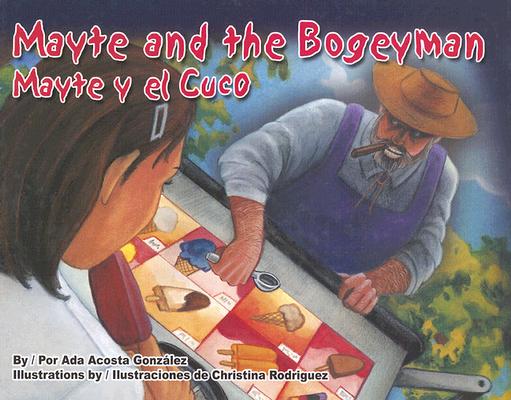
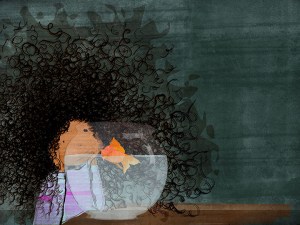
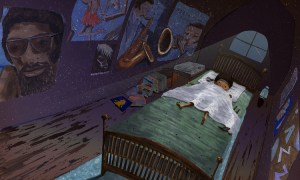
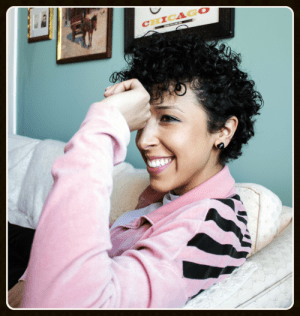 Jacqueline Alcántara is a freelance author and illustrator who previously taught high school art and photography. She won the inaugural We Need Diverse Books Illustrator Mentorship Award in 2016. Her first book is The Field which will be published in 2018 by NorthSouth Books.
Q: What inspired you to become an artist?
A: For as long as I can remember, I loved drawing, cutting, gluing, painting, inventing characters, and writing stories. As a kid, my mom would take me down to the Art Institute’s kids programs, and I still remember the texture of the paper they gave me, and how excited I felt about creating art inside the museum. When I was in high school, my dad took me to Honduras a few times, and each time, we visited with one his best friends who happened to be a fantastic painter and brilliant musician. His name was Carlos Brizzio, and he quickly became the coolest person in the world to me. By the time I finished high school, I knew I wanted to work within “the arts,” even if I hadn’t yet figured out what that meant.
After I graduated from college, I worked as an art teacher, and I decided that I wanted to combine my love of art and kids, and pursue children’s illustration. Lots of artists have inspired me along the way, but my first loves, beyond Quentin Blake and Chris Van Allsburg, were Dalí, Picasso, and Redon. I still look at a lot of art and visit my favorite paintings at the Art Institute of Chicago, but now I’m mostly inspired by silly things that happen throughout the day, serious things that are happening in the world, and all of the beauty that I find in between.
Q: Tell us something about your favorite artistic medium.
A: At this point in time, I’m most in love with markers and gouache. I love gouache because of the opaque/flat feeling of the color. I like that it’s an old medium as well—that it has history and depth. I started using markers recently, when I became interested in fashion illustration. Markers allow you to work fast and consistently, and I love the way they layer on top of one another to almost look and feel like watercolors, or digital painting. I use Photoshop for almost all of my illustrations to collage, experiment, and play with light, color and composition.
Mixed media is so much fun because you can have a plan for your piece, but so much is still left to chance and experimentation, which is exciting when you’re creating a piece, and so satisfying when it’s complete.
Q: Please finish this sentence. “Picture books are important because…”
A: Along with TV and movies, books are largely responsible for how we formulate our ideas about people, cultures, and especially, ourselves from an early age. The stories and characters we read in picture books represent some of the first ways in which we begin to explore these things, and those impressions stick with us, whether consciously or subconsciously, for a very long time. Picture books ask questions about our world and ourselves and can provide us with comfort, curiosity, hope and empathy. But my favorite part is the details, and the magical way in which the words and pictures can tell the same story while saying different things. I also love that children can “read” a picture book even before they are ready to read the text, and how repeated readings help them to discover the details, thought, humor and care that goes into the process of creating them. Picture books are important because they help us to visualize our pasts and futures, as they feed our imagination.

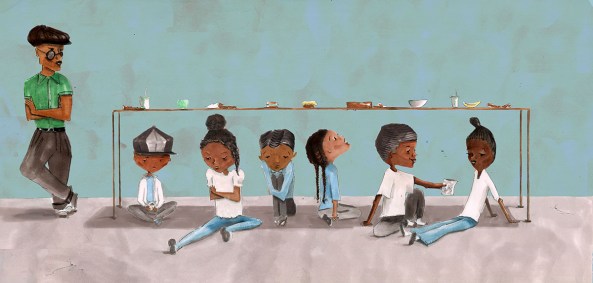
Books to Look For:
Dale, dale, dale: una fiesta de números/Hit it, hit it, hit it: a fiesta of numbers by Carolyn Dee Flores
Canta, Rana, Canta/ Sing Froggie Sing by Carolyn Dee Flores
Una Sorpresa para Teresita/ A Surprise for Teresita by Carolyn Dee Flores
Un día con mis tias/ A Day with my Aunts illustrated by Christina Rodriguez
Mayte and the Bogeyman illustrated by Christina Rodriguez
We are Cousins/ Somos primos illustrated by Christina Rodriguez
Adelita and the Veggie Cousins illustrated by Christina Rodriguez
 The
The 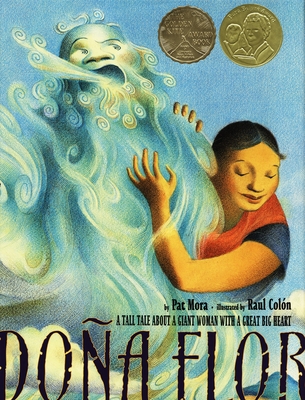 DESCRIPTION FROM THE PUBLISHER: Doña Flor is a giant lady who lives in a tiny village in the American Southwest. Popular with her neighbors, she lets the children use her flowers as trumpets and her leftover tortillas as rafts. Flor loves to read, too, and she can often be found reading aloud to the children.
 Dr. Sonia Alejandra Rodriguez’s research focuses on the various roles that healing plays in Latinx children’s and young adult literature. She currently teaches composition and literature at a community college in Chicago. She also teaches poetry to 6th graders and drama to 2nd graders as a teaching artist through a local arts organization. She is working on her middle grade book. Follow Sonia on Instagram @latinxkidlit
 In Los Gatos Black on Halloween, the colors are layered, allowing some characters to be visible through the transparent ghosts and building up as more and more ghostly characters join what eventually becomes the monster ball in an old abandoned house. The color palette is dark and rich, contrasting the glowing moon and night sky with colored tombstones and the interior of the old mansion. Morales plays with scale and perspective to lend an otherworldly look to the spreads; sometimes we only see a pair of legs dangling over a broomstick or the round face of a ghost as its tail extends right off the page.
 The colors in Just a Minute are brighter and the spreads less crowded than Los Gatos Black on Halloween, but the story they tell is just as dynamic. This was Morales’ first project as both author and artist, and she keeps the story moving at a fast pace as Grandma goes from cleaning to cooking, to decorating. Subtle touches of color make Señor Calavera a less scary figure for the youngest readers, including the flowers for eyeballs and the expressive mouth that finally turns into a smile. As befits a heroine who is using action to delay Señor Calavera, Grandma Beetle’s poses are precise and sharp, whether she is placing cheese in a frying pan or leaning over to put pots in the oven. Grandma’s eyes and face express her cleverness and care as she watches Señor Calavera from across the room or gives a wink while chopping up fruit. Perspective shifts reinforce the upside-down nature of this story; the floor of Grandma’s house seems to tilt as we first see Señor Calavera in close-up, peeking over her shoulder and then far away in the corner of the room, stamping his foot in frustration. The little cat’s reactions to Señor Calavera are a humorous touch, and readers will enjoy finding it on each spread, looking curious, tentative or scared, depending on the page. Readers will love the final note left by Señor Calavera and cheer for Grandma Beetle, who was so resourceful in buying herself a little more time on Earth.
 Morales brings more texture and mixed media to the illustrations in Just in Case, her second effort as both author and artist. Perhaps because most of the action in the book takes place in the cemetery, rather than in Grandma’s house, the backgrounds are looser and the characters float around on the page. The new character Zelmiro the ghost blends in with the background color on each spread as he advises Señor Calavera on what to give Grandma Beetle for her birthday. The list of presents grows with the alphabet, and Morales keeps things interesting by not just including objects such as the accordion but also actions such as cosquillas (tickles) and natural phenomena like niebla (fog). One of my favorite things about this book is that it follows the Spanish, rather than the English alphabet, including letters I learned as a child, like ‘Ch’, ‘Ll’ and ‘Ñ’. Depending on where you are in the Spanish-speaking world, ‘ch’ and ‘ll’ aren’t taught as separate letters anymore, so it was nice to see them here! Some of the presents are words commonly taught in Spanish classes, such as ‘escalera’ or ‘semilla,’ but others are more colloquial and region-specific like ‘granizado’ and ‘ombligo.’ The specificity in both language and image are lovely. Careful readers will note that the historieta (comic book) that Señor Calavera gives Grandma is a handmade version of Morales’ earlier book Just a Minute and will also find the reason for the spectacular bicycle crash that ruins all the presents.
 Yuyi Morales
 Cecilia Cackley is a performing artist and children’s bookseller based in Washington DC where she creates puppet theater for adults and teaches playwriting and creative drama to children. Her bilingual children’s plays have been produced by GALA Hispanic Theatre and her interests in bilingual education, literacy, and immigrant advocacy all tend to find their way into her theatrical work. You can find more of her work at


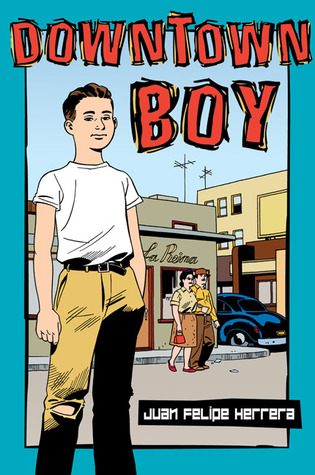 For older students I often refer to Juan Felipe Herrera’s novel in verse Downtown Boy. More often than not, we focus on the young main character Juanito to discuss issues such as discrimination in school, immigration, gender roles, masculinity and femininity, diabetes, family, and more. If I have an opportunity to teach the entire novel, then I often create poetry portfolios with my students where we pick a broader theme like identity, culture, and/or community that will thread throughout all their poems. If I don’t have enough time to cover the entire novel, then I usually pick the poems that will best represent the student population or the poem with which they can connect to the most.
 Dr. Sonia Alejandra Rodriguez’s research focuses on the various roles that healing plays in Latinx children’s and young adult literature. She currently teaches composition and literature at a community college in Chicago. She also teaches poetry to 6th graders and drama to 2nd graders as a teaching artist through a local arts organization. She is working on her middle grade book. Follow Sonia on Instagram @latinxkidlit

 Latinxs in Kid Lit