
Review by Jessica Agudelo
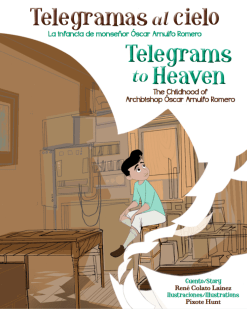 DESCRIPTION OF THE BOOK: Telegrams to Heaven / Telegramas al Cielo recounts the moving childhood of Archbishop Óscar Arnulfo Romero y Galdámez, who from an early age discovers the candor, light and power of the word, which he uses to pray and to write poetry, sending telegrams to heaven from his heart. René Colato Laínez, the renowned Salvadoran writer, has written a touching story about the great Salvadoran prophet who dreamed from his childhood of being a priest, and became not only a priest, but also a bishop, an archbishop, and the great orator of his country. His word remains, for the Salvadoran people and the world—a prayer, a poem, a sweet telegram that Archbishop Romero continues to send in the name of his people to the heart of heaven. The colorful, modern illustrations of Pixote Hunt make us reflect with deep tenderness, showing us the innocence of the great Archbishop Romero as a young child.
MY TWO CENTS: René Colato Laínez offers a bilingual picture book tribute to the Archbishop Oscar Arnulfo Romero, chronicling the icon’s early spiritual development. The Archbishop, then simply known as Oscar, grew up in Ciudad Barrios, in the San Miguel department of El Salvador. Laínez introduces us to Oscar as he works in his family’s home post office and telegram business. Oscar marvels at the telegraph, which can, “like magic” send messages across long distances. He then begins to wonder if he can also use this technology to communicate with heaven. His father clarifies that messages can be sent to God through prayer, prompting Oscar’s dedication to praying “when he woke up, when he milked the cow, after he finished his homework and to give thanks before every meal.” Oscar’s devotion permeates all aspects of his life. Even his artistic talents, like playing the flute and writing poetry and music, serve as expressions of his spirituality and commitment to God.
The story’s sole source of tension arises when Oscar expresses his desire to become a priest. His father is chagrined, and instead sends his son to work at a carpentry shop as a distraction. The text, however, does not specify why Oscar’s parents were not supportive of his wish to become a priest. His father’s admonition, “there are so many things that you can be in this life,” coupled with details in the text about businesses owned by the Romeros and their ability to hire a private teacher for Oscar, hint at a socioeconomic reason. Laínez may have highlighted the moment to demonstrate Oscar’s staunch and early commitment to the Church, but I wanted more clarity.
Indeed, Oscar is not dissuaded from entering the priesthood. When Bishop Dueñas visits Ciudad Barrios, Oscar uses his carpentry shop earnings to buy a crisp white suit to meet the prelate. This encounter is a watershed moment in Oscar’s life, and thus ends the narrative chronicling his childhood. On the following page, we see Oscar as an adolescent, headed to youth seminary in San Miguel and, as the text indicates, later on to Rome, at the behest of Bishop Dueñas, to complete his studies. The final spread is of Oscar, now ordained as Father Arnulfo Romero, palms facing up in front of the church altar, ready to celebrate mass in front of the Ciudad Barrios community, where his journey began.
The accompanying illustrations by Pixote Hunt mainly mirror the information conveyed in the text, but the images lack the warmth of Laínez’s tone. The digital, abstract style leaves characters appearing flat and expressionless, and fail to depict settings distinctly. Many of the spreads are set against surreal or monochromatic backgrounds, such as the telegram and carpentry shops, which appear almost indistinguishable because of the identical color choices. In the few scenes in which a setting is clear, such as the central plaza or the town’s church, details are limited to straight lines, and the people of the community appear as outlined shapes in a solid color with indistinguishable facial features. Although the story is about The Archbishop, who came to be loved and respected across the world, he will be forever identified with El Salvador. The abstract visual elements used in the illustrations instead create a distance between the subject and his surroundings, an overall disappointing effect.
Laínez’s admiration and respect for the Archbishop is evident and deeply personal, as he relates in the Author’s Note. No doubt Salvadorans and other Latinxs familiar with the Archbishop will be touched and pleased to see his story in print, particularly for young audiences. This title also serves as a reminder of the hope that lives within the Salvadoran community despite many current and past hardships. However, for audiences completely unfamiliar with the Archbishop, or those looking for a comprehensive biography, the story’s narrow focus and static illustrations will fall short. I was left with many additional questions about Oscar’s childhood, his hometown, and his family. Perhaps other readers will, like me, be encouraged to seek more information elsewhere. I do, however, reserve the hope that this will be the first of many titles for young readers that will chronicle that Archbishop’s life and legacy.
 ABOUT THE AUTHOR: Known as “the teacher full of stories,” René Colato Laínez is the Salvadoran author of several bilingual picture books including I Am René, the Boy/Soy René, el niño (Piñata Books), Waiting for Papá/Esperando a papá (Piñata Books), Playing Lotería/ El juego de la lotería (Luna Rising). I Am René, the Boy received the Latino Book Award for “Best Bilingual Children’s Book.” Playing Lotería was named a “Best Children’s Book” by Críticas magazine and the New Mexico Book Award “Best Children’s Book.” Playing Lotería and I Am René have both been nominated for the Tejas Star Book Award—the K-6 bilingual counterpart to the Texas Bluebonnet Award.
 ABOUT THE ILLUSTRATOR (From his website): As a director, art director and designer in the film industry I bring more than 10 years experience in animation to every project. Highly skilled in drawing, painting and musical composition, my creative goal is to bring an innovative insight to every project. Always on the cutting edge, my experience in combining animation with live action began in 1994 when I directed and art directed THE PAGEMASTER, and continued as I designed the 3D opening and interstitials for FANTASIA 2000 that seamlessly weaved the animated sequences together. I feel my unique achievements in film and music have garnered me the honors of being a voting member of both the Academy of Motion Picture Arts and Sciences and the GRAMMYs/Recording Academy.
 ABOUT THE REVIEWER: Jessica Agudelo is a Children’s Librarian at the New York Public Library. She has served on NYPL’s selection committee for its annual Best Books for Kids list, and is currently a co-chair for the 2018 list. She contributes reviews of English and Spanish language books for School Library Journal and is a proud member of the Association of Library Services to Children and REFORMA (the National Association to Promote Library and Information Services to Latinos and Spanish Speakers). Jessica is Colombian-American and was born and raised in Queens, NY.
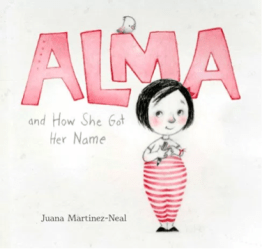
 ABOUT THE AUTHOR-ILLUSTRATOR: Juana Martinez Neal is an award-winning illustrator and artist. Her passion for art started as a child and led her to study at one of the best schools in fine arts in Peru. Her journey as an illustrator led her to the United States, where she continues to illustrate a variety of children’s books. For updates on her art, follow her on Instagram
  ABOUT THE REVIEWER: Dora M. Guzmán is a bilingual reading specialist for grades K-5 and also teaches college courses in Children’s Literature and Teaching Beginning Literacy. She is currently a doctoral student with a major in Reading and Language. When she is not sharing her love of reading with her students, you can find her in the nearest library, bookstore, or online, finding more great reads to add to her never ending “to read” pile!
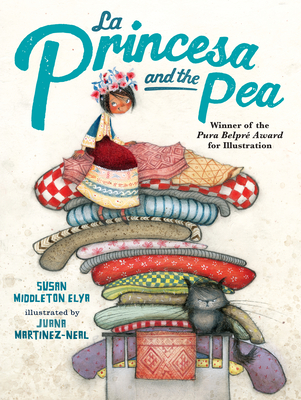 DESCRIPTION OF THE BOOK: The Princess and the Pea gets a fresh twist in this charming bilingual retelling. El principe knows this girl is the one for him, but, as usual, his mother doesn’t agree. The queen has a secret test in mind to see if this girl is really a princesa. But the prince might just have a sneaky plan, too. Readers will be enchanted by this Latino twist on the classic story, and captivated by the vibrant art inspired by the culture of Peru.
 ABOUT THE AUTHOR:
  ABOUT THE ILLUSTRATOR:
  ABOUT THE REVIEWER: Dora M. Guzmán is a bilingual reading specialist for grades K-5 and also teaches college courses in Children’s Literature and Teaching Beginning Literacy. She is currently a doctoral student with a major in Reading and Language. When she is not sharing her love of reading with her students, you can find her in the nearest library, bookstore, or online, finding more great reads to add to her never ending “to read” pile!
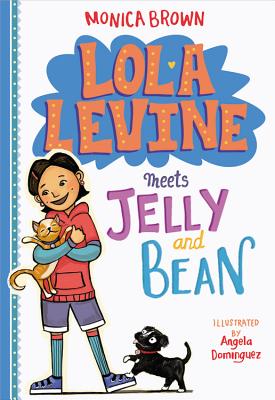 DESCRIPTION OF THE BOOK: The Levines are finally getting a pet–a furry one that is. They are excited about adopting a kitty they name Jelly, but they don’t get very far in the process when Ben starts sneezing. Oh no, he’s allergic! Lola is devastated and sets out to find Jelly a good home. Luckily, Lola is rewarded with a very happy (and still furry) ending. With Lola’s trademark humor, we can expect a few mishaps, many funny moments, and a cute new pet all wrapped in one adorable book.
 ABOUT THE AUTHOR:
  ABOUT THE ILLUSTRATOR:
 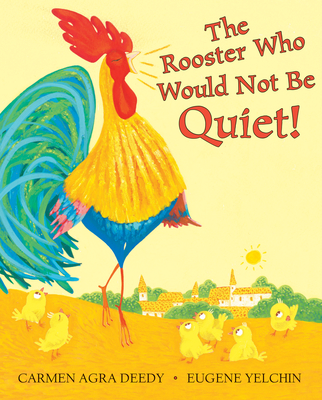 DESCRIPTION OF THE BOOK: La Paz is a happy, but noisy village. A little peace and quiet would make it just right. So the villagers elect the bossy Don Pepe as their mayor. Before long, singing of any kind is outlawed. Even the teakettle is afraid to whistle
 ABOUT THE AUTHOR:
  ABOUT THE ILLUSTRATOR: Russian-born artist Eugene Yelchin graduated from the Leningrad Institute of Theater Arts. During his studies, he designed sets and costumes for dramas, comedies and ballets. He also co-founded a children’s theatre in Siberia. Despite obstacles, Eugene traveled to the United States to share his expertise and talent as an artist. His work has appeared in magazines and newspapers and advertising campaigns, TV commercials, and animated films. His novel


 ABOUT THE REVIEWER: Maria Ramos-Chertok is a writer who lives in Mill Valley, CA. She is the founder and facilitator of The Butterfly Series, a writing and creative arts workshop for women who want to explore what’s next in their life journey. Her work, most recently, has appeared in San Francisco’s 2016 Listen to Your Mother show (www.listentoyourmothershow.com) and in the Apogee Journal of Colombia University. Her piece Meet me by the River will be published in Deborah Santana’s anthology All the Women in my Family Sing (2017) and she will be reading in San Francisco’s LitCrawl in October 2016. For more information please visit
 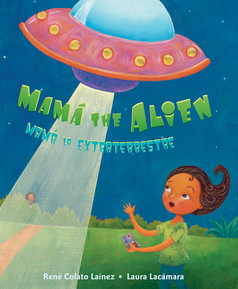 DESCRIPTION FROM THE BOOK JACKET: Sofía has discovered a BIG secret. Mamá is an alien–una extraterrestre! At least, that’s what it says on the card that fell out of her purse. But Papá doesn’t have an alien card. Does that mean that Sofía is half alien?
 ABOUT THE AUTHOR:
  ABOUT THE ILLUSTRATOR:
  ABOUT THE REVIEWER: Sanjuana C. Rodriguez is an Assistant Professor of Literacy and Reading Education in the Elementary and Early Childhood Department at Kennesaw State University. Her research interests include the early literacy development of culturally and linguistically diverse students, early writing development, literacy development of students who are emergent bilinguals, and Latinx children’s literature. She has published in journals such as Journal of Language and Literacy Education, Language Arts, and Language Arts Journal of Michigan.
 Latinxs in Kid Lit