
Reviewed by Sanjuana C. Rodriguez
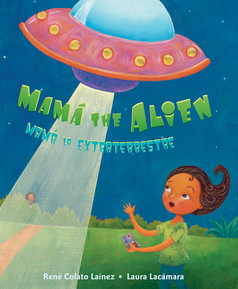 DESCRIPTION FROM THE BOOK JACKET: Sofía has discovered a BIG secret. Mamá is an alien–una extraterrestre! At least, that’s what it says on the card that fell out of her purse. But Papá doesn’t have an alien card. Does that mean that Sofía is half alien?
Sofía heads to the library to do some research. She finds out that aliens can be small, or tall. Some have four fingers on each hand, and some have big round eyes. Their skin can be gray or blue or green. But she and Mamá look like human people. Could Mamá really be an alien from another planet?
Filled with imagination and humor, Mamá the Alien/ Mamá la extraterrestre is a sweet and timely immigration story, and a tender celebration of family, no matter which country (or planet) you are from.
MY TWO CENTS: In this bilingual book, Sofía is bouncing a ball when she knocks her mother’s purse to the floor. In the purse, Sofia discovers a card with the word “ALIEN” at the top. Sofía begins to think that her mother is, indeed, an alien. She even thinks she must be half alien, “I started to put the puzzle together. Mamá was an alien. Papá didn’t have a card, so he was not an alien. That mean I was half alien.”
Sofia researches aliens and wonders how her mother has hidden the fact that she is an alien from her. As Mamá gets ready for her citizenship ceremony, Sofía sees a shadow of her mom with rollers in her hair and tells her parents her suspicion about Mamá being an alien. Sofía learns that the word alien can have different meanings.
Her mother explains, “Sofía, I’m not from outer space. What you saw was my old Resident Alien card. That card allowed me to live and work here in the United States.” The story comes to an end when Sofía’s mom becomes a citizen. This book provides a glimpse into one way a girl makes sense of a complicated immigration process. Few books allow the reader to understand the complexity of the immigration system in the United States through the eyes of a child. This book is an entrance into discussion of the complex process that families must go through to become American citizens.
The illustrations are large and beautiful. In particular, the illustrator, Laura Lacámara, provides vivid pictures of the imagined aliens with humans. It is through the illustrations that we learn that Sofía’s mother is from El Salvador. A picture shows Mamá standing on an outline of El Salvador on a map. The illustrations provided in the thought bubbles add to the story and help the reader understand what Sofía is thinking about.
The author’s note at the end of the book details his own story of coming to the United States and receiving his Resident Alien Card. The author ends the note with the following, “I want readers to know that immigrants may be referred to as aliens, but this only means that they come from other countries. We are all citizens on planet Earth.”
TEACHING TIPS: Author René Colato Laínez wrote a blog post for Lee and Low books titled “No More Illegal Aliens.” In this post, Laínez discusses the use of the term “illegal aliens” and why he advocates for the use of the term “undocumented immigrants. This blog entry could be used as a paired text with the book Mamá the Alien/ Mamá La Exraterrestre.
Also, Lee and Low has developed an extensive teacher’s guide for Mamá The Alien/ Mamá La Extraterrestre. This guide includes vocabulary, discussion questions, specific activities for English Language Learners, and interdisciplinary activities.
 ABOUT THE AUTHOR: René Colato Laínez is an award-winning Salvadoran author of many multicultural books. He is a graduate of the Vermont College MFA program in Writing for Children & Young Adults. Rene is a bilingual elementary teacher at Fernangeles Elementary School, where he is known by the students as “the teacher full of stories.”
Here are other posts we’ve done about the author:
A Conversation with René Colato Laínez
 ABOUT THE ILLUSTRATOR: Laura Lacámara is a Cuban-born children’s books author and illustrator. Lacámara holds a Bachelor of Fine Arts in Drawing and Painting from California State University, Long Beach and studied printmaking at Self Help Graphics in East Los Angeles. Her love for writing and illustrating children’s books grew when she signed up for a children’s book illustration class at Otis College of Art and Design in Los Angeles, California. She is the author of Floating on Mama’s Song/Flotando en la Canción de Mamá (Junior Library Guild Selection, Fall 2010 & Tejas Star Book Award finalist 2011-12) and illustrator of The Runaway Piggy/El Cochinito Fugitivo (winner of 2012 Tejas Star Book Award) and Alicia’s Fruity Drinks/Las Aguas Frescas de Alicia.
Here are other posts we’ve done about the illustrator:
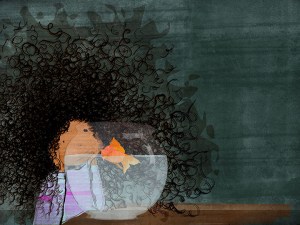
Book Review: Dalia’s Wondrous Hair/El Cabello Maravilloso de Dalia
Growing Up Cuban: Laura Lacámara and Meg Medina
 ABOUT THE REVIEWER: Sanjuana C. Rodriguez is an Assistant Professor of Literacy and Reading Education in the Elementary and Early Childhood Department at Kennesaw State University. Her research interests include the early literacy development of culturally and linguistically diverse students, early writing development, literacy development of students who are emergent bilinguals, and Latinx children’s literature. She has published in journals such as Journal of Language and Literacy Education, Language Arts, and Language Arts Journal of Michigan.
 DESCRIPTION FROM THE BOOK JACKET: An eloquent and moving account of the tragic migrations of thousands upon thousands of children who are leaving their homes in Central America, often alone, to seek refuge in the United States. Why are they going and how does it feel to be one of them? What is this terrible trip like? What do their hopes and dreams for safety, a new life and a loving reception mean to them?
 ABOUT THE AUTHOR:
  ABOUT THE ILLUSTRATOR: Alfonso Ruano was born in 1949 in Toledo, Spain. He studied painting at the School of Fine Arts in Madrid. He has published about 20 books for children and has received multiple awards for his work.



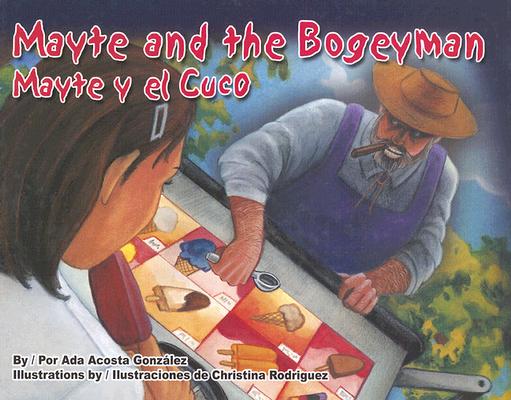
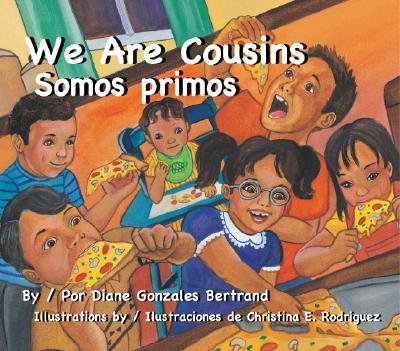

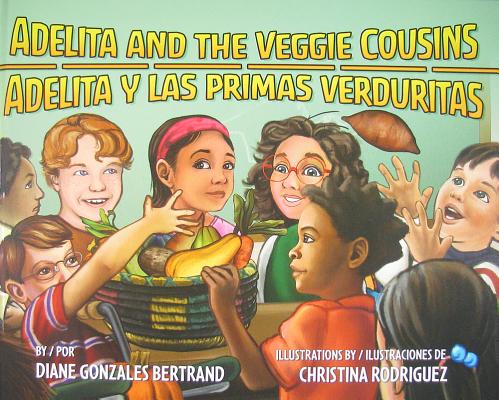


 Aren’t children too young to think about social and political issues? Should we interfere with children’s innocence by prematurely exposing them to the darker sides of life?
 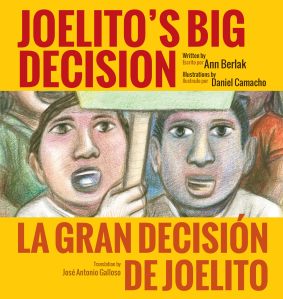 Joelito’s Big Decision/ La gran decisión de Joelito
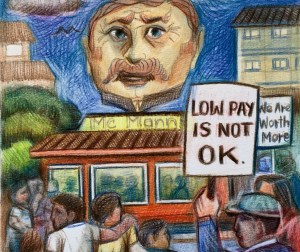 Our book tells the tale of Joelito, who eats dinner at MacMann’s Burger Restaurant with his family every Friday. The story begins one Friday when he finds his best friend Brandon and Brandon’s parents at the restaurant entrance, holding up signs saying, “Low Pay is Not OK,” and “Fight for 15,” and urging the hungry Joelito not to eat at MacMann’s tonight.
 Hope
Hope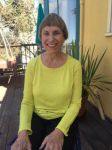 Author Ann Berlak has been a teacher and teacher educator for over fifty years. She envisions schools as places where children learn to become active, caring participants in the creation of a world that works for everyone. Joelito’s Big Decision/La gran decisión de Joelito was selected for the 2016-2017
  The
The 
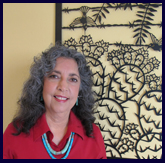 ABOUT THE AUTHOR-ILLUSTRATOR (from her
  Marianne Snow Campbell
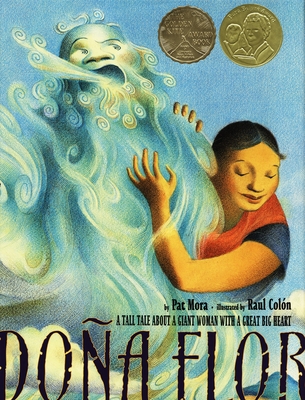 DESCRIPTION FROM THE PUBLISHER: Doña Flor is a giant lady who lives in a tiny village in the American Southwest. Popular with her neighbors, she lets the children use her flowers as trumpets and her leftover tortillas as rafts. Flor loves to read, too, and she can often be found reading aloud to the children.
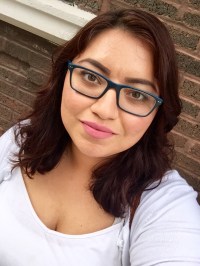 Dr. Sonia Alejandra Rodriguez’s research focuses on the various roles that healing plays in Latinx children’s and young adult literature. She currently teaches composition and literature at a community college in Chicago. She also teaches poetry to 6th graders and drama to 2nd graders as a teaching artist through a local arts organization. She is working on her middle grade book. Follow Sonia on Instagram @latinxkidlit
 Latinxs in Kid Lit