By Zetta Elliott
“I am an immigrant.” When I visit schools, I always start my presentation with these words. Next, I ask the students to guess my country of origin. Their answers are often predictable and sometimes surprising: the Dominican Republic, Puerto Rico, Mexico—Italy! When I tell them that I don’t speak Spanish but I do speak a little French, they call out a different list of countries until someone gets it right: Canada.
I open with my immigrant status in part because I once had a Latina approach me at the end of a presentation in Brooklyn and say, “I hate that word.” I didn’t ask about her status, but it was clear that she felt there was something shameful about being an immigrant. So I announce my own status with pride and use my presentation to demonstrate how my early years in Canada helped to shape the writer I became after I migrated to the US twenty years ago.
Immigration is a charged issue here, and though Canadians aren’t generally mentioned in the national debate, there’s still a pretty good chance I could run into trouble in Arizona. As a mixed-race woman of African descent, I often get read as Latina. Here, in New York City, I walk with my driver’s license, my passport, and my green card at all times because my Afro-Caribbean father taught me that some protections are reserved for citizens only (and only those citizens who aren’t brown like me). My father also urged me not to get involved in social justice movements, but I chose to disregard that advice.
I’m a black feminist—or what my father would call “a troublemaker.” I began to write for children over a decade ago because I couldn’t find culturally relevant material to use with my black students. I came to the US to attend graduate school, and there I developed a deeper understanding of intersectionality and invisibility. The title of one black feminist anthology encapsulates this perfectly: All the Women are White, All the Blacks are Men, But Some of Us Are Brave. Black women too often find themselves erased from discussions of racism and sexism, and when it comes to children’s literature, it can be just as easy for Afro-Latin@ kids to fall through the cracks.

Published by Skyscape, 2010
In 2000, I started a book club for the girls in my building. They were all black and we had been meeting for weeks before I realized that half the girls in the group were Panamanian. When they were with me, they spoke the black vernacular of their African American peers, but at home they spoke Spanish. When I wrote my YA time-travel novel A Wish After Midnight, I decided to give my protagonist a hybrid identity—Genna Colon’s mother is African American but her father is an Afro-Panamanian immigrant. When her father leaves the family to return to Panama, Genna yearns for a connection to her Latino heritage, but her jaded mother insists that race trumps ethnicity: “in America, it doesn’t matter where you’re from or what language you speak. Black is black and you might as well get used to it.”
Such a simplistic understanding of race is not uncommon, but many scholars, activists, and artists advocate for an appreciation of multiplicity—recognizing and respecting the specificity of blackness instead of reducing it to a single generic identity. As a black feminist writer, one of my goals is to counter the marginalization of black children in literature by writing stories about kids who are silenced and/or rendered invisible. I try to avoid the all too familiar “types” that seem to show up over and over again. Hakeem Diallo is a gifted basketball player but he’s also Muslim, biracial (black and South Asian), and he dreams of becoming a chef one day. Dmitri is a bird-watching math whiz who loses his mother to cancer and so lives with his elderly white foster mother. Judah is a Rastafarian teen from Jamaica who dreams of moving to Africa.
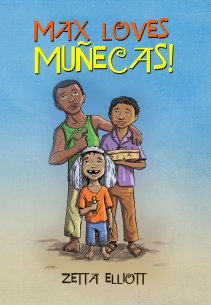
Self-published through CreateSpace under Rosetta Press
In 2009, I went to see the film adaptation of Neil Gaiman’s novella Coraline. I had some issues with the representation of women in the film, and went home thinking of a way to write a story about black boys and dolls. The end result was Max Loves Muñecas!—one of four chapter books that I self-published in May. The story follows three homeless boys in 1950s Honduras who are taken in by a kind woman who makes dolls. I was inspired by my father’s childhood in the Caribbean. He was raised by his grandmother on the island of Nevis, and with no money to spare, my father learned to make his own toys out of recycled materials. They were poor but my great-grandmother made sure my father was always presentable and well behaved. Respectability meant a lot since the family had so little.
I knew I wanted my story to take place within the Caribbean basin, but I had limited knowledge of Latin America. I chose Honduras for the setting of Max Loves Muñecas! because the best doll maker I know is Afro-Honduran designer Cozbi Cabrera. Also my community college student Saira, a Garífuna woman, gave a presentation in class about the murder rate in Honduras—the highest in the world. This is due, in part, to street violence fueled by gang members who have been deported from the US. My story isn’t set in contemporary Honduras, but the book does challenge gender norms and exposes the tender, creative side so many boys are forced to conceal.
I often write about boys because I have seen firsthand how expressive, sensitive boys shut down as they mature and assume the hard, unfeeling posture of a young “thug.” Boys around the world are socialized in a way that leaves them unable to reveal their authentic selves and the consequences can be devastating—especially for girls, but for boys and men as well. As a feminist I realize that if I want to end violence against women and girls, I have to start paying more attention to boys.
These issues mean a lot to me, but social justice is not generally a priority for the children’s publishing industry. For the past five years I have written essays and given talks about the glaring inequality within publishing, and the issue has garnered more attention recently thanks to the social media campaign #WeNeedDiverseBooks. Several editors rejected Max Loves Muñecas! (the last one wrote, “Zetta is such a lovely writer and I did enjoy this story – but I just don’t think we can find a big enough market for it”) and so the story sat on my hard drive for five years until I finally decided to self-publish it. I found a Honduran illustrator, Mauricio J. Flores, on Elance; he completed ten black and white illustrations and I used the print-on-demand site CreateSpace to publish the book.
The biggest challenge with self-publishing is finding a way to connect your books with readers. The Brown Bookshelf recently ran a series called “Making Our Own Market,” and I contributed a guest post in which I shared my core objectives:
- To generate culturally relevant stories that center children who have been marginalized, misrepresented, and/or rendered invisible in children’s literature.
- To produce affordable, high-quality books so that families—regardless of income—can build home libraries that will enhance their children’s academic success.
- To produce a steady supply of compelling, diverse stories that will nourish the imagination and excite even reluctant readers.
If these objectives resonate with you, I hope you’ll give my books a chance. The bias against self-published books is hard to overcome; major outlets refuse to review them, and only a few book bloggers are willing to give self-published books a chance (thank you, Latin@s in Kid Lit). Many are poorly written and shoddily produced, but when publishing gatekeepers exclude so many talented writers of color, self-publishing is often our only recourse. If we wait for the industry to change, another generation of children will grow up as I did—without the “books-as-mirrors” they need and deserve.
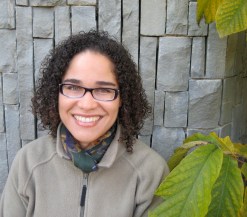 Born in Canada, Zetta Elliott earned her PhD in American Studies at NYU. Her poetry has been published in several anthologies, and her plays have been staged in New York and Chicago. Her essays have appeared in Horn Book Magazine, School Library Journal, and The Huffington Post. Her picture book, Bird, won the Honor Award in Lee & Low Books’ New Voices Contest and the Paterson Prize for Books for Young Readers. Elliott’s young adult novel, A Wish After Midnight, has been called “a revelation…vivid, violent and impressive history.” Ship of Souls, published in February 2012, was included in Booklist’s Top Ten Sci-fi/Fantasy Titles for Youth and was a finalist for the Phillis Wheatley Book Award. Her third novel, The Deep, was published in November 2013. She currently lives in Brooklyn.
Other books by Zetta Elliot. For a full list, visit her blog.

Published by Lee and Low, 2008

Published by Skyscape, 2012
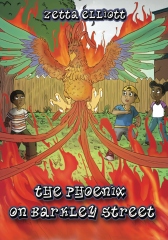
One of four kids books self-published, 2014

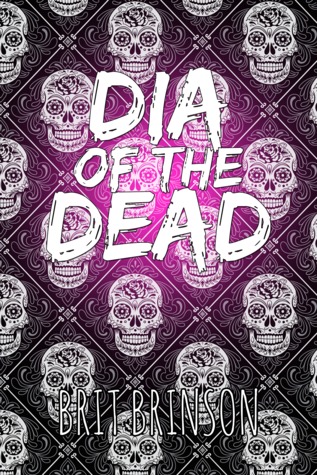 One YA book that stood out to me this year was Dia of the Dead by Brit Brinson. It had zombies, it had action, and it definitely had drama. But most importantly to me, it had something that’s always left out of the conversation about Latinos in fiction–an Afro-Latina protagonist named Dia.
 Guinevere Zoyana Thomas is one half of the ever so silent and deadly “Twinjas” @Twinja Book Reviews. When she isn’t perfecting back handsprings or working on her red belt in Tang Soo Do, she’s going H.A.M. editing her diverse time-travel YA novel under the pseudonym “GL Tomas.”
 Latinxs in Kid Lit