
By Marie Marquardt
A few years ago, I made a rather unusual decision for a sociologist of religion. I decided to write a romance for young adults – one that is, in many ways, linked to my academic research. I’m going to be honest: it wasn’t exactly a decision. It was something I sat down before dawn one November morning and started doing, despite the constant nagging feeling that this was a huge waste of time and energy because the story would never, ever be finished — much less published.
 The words I wrote in those pre-dawn hours eventually became my debut YA novel, Dream Things True. It tells of one Mexican-American family’s journey through immigration, settlement, adaptation, detention, and deportation. It’s told from the perspective Alma Garcia, an ambitious Latina on the verge of adulthood, and Evan Roland, the privileged Southern boy who falls in love with Alma, and who tries with all his might to help Alma preserve her humanity, her extraordinary individuality, andher dreams.
When I began to write Alma and Evan’s story, I was a published author of two non-fiction books on Latin American immigration to the United States, a full-time college professor, and a mother pregnant with my fourth child. So, clearly, the decision was not one that I made because I needed a new project! I had plenty of projects.
What was I thinking?
Looking back, I see two reasons that I needed to write this story. I work as a researcher, advocate, and service provider with undocumented immigrants in the U.S. South, and because of that work, I often get asked to speak to groups about the contentious topic of undocumented immigration. After several years of standing in front of crowds and sharing great quantities of data and information, I came to a realization: It’s important to know the facts, particularly when so much misinformation is floating around about the causes and consequences of undocumented immigration. But what people long for is the personal connection, the human story.
I have come to believe that, in our polarized, fragmented society, we do not need more information. Our lives are saturated with information (and misinformation). What we need – what humans long for – is connection. I have been granted the privilege of building friendships with undocumented immigrants, of being a part of their lives, and of caring deeply for them. I have seen the struggles they face not through media sound bites and political rhetoric, but instead through the eyes of love. I wanted to give others, who may not have these opportunities, a chance to enter intimately into the experiences of undocumented immigrants and the people who love them.
I wanted to build connection.
That’s the first reason I wrote Dream Things True. The second reason was one I would only grasp in hindsight. I started writing this book during a very difficult time for undocumented immigrants in the South – when families I knew and loved were being torn apart by detention and deportation. I joined several friends and colleagues to develop a non-profit that works with immigrants in detention and their families. This work is, I believe, the most important work that I do, but it also breaks my heart wide open almost every day. Writing fictional stories about immigrants in crisis allows me to affirm and celebrate their resilience. It also helps me to process the emotion of accompanying these families through very hard times.
I write fiction from a broken heart.
Along the way, I have discovered some surprising similarities between writing fiction and writing academic non-fiction. Both are very hard work. Whether we want to do it or not, authors have to sit down and put words on a page. The professional practice of most good fiction authors I know is much like the practice of good academics: they are inquisitive and creative, and also structured and disciplined. They exist not in solitude, but in a community of people who share their passion and who support their efforts.
Another shared quality is the need for rigorous research. When I began writing Dream Things True, I already had more than a dozen years of experience researching undocumented immigration and working with undocumented immigrants. Nevertheless, I had a great deal of additional work to do, if I wanted to get the story right. Perhaps it’s a sign of how profoundly complex immigration law is, but I consulted with several immigration attorneys and paralegals to ensure that the details of Alma’s story were correct. The story is “true” – not in the sense of reflecting one person’s actual experience, but in the sense of accurately characterizing the journey that Alma’s family would make through the labyrinth that is the U.S. immigration system.
It’s not easy to write a scene at a lawyer’s office or in a courtroom that is both emotionally compelling and accurate, but I do my very best. One of the most amazing compliments I have received was from a colleague who worked for thirty years as the head of immigration legal services for a large non-profit in Atlanta. She told me that the story was, indeed, accurate (yay!) and that she wanted to make it required reading for every incoming attorney at her agency. She believed that reading the story would help them to remember the full, complicated, and profound humanity of each of their clients.
This is the power of fiction.
So I will continue my work as a scholar, advocate, and service provider with undocumented immigrants. And I also will keep writing love stories, because I firmly believe that love is more powerful than fear, and that thorny issues are best solved not from a place of fear but from a place of love.
Below are six short videos of Marie Marquardt talking about her debut novel Dream Things True and her work with undocumented immigrants.
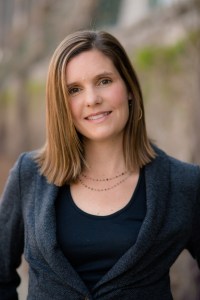 Marie Marquardt is a Scholar-in-Residence at Emory University’s Candler School of Theology and author of contemporary YA fiction. She has written several articles and co-authored two non-fiction books about Latin American immigration to the U.S. South. DREAM THINGS TRUE (St. Martin’s Griffin/ September 2015) is her first work of fiction. She lives in a very busy household in Decatur, Georgia with her spouse, four children, a dog, and a bearded dragon. When not writing, teaching, or chauffeuring her children, she can be found working with El Refugio, a non-profit that serves detained immigrants and their families.
 By Cecilia Cackley


 Today is the official release day of
  This first picture represents the writing, revising, and editing phase done alone and then with critique partners. It took me three years to write the draft that I used to query agents. Yes, that’s a long time, but I was working a full-time job and a part-time job, while single-parenting. My writing place is on my bed, and without fail, my dogs–first Rusty (RIP) and now Ozzie–have kept me company. This has been very sweet, except for the times they pawed the keyboard. Notice the guilty look in his eyes.
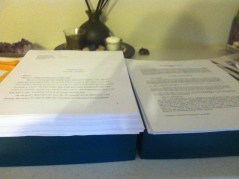 I landed an agent, Laura Langlie, after a few months of querying. I revised based on her feedback, and then the manuscript went out on submission. It stayed out there for a long, long time. We received some valuable feedback after the first round, so I revised again and went back out on submission. Finding the right agent and editor is kind of like literary Match.com. You might go on lots of dates that don’t work, but that’s okay, because the goal is finding the perfect person. So, it took a long time, but the book landed with the perfect person, Mary Kate Castellani at Bloomsbury. This is a picture of the manuscript next to my contract. Receiving the contract is one of those “oh-my-goodness-this-is-happening” moments. At this point, the deal had already been announced online, but seeing the contract in black-and-white makes it real.
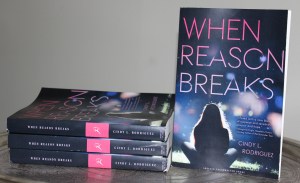 AHHHHH! ARCs. This was a big moment. I didn’t taken any pictures during revising and copy editing. They wouldn’t have been pretty. But, please know that a lot goes on between the previous picture and this one (major understatement). After revisions, the manuscript went to copy edits. That day was significant because it meant drafting, for the most part, was over. Changes could still be made, but the story moved from creation into production. I received a blurb from the amazing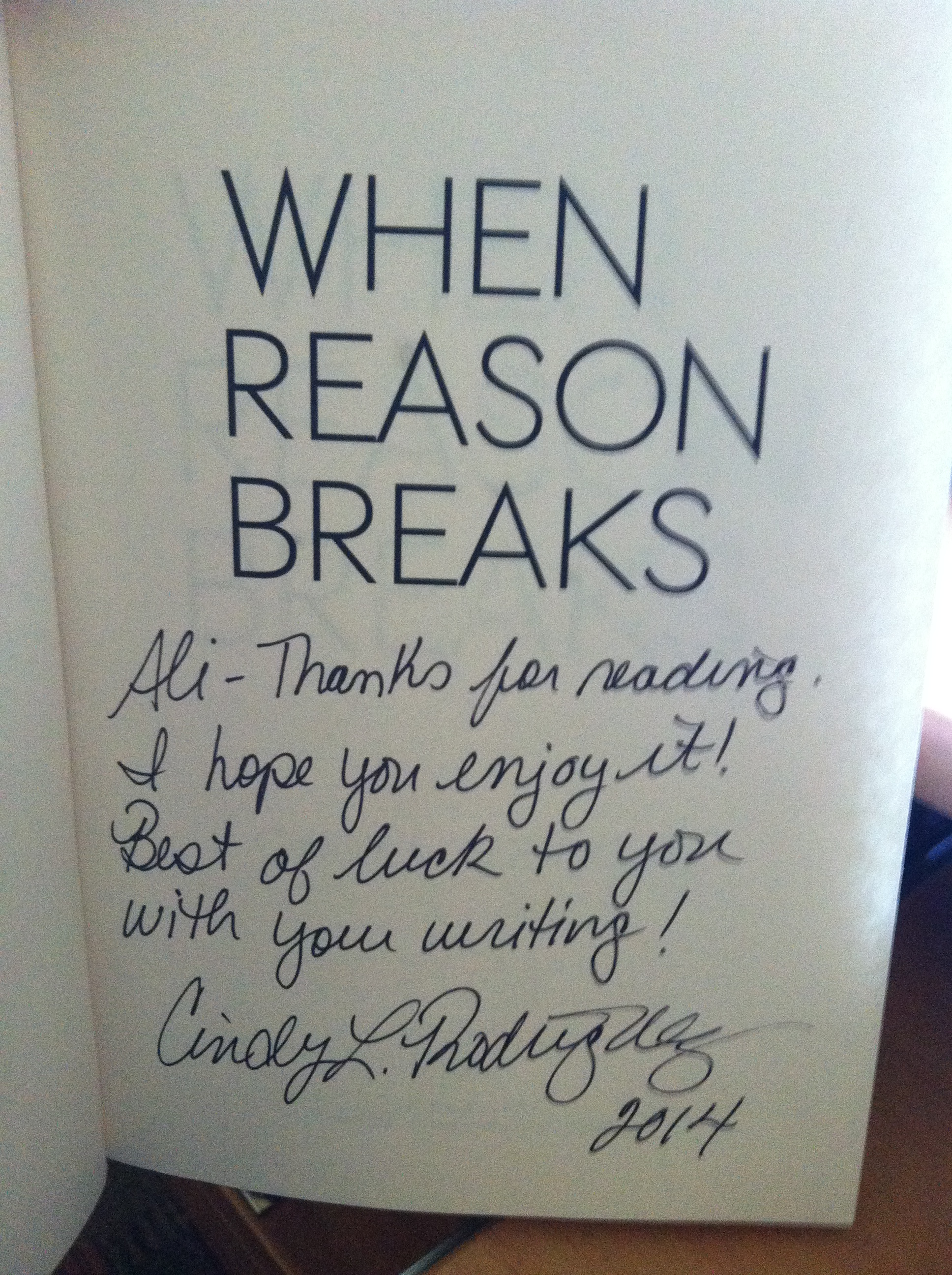

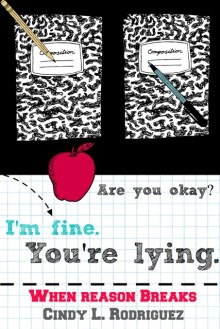
 Now that ARCs were out in the world, I considered ways to help market the novel. One thing I learned from other authors was that I had to do my part when it came to marketing. I didn’t go overboard with swag. I decided to create a book trailer and print book marks and postcards with a QR code linked to the book trailer.
 nephew–a high school freshman–doing all of the real tech work. He’s a genius with computers, so he handled putting it all together. The opening voice belongs is my niece, and I narrate the rest of it, although my voice was altered to be lower and much cooler, in my opinion. Bookmarks have been distributed to teachers, librarians, and bloggers. Postcards went to high schools, public libraries, and independent bookstores in Connecticut, in addition to some libraries and bookstores in other parts of the country. Writers always question “what works,” and I think the answer is different for each of us. Bookmarks worked for me because I’m a teacher and I have lots of teacher friends who asked for 50-100 at a time. I knew they’d get into the hands of teen readers. Also, I have received some positive feedback from the postcards. A few librarians emailed me saying they received the post card, viewed the trailer, and planned to order the book; some even invited me to participate in events. So, in my mind, these three things were worth it.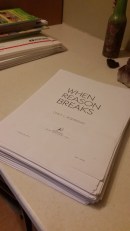

 When I was 23 years old, I left Connecticut for Boston for what should have been an amazing experience. I had been recently hired to be a researcher for the Boston Globe’s award-winning investigative team, a dream come true for a young journalist. Over the next two years, however, depression slowly ruined me, although many people close to me never knew. I wrote about it for the Courant years later, when my mind was clear enough to make sense of it. Here’s an excerpt from that article:






 Latinxs in Kid Lit