Author Samantha Mabry on her Debut Novel, a Student’s Shrug, and Straddling Two Cultures


By Samantha Mabry

I teach English at a community college in downtown Dallas. Currently, some of my students are reading a book entitled Midnight in Mexico: A Reporter’s Journey Through a Country’s Descent Into Darkness by Alfredo Corchado. In his book, Corchado, who was born in the Mexican state of Durango and raised in California and El Paso, Texas, writes mostly about his own reporting on the drug trade and corruption in Mexico, but there’s also an interesting, underlying theme he explores regarding identity: what it means to straddle two worlds, to have a foot on each side of the border, but to never feel fully rooted, truly at home in either place. As he puts it, he can sometimes feel too American when he’s in Mexico and too Mexican when he’s in America.

Among my students, discussions have taken place regarding what it means to be a part of two cultures. When I ask if they’re able to relate to Corchado, many nod their heads, and one girl said, “Absolutely.” She then elaborated: “At home, I’m Mexican. At school, I’m American.” Then she shrugged. Like, obviously. She made it seem like it was pretty easy to understand what the different expectations are in different spheres of her life and that it took little effort and not a whole lot of thought to navigate those spheres.

I keep thinking about this student –in particular, that shrug. Like, what’s in that shrug? What does that shrug mean? I want there to be something deep in that shrug because I am critical by nature and like for things like shrugs to mean something, to be symbolic, to say something about what it means to be a Mexican-American young woman living in Texas right this minute. I keep thinking about all the comments I could have followed up with: Okay, so you’re Mexican in one place and American in another. Is there an identity that feels more true to you? Are you more Mexican than American? Would you say you are Mexican-American? Would you call yourself Chicana? Latina? Hispanic? Do these words, these markers of identity, matter to you, or am I just really wanting them to matter??

My mother is Mexican-American, though I think she would say she’s just American. Or Hispanic. My dad’s mother was from Puerto Rico, and his dad was white. I’m light olive-skinned with brown hair and brown eyes, but my last name, Mabry, is European. I first heard Spanish at my grandmother’s house but learned it properly in a classroom. I call myself mestiza because that’s what really rings true for me. I think that identity matters, and I think that –particularly for those from mixed backgrounds or with migrations or diaspora in their histories –identity can be fluid. I think that many Latinx people, like Alfredo Corchado, are standing with one foot here and one foot there. Some of them may be standing with an imbalance: one foot rooted in one place more heavily than the other. Some may feel as if they have many limbs, all which are reaching across geography and back into time. Some may feel, however, like they’re not straddling at all. It is not my place, of course, to tell another Latinx person how to be or how to feel.

In my book, A Fierce and Subtle Poison, both of the main characters are of mixed backgrounds, racially and culturally. They are a mix of white and non-white. Lucas, the narrator looks white, has a white kid’s name, but there’s something else there, tugging in his blood. Isabel is the product of an English father and native Puerto Rican mother, and sides with her mother when it comes to her identity. I specifically tried to make their histories and their identities complex. They are influenced –haunted and inspired, inspired or haunted –by their past. They are trying to fix centuries-old errors and clear new paths.

So…after all that, we’re back to the shrug. Is it simple, or is it complex? Is it a small gesture that signifies nothing, or something brimming with meaning? Maybe it’s simple: with these people, I am this one thing; with those people, I am this other thing. It’s easy to figure out. Simple, simple. Or maybe it’s complex: a gesture so full that words pale. It’s obvious that I want it to be the latter, but who cares what I want? I wrote a book about complex identities, one that I hoped explored nuance, but of course that’s not the only way to write about identity.  Someone –maybe me, maybe not –needs to write the story about the Mexican-American girl who is Mexican at home and American everywhere else. And maybe she is wildly complicated but not because of that, but because of all the other things that go on in a young woman’s life.

FOR MORE INFORMATION about A Fierce and Subtle Poison, which releases April 12, 2016 with Algonquin Young Readers, check your local public library, your local bookstore or IndieBound. Also, check out GoodreadsAmazon, and Barnes & Noble.


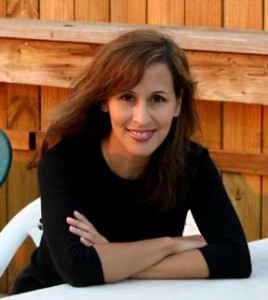
Samanth Mabry author photo

Samantha Mabry grew up in Texas playing bass guitar along to vinyl records, writing fan letters to rock stars, and reading big, big books, and credits her tendency toward magical thinking to her Grandmother Garcia, who would wash money in the kitchen sink to rinse off any bad spirits. She teaches writing and Latino literature at a community college in Dallas, Texas, where she lives with her husband, a historian, and her pets, including a cat named Mouse. A Fierce and Subtle Poison is her first novel.

Book Review: Allie, First At Last by Angela Cervantes


Allie, First At Last (1)Reviewed by Marianne Snow Campbell

FROM ANGELA CERVANTES’S WEBSITE: Allie Velasco wants to be a trailblazer. A trendsetter. A winner. No better feeling exists in the world than stepping to the top of a winner’s podium and hoisting a trophy high in the air. At least, that’s what Allie thinks…. she’s never actually won anything before. Everyone in her family is special in some way—her younger sister is a rising TV star; her brother is a soccer prodigy; her great-grandfather is a Congressional Medal of Honor winner. With a family like this, Allie knows she has to make her mark or risk being left behind.  She’s determined to add a shiny medal, blue ribbon, or beautiful trophy to her family’s award shelf. When a prestigious school contest is announced, Allie has the perfect opportunity to take first —at last. There’s just one small snag… her biggest competition is also her ex–best friend, Sara. Can Allie take top prize and win back a friend — or is she destined to lose it all?

MY TWO CENTS: Fifth grade can be a tough year – it certainly was for me.  As kids approach and enter adolescence, many begin to grapple with who they are and who they want to be. Meanwhile, they may fall out with longtime friends who are going through the same transitions. While experiencing these growing pains and periods of uncertainty, kids can find comfort in books. Reading about characters who are undergoing the same journeys and struggles can help young readers see that they’re not alone – it’s normal to feel out of place and unsure of oneself.

Allie Velasco is a fifth-grader trying her best to discover her identity and make her mark on the world around her. For Allie, that means being the best at something – not that she’s sure what that something is. While her siblings excel at acting, soccer, and community service, her mother has been voted Best News Anchor of the Year, and her great-grandfather is a war hero, Allie is keenly seeking out her niche and putting a lot of pressure on herself to “succeed.”

Frankly, I wish Allie, First at Last had existed when I was in fifth grade. Although it’s been a couple of decades since I experienced my own tween tribulations, it was almost therapeutic to revisit that stage of my life through Allie. And I’m certain there are plenty of young readers out there today who will relate to her as well. This book is sure to appeal to kids who are “finding themselves,” having friend problems, or feeling eclipsed by siblings.

But don’t go thinking that this book is all sadness and doubt! Angela Cervantes fills the pages with humor that’s sharp with hints of snark and sarcasm, but never mean. For example, Allie and her best friend write a song about her cat called “It’s Not Easy Being Fluffy.” I approve. Also, although Allie faces challenges and insecurities, she still demonstrates strength and self confidence by assertively confronting rude kids in her class, nurturing a loving relationship with her sister and bisabuelo, and demonstrating a deep, natural appreciation for her Mexican-American roots. A great role model indeed.

TEACHING TIPS AND RESOURCES:  Allie, First at Last would be a perfect choice for a middle-grade classroom book club. Teachers can provide students with a list of books (including this one), and students can then choose which book they’d like to read, form small groups with classmates who chose the same book, enjoy, and discuss. With its highly relevant themes and humor, Allie is certain to be a hit, and kids can make it their own as they connect it to their lives and respond collaboratively. Educators should be sure to stock this volume in their classroom libraries and media centers for self-selected reading time. There’s nothing like a fun, engrossing book for motivating kids to read!

Also, be sure to check out Angela Cervantes’s teacher resources, available on her website. She’s created printer-friendly activity sheets with writing prompts for both Allie, First at Last and her previous novel, Gaby, Lost and Found.  The prompts present great ideas for journaling, in-class discussions, and even research projects.  Enjoy!

Angela CervantesABOUT THE AUTHOR: Angela was born and raised in Kansas. Most of her childhood was spent in Topeka, Kansas living in the Mexican-American community of Oakland. Her family also spent a lot of time in El Dorado and Wichita visiting a slew of aunts, uncles and cousins on weekends.
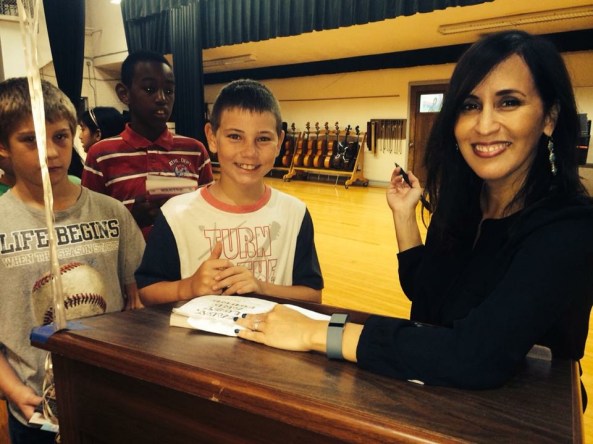
Angela graduated from the University of Kansas (Go Jayhawks!) with a degree in English. After KU, she moved to Brownsville, Texas. In Brownsville, Angela was introduced to the music of Selena, ceviche, and learned to two-step. After Brownsville, Angela moved to Guadalajara, Mexico, where for two years she taught High School English and literature. In 2003, Angela returned to Kansas City, completed an MBA, co-founded Las Poetas, an all-female poetry group, and began working at an international children’s organization.

In 2005, Angela’s short story, “Pork Chop Sandwiches” was published in Chicken Soup for the Latino Soul. In 2007, she won third place for Creative Nonfiction in the Missouri Review’s audio competition for her story “House of Women” and Kansas City Voices’ Best of Prose Award (Whispering Prairie Press) for her short story, “Ten Hail Marys”. In 2008, she was recognized as one of Kansas City’s Emerging Writers by the Kansas City Star Magazine. In 2014, she was named one of the Top Ten New Latino Authors to Watch by LatinoStories.Com.

Angela’s first novel, Gaby, Lost and Found [Scholastic Press; 2013], won Best Youth Chapter Fiction Book in the International Latino Book Awards. Angela’s second middle-grade novel, Allie, First At Last, will be released Spring 2016. See FAQs about the author.

WE ARE GIVING AWAY A HARDCOVER OF ALLIE, FIRST AT LAST BY ANGELA CERVANTES, WHICH OFFICIALLY RELEASES 3/29/16.

CLICK HERE TO LINK TO THE RAFFLECOPTER GIVEAWAY!


MarianneMarianne Snow Campbell is a doctoral student at The University of Georgia, where she researches nonfiction children’s books about Latin@ and Latin American topics and teaches an undergraduate course on children’s literature. Before graduate school, she taught pre-K and Kindergarten in Texas, her home state. She misses teaching, loves critters, and can also be found on Twitter and Facebook.


Guest Post by Angela Cervantes: Piñata Busters and Trailblazers

IMG_0149We’ve all met piñata busters and trailblazers. These are the extraordinary people who take on immense challenges to pave the way for others to succeed. These folks are determined, ready-to-bust-through-obstacle-types who put the “P” in perseverance and the “G” in ganas.
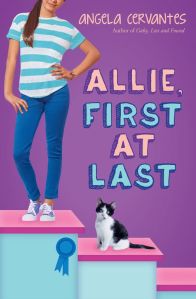
In my second middle grade novel, Allie, First At Last (3/29/16; Scholastic Inc.) ten-year old Alyssa Velasco wants desperately to make her mark and be a trailblazer like the rest of her family—a highly motivated group of trophy-winners and “first-evers.” However, in her determination to win something, she steamrolls through anyone she believes is trying to compete with her, including her ex-best friend, Sara, and new buddy, Victor Garcia.

Allie, First At Last (1)In short, Allie has no clue what it means to be a true trailblazer or piñata buster, but by the end of the book, she finds out the hard way.
I was inspired to write this book because I grew up in a close-knit, proud, Mexican-American community where we celebrated the accomplishments of people like Ellen Ochoa, the first Hispanic woman to go to space (1993 Discovery mission); Henry Cisneros, the first Mexican-American mayor of San Antonio (Yay, Texas!); Tom Flores, the first Hispanic NFL head coach to win the Super Bowl (Go Raiders!).

Being raised in this community, I have always been inspired by the stories of individuals who, regardless of the obstacles before them, like racism, sexism, and poverty, could deliver a strong smack to the status quo and negative stereotypes.

As I wrote Allie, First At Last, I relished researching other Hispanic and non- Hispanic “piñata busters.” I couldn’t feature all of the piñata busters I wanted in my novel, but here are just a few I mention:

  • Katie Jurado – First Mexican actress to be nominated for an Academy Award in an acting category (1954)
  • Sonia Sotomayor- First Latina Supreme Court Justice (2009)
  • Gwendolyn Brooks –  The first African-American person to win a Pulitzer prize (1950)
  • Junko Tabei- First woman to reach the summit of Mount Everest (1975)
  • Billy Mills – First American to win the 10,000m at the Olympics (1964)

The thing about piñata busters/trailblazers is that sometimes we look for them in Hollywood films, Wikipedia, or our history books, but the truth is we don’t have to look that far. They’re all around us.

In Allie, First At Last, Allie’s new friend, Victor Garcia, is a true trailblazer. He is not concerned about a trophy shelf or being famous; he is simply trying to be the first in his family to graduate from high school and go to college someday. The obstacles in front of him are clear: his family is poor, and he will depend on scholarships to afford college. He is a child of immigrants and will be navigating the path to college by himself.

Regardless of the hurdles, Victor enters the game willingly and with one sole purpose: to gash a hole in the obstacles (the piñata) so that his younger siblings and entire family get the sweet rewards.

How many of us have been in Victor’s shoes or know of someone who has been the first in his/her family to go to college? Graduate from college? Start a business? Become a teacher? Publish a children’s book?

For me, Allie, First at Last, is a story celebrating generations of piñata busters and trailblazers.

I wrote it because I couldn’t get Allie Velasco out of my head. She had something to say, so I wrote it for her and for all the kids out there dealing with competition and finding their place in the world. I hope Allie’s story inspires children to explore trailblazers in their own families who have opened a path for them to reach their dreams. I hope they, just like Allie, decide that in their young lives, they won’t close doors behind them, but leave them wide open for others to enter, too.  And I hope, like Allie, they understand that, “true trailblazers are motivated not by glory, but by love for friends, family, and country.”

angela at libraryAngela Cervantes is a native of Kansas. Her achievements are manifold and include earning an MBA, co-founding an all-female poets group, teaching high school, and writing two middle-grade novels, Gaby, Lost and Found, and Allie, First at Last. To learn more, visit her website here.


WE ARE GIVING AWAY A HARDCOVER OF ALLIE, FIRST AT LAST BY ANGELA CERVANTES, WHICH OFFICIALLY RELEASES 3/29/16.

CLICK HERE TO LINK TO THE RAFFLECOPTER GIVEAWAY!


Spotlight on Latina Illustrators Part 2: Juana Martinez-Neal, Maya Christina González & Laura Lacámara


By Cecilia Cackley

This is the second in a series of posts spotlighting Latina illustrators of picture books. Some of these artists have been creating children’s books for many years, while others will have their first book out this year. Some of them live in the US, while others live overseas. They come from many different cultural backgrounds, but all are passionate about connecting with readers through art and story. Please look for their books at bookstores and libraries!


Juana Martinez-Neal

Children's Illustrator Juana Martinez-NealJuana was born in Lima, the capital of Peru. She has been illustrating for children since she was 16. Juana attended the best art school ever, Pontificia Universidad Catolica del Peru – School of Fine Arts. After 3 years of a crazy 8-to-8 schedule and way too many all-nighters, she was in desperate need of a semester-break and decided to give L.A. a “test drive.” She has lived in the US ever since.

Q: What inspired you to become an artist?

A: My father and grandfather were artists. The walls of our house were full of their paintings, and we had art supplies all around the house. Drawing and painting were natural ways to use our time. Every Summer, my mom enrolled us in a different art classes. She always took us to visit Museums, and her special treat was taking us to see puppet shows. Art was part of our life. There is nothing else I could be but an artist.

Q: Tell us about your favorite artistic medium.

A: I love the process more than a specific media. I think that’s the reason why I’m a mixed media illustrator. When I add materials and change my the process, the work becomes even more interesting. The idea of solving the problem makes the process so very exciting.

Q: Please finish the sentence “Picture books are important because…”

A: They expand a child’s mind, fulfill their soul, and show new points of views.


Maya Christina González

Maya Gonzalez is an artist, author, educator, activist, peacemaker, publisher, equality lover, obsessive recycler, traveler, river lover, tree talker, sky kisser……

Her fine art graces the cover of Contemporary Chicano/a Art and is well documented as part of the Chicano Art Movement. She has illustrated over 20 award-winning children’s books, several of which she also wrote, Her book My Colors, My World won the prestigious Pura Belpré Award Honor from the American Library Association and her most recent picture book, Call Me Tree was listed in Kirkus’ Best Picture Books of 2014 that Celebrate Diversity. Since 1996, Maya has been providing presentations to children and educators about the importance of creativity as a tool for personal empowerment. Her work with children in public schools helped her develop several lines of curriculum that offer a holistic approach to learning and open doors to new ways of thinking and relating in the world. In 2009 she co-founded Reflection Press, an independent press that publishes radical and revolutionary children’s books, and works that expand spiritual and cultural awareness. And in 2013, Maya co-created an online learning environment called School of the Free Mind about expanding the mind and reclaiming the creative. The School offers e-courses for those who are ready to uncover and connect with their unique and most powerful way of living and creating.

Q: What inspired you to become an artist?

A: I remember as a child drawing my round Chicana face into the backs of books. I think on some level I knew I needed to see myself in my books. I didn’t. I know in many ways those early ‘self-portraits’ were my way of affirming my existence in a world that did not include me. We are born artists. Creativity is our greatest tool to express and transform our world. I think it was a natural act to be an artist. I think I’ve remained visually expressive because it is the most powerful and immediate way to communicate and create change.

Q: Tell us about your favorite artistic medium.

A: I am notorious for trying different mediums in my children’s books. Acrylics, watercolors, oil pastels, ink, charcoal, painted collage, photo collage, color pencils and combinations of all of those. What I love is the feeling of exploration and not completely knowing what I’m doing. I know that’s how kids feel all the time. Everything is new and curiosity rocks. So I follow that feeling. I’ve made so much art that I’m familiar with all the materials so now I’m exploring how to use them differently. More expression. More immediate and raw. This is how kids create because this is how kids feel. I’m always exploring the edges of my expression.

Q: Please finish the sentence “Picture books are important because…”

A: Picture books are important because they are powerful tools of expression, support and potential healing. I believe children’s books are one of the most radical things we can do for ourselves and our communities.


Laura Lacámara

Laura_photo_2015-300 dpiCuban-born Laura Lacámara is the award-winning author and illustrator of Dalias Wondrous Hair / El cabello maravilloso de Dalia (Piñata Books), a bilingual picture book about a clever girl who transforms her unruly hair into a vibrant garden. Laura also wrote Floating on Mamas Song / Flotando en la canción de mamá, a bilingual picture book inspired by her mother, who was an opera singer in Havana. Illustrated by Yuyi Morales and published by HarperCollins, Floating on Mamas Song was a Junior Library Guild Selection for Fall 2010 and was a Tejas Star Book Award Finalist for 2011-2012.

Laura earned her Bachelor of Fine Arts in Drawing and Painting at California State University, Long Beach. She studied printmaking at Self Help Graphics in East Los Angeles and began exhibiting and selling her work.

When a fellow artist suggested Laura’s images would be ideal for picture books, Laura signed up for a children’s book illustration class at Otis College of Art and Design. She instantly fell in love with both writing and illustrating for children. It was in that class that she wrote the first draft of Floating on Mamas Song.

Laura illustrated the 2012 Tejas Star Book Award winner, The Runaway Piggy / El cochinito fugitivo (Piñata Books), as well as Alicias Fruity Drinks / Las aguas frescas de Alicia (Piñata Books). Laura is a popular presenter at schools, book festivals, and conferences, and she is an active member of the Society of Children’s Book Writers and Illustrators (SCBWI).  Laura lives in Southern California with her husband, their daughter, and a lovable mutt.

Q:  What inspired you to become an artist?

A: Having an artist father, who made a living as a graphic designer and illustrator, inspired me and showed me that it was possible to be a working artist.  In high school and beyond, I had many artist friends – we found inspiration together in art classes and museum visits.  And, to be honest, as a young adult, doing art was the only job I didn’t get fired from!

Q: Tell us about your favorite artistic medium.

A: I like painting with acrylics on a variety of surfaces – my current favorite being wood. (I love the texture.)  I also enjoy adding collage elements to my paintings.  I’ve always loved bright patterned fabrics and papers – the more the colors and patterns clash, the better!

Q: Please finish this sentence: “Picture books are important because…”

A: Picture books are important because they teach us about ourselves, our world, our feelings, our realities.  Stories with pictures can give young kids a great deal of validation and comfort.  A picture book may be the first time a child realizes, “I’m not the only one who feels that way!”


Books to Check Out:

Lacámara Laura. Dalias Wondrous Hair

Luna, James. The Runaway Piggy

Ruiz-Flores, Lupa. Alicias Fruity Drinks

Elya, Susan Middleton. La Madre Goose (coming in July)

Gonzalez, Maya Christina. Call me Tree/Llamame Arbol

Gonzalez, Maya Christina. I Know the River Loves Me/Yo se que el rio me ama

Gonzalez, Maya Christina. My Colors, My World/Mis colores, mi mundo

Alarcon, Francisco X. Animal Poems of the Iguazu

Perez, Amada Irma. Nanas Big Surprise

Perez, Amada Irma. My Diary from Here to There

Alarcon, Francisco X. Iguanas in the Snow

A Conversation with Author-Illustrator Matt Tavares

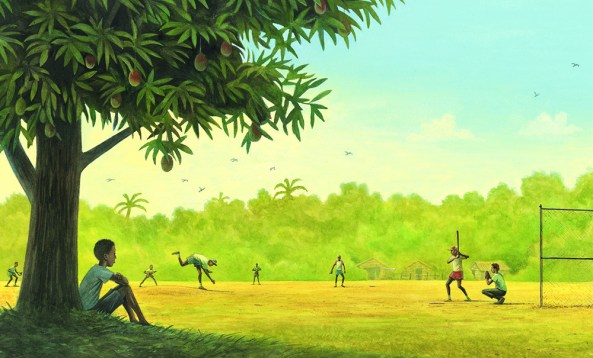
GROWING UP PEDRO. Text and Illustrations copyright 2015 Matt Tavares. Reproduced by permission of the publisher, Candlewick Press, Inc., Somerville, MA.

GROWING UP PEDRO. Text and Illustrations copyright 2015 Matt Tavares. Reproduced by permission of the publisher, Candlewick Press, Inc., Somerville, MA.

By Lila Quintero Weaver

When author-illustrator Matt Tavares turns his focus on a children’s book topic, beautiful things happen. We love what he did with Growing Up Pedro: How the Martinez Brothers Made It  from the Dominican Republic All the Way to the Major Leagues, a stirring picture book biography of the Dominican baseball great Pedro Martinez and his highly influential brother Ramón. Now we’re turning our focus on Matt himself, a prolific producer of books for kids, who agreed to answer a few of our burning questions.

Latin@s in Kid Lit: Wow, your paintings are magnificent! They’re highly realistic yet deliver much more than faithful representation, in terms of their emotive power and aesthetics. Please tell us about your journey to professional illustration.

Matt: Wow, thank you! That’s certainly what I always try to do, so it’s very nice to hear my pictures described that way. Even if I’m painting a realistic scene, there is always something I can do to heighten it, to go beyond what a photograph might show.

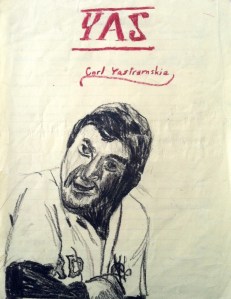
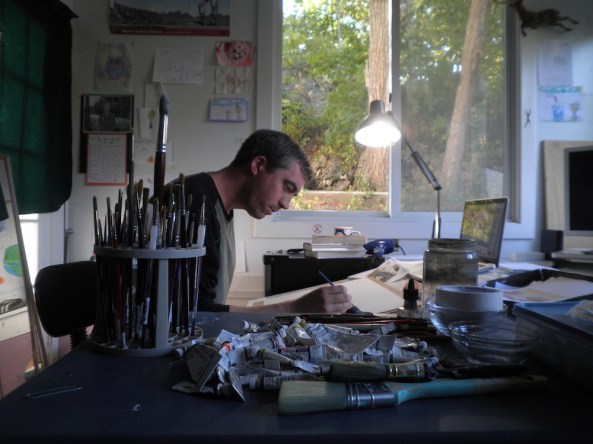
Matt's been drawing since childhood.

Matt’s been drawing baseball figures since childhood.

I’ve always loved to draw. Even when I was 4 or 5 years old, I thought of myself as an artist. I drew all the time, and knew I wanted to be some kind of artist when I grew up. It wasn’t until I was a junior at Bates College that I decided I wanted to illustrate picture books. I wrote and illustrated a picture book as my senior thesis. I spent my whole senior year working on it. After that, things happened pretty quickly- I found an agent who liked it, and she shopped it around to publishers, and found Candlewick Press. They basically asked me to do the whole thing over again with the guidance of an editor and art director, which I happily did. Then in 2000, Zachary’s Ball was published, my first book.

Matt hard at work in his studio

Matt hard at work in his studio

LiKL: You’re not only an illustrator—you also write. Can you walk us through the process of creating a picture book, starting from the idea phase and ending with publication?

Matt: Sure. The beginning part is pretty messy, where I just have all kinds of ideas floating around and I write everything down in my notebook. From there, most of the ideas just wither away, but every now and then one of them grows into something I think I might actually be able to work with.

I always write the words first, then once I figure out how to divide it up into pages, I do rough sketches. And there is always a lot of back and forth between the words and pictures. In a picture book, part of the story will be told with words and part of the story will be told with pictures. Once I start figuring out what the pictures are going to be, I realize I don’t need some of the words.

Once all my sketches are approved by my art director (after a couple rounds of revisions, usually), I start working on the final illustrations. That part usually takes 4 to 6 months. The whole process, from start to finish, can take 9 months to a year, depending on the book. Then once all the illustrations are done, it’s about a year until it comes out in stores.

LiKL: By my count, seven of your published children’s books center on baseball stories, including Growing Up Pedro, your picture-book bio of Dominican major league star Pedro Martinez, which we reviewed in November. What’s your connection to the sport?

Matt: Baseball is just something I’ve always loved. I grew up near Boston and have great memories of going to Fenway Park to watch the Red Sox play. When I was a kid, I was really into collecting baseball cards, watching baseball, playing baseball and wiffle ball. It’s one of the few things that has been a constant in my life from the very beginning. So when I started writing books for kids, baseball was a natural subject. Honestly, I wasn’t a big reader when I was a kid, but I would read anything if it was about baseball. I know there are still kids like that, and I hope they find my books!

LiKL: Speaking of Growing Up Pedro, you must have done a great deal of research on Pedro Martinez’s life and career, not to mention baseball in general and Dominican life. Fill us in.

Matt: This was my fourth baseball biography, but it was the first about a player I actually got to watch play. So this book was very personal for me. I read a lot of interviews and articles, but I also relied on my own memories of being at Fenway when Pedro was pitching. When he was on the mound, Fenway Park transformed into a different place. There was this electricity that surrounded him. I was excited to try to capture that in a book.

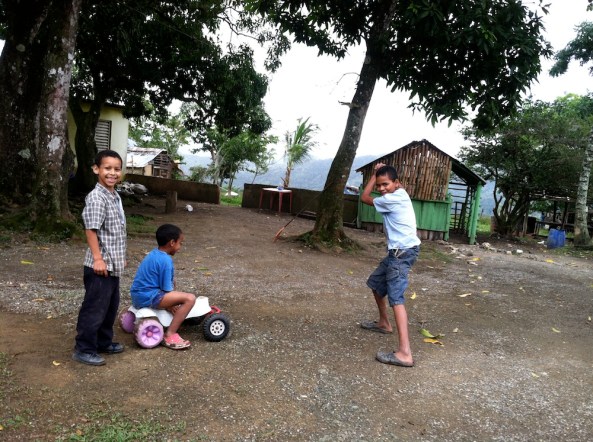
DR1

In the Dominican Republic, local children were happy to pose for photos Matt would use in illustrating Growing Up Pedro.

I also traveled to the Dominican Republic when I was working on Growing Up Pedro, which was amazing. Instead of just finding pictures online, I actually got to go to places that still look how they did when Pedro was a kid. I took tons of pictures. It was incredible to be able to go home after that trip and use all these experiences that were fresh in my mind and put them right into my book. It really helped me feel personally connected to the whole story.

LiKL: On this blog, we highlight excellent kid lit that focuses on Latino/a characters, something you pulled off beautifully in Growing Up Pedro. As far as you can tell, has this picture book expanded your reach into the Latino community?

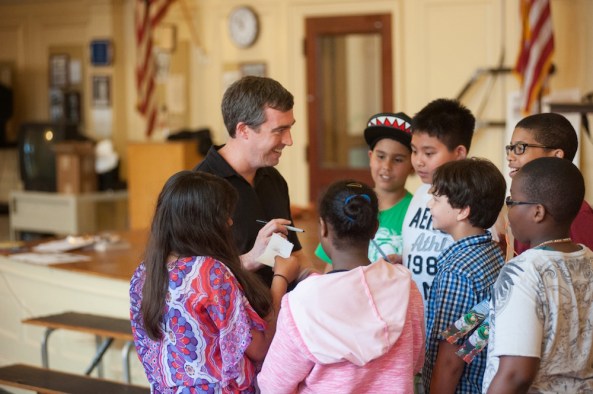
tavares1

Meeting young fans at book events

Matt: Absolutely, and that’s been really great. I was thrilled when I found out Candlewick was going to do a Spanish edition of the book, because I know that Pedro is a hero to millions of Spanish-speaking people. I love knowing that kids can read Pedro’s story in English or Spanish.

It’s such a powerful thing when a kid can see a bit of themselves in a character, and I think a lot of people have made that connection with Pedro. For some kids it’s because he grew up poor, or even just that he was skinny and small. But I think the fact Pedro is Latino definitely helps a lot of Latino/a readers feel more connected to the story.

GROWING UP PEDRO. Text and Illustrations copyright 2015 Matt Tavares. Reproduced by permission of the publisher, Candlewick Press, Inc., Somerville, MA.

GROWING UP PEDRO. Text and Illustrations copyright 2015 Matt Tavares. Reproduced by permission of the publisher, Candlewick Press, Inc., Somerville, MA.

LiKL: Suppose you could hang around the studios of any three illustrators—living or dead—for the purpose of asking questions and observing technique. Who would those illustrators be and why?

Matt: Tough to pick three… I’ll say Chris Van Allsburg, because he’s one of my all-time favorite illustrators, and I would love to watch him work. I would probably just take pictures of all his art supplies then go to the art store and buy all the same stuff. Maurice Sendak, because he was a genius and was always so fascinating in interviews. I never got to meet him. And Jerry Pinkney. I did a book signing with him once, and he was so nice and humble and approachable. He’s been making books for so long, and has had so much success. I’d love to spend some time with him and maybe pick up some good habits.

LiKL: Naturally, we’re curious to know what’s next from Matt Tavares. If you’re free to share, tell us about books already in production, or a project still shiny with wet paint.

Matt: My next book is Crossing Niagara, which is a picture book about The Great Blondin, the first person to walk across Niagara Falls on a tightrope. That comes out in April. Then I have another picture book biography that I illustrated with Candlewick that comes out in Spring 2017, about the first woman pilot. And right now I’m just starting final art for a book I wrote that comes out in Fall 2017. This one is going to be a very new direction for me- it’s fiction, and the main characters are birds. I’m very excited to try something new.

DR2Writer, illustrator, baseball lover! Learn more about Matt Tavares and his books at his official website.

Book Review: Kill the Boy Band by Goldy Moldavsky

First, a a few words from debut author Goldy Moldavsky:

Goldy M.

From Goldy’s Twitter account

New York is my hometown. It’s the place where I grew up, the place I love like a person. But the first time I set foot in New York, I didn’t know a word of English. My family immigrated to New York from Peru when I was five, leaving behind my grandparents, aunts, uncles, and cousins in Lima. I can’t imagine how hard it was for my parents to move to a new place, and obviously it was infinitely easier for a five year old to adapt, but still—the culture shock was no joke. I remember crying as a kindergartner because I could not understand anything that my teacher was saying. Luckily, there was a girl in my class who spoke Spanish and translated everything for me.

Eventually, I picked up the language quickly enough, and it was this new culture—and specifically pop culture—that taught me to speak English. When I showed up in Brooklyn, neighborhood kids were singing along to New Kids on the Block and everyone was quoting Steve Urkel. I soaked it up. I guess it’s only fitting that my debut novel, Kill the Boy Band, is infused with pop culture references. While my parents were out working hard, I was learning a new language watching episodes of Saved By the Bell and the Fresh Prince of Bel Air after school. Though, I would still watch telenovelas with my family after dinner. I was just as hooked on episodes of Full House as I was on the melodramatic struggles my favorite childhood actress Thalia had to face on Maria del Barrio.

As a Jewish Latina girl who has confounded Jewish people with my Latinaness and Latino people with my Jewishness, pop culture was my great equalizer. And now I have a book that will hopefully be a part of that pop culture, written in a language that I adopted. As corny as it may sound, for an immigrant like me, getting Kill the Boy Band published is my very own version of the American Dream.

Now, the review of Kill the Boy Band by Zoraida Córdova

DESCRIPTION FROM THE PUBLISHER: From debut author Goldy Moldavsky, the story of four superfan friends whose devotion to their favorite boy band has darkly comical and murderous results.

Okay, so just know from the start that it wasn’t supposed to go like this. All we wanted was to get near The Ruperts, our favorite boy band.

We didn’t mean to kidnap one of the guys. It kind of, sort of happened that way. But now he’s tied up in our hotel room. And the worst part of all, it’s Rupert P. All four members of The Ruperts might have the same first name, but they couldn’t be more different. And Rupert P. is the biggest flop out of the whole group.

We didn’t mean to hold hostage a member of The Ruperts, I swear. At least, I didn’t. We are fans. Okay, superfans who spend all of our free time tweeting about the boys and updating our fan tumblrs. But so what, that’s what you do when you love a group so much it hurts.

How did it get this far? Who knows. I mean midterms are coming up. I really do not have time to go to hell.

MY TWO CENTS: Fandom is a complicated culture. ~Goldy Moldavsky, Kill the Boy Band

I loved this book. It’s a refreshing feeling when you find a book that stands out the way Kill the Boy Band does. The book boasts it’s “The most shocking debut of the year,” and I think it might be right. This isn’t the YA novel we’re used to. It’s like a fangirl version of Scream Queens and Mean Girls. And it’s an unapologetic satire, which you need to keep in mind while reading it. It follows four fangirls who idolize a British mega pop band called The Ruperts. They are named so because each of the four boys is named Rupert. They end up kidnapping Rupert P, the least talented, “ugly” one. Every boy band has one. (Chris Kirkpatrick, anyone?) What was meant as an opportunity to get as close as possible to the Boys ends up with girls committing a felony. Things get out of hand. Like, way out of hand. Pause for suspension of disbelief, Weekend at Bernie’s style.

IMG_1839

Zoraida reading Kill the Boy Band on a beach in the Dominican Republic

The girls are at various stages of fandom. There’s Isabel: The Tough One. She’s Dominican and curses in Spanish when she’s mad. She runs a fansite dedicated to The Ruperts, online harasses people who hate The Ruperts, and blackmails her way into being the #1 source for The Ruperts. She’s seen them so often that she’s really at the end of her fandom and more in it for the hits she gets on her website. There’s Erin. She’s like Emma Roberts in every role she plays. She’s the Beautiful, Mean One. Her role is “The Mastermind” of the layers to this scheme. Her story arc and twist are compelling and shocking. There’s Apple. “The Simple One” by a long shot. She doesn’t seem to have a good grasp on reality, and her whims are totally dictated by The Ruperts. She’s Chinese and was adopted by an elderly wealthy couple who gives her everything she wants. They have funded her obsession with The Ruperts, including concerts and Apple’s own Latin nanny (who is an honorary Rupert’s fangirl at this point). Without Apple, the girls wouldn’t be able to secure the super expensive hotel room they need to carry out their plans. Trigger warning: Apple is the target of fat shaming from the other girls. This is where the “friendship” between these girls unravels. They’re friends, but not. This trial is what forces them to remain a unit, even if the only thing they truly have in common is The Ruperts. Once that tie is broken, what do they have left when it comes to friendship?

Finally, there’s our unreliable narrator. She goes by many names, usually plucked from popular 80s movies. The final and most prominent identity is Sloane from Ferris Bueler’s Day Off. “Sloane” is the “Innocent One.” She’s the voice of reason and law in this slice into crime and murder. The best part of this novel is the use of the unreliable narrator. Do we trust Sloane? We shouldn’t, but she frames the story to make herself come out as the “Good One.” Even she tells the reader, breaking the fourth wall constantly, that she very well could make herself as the “Innocent” when she should be or could be the “Crazy” one. There’s a very real moment when Sloane wonders what is the truth in her web of lies. She is a writer of fanfic, after all. What if this is just one more of her elaborate stories she makes up?

Another wonderful aspect of the narrative is the use of modern dialect and internet slang. Gosh, saying that makes me feel a tad old, but it’s true. Sloane speaks the way the internet does. She offers a reflection on fandoms, the mad frenzy of loving someone you only know through music or film, the rush that comes with knowing the intimate details through gossip websites, Twitter, and stolen photos. (I did learn a new term: Citizen Pap. No that kind of pap. It’s Citizen Paparazzi. Duh.) Sloane slowly comes out of her fangirl craze and sees other fangirls through the eyes of their critics. The entire time I think, Why is it that when girls love something, it is easily dismissed? There’s a pivotal moment that summarizes my takeaway from this book. It’s when Sloane is speaking to an adult male:

“You girls…”

Are never taken seriously.

“…should find a nice hobby.”

But we should be taken seriously. We can be amazing. And dangerous.

Kill the Boy Band by Goldy Moldavsky is a crazy, ultra modern ride into the world of fangirls everywhere. With ROTFL moments and girls who are as smart as they are mean, as cunning as they are unreliable, it is a must read.

*Bonus points for cleverly threading in boy band lyrics throughout the novel. #ItsTheHardestThingIllEverHaveToDo.


ABOUT THE AUTHOR:

From Goldy’s Tumblr

Goldy Moldavsky writes YA fiction from her hometown of Brooklyn. She studied journalism in college, where she got to interview some cool celebrities for her school paper. After a bit she realized it’d be more fun making up stories about celebrities, so that’s what she does in her writing. Some of her influences include Buffy the Vampire Slayer, the esteemed works of John Irving, and the Mexican telenovelas she grew up watching with her mother. Follow her on Twitter @GoldyWrites and visit her website.

Goodreads * Amazon * B&N