Celebrating Pura Belpré Winners: Spotlight on Rafael López


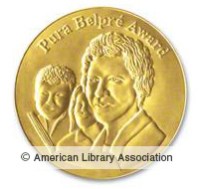
PuraBelpreAwardThe Pura Belpré Awards turns 20 this year! The milestone will be marked on Sunday, June 26, from 1:00-3:00 p.m. during the 2016 ALA Annual Conference in Orlando, FL. According to the award’s site, the celebration will feature speeches by the 2016 Pura Belpré award-winning authors and illustrators, book signings, light snacks, and entertainment. The event will also feature a silent auction of original artwork by Belpré award-winning illustrators, sales of the new commemorative book The Pura Belpré Award: Twenty Years of Outstanding Latino Children’s Literature, and a presentation by keynote speaker Carmen Agra Deedy.
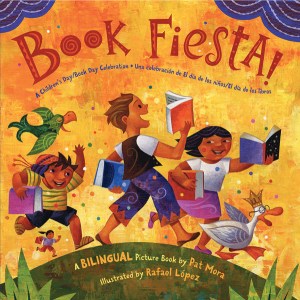
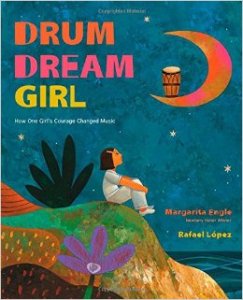
hires-cover-fiesta  Drum Dream GirlLeading up to the event, we will be highlighting the winners of the narrative and illustration awards. Today’s spotlight is on Rafael López, the winner of the 2010 Pura Belpré Illustration Award for Book Fiesta! Celebrate Children’s Day/Book Day, Celebremos El dia de lo niños/El día de los libros, written by Pat Mora, and the 2016 Pura Belpré Illustration Award for Drum Dream Girl, written by Margarita Engle. We featured Drum Dream Girl in a book talk and in a special report about a library event.
Tito book  Cazuela  Celia

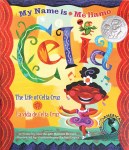
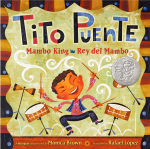
Rafael also received a Pura Belpré Illustration Honor three times: In 2014, for Tito Puente: Mambo King/Rey de Mambo, written by Monica Brown; in 2012, for The Cazuela that the Farm Maiden Stirred, written by Samantha R. Vamos; in 2006, for My Name is Celia/Me Llamo Celia: The Life of Celia Cruz/ La Vida de Celia Cruz, written by Monica Brown.

Book Fiesta!

Illustration Review by Lila Quintero Weaver

Book Fiesta! Celebrate Children’s Day/Book Day/ Celebremos El día de los niños/El Día de los libros, written by Pat Mora and illustrated by Rafael López, is a gem of a picture book that offers its wonders in two languages, English and Spanish.

Book Fiesta! exuberantly proclaims the joys of reading and introduces the concept of Día, an annual celebration of literature for children, founded by Pat Mora in 1996, and observed through special events by many libraries nationwide.

What Mexican painter, muralist, and illustrator Rafael López brings to a picture book must be seen and not just read about. His mastery as an illustrator extends to every aspect of the art: a strong concept, dynamic design, brilliant execution, and irresistible charm. It’s no wonder that the Pura Belpré committee recognized his work. Let’s take a closer look.
BookFiests_03

Used by permission from HarperCollins Children’s Books.

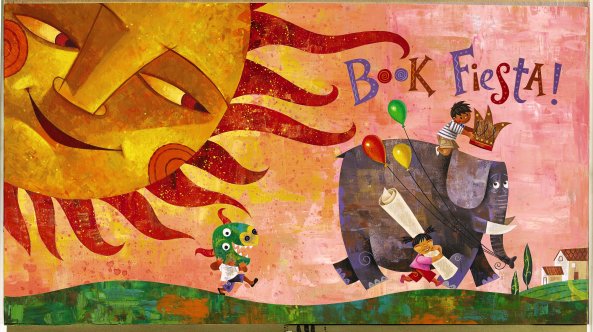
You don’t have to be an artist to appreciate López’s expert techniques, including his winning combination of hard-edged shapes and saturated colors, delivered through heavily textured paint and splashy accents, and supported by a golden undertone that unifies all of the spreads. In the pages above, a huge, friendly sun smiles down on the children, accompanied by a trotting elephant. Such charm!
BookFiests_06

Used by permission from HarperCollins Children’s Books.

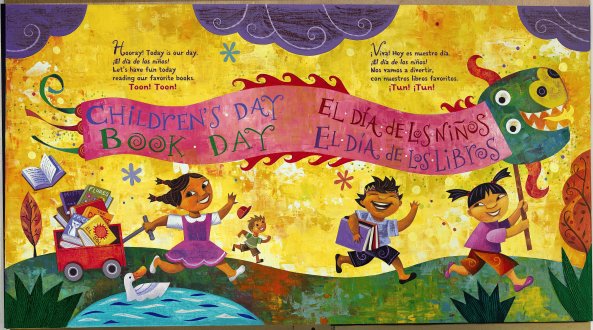
López champions diversity in his illustrations. Here, a parade of children follows a Chinese dragon whose tail doubles as a banner, announcing Día to one and all. Note the diversity represented in the races of the children. One child pulls a wagon full of books bearing titles in English and Spanish.
BookFiests_08

Used by permission from HarperCollins Children’s Books.

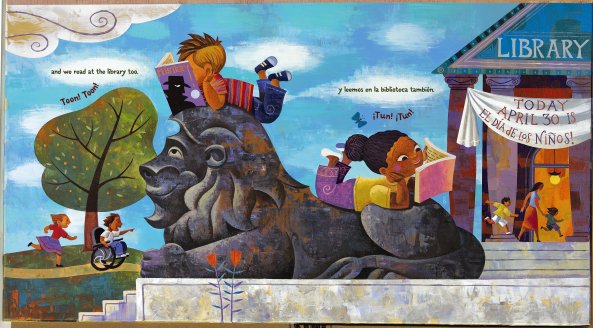
Outside the library, even the stone lion looks pleased to take part in Día. The children relaxing on the marble beast are immersed in their books. In the background, a boy in a wheelchair eagerly makes his way to the library—another evidence of the illustrator’s awareness of diverse representation.
BookFiests_15

Used by permission from HarperCollins Children’s Books.

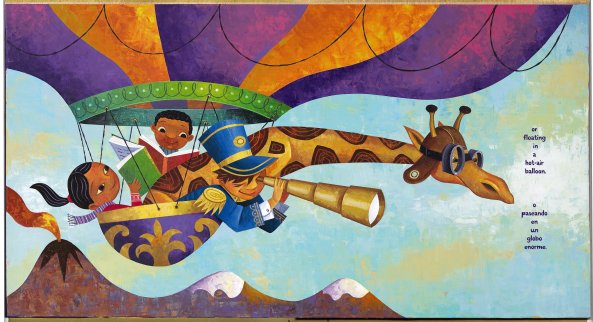
López amplifies Pat Mora’s words through many inventive means. Here, in a depiction of the glorious adventures made possible by reading, a hot-air balloon floats over a mountainous backdrop, complete with a smoking volcano. The pilot is a giraffe in old-fashioned aviator goggles. Elsewhere, books transport children by other means: on an airplane, a train, an automobile, a rowboat, on the back of an elephant, and even in a submarine. Simply put, stories hold the power to magically ferry readers to far-away places and imaginary lands. López brings this virtual travel to life through an enthralling variety of presentations and an engaging level of detail.
Fiesta_25

Used by permission from HarperCollins Children’s Books.

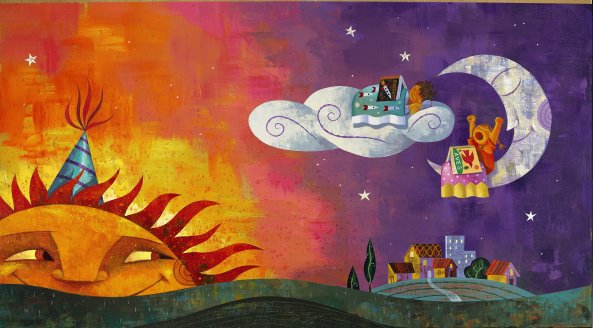
Reading in bed—what better way is there to top off a busy day? In a color-drenched scene, López presents two children indulging in this lovely pastime. One child, floating on a bed of clouds, has already fallen asleep, while the other is midway through a yawn. Her bed is supported by the curve of a crescent moon. López’s trademark brushwork fills the sky with vivid sunset hues that transition to the deep violet of late evening. It’s all grounded by rolling hills, painted in shades of teal, a color appropriate to the dying light. In the distance, the windows of buildings twinkle with warmly lit interiors, while cutout stars punctuate the heavens. Dreamy.

The richness of each spread in Book Fiesta! invites long looks and repeated views that reward readers with the new discoveries. Every page turn reveals a refreshing surprise, backgrounded by a palette that spans the rainbow. Thanks to Pat Mora’s wonderful vision and Rafael López’s dynamic illustrations, this picture book offers a perennial delight to readers of all ages.

Book Fiesta! Celebrate Children’s Day/Book Day; Celebremos el día de los niños/el día de lo libros. Text copyright ©2009 Pat Mora. Illustration copyright ©2009 Rafael López. Images used by permission of HarperCollins Children’s Books.

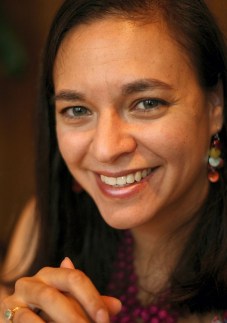
RafaelAbout the illustrator:

Raised in Mexico City, Rafael López makes his home part of the year in San Miguel de Allende, Mexico, as well as in San Diego, California. He credits Mexican surrealism as a major artistic influence. Besides his Pura Belpré medals and honors, Rafael is also a double recipient of the Américas Award. For more about his work, including poster illustrations and a mural project in San Diego that is the subject of a new picture book, Maybe Something Beautiful, visit his official website.

TEACHING TIPS:

  • Lead children in an imagination exercise based on the reading spots depicted in Book Fiesta. What are some places that you can take a book to? What are some places that a book takes you to? Ask students to include real-life and imaginary destinations.
  •  Devise a book parade, featuring wagons loaded with books, masks or disguises based on favorite characters, and banners heralding Día, or another book-related holiday or theme.
  • Invite children to create illustrations based on López’s style. This can include painted backdrops and cutout figures, with an emphasis on strong shapes and bright colors.

Watch Rafael López’s thank you video for his most recent Pura Belpré medal, for Drum Dream Girl:
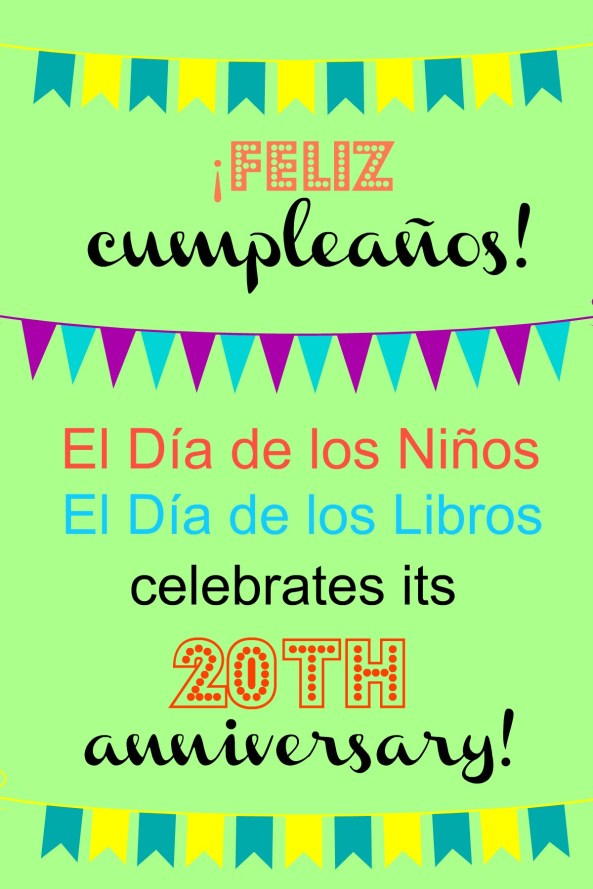
 

Hip, Hip Hooray, it’s Día’s Birthday!

Feliz Cumple DIA

Look for an upcoming post about the joys of El Día de los Niños/El Día de los Libros. For more information about celebrating Día, visit the American Library Association.

Celebrating Pura Belpré Award Winners: The Dreamer by Pam Muñoz Ryan

PuraBelpreAward

The Pura Belpré Awards turns 20 this year! The milestone will be marked on Sunday, June 26, from 1:00-3:00 p.m. during the 2016 ALA Annual Conference in Orlando, FL. According to the award’s site, the celebration will feature speeches by the 2016 Pura Belpré award-winning authors and illustrators, book signings, light snacks, and entertainment. The event will also feature a silent auction of original artwork by Belpré award-winning illustrators, sales of the new commemorative book The Pura Belpré Award: Twenty Years of Outstanding Latino Children’s Literature, and a presentation by keynote speaker Carmen Agra Deedy

Leading up to the event, we will be highlighting the winners of the narrative and illustration awards. Today’s spotlight is on The Dreamer by Pam Muñoz Ryan, winner of the 2011 Pura Belpré Narrative Award. We have already highlighted Esperanza Rising, which won the 2002 Narrative Award.


Reviewed by Cecilia Cackley

DESCRIPTION (from Goodreads): Neftali finds beauty and wonder everywhere: in the oily colors of mud puddles; a lost glove, sailing on the wind; the music of birds and language. He loves to collect treasures, daydream, and write–pastimes his authoritarian father thinks are for fools. Against all odds, Neftali prevails against his father’s cruelty and his own crippling shyness to become one of the most widely read poets in the world, Pablo Neruda. This moving story about the birth of an artist is also a celebration of childhood, imagination, and the strength of the creative spirit.

MY TWO CENTS: As an object, The Dreamer has to be one of the most beautiful books ever created. Every detail—the silver on the cover, the words printed in green, the generous white space on each page and the precise, delicate illustrations by Peter Sís—combine to create a stunning work of art, even before you begin reading. I knew the name Pablo Neruda before I read this book, but other than a few poems from Twenty Love Poems and a Song of Despair, I was not all that familiar with the Chilean poet’s life and work. This book is a fantastic introduction. Ryan is clear in her author’s note that The Dreamer is a work of fiction, and yet it seems perfectly plausible that Neftalí, the fictional main character (Neruda was born Neftalí Reyes and created his pen name as a young man), grew up to be the famous poet whose poems are included at the end of the text.

The Dreamer engages all the senses, as Ryan uses onomatopoeia and changing text size to indicate sound and her lush descriptions bring Neftalí and his family to life. Sís alternates between tiny spot drawings that require close scrutiny and sweeping spreads that go right to the edge of the page. The importance that nature holds for Neftalí is reflected in the chapter titles: Rain, Mud, Tree. Some of the most poignant moments come when Neftalí is engaging with the natural world, such as when he hears the chucao bird in the forest and when he tries his best to save a hurt swan in the lagoon. These moments of calm and curiosity are contrasted with his more difficult interactions with people, such as when he stutters to his father and endures abuse from the bully Guillermo. Yet as Neftalí gets older, he finds allies like his Uncle Orlando and his little sister Laurita and eventually has the strength to find ways around his father’s demand that he stop writing poetry. Each chapter ends with an open-ended question, in the same spirit as Neruda’s own question poems that encourages the reader to consider the characters and their choices and actions. Is fire born of words? Or are words born of fire? Where is the heaven of lost stories?

Neruda is said to be the most widely translated and well-known poet, not just in Latin-America but throughout the entire world. With this richly imagined childhood, Ryan celebrates the Latino cultural experience of Neruda and his work. Although fictional, The Dreamer captures Neruda’s spirit of wonder, curiosity and love for the world and inspires young readers to look at their surroundings with a poet’s eyes.

TEACHING TIPS: The Dreamer was published when I was still teaching third grade. I read it aloud to my students, so I can say with confidence that it is a wonderful book to share as a class! This book makes a great read-aloud, as the descriptions and slow pace of the story mean it works better for some readers broken up into smaller pieces. April is Poetry Month, a perfect time to share The Dreamer with students. I used it as the basis for two different poetry lessons, one about Neruda’s odes to objects and one using his Book of Questions poems. The episode from the book with the toy sheep (128-132) is a nice introduction to the importance Neruda placed on everyday objects and several of his odes are reproduced at the end of the book. Students can read these and other odes (or excerpts, as some of them are long) and then either individually or in small groups, write their own odes to objects that they feel are important.

With the question poems, I had students discuss them in small groups and then create a dramatic presentation of their poem in any way they chose. If you want to share more of Neruda’s objects with a class, the Fundación Pablo Neruda in Chile has photos of his houses online to look at. For younger students, Monica Brown’s picture book biography Pablo Neruda: Poet of the People is another good resource for separating fact from fiction. It might be a good idea to begin with Brown’s book as a way of introducing students to Neruda and giving them an overview of his life before starting The Dreamer.

Vocabulary is another good activity for this book and students can find new words or make lists of words they think are especially rich and vivid. The setting of Chile, possibly an unfamiliar country to students, is also an opportunity to make geography connections and students could find Temuco, Puerto Saavedra and Santiago de Chile on a map or GoogleEarth.

From her website

ABOUT THE AUTHOR: Pam Muñoz Ryan, a New York Times Bestselling author, has written over forty books, including the novels Esperanza Rising, Becoming Naomi León, Riding Freedom, Paint the Wind, The Dreamer, and Echo. She is the author recipient of the National Education Association’s Civil and Human Rights Award, the Virginia Hamilton Literary Award for Multicultural Literature, the Newbery Honor for Children’s Literature, and is twice the recipient of the Pura Belpré Medal and the Willa Cather Award.

Other selected honors include the PEN USA Award, the Américas Award, the Boston Globe-Horn Book Honor, and the Orbis Pictus Award. She was born and raised in Bakersfield, California, (formerly Pam Bell) holds a bachelor’s and master’s degree from San Diego State University and lives near San Diego with her family.

RESOURCES:

Educator Guide from Vamos a Leer blog: https://teachinglatinamericathroughliterature.wordpress.com/october-2012-the-dreamer/

BookPage interview: https://bookpage.com/interviews/8572-pam-munoz-ryan#.VvNk4KsbRoM

Language Arts Journal of Michigan article: http://scholarworks.gvsu.edu/cgi/viewcontent.cgi?article=1079&context=lajm

TeachingBooks.net Guest Blog: http://forum.teachingbooks.net/2010/05/guest-blogger-pam-munoz-ryan/


Cackley_headshotCecilia Cackley is a performing artist and children’s bookseller based in Washington DC where she creates puppet theater for adults and teaches playwriting and creative drama to children. Her bilingual children’s plays have been produced by GALA Hispanic Theatre and her interests in bilingual education, literacy, and immigrant advocacy all tend to find their way into her theatrical work. You can find more of her work at www.witsendpuppets.com.

Q&A with Author Diana López about NOTHING UP MY SLEEVE


By Marianne Snow Campbell

Today we’re very pleased to host a dialogue with Diana López in honor of her newest middle grades novel, Nothing Up My Sleeve, which released on April 19.  This book follows three friends – Dominic, Loop, and Z – as they discover the exciting world of stage magic one summer. It’s equal parts humor, character study, and magic lessons – a fun and fascinating read. After finishing Nothing Up My Sleeve (click here for our book review), I was definitely curious about Diana’s creative process, so I’m very grateful that she was able to answer these questions for me. Enjoy!

I love the backdrop of stage magic in Nothing Up My Sleeve.  What inspired you to explore this topic?

My husband, Gene, inspired me. I wouldn’t know the first thing about magic if it weren’t for him. He’s an aficionado with a great collection of magic books, props, and videos. Over the years, I’ve been a tagalong at magic lectures and conventions, including the TAOM convention that I write about. Magicians are so creative, and if you think about a magic performance, you’ll realize that it’s just another form of storytelling. How could I resist? I had to write this book! And I had so much fun finding magic tricks that resonated with the characters’ personal lives. This is what stories do—give us tools for coping and for celebrating life.

Another important source of inspiration comes from my nephews who turn absolutely everything into a competition. Think about it. Competitions are wonderful for writers because they have a built-in sense of conflict—you’re “fighting” against others but you’re also fighting against yourself as you work to problem-solve or overcome insecurities. In a sense, a competition is a form of story, too.

Also, could you describe your process in creating this book?

I carry a little notebook around and jot down bits of dialogue or names of interesting things. I sometimes take pictures, too. Anything that feels like a good detail for a story. The magic shop, Conjuring Cats, is completely inspired by JCR Magic in San Antonio, for example.

Eventually, I realized that I wanted to write about three boys at a magic competition. But who were they? What kind of magic did they do? What else were they dealing with? To find out, I had to do a lot of exploratory writing, stuff that never gets into the final novel. It’s my way of searching for voices. And with three boys, I needed three voices that were distinct.

Once I had the voice and general sense of where the book was going, I started drafting. I’m not an outliner. I prefer to write, rewrite, rewrite, and rewrite. Stuff gets moved around, deleted, added, and the story eventually works itself out. I know it’s not the most efficient way to write, but for me, it’s the most enjoyable.

What made you decide to use three narratives? How did you go about developing Dominic, Loop and Z?

My previous books follow one character, so using three narratives was a new experience for me. From the beginning, however, it felt like the best approach for this novel. I love competitions—sports, board games, reality shows like Survivor or Amazing Race. It’s fun to root for someone, but often, I find myself rooting for more than one person. Something similar happened when writing this book. I found myself rooting for all three boys, so I wanted to give each of them time on the stage.

Using three perspectives also gave me a chance to explore how different people learn a new skill and perform in front of audiences. I love the unique set of abilities and insecurities that accompany each character. One of my favorite experiences with this book was taking a classic sleight, like the French drop, and seeing how the boys used their personalities to create different versions of this one move.

As for developing the characters, Dominic, Loop, and Z are very loosely based on three of my nephews. I love to eavesdrop on their conversations, and I’ve had plenty of chances to witness how they fight and how they show affection. Writers harvest ideas and voices from their environment, and that’s exactly what I did. I even called my nephews when I was looking for creative insults like “Fungus Foot, Toilet Clogger, Slobber Boy, and Stink Bomb.” Yup, they get total credit for that.

What do you want readers to carry away from Nothing Up My Sleeve and your other middle-grades books, Confetti Girl, Ask My Mood Ring How I Feel, and Choke?

I want them to enjoy the books. Just have fun. It breaks my heart to hear young people (or anyone) complain that books are boring. If I can make people laugh or nod because they recognize a bit of themselves in the story, then I have done my job.

For readers who like to dig a little deeper, I’ve posted some discussion guides on my website. You can find them on the “classroom” page http://www.dianalopezbooks.com/classroom.php . Find a friend and have a book chat. Published books don’t belong to the authors anymore. They belong to the readers.


As an author and creative writing professor, you clearly know a thing or two about writing. What kind of advice would you like to give to aspiring young writers out there – especially writers who want to publish books that celebrate diverse experiences and perspectives?

Aspiring writers are probably tired of hearing this, but it bears repeating because it’s so true. The best way to improve your writing is to read, read, read. And if you’re interested in celebrating diverse perspectives, then buy those titles. Do a little research to discover writers from your community, and then support them. We need to let publishers know that there’s a real interest in these books.

The second bit of advice is to pay attention to the world around you. Just read the signs, watch the people at parks or malls, browse the aisles at grocery stores. Examine familiar places as if seeing them for the first time. The diversity is built-in, and these are the details you want to capture in your books.

Since you published your first book, have you seen a change in the quality/quantity of diverse books published?

Yes, there’s an enthusiastic call for diverse books right now. I’m thinking of the We Need Diverse Books Campaign, and I’m seeing more diversity in our award-winners. This makes me very happy.

But, we still have a long way to go. I grew up in a working class, Mexican American family, a group that is still underrepresented. Here is a population statistic from “A Demographic Portrait of Mexican-Origin Hispanics in the United States” by Ana Gonzalez-Barrera and Mark Hugo Lopez: “Mexicans are by far the largest Hispanic-origin population in the U.S., accounting for nearly two-thirds (64%) of the U.S. Hispanic population in 2012.” Two-thirds of the Hispanic population in this country! I haven’t done the research, but I’m curious. If you took all the books published by Latinos in this country, what percentage will be by Mexican Americans?

So, moving in the right direction? Yes. But are we there yet? No. That’s why it’s an exciting time to be a writer and an advocate for diverse books.

Do you have any new book projects in the works?  Can you share anything about these projects?

Right now, I’m working hard to spread the news about NOTHING UP MY SLEEVE. I like to write short stories, too, so I’m using the time between book projects to finish and polish some shorter pieces I’ve been working on.

I was so excited to find out about CentroVictoria!  Tell us about your work there.

Photo credit: Todd Yates

Photo credit: Todd Yates

CentroVictoria is supported by the University of Houston-Victoria, where I work. Its founding director is Dagoberto Gilb, author of BEFORE THE END, AFTER THE BEGINNING. Our goal is to promote Mexican American literature and art. Right now, we’re doing this in two ways. One is the publication of an annual magazine called HUIZACHE. It’s a beautiful magazine, and I highly recommend it for people interested in Latino literature. Please visit our website http://huizachemag.org/ to learn more. The second way we promote the literature is to help educators. Dagoberto and his son, Ricardo Gilb, edited a textbook that was just released by Bedford St. Martin’s. It’s called MEXICAN AMERICAN LITERATURE: A PORTABLE ANTHOLOGY, a great resource for those who want a taste of important works and a sense of how the literature has changed. Dagoberto and Ricardo did a phenomenal job. For my part, I wrote an instructor’s manual full of discussion questions. It’s available as a downloadable pdf file.

To learn more about me, my books, and my work with CentroVictoria, please visit my website at www.dianalopezbooks.com


MarianneMarianne Snow Campbell is a doctoral student at The University of Georgia, where she researches nonfiction children’s books about Latin@ and Latin American topics and teaches an undergraduate course on children’s literature. Before graduate school, she taught pre-K and Kindergarten in Texas, her home state. She misses teaching, loves critters, and can also be found on Twitter and Facebook.

Celebrating Pura Belpré Winners: Spotlight on Writer & Illustrator Yuyi Morales


PuraBelpreAwardThe Pura Belpré Awards turns 20 this year! The milestone will be marked on Sunday, June 26, from 1:00-3:00 p.m. during the 2016 ALA Annual Conference in Orlando, FL. According to the award’s site, the celebration will feature speeches by the 2016 Pura Belpré award-winning authors and illustrators, book signings, light snacks, and entertainment. The event will also feature a silent auction of original artwork by Belpré award-winning illustrators, sales of the new commemorative book The Pura Belpré Award: Twenty Years of Outstanding Latino Children’s Literature, and a presentation by keynote speaker Carmen Agra Deedy

Leading up to the event, we will be highlighting the winners of the narrative and illustration awards. Today’s spotlight is on Yuyi Morales, winner of the 2015 Pura Belpré Illustration Award for Viva Frida, the 2014 Illustration Award for Niño Wrestles the World, the 2009 Illustration Award for Just in Case, the 2008 Award for Illustration for Los Gatos Black on Halloween, and the 2004 Illustration Award for Just a Minute: A Trickster Tale and Counting Book.

We have already covered Viva Frida and Niño Wrestles the World. Below, we highlight the others:


Reviews by Cecilia Cackley

Descriptions (all from Goodreads): Los Gatos Black on Halloween: Under October’s luna, full and bright, the monsters are throwing a ball in the Haunted Hall. Las brujas come on their broomsticks. Los muertos rise from their coffins to join in the fun. Los esqueletos rattle their bones as they dance through the door. And the scariest creatures of all aren’t even there yet! This lively bilingual Halloween poem introduces young readers to a spooky array of Spanish words that will open their ojos to the chilling delights of the season.

Just a Minute: A Trickster Tale and Counting Book: In this original trickster tale, Señor Calavera arrives unexpectedly at Grandma Beetle’s door. He requests that she leave with him right away. “Just a minute,” Grandma Beetle tells him. She still has one house to sweep, two pots of tea to boil, three pounds of corn to make into tortillas — and that’s just the start! Using both Spanish and English words to tally the party preparations, Grandma Beetle cleverly delays her trip and spends her birthday with a table full of grandchildren and her surprise guest. This spirited tribute to the rich traditions of Mexican culture is the perfect introduction to counting in both English and Spanish. The vivacious illustrations and universal depiction of a family celebration are sure to be adored by young readers everywhere.

Just in Case: Yuyi Morales takes us on a new journey with Señor Calvera, the skeleton from Day of the Dead celebrations. Señor Calvera is worried. He can’t figure out what to give Grandma Beetle for her birthday. Misunderstanding the advice of Zelmiro the Ghost, Señor Calvera decides not to get her one gift, but instead one gift for every letter of the alphabet, just in case. Una Acordéon: An accordion for her to dance to. Bigotes: A mustache because she has none. Cosquillas: Tickles to make her laugh… only to find out at the end of the alphabet that the best gift of all is seeing her friends.

MY TWO CENTS: First of all, I want to take a moment and talk about just how much of a force Yuyi Morales is in picture book illustration. She has won a third of the 15 Pura Belpré Medals for illustration that have been awarded since 1996. In addition, she has won two illustration honors and one narrative honor, bringing her total to eight awards, nearly twice as many as any other artist and all since 2004. That is a huge achievement, and a testament to the vision, craft, and beauty that Morales puts into her work. There is no one quite like her working in picture books today.

All three of these picture books feature Morales’ acrylic paintings, with touches of the mixed-media that has become more prominent in her recent work. Each also has a fantastical element, from the various monster creatures in Los Gatos Black on Halloween to Señor Calavera in Just a Minute and Just in Case.

In Los Gatos Black on Halloween, the colors are layered, allowing some characters to be visible through the transparent ghosts and building up as more and more ghostly characters join what eventually becomes the monster ball in an old abandoned house. The color palette is dark and rich, contrasting the glowing moon and night sky with colored tombstones and the interior of the old mansion. Morales plays with scale and perspective to lend an otherworldly look to the spreads; sometimes we only see a pair of legs dangling over a broomstick or the round face of a ghost as its tail extends right off the page.


The colors in Just a Minute are brighter and the spreads less crowded than Los Gatos Black on Halloween, but the story they tell is just as dynamic. This was Morales’ first project as both author and artist, and she keeps the story moving at a fast pace as Grandma goes from cleaning to cooking, to decorating. Subtle touches of color make Señor Calavera a less scary figure for the youngest readers, including the flowers for eyeballs and the expressive mouth that finally turns into a smile. As befits a heroine who is using action to delay Señor Calavera, Grandma Beetle’s poses are precise and sharp, whether she is placing cheese in a frying pan or leaning over to put pots in the oven. Grandma’s eyes and face express her cleverness and care as she watches Señor Calavera from across the room or gives a wink while chopping up fruit. Perspective shifts reinforce the upside-down nature of this story; the floor of Grandma’s house seems to tilt as we first see Señor Calavera in close-up, peeking over her shoulder and then far away in the corner of the room, stamping his foot in frustration. The little cat’s reactions to Señor Calavera are a humorous touch, and readers will enjoy finding it on each spread, looking curious, tentative or scared, depending on the page. Readers will love the final note left by Señor Calavera and cheer for Grandma Beetle, who was so resourceful in buying herself a little more time on Earth.

Morales brings more texture and mixed media to the illustrations in Just in Case, her second effort as both author and artist. Perhaps because most of the action in the book takes place in the cemetery, rather than in Grandma’s house, the backgrounds are looser and the characters float around on the page. The new character Zelmiro the ghost blends in with the background color on each spread as he advises Señor Calavera on what to give Grandma Beetle for her birthday. The list of presents grows with the alphabet, and Morales keeps things interesting by not just including objects such as the accordion but also actions such as cosquillas (tickles) and natural phenomena like niebla (fog). One of my favorite things about this book is that it follows the Spanish, rather than the English alphabet, including letters I learned as a child, like ‘Ch’, ‘Ll’ and ‘Ñ’. Depending on where you are in the Spanish-speaking world, ‘ch’ and ‘ll’ aren’t taught as separate letters anymore, so it was nice to see them here! Some of the presents are words commonly taught in Spanish classes, such as ‘escalera’ or ‘semilla,’ but others are more colloquial and region-specific like ‘granizado’ and ‘ombligo.’ The specificity in both language and image are lovely. Careful readers will note that the historieta (comic book) that Señor Calavera gives Grandma is a handmade version of Morales’ earlier book Just a Minute and will also find the reason for the spectacular bicycle crash that ruins all the presents.

From ghosts to skeletons to grandmothers cooking elaborate birthday feasts, these three picture books showcase Morales’ talents at depicting both the light and dark in Latino culture.

TEACHING TIPS: Los Gatos Black on Halloween is a wonderful choice for a storytime, especially events connected to the holiday. Both Just a Minute and Just in Case are also perfect for reading aloud, as well as excellent teaching tools for counting and the alphabet. Morales has various activities for mask and puppet making on her website and the actions of Just a Minute in particular are perfect for acting out with younger readers. Just in Case is an excellent mentor text for classes working on writing their own culture-specific alphabet books. Just a Minute could also be used as a writing tool, with students inventing their own ways of making Death wait just a little longer.

ABOUT THE AUTHOR:
Yuyi Morales
is a Mexican author, illustrator, artist, and puppet maker. She has a bachelor’s degree in Psychology and Physical Education from the University of Xalapa, México and used to host her own Spanish-language radio program for children in San Francisco, California.She has won numerous awards for her children’s books, including the Caldecott Honor for Viva Frida, Tomás Rivera Mexican American Children’s Book Award for Just a Minute: A Trickster Tale and Counting Book (2004) and Los Gatos Black on Halloween (2008), the Pura Belpré Author Honor for Just in Case: A Trickster Tale and Spanish Alphabet Book (2009), the Pura Belpré Illustrator Award for Viva Frida (2015), Niño Wrestles the World (2014) Just a Minute: A Trickster Tale and Counting Book (2004), Just in Case: A Trickster Tale and Spanish Alphabet Book (2009) and Los Gatos Black on Halloween (2008), and Pura Belpré Illustrator Honor for My Abuelita (2010) and Harvesting Hope: The Story of Cesar Chavez (2004). Morales divides her time between the San Francisco area and Veracruz, Mexico. Her next picture book, Thunder Boy Jr. (written by Sherman Alexie), will be published in May 2016.

RESOURCES:

Activities with Señor Calavera on Morales’ website: http://www.yuyimorales.com/muerte.htm

Teacher’s Guide from Chronicle: http://www.chroniclebooks.com/landing-pages/pdfs/Just_A_min.pdf

Americas Award resources: http://www.lindakreft.com/Americas/pdf/voices_minute.pdf

Elementary lesson on culture using Just in Case: http://team33culture.weebly.com/uploads/8/9/8/4/8984769/lesson_plan.pdf

Vamos a Leer blog on Los Gatos Black on Halloween: https://teachinglatinamericathroughliterature.wordpress.com/2014/10/22/en-la-clase-los-gatos-black-on-halloween-2/

Recent PW interview: http://www.publishersweekly.com/pw/by-topic/childrens/childrens-authors/article/63359-yuyi-morales.html

And as a bonus, here is a video from Yuyi about why she loves picture books:


Cackley_headshotCecilia Cackley is a performing artist and children’s bookseller based in Washington DC where she creates puppet theater for adults and teaches playwriting and creative drama to children. Her bilingual children’s plays have been produced by GALA Hispanic Theatre and her interests in bilingual education, literacy, and immigrant advocacy all tend to find their way into her theatrical work. You can find more of her work at www.witsendpuppets.com.

Celebrate Earth Day By Reading Kid Lit Books As An Ecocritic

By Marianne Snow Campbell

Earth Day is here again!  It’s a time to honor the natural world that surrounds us, consider how we can take better care of the environment, and take action keep our planet healthy and beautiful. In schools, many teachers and students will join together to read and discuss books with environmentalist lessons – The Lorax, The Great Kapok Tree, a variety of picture books about recycling and picking up litter. Last year, Lila Quintero Weaver shared a beautiful post about books celebrating “Latin@ Heroes of the Planet” and other “Earth Day-friendly books with Latin@ connections.” I love the strong messages that these texts carry and believe that they should play a prominent role in educating children about conservation and ecology.

However, reading literature with overt lessons about the earth isn’t the only method for learning about environmentalism. There’s another, somewhat subtler, approach – ecocriticism. Ecocriticism is a form of literary analysis that investigates how literature depicts nature and, ideally, inspires readers to take action to keep the natural environment healthy. But it’s not just for literature scholars – kids of all ages can be ecocritics, too!

To start an ecocritical analysis, choose a book that depicts nature but isn’t about ecological themes like conservation, recycling, and saving the earth.  For example, I like to use Maya Christina González’s Call Me Tree / Llámame árbol, a poetic, bilingual picture book that celebrates the strength and beauty of trees, as well as humans’ connections with these majestic plants.

Throughout the book, the narrator, a child, embodies nature by pretending to be a tree. They begin as a seed nestled in the earth. Slowly, they sprout from the earth and stretch toward the sky, just like a young sapling. As the child/tree grows, they are joined by other children, who also identify as diverse, strong, leafy forest residents:

“Trees!

More and more trees

Trees and trees

Just like me!


¡Árboles!

Más y más árboles

Árboles y árboles

¡Iguales a mí!”

To explore a book like Call Me Tree / Llámame árbol with an ecocritical lens, young readers can ponder questions (adapted from Dobie, 2011) that facilitate thinking about nature and readers’ relationship with the earth:

  • How do the author and illustrator depict nature in this text?
  • What is/are the relationship/s between humans and nature in this text?
  • What does this text tell you about nature?
  • Do you agree with this text’s representation of nature?  Why or why not?
  • Does this text make you want to do something to help the environment?  Why or why not? What do you want to do, and how can you accomplish these goals?

Let’s apply those questions to Call Me Tree / Llámame árbol. When I consider these questions in relation to this book, I’m filled with awe and gratitude for the trees that surround me. I love how González depicts trees and humans as equals. In both the text and the illustrations, she presents children and trees as one and the same; people are trees, and trees are people. Nature isn’t a commodity for us to consume. This representation makes me rethink my responsibility for the environment and how I should treat nature as I want to be treated. Trees care for me by cleaning the air, providing shade, and sharing their beauty, so shouldn’t I do more to care for trees? Even though Call Me Tree isn’t about conservation, it certainly makes me want to do my part to respect and sustain the natural world.

Doing ecocriticism can benefit kids in a variety of ways. By analyzing and evaluating representations of nature in texts, they’ll flex their critical thinking muscles. Moreover, ecocriticism’s blending of environmental science and literary studies can help science lovers get more into literature (and vice versa). Also, readers who enjoy expressing themselves creatively can take ecocritical analysis a step further by creating their own nature poetry, art, music, and drama.

 The best news? There are tons of literature by Latinx and Latin American authors that kids can explore with an ecocritical lens. Below are some great books for readers of all ages that feature various types of nature motifs. (Special thanks to Lila Quintero Weaver, Sonia Alejandra Rodriguez, Cindy L. Rodriguez, and Cecilia Cackley for their rich contributions to this list of suggested books!)

Picture Books

It’s Our Garden (George Ancona)

Kids get their hands dirty and grow food for their community in this nonfiction tale about a school garden.


Prietita and the Ghost Woman / PRIETITA Y LA LLORONA
(Gloria Anzaldúa, Maya Christina Gonzalez)

Prietita wanders the South Texas woods seeking a medicinal plant for her ailing mother.  What will happen when she meets la Llorona?

Domitila y el mar (Nina Basich, Teresa Martínez)

After receiving a postcard from her uncle, who’s vacationing at the beach, Domitila can’t get the sea out of her head. (Text in Spanish.)

Domitila

I Know the River Loves Me / Yo sé que el río me ama (Maya Christina Gonzalez)

Can a child and a river be best friends?  Of course!

Talking with Mother Earth / Hablando con Madre Tierra (Jorge Argueta, Lucía Angela Pérez)

In this sumptuous collection of poetry, Argueta explores his childhood connections with the earth.

Chavela and the Magic Bubble (Monica Brown, Magaly Morales)

Magical bubble gum takes Chavela back in time to visit a grove of sapodilla trees and the people who harvest their chicle in Playa del Carmen, Mexico.

Middle Grades Books

Silver People: VOICES OF THE PANAMA CANAL (Margarita Engle)

This collection of poems about the construction of the Panama Canal is narrated not only by humans, but also by animals and plants.

The Dreamer (Pam Muñoz Ryan)

As an adult, Chilean poet Pablo Neruda often incorporated nature into his work.  This account follows the young Neruda (born Ricardo Eliécer Neftalí Reyes Basoalto) and his encounters with the natural world.

Esperanza Rising (Pam Muñoz Ryan)

Forced off of their wealthy ranch in Mexico, Esperanza and her mother immigrate to California to work the land.

Where the Flame Trees Bloom (Alma Flor Ada)

Natural imagery permeates Alma Flor Ada’s stories of her childhood in Cuba.

My Ocean: A Novel of Cuba (Enrique Pérez Díaz)

Struggling to understand why friends and family are leaving Cuba for the United States, Enrique seeks solace and comfort in the ocean.

3364012

Young Adult Books

Under the Mesquite (Guadalupe García McCall)

Wrestling with her mother’s cancer diagnosis and the responsibility of caring for her siblings, Lupita seeks refuge and resilience in the shade of a tree.

The Vicious Deep (Zoraida Córdova)

Nature meets fantasy!  Tristan has always loved the water – a love that begins to make sense when he discovers that he’s heir to an underwater kingdom.

Out of Darkness (Ashley Hope Pérez)

The East Texas woods are a place of safety for Naomi and Wash as they cope with violence and racism.

.

.

MarianneMarianne Snow Campbell is a doctoral student at The University of Georgia, where she researches nonfiction children’s books about Latin@ and Latin American topics and teaches an undergraduate course on children’s literature. Before graduate school, she taught pre-K and Kindergarten in Texas, her home state. She misses teaching, loves critters, and can also be found on Twitter and Facebook.