Viva Smart, Bold Girls, and Viva Lola!: A Guest Post by Author Monica Brown


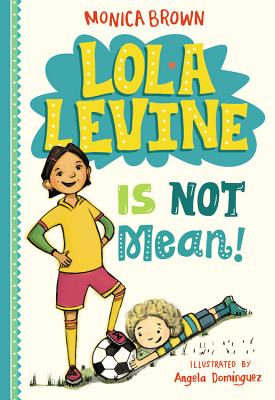
Lola Levine Is Not Mean! CoverBy Monica Brown

Why write a chapter book series?

I love this age of reader and I love this age. It really is an honor and a delight to write an #ownvoice chapter book series because my books might be the very first “novels” a child will be read, and the first read on their own! There are plots, subplots, world creation, and all those things that go into any novel. It’s a challenging genre to write in, but it’s an important one, because chapter books can establish a true love of reading. It is also one that has had a paucity of diverse main characters, and even fewer authors of color. While most librarians will know exactly who Junie B. Jones and Judy Moody are, we just don’t have multicultural chapter books with that reach and readership, and we desperately need them.

I’m very proud of the books my amazing illustrator Angela Dominguez and I created with this series! Picture books, middle-grade, and YA get a lot of literary attention–chapter books much less so. When I Lola Levine Coverdecided to write a chapter books series, my agent told me it would be a challenge to publish because there are fewer houses that publish them and a series is a big investment. Against all odds, Angela and I did it, and our books are among the first, if not the first, Latina-authored and illustrated chapter book series.
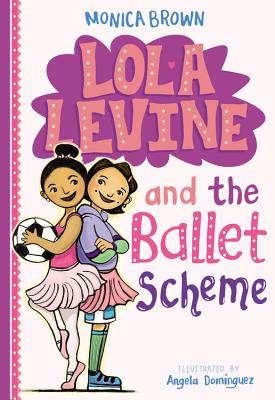
When I was in second grade, I would have loved to meet a rough and tumble girl like Lola Levine. You see, I spent a fair bit of time on the bench at recess! Apparently I talked a lot in class, played tag a little too competitively, and jumped in puddles on purpose. I do remember that my mother was called more than once to bring me dry shoes. In fiction, as in life, rascals and rebels might have more fun, but I learned to channel that mischievousness into creative outlets and team sports, not to mention a great deal of humor. Like Lola, I was also a child of two cultures, and I know first hand that mixed-race children, like myself and my daughters, are sometimes described as “half” this or “half” that, instead of beautifully whole. Lola Levine isn’t a fraction; she is made up of multitudes! As a Lola Levine and the Ballet Scheme Covermother, a teacher, and a writer who meets thousands of children each year, I’ve also observed the way girls (and boys) who don’t quite “fit in” can experience social exclusion, teasing, and even bullying.
These are some of the reasons I created the chapter book series focusing on this irrepressible character of Lola Levine, who is boldly, fiercely, herself. Lola teaches us that girls can be competitive and loud and funny, but sensitive and nurturing, too. This series is also covering new territory. For example, in the upcoming Lola Levine and the Vacation Dream (Book 5), Lola goes to Peru with her family and visits her beloved Tia Lola. She stays in the house her mother grew up in and learns about her own complex history and Peru’s. This may be the first chapter book that addresses themes of indigenous identity and colonization in Peru.

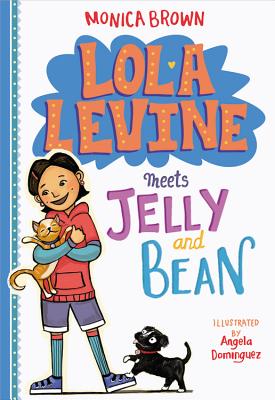
As a writer, I’ve been inspired by director Guillermo del Toro, famous for the film Pan’s Labyrinth, who in relationship to art, imagination, and childhood once noted that there is “a particular moment that we all go through when we are asked to stop believing and stop choosing who we are and become who Lola Levine Meets Jelly and Bean Covereverybody else tells us to be.” He goes on to say, “we should not obey . . . imagination should not comply.” There is such a freedom in being oneself, and that is a gift I bestow on my character Lola.  It was a dream and a pleasure to create a smart, diverse, multicultural character who each day chooses to be herself, and whose imagination certainly does not comply! Viva smart, bold girls, and viva Lola!
Interested in more Chapter Books featuring Latina Characters?  In her recent blog on “Latina Girl Power! Chapter Books with Latina Characters,” librarian Mary Ann Schuer highlights Lola and other chapter books featuring Latina characters.


To the left is Monica Brown as a young soccer player; to the right is her daughter, JuJu, the original “Lola.”

monicasoccer  julessoccers


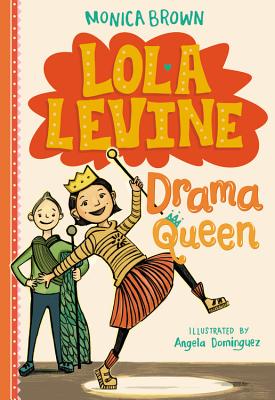
monica6Monica Brown, Ph.D. is the author of many award-winning books for children, including Waiting for the BiblioburroMarisol McDonald Doesn’t Match/ Marisol McDonald no combina The Lola Levine series including: Lola Levine is Not Mean!Lola Levine, Drama Queen; Lola Levine and the Ballet Scheme, and Lola Levine Meets Jelly and Bean. Find Monica on Facebook at Monica Brown, Children’s Author, on twitter @monicabrownbks, or online at www.monicabrown.net.
Things Boys Have Asked Me: A Guest Post by Author Joe Jiménez

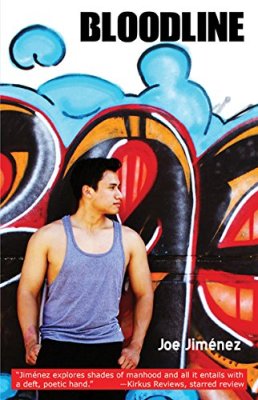
bloodline

by Joe Jiménez

I started my Young Adult novel Bloodline with a question on a single pale yellow Post-it: Does a boy need a father to be a good man?

For much of my life, I grew up without a father, so that question matters to me. When I was in first grade, my father left our family for a life more appealing than the one he had with my mother and with us, and though he came in and out of our lives after that, my mom’s the one who held it down. When I was nineteen, home from college, I ran into my father and his new wife and their son at a Wal-Mart, near the beer aisle, but he didn’t see me, or if he did, he didn’t recognize me, or perhaps he just walked by, all of them pretending I wasn’t there. Maybe I was twenty. Maybe this didn’t hurt.

Asking questions is the way I write.

I start with a question, not so much as a prompt. More as kindling. That’s the comparison I’ll use.

I think of Socrates: Education is the kindling of a flame, not the filling of a vessel.

Questions matter, I tell my students. How we arrive at a question, that matters, too. Over the years, boys in my classes have asked me questions that sometimes blew my mind.

            What’s the worst thing that’s ever happened to you?

            You ever get sad?

            Do you take a pre-workout or just protein?

            Do you think people can change, like go from bad to good?

            Why does my dad hate gay people?

The turmoil we live through manifests in the questions we hold. Sometimes, we tuck them away, deep in the waters of our hearts. No one ever sees them. Sometimes we might even forget they are there. Other times, we let these questions stick to us, like splinters, buried in our hands and feet. There is real pain in people’s lives. There is real triumph, too. A question might disintegrate, might lose its parts, but sometimes, we come to an answer. Other times, we come to more questions.

When I feel stuck with my words or misfire, I come back to these questions. In my notebook, I keep a list of them. I also keep lists of favorite words, odd words, words whose sounds and spellings fascinate me. I keep lists of how writers I love start their sentences. In a folder I keep these Post-Its, scraps of long paper, pages from journals, writing on the backs of receipts—papelitos.

            Do you own a gun?

            In a zombie apocalypse, would you opt out or put up a fight?

            What do you think is more important: street smarts or book smarts?

            What’s the worst way to die?

            Is it scary getting old?

            How did you tell your parents you were gay?

            Why does my dad hate me?

As I was writing Bloodline, I regularly looked at my collection of Post-Its, and I thought of questions—what if? why? how? I questioned: Why does Ophelia have to die? Why else might she climb a tree? What if Hamlet was alive in San Antonio and his father was a cholo? What if we really are destined to be men like our fathers? Is it true that some of us might be genetically predisposed to violent behaviors? How do you become a good man when all the men around you are twisted?

“The answers you get from literature depend on the questions you pose.” Margaret Atwood said this. I put this quote on one of my handwritten posters right near my desk. It’s one of the first things you see when you walk into my classroom. I want my students to know that their questions matter. And the questions keep coming.

            How do I know when I’m in love?

            Can guys be feminists?

            Who gets to decide who are the “good guys”?

            Do you think it’s fair that I work harder than most kids and I can’t get money for college because I don’t have my papers?

            Why does Trump want to deport us?

Questions. Power. Love. Possibilities.

Questioning is an anchor for the learning of consciousness, of the molcajete inside the woke corazón. Rasquache, that’s the Chicanx aesthetic for making beauty and fierceness from what we have available. So much of my life is handmade. I’ve learned to make the best out of what I have available to me. Perhaps that’s a result, a triumph of growing up working class. I’d like to believe it is. If readers and my students leave their time with me with anything, I hope it’s a commitment to questions—and to the belief that each of us has a right to ask them.


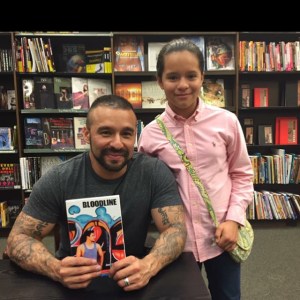
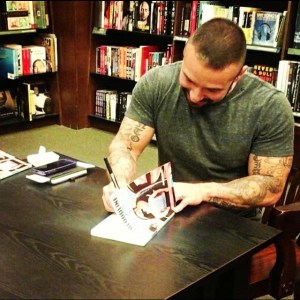
Below, Joe signs books at a Barnes & Noble event. One of his fans is his niece, Sophia Jiménez. 

image2

image1


jimenez-joe-2Joe Jiménez is the author of The Possibilities of Mud (Kórima 2014) and Bloodline, a young adult novel (Arte Público 2016).  Jiménez is the recipient of the 2016 Letras Latinas/ Red Hen Press Poetry Prize and holds an MFA in Creative Writing from Antioch University, Los Angeles.  The short film “El Abuelo,” based on Jiménez’s poem, has been screened in Belgium, the Netherlands, Mexico, France, Argentina, Ireland, England, and the US. He lives in San Antonio, Texas, and is a member of the Macondo Workshops. (Bio taken from Joe’s official website.)  

Educating Children and Young People for Joy and Justice: A Guest Post by Author and Teacher Ann Berlak

img_0265_2

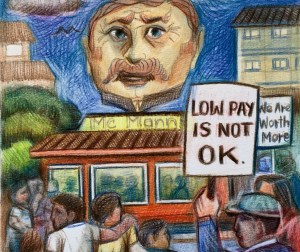
All art in this article is by Daniel Comacho for Joelito’s Big Decision/La gran decisión de Joelito by Ann Berlak.

By Ann Berlak

To prepare children and young people to participate in the construction of a more just and joyful future, we must tell them stories that make the invisible visible and unsettle what is taken for granted.

 “Everything in the mainstream media suggests that popular resistance is ridiculous…unless it is far away, long ago.”

Solnit (2016)

Poverty is increasing worldwide in the face of unimaginable wealth for the very few. Talk of the public good has been almost silenced, public services are rapidly being privatized and the environment degraded, and we have come to take as normal wars without end. Yet, though largely obscured by mainstream media and by schooling at all levels, movements for climate, racial, and economic justice are sweeping the globe.

Given these realities, what stories should we tell young people to prepare them to participate in social transformation?

 Stories that reveal:

  • how the decisions and actions of each of us affect the lives and actions of others, often in hidden ways
  • how differences of power in the hierarchies of race, class, gender, sexual orientation, and disability—differences that may be initially invisible– affect how we and others experience our lives differently (empathy)
  • how to connect the dots between everyday injustices and the social forces that create and sustain them—for example, societal dynamics that create the vast extremes of wealth and poverty
  • how ordinary people acting together can create a more just and joyful world
  • that joining with others to create a more just future is a joyful life option for each of us

img_0268-2Aren’t children too young to think about social and political issues? Should we interfere with children’s innocence by prematurely exposing them to the darker sides of life?
Which children are we talking about here? Certainly not those children who already experience despair, who go to bed hungry, whose parents can’t find jobs. Acknowledging these realities means acknowledging the experiences of children and young people who are often marginalized in school and in children’s fiction.

When adults are silent about the social, political, and economic dynamics of society, children internalize the perspectives that dominate public discourse and begin to believe, for example, that people get rich because they are smarter or work harder. They learn to blame “the victim,” and to normalize war, violence, and astounding inequalities.

This is disastrous for privileged children as well as for members of groups that are on the downside of the prevailing power imbalances. Both groups drift toward the belief that this is how things have always been and how they must continue to be, and these convictions become quite resistant to change. As the tree is bent, the tree grows.

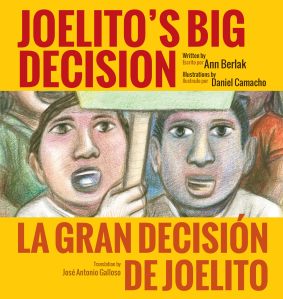
joelito-cover-two-boysJoelito’s Big Decision/ La gran decisión de Joelito
For thirty years, I taught prospective elementary school teachers. My primary intention was to challenge them to think about what kind of future they wanted to construct through what they taught. What should schooling in their classrooms be for, beyond preparing children to be “college and career ready”?

After I retired, I went back into classrooms as a guest social-justice teacher. This experience reconfirmed my belief that if given any encouragement at all, children and young people will eagerly engage in dialogue about the social, political, and economic issues that surround and shape them.

I also realized that when adults don’t address these issues, children construct their own explanations for what they see around them, and that they weave these from the dominant ideologies of the society. For example, the children I taught had a variety of explanations for how and why some people get rich: They “won the lottery,” “worked hard at school,” “were really smart.” Of course, many also believed the inverse—that people who are poor do not work hard, or are not smart—even when these beliefs conflicted with their own first-hand experiences.

Eventually, I decided to write a storybook for children that would help teachers and parents spark lively conversations like the ones I had as a social-justice teacher, and elicit looks of surprise that conveyed “ah-ha” experiences that are our rewards as teachers. The result is the bilingual, beautifully illustrated and timely Joelito’s Big Decision/ La gran decisión de Joelito. It’s about a boy, a burger, a friendship, and the fight to raise the minimum wage. The book’s illustrator is Daniel Camacho. José Antonio Galloso provided the translation.

img_0267Our book tells the tale of Joelito, who eats dinner at MacMann’s Burger Restaurant with his family every Friday. The story begins one Friday when he finds his best friend Brandon and Brandon’s parents at the restaurant entrance, holding up signs saying, “Low Pay is Not OK,” and “Fight for 15,” and urging the hungry Joelito not to eat at MacMann’s tonight.
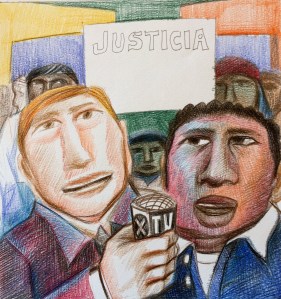
Our book explains the sources of income inequality in a way that young children can understand—Brandon’s dad tells Joelito, “I would have to work for 500 years to earn what Mr. MacMann earns in one year” —and shows that people working together are making history today.

Why don’t parents and teachers talk more about economic inequality with children and young people?

The school curriculum is increasingly controlled by the 1%. This control militates against schools teaching children and young people to question the huge discrepancies of wealth and power. Because the structure of our economy offers most people an uncertain economic future, many parents are preoccupied with their children becoming “college and career ready.” Readiness is often reduced to achieving high scores on standardized tests, while preparing children for active citizenship and critical thinking increasingly falls by the wayside.

img_0264_2Hope

We hope that literary gatekeepers—parents, teachers, caregivers, and librarians will include among the stories that they share with children depictions of ordinary people working together toward a better future. The bookshelves in our classrooms, libraries, and homes are crowded with the tales of solitary heroes and heroines fighting battles in worlds of fantasy, mystery, and historical fiction. Stories of contemporary people in the trenches for social change belong on those bookshelves, too.


IMG_0297Author Ann Berlak has been a teacher and teacher educator for over fifty years. She envisions schools as places where children learn to become active, caring participants in the creation of a world that works for everyone. Joelito’s Big Decision/La gran decisión de Joelito was selected for the 2016-2017  California Reads list of teacher recommended books. Keep up with current news about Joelito on Facebook.
Illustrator Daniel Camacho lives and works in Oakland, California. His at-home studio is filled with ongoing projects, and is usually open to visitors upon request. He teaches art to elementary and middle school students and works to promote an awareness of Mexican/Latino culture through his participation with the Oakland Museum of California, the Spanish Speaking Unity Council, local public libraries and other community based organizations. Learn more about Daniel from his official website.

Translator José Antonio Galloso was born in Lima, Peru. He is a writer, photographer, and a bilingual teacher with studies in audiovisual communication, Spanish, and writing. He has published poetry and fiction and his works have been included in several anthologies. His photographic work, which he considers an extension of his writing, has been exhibited and published in different galleries, printed media and online. He has been living in the Bay Area since 2002.

Spotlight on Pura Belpré Winners: Illustrator Stephanie Garcia for Snapshots from the Wedding


PuraBelpreAward
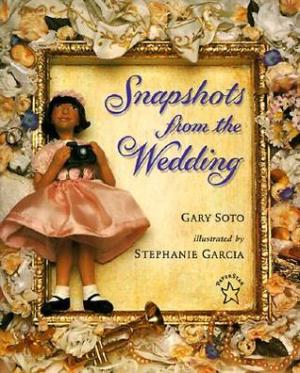
This year marks the 20th anniversary of the Pura Belpé Awards. Starting in the spring, we began shining a spotlight on the winners. This post features the beautiful and imaginative illustration work of Stephanie Garcia for Snapshots from the Wedding, a delightful picture book written by Gary Soto, and the winner of the 1998 Pura Belpré Illustration Award.


Review by Lila Quintero Weaver

snapshots-cover-2DESCRIPTION FROM THE BOOK JACKET: Meet Maya, Isabel’s flower girl, as she describes in vivid detail the exciting wedding day. Maya introduces us to Danny, the ring bearer; Aunt Marta, crying big tears; Uncle Trino, jump-starting a car in his tuxedo; and Rafael, the groom, with a cast on his arm. Of course, the big day also includes games, dancing, cake, and a mariachi band that plays long into an evening no one will ever forget.

Snapshots from the Wedding captures the unique moments of a special occasion—the big scenes as well as the little ones—that together form a rich family mosaic.

MY TWO CENTS: Snapshots from the Wedding is a lightly humorous story told through the eyes of a young girl named Maya. Gary Soto delivers this joyous narrative of a traditional Mexican boda in lyrical and rhythmic language.

By casting Maya in the role of narrator, Soto allows the reader the same view of the festivities as a member of the wedding party. From her position, Maya observes and comments on the assembled guests, the bridal procession, the photographer at work, and the moment when the couple exchanges vows at the altar. Afterward, at the reception, Maya revels in the mariachi band, the pinning of paper money to the bride’s skirt, and the couple’s departure beneath a shower of rice. As her gaze travels across each scene, she stops to focus on details ranging from the ring bearer’s slicked-back hair, to a boy whose tongue wiggles through the space left by newly lost baby teeth, and to the eye-popping spectacle of a towering wedding cake.

In Soto’s words, “Here’s the wedding cake, seventh wonder of the world, from Blanco’s Bakery, with more frosting than a mountain of snow, with more roses than mi abuela’s back yard, with more swirls than a hundred turns on a merry-go-round.”

Stephanie Garcia, the Pura Belpré-winning illustrator, depicts Maya’s wide-eyed experience of the wedding as something remembered through a series of winsome snapshots. Yet, in one of the most surprising and original aspects of this book, Garcia brings the scenes into sharp relief through exquisitely constructed dioramas that defy all expectations for a story conceived around the idea of photographs.

Each of the three-dimensional illustrations is a miniature stage that sits within a shallow wooden box. The overall effect is that of a dollhouse whose rooms brim with texture and engaging detail, and which cry out to be touched and played with, in order to fully appreciate the tactile gifts they offer. Using a wide range of materials that includes fabric, clay, paint, and found objects, Garcia populates her scenes with individually rendered characters, furnishings, and backdrops. Fashioned from Sculpy clay, each human figure bears distinct facial features and expressions. The skin tones come in varied shades of brown, and each is dressed in clothing suitable for that person’s role in the wedding.

By leaving the diorama’s rough wooden edges in full view and by dressing some of the wedding guests in homespun fabrics, the book hints at the deeper, economic realities of life in a working-class Mexican community. Yet, the momentous social importance of weddings often leads families to go all out for the occasion, evidenced here by the elaborate costumes of the mariachi band and the satin-and-lace gowns of the bridal party.

In nearly every spread, Garcia employs a clever frame-within-a-frame concept that plays with the passage of time. In these instances, select characters appear inside a gilt-edged frame, like mannequins propped in a store window, even as the activity of the moment continues to swirl around them. This approach suggests a future glimpse of the photos being taken. Appropriately, the photographer himself appears in one of the dioramas, snapping his shutter just as the bride and groom are about to kiss.

Garcia’s attention to individual characters complements Soto’s depictions. In one of my favorite vignettes, little Maya and another young lady try their best to snare the bouquet as the bride tosses it. But the bouquet is “caught by the tallest woman there, my cousin Virginia, a college basketball player, with a three-foot vertical leap.” Garcia gives Virginia a mint-green bridesmaid’s dress, with low-heel pumps dyed to match, and a long reach that ensures her effortless catch. We can easily imagine Virginia in a basketball uniform, putting her vertical leap to good use in a different context.

With such singular moments, Soto and Garcia illuminate a range of experiences not often captured in portrayals of Mexican culture. Through its engaging text and rich dioramas, this picture book offers charming views of an important social occasion as seen through the delighted eyes of a little girl who feels at home within this community. And this wedding is an occasion she’ll remember for years to come through its album of snapshots.

Note: We were not able to secure permission from the publisher to share images from the book’s interior pages. Please locate a copy and see them for yourself! 

Portrait of Stephanie GarciaABOUT THE ILLUSTRATOR: Stephanie Garcia is an illustrator, graphic designer, art director, and design consultant, with a wealth of experience in the corporate world and the classroom, where she shares her knowledge with others. Learn more about her in this publisher profile.


Image result for GARY SOTOABOUT THE AUTHOR: Gary Soto is the author of multiple picture books, including the Chato series, which won the Pura Belpré illustrator award for Susan Guevara. He also published many novels for youth, as well as books of short stories for young readers, and collections of essays and poems. His awards include the prestigious Guggenheim Fellowship, the Andrew Carnegie Medal, and the National Book Award. Learn more at his official website. See some of our coverage of Soto’s work in this review and in a post about his decision to stop publishing children’s literature.


Lila Quintero Weaver is the author-illustrator of Darkroom: A Memoir in Black & White. She was born in Buenos Aires, Argentina. Darkroom recounts her family’s immigrant experience in small-town Alabama during the tumultuous 1960s. It is her first major publication. Her next book is a middle-grade novel scheduled for release in 2018 (Candlewick). Lila is a graduate of the University of Alabama. She and her husband, Paul, are the parents of three grown children. She can also be found on her own websiteFacebookTwitter and Goodreads.

The Powerful Role of Coach in the Latinx Community: A Guest Post by Author Claudia Meléndez Salinas


By Claudia Meléndez Salinas

It’s Monday evening and more than 200 youngsters pour into the gym of Alisal High, a school located in the heart of one of the poorest neighborhoods in California’s central coast. The children, most dressed in the gold and black colors of the Gil Basketball Academy, are not high school students: they’re as young as four years old, some of them hardly big enough to pick up the basketballs.

After the initial chaos, the children settle into a series of warm up exercises you can tell they know by heart: run forward, stop midway and run backward; run twisting your body; leap sideways and stop to touch the ground, repeat.

From the edge of the gym, Coach Jose Gil watches the action and directs the children into their next moves. It’s a task that he can’t do alone – especially when he has to stop to provide direct instruction to kids who can’t seem to get a handle on the ball. So he relies on the assistance of other coaches, men and women who, like him, mostly offer their services on a volunteer basis.

“The word ‘Coach’ is powerful beyond belief,” Gil says. “Some think it’s easy and want to sometimes judge or criticize us for in-game situations, but at the end of the day, if coaching kids was that easy, everyone would be doing it. Endless hours, sleepless nights, responsibility beyond belief, challenges dealing with a variety of talents and skill levels etc… It boils down to the process at hand, are you willing to sacrifice your alone time to help others?”

“Coaches” or “mentors” have been crucial for the development of mankind since time immemorial. Older or wiser men and women took young wards under their wings to teach them hunting and gathering edible plants, or to pass down traditions important for survival. The concept was crystallized in ancient Greece, when Mentor, a friend of King Odysseus, stayed behind to take care of the king’s son, Telemachus. The boy and Mentor developed a trusted friendship, one whose importance can be observed in centuries of literature and movies. Think Arthur and Merlin. Leonardo Da Vinci and Raphael Sanzio. Or Daniel and Mr. Miyagi.

In places like the Alisal, where the population is 90 percent Latinx and 33 percent of the residents live in poverty, coaches and mentors are not a matter of legend, they’re a matter of survival. Parents who must work long hours in minimum wage jobs to put food on the table have to rely on the kindness of strangers to look after their broods. In the absence of trusted adults who can guide youngsters through the difficult passage through adolescence, some fall prey to the gangs.

Latinxs are a young population. While more than 30 percent of Latinxs are under 18 years old, the same is true for 20 percent of whites. Nearly half of U.S. born Latinxs are younger than 18.

At the same time, more than 23 percent of Latinxs live in poverty – second only to African Americans. Thirty-seven percent of all the children in the United States who live in poverty are Latinxs.

For four of the last five years, Monterey County has led California in youth homicide rate. In 2013, 22 young people were slain in the county, also the fourth largest agricultural area in the Golden State. While parents are picking lettuce, their children are picking fights.

This is why people like Jose Gil are vital – and luckily, there are a few. You can see them most afternoons in the soccer field, or in classrooms teaching painting, or dance, or music. They’re not just coaches: they’re role models, mentors,  friends. They’re the glue of after-school programs, the difference between wholesome entertainment and life in the streets.

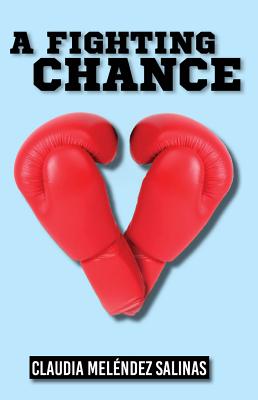
A Fighting Chance CoverOne of the reasons why I wrote A Fighting Chance was to pay homage to these unsung heroes. Under the stern gaze of Coach, Miguel Ángel, the 17-year-old main character, trains to be a champion boxer. Not only is the sport keeping him away from gangs, but it’s also his ticket out of poverty. Coach’s importance to Miguel Ángel, like that of dozens of Coaches and mentors in the Alisal, cannot be overstated.

“We have a huge responsibility to make the place we live in a better one,” Jose Gil muses. In his view, prospective coaches have to ask themselves: “Can you work and mold these young kids to make right choices and decisions in life? Are you a great enough example for others to follow? What is your passion or belief about life and the community you live in? Are you willing to invest time into changing the community one child at a time? Do you even think our community can be improved?

“I love it when people are willing to volunteer to coach in our academy because that just challenges me to coach and mentor them so that they can in return help our youth. We grow our own from within which makes me proud and keeps me hungry.”

And that’s how Coach Gil not only keeps hundreds of kids off the street, but inspires a new crop of coaches to do the same.


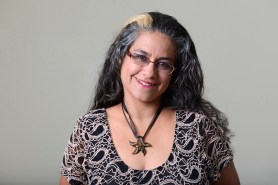
Writer Claudia Melendez in Monterey on Monday January 5, 2015. Photo www.davidroyal.net

Writer Claudia Melendez in Monterey on Monday January 5, 2015. Photo http://www.davidroyal.net

Claudia Meléndez Salinas is an award-winning multi-media journalist now working for the Monterey County Herald, a daily newspaper in California’s Central Coast. She has nearly two decades of experience covering politics, education, and immigration both in Mexico and the United States. She holds a master’s in specialized journalism from the University of Southern California, and a bachelor’s in Latin American and Latino Studies from the University of California, Santa Cruz. Her journalistic work has been published in Mexico’s El Financiero and La Jornada; in Latina and El Andar magazines in the United States, and numerous newspapers.

A Fighting Chance, Meléndez’s first book, is a young adult novel that narrates the struggles of a Mexican-American boy trying to stay away from gangs as he trains to become a champion boxer. She’s been named as one the Latino authors to watch in 2016 from LatinoStories.com.

The Chupacabra Ate the Candelabra: A Cover Reveal!


We are excited to participate in the cover reveal of  The Chupacabra Ate the Candelabra, an upcoming picture book written by Marc Tyler Nobleman and illustrated by Ana Aranda!

With a title like that, you can tell how much fun kid readers are in for, as this early review makes clear: “A nervous herd of goats tries to convince the legendary chupacabra, a monster that allegedly eats goats, that there are other culinary surprises he may enjoy.”                                –Publishers Weekly.

Here is the book description from Nancy Paulsen Books, an imprint of Penguin Young Readers Group:

With its hilarious dialogue, trio of bumbling goats, and fantastically zany villain, this unique, laugh-out-loud story based on a legendary monster is sure to crack up kids and grown-ups alike.  Like most goats, Jayna, Bumsie, and Pep’s greatest fear is being eaten for dinner by the legendary chupacabra—it’s common knowledge that goats are a chupacabra’s favorite food! One night, tired of living in fear, the impetuous goats whip out their trusty candelabra and head off to find the beast and scare it away before it can find them. Little do they know that candelabras are the chupacabra’s third-favorite food . . . and he isn’t about to stop there. This chupacabra has quite the appetite, and the goats are in for a big surprise!


Intrigued? So are we. The release date is March 7, 2017. While we patiently wait to see the book in person, let’s feast our eyes on the fabulous cover created by Ana Aranda, a bright new star in the field of children’s illustration, and one we’re proud to claim as a Latinx creator!  You met Aranda in an illustrator round-up we featured earlier this year.

Ana ArandaAna writes: “This cover design was created in watercolor, inks and gouache. I’m so happy to share with everyone the face of an unknown, mysterious and mischievous creature: the chupacabra!”
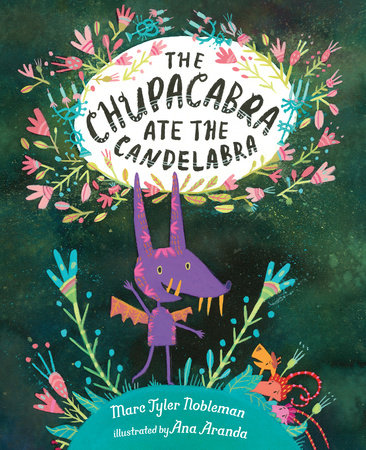
We look forward to reading the full story and enjoying all of Ana’s adorable illustrations!


Here we go….

Scroll…

Scroll…

Scroll…

Ta da!!


cover-the-chupacabra-ate-the-candelabra