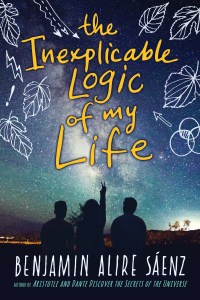
Book Review: The Inexplicable Logic of My Life by Benjamin Alire Sáenz

This review is by Lila Quintero Weaver and is based on an advanced reading copy.

From the publisher:

The first day of senior year: Everything is about to change. Until this moment, Sal has always been certain of his place with his adoptive gay father and loving Mexican-American family. But now his own history unexpectedly haunts him, and life-altering events force him and his best friend, Samantha, to confront issues of faith, loss, and grief. Sal discovers that he no longer knows who he really is—but if Sal’s not who he thought he was, who is he?

My two cents:

The 2012 multiple prize-winning YA novel Aristotle and Dante Discover the Secrets of the Universe, by Benjamin Alire Sáenz, delivered a spellbinding story of remarkable teen characters on the brink of self-discovery. Among its achievements, the novel provided positive and authentic representations of gay teens and Latinx families. Sáenz follows that feat with The Inexplicable Logic of My Life, which subtly echoes themes in Aristotle and Dante and reaffirms the author’s virtuosity.

Seventeen-year-old Sal (Salvatore) lives in El Paso, Texas, with his adoptive father, a gay Mexican-American art professor named Vicente Silva. Vicente assumed responsibility for Sal after his mother died, when Sal was just three years old. (The connections between Sal’s mother and Vicente don’t become clear until late in the book, when Sal finally opens a letter his dying mother wrote and left in Vicente’s care.) Although Sal is white, the adoption secures his place in the heart of a loving Mexican-American family, which is headed by the matriarch Sal comes to know as Mima. As his adoptive grandmother, Mima refers to Sal as her “hijito de mi vida,” and the adoration is mutual.

The warmth of the Silva family magnetically pulls in two other teen characters. Sal’s best friend, Sam (Samantha), is locked in raging conflict with her mom. Another friend, Fito, suffers the effects of a drug-addicted mother and an absentee dad. In order to survive, Fito must hold down two after-school jobs.

Compared to the home lives of his friends, Sal’s family is golden. But for all the advantages he enjoys, Sal is a complex character, who on the surface, feels secure in his identity as a peaceful, self-confessed straight edger. He eschews cigarettes and alcohol (well, mostly), and is still a virgin. But he harbors a reactionary side. When a classmate utters a homophobic slur against Vicente, Sal resorts to violence that lands him in Principal Cisneros’s office. This impulse to lash out physically catches Sal by surprise, and it won’t be the last time.

Other big questions disrupt Sal’s world. His beloved Mima is diagnosed with late-stage bone cancer. Vicente’s one-time boyfriend, Marcos, reappears on the scene, bringing heartache and mistrust to the Silva house. There’s still that matter of the unopened letter from Sal’s mother, and then, major crises hit Sam’s and Fito’s families, radiating tremors in all directions. How fortunate for everyone that Vicente possesses finely tuned paternal instincts and the willingness to open the family circle even wider. Even so, don’t mistake this for a sentimental story. The struggles these young characters wrestle with are real and not easily resolved.

Although compelling plot developments push the story along, this novel also distinguishes itself through skillful characterization and crisp, realistic dialogue. The dialogue especially stands out during volleys between the teen characters. Sal and Sam, who’ve known each other since early childhood, share a platonic friendship that’s built on love and mutual respect, but that doesn’t keep them from ribbing one another mercilessly and butting into each other’s business. As Fito becomes a larger part of their lives, his comi-tragic flavor gets added to the mix. The verbal conversations and text messages these three engage in are, by turns, hilarious, poignant, revealing, laced with profanity, and true to the way teens speak in 2017. These exchanges reveal the intricate give-and-take of teen friendships, where mutual support is often coded as deprecatory banter.

The novel also takes on complex racial and ethnic dynamics, but it’s done with a subtle touch. In writing Sal as a white child adopted by a Mexican family, Sáenz makes a daring choice that reverses typical scripts of interracial or interethnic adoption. Much of Sal’s identity stems from Vicente, the man he considers his true father. In the Silva family, Mexican heritage is freely offered as a gift—one Sal knows he’s lucky to receive and absorb into his cultural makeup. But acceptance at home doesn’t extend to every corner of Sal’s world, and elements of race appear mostly around his role as a rare white kid in a setting dominated by Mexican and Latinx culture. At one point, a classmate drops the slur “pinche gringo” on him, leading to one of several bursts of violence on Sal’s part. On the flip side, Mexican American Sam teasingly refers to Sal as “white boy,” all the while fully aware that by virtue of his upbringing, Sal is more deeply ensconced in Mexican tradition than she is. Sal appreciates the irony and won’t let Sam get away with drawing false distinctions. This is a tricky point, but Sáenz successfully plays it with humor.

The question that persists almost to the end of the book is why Sal puts off reading his mother’s letter. He doesn’t understand his own reluctance, and this is part of the “inexplicable logic” referred to in the title. Could it be that Sal fears losing the rock-solid foundation offered by the family that raised him? Many writers would’ve dangled such a compelling object as catnip before their readers. But Sáenz uses uncommon restraint, allowing mentions of the sealed letter to bubble up in conversation or in Sal’s interior monologue sparingly, as if he’s holding that question just inside our peripheral vision while the characters occupy themselves with more urgent concerns.

In the writing itself, the author demonstrates other forms of restraint that recall his poetic side. He clips sentences and keeps chapters unusually short, suggesting the poetic habit of brevity. While his prose enthralls the ear, Sáenz’s mastery goes beyond the level of the sentence. He’s an accomplished storyteller who works magic with dialogue, gives characters muscle and breath, and creates intrigue through the subtle layering of reveals and building questions. Another satisfying aspect of The Inexplicable Logic of My Life is the treatment of intergenerational relationships. We’re reminded that healthy family connections help us thrive, while their absence leaves us yearning. Above all, Sáenz crafts a narrative around things that deeply matter to teen readers: identity, belonging, and finding one’s place in the world—and he charges his characters with the drive to pursue these prizes.
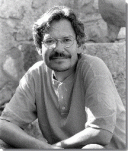
Benjamin Alire Sáenz is a scholar, a teacher of creative writing, and a prize-winning poet and novelist. Along with other distinctions, his 2012 novel Aristotle and Dante Discover the Secrets of the Universe won the Pura Belpré Award, the Stonewall Award, and the Lambda Literary Award. Our review is here. In 2013, National Public Radio featured Sáenz in a fascinating interview. Long based in El Paso, Texas, Sáenz retired from teaching in 2016. Keep up with him via Twitter.
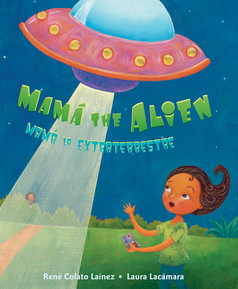
Book Review: Mamá The Alien/ Mamá La Extraterrestre Written by Rene Colato Laínez, Illustrated by Laura Lacámara


Reviewed by Sanjuana C. Rodriguez

Main_mama_the_alien_fc_hi_res_finalDESCRIPTION FROM THE BOOK JACKET: Sofía has discovered a BIG secret. Mamá is an alien–una extraterrestre! At least, that’s what it says on the card that fell out of her purse. But Papá doesn’t have an alien card. Does that mean that Sofía is half alien?

Sofía heads to the library to do some research. She finds out that aliens can be small, or tall. Some have four fingers on each hand, and some have big round eyes. Their skin can be gray or blue or green. But she and Mamá look like human people. Could Mamá really be an alien from another planet?

Filled with imagination and humor, Mamá the Alien/ Mamá la extraterrestre is a sweet and timely immigration story, and a tender celebration of family, no matter which country (or planet) you are from.

MY TWO CENTS: In this bilingual book, Sofía is bouncing a ball when she knocks her mother’s purse to the floor. In the purse, Sofia discovers a card with the word “ALIEN” at the top. Sofía begins to think that her mother is, indeed, an alien. She even thinks she must be half alien, “I started to put the puzzle together. Mamá was an alien. Papá didn’t have a card, so he was not an alien. That mean I was half alien.”

Sofia researches aliens and wonders how her mother has hidden the fact that she is an alien from her. As Mamá gets ready for her citizenship ceremony, Sofía sees a shadow of her mom with rollers in her hair and tells her parents her suspicion about Mamá being an alien. Sofía learns that the word alien can have different meanings.

Her mother explains, “Sofía, I’m not from outer space. What you saw was my old Resident Alien card. That card allowed me to live and work here in the United States.” The story comes to an end when Sofía’s mom becomes a citizen. This book provides a glimpse into one way a girl makes sense of a complicated immigration process. Few books allow the reader to understand the complexity of the immigration system in the United States through the eyes of a child. This book is an entrance into discussion of the complex process that families must go through to become American citizens.

The illustrations are large and beautiful. In particular, the illustrator, Laura Lacámara, provides vivid pictures of the imagined aliens with humans. It is through the illustrations that we learn that Sofía’s mother is from El Salvador. A picture shows Mamá standing on an outline of El Salvador on a map. The illustrations provided in the thought bubbles add to the story and help the reader understand what Sofía is thinking about.

The author’s note at the end of the book details his own story of coming to the United States and receiving his Resident Alien Card. The author ends the note with the following, “I want readers to know that immigrants may be referred to as aliens, but this only means that they come from other countries. We are all citizens on planet Earth.”

TEACHING TIPS: Author René Colato Laínez wrote a blog post for Lee and Low books titled “No More Illegal Aliens.” In this post, Laínez discusses the use of the term “illegal aliens” and why he advocates for the use of the term “undocumented immigrants. This blog entry could be used as a paired text with the book Mamá the Alien/ Mamá La Exraterrestre.

Also, Lee and Low has developed an extensive teacher’s guide for Mamá The Alien/ Mamá La Extraterrestre. This guide includes vocabulary, discussion questions, specific activities for English Language Learners, and interdisciplinary activities.

PictureABOUT THE AUTHOR: René Colato Laínez is an award-winning Salvadoran author of many multicultural books. He is a graduate of the Vermont College MFA program in Writing for Children & Young Adults. Rene is a bilingual elementary teacher at Fernangeles Elementary School, where he is known by the students as “the teacher full of stories.”


Here are other posts we’ve done about the author:

A Conversation with René Colato Laínez

Book Review: The Tooth Fairy Meets El Ratón Pérez


Laura_photo_2015-300 dpiABOUT THE ILLUSTRATOR
Laura Lacámara is a Cuban-born children’s books author and illustrator. Lacámara holds a Bachelor of Fine Arts in Drawing and Painting from California State University, Long Beach and studied printmaking at Self Help Graphics in East Los Angeles. Her love for writing and illustrating children’s books grew when she signed up for a children’s book illustration class at Otis College of Art and Design in Los Angeles, California. She is the author of Floating on Mama’s Song/Flotando en la Canción de Mamá (Junior Library Guild Selection, Fall 2010 & Tejas Star Book Award finalist 2011-12) and illustrator of The Runaway Piggy/El Cochinito Fugitivo (winner of 2012 Tejas Star Book Award) and Alicia’s Fruity Drinks/Las Aguas Frescas de Alicia.

Here are other posts we’ve done about the illustrator:

Book Review: Dalia’s Wondrous Hair/El Cabello Maravilloso de Dalia

Growing Up Cuban: Laura Lacámara and Meg Medina

Spotlight on Latina Illustrators Part 2: Juana Martinez-Neal, Maya Christina González & Laura Lacámara


ABOUT THE REVIEWER: Sanjuana C. Rodriguez is an Assistant Professor of Literacy and Reading Education in the Elementary and Early Childhood Department at Kennesaw State University. Her research interests include the early literacy development of culturally and linguistically diverse students, early writing development, literacy development of students who are emergent bilinguals, and Latinx children’s literature. She has published in journals such as Journal of Language and Literacy Education, Language Arts, and Language Arts Journal of Michigan.

March 2017 Latinx Book Deals


Compiled by Cecilia Cackley

This is a monthly series keeping track of the book deals announced by Latinx writers and illustrators. The purpose of this series is to celebrate book deals by authors and illustrators in our community and to advocate for more of them. If you are an agent and you have a Latinx client who just announced a deal, you can let me know on Twitter, @citymousedc. If you are a Latinx author or illustrator writing for children or young adults, and you just got a book deal, send me a message and we will celebrate with you! Here’s to many more wonderful books in the years to come.

March was a great month for picture book deals, but there were almost no deals for middle grade and YA books. My fellow blogger Cindy L. Rodriguez recently highlighted 10 Latinx middle grade books in 2017, but unless publishing steps it up, 2018 is going to be sadly lacking by comparison. I am hoping for a better report in April!

March 30

None.

March 28

Ken Geist at Scholastic has acquired world rights to We’ve Got the Whole World in Our Hands, a picture book celebration of what connects us all, illustrated by Rafael Lopez with the text adapted from the original lyrics by Reverend F.W. McGee. Publication is planned for fall 2018. Illustrator agent: Adriana Domínguez and Stefanie Von Borstal from Full Circle Literary.

March 23

Nancy Paulsen at Penguin’s Nancy Paulsen Books has acquired world rights to Señorita Mariposa, a debut picture book celebrating butterfly migration as witnessed by American and Mexican children, written by Latin Grammy Award-winning children’s musician Mister G (Ben Gundersheimer) (l.), to be illustrated by Mexican artist Marcos Almada Rivero. Publication is slated for 2018. Author agent: Zoe Sandler at ICM.

Marissa Moss at Creston Books has bought world rights to Nancy Churnin‘s Irving Berlin: The Immigrant Boy Who Made America Sing, to be illustrated by James Rey Sanchez. The nonfiction picture book tells the story of the boy who grew up to become the prolific songwriter who wrote “God Bless America” and gave every penny the song earned to the children of the land that he loved. Publication is planned for spring 2018, to coincide with the 100th anniversary of the year Berlin wrote the song.

March 21

Amy Novesky at Cameron Kids has bought world rights to Los Angeles, written by Elisa Parhad and illustrated by Alexander Vidal, a board book featuring the sights and delights of Los Angeles in simple rhyme. Publication is set for spring 2018.

March 16

None.

March 14

None.

March 9

Nancy Paulsen at Penguin/Nancy Paulsen Books has acquired world rights to Moth & Butterfly by Dev Petty (l.), about two caterpillar friends who emerge post-metamorphosis with different results. Ana Aranda is set to illustrate; publication is set for spring 2019. Illustrator agent: Adriana Domínguez at Full Circle Literary.

March 7

Stacey Barney at Putnam has acquired at auction Alex Villasante‘s The Grief Keeper, about sisters Marisol and Gabriella Morales who make it across the Mexican border only to learn their request for asylum is being denied, unless Marisol participates in a human study for a cutting-edge PTSD treatment. It’s scheduled for spring 2019. Author agent: Barbara Poelle at Irene Goodman Agency.

Carter Hasegawa at Candlewick has bought world rights to Tami Charles‘s (l.) debut picture book, Freedom Soup, celebrating the history behind the Haitian tradition of ringing in the New Year by eating soup joumou. Jacqueline Alcántara, the inaugural winner of the We Need Diverse Books Illustration Mentorship Award, will illustrate. Publication is planned for fall 2019. Illustrator agent: Adriana Domínguez at Full Circle Literary.

March 2

None.

Book Review: Here We Are: Feminism for the Real World Edited by Kelly Jensen


Reviewed by Cecilia Cackley

25226116DESCRIPTION OF THE BOOK: Let’s get the feminist party started!

Here We Are is a scrapbook-style teen guide to understanding what it really means to be a feminist. It’s packed with essays, lists, poems, comics, and illustrations from a diverse range of voices, including TV, film, and pop-culture celebrities and public figures such as ballet dancer Michaela DePrince and her sister Mia, politician Wendy Davis, as well as popular YA authors like Nova Ren Suma, Malinda Lo, Brandy Colbert, Courtney Summers, and many more. Altogether, the book features more than forty-four pieces, with an eight-page insert of full-color illustrations.

Here We Are is a response to lively discussions about the true meaning of feminism on social media and across popular culture and is an invitation to one of the most important, life-changing, and exciting parties around.

MY TWO CENTS: This is an excellent, comprehensive look at feminism from many different perspectives. For the purposes of this book talk, I will be focusing on three essays in particular, but the whole book is a great balance of voices. By turns funny, serious, personal, or historical, it includes comics, lists, poetry, song lyrics, and interviews. This collection is the perfect book to hand to a teen who strongly identifies as a feminist, as well as the teen who is trying to figure out what it’s all about. In short, there is something for everyone here.

Three essays in particular are of interest to us here at Latinxs in Kid Lit (full disclosure, one is by my fellow blogger Ashley Hope Pérez) and they couldn’t be more different. “Pretty Enough” by Alida Nugent, is a personal story about growing up feeling out of place because of her Puerto Rican features and the change in her self-image after a trip to Puerto Rico. ‘The “Nice Girl” Feminist” by Ashley Hope Pérez is an amusing but incisive list of unspoken commandments for being a “nice girl” that really should be broken. And “Many Stories, Many Roads” by Daniel José Older is a stirring call to action and a testament to the truth that there are many different journeys to being a feminist.

Nugent’s description of her hometown in Westchester is amusing. “Antique shops, cider festivals and designer purses” are some points she includes on the list, along with high school friends who questioned her background (“Where are you from again?”) and pointed out her physical differences. It was a trip to Puerto Rico and her mother’s hometown that helped Nugent figure out that it wasn’t that she didn’t like her looks, but that she was tired of being the one person who stuck out. For teens growing up in similar situations where they feel out of place, Nugent holds out the promise that we can find somewhere to belong and be ourselves–whatever that looks like.

I laughed when I saw the title of Pérez’s piece. “Nice girl” is not a label I would have applied to myself as a teen. And yet, although I grew up in a much more liberal environment than Pérez, I was also one of those girls who didn’t understand the big deal about orgasms (like Pérez, I eventually figured it out). Not all teens are comfortable speaking loudly and challenging authority. One of the best things about Pérez’s piece is that she demonstrates how big injustices have their roots in small, everyday attitudes toward women and girls—attitudes that teens can absolutely challenge in small ways. In the end, Pérez writes, realizing you don’t have to conform to someone else’s expectations is a feminist act all by itself.

Older sets his essay in Barcelona and builds a strong setting, taking the reader along as he wanders through the city to the harbor. As he walks, he meditates both on the past he is processing (history, personal relationships, career experiences) and the future he is trying to figure out. Older makes clear that he considers art (specifically storytelling) to be essential to his activism and that being a feminist is a process, one that requires constant learning, unlearning and relearning. His prose is both reassuring and energizing at the same time, so that by the end of the essay, I felt ready to move forward, try again, and do better. You can’t ask for more from a book for young people.

TEACHING TIPS: Many of the selections here would be great to assign and discuss in a high school class on history, sociology, or psychology. My 16-year-old brother is currently in the middle of a gender inequality unit in his AP English class, and he is using this book to fulfill an independent reading assignment. Nova Ren Suma’s piece about gender inequality in school reading lists is a great choice to start a discussion about curriculum, canon, and the choices made by teachers and professors.

The short length of the selections and incorporation of lists, photos, and questionnaires make this a great book to recommend to teens who are interested in the subject, but not ready to tackle something lengthy by bell hooks or Simone de Beauvoir. Many of the contributors, such as Kody Keplinger, Brandy Colbert, Malinda Lo, Nova Ren Suma and Erika Wurth have other published work that readers can seek out and read as well. The piece by Wendy Davis would be an excellent choice for a government or civics class when talking about women in politics and schools reading Michaela DePrince’s autobiography can use her essay to further their knowledge about her life and art.

ABOUT THE EDITORKelly Jensen is a former teen librarian who worked in several public libraries before pursuing a full-time career in writing and editing. Her current position is with Book Riot, the largest independent book website in North America, where she focuses on talking about young adult literature in all of its manifestations. Her writing has been featured on The Huffington Post, at Rookie Magazine, The Horn Book, BlogHer, School Library Journal. She contributed an essay and a guide to teen sexuality in pop culture for Amber J. Keyser’s The V-Word: True Stories of First-Time Sex and is the author of the book It Happens: A Guide to Contemporary Realistic Fiction for the YA Reader from VOYA Press.

OTHER LINKS:

Interview with Daniel José Older:

http://www.teenlibrariantoolbox.com/2017/01/feminism-is-for-everyone-here-we-are-editor-kelly-jensen-interviews-contributor-daniel-jose-older/

Interview with Alida Nugent:

http://www.teenlibrariantoolbox.com/2017/01/here-we-are-feminism-for-the-real-world-kelly-jensen-talks-with-contributor-alida-nugent-about-social-justice-feminism-finding-and-using-your-voice/


Cackley_headshotABOUT THE REVIEWER: Cecilia Cackley is a performing artist and children’s bookseller based in Washington, DC, where she creates puppet theater for adults and teaches playwriting and creative drama to children. Her bilingual children’s plays have been produced by GALA Hispanic Theatre and her interests in bilingual education, literacy, and immigrant advocacy all tend to find their way into her theatrical work. You can find more of her work at www.witsendpuppets.com.
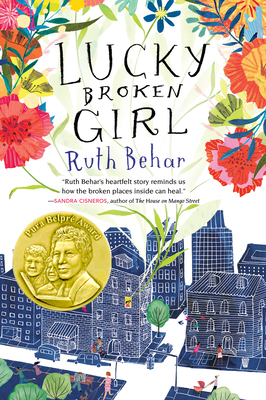
Book Review: Lucky Broken Girl by Ruth Behar


Reviewed by Maria Ramos-Chertok

Lucky Broken Girl CoverDESCRIPTION FROM THE PUBLISHERS: Ruthie Mizrahi and her family recently emigrated from Castro’s Cuba to New York City. Just when she’s finally beginning to gain confidence in her mastery of English—and enjoying her reign as her neighborhood’s hopscotch queen—a horrific car accident leaves her in a body cast and confined her to her bed for a long recovery. As Ruthie’s world shrinks because of her inability to move, her powers of observation and her heart grow larger and she comes to understand how fragile life is, how vulnerable we all are as human beings, and how friends, neighbors, and the power of the arts can sweeten even the worst of times.

MY TWO CENTS:  I read this book and couldn’t put it down and then gave it to my 11-year-old son to read and he couldn’t put it down. His review was, “It’s really good,” and while I wholeheartedly agree with him, I’ll elaborate. Ruth Behar does a great job capturing the voice and thoughts of a young girl immigrating to the United States from Cuba. Ruti, the young protagonist, shares her insights about what it is like to be smart, yet treated as if she were “dumb” because she can’t speak English.

As a reader, I found myself joyfully cheering for her to succeed and then devastated when she is injured in an accident, only to find myself re-engaged in rooting for her as she embarks on a journey to regain to her childhood body and the ease of movement she once had. I fell in love with her bohemian neighbor whose child-like appreciation for fun and non-traditional ways of living made me want to copy his interior design tips and decorate my house with piñatas. Behar doesn’t sugar coat the immense challenges of immigrant life, including financial troubles, family tensions and jealousies. Nor does she hide the emotional complexity of love, sacrifice and resentment that Ruti’s mother experiences when she finds herself in the role of 24-hour caretaker for her bed-bound daughter. Behar is also able to capture the volatility of friendships and did a great job bringing me along as Ruti first adores a girlfriend, then feels betrayed by her, and ultimately understands her motivations. The added texture to the story is that Ruti is a Cuban-Jew, which adds another dimension to her arrival in the United States as she encounters friends from different religious (and cultural) backgrounds. As she experiences the beauty of multicultural friendship, she also learns about the boundaries such friendships can have.

In writing with such honesty, Behar allows the reader to examine his/her own assumptions, biases and prejudices and pushes us to consider what is gained by the immigrant experience, but also what is lost in that transition.  This book would have automatic appeal to an immigrant child, but clearly a much wider appeal given that both my son and I are U.S. born and we were immediately captivated by the story Behar has to tell.

TEACHING TIPS:  This book is a wonderful companion to courses related to English, U.S History, Social Studies, Civics/Civic Engagement, Religious Studies, Economics and Health. I’d recommend assigning a few chapters at a time and bringing students along the various stages of Ruti’s arrival in the United States. It is a particularly compelling story to use for any discussion of immigration into the United States and what life is like from the perspective of a young immigrant.  There are rich conversations to be had related to assumptions, biases and prejudices. It is also a great way to teach empathy, as readers get a sense of what it is like to be in need of care taking and to be the care taker as they are learning about life from the perspective of a newcomer.

From an economic standpoint, there are many layers of lessons and conversations that can be facilitated about the role of consumerism and “wanting” something. What are the actual costs of the thing and what are the hidden costs and the opportunity costs? In this regard, I’m thinking, in particular, about the role that the family automobile played in Ruti’s life.

There are also discussions about the impact of making choices:  the choices to drink, how much to drink, whether to drive when drinking and what the consequences of various choices can be.

There are also some very rich conversations to have about friendship:

  • How do you know when someone is your friend?
  • What’s the difference between a friend and an acquaintance?
  • What role do friends play during hard times?
  • What happens if something happens to a friend that is hard for you to deal with?

FOR MORE INFORMATION about Lucky Broken Girl, check your local public library, your local bookstore or IndieBound. Also, check out GoodreadsAmazon, and Barnes & Noble.


ruth-bioporchABOUT THE AUTHOR (from her website): As a storyteller, traveler, memoirist, poet, teacher, and public speaker, Ruth Behar is acclaimed for the compassion she brings to her quest to understand the depth of the human experience. She now makes her fiction debut with Lucky Broken Girl, a novel for young readers about how the worst of wounds can teach a child a lesson about the fragile, precious beauty of life. Born in Havana, Cuba, she grew up in New York, and has also lived in Spain and Mexico. Her recent memoirs for adults, An Island Called Home and Traveling Heavy, explore her return journeys to Cuba and her search for home as an immigrant and a traveler. She was the first Latina to win a MacArthur “Genius” Grant, and her honors also include a John Simon Guggenheim Fellowship, a Distinguished Alumna Award from Wesleyan University, and an honorary doctorate in Humane Letters from the Hebrew Union College. She is an anthropology professor at the University of Michigan and lives in Ann Arbor, Michigan.


ABOUT THE REVIEWER: Maria Ramos-Chertok is a writer who lives in Mill Valley, CA. She is the founder and facilitator of The Butterfly Series, a writing and creative arts workshop for women who want to explore what’s next in their life journey. Her work, most recently, has appeared in San Francisco’s 2016 Listen to Your Mother show (www.listentoyourmothershow.com) and in the Apogee Journal of Colombia University. Her piece Meet me by the River will be published in Deborah Santana’s anthology All the Women in my Family Sing  (2017) and she will be reading in San Francisco’s LitCrawl in October 2016.  For more information please visit www.mariaramoschertok.com
Going For It: Q&A with Illustrator Jacqueline Alcántara


By Cecilia Cackley

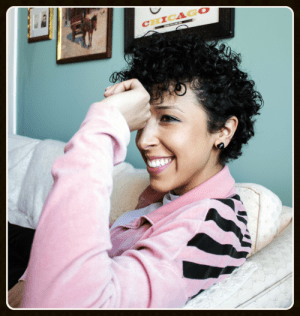
photo credit @eyeshotchaJacqueline Alcántara was featured in a previous round-up of Latina illustrators here on Latinxs in Kid Lit. When I found out she was also the inaugural recipient of a mentorship from the We Need Diverse Books organization, I wanted to find out more about her experience in the program and how it affected her work. Alcántara worked with the illustrator Carolyn Dee Flores (who has also participated in a Latina Illustrators post) as her mentor and recently announced her second book deal. She will illustrate the book Freedom Soup by Tami Charles, which will be released by Candlewick Books in 2019. She will also illustrate The Field by Baptiste Paul, which is scheduled to release with NorthSouth Books in Spring 2018.

How did you hear about the WNDB mentorship and what made you decide to apply?

A friend/illustrator in my critique group forwarded me the email announcing the mentorship. He knew my work included a lot of diverse characters and knew that my interests were in pursuing projects that featured diverse main characters, so thankfully, he assumed I would be a good fit! At that time, I knew that I needed someone to help guide me, give me feedback on my work, grow my network, and help me build confidence. I wasn’t sure if that would be a friend, agent, editor, or mentor but was doing everything I could to find relationships like that. I decided to apply because it was honestly exactly what I was looking for!

What has been the best part about working with your WNDB mentor?

I think the best part of a mentor/mentee relationship is that there’s no other reason you are working together, other than to improve your work and career. Relationships with other people in the industry, i.e. agents, editors, fellow illustrators, etc are wonderful and critical as well, but there are quickly a lot of other factors those people can be thinking about in addition to your work when giving you advice or suggestions. Conversations with my mentor helped not only to allow me to see a path for myself within the industry, but also to see my strengths and weaknesses as an artist. Carolyn is brutally honest, which I love. She has really wonderful instincts and fantastic advice. I believe a lot in instincts and trusting my gut, but working alone and pursing this dream can become really difficult. Carolyn is always reminding me to trust my instincts and to have fun! So I built up a lot of confidence in myself relatively quickly once we started working together. Not only confidence in my actual illustrations, but in goals, ideas, and direction of my career. I also felt a pressure to succeed, now that I had not only Carolyn, but WNDB holding me accountable! When you work for yourself, there is no one to push you or hold you accountable, so it requires a lot of self confidence and motivation. The boost I got from WNDB was great for that, but I also knew I finally had the resources to make it happen!

The next best part of working with my mentor was that fact that Carolyn introduced me to Adriana Domínguez at last winter’s SCBWI conference. Adriana and I continued talking for months after that and I ultimately signed with her and Full Circle Literary over the summer. That was the best possible outcome from the mentorship, and it actually happened! Relatively soon after working with Adriana, I got my first picture book offer. I’m very happy to share that I’m now working on 2 books, one with North South and the second with Candlewick. The first will be released in 2018, and the second in 2019.  I cannot wait for them to come out!

What other artists and writers do you consider your greatest influences (kidlit or not)?

In the kid lit world, my greatest influences are Chris Raschka, Patricia Pollacco, Chris Van Allsburg, and Kadir Nelson. As for traditional artists I’m a bit cliche; Picasso, Matisse, and Redon are some top favorites. Picasso’s sketchbooks are a constant source of inspiration for me. Redon and Matisse, I love their use of color and the imagination they brought into their work. I’ve also been in love with Japanese Ukiyo-e art since I was young. I think a lot of my energy and inspiration also comes from music. I have music on constantly in my studio, different genres depending on what I’m doing, but there’s a lot of electronic, disco/soul, hip hop. My favorite writer (currently) is Neil Gaiman.

You were a high school art teacher at one point. Do you think your students influenced your work, and if so, how?

I taught high school art for a short time before school funding was cut significantly in Illinois. Our department (along with many art departments state-wide) saw massive cuts, so I took the opportunity to push my own artistic career. I will always be influenced by my time teaching (I hope to still have teaching opportunities in the future) and the students I had! Remembering a personality, hairstyle, attitude, or name for character can be inspiration—or remembering a conversation or story a student shared about their life. I left teaching wanting to be a successful working artist, but I also wanted to do work that would directly influence, inspire, and speak to children.

What advice would you give other Latinx artists who might want to apply for the WNDB program?

Be open to everything. Participating in this program has led to so many other relationships and opportunities, and has launched my career. WNDB has really opened the door for a lot of people, beyond those who have received mentorships or grants. They are bringing the issue to the forefront of the industry, and editors and agents are definitely listening and searching for new diverse talented writers and illustrators. It’s been so encouraging. It’s an industry that can seem daunting and a job that seems too good to be true. It takes a lot of patience and time, but it’s really important work, so if you are thinking of pursuing it,  get involved ASAP! It’s much more fun to do with a network of people around you, and SCBWI (the Society of Children’s Book Writers and Illustrators), WNDB and others are all fantastic ways to do so.


Cackley_headshotCecilia Cackley is a performing artist and children’s bookseller based in Washington, DC, where she creates puppet theater for adults and teaches playwriting and creative drama to children. Her bilingual children’s plays have been produced by GALA Hispanic Theatre and her interests in bilingual education, literacy, and immigrant advocacy all tend to find their way into her theatrical work. You can find more of her work at www.witsendpuppets.com.