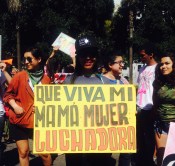
Book Reviews: Lucía the Luchadora by Cynthia Leonor Garza; illustrated by Alyssa Bermudez and ABC Pasta by Juana Medina


LUCÍA THE LUCHADORA

Review by Dr. Sanjuana Rodriguez
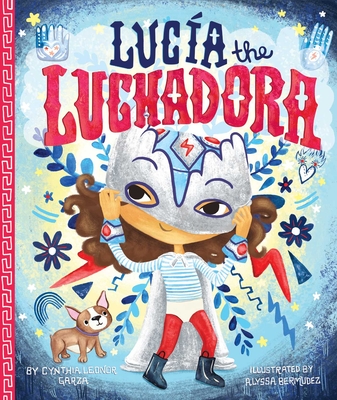
Lucia the Luchadora CoverDESCRIPTION OF THE BOOK: Lucía zips through the playground in her cape just like the boys, but when they tell her “girls can’t be superheroes,” suddenly she doesn’t feel so mighty. That’s when her beloved abuela reveals a dazzling secret: Lucía comes from a family of luchadoras, the bold and valiant women of the Mexican lucha libre tradition. Cloaked in a flashy new disguise, Lucía returns as a recess sensation! But when she’s confronted with a case of injustice, Lucía must decide if she can stay true to the ways of the luchadora and fight for what is right, even if it means breaking the sacred rule of never revealing the identity behind her mask. A story about courage and cultural legacy, Lucía the Luchadora is full of pluck, daring, and heart.

MY TWO CENTS: The cover of the book is flashy with a larger than life young girl in a luchadora outfit. The story begins with Lucía playing on the playground where there are two other boys. Lucía tries to play with the boys, but they are not interested in playing with her. One of the boys tells Lucia that “girls can’t be superheroes” and she gets angry that they have told her this. That’s when Lucia’s abuela whispers a secret to Lucía. Abuela shows Lucia her cape and mask and tells her about the Mexican lucha libre tradition. She shares that she was a luchadora as a young girl and tells her that “a luchadora has moxie. She is brave and full of heart, and isn’t afraid to fight for what is right.” The next day, Lucia goes back to the playground wearing her luchadora cape and mask. Everyone notices Lucía, but she does not reveal her identity to the kids. One day when she is playing she notices another luchadora dressed in pink. She hears the boys telling her the same thing, “girls can’t be superheroes! Girls are just made of sugar and spice and everything nice!”. Lucía remembers when her abuela told her that “a real luchadora must fight for what is right” and reveals that she is a girl. When others start clapping, she notices that there are luchadoras all around her who also reveal their identity. She continues to play without her mask and tells herself the following with her grandmother smiling as she watches her play, “I am still the best kind of superhero. I am Lucía the Luchadora, mask or no mask.”

This book is a rare jewel–it features a strong Latina girl as a superhero! This book sends a clear message to all kids to be courageous in the face of injustice. Lucía does not reveal who she is until she understands that it will help another little girl who is going through something similar. In the end, Lucía realizes that she does not need a mask to be a hero. The book also shows the importance of inter-generational relationships in the Latinx culture.  Lucía’s abuela is the one who shares her own experience and shares with her the mask and the cape. The last picture shows abuela smiling as Lucía plays with the other luchadoras on the playground.

The illustrations in this book are beautiful and bright. My favorite illustration shows Lucía when she gets angry.  In a full page spread, red and orange peppers surround Lucia to show that she is “spicy mad. KA-POW kind of mad.” The illustrations are very detailed and show careful attention to the depiction of cultural artifacts and symbols such as rosary beads and the abuela’s perfume.

TEACHING TIPS: At the end of the book, the author included a note on luchadoras, luchadores, and lucha libre in which the author discusses luchadores in Mexico and the history of lucha libre.

The author worked with an educator to create a curriculum guide to go along with Lucía the Luchadora. The guide includes questions, lesson ideas, and information about the author and illustrator.

http://www.cynthialeonorgarza.com/curriculum-guide-download-for-lucia-the-luchadora/

The following is an article of an interview with the author, Cynthia Leonor Garcia.

http://www.chron.com/entertainment/books/article/Luc-a-the-Luchadora-author-wants-more-11056270.php

This guide titled “Lucha Libre and Mexican Culture for Kids” features information about lucha libre as well as other picture books about this topic:

http://www.spanishplayground.net/mexican-culture-lucha-libre/

WHERE TO GET IT: To find Lucía the Luchadora, check your local public library, your local bookstore, or IndieBound. Also, check out GoodreadsAmazon, and Barnes & Noble.

Cynthia Leonor GarzaABOUT THE AUTHOR (from her website): I’m a writer and write all sorts of things. My debut picture book Lucía the Luchadora was published in March 2017. I’ve written essays for The Atlantic, commentaries for NPR’s All Things Considered and am an alum of the VONA/Voices writer’s workshop. I’m also a journalist and have worked as a reporter for several newspapers including the Houston Chronicle and the Fort Worth Star-Telegram. I graduated from Rice University and have a Master’s in Journalism from Northwestern University’s Medill School of Journalism. I was born and raised in South Texas and currently live with my husband and two young daughters in Nairobi, Kenya. Reach me via Twitter or at luchalady [@] gmail.com

Photo by Mark Cowles

Photo by Mark Cowles

ABOUT THE ILLUSTRATOR (from her website): As a born and bred New Yorker, my recent move to Tasmania has led me to discover a limitless wellspring of inspiration in the form of an urban and rural coalescence.  My artistic framework stems from my undergraduate and graduate degree courses at the Fashion Institute of Technology in New York where I studied illustration, computer animation and interactive media. Illustration is my main form of communication and memory keeping, and I believe that even the smallest life experiences can be the greatest asset to inspired creations. To me, art is a powerful motivator which equips me with the ability to transcribe my imagination into something tangible. I hope to direct those who view my work into a deeper experience with curated colour, delightful subject matter and professional craftsmanship.

 

ABOUT THE REVIEWER: Sanjuana C. Rodriguez is an Assistant Professor of Literacy and Reading Education in the Elementary and Early Childhood Department at Kennesaw State University. Her research interests include the early literacy development of culturally and linguistically diverse students, early writing development, literacy development of students who are emergent bilinguals, and Latinx children’s literature. She has published in journals such as Journal of Language and Literacy Education, Language Arts, and Language Arts Journal of Michigan.


ABC PASTA: An Entertaining Alphabet

Review by Cecilia Cackley
DESCRIPTION OF THE  BOOK:
A is for angel hair acrobat
M is for Macaroni the Magician
and T is for tortellini trapeze artist.
It’s an ABC circus that’s good enough to eat

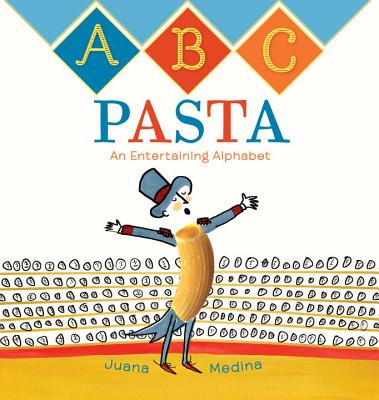
MY TWO CENTS: We all know pasta is delicious, but who knew it could be so colorful and informative? After focusing on depicting animals in her last delightful concept book 1 Big Salad, Juana Medina adds human limbs, features and accessories to various pastas and other ingredients to create an engaging circus alphabet. Her lines are bold and sketchy, with splashes of color for cheeks and clothing added to create a beautiful, balanced effect. Medina has told me that Quentin Blake was a huge influence on her art, and it’s really visible in these energetic drawings. She constantly changes the way she incorporates the photographs of the different kinds of pasta (plus a few herbs and cheeses), sometimes using it for the body of the character, sometimes the head or the hair, and occasionally for wheels, instruments or hoops. This is a delicious concept picture book that readers of many ages will be thrilled to pick up.

TEACHING TIPS: This is a book that rewards careful observation, and teachers can use it with preschool and kindergarten classes as a fun read aloud for introducing the alphabet. For slightly older students, a scavenger hunt would be a fun way to create an activity to go with the text, asking kids to find letters that use the pasta for different effects, or count how many letters include an instrument. Medina’s vocabulary is very sophisticated for an alphabet book, making this a good choice for a language lesson explaining words like ‘spectator,’ ‘invincible,’ or ‘zestful.’ Art teachers can use this alongside Debbie Ridpath Ohi’s found object art to spark ideas for student drawings using pasta or other items. I’d also like to point out that unlike many other circus themed books, Medina focuses solely on the humans, with no animals included at all. Now that the Ringling Bros circus has closed, most circuses in the U.S. have retired the elephants and seals and instead feature an incredible range of acts from acrobats to jugglers to clowns. It was nice to see those acts introduced to young people in this book.
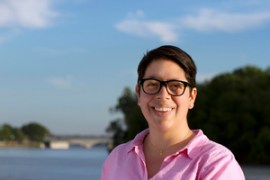
Photo: Silvia Baptiste © 2013ABOUT THE AUTHORJuana Medina was born in Bogotá, Colombia, where she grew up, getting in a lot of trouble for drawing cartoons of her teachers. Eventually, all that drawing (and trouble) paid off. Juana studied at the Rhode Island School of Design – RISD (where she has also taught). And she has done illustration & animation work for clients in the U.S., Latin America, and Europe. She now lives in Washington, D.C., where she teaches at George Washington University. She is the illustrator of Snick! by Doreen Cronin and the author and illustrator of 1 Big Salad, Juana and Lucas (which won the Pura Belpré Award) and the upcoming picture book Sweet Shapes.

WHERE TO GET IT: To find ABC Pasta, check your local public library, your local bookstore, or IndieBound. Also, check out GoodreadsAmazon, and Barnes & Noble.

Click here for a post about a studio visit with Juana Medina.

 

Cackley_headshotABOUT THE REVIEWER: Cecilia Cackley is a performing artist and children’s bookseller based in Washington DC where she creates puppet theater for adults and teaches playwriting and creative drama to children. Her bilingual children’s plays have been produced by GALA Hispanic Theatre and her interests in bilingual education, literacy, and immigrant advocacy all tend to find their way into her theatrical work. You can find more of her work at www.witsendpuppets.com.

September 2017 Latinx Book Deals


Compiled by Cecilia Cackley

This is a monthly series keeping track of the book deals announced by Latinx writers and illustrators. The purpose of this series is to celebrate book deals by authors and illustrators in our community and to advocate for more of them. If you are an agent and you have a Latinx client who just announced a deal, you can let me know on Twitter, @citymousedc. If you are a Latinx author or illustrator writing for children or young adults, and you just got a book deal, send me a message and we will celebrate with you! Here’s to many more wonderful books in the years to come.

September 28

Christina Pulles at Sterling has bought world rights to American Gothic and Esquivel! author Susan Wood‘s Holy Squawkamole! Little Red Hen Makes Guacamole, a little red hen story. Laura Gonzalez is set to illustrate; publication is expected in October 2018. Illustrator agent: Lisa Musing at Advocate Art.

September 26

Amy Fitzgerald at Lerner/Carolrhoda Lab has acquired The Book of Love, a standalone novel by NoNieqa Ramos. Overachiever Verdad is struggling to process her best friend’s death while meeting her mother’s high expectations. When she falls for a classmate—who happens to be trans—their romance forces her to confront her demons and figure out who she really is. Publication is planned for fall 2019. Author agent: Emily Keyes at Fuse Literary.

September 21

None.

September 19

Tamar Brazis at Abrams Books for Young Readers has acquired world rights to Chicago author Suzanne Slade‘s (l.) Exquisite, a picture book biography about Gwendolyn Brooks, the influential poet and the first African-American to win a Pulitzer Prize. Cozbi A. Cabrera will illustrate; publication is scheduled for spring 2019.

September 14

None

September 12

Filip Sablik at BOOM! Box has acquired world rights to fantasy author C.S. Pacat‘s (l.) five-issue YA comic series, Fence; Dafna Pleban and Shannon Watters will edit. Illustrated by Johanna the Mad, the series follows the rise of 16-year-old outsider Nicholas Cox in the world of competitive fencing as he joins the team at an elite boys’ school. Publication begins in November 2017.

Fiona Simpson at Simon & Schuster has acquired world rights, in a preempt, in a two-book deal, to Ryan Calejo‘s The Morphling. The middle grade novel follows a boy who tries to solve the mystery of his parents’ disappearance with the help of his lifelong crush, while strange things keep happening to his body—things that resemble the Central and South American myths and legends that his abuela raised him on. The first book is set for fall 2018; Rena Rossner at the Deborah Harris Agency negotiated the deal.

September 7

None


Cecilia Cackley is a performing artist and children’s bookseller based in Washington, DC, where she creates puppet theater for adults and teaches playwriting and creative drama to children. Her bilingual children’s plays have been produced by GALA Hispanic Theatre and her interests in bilingual education, literacy, and immigrant advocacy all tend to find their way into her theatrical work. You can find more of her work at www.witsendpuppets.com.
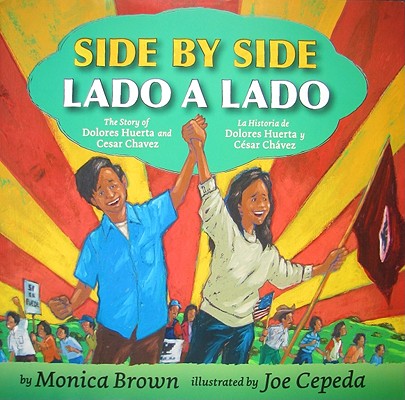
Book Review: Side by Side/Lado a Lado by Monica Brown, illustrated by Joe Cepeda


Reviewed by Maria Ramos-Chertok

Side by Side/Lado a Lado CoverDESCRIPTION FROM THE PUBLISHER: Every day, thousands of farmworkers harvested the food that ended up on kitchen tables all over the country. But at the end of the day, when the workers sat down to eat, there were only beans on their own tables. Then Dolores Huerta and Cesar Chavez teamed up. Together they motivated the workers to fight for their rights and, in the process, changed history.

Award-winning author Monica Brown and acclaimed illustrator Joe Cepeda join together to create this stunning tribute to two of the most influential people of the twentieth century.

MY TWO CENTS: Growing up, my mother told us we had to boycott grapes. At that time, I only understood farmworkers were treated badly and Cesar Chavez was helping them. Years later, I’ve found a bilingual children’s book that would have helped me understand, not only the history of the farmworker movement, but who Cesar Chavez was and how he and Dolores Huerta worked together to inspire a national consciousness about the treatment of farmworkers. I love that this book introduces Dolores and Cesar as children and connects their early life experiences to the decisions they made as they grew up. I value the discussion of poverty, which the author introduces by explaining that Cesar’s family ended up working as migrant farmworkers after they lost their home. Given the shame and confusion children are apt to feel when their family faces eviction and/or loss of a home, the book offers an important perspective on family displacement by following Cesar throughout the loss, showing how it impacted his life as an activist for human dignity. It also does a good job of showing how a teacher, Dolores Huerta, became a social justice leader, adding a texture and dimension to those in the teaching profession that students might not otherwise get an opportunity to witness.

The illustrations by Jose Cepeda really welcome readers into the story and younger children will be engaged visually. His illustrations are lively and are reminiscent of comic book characters.

I learned several things about the early lives of Caesar and Dolores that enriched my understanding of them as people and about the farmworker movement, so while the book is focused on ages four to eight, I suspect adults will learn something new as well.

Given that I longed for bilingual children’s books when my two sons were growing up, I only wish I had known about this book earlier. I applaud our local library for having a copy on display and bringing it to my attention.

TEACHING TIPS: The story offers educators the chance to engage their students in discussions about social justice. While there are many ways to talk about how and why people have to fight for human rights, this book offers a slice of American history that has resonance with contemporary issues related to the working and living conditions of the people who grow and pick our fruits and vegetables. Teachers might even bring in some fruit or veggies and ask children to think about how it ended up at the supermarket or fruit stand. Making a connection between planting, cultivating, growing, harvesting, marketing, and shipping and the human beings behind each step could be a valuable lesson on introductory economics.

There’s a deeper issue that surfaces in the book about “Why people do things that hurt other people?” (or why would a person do something that hurts another person?). Pre-school and elementary school aged children would already have a frame of reference for exploring the motivations and psychology behind this universal question. Along these lines, I offer one cautionary note related to the issue of how the landowners and bosses are portrayed. The author writes that “mean bosses sprayed the plants with poisons that made the farmworkers sick.” I understand the need to provide accessible language and concepts for four to eight year olds, as well as the desire to avoid delving into profit margins, racism, immigration, landowners versus farmworkers and economic class. Yet, there may well be children in one class/school/community who come from both farmworker families and farm owning families. As such, I think it is important to explore the term “mean” and work to avoid polarized thinking/labels. I’d recommend focusing young children on what motivates someone who’s being “mean” and the consequences of mean treatment:

  • What makes people act in a mean way?
  • Why are people mean to some and not to others?
  • What happens when you are on the receiving end of someone who is mean?
  • What if the person being mean has power over you (e.g. boss, police officer, parent)?

Children know about these issues first-hand, and I’d suspect they’d have amazing insights.

I also see Side by Side being used to talk about work and career. So many adults ask kids what they want to be when they grow up, and that pressure can make kids feel like they have to provide an acceptable response. This book provides insights into how your calling can find you. It also shows how one’s chosen profession, teacher in Dolores’s Huerta’s case, can morph, grow, expand and change over time.

The book offers a wonderful opportunity to explore friendship. By highlighting the platonic partnership and bond between a man and woman working toward a common vision, it shows a model of what two people can do when they unite. The idea of strength in numbers or working in pairs can be explored by asking students about the benefits of working with someone else on a school project or a sports team.

The book can also be used to discuss feminism. Many people think about Cesar Chavez’s connection to the farmworker movement. This book highlights Dolores Huerta’s work as a bold and fearless leader in her own right. She is an important role model for girls, displaying courage, skills to inspire and mobilize, and political savvy. For lessons that focus on women in American History, she would be a great person to showcase.

Finally, because so much of the telling of history has to do with who is telling the story, Side by Side provides a perspective on history that departs from the dominant culture’s narrative on landowning, California’s natural agricultural bounty, modernization, and unionization.

I’d recommend reading the Note for Parents and Teachers at the back of the book to gain more context and facts about Cesar Chavez and Dolores Huerta.

WHERE TO GET IT: To find Side by Side / Lado a Lado, check your local public library, your local bookstore, or IndieBound. Also, check out GoodreadsAmazon, and Barnes & Noble.


 monica6ABOUT THE AUTHOR: Monica Brown, Ph.D. is the author of many award-winning books for children, including Waiting for the BiblioburroMarisol McDonald Doesn’t MatchMarisol McDonald no combina The Lola Levine series including: Lola Levine is Not Mean!Lola Levine, Drama QueenLola Levine and the Ballet Scheme, and Lola Levine Meets Jelly and Bean. Find Monica on Facebook at Monica Brown, Children’s Author, on twitter @monicabrownbks, or online at www.monicabrown.net.
For other posts about Monica Brown, click here and here.


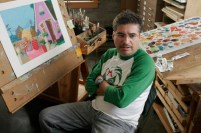
second_pic_4x6_72ABOUT THE ILLUSTRATOR: Joe Cepeda is an award-winning illustrator of children’s books who also works in magazine illustration. He lives in California and serves as president of the Society of Illustrators of Los Angeles. For more information, visit his website.



Joe Cepeda did a two-part interview with us about his work. To read those posts, click here and then here.


Extra: A movie about Dolores Huerta released on September 1, 2017. Here is the official trailer:


ABOUT THE REVIEWER: Maria is a writer, workshop leader and coach who facilitates The Butterfly Series, a writing and creative arts workshop for women who want to explore what’s next in their life journey. In December 2016, she won 1st place in the 2016 Intergenerational Story Contest for her piece, Family Recipes Should Never be Lost. Her work has appeared in the Apogee Journal, Entropy Magazine, and A Quiet Courage.  Her piece Meet me by the River will be published in Deborah Santana’s forthcoming anthology All the Women in my Family Sing (Jan 2018) http://nothingbutthetruth.com/all-the-women-in-my-family-sing/.  She is a trainer with Rockwood Leadership Institute www.rockwoodleadership.org and a member of the Bay Area chapter of Write on Mamas. For more information, visit her website at www.mariaramoschertok.com
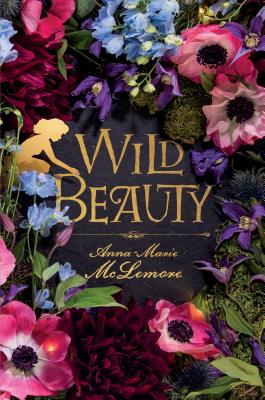
An Interview with Author Anna-Marie McLemore about Wild Beauty


By Cecilia Cackley

Anna-Marie McLemore‘s lush, sensory YA fiction has been a finalist for the William C. Morris Award and won a Stonewall Honor from the American Library Association. Her new book Wild Beauty (releases tomorrow!) takes place in a magical, predatory garden tended by the women of the Nomeolvides family, so it seemed fitting to have our interview about the book take place in a garden. I met up with McLemore at the National Botanic Garden in Washington, D.C. to look at the various themed rooms (tropical, desert, poisonous plants etc.) and discuss the plants, characters, and world of Wild Beauty. Here is our conversation, edited for clarity.

Anna-Marie McLemore

Q: Can you talk a little about your inspiration for the character Fel and his story?

Anna-Marie McLemore: Without giving too much away, I’ll say this: I started with his history, where he comes from, his family. And the fact that we sometimes don’t hear the stories of what happens when the farms fail, when the harvest dies, what you do when you’re trying to take care of your loved ones. So that’s one side of it. Another is that there’s a brutal history of child immigrants doing dangerous jobs, jobs that are already dangerous if you’re a grown man, and either the people doing the hiring don’t care or they look the other way. But amid that kind of brutality, there’s also family; I wanted to write characters who were looking out for each other even in a place that doesn’t really want them.

Q: It’s a feature of stories categorized as magical realism that the characters accept magic as simply part of regular life. In what way do the characters in Wild Beauty, both from the family that lives in La Pradera and the surrounding town accept magic as part of their world?

AMM: The way the Nomeolvides women tend these gardens, the ways that they and their loves are cursed, that’s accepted as part of the lore of this town. But this book is also about what you get made into by rumor; there’s so much talk about these women, everybody else trying to decide what the truth of them is. In response to all that, the Nomeolvides women become their own community. They make their own space. And I think that’s threatening to many watching them from the outside. But it’s how the women push back against the way people see them as a sideshow attraction, how visitors expect them to perform, to entertain.

Q: And we see that a lot in the real world.

AMM: We do.

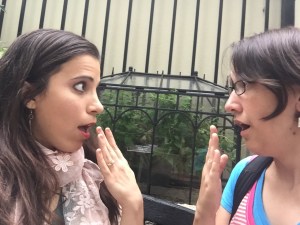
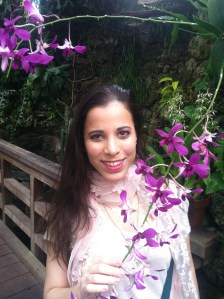
Anna-Marie and Cecilia at a poisonous plants exhibit at the National Botanic Garden in Washington, D.C.

Q: That people who are from marginalized populations—that happens to them more, that if you are not the majority you’re accepted but only in as much as you provide entertainment or only in as much as you can be exploited.

AMM: Exactly, you have a role that you’re expected to play.

Q: How did you choose the flower names for each of the girls?

AMM:  I chose the flowers based on how I pictured these women. Maybe it would have been easier to go for the flower names first and then build the character but I started the other way around. I imagined each girl and then thought, “What is her flower? What is she growing?”

Q: Does the family ever repeat flower names?

AMM: They probably can have the same flower as a relative, but I think, unfortunately, things go so badly for so many of these women that they’re reluctant to repeat names. In this family, repeating a name is, in a sense, to pass on that woman’s legacy.

Q: La Pradera, the magical garden setting is so vivid and distinct. If it had a soundtrack, what sort of music would be on it?

AMM: Because the women living on La Pradera are so different, the gardens’ soundtrack would cover a range—some Lila Downs, Iron & Wine, Poe, Madi Diaz, Wailin Jennys, and some contemporary classical like Einaudi.

Q: If you had a flower name like the characters in this book, which would you choose?

AMM: I love the name Rosa, but in a family of women who grow flowers, I’m not sure I’d want the pressure of being the one who grows roses! I also love lilacs, so I might choose Lila. Then again, after our trip through the dangerous plants exhibit, maybe something like Belladona…

Q: What kind of flower books did you use in your research? Are there books that you would recommend (fiction or non-fiction) to readers who also love flowers?

AMM: Though La Pradera is very much fictional, I based the botany of the estate on a botanical garden in western Canada, so my go-to books were twin volumes called Annuals of British Columbia and Perennials of British Columbia. Both were invaluable references. To readers who love flowers, I recommend checking out a book about the botany of where you live. If you live in a place that has drought, you can learn which plants survive, which are drought-resistant. If you live somewhere with heavy rain, you learn which plants anchor into hillsides so they’re not washed away. Having that kind of interaction with your own landscape, learning the incredible things that are happening under the ground, there’s magic in that.

Q: I know you’ve talked about how you love to visit botanical gardens, which inspired La Pradera. Which gardens would you recommend people try and visit?
AMM: Butchart Gardens in Victoria, British Columbia was a huge inspiration, both in its scope and its beautiful detail. Huntington Library in Los Angeles, in addition to being a museum of books and paintings, has spectacular gardens based on different landscapes. For something closer to home, I recommend local parks, which often have gardens ranging from small and meticulous to wide and sprawling. And the grounds around capitol buildings. The capitol in California, for instance, I think has one of every tree that grows in the state.

I also really like this one [National Botanic Garden in DC] because it’s part garden and part museum; the plants are carefully labeled and there’s so much information posted. And I loved getting to meet up with you here! Thanks for taking me through the orchids and desert gardens and all the gorgeous plants here!

ABOUT THE AUTHOR: Anna-Marie McLemore was born in the foothills of the San Gabriel Mountains and grew up in a Mexican-American family. She attended University of Southern California on a Trustee Scholarship. A Lambda Literary Fellow, she has had work featured by the Huntington-USC Institute on California and the West, CRATE Literary Magazine’s cratelitCamera Obscura’s Bridge the Gap Series, and The Portland Review. She is the author of The Weight of Featherswhich was a Morris Award finalist, When the Moon was Oursa 2017 Stonewall Honor book, and Wild Beauty, which has earned starred reviews from Kirkus, Booklist, and School Library Journal.


Cecilia Cackley is a performing artist and children’s bookseller based in Washington, DC, where she creates puppet theater for adults and teaches playwriting and creative drama to children. Her bilingual children’s plays have been produced by GALA Hispanic Theatre and her interests in bilingual education, literacy, and immigrant advocacy all tend to find their way into her theatrical work. You can find more of her work at www.witsendpuppets.com.

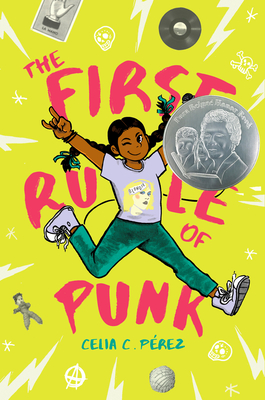
Book Review: The First Rule of Punk by Celia C. Pérez


Review by Lettycia Terrones, MLIS, PhD Student

Malú and the D.I.Y. (with a little help from the Elders) Aesthetic of Punk Rock Girls

There is a scene half-way through Celia C. Pérez’s brilliant middle-grade novel The First Rule of Punk that pulls so powerfully at the heartstrings of all those who have ever struggled with forming their identity as a minoritized person in the U.S. Having just wrapped up the first practice session of her newly formed punk band, The Co-Co’s, Malú (María Luisa O’Neill-Morales), the novel’s protagonist, learns an important lesson about what it means to be “Mexican.” It’s a lesson that not only connects Malú to her cultural heritage in a way that is authentic, it also invites her to self-fashion an identity that encompasses all parts of her, especially her punk rock parts! The lesson comes at the hands of Mrs. Hidalgo, the mother of Joe (José Hidalgo) who is Malú’s friend-in-punk, fellow seventh-grader at José Guadalupe Posada Middle School, and the guitarist of her band. And, it’s a lesson that complements those imparted by the many teachers guiding Malú to incorporate the complexity of seemingly disparate parts that make up who she is.

Before leaving the Hidalgo basement, which serves as the band’s practice space, Mrs. Hidalgo asks Malú to pull out a vinyl copy of Attitudes by The Brat. Putting needle to the Image result for Attitudes by The Bratrecord, Malú listens to the first bars of “Swift Moves” the EP’s opening song and asks in wonder, “Who is she?” To which Mrs. Hidalgo replies, “That’s Teresa Covarrubias.” And, so begins a history lesson for the ages. By introducing Malú to Teresa Covarrubias, the legendary singer of The Brat—the best punk band ever to harken from East L.A. —Mrs. Hidaldo, in a true punk rock move, being that she’s one herself, reclaims the cultural lineages that are so often erased and suppressed by dominant narratives, by affirming to Malú: “And they’re Chicanos, Mexican Americans … Like us.” (Pérez 162). Mrs. Hidalgo opens a door and illuminates for Malú something so beautiful and lucent about our culture. She designates this beauty as being uniquely part of a Chicanx experience and sensibility. So that in this moment, Malú’s prior knowledge and understanding of the punk narrative expands to include her in it as a Mexican American girl. She too belongs to this lineage of Mexicanas and Chicanas that made their own rules, which as Malú will go on to learn, indeed is the first rule of punk (Pérez 310).
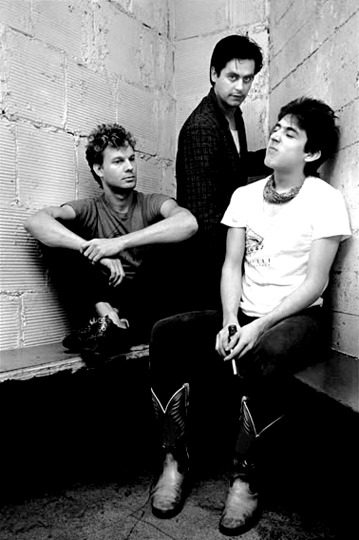
Image result for Poly-Styrene

Joan Elliott-Said a.k.a. Poly-Styrene

This “like us,” this cultural resonance, this CORAZONADA to our heritage as Chicanx people in the U.S. is exactly the attitude and voice that can only come from one who has experienced what it’s like to live in the liminal spaces where as you’re neither from here nor from there. Pérez, herself of bicultural Cuban and Mexican heritage, indeed speaks to this experiential knowledge, saying in a recent interview in The Chicago Tribune that it wasn’t until college when she read Pocho by José Antonio Villareal that she recognized her own experience reflected in the pages of literature for youth (Stevens). Pérez in The First Rule of Punk speaks to the same imperatives that Marianne Joan Elliott-Said a.k.a. Poly-Styrene, another legendary woman of color, punk rock innovator, and singer of the classic British punk band X-Ray Spex, expressed when she sang following lyrics: “When you look in the mirror/ Do you see yourself/ Do you see yourself/ On the T.V. screen/ Do you see yourself/ In the magazine” (“Identity” X-Ray Spex).

Pérez holds up a mirror to all the weirdo outsiders, all the underrepresented youth who are made to not fit in, and shows them a story that reflects and honors their truth. She takes on the complexities and messiness of culture and identity construction, doing justice to this tough work of self-fashioning by presenting to us the diverse ingredients that combine in such a way to produce a beautifully vibrant, brave, and rad punk rock twelve-year-old girl, Malú. Most importantly, Pérez shows us the significance of our elders, our teachers who assume different roles in guiding us, and guiding Malú, to always “stand up for what she believes in, what comes from here,” her/our corazón (Pérez 190).

Malú is a second-generation, avid reader, and bicultural kid (Mexican on her mom’s side, Punk on her dad’s side), who has to contend with starting a new school in a new town, making new friends, and dealing with her mom’s fussing over her non-señorita fashion style. She moves to Chicago with her mother who (in the type of first-generation aspirational splendor so integral to our Chicanx cultural capital that many of us will surely recognize) will begin a two-year visiting professorship. Malú dances away her last night in Gainesville to The Smith’s Please Please Please Let Me Get What I Want with her dad, an old punk rocker who owns Spins and Needles, a records store. She brings with her handy zine supplies to chase away the homesick blues, creating zines and surrendering her anxieties to her worry dolls.

On the first day of school, Malú puts on her best punk rock fashion armor: green jeans, Blondie tee, trenzas, silver-sequined Chucks in homage to the OG Dorothy from the Wizard of Oz, and some real heavy black eyeliner and dark lipstick, yeah! Of course, she gets called out. First, by her mom who tells her she looks like a Nosferatu(!), and then by the popular Selena Ramirez, her nemesis, who calls her weird, and then by the school policy, which lands Malú in the auditorium full of all the other kids who also stick out. Pérez captures the sticky reality of socialization where school serves as an agent of assimilation. She renders this moment with a tender humor that grateful adult eyes can point to when dealing with our children who will also likely experience this rite of passage. Malú resists being boxed in. She doesn’t want to assimilate. She doesn’t want to be “normal,” and neither does her friend Joe, whose bright blue hair and Henry Huggins steelo communicates an affinity with Malú’s punk aesthetic.

Thus, Pérez sets the stage. Malú, and her Yellow-Brick-Road crew comprised of Joe, Benny (trumpet player for the youth mariachi group), and Ellie (burgeoning activist and college-bound), are all Posada Middle School kids brought together by Malú’s vision and verve to start a punk band to debut at the school’s upcoming anniversary fiesta and talent show. Rejected, some would say censored, for not fitting into Principal Rivera’s definition of traditional Mexican family-friendly fun that she intends for the fiesta, The Co-Co’s decide to put on their own Do-It-Yourself talent show. Dubbed Alterna-Fiesta, The Co-Co’s plan to feature themselves and all the other students rejected from the school showcase for not fitting the mold.

Image result for the plugz

The Plugz

Image result for Ritchie Valens

Ritchie Valens

The self-reliance of D.I.Y. ethos, however, does not overshadow the importance of collectivism and solidarity that supports Malú’s response and agency toward expression. Again, she has her elders to thank. Mrs. Hidalgo helps set up the Alterna-Fiesta stage, which they improvised outside the school directly following the “official” talent show. Señora Oralia, Joe’s grandmother and Mrs. Hidalgo’s mom, turns Malú on to the power of Lola Beltrán, whose rendition of “Cielito Lindo” Malú transforms into a punked-out version in the tradition of Chicanx musical culture—from Ritchie Valens to The Plugz—that fuses traditional Mexican songs with rock and roll. Even Malú’s mom, who often projects her notions of what Malú should look and be like, is also the source of an important lesson. She teaches Malú about her abuelo Refugio Morales who came to the U.S. as a Bracero, and about her abuela Aurelia González de Morales who migrated to the U.S. at sixteen years old. She helps Malú see her grandparents’ experiences reflected in her own day-to-day life in Chicago.

Malú recognizes her family’s story of migration in the lives of her peers at Posada Middle School who might be recent immigrants. She reflects upon today’s workers, whose hands, like those of her grandfather, pick the strawberries she sees in the supermarket. Through zine-making, Malú makes sense of her world. She synthesizes the new information she’s learned about her family history to create new knowledge, as documented by her zine: “Braceros like my abuelo worked with their arms … and their hands manos (Abuelo’s tools). I work with my hands, too. Not in a hard way like Abuelo. But we both create (my tools) … scissors, paper, glue stick, markers, stack of old magazines, copy machine” (Pérez 116-117). Through the creative process of making zines, Malú weaves herself into her family’s tapestry of lived experiences, values, and character that are collectively shaped by her family. Malú’s Bracero zine exemplifies what Chicana artist Carmen Lomas Garza describes as the resilient function of art, which works to heal the wounds of discrimination and racism faced by Mexican Americans—a history that is also part of Malú cultural DNA (Garza 19). Her Bracero zine is an act of resilience through art. It reflects a creative process tied to collective memory. Indeed, she calls upon herself, and by extension, her reader, to remember. For it is the act of remembering and honoring who and where we come from that enables us to integrate and construct our present lives.

Malú’s family tapestry also includes her father, who despite being geographically far away, is firmly present throughout Malú’s journey. Malú seeks his counsel after Selena calls her a coconut, i.e. brown on the outside, white on the inside. Selena, the popular girl at Posada Middle School, embodies all of the right “Mexican” elements that Malú does not. She’s dances zapateado competitively, speaks Spanish with ease, and dresses like a señorita. Confused and hurt by Selena’s insult, Malú, being the daughter of a true punk rocker, flips the insult around and turns it into the name of her band, The Co-Co’s. The move, like her father said, is subversive. And it’s transformative as it addresses how divisions happen within our culture where demarcations of who is “down” or more “Mexican” often mimic the very stereotypes that we fight against. And it’s her father’s guidance to always be herself that equips her to resist the identity boxes that try to confine her. Malú, through the course of this story, figures out her identity by shaping, combining, fashioning—even dying her hair green in homage to the Quetzal—and harmonizing all the parts of herself to create an identity that fits her just right.

The First Rule of Punk is outstanding in its ability to show authentically how children deal with the complexities and intersections of cultural identity. It reminds us of what Ghiso et al. interrogate in their study of intergroup histories as rendered in children’s literature. As children’s literature invites young people to use its narrative sites to engage the intellect in imagination and contemplation, the researchers ask, “whether younger students have the opportunity to transact with books that represent and raise questions about shared experiences and cooperation across social, cultural, and linguistic boundaries” (Ghiso et al. 15). The First Rule of Punk responds affirmatively to this question in its resplendent example of our connected cultures and collective experiences. Malú, in making whole all the parts that comprise her identity, models for us, the reader, our own interbeing, our own interconnection. It’s like she’s asking us: “Wanna be in my band?” I know I do! Do you?

ABOUT THE AUTHOR: (from her website): Inspired by punk and her love of writing, Celia C. Pérez has been making zines for longer than some of you have been alive. Her favorite zine supplies are her long-arm stapler, glue sticks, animal clip art (to which she likes adding speech bubbles), and watercolor pencils. She still listens to punk music, and she’ll never stop picking cilantro out of her food at restaurants. Her zines and writing have been featured in The Horn Book MagazineLatinaEl AndarVenus Zine, and NPR’s Talk of the Nation and Along for the Ride. Celia is the daughter of a Mexican mother and a Cuban father. Originally from Miami, Florida, she now lives in Chicago with her family and works as a community college librarian. She owns two sets of worry dolls because you can never have too many. The First Rule of Punk is her first book for young readers.

To read a Q & A with the author, click here


ABOUT THE REVIEWER: Lettycia Terrones is a doctoral student in the Department of Information Sciences at University of Illinois at Urbana-Champaign, where she researches Chicanx picturebooks as sites of love and resilient resistance. She’s from East L.A. Boyle Heights.


Works Cited

The Brat. Attitudes. Fatima Records, 1980.

Pérez, Célia. C. The First Rule of Punk. New York, Viking, 2017.

Garza, Carmen Lomas. Pedacito De Mi Corazón. Austin, Laguna Gloria Art Museum, 1991.

Ghiso, Maria Paula, Gerald Campano, and Ted Hall. “Braided Histories and Experiences in Literature for Children and Adolescents.” Journal of Children’s Literature, vol. 38, no.2, 2012, pp. 14-22.

Stevens, Heidi. “Chicago Librarian Captures Punk Aesthetic, Latino Culture in New Kids’ Book.” Chicago Tribune, 23 August 2017. chicagotribune.com/lifestyles/stevens/ct-life-stevens-wednesday-first-rule-of-punk-0823-story.html . Accessed 25 August 2017.

X-Ray Spex. “Identity.” Germfree Adolescents, EMI, 1978.

Spotlight on Middle Grade Authors Part 2: Celia C. Pérez


By Cindy L. Rodriguez

This is the second in an occasional series about middle grade Latinx authors. We decided to shine a spotlight on middle grade writers and their novels because, often, they are “stuck in the middle”–sandwiched between and overlooked for picture books and young adult novels. The middle grades are a crucial time in child development socially, emotionally, and academically. The books that speak to these young readers tend to have lots of heart and great voices that capture all that is awkward and brilliant about that time.

Today, we highlight Celia C. Pérez.

Inspired by punk and her love of writing, Celia C. Pérez has been making zines for longer than some of you have been alive. Her favorite zine supplies are her long-arm stapler, glue sticks, animal clip art (to which she likes adding speech bubbles), and watercolor pencils. She still listens to punk music, and she’ll never stop picking cilantro out of her food at restaurants. Her zines and writing have been featured in The Horn Book MagazineLatinaEl AndarVenus Zine, and NPR’s Talk of the Nation and Along for the Ride. Celia is the daughter of a Mexican mother and a Cuban father. Originally from Miami, Florida, she now lives in Chicago with her family and works as a community college librarian. She owns two sets of worry dolls because you can never have too many. The First Rule of Punk is her first book for young readers.

Celia C. Pérez

Q. Who or what inspired you to become a writer?

A. I’ve loved writing for as long as I can remember. I think for me it just went hand in hand with being a reader. The earliest memory I have of writing something and realizing writing might be something I was good at was when I was in the third grade. All the third graders had to write an essay about what our school meant to us. One essay would be picked and that student would get to read it at our graduation. Mine was chosen. I don’t have the essay anymore and it’s been so long that I can’t remember what Comstock meant to me, but I do remember that it was the first time I felt like perhaps my writing held some power. And as someone who grew up a quiet, shy child of immigrant parents, it really was that sense of power it gave me that kept me writing throughout my life.

Q. Why do you choose to write middle grade novels?

A. I love middle grade books above all others! My fondest memories of my life as a reader start in the later years of elementary school so I have a soft spot for middle grade. I think that age range that middle grade covers (eight or nine to twelve) is such a vibrant and varied period of life. It’s this time of life when kids are teetering between childhood and adolescence and all the contrasts and clashing emotions that are part of those stages. They’re often still full of wonder and curiosity and innocence but also full of difficult questions and realizations about the world around them that aren’t always pleasant. There’s just so much to discover and explore there.

Q. What are some of your favorite middle grade novels?

A. I love the Pacy Lin books by Grace Lin (Year of the RatYear of the Dog, and Dumpling Days); When You Reach Me by Rebecca Stead; Enchanted Air by Margarita Engle; Ninth Ward by Jewell Parker Rhodes. Oldies that are dear to my heart are Jennifer, Hecate, Macbeth, William McKinley, and Me, Elizabeth by E.L. Konigsburg. I love Harriet the Spy by Louise Fitzhugh (and will always associate dumbwaiters and egg creams with her), but I remember especially enjoying Nobody’s Family Is Going to Change. Although, to be honest, I feel like that’s a book I would probably have to reread because she’s a white woman writing an African American family. I also have a soft spot for my earliest favorites like Witch’s Sister by Phyllis Reynolds Naylor, The Witch of Blackbird Pond by Elizabeth George Speare, and the Anastasia Krupnik books by Lois Lowry. I’m always afraid I’m leaving something out, and I likely am.

Q. If you could give your middle-grade self some advice, what would it be?

A. Oh, boy. I have a lot of advice for my middle grade self but let’s start with these:

Keep everything you write even if you think it’s terrible. You’ll be happy you did.

Your voice is worth listening to. Don’t be afraid to express yourself.

You’re a good athlete. Stop reading during P.E. and play!

Q. Please finish this sentence: “Middle grade novels are important because…”

A. Middle grade novels are important because more than any other type of book I believe they give young readers the keys to discovering their place in the world.


Come back on Thursday to see our review of THE FIRST RULE OF PUNK!


photo by Saryna A. JonesCindy L. Rodriguez was a newspaper reporter for The Hartford Courant and researcher at The Boston Globe before becoming a public school teacher. She is now a reading specialist at a Connecticut middle school. Cindy is a U.S.-born Latina of Puerto Rican and Brazilian descent. She has degrees from UConn and CCSU. Her debut contemporary YA novel, When Reason Breaks, released with Bloomsbury Children’s Books (2015). She will have an essay in Life Inside My Mind, which releases 4/10/2018 with Simon Pulse. She can also be found on FacebookTwitter, and Goodreads.