Book Review: Luca’s Bridge/El puente de Luca by Mariana Llanos, illus by Anna López Real


Review by Sanjuana Rodriguez
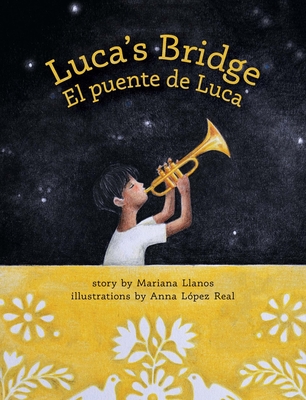
DESCRIPTION FROM THE PUBLISHER: Luca has never lived outside the U.S., but when his parents receive a letter in the mail, the family must pack up and leave home for a strange land. Together in their car, Luca, his brother Paco, and their parents head across the border to Mexico, where his parents were born. Luca doesn’t understand why he must leave the only home he’s ever known, his friends, and his school. He struggles through lonely and disorienting times–reflected both in Real’s delicate, symbolic illustrations and through Llanos’ description of his dreams–and leans on music, memory, and familial love for support. Luca’s Bridge / El puente de Luca is a story for everyone about immigration, deportation, home, and identity.

MY TWO CENTS: Luca lives in the United States with his parents. One day his parents receive a letter in the mail letting them know that they must leave the U.S. The entire family chooses to stay together and they leave the U.S. to go live in Mexico. Luca has a difficult time understanding why they must leave and he thinks about his friends, his school, and how he doesn’t speak Spanish. When he arrives in Mexico, he sees the small house where they will live and he has a difficult time imagining a life there. Luca uses music to help him cope with his new reality. He plays the trumpet and the entire family dances to the music reminding the readers that there is hope in what may appear to be a hopeless situation.

This bilingual picture books is timely considering the anti-immigrant sentiment in the United States and the realities for many families experiencing family separation due to immigration status. It is particularly important because it addresses the situation of many families who are considered to have mixed-family status, meaning that some in the family are authorized to live in the U.S. (typcially children who are U.S. citizens) and others are not (typcially the parent or parents).

The story begins with the family leaving together and the father telling his sons the following: “Mami and I don’t have the papers we need to stay here… we have to go back to Mexico if we want to stay together.” In the picture book, Luca fears what it means to return to a country that he does not know. He thinks about his friends and even wonders what will happen when he returns to his country since he does not speak Spanish. What makes this books particularly special is that allows the reader to have some insight into the emotional toll that immigration takes on children. The illustrations includes hues of gray and speak to the emotions that Luca is feeling. At one point, when Luca is thinking about how he doesn’t speak Spanish, the books states that “Luca sobbed quietly until he ran out of tears.” Another instance of a strong emotion is when Paco, Luca’s older brother, yells, “They don’t want us here,” when their parents received the letter.

This books sheds a light on the decisions that families must make in situations where the parents are not allowed to stay in the U.S. In the case of Luca’s family, the parents decide that they must stay together. This decision allows the family to stay together, but the sadness of leaving the only home that Luca knows is heartbreaking. This is one of the few picture books that addresses the issue of deportation and the strong sentiments that families experience when forced to make decisions that impact the entire family. The books also sheds light on the emotions that children experience when faced with realities of immigration.

The backmatter includes the author’s note that discusses the difficulties of immigration, describes the process of deportation, and the realities of family separation. The author discloses that she is an immigrant and discusses the need to address immigration in a humane way.

RESOURCES:

Toolkit for Educators from Teaching Tolearnce on supporting immigrant families

https://www.tolerance.org/magazine/fall-2018/toolkit-for-this-is-not-a-drill


ABOUT THE AUTHOR: Born in Lima, Peru, to two journalists, Mariana Llanos developed an early passion for writing and studied theater in the prestigious CuatroTablas school in Lima. She has lived in Oklahoma since 2002, where she worked as a teacher in a preschool center. In 2013, Mariana self-published her first book, Tristan Wolf, which won a Finalist in the 2013 Readers’ Favorite Book Award. Since then, she has published seven books independently in English and Spanish and through virtual technology has chatted with students from more than 150 schools around the world to promote literacy.
 

Anna Lopez photo 2ABOUT THE ILLUSTRATOR: Anna López Real is a freelance illustrator born in Guadalajara, Mexico. She spent her early years in a small town with a big lake, in a
bilingual home full of books, movies, diverse music and art. She has a degree Graphic Design from Universidad de Guadalajara. Since she was young, she has needed to feel colors, shadows, textures, and shapes with her own hands, which inspired her to use
traditional techniques. She is also the co-founder of a local stationary company. Her favorite place is the beach, and she loves to read and hang out with her family and her cats and dogs. She is passionate about human rights, animal rights and has a great
love for nature.


ABOUT THE REVIEWER: Sanjuana C. Rodriguez is an Assistant Professor of Literacy and Reading Education in the Elementary and Early Childhood Department at Kennesaw State University. Her research interests include the early literacy development of culturally and linguistically diverse students, early writing development, literacy development of students who are emergent bilinguals, and Latinx children’s literature. She has published in journals such as Journal of Language and Literacy Education, Language Arts, and Language Arts Journal of Michigan.
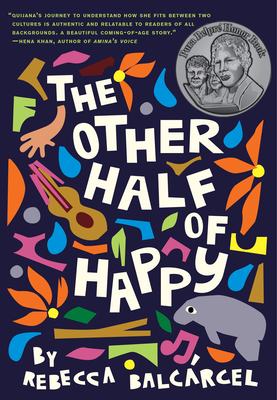
 

Book Review: The Other Half of Happy by Rebecca Balcárcel


On Thursday, we posted a Q&A with debut author Rebecca Balcárcel. Today, Mimi Rankin reviews her novel, The Other Half of Happy.

Review by Mimi Rankin

DESCRIPTION OF THE BOOK: Quijana is a girl in pieces. One-half Guatemalan, one-half American: When Quijana’s Guatemalan cousins move to town, her dad seems ashamed that she doesn’t know more about her family’s heritage. One-half crush, one-half buddy: When Quijana meets Zuri and Jayden, she knows she’s found true friends. But she can’t help the growing feelings she has for Jayden. One-half kid, one-half grown-up: Quijana spends her nights Skyping with her ailing grandma and trying to figure out what’s going on with her increasingly hard-to-reach brother. In the course of this immersive and beautifully written novel, Quijana must figure out which parts of herself are most important, and which pieces come together to make her whole. This lyrical debut from Rebecca Balcárcel is a heartfelt poetic portrayal of a girl growing up, fitting in, and learning what it means to belong.

MY TWO CENTS: I was lucky enough to receive an ARC of The Other Half of Happy at TLA from Michaela at Chronicle Books (Thank you!). Although a normal Middle Grade length, I breezed through Quijana’s story without noticing time pass. Quijana is delightfully normal in the best way possible, and yet she still feels wholly developed, along with the other characters throughout the book. By the time I reached the end, I knew these characters as fully realized, multidimensional people in my own life.

My bias as an adult reader of children’s lit is that although I can remember being twelve, I am not reading this as a twelve year old, so I am truly not reading in the perspective of a child. Likewise, I am not a mother, so while I can empathize with Quijana’s mom, I also cannot read accurately through a shared lens of a parent. Still, even with this disclaimer, Balcárcel’s writing allowed me to have both pairs of eyes; to step back into that horribly awkward preteen skin and empathize with the adult woman whose world is crashing around her as she’s spinning ten plates at once.

Quijana’s story is a beautiful yet fairly simple story of a twelve-year-old girl. She has crushes, she is figuring out her passions, and she struggles with certain school subjects. But there are so many layers to Quijana’s story that many middle schoolers may resonate with; layers that they may think no one else could possibly understand. From having a sibling with sensory sensitivities and developmental delays, to losing a loved one for the first time, to one of the most poignant parts of the story for this reviewer, understanding what it means to be a third culture kid, Balcárcel combines the personal with the universal into a story that is likely to be felt deeply by preteens far beyond the Latinx community. Quijana loves her father but feels a barrier of culture in her own home; the culture she is growing up in is not that of her father’s upbringing. Finding her own balance of defining her identity on her own terms is something she will have to decipher on her own, and I find that to be a compelling and inspiring piece of this book.

Another favorite moment was Quijana’s solidarity with other Latinx kids at the bus stop; Quijana’s perspective guesses that they are Mexican. She tries to strike up a conversation with the little Spanish she knows only to be ridiculed by another student at the bus stop who is assumed to be non-Latinx. This moment bonds together the Latinx students at the bus stop, Quijana included, although it’s made clear that they are not all Guatemalan as Quijana is. This brings up a fascinating idea of unity among Latinx communities in the US; there is some bond beyond differing cultures based solely in language and the experience of the immigrant, of coming from somewhere else.

“That’s what it’s really like being twelve. Everything rolling toward you.” -Page 1

Balcárcel effortlessly brings huge conversations about cultural identity and disabled children to a very real and very simple discussion: life as a twelve-year-old girl. When you’re twelve, everything seems monumental, even if it may not seem that way in nostalgic hindsight. Thanks to Rebecca Balcárcel and Chronicle Books for a wonderful read that brought me back to middle school!


ABOUT THE AUTHOR: Rebecca Balcárcel authored THE OTHER HALF OF HAPPY, a middle-grade novel from Chronicle Books . Rebecca took her MFA from Bennington Writing Seminars and received their Jane Kenyon Poetry Prize. Her work has appeared in journals such as Third Coast and North American Review. Pecan Grove Press of St. Mary’s University published her book of poems, Palabras in Each Fist. Find her on YouTube as the Sixminutescholar. She loves popcorn, her kitty, and teaching her students at Tarrant County College as Associate Professor of English.


file-2ABOUT THE REVIEWERMimi Rankin received her Master’s Degree with distinction in Children’s Literature from the University of Reading. Her thesis, on which she received a rating of First, centered around claims to cultural authenticity and representation in Hispanic Children’s Literature. She currently works in the publishing industry as a marketing manager. Her reviews do not reflect the opinions of her employer.


Spotlight on Middle Grade Authors Part 11: Rebecca Balcárcel


We are back from our summer break with lots of great, new interviews, book reviews, and events planned. We start today with a Q&A with middle grade author Rebecca Balcárcel, who is celebrating the recent release of her debut novel The Other Half of Happy.

By Cindy L. Rodriguez

This is the 11th in an occasional series about middle grade Latinx authors. We decided to shine a spotlight on middle grade writers and their novels because, often, they are “stuck in the middle”–sandwiched between and overlooked for picture books and young adult novels. The middle grades are a crucial time in child development socially, emotionally, and academically. The books that speak to these young readers tend to have lots of heart and great voices that capture all that is awkward and brilliant about that time.

Today, we highlight Rebecca Balcárcel.

Rebecca Balcárcel authored THE OTHER HALF OF HAPPY, a middle-grade novel from Chronicle Books . Rebecca took her MFA from Bennington Writing Seminars and received their Jane Kenyon Poetry Prize. Her work has appeared in journals such as Third Coast and North American Review. Pecan Grove Press of St. Mary’s University published her book of poems, Palabras in Each Fist. Find her on YouTube as the Sixminutescholar. She loves popcorn, her kitty, and teaching her students at Tarrant County College as Associate Professor of English.

The Other Half of Happy is her debut middle grade novel.

It was released August 20, 2019!


Here is the publisher’s description:

Quijana is a girl in pieces. One-half Guatemalan, one-half American: When Quijana’s Guatemalan cousins move to town, her dad seems ashamed that she doesn’t know more about her family’s heritage. One-half crush, one-half buddy: When Quijana meets Zuri and Jayden, she knows she’s found true friends. But she can’t help the growing feelings she has for Jayden. One-half kid, one-half grown-up: Quijana spends her nights Skyping with her ailing grandma and trying to figure out what’s going on with her increasingly hard-to-reach brother. In the course of this immersive and beautifully written novel, Quijana must figure out which parts of herself are most important, and which pieces come together to make her whole. This lyrical debut from Rebecca Balcárcel is a heartfelt poetic portrayal of a girl growing up, fitting in, and learning what it means to belong.


Rebecca Balcárcel

Q. Who or what inspired you to become a writer?
A. Storytellers, books, and teachers! My father is an entertaining storyteller, and I absorbed much from his natural sense of drama and comedic timing. He’ll also suddenly quote a poem with misty eyes and point out the beauty of Spanish sounds. All of this gave me a heightened awareness of language’s power. Books served as my dearest friends throughout childhood. From the magic of picture books before bedtime to full novels, I loved being transported to fictional worlds. I always dreamed of creating that experience for others. I still read to apprentice myself to great authors and learn their craft. And a shout out to my third grade teacher, Miss Valentine, who read Where the Red Fern Grows aloud to us chapter by chapter after lunch. I cried in school, but it was worth it! Later teachers encouraged me to write, and their confidence in me helped me take my writing seriously.

Q: Why did you decide to write a middle grade novel?

A: Can you believe that when I started writing, I didn’t know that this book was middle grade, nor that it was a novel?! Trained as a poet, I started writing prose poems in the voice of a bi-cultural twelve-year-old. She had a lot to say, and in one summer, I created about 40 little scenes. I wasn’t sure, though, if this was an adult looking back or a true MG project. It was my agent who said, “I think this would sing as a middle-grade novel.” I decided to go for it! It took two years of revision and rewriting to turn my stack of poems into a novel. It turns out, I love writing middle grade. That age is a time of deepening self-knowledge and broadening world-knowledge, the pivot point between child and adult. So much of who we are emerges in those years. It’s a psychologically rich moment to write about.

Q. What are some of your favorite middle grade novels?

A. So many! The classics, like Charlotte’s Web and Bridge to Terabithia, still make me cry. But I’m thrilled to be reading many new novels of worth. This year, I’ve especially enjoyed Caterpillar Summer by Gillian McDunn, which has a child with autism like my book does, and the just-released For Black Girls Like Me by Mariama Lockington, whose main character straddles two cultures, as mine does. I’ve sought out Latina writers, and have found an amazing community. Las Musas Books (https://www.lasmusasbooks.com/) is an entire collective of new YA and MG novelists! I’ve also loved Me, Frida, and the Secret of the Peacock Ring by Angela Cervantes and Stef Soto, Taco Queen by Jennifer Torres. And let’s not leave out this year’s Newbery winner, Merci Suarez Changes Gears by Meg Medina. Great books!

Q. If you could give your middle-grade self some advice, what would it be?

A. Don’t be embarrassed by what moves you! If a song or an idea touches your heart or blows your mind (in a good way), keep exploring in that direction. That’s the direction in which you will find kindred spirits, true friends, and your own growth. Ignore the people that pooh-pooh your music, your style, or whatever you geek out on. Fly that freak flag and own your joy!

Q. Finish this sentence: Middle grade novels are important because…

A.  . . . they inspire us to be our best selves!


photo by Saryna A. JonesCindy L. Rodriguez was a newspaper reporter for The Hartford Courant and researcher at The Boston Globe before becoming a public school teacher. She is now a reading specialist at a Connecticut middle school. Cindy is a U.S.-born Latina of Puerto Rican and Brazilian descent. She has degrees from UConn and CCSU. Her debut contemporary YA novel, When Reason Breaks (Bloomsbury 2015). She also has an essay in Life Inside My Mind (Simon Pulse 2018). She can be found on FacebookTwitter, and Goodreads.


We’re on Summer Break!


As of today, we are on summer vacation! When we return in September, we’ll celebrate more books by Latinx creators. Through the remaining summer weeks, we’ll keep in touch by tweeting past posts you may have missed, but shouldn’t!

You keep in touch, too. If you would like to contribute a blog post related to our mission, or request a review of a book, please contact us through the form on the blog or by emailing: latinosinkidlit@gmail.com. Note: We regrettably cannot guarantee a review for every book, as you’ll see in our reviewing policy.

So look for new posts in September, and don’t forget to follow us on Twitter or Facebook. Happy summer, everyone!

IMG_2938

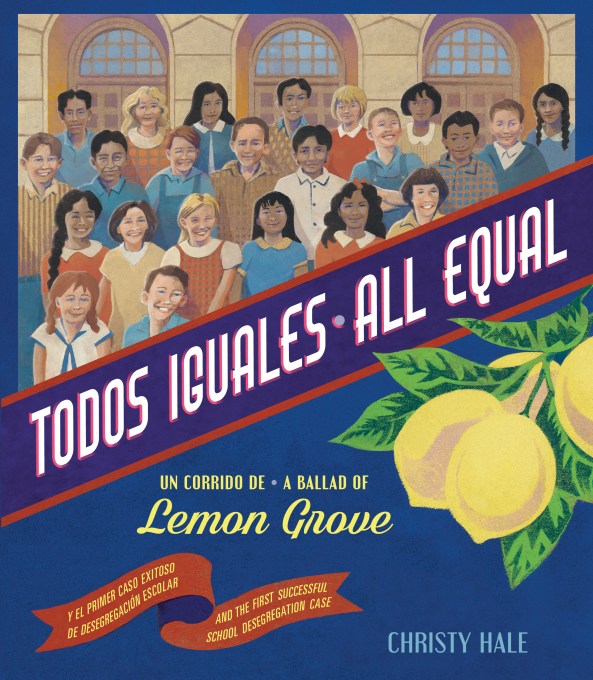
Cover Reveal: Todos Iguales: Un Corrido de Lemon Grove/All Equal: A Ballad of Lemon Grove by Christy Hale

We are delighted to host the cover reveal for Christy Hale’s picture book, Todos Iguales: Un Corrido de Lemon Grove/All Equal: A Ballad of Lemon Grove, which will be published by Lee & Low Books.

Before we reveal the cover, here is some information about the author-illustrator, taken from her website:


Christy HaleAs a young child I resisted the temptation to make marks in books by drawing on a handy little pad of paper. I tore off my “illustrations” and tucked them along side the appropriate writing passage. By age ten I decided to become a writer and illustrator. At this time my best friend and I acted out all the books we loved. A favorite was Harriet the Spy. We dressed up in disguises, lurked around the neighborhood, and took notes of anything interesting we observed. Then we began writing and illustrating our own stories after school.
I have created books as long as I can remember. I studied calligraphy, bookbinding, letterpress and all other means of printing, typography, design, illustration, and desktop publishing.

I received a B.A. in Fine Arts and Masters in Teaching at Lewis & Clark College in Portland, Oregon, then worked as an art educator for several years. I relocated to New York, earned a B.F.A. in illustration at Pratt Institute, then worked in publishing as a designer and art director. I taught at the Center for Book Arts and as an adjunct professor in the Communication Design department at Pratt Institute—all while beginning my illustration career. I’ve illustrated many books for children and now am writing stories as well.

At the end of 2001 I relocated to Northern California with my husband and daughter. I continue to work as a writer, illustrator, designer, art director, and as an educator—offering programs at museums, schools, libraries, and for staff development. I teach an online course in Writing for Picture Books through the illustration department at the Academy of Art University in San Francisco.

Now, here is some information about the book from the publisher:

Twelve-year-old Roberto Álvarez loved school. He, his siblings, and neighbors attended the Lemon Grove School in California along with the Anglo children from nearby homes. The children studied and played together as equals.

In the summer of 1930, the Lemon Grove School Board decided to segregate the Mexican American students. The board claimed the children had a “language handicap” and needed to be “Americanized.” When the Mexican families learned of this plan, they refused to let their children enter the new, inferior school that had been erected. They formed a neighborhood committee and sought legal help. Roberto became the plaintiff in a suit filed by the Mexican families. On March 12, 1931, the case of Roberto Álvarez v. the Board of Trustees of the Lemon Grove School District was decided. The judge ruled in favor of the children’s right to equal education, ordering that Roberto and all the other Mexican American students be immediately reinstated in the Lemon Grove School.

This nonfiction bilingual picture book, written in both English and Spanish, tells the empowering story of The Lemon Grove Incident–a major victory in the battle against school segregation, and a testament to the tenacity of an immigrant community and its fight for equal rights.

Finally, here is the cover of Todos Iguales: Un Corrido de Lemon Grove/All Equal: A Ballad of Lemon Grove:

Start scrolling…

*

*

*

*

*

Keep scrolling…

*

*

*

*

*

Almost there…

*

*

*

*

*

Ta-da!

TODOS IGUALES FC hi res

The book releases August 13, 2019 and is available for pre-order now.


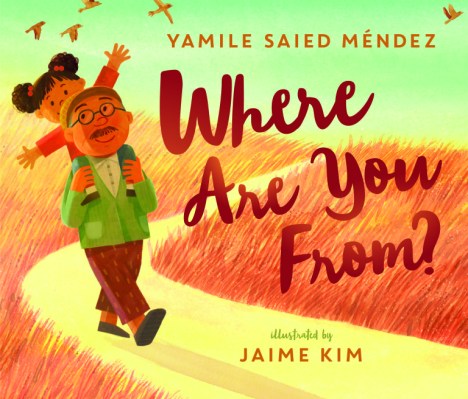
Where Are You From? by Yamile Saied Méndez


Reviewed by Romy Natalia Goldberg

Description of the book:

“Where are you from? they ask.” A young girl’s confidence is shaken after increasingly persistent questioning from her peers, teachers and friends’ parents. She turns to Abuelo, her loving grandfather, for answers. “Where am I from?” she asks, knowing he has faced these questions before. Abuelo answers by describing with lyrical beauty her parents’ places of origin. As he speaks, the landscapes around them morph, from the Pampas and Andean peaks of Argentina to the coastline and rainforests of Puerto Rico. But this immersive journey is not powerful enough to quell the doubts instilled by her peers. Echoing their questioning, she insists, “where am I really from?” At this, Abuelo points to his heart. She comes from her family’s love. As he continues, they are joined by a large, joyful family. The sun begins to set as her doubts settle. Surrounded by their unquestioning love, bathed in the light of the afterglow, she is newly confident.

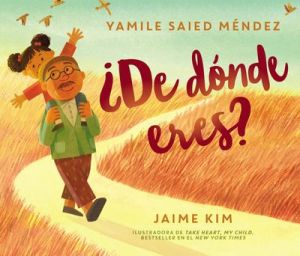
Released simultaneously in English and Spanish, WHERE ARE YOU FROM? joins a slate of high quality Latinx books dealing with identity and belonging. Additionally, it is one of very few picture books depicting Latinx characters from the Southern Cone.
My two cents:

“Where are you from?” The question implies a progression – where did you begin and where are you going? Though often asked out of sheer curiosity, many times it is a loaded question, one whose answer can be used to justify exclusion and discrimination. The girl’s declaration that she is “from here, from today, same as everyone else” is a request to be treated as an equal, as someone who belongs. Once this request is ignored, she retreats to the family that created her, that asks her to justify nothing. The luminous landscapes with skies full of birds and stars suggest the limitless possibilities Abuelo wants for his granddaughter. Though the soaring landscapes could have felt overwhelming, they exude warmth and reassurance. As educators and parents, is this not how we want our kids to feel?

WHERE ARE YOU FROM? could easily have opened with a scene of overt bullying. Instead, the author and illustrator create a more nuanced scenario. The girl is being questioned by a diverse group of kids and adults, all with facial expressions that range from neutral to kind.

By eliminating a stereotypical “villain,” WHERE ARE YOU FROM offers a more realistic depiction of microaggressions endured by children of color (and children with other noticeable differences, such as accented speech).

One of the things I appreciate the most about this book is that we never circle back to the people who questioned the main character at the start. This is an excellent example of what happens when an “own voices” author is allowed to write from their experience. As adult readers, we know the girl will be asked “where are you from?” countless times and ways throughout her life due to the color of her skin. We know that, for some people, her answers will never be right or good enough. By allowing the girl to find an emotional resolution entirely within the context of her support system, WHERE ARE YOU FROM? sends young readers a powerful message: you do not have to justify your existence to others.

For children of mixed heritage, the question “where are you from?” has the power to generate an additional level of self-doubt. A few spreads into the girl’s journey with Abuelo, readers are lulled into the sense that they know where she is from. When Abuelo takes us from Argentina to Puerto Rico we are challenged to open our minds. Like many children, she is not “from” a single place.  Rather than simplify (or flatten, or erase) her heritage, WHERE ARE YOU FROM? invites readers to accept the main character’s complex heritage as something that is beautiful to behold.

Teaching Tips

WHERE ARE YOU FROM? can be used as a prompt for students to explore their heritage. This could be done exclusively as a writing exercise or could incorporate art in the form of illustrations or collage/printed images. Additionally, students could choose who they would like to go on their journey with – would they want to travel through space and time with a family member, as the girl in this book does? Or would they rather choose a historical figure as their guide?

WHERE ARE YOU FROM? naturally lends itself to a nuanced discussion of microaggressions. Students could be prompted to discuss whether they believe the main character’s peers are questioning her out of curiosity or malice. Does that change the effect their constant questioning has on the girl? Do they even have the right to ask this question? And what does it mean that no one was willing to accept the girl’s original answer? However, educators should take care to ensure class discussions do not put undue burden on students of color to share personal experiences of mistreatment.

WHERE ARE YOU FROM? can be a starting point for learning about two very different parts of the Americas. Lessons for younger students could focus on the eco-systems of both regions. Older students can tackle heavier subjects alluded to in the final spreads for each location: the history of colonialism and slavery in Puerto Rico and the human rights abuses of Argentina’s military dictatorship. Lessons on Puerto Rico should also touch on the territory’s relationship to the rest of the United States and Latin America. Like the protagonist, Puerto Rico has a multifaceted background.

Additionally, the vivid verbs featured in WHERE ARE YOU FROM? could be incorporated into a lesson on synonyms and/or creative writing.

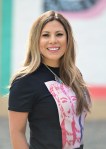
About the author: Yamile Saied Méndez is an Argentine-American who lives in Utah with her Puerto Rican husband and their five kids. An inaugural Walter Dean Myers Grant recipient, she’s also a graduate of Voices of Our Nations (VONA) and the Vermont College of Fine Arts MFA Writing for Children’s and Young Adult program. In this blog post from 2017, she shares with our readers what it was like to study for her MFA. Much has happened since then. Yamille is now a PB, MG, and YA author, and is also part of Las Musas, the first collective of women and nonbinary Latinx MG and YA authors. To learn more, visit Yamile’s website.
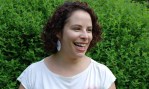
 

About the reviewer: Romy Natalia Goldberg is a Paraguayan-American travel and kid lit author with a love for stories about culture and communication. Her guidebook to Paraguay, OTHER PLACES TRAVEL GUIDE TO PARAGUAY, was published in 2012 and 2017 and led to work with “Anthony Bourdain: Parts Unknown,” and The Guardian. She is an active SCBWI member and co-runs Kidlit Latinx, a Facebook support group for Latinx children’s book authors and illustrators.