Review: The Adventures of Chupacabra Charlie by Frederick Luis Aldama, illus. by Chris Escobar

Reviewed by Elena Foulis

SUMMARY FROM OHIO STATE PRESS: In their debut picture book, Frederick Luis Aldama and Chris Escobar invite young readers along on the adventures of Chupacabra Charlie, a polite, handsome, and unusually tall ten-year-old chupacabra yearning for adventure beyond the edge of los Estados Unidos. Little does Charlie know when he befriends a young human, Lupe, that together, with only some leftover bacon quesadillas and a few cans of Jumex, they might just encounter more adventure than they can handle. Along the way, they meet strange people and terrifying danger, and their bravery will be put to the test. Thankfully, Charlie is a reassuring and winsome companion who never doubts that he and Lupe will return safely home.

With magical realism, allegory, and gentle humor, Aldama and Escobar have created a story that will resonate with young and old readers alike as it incorporates folklore into its subtle take on the current humanitarian crisis at the border.

MY TWO CENTS: Based on real and imagined tales, The Adventures of Chupacabra Charlie, tells the story of a young Chupacabra whose life at the border is full of adventure, if you dare to follow. Charlie lives in the attic of a Bordertown in Mexico. He tells the reader about how, although considered a monster and sometimes feared, he is a kid who is looking for adventures. He tells us about his family life, and we see and read about the importance of family, education, and creativity. For example, the author and illustrator provide a wonderful scene of Charlie’s family dinner, the long tradition of family storytelling and the importance of listening to and learning from these stories. The story provides a great, balanced view of the value of learning in formal and informal settings and of using our imaginations to solve problems. The storyline always warns us about forgetting those family values and how that sometimes leads into negative stereotypes that can affect an entire community. While this is a children’s story, the writing and illustrations help young readers see how the poor choices of a few bad apples can impact the welfare of others.

Despite some of the obstacles and negative perceptions that Charlie faces, this story is about a voyage of bravery, and the meaning of friendship, even with people who do not look like you. We can choose to share life together. Charlie’s new friend, Lupe, becomes Charlie’s partner in an adventure that provides more than a thrill for them; indeed, their mission becomes to free children al otro lado of The Wall, who have been kept in cages. This young readers’ book is refreshing in the way it incorporates life at the border, through bilingualism and storytelling rooted in Latin American traditions such as Realismo Mágico.

One thing that catches our attention is the use of Spanish. While it only incorporates a few words and phrases, it only writes them in italics once, and if the word or phrase is used again, it uses the same font as the rest of the story. This is significant, in my view, because it allows the reader—who may or may not be bilingual—to pause, but then it expects them to learn and normalize bilingualism. Indeed, much of what this book presents are topics that are often complex or controversial and frequently void of the human perspective. More specifically, in the thinking about The Wall that separates the U.S. and Mexico, accepting people’s use of Spanish as part of who they are, and the reality of family separation at the border, which includes putting young kids in detention centers that are cage-like, often times, we forget to broadly think about how real people are deeply affected by all of this. The book tackles those topics in a way that is natural and promotes acceptance and heroism, as we dare to imagine that we can all do something to make someone else’s life a little or a lot easier.

Lastly, the illustrations are detailed and complement the storyline beautifully. I like how the images pay attention to details of city and rural life, highlighting cultural and geographical markers with care, such as el paletero, los nopales, the Wall, and even the flying car and the jar of pickles.


ABOUT THE AUTHOR: Frederick Luis Aldama is Irish-Guatemalan and Mexican Latinx. His mamá was a bilingual elementary school teacher in California. As a kid, he couldn’t get enough of his abuelita’s stories of El Chupacabra, La Llorona, and El Cucuy. Today he is a Distinguished University Professor at The Ohio State University. He is the author, coauthor, editor, and coeditor of 36 books.


ABOUT THE ILLUSTRATOR: Chris Escobar is a printmaker and cartoonist currently living in Savannah, Georgia. He has an MFA in Sequential Art from the Savannah College of Art and Design. Chris has created illustrations for the comic anthology Floating Head and editorial illustrations for Dirt Rag magazine, among other publications.


ABOUT THE REVIEWER: Elena Foulis has a Ph.D. in Comparative Literature and Cultural Studies from the University of Arkansas. Her research and teaching interests include U.S. Latina/o literature, and Digital Oral History. Dr. Foulis is currently working on a digital oral history project about Latin@s in Ohio, which is being archived at the Center for Folklore Studies’ internet collection. Some of these narratives can be found in her iBook titled, Latin@ Stories Across Ohio. She is also producer and host of Ohio Habla.


Our Stories Are the Remedios We Need Right Now

by Tracey T. Flores

I think about my city and all the changes that it’s been through. And all the changes that will come. But I know that here in our little house, there are things that will always be the same.  ~from My Papi has a Motorcycle by Isabel Quintero
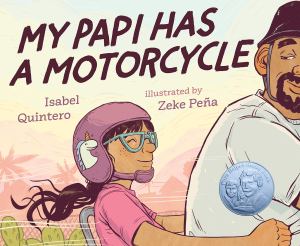
My Papi Has a Motorcycle, written by Isabel Quintero and illustrated by Zeke Peña, tells the story of young Daisy Ramona, a girl who eagerly awaits her Papi’s return home after a long day at work. When he arrives, Daisy Ramona and her Papi will take a ride through their city on the back of his motorcycle. Their ride takes us on a journey through their changing neighborhood, where we get a glimpse into the places and people that make her community so special. On their ride, Daisy and her Papi pass the local panadería where they buy conchas on Sunday mornings, the post office, and their abuelito’s yellow house (where the food always tastes better). They greet each person they meet with a nod of the head or a wave, letting readers see the closeness of this comunidad. Daisy’s ride with her Papi reminds us that although the world outside their home is changing, the love inside will always stay the same.

I love this cuento. I have shared it with my 4-year old daughter, Milagros, my graduate students in our family-and-community literacies course, and the mamas that I work alongside and learn from at our partner school. Recently, I revisited this cuento and found healing and comfort in it, like a warm bowl of sopa de fideo.

Currently, when I watch the news, it is easy to feel scared and helpless. The impact of this moment on our familias and comunidades is real and heartbreaking. At times, I have found it difficult to imagine our world after this moment. Will my parents be okay? How will my daughter remember this time? What will our comunidades look like after this moment?

In these questioning moments, these moments of uncertainty, I am finding healing, comfort and strength in the lessons and wisdom of our collective Latinx stories.

In our stories, I feel the deep, unconditional love that is the foundation of our familias.

In our stories, I remember every day moments with my loved ones.

In our stories, I bear witness to the fight of our Nanas and Tatas and the obstacles they have overcome in their lives so that we can thrive.

In our stories, I am gifted our history and the wisdom and lessons of our ancestors we carry with us as tools of resistance, hope and survival.

It is in the telling and retelling of our stories that I remember good times, where I am reminded that although the world outside our homes is changing, there are things like our familial love, the strength of our comunidades, and the fight of our gente that will always stay the same.

I offer more cuentos for you to turn to in this moment. From these cuentos, our cuentos, I hope you find peace, comfort and healing. In addition, I invite you to reflect on and remember the cuentos from your own life, those gifted to you by your elders, and those you share with the younger generations—write them down, record them, create art around them—and never forget them, for they are your strengths.
Abuelita Full of Life/Llena de vida

Written by Amy Costales & Illustrated by Martha Aviles

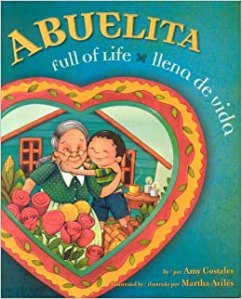
When José goes to the park with Abuelita, they have a walk. At first he misses his bike. But, he likes when Abuelita holds his hand and he can feel the strength that flows beneath her wrinkly skin. She teaches him the names of the trees and the flowers they see on the way. José is amazed by how much he used to miss by rushing by on his bike.

These words capture the loving relationship that José develops with his abuelita when she comes to live with the family. Abuelita brings life, love and pride into their home. In her company, he learns healing remedies, the beauty of English and Spanish, and the deep love of his abuelita. This book reminds me of the wisdom and love that is deeply rooted and embodied in the stories, histories and ways of knowing and being of our Nanas, Tatas, and Abuelitos, and the healing that comes from their presence in our lives.
 

Tía Isa Wants a Car

Written by Meg Medina & Illustrated By Claudio Muñoz

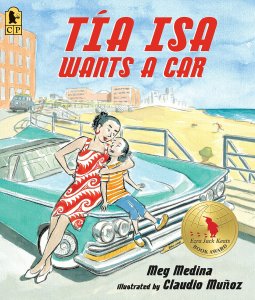
But Tía Isa is already touching the front seat, big enough for three. She nods when I show her there’s room in the back for more of us, who’ll come soon.

“You’re right mi hija,” she says. “This one will take us all where we want to go.”

 Tía Isa shares with the family that she wants to buy a car. Her declaration is met with resistance and ridicule from everyone except her young niece, who imagines all the places this car will take them. Together, Tía Isa and her niece save money to buy a car, one big enough for the entire family to travel to the sea. This cuento truly touches my heart, as I see the faces of all the women in my familia represented in Tía Isa. In this cuento, I remember the strength, determination and creativity of my own mama, nana and tias, and I think about the ways they always speak and manifest their dreams and goals into reality for our entire family. It also reminds me of the strong bond of our familias and the importance of always sticking together.
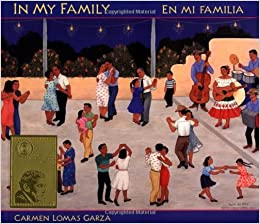
In My Family/En mi familia

Written & Illustrated By Carmen Lomas Garza

My grandmother is holding a baby. She was holding the babies. And, feeding them, and putting them to sleep.

Through detailed illustrations and short vignettes, artist Carmen Lomas Garza captures the essence of the love for her familia and comunidad that are central to her childhood memories of growing up in Kingsville, Texas. Each illustration features special moments spent with her familia as they gathered for birthday parties, to cook tamales, to make cascarons and dance en el jardín. This book reminds me of the beauty and remedios of our family memories and the joy that is present in our daily lives.
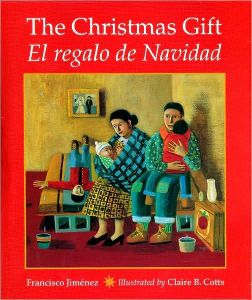
The Christmas Gift/El regalo de la navidad

Written by Francisco Jiménez and Illustrated by Claire B. Cotts

Most of us have a favorite Christmas story to tell…Like all of my short stories, it is based on an experience I had as a child…It took place in a farm labor tent camp in Corcoran, California.

Author and storyteller Francisco Jiménez (Panchito) shares a Christmas story from his childhood. A few days before Christmas, the family had just moved again to a new camp to find work, money and food was scarce. For Christmas, Panchito was hoping to receive a red ball. When he awoke on Christmas day to find that he did not receive a ball, but a bag of candy, he was disappointed, until he saw the thoughtful gift that his father gave to his mother. I love all books written by Francisco Jiménez, and this book is one of my favorite stories to share with others. In his story, I am reminded of my own family, especially my mother and father, and all the sacrifices they have made and continue to make for our family. It makes me remember the important things in life – our health, our bond as a family and the gift of being together.

Imagine

Written By Juan Felipe Herrera & Illustrated by Lauren Castillo

If I jumped up high into my papi’s army truck and left our village of farmworkers and waved adios to my amiguitos. Imagine.

 Poet Juan Felipe Herrera journeys us through his life recounting moments of both triumph and struggle as he continued imagining the future. His words take us from the village where he lived as a small child, to his first day of school in a new country, all the way to the steps of the Library of Congress where he reads his poetry and signs his books with “Poet Laureate of the United States.” The poetry of his experiences that he shares can teach us to always imagine endless possibilities for our lives and our worlds. In his words, I am reminded to always have hope and to never stop being a learner.
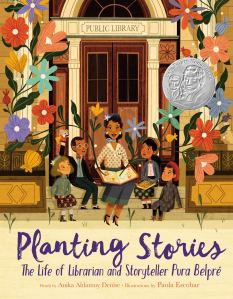
 

Planting Stories: The Life of Librarian and Storyteller Pura Belpré

Written by Anika Aldamuy Denise & Illustrated by Paola Escobar

Now a published author, puppeteer, and storyteller, Pura travels from branch to branch, classroom to classroom, to churches and community centers…planting her story seeds in the hearts and minds of children new to this island who wish to remember la lengua y los colores of home.

 This book stories the life of librarian, author, puppeteer, and storyteller Pura Belpré. As the first children’s librarian from Puerto Rico, Pura Belpré planted seeds of cuentos from her homeland, retelling traditional stories, in English and Spanish, to bilingual children and families in New York. Noticing a lack of Spanish books in the library, Pura Belpré wrote and published the traditional stories she orally shared and opened space in the library for the Spanish-speaking comunidad to feel included and at home. This book reminds me of the power of our stories and the necessity of sharing them with others. Also, the importance of writing and recording them for future generations.
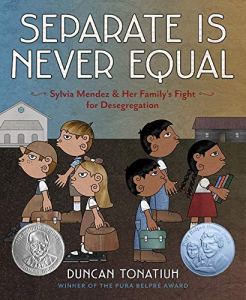
Separate is Never Equal: Sylvia Mendez and Her Family’s Fight for Desegregation

Written and Illustrated by Duncan Tonatiuh

The Mendez family did not give up. Time and time again, Sylvia hear her father talk with coworkers, friends, and other parents. “It’s not fair that our kids have to go to an inferior school,” he said. “It’s not only the building that’s a problem—the teachers at school don’t care about our children’s education. They expect them to drop out by the eighth grade. How will our children succeed and become doctors, lawyers and teachers?”

 This book tells the true story of Sylvia Mendez and her parents’ fight to end school segregation in California in the historic Mendez v. Westminster decision. The Mendez decision was reached seven years prior to the Brown V. Board of Education case which dismantled the “separate but equal” doctrine in public education. From this story, we learn about the key role that our familias and comunidades had in the desegregation of our schools, which is often absent from the history we learn in school. In this book, I witness the courage and advocacy of the Mendez family and I am reminded of our proud history and our collective power when we come together.

Tracey T. Flores is an assistant professor of language and literacy in the Department of Curriculum and Instruction at the University of Texas at Austin. She is a former English Language Development (ELD) and English language arts teacher, working for eight years in K-8 schools throughout Glendale and Phoenix, Arizona. Tracey is the founder of Somos Escritoras/We Are Writers (www.somosescritoras.com), a creative space for Latina girls (grades 6-8) that invites them to write, share and perform stories from their lived experiences using art, theater and writing as a tool for reflection and examination of the worlds. She can be contacted at: tflores@austin.utexas.edu and on Twitter @traceyhabla.

Don’t miss Tracey’s write-up for Latinxs in Kid Lit about her work with Somos Escritoras! 


Spotlight on Middle Grade Authors: Kim Baker


By Cindy L. Rodriguez

This is an occasional series about middle grade Latinx authors. We decided to shine a spotlight on middle grade writers and their novels because, often, they are “stuck in the middle”–sandwiched between and overlooked for picture books and young adult novels. The middle grades are a crucial time in child development socially, emotionally, and academically. The books that speak to these young readers tend to have lots of heart and great voices that capture all that is awkward and brilliant about that time.

Today, we highlight Kim Baker.

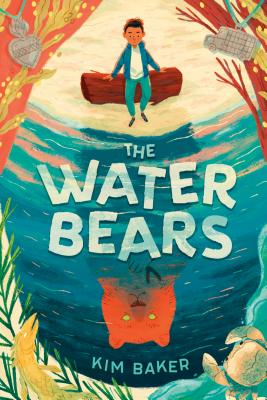
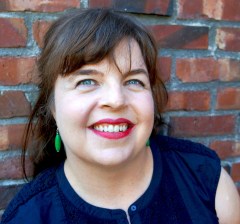
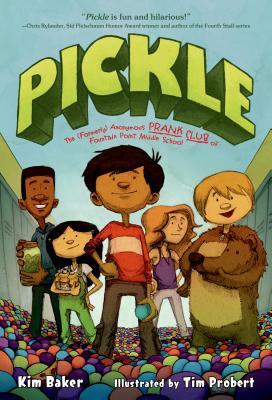
Kim Baker’s first middle grade novel, PICKLE, has been selected for many reading lists and was a CBC Children’s Choice Awards Book of the Year finalist, a Texas Bluebonnet Award finalist, and an SCBWI Crystal Kite winner. Her next book, THE WATER BEARS, will be released from Wendy Lamb Books, Random House on April 21, 2020. When she was thirteen, she lived above an old theater and drove a rusty VW van to odd jobs. Now she lives in Seattle, near tide pools but usually far from bears. Find more at www.kimbakerbooks.com

Water Bears releases tomorrow, April 21, 2020.


Here is the publisher’s description:

Newt Gomez has a thing with bears. Last year, he survived a bear attack. And this year, he finds an unusual bear statue that just might grant wishes. Newt’s best friend, Ethan, notices a wishbone on the statue and decides to make a wish. When it comes true, Newt thinks it’s a coincidence. Even as more people wish on the bear and their wishes come true, Newt is not convinced.

But Newt has a wish too: while he loves his home on eccentric Murphy Island, he wants to go to middle school on the mainland, where his warm extended family lives. There, he’s not the only Latinx kid, he won’t have to drive the former taco truck–a gift from his parents–and he won’t have to perform in the talent show. Most importantly, on the mainland, he never has bad dreams about the attack. Newt is almost ready to make a secret wish when everything changes.

Tackling themes of survival and self-acceptance, Newt’s story illuminates the magic in our world, where reality is often uncertain but always full of salvageable wonders.


Kim Baker

KimBaker_headshot

Q. Who or what inspired you to become a writer?

I wanted to be a writer for my whole life. I love reading. I love spending time around books and story makers. Shelves of books are my happy place. I volunteered after school in the school library during fourth and fifth grade. I would bike across town to go to the used bookstore and soak up that vanilla smell that comes off the yellow pages. Some of my favorite places are libraries and bookstores. My parents and teachers were supportive, so I wrote a lot as a kid. My second grade teacher, Ms. Moyer, wrote, “Hope to see you as a writer someday!” in my yearbook. She probably wrote that in every student’s yearbook, but I took it to HEART. I felt like she really saw me that way. For a long time, I didn’t think writing stories for a living was practical, so I pursued other careers. After a move, I switched gears and took writing classes when my kids were little. I got involved in our regional SCBWI community. I attended conferences and workshops, read craft books, and wrote crappy stories. I honed my abilities and took a shot. Now, I’m inspired to keep writing by the book community. I want to stay in this club forever.

Q. Why do you choose to write middle grade novels?

Sometimes, when I teach workshops, I have writers make a list of their five favorite books growing up. Not just the first ones they remember, but the ones that they identified with that filled their hearts. It’s a good gauge to find where your voice might be. Most of my favorites came from the middle grade years. They call it the golden age of reading, when kids pick out more of their own books and look for those windows and mirrors. It’s outwardly focused as kids look for where they might fit in the world. When I really started diving in and considering middle grade as a direction, I’m continuously amazed by how much great writing and potential there is with the form.

I didn’t have a lot in common with the characters as a kid because they didn’t reflect a lot about my life. There weren’t a lot of Latinx families, or working class families, or blended families. I really like that stories are reflecting more realities now and giving kids those opportunities to see themselves as the heroes.

Q. What are some of your favorite middle grade novels?

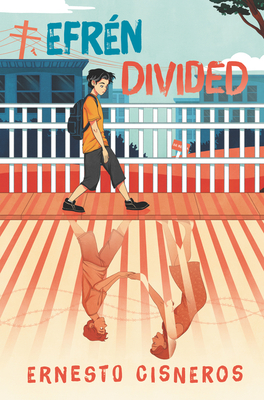
The quality of middle grade novels is amazing these days! There’s so much more choice now than when I was young. It’s so hard to narrow down, but I’ll read anything by Kate Messner, Jason Reynolds, Meg Medina, or Rebecca Stead. We’ve seen some amazing debut novels in the last couple of years— Front Desk by Kelly Yang, The Line Tender by Kate Allen, I Can Make This Promise by Christine Day, Into the Tall, Tall, Grass by Loriel Ryon, and Efrén Divided by Ernesto Cisneros. And I’m preordering so many books by new Latinx authors, like my fellow writers in Las Musas. How cool is that?

Q. If you could give your middle-grade self some advice, what would it be?

I would say that anything is possible and never to count myself out.

Q. Please finish this sentence: Middle grade novels are important because…

They offer hope.


Also by Kim Baker:


photo by Saryna A. JonesCindy L. Rodriguez was a newspaper reporter for The Hartford Courant and researcher at The Boston Globe before becoming a public school teacher. She is now a reading specialist at a Connecticut middle school. Cindy is a U.S.-born Latina of Puerto Rican and Brazilian descent. She has degrees from UConn and CCSU. Her debut contemporary YA novel is When Reason Breaks (Bloomsbury 2015). She also has an essay in Life Inside My Mind (Simon Pulse 2018) and wrote the text for Volleyball Ace, a Jake Maddox book (Capstone 2020). She can be found on FacebookTwitter, and Goodreads

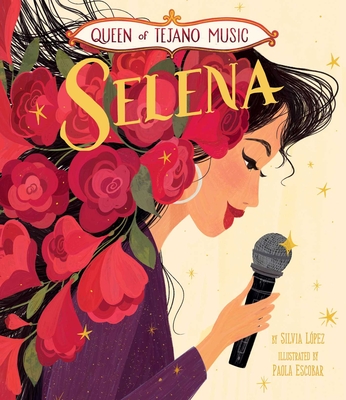
Book Review: Queen of Tejano Music: Selena by Silvia López, illus. by Paola Escobar


Review by Emily R. Aguiló-Pérez

DESCRIPTION OF THE BOOK: Selena Quintanilla’s music career began at the age of nine when she started singing in her family’s band. She went from using a hairbrush as a microphone to traveling from town to town to play gigs. But Selena faced a challenge: People said that she would never make it in Tejano music, which was dominated by male performers. Selena was determined to prove them wrong.

Born and raised in Texas, Selena didn’t know how to speak Spanish, but with the help of her dad, she learned to sing it. With songs written and composed by her older brother and the fun dance steps Selena created, her band, Selena Y Los Dinos, rose to stardom! A true trailblazer, her success in Tejano music and her crossover into mainstream American music opened the door for other Latinx entertainers, and she became an inspiration for Latina girls everywhere.

MY TWO CENTS: As a middle-grader, Selena was my idol! I wish I had found her music earlier, but it was perhaps a year or so before her death. When the news broke, I was devastated and found solace in listening to her music and learning about her as much as possible. To this day, her music is a big part of my life. I had her CDs and her doll, I learned her songs and movements, and sometimes I even made up my own choreography. I approached this book, then, not only as a reviewer of children’s books but also as a lifelong fan of Selena.

 How does one introduce to children the life of such an important icon of Latinx music whose life ended so tragically and so soon? Queen of Tejano Music: Selena tells the story of Selena Quintanilla, from her childhood in Lake Jackson, Texas to her successful career as a trailblazing singer and fashion designer. Presented in twenty short vignettes, López perfectly presents enough details on each page without overwhelming the reader with too much text.

Selena Quintanilla was born on an Easter Sunday, on April 16, 1971 to Marcella and Abraham Quintanilla, who, as a young man, had dreams of a music career. Selena “had been singing almost since she could talk” and soon after her parents realized she had perfect pitch. With her brother A.B. on guitars and her sister Suzette on the drums, music became a family affair. Through the years, the family band performed anywhere they could, and after a few years, Selena y Los Dinos was born. Through this history of Selena’s life and music career, López reminds readers of the challenges she faced: overcoming the language barrier, stepping into a male-dominated music landscape, and her father’s initial opposition to Selena’s romantic relationship with Chris Pérez.

This biographical account of Selena’s life and work is inspirational. Along with some of the obstacles that Selena encountered, the author highlights so many of the singer’s achievements that paved the way for women in music. At age fifteen, Selena won a Tejano Music Award for Female Vocalist of the Year, an accolade she continued receiving for years, along with other ones. She later received a Grammy Award for Best Mexican American Album. Yet, her success was not only measured in awards. López writes about Selena as a philanthropist, fashion designer, entrepreneur, and caring human who loved her family.

The narrative part of the book does not explicitly mention Selena’s death. Rather, this information is offered on the back pages of the book. I debated whether this part of Selena’s story should have been included in the main narrative or not. Yet, I thought it was handled gracefully. By writing the main text in past tense, López alludes to her passing and then offers more information about it after the last vignette. At this point, readers are presented with a timeline that begins with Selena’s birth in 1971 and ends in 1997, when the movie Selena starring Jennifer Lopez opened in theaters. Following the timeline, the book presents “A Little More About…,” a section with short pieces of information about Tex-Mex Music, Quinceañeras, and Corpus Christi, among others, as well as more details about Selena, including her tragic death. One observation to make here is the section titled “Hispanics or Latinos” seems to present the terms as synonyms: “Tejanos are part of a larger group of Americans, called Hispanics or Latinos, who have Spanish-speaking ancestors.” While many Latinxs are also Hispanic, there are some differences that could have been easily explained there. Nevertheless, the information is accessible, clear, and easy to understand.

The colorful illustrations are as vibrant as Selena’s smile and capture the singer’s bubbly personality. Paola Escobar creates a medley of double-page spreads and illustrated vignettes that depict in more detail specific moments in Selena’s life and specific aspects of her culture. One page depicts five moments as if they were Polaroid pictures, inviting the reader perhaps to think of her song “Fotos y Recuerdos” (pictures and memories). I noticed that on almost every page or spread, a flower is illustrated, whether it is a print fabric, picture, real flower, or even a pin. Details such as this one are just an example of how Escobar’s illustrations enhance and complement López’s writing to create an engaging work of art.

There have been several books and media about Selena’s life, in addition to musical tributes, fan-made merchandise, anniversary albums, and makeup lines, to name a few. In October 17, 2017, Google honored her with a doodle, as part of the launch of a virtual exhibit on Google Arts & Culture. Joining these tributes, Queen of Tejano Music: Selena is a celebration of the singer’s life—her music, her fashion, her memory, and her legacy, still alive and strong 25 years after her passing. A perfect addition to any picture book collection!

Queen of Tejano Music: Selena releases August 25, 2020 in both English and Spanish.


IMG_6548.JPGABOUT THE AUTHOR: (from the dust jacket) A Cuba native raised in Miami, Silvia López holds degrees in English, library science, and educational technology. Her career as a children’s librarian at schools and public libraries spans over three decades. She is a published author of books for children, including biographies and picture books such as Just Right Family: An Adoption Story, and a collaboration with Italian artist Guido Daniele, Handimals: Animals in Art and Nature. Also, her digital book, Zuzuncito: Un Cuento del Pájaro Abeja Cubano, was named Best Children’s Picture eBook of 2017 by the International Society of Latino Authors.


Paola Escobar Biography - pickledinkABOUT THE ILLUSTRATOR: Paola Escobar is a Colombian graphic designer and illustrator. She has illustrated books for a variety of publishers in Latin America, Europe, and the United States, as well as for digital and print magazines. Some of her work includes Planting Stories: The Life of Librarian and Storyteller Pura Belpré, written by Anika Aldamuy Denise, and Little Guides to Great Lives: Anne Frank, written by Isabel Thomas. She is currently drawing and living very happily in Bogotá with her husband and her dog, Flora.


headshotABOUT THE REVIEWER: Emily R. Aguiló-Pérez is an Assistant Professor of English (Children’s Literature) at West Chester University of Pennsylvania.  Her teaching and research are in the areas of children’s literature (particularly Latinx literature), girlhood studies, and children’s cultures. Currently her research examines representation in transitional chapter books that feature Latinx characters. In addition, she is managing editor of Anansesem: The Caribbean Children’s Literature Magazine. She has presented on Latinx children’s books at various conferences and has served on children’s book award committees such as the 2018 Pura Belpré Award. At present, she is part of the Pennsylvania Center for the Book’s “A Baker’s Dozen” committee.
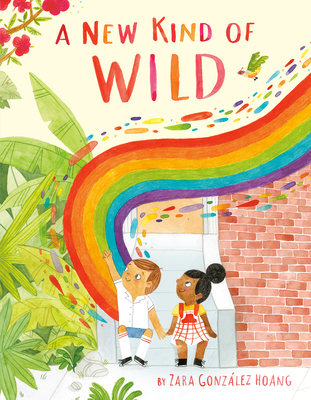

 

Book Review: A New Kind of Wild by Zara González Hoang


Review by Romy Natalia Goldberg

DESCRIPTION OF THE BOOK: For Ren, home is his grandmother’s little house, and the lush forest that surrounds it. Home is a place of magic and wonder, filled with all the fantastical friends that Ren dreams up. Home is where his imagination can run wild.

For Ava, home is a brick and cement city, where there’s always something to do or see or hear. Home is a place bursting with life, where people bustle in and out like a big parade. Home is where Ava is never lonely because there’s always someone to share in her adventures.

When Ren moves to Ava’s city, he feels lost without his wild. How will he ever feel at home in a place with no green and no magic, where everything is exactly what it seems? Of course, not everything in the city is what meets the eye, and as Ren discovers, nothing makes you feel at home quite like a friend.

Inspired by the stories her father told her about moving from Puerto Rico to New York as a child, Zara González Hoang’s author-illustrator debut is an imaginative exploration of the true meaning of “home.”

MY TWO CENTSRen, an imaginative young boy, lives at the edge of El Yunque, a tropical rain forest whose lush vegetation is the perfect setting for daily magical escapades. A move to the city (location unspecified) leaves Ren homesick and lonely. He sees no room for magic in the urban landscape. Ava, on the other hand, is at home in the city. Equally imaginative, she delights in the hustle and bustle.

When she meets Ren, Ava is determined to help him see the city through her eyes. But her enthusiastic city tour only makes Ren more homesick and they part ways frustrated with each other. From his apartment window, Ren observes Ava, noticing she is as happy and at ease in the city as he used to be in El Yunque. When they meet up again, Ren apologizes, explaining how everything feels different to him. Ava listens first, rather than barreling into action. Armed with a new understanding of Ren, Ava takes him on yet another tour of the city. This time, Ren is able to see the magic she was trying to show him all along.

I thoroughly enjoyed A New Kind of Wild’s take on how the unfamiliar can become familiar with the help of an understanding friend. It would have been easy to simply have Ava show Ren around, resulting in him immediately seeing all the magical possibilities he missed before when experiencing the city alone. The message there would be “All it takes is a friend!” However, González Hoang’s approach is different. When Ava first approaches Ren, she eagerly bombards him with questions, so many “he thought his head would explode.” When Ren explains his discomfort with his new surroundings, “all Ava heard was a challenge.” Ava enthusiastically shows Ren her world, but it is only after she has truly listened to Ren and understood where he came from that she is able to connect with him and help him feel welcome. In a time when we are (too) slowly realizing good intentions aren’t always enough, the lessons this book imparts can be powerful and useful both at home and in the classroom.

I also appreciate A New Kind of Wild’s depiction of magic in a working class, urban setting. Often the “positives” of urban areas are all upper class signifiers, but González Hoang’s delightful watercolors show us children finding inspiration and fun in basements and on rooftops, rather than on outings to museums or large fancy parks. I’m not sure I’ve ever seen so many garbage bags in a picture book, but I loved it. 

TEACHING TIPSA New Kind of Wild could be used to start a classroom discussion about moving, be it from one country to another or simply one type of community to another. Where would students take Ren if he moved to their community? Another possible activity is to take a photo of an everyday place (a street corner, a storefront) and have students use mixed media to overlay imaginative elements.

A New Kind of Wild releases April 21, 2020.


ABOUT THE AUTHOR: (from her website): Zara González Hoang grew up in a little bungalow in the frozen tundra of Minnesota. Surrounded by snow, she spent her days dreaming, doodling and listening to the colorful stories of her Dad’s life growing up in Puerto Rico while trying to figure out where she fit in as a Puerto Rican Jew in a sea of Scandinavians. (She’s still figuring that out.)

These days, she lives outside of DC in a magical suburban forest with her Mad Man husband, human-shaped demon, and curly coated corgi. She still spends her days dreaming and doodling, but now instead of listening to stories, she’s starting to tell some of her own.

To learn more about Zara González Hoang, click HERE to get an inside look at her studio and HERE to for a brief Q&A as part of our Spotlight on Latina Illustrators series.


RNGoldberg-profile.jpegABOUT THE REVIEWER: Romy Natalia Goldberg is a Paraguayan-American travel and kid lit author with a love for stories about culture and communication. Her guidebook to Paraguay, Other Places Travel Guide to Paraguay, was published in 2012 and 2017 and led to work with “Anthony Bourdain: Parts Unknown,” and The Guardian. She is an active SCBWI member and co-runs Kidlit Latinx, a Facebook support group for Latinx children’s book authors and illustrators. Learn more at romynatalia.com


Spotlight on Middle Grade Authors Part 14: Ernesto Cisneros


By Cindy L. Rodriguez

This is the 14th in an occasional series about middle grade Latinx authors. We decided to shine a spotlight on middle grade writers and their novels because, often, they are “stuck in the middle”–sandwiched between and overlooked for picture books and young adult novels. The middle grades are a crucial time in child development socially, emotionally, and academically. The books that speak to these young readers tend to have lots of heart and great voices that capture all that is awkward and brilliant about that time.

Today, we highlight Ernesto Cisneros.

Ernesto Cisneros was born and raised in Santa Ana, California, where he still teaches. Efrén Divided is his first book. He holds an English degree from the University of California, Irvine; a teaching credential from California State University, Long Beach; as well as a master of fine arts in creative writing from National University. As an author, he believes in providing today’s youth with an honest depiction of characters with whom they can identify. The real world is filled with amazing people with diverse backgrounds and perspectives. His work strives to reflect that. You can visit him online at www.ernestocisneros.com.


Here is the publisher’s description:

Efrén Nava’s Amá is his Superwoman—or Soperwoman, named after the delicious Mexican sopes his mother often prepares. Both Amá and Apá work hard all day to provide for the family, making sure Efrén and his younger siblings Max and Mía feel safe and loved.

But Efrén worries about his parents; although he’s American-born, his parents are undocumented. His worst nightmare comes true one day when Amá doesn’t return from work and is deported across the border to Tijuana, México.

Now more than ever, Efrén must channel his inner Soperboy to help take care of and try to reunite his family.

.

.

.

Ernesto Cisneros

Q. Who or what inspired you to become a writer?

A long, long time ago, during my senior year in high school, my teacher Sharon Saxton invited Helena Maria Miramontes to speak with our classroom about her anthology, The Moths and Other Short Stories. I was pleasantly surprised to find that someone else saw the world through a similar lens as me—same Latinx lens. Her story made me feel connected, grounded. This was the first time that the idea of being a writer ever entered my mind. It also served as my motivation for writing my first short story—which I am now turning into my very own YA novel, entitled: The Writing on the Wall.

Q. Why do you choose to write middle grade novels?

After giving up on a career writing screenplays, I decided to drop writing altogether and began teaching instead. The itch to write proved to be to powerful. I began writing short stories that served as prompts and writing samples for my students which they began to really enjoy. Before long, my students began pushing me to write. Eventually, I joined SCBWI and met a handful of individuals who helped me find my way.

Q. What are some of your favorite middle grade novels?

There so many fantastic middle grade novels out there, but the ones I turn to every time I need further encouragement are: Maniac Magee by Jerry Spinelli because of they way it deals with serious issues of race, running away, and mental health in a way that’s accessible to young children. There’s also Operation Frog Effect by Sarah Scheerger. I love the way she captures the voices of such diverse characters in an entertaining fashion—makes it all seem so effortless, although I know better.

Q. If you could give your middle-grade self some advice, what would it be?

My advice is to believe in myself and to value my heart. It is easily my most important asset I have because it definitely seeps its way into everything I write.

Q: Please finish this sentence: Middle grade novels are important because…

…they reach children while they are still at work shaping their views of the world. I feel that books can serve as moral compasses that can help instill morals, characters, and empathy—all things the world really needs.


photo by Saryna A. JonesCindy L. Rodriguez was a newspaper reporter for The Hartford Courant and researcher at The Boston Globe before becoming a public school teacher. She is now a reading specialist at a Connecticut middle school. Cindy is a U.S.-born Latina of Puerto Rican and Brazilian descent. She has degrees from UConn and CCSU. Her debut contemporary YA novel is When Reason Breaks (Bloomsbury 2015). She also has an essay in Life Inside My Mind (Simon Pulse 2018) and wrote the text for Volleyball Ace, a Jake Maddox book (Capstone 2020). She can be found on FacebookTwitter, and Goodreads